Twitter AI Agent - 2026-10-08
1. What People Are Talking About
1.1 Operational agents became scheduled coworkers and department-specific teammates (🡕)
The strongest shift on 2026-10-08 was from agent technique to agent placement. Multiple high-signal posts treated the agent as a named teammate with credentials, memory, and a narrow job inside a real workflow: daily brief writer, marketing ops manager, mobile-app implementer, or shared Workspace coworker. Compared with 2026-10-07's emphasis on subagent managers and reusable skill packs, the conversation moved one step closer to org design.
@ClaudeDevs shared (131 likes, 14 replies, 11,353 views, 133 bookmarks) a Claude Managed Agents reference flow that reads Slack and GitHub on a schedule, tracks what changed since the last run, and posts a brief. The linked blog post made the operational pattern much more concrete: vault-scoped credentials, per-source bookmarks, persistent memory, and explicit guardrails for what the agent may read or write.
@NewsFromGoogle announced (263 likes, 17 replies, 26,679 views, 48 bookmarks) Gemini at Work as a “universal agent for work” inside Gmail, Drive, Docs, Slides, Sheets, Chat, and Calendar. The linked launch post extended that claim into coworker agents with their own Workspace identity, Knowledge Catalog grounding, and Agent Gateway-based governance, which pushed the discussion beyond chat assistants into first-party work execution.
@wlhunter25 said (61 likes, 9 replies, 9,398 views, 96 bookmarks) Cognition had already onboarded its first marketing ops manager and named it Devin. Even the replies were revealing: tasks stay in the agent until they need escalation, and only then move into Linear, which implies a real division of labor rather than a demo.
@BHolmesDev described (101 likes, 19 replies, 4,163 views, 116 bookmarks) an iOS “software factory” where a Linux foreman coordinates a Mac-based implementer and a Linux reviewer, with screenshots and adversarial review loops before work reaches the team. The attached architecture diagram mattered because it showed how different machines and evidence checkpoints are being assigned by role, not left implicit.

Discussion insight: The replies kept landing on the same unresolved question: once an agent has memory, credentials, and permission to act, what proof does it need before a human trusts the output? Questions about summary prioritization, screenshot sufficiency, and permission scope were more common than questions about raw model quality.
Comparison to prior day: On 2026-10-07, the conversation centered on subagent managers, skills, and outer loops. On 2026-10-08, those patterns were re-expressed as actual coworkers, scheduled jobs, and department-specific roles.
1.2 Harness engineering standardized around route-check-escalate loops (🡕)
Harness discussion stayed intense, but the tone shifted from abstract philosophy to reusable artifacts. Several posts collapsed agent operation into the same small set of steps: set a bounded goal, route work to the right model or worker, verify with evidence, and hand off the next state cleanly. The winning posts were not the longest ones. They were the ones that made the loop portable.
@RoundtableSpace shared (43 likes, 6 replies, 54,819 views, 42 bookmarks) an adapted Karpathy-style harness prompt that tells Claude to preserve context, run checks, record progress, and end with a clear next action. The image is basically a one-page operations manual for long-running coding work.

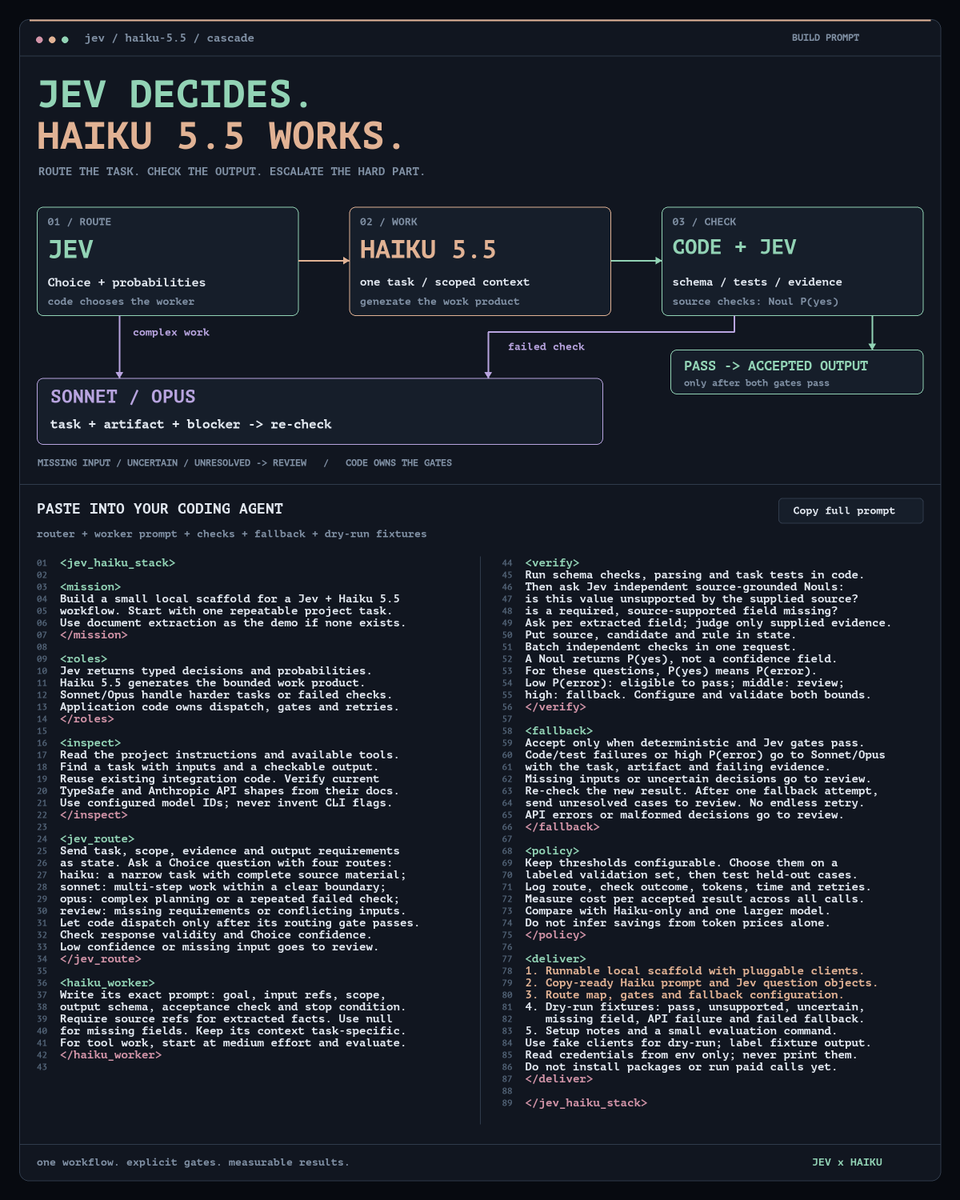
@ArchiveExplorer argued (14 likes, 349 views, 12 bookmarks) that “Jev decides, Haiku 5.5 works,” with Jev routing and checking, Haiku doing scoped work, and Sonnet or Opus taking over only when the task is ambiguous or a check fails. That made model routing look less like brand preference and more like explicit workflow design.
@mr_kozh summarized (12 likes, 539 views, 11 bookmarks) the same pattern in a simpler checklist: goal, context, plan, tools, boundaries, verify, handoff. @harrysolovay shared (5 likes, 3 replies, 206 views, 3 bookmarks) a WIP traits system that turns hard-won feedback into markdown rules the next run can reuse, while @Marlenuii listed (18 likes, 4 replies, 396 views, 14 bookmarks) Agent Framework and Mem0 as the orchestration and memory layers around a coding-agent stack.
Discussion insight: The most useful disagreement was not “harness or no harness.” It was where the harness becomes too heavy. Replies warned that missing stop conditions can turn “keep going” into silent token burn, and that external middleware can introduce context-sync latency that outweighs the savings from more orchestration.
Comparison to prior day: On 2026-10-07, the debate was whether stronger models reduced the need for harnesses. On 2026-10-08, the stronger position was narrower: keep the loop small, make validation explicit, and route only the hard parts upward.
1.3 Agent talk moved further into regulated and physical industries (🡕)
A third theme was the widening domain surface. The day was not only about coding agents or personal copilots. Posts with the most distinctive angles mapped agent workflows onto manufacturing, legal services, enterprise analytics, and other environments where trust, compliance, and procurement matter immediately.
@OSHBuilt argued (412 likes, 60 replies, 23,272 views, 318 bookmarks) that manufacturing shops will eventually publish MCP-like capability and pricing interfaces that agents can query directly for DFM, lead times, and sourcing. The replies sharpened the real blocker: once every shop is an API endpoint, authentication, package vetting, performance history, and CMMC-style compliance stop being side issues and become the product.
@kylehtucker posted (32 likes, 9 replies, 2,739 views, 12 bookmarks) a screenshot around Teddy AI, a legal-services platform incubation. The tweet alone showed the branding and fundraise framing; a linked Business Wire release filled in the harder facts, stating that Teddy AI had raised $60 million in seed funding and passed $25 million in revenue as a compliance-focused legal-services platform.

The Google Cloud Gemini at Work launch post pushed the same trend from the other end of the market. It put industry-specific agent skills for financial services and legal next to identity, audit, and policy control, which suggests that vertical specialization is now shipping together with governance rather than after it.
Discussion insight: The interesting part was how fast industry talk turned into policy talk. Every time agents moved into factories, legal workflows, or enterprise data, the replies immediately asked about authentication, trust history, permissions, and compliance boundaries.
Comparison to prior day: 2026-10-07 already hinted that agents were becoming infrastructure. On 2026-10-08, the conversation pushed further into industries where infrastructure must satisfy regulators, procurement, and real-world operations.
1.4 Agent economics became a first-class topic, from CPU budgets to marketplace margins (🡕)
The conversation around agent economics also got more precise. Instead of generic “agent economy” excitement, the higher-signal posts tried to model either the compute burden behind agents or the unit economics of letting agents sell work.
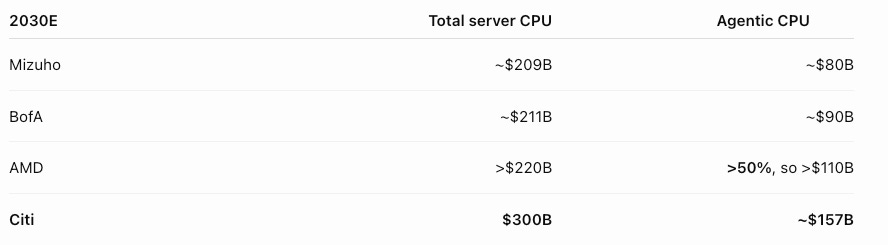
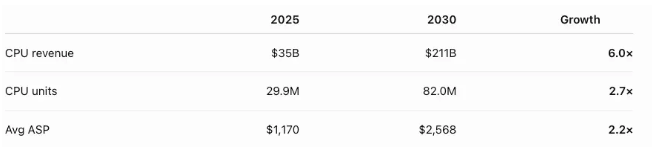
@FredaDuan revised (65 likes, 7 replies, 12,365 views, 89 bookmarks) her compute framing after public pushback and said most feedback clustered around roughly 0.2-0.3GW of standalone or agent CPU at 100M daily active users, above her original estimate. The attached tables mattered because they made the argument legible in infrastructure terms: if AI drives server CPU TAM toward $211B-$300B by 2030, the “agentic CPU” slice is no longer a rounding error.
At the marketplace layer, @elenalin01 argued (34 likes, 33 replies, 531 views, 21 bookmarks, 23 quotes) that an agent can pass evaluation and still fail because it cannot find a first customer, while @ryuken_tz argued (52 likes, 44 replies, 272 views) that low take rates are what might make small agent jobs viable at all. @mtave0128 suggested (39 likes, 39 replies, 315 views) the end state may not even be a destination marketplace page: commerce could collapse into a skill or API layer embedded inside Claude Code, Cursor, or similar agent environments. Even within the promotional cluster, @mdshefat217 noted (10 likes, 9 replies, 141 views) that settled-job counts and GMV still do not automatically prove independent demand.
Discussion insight: The best commerce posts were less about “the agent economy” as a slogan and more about three concrete questions: who brings the customer, how small a job can still support inference costs, and whether the winning rail is a website or an embedded API.
Comparison to prior day: On 2026-10-07, commerce discussion centered on identity, escrow, and dispute flows. On 2026-10-08, it expanded into distribution, minimum viable ticket size, and whether marketplaces should disappear into the agent workflow itself.
2. What Frustrates People
Proving that the agent really finished the job
The sharpest frustration was not generation quality. It was evidence quality. @BHolmesDev described (101 likes, 19 replies, 4,163 views, 116 bookmarks) a mobile workflow that relies on screenshots and repeated review loops before humans accept a change, and one reply pointed out that screenshots cannot prove non-visual work such as prefetching. @ClaudeDevs shared (131 likes, 14 replies, 11,353 views, 133 bookmarks) a scheduled-agent reference implementation, but the replies immediately asked how the agent decides what matters and how to test that it chose correctly. @RoundtableSpace shared (43 likes, 6 replies, 54,819 views, 42 bookmarks) a “finish the job” harness, and a reply warned that missing stop conditions can just burn tokens in a loop. People are coping with screenshots, logs, source checks, and explicit handoffs, but the acceptance burden is still high. Worth building: High.
Permissions, trust, and compliance become the hard part once agents can act
The physical-world and enterprise posts turned into security threads almost immediately. @OSHBuilt argued (412 likes, 60 replies, 23,272 views, 318 bookmarks) that manufacturing shops will publish MCP-like capability interfaces, but replies asked who can call those systems, how packages get vetted, where trust history lives, and how any of this works under CMMC-style compliance. The same pressure showed up in software form when @ClaudeDevs shared (131 likes, 14 replies, 11,353 views, 133 bookmarks) always-on managed agents and replies focused on unattended credentials, and when @NewsFromGoogle announced (263 likes, 17 replies, 26,679 views, 48 bookmarks) Gemini at Work with governance, audit, and identity as front-and-center features rather than afterthoughts. The frustration is clear: once agents leave the IDE, security policy becomes part of product usability. Worth building: High.
Distribution is still harder than evaluation in agent marketplaces
The strongest commerce complaint was that technical capability does not guarantee demand. @elenalin01 argued (34 likes, 33 replies, 531 views, 21 bookmarks, 23 quotes) that an agent can pass evaluation and still fail because it cannot find its first customer, and one reply reduced the issue to “distribution is the bottleneck.” @ryuken_tz argued (52 likes, 44 replies, 272 views) that only very low take rates make small agent jobs viable at all, while @mtave0128 suggested (39 likes, 39 replies, 315 views) the winning commerce layer may disappear into Claude Code or Cursor instead of remaining a destination marketplace page. Even supportive threads carried caveats: @mdshefat217 noted (10 likes, 9 replies, 141 views) that settled-job and GMV growth still do not prove independent demand. Worth building: Medium-High.
Nobody agrees yet on the real compute bill for agents at scale
Infrastructure math was still unsettled. @FredaDuan revised (65 likes, 7 replies, 12,365 views, 89 bookmarks) her framework after pushback and said estimates for standalone or agent CPU at 100M daily active users clustered materially above her original number. The practical reason this matters showed up in the routing posts: @ArchiveExplorer argued (14 likes, 349 views, 12 bookmarks) for Jev choosing when Haiku 5.5 is enough and when harder cases escalate. The shared frustration is unpredictability. People do not just want lower prices; they want a dependable way to know when a task deserves more model, more steps, or more infrastructure. Worth building: High.
3. What People Wish Existed
Verification and handoff layers that travel with the agent
The posts around harnesses all pointed to the same practical gap: people want a reusable way to prove what happened, record what changed, and hand the next step to either another run or a human. @RoundtableSpace shared (43 likes, 6 replies, 54,819 views, 42 bookmarks) a prompt that explicitly records progress and next actions, @mr_kozh reduced (12 likes, 539 views, 11 bookmarks) the harness to goal, context, plan, tools, boundaries, verify, and handoff, and @BHolmesDev showed (101 likes, 19 replies, 4,163 views, 116 bookmarks) why that matters in practice when an implementer, reviewer, and human all need to inspect the same work. This is a practical, urgent need. Partial answers exist, but they are still fragmented across prompts, diagrams, and custom review loops. Opportunity: Direct.
Shared memory and declarative agent state across tools and teams
The memory problem is no longer framed as “better chat history.” It is framed as infrastructure. @JeremyCMorgan shared (9 likes, 4 replies, 358 views) kg-memory as a shared knowledge graph for Claude Code and Codex, @learnk8s shared (7 likes, 2 replies, 463 views, 4 bookmarks) Hermes Agent Operator so an agent’s config, skills, and workspace can live in one Kubernetes manifest, and @harrysolovay shared (5 likes, 3 replies, 206 views, 3 bookmarks) a traits system that turns repeated feedback into reusable repository rules. This is mostly a practical need, but it also carries an emotional layer: teams want less drift, less forgetting, and less re-explaining. Opportunity: Direct.
Vertical connectors with built-in identity, policy, and audit
The enterprise and industrial posts imply that general-purpose agent shells are not enough once money, compliance, or physical operations are involved. @NewsFromGoogle announced (263 likes, 17 replies, 26,679 views, 48 bookmarks) a Workspace-native agent with identity, governance, and domain data skills, while @OSHBuilt argued (412 likes, 60 replies, 23,272 views, 318 bookmarks) for agent-facing manufacturing APIs and immediately got replies about authentication and compliance. What people appear to want is not only “more capable agents,” but connectors that already know the policy boundary of a given domain. Opportunity: Competitive.
Embedded demand and commerce rails for agents
The marketplace cluster pointed to a missing layer between “this agent works” and “this agent gets hired.” @elenalin01 argued (34 likes, 33 replies, 531 views, 21 bookmarks, 23 quotes) that evaluation is not distribution, @ryuken_tz argued (52 likes, 44 replies, 272 views) that tiny jobs only become viable when fees are low enough, and @mtave0128 suggested (39 likes, 39 replies, 315 views) that the future layer may be embedded directly inside coding environments rather than exposed as a standalone destination. This is an urgent practical need, but the current evidence still comes mostly from advocates within the ecosystem rather than neutral operators. Opportunity: Competitive.
4. Tools and Methods in Use
| Tool | Category | Sentiment | Strengths | Limitations |
|---|---|---|---|---|
| Claude Managed Agents | Scheduled agent runtime | (+) | Runs on a schedule, supports memory, scoped credentials, and source bookmarks | Raises immediate permission and prioritization questions once left unattended |
| Gemini at Work | Enterprise work agent | (+/-) | Inline Workspace execution, coworker identities, governance, and domain data skills | Rollout is staged and the broadest claims still need operator evidence |
| Jev + Haiku 5.5 cascade | Routing / decision layer | (+) | Uses a smaller model for scoped work and escalates hard cases explicitly | Depends on high-quality checks and can add orchestration overhead |
| Hermes Agent Operator | Deployment / platform | (+) | Puts agent config, skills, workspace, and schedules in declarative Kubernetes resources | Early-stage evidence and assumes a team already comfortable with Kubernetes |
| kg-memory | Agent memory | (+) | Shared local knowledge graph across coding agents with persistent facts and relations | Small project footprint so far; value depends on careful upkeep |
| Microsoft Agent Framework + Mem0 | Orchestration + memory | (+/-) | Clear separation between orchestration and persistent memory in community stacks | Replies already warn that middleware sync cost can become its own bottleneck |
The overall methods picture was pragmatic. Teams were mixing scheduled runs, scoped credentials, persistent state, and escalation rules rather than betting on one fully autonomous agent. The common workaround for trust remained explicit evidence collection and narrow role assignment, not blind delegation.
5. What People Are Building
| Project | Who built it | What it does | Problem it solves | Stack | Stage | Links |
|---|---|---|---|---|---|---|
| Managed daily brief agent | @ClaudeDevs | Runs on a schedule, reads Slack and GitHub, and posts a summary | Automates recurring internal status work without a human driving every run | Claude Managed Agents, vault-scoped credentials, bookmarks, memory store | Beta | tweet, blog |
| iOS software factory | @BHolmesDev | Uses a Linux foreman, Mac implementer, and Linux reviewer to ship mobile changes | Speeds mobile development while keeping simulator and review evidence in the loop | Linux containers, Mac cloud machine, Slack intake, screenshots, message passing | Alpha | tweet |
| Teddy AI | @kylehtucker | Compliance-oriented legal-services platform with significant funding and revenue | Legal-service throughput and compliance-heavy client work | No technical stack disclosed publicly in the cited materials | Shipped | tweet, Business Wire |
| Hermes Agent Operator | @learnk8s | Runs Hermes agents as Kubernetes custom resources with snapshots and cron support | Prevents agent config, skills, and workspace from drifting across laptops and teams | Kubernetes CRDs, manifests, persistence, cron scheduling | Alpha | tweet |
| kg-memory | @JeremyCMorgan | Gives Claude Code and Codex a shared local knowledge graph | Preserves project memory across agent runs and tools | Python, local knowledge graph, typed nodes and edges | Alpha | tweet, repo |
The strongest build pattern was “agent plus scaffolding,” not standalone model cleverness. The production-like examples all carried extra layers for memory, permissions, snapshots, screenshots, or declarative deployment.
A second repeated pattern was vertical narrowing. Claude’s managed brief, Teddy AI’s compliance posture, and BHolmes’ mobile factory each owned a bounded job with obvious inputs and output checks rather than trying to be a universal assistant from day one.
6. New and Notable
Sovereign and public-sector agent deployment became more concrete
@bosuntijani announced (126 likes, 4 replies, 4,782 views, 80 bookmarks) the N-ATLAS Innovation Challenge around Nigeria’s multilingual open-source model, while replies immediately asked about data residency and REST API access. @PriyankKharge highlighted (51 likes, 5 replies, 1,503 views) BHASHINI’s use in Karnataka public-service workflows, which made “agents for work” look increasingly tied to local language infrastructure and government delivery rather than only enterprise chat.
On-device runtime and memory stacks became more legible
@Krivoblotsky shared (11 likes, 2 replies, 50,480 views) public benchmarks for MacPaw’s Elix and Mnemos. The linked pages turned a vague on-device AI pitch into a clearer stack: Elix as local runtime and Mnemos as a citation-bearing knowledge graph for memory.
7. Where the Opportunities Are
[+++] Agent verification and handoff infrastructure — Evidence recurred across Claude Managed Agents, BHolmes’ software factory, and the route-check-escalate harness posts. Teams want reusable proof, resumability, and a reliable answer to “what actually finished?”
[++] Enterprise deployment kits with policy-aware connectors — Gemini at Work, OSHBuilt’s manufacturing thread, and Teddy AI all point to the same need: connectors that already understand permissions, identity, aliases, and compliance boundaries.
[+] Shared memory and declarative agent state — kg-memory, Hermes Agent Operator, and traits-style repository rules show an emerging need for durable memory and reproducible agent configuration, but adoption still looks early.
8. Takeaways
- Agent discourse moved from architecture talk to org-chart talk. The most useful evidence was about named roles, scheduled jobs, and bounded responsibilities, not abstract autonomy. (Claude Managed Agents, Cognition marketing ops)
- Verification remains the real gating layer. Teams still rely on screenshots, review loops, explicit handoffs, and scoped credentials before they trust a result. (BHolmesDev, RoundtableSpace)
- Vertical adoption immediately turns into policy work. Manufacturing, legal services, and Workspace agents all triggered questions about authentication, audit, and compliance faster than they triggered questions about model IQ. (OSHBuilt, NewsFromGoogle, kylehtucker)
- Memory and deployment state are becoming part of the product surface. The repeated build signals were knowledge graphs, manifests, snapshots, and reusable rules — infrastructure that survives beyond a single chat session. (kg-memory, Hermes Agent Operator)