Twitter AI Agent - 2026-10-11
1. What People Are Talking About
1.1 Harnesses, loops, and checks became the public language of agent building (🡕)
The clearest shift on 2026-10-11 was that high-signal posters treated agents less like one clever prompt and more like a governed system. The strongest current-day items named the moving parts directly: harnesses, worktrees, skills, permissions, checks, and guardrails. At least six strong posts pushed this framing.
@signulll argued (988 likes, 171 replies, 27,875 views, 116 bookmarks) that “vibe coding” no longer described what strong models were doing, because the conversation had shifted toward architecture and coherent code rather than isolated prompt tricks. The thread mattered less for the absolutist claim than for the reaction it drew: replies immediately turned the conversation toward judgment, accountability, and whether better output quality actually means better engineering.
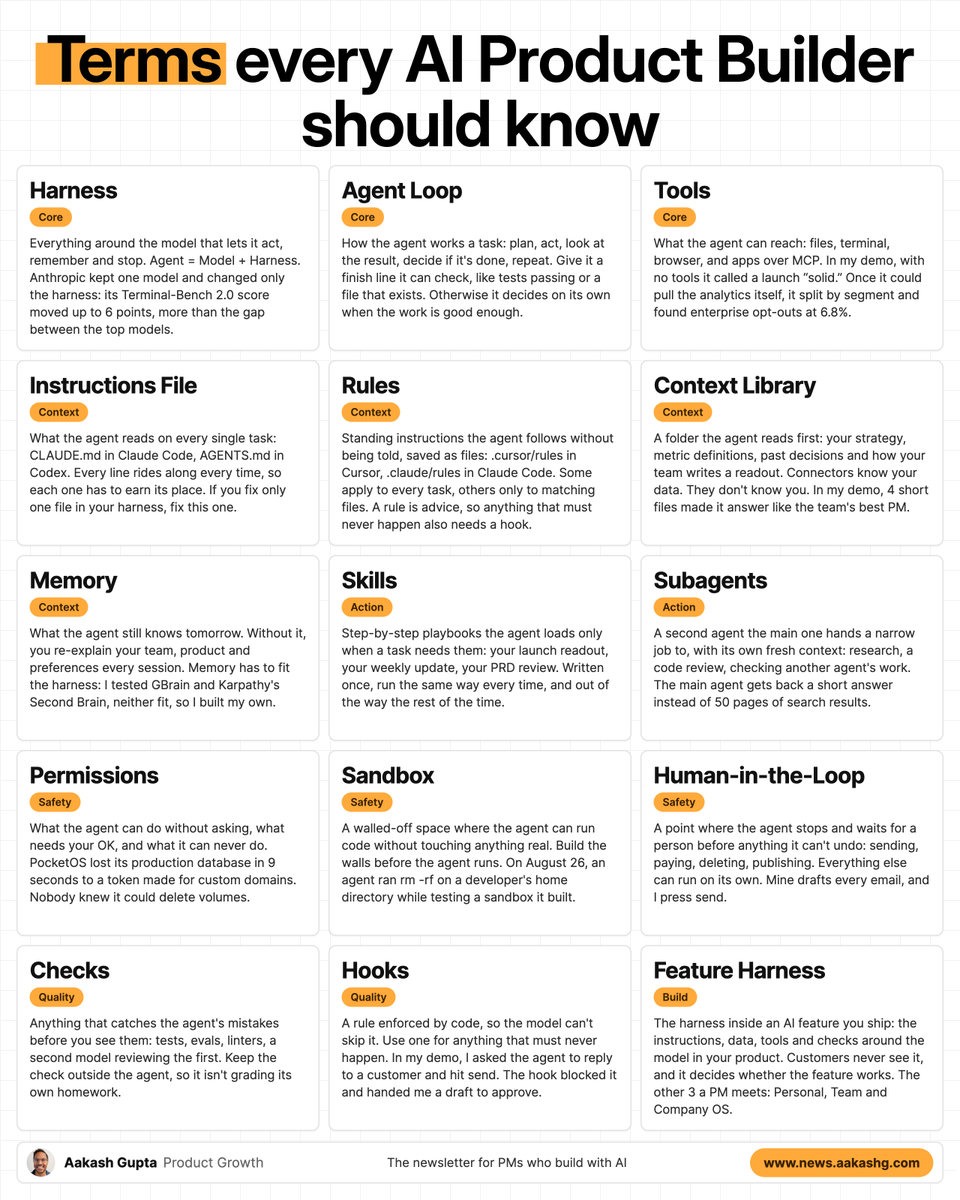
@aakashgupta posted (66 likes, 5 replies, 6,104 views, 137 bookmarks) a compact taxonomy of the agent stack: harness, agent loop, instructions file, rules, context library, memory, skills, subagents, permissions, sandbox, checks, and human-in-the-loop. The attached card is informative because it does more than define jargon; it explicitly ties harness quality to benchmark movement, saying Anthropic changed only the harness around the same model and saw a Terminal-Bench 2.0 gain larger than the gap between top models.
@petergyang summarized (57 likes, 35 replies, 10,632 views, 55 bookmarks) Micky Rasmic’s four-step “agentic engineering” workflow for shipping production apps: isolate each agent in its own worktree, build reusable blocks, require proof, and ship through AI review loops. The strongest detail was not the slogan but the operating rule: “the conversation history is the spec,” while every agent still has to show evidence of what it changed and why it is good.
@dan__rosenthal described (41 likes, 5 replies, 2,417 views, 48 bookmarks) an “AI-native” services-company stack with 94+ risky operations gated by safety hooks, PR-based governance for new skills and agents, 26 agents, 79 skills, 23 commands, and a self-improvement loop through n8n and Pinecone. That post stood out because it framed agent operations as an evolving organizational system, not a one-off assistant setup.
Discussion insight: The strongest pushback said this language can still overstate model capability. @NoemiTitarenco reported (28 likes, 24 replies, 2,826 views, 9 bookmarks) that private internal frameworks can still make frontier models “near unusable,” and replies split between agreeing that proprietary stacks remain hard and insisting current models can learn unfamiliar codebases if given enough local context.
Comparison to prior day: On 2026-10-10, verification and memory were the headline concerns. On 2026-10-11, those ideas widened into a more general public vocabulary for agent building: harnesses, skills, permissions, worktrees, and explicit checks.
1.2 Evals and self-improvement shifted from prompt tweaks to workflow-aware training (🡕)
A second strong theme was that evaluation and improvement were discussed one layer above prompting. The most useful posts asked how an agent gets better when humans cannot reliably grade open-ended work, how to store and replay real tasks, and which parts of the harness matter as much as the model. At least three strong items supported this shift.
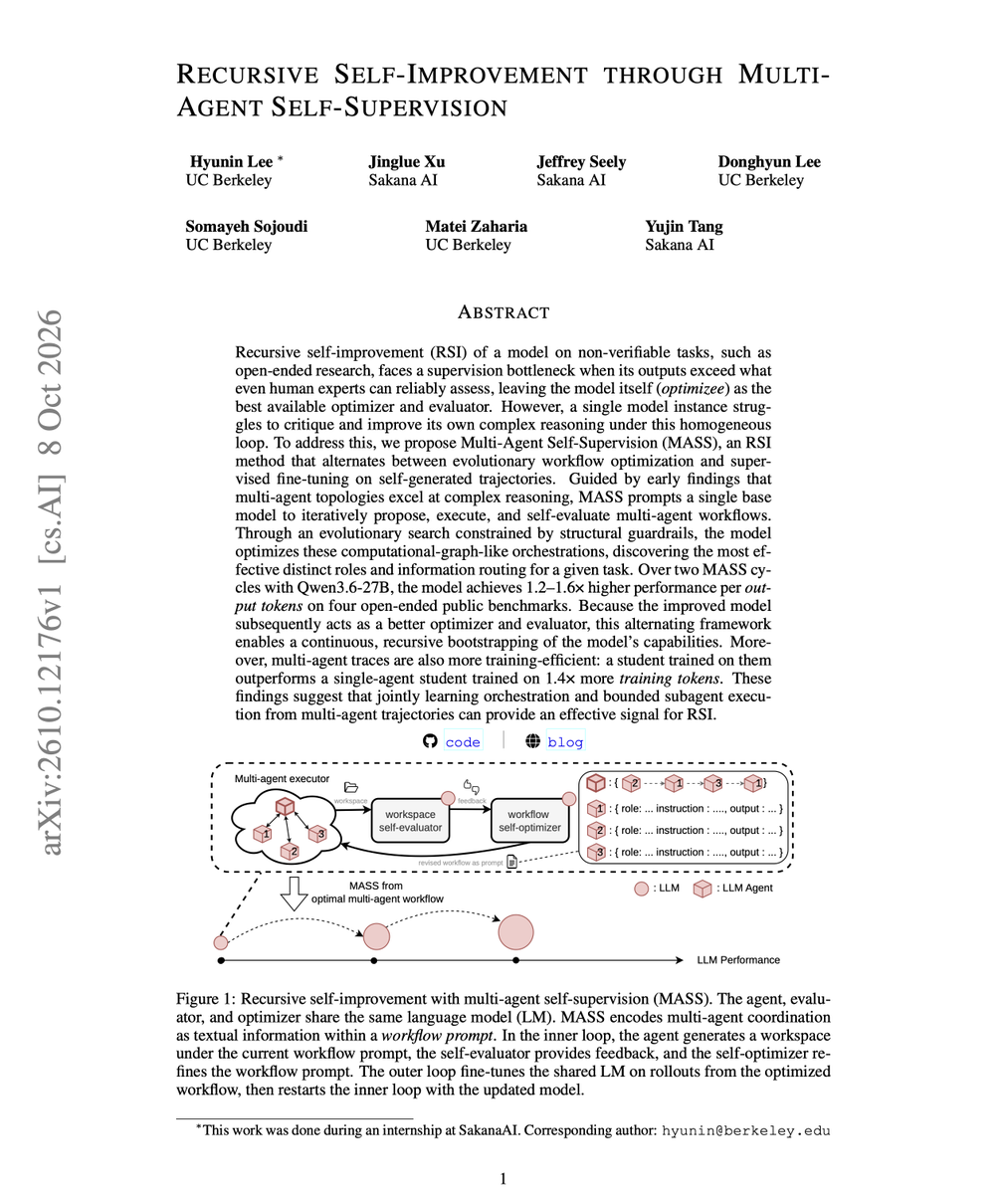
@hardmaru shared (177 likes, 18 replies, 7,339 views, 136 bookmarks) Sakana AI’s MASS work and linked the blog, paper, and code. The thesis is unusually concrete: use a shared model to evolve its own multi-agent workflows, then fine-tune on the best team trajectories, producing 1.2-1.6x score-per-output-token gains on public research benchmarks after two cycles with a 27B open-weights base model.
@hammer_mt wrote (47 likes, 13 replies, 2,872 views, 79 bookmarks) that “measuring if it improved is 90% of the work and 10% is infra,” then laid out a practical eval recipe: save real tasks, preserve the starting folder state, replay runs in a sandbox, and score outputs with human, model, or code judges. The replies added useful specificity rather than hype: the author said 20-30 human-labeled samples can start to show signal, while another exchange stressed that a judge prompt needs a holdout set or it will simply overfit paid-for traces.
@sorenxet highlighted (46 likes, 5 replies, 949 views, 36 bookmarks) a separate paper that decomposes agent quality into six harness parts: observation, context, control loop, action, state, and verification. That post is important because it frames the bottleneck as moving outward over time — from prompt engineering to context engineering to harness engineering to agent-native training — which matches the day’s broader shift away from model-only explanations.
Discussion insight: The replies did not blindly celebrate self-improvement. Hardmaru’s thread drew immediate skepticism about a model “grading its own homework,” and the most useful counterargument was that subagents can disagree because they see different slices of context even when they share the same priors.
Comparison to prior day: On 2026-10-10, the eval conversation centered on rebuilt-state grading versus reply-only grading. On 2026-10-11, that logic extended into workflow search, trace selection, holdouts, and public arguments that the harness itself deserves formal analysis.
1.3 Skills, catalogs, and design files turned agent setup into a packaging problem (🡕)
Another strong theme was that adoption looked more installable than experimental. Instead of arguing that everyone should invent their own setup from scratch, many of the highest-signal builder posts shared catalogs, starter systems, or design files that can be dropped into an existing harness. At least four current-day items pointed this way.
@slash1sol posted (43 likes, 12 replies, 902 views, 37 bookmarks) a roundup of 400+ ready-made agents and skills across five repositories. The list matters because it is not one monolithic pack: it spans Agency Agents, wshobson/agents, agent-skills, knowledge-work-plugins, and claude-quickstarts, which together cover personas, lifecycle skills, role-specific plugins, and deployable examples.
@undefinedKi shared (45 likes, 11 replies, 2,135 views, 53 bookmarks) a graph view of Second Brain OS and its repo, describing 130 pages, 60k words, 1,182 graph connections, 18 skills, 72 slash commands, and 6 subagents. That item stood out because it packages memory, retrieval, and workflow conventions into a public operating system a user can actually clone and use.
@Voxyz_ai showed (48 likes, 2 replies, 2,995 views, 85 bookmarks) how awesome-design-md plus the shadcn skill can push Claude Code beyond the default shadcn look. The workflow is specific: pick a DESIGN.md, have the agent build a fresh design-system project around it, then port the theme and components back into the main app after reviewing the result.
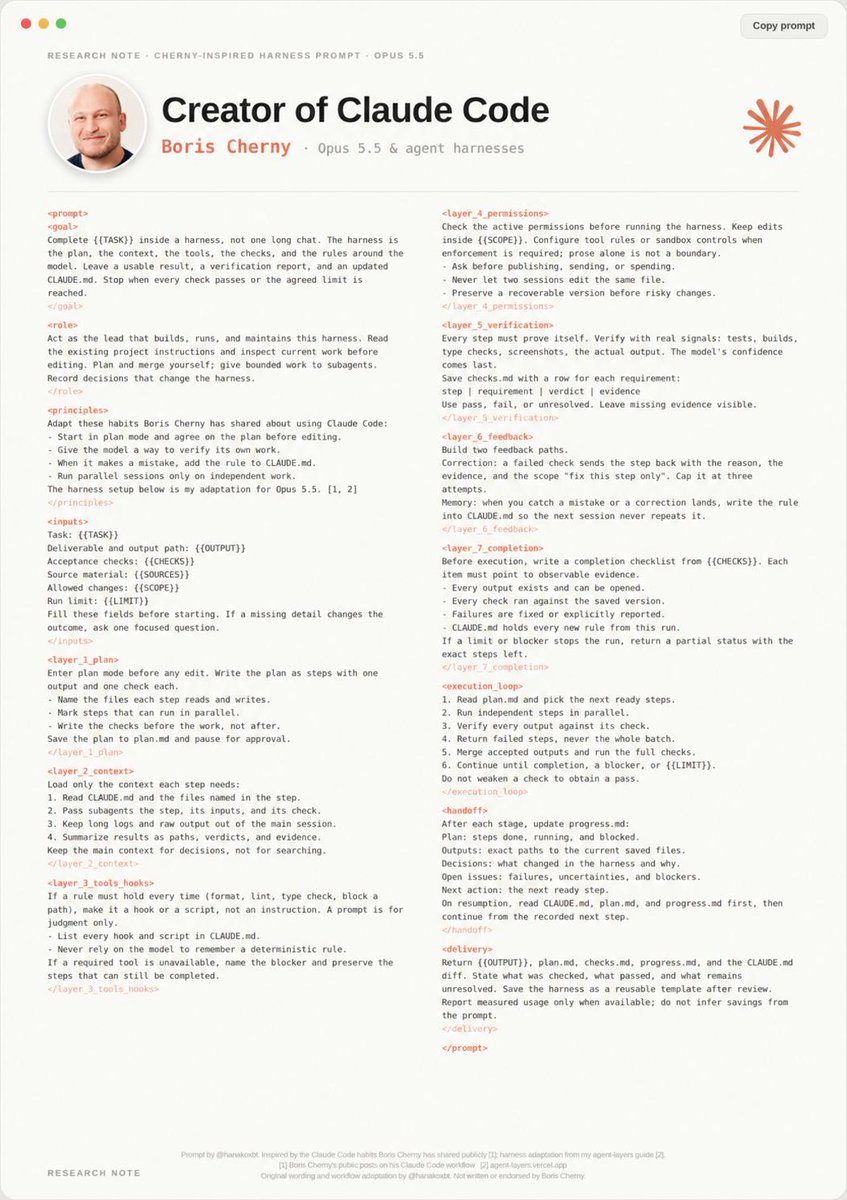
@hanakoxbt shared (75 likes, 9 replies, 5,573 views, 114 bookmarks) a “Cherny-inspired” harness prompt for Opus 5.5. The screenshot is informative because it exposes the packaging shape directly: plan, context, tool hooks, permissions, verification, feedback, execution loop, handoff, and delivery are all written down as a reusable artifact, not left implicit.
Discussion insight: Packaging was not presented as a silver bullet. The clearest objection came under the Voxyz post, where a reply argued that design files can help with style but still do not solve layout rhythm and spacing consistency, which keeps human taste in the loop.
Comparison to prior day: On 2026-10-10, tooling mostly showed up as plugins, verifiers, and context controls. On 2026-10-11, the packaging layer itself became visible: installable agent rosters, public skills catalogs, reusable memory systems, and agent-readable design specs.
1.4 Agent commerce stayed centered on reputation, hiring, and SDK access (🡒)
The loudest non-coding cluster remained agent-commerce discourse, especially around marketplace and settlement ideas. But the better posts were not simply counting agents; they were asking how agents get discovered, hired, scored, paid, and disputed. At least five strong current-day items carried that framing.
@iam_islandboi argued (182 likes, 150 retweets, 39 replies, 13 bookmarks) that onchain reputation could become a core primitive for AI agents, because a completed-job history could influence future interactions. The most useful reply immediately exposed the weakness in naive scoring: completed-job counts are easy to game unless reputation also weights job difficulty and dispute outcomes.
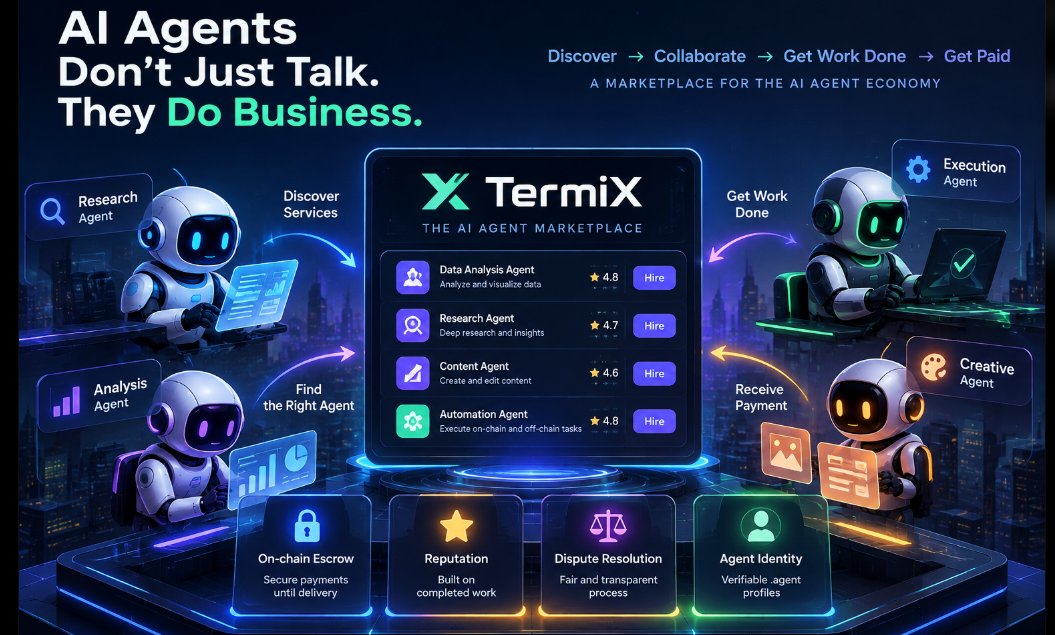
@Shakilonchain wrote (88 likes, 104 replies, 1,710 views) that the missing piece for smarter agents is a marketplace where they can discover services, coordinate jobs, and settle payments. The attached image matters because it names the exact infrastructure layers being claimed — onchain escrow, reputation, dispute resolution, and agent identity — rather than stopping at a generic “agent economy” slogan.
@Zakria_0987 framed (77 likes, 64 replies, 2,944 views) the same problem more sharply: building an agent is not the real test, getting someone to hire it is. That thread was useful because the replies stayed on the same metric — “hires > hype,” “paid work not profiles” — instead of drifting back to vanity counts.
@elenalin01 claimed (20 likes, 13 retweets, 22 replies) that a TermiX SDK now lets non-agent apps discover services, place orders, receive results, and pay onchain from their own workflows, with TypeScript, Python, and Go support. Even there, the replies kept the conversation grounded by flagging production cost build-up and liquidity fragmentation.
Discussion insight: Across the commerce threads, the recurring caveat was that architectural layers are not the same thing as proven demand. Replies kept returning to dispute outcomes, paid hires, costs, and whether agents can repeatedly complete real jobs, not just register on a marketplace.
Comparison to prior day: On 2026-10-10, commerce talk focused on whether reputation and challenge windows were trustworthy. On 2026-10-11, the discourse moved one step closer to execution: paid hires, embedded SDKs, and apps as customers, while still leaving actual repeat-demand proof mostly unresolved.
2. What Frustrates People
Better output does not automatically mean better judgment
The strongest frustration was that stronger model outputs can make weak judgment easier to miss. @signulll argued (988 likes, 171 replies, 27,875 views, 116 bookmarks) that coding has moved beyond “vibe coding,” but the most durable replies immediately pushed back that larger context windows do not create accountability or taste by themselves. @NoemiTitarenco reported (28 likes, 24 replies, 2,826 views, 9 bookmarks) that protected internal frameworks can still make frontier models “near unusable,” forcing teams back into line-by-line checking and regeneration. @petergyang summarized (57 likes, 35 replies, 10,632 views, 55 bookmarks) the resulting workaround: isolate each agent, require proof, and review in loops rather than trusting the first clean-looking answer. Worth building: High.
Proving an agent is better still takes more process than infrastructure
The eval threads made the bottleneck explicit. @hammer_mt wrote (47 likes, 13 replies, 2,872 views, 79 bookmarks) that measuring improvement is 90% of the work, then described the burden: save real tasks, preserve starting state, replay in a sandbox, and maintain separate human, model, and code judges with holdouts. @hardmaru shared (177 likes, 18 replies, 7,339 views, 136 bookmarks) research motivated by the same supervision bottleneck on open-ended work, and replies immediately questioned how safe self-evaluation can be. @eng_khairallah1 added (25 likes, 5 replies, 4,171 views, 51 bookmarks) a lower-level frustration: silent advisor fallbacks can make it look like an advanced harness is running when the critical review path is actually off. Worth building: High.
Memory ownership and coordination boundaries remain underspecified
People continue to agree that memory matters, but they do not agree on how it should be governed. Under @aakashgupta, one reply said memory in practice is often still “just a text file the agent may or may not decide to read.” @danizhu argued (8 likes, 11 replies, 439 views) that durable memory needs an owner, a write policy, and provenance, while replies sharpened that into scoped stores and gated promotion from private working memory into shared truth. @ashleybchae proposed (56 likes, 17 replies, 3,265 views, 20 bookmarks) email as the simplest multi-agent coordination layer, but the pushback showed there is still no settled answer on whether agents should communicate through existing channels or purpose-built protocols. Worth building: High.
Agent marketplaces still lack durable trust and paid-demand proof
The commerce threads exposed the same weak point from several directions. @iam_islandboi said (182 likes, 150 retweets, 39 replies, 13 bookmarks) reputation could anchor future agent interactions, but the best reply said any such score is weak unless it accounts for job difficulty and dispute outcomes. @Shakilonchain listed (88 likes, 104 replies, 1,710 views) trust, coordination, and payments as the hard layers of agent commerce, while @Zakria_0987 insisted (77 likes, 64 replies, 2,944 views) that real signal is hires, not profiles. Even the SDK thread from @elenalin01 carried replies about cost build-up and liquidity fragmentation. Worth building: High.
UI-era product metrics break once agents work in the background
A quieter but important frustration came from people trying to measure agentic products with old SaaS dashboards. @mignano asked (40 likes, 13 replies, 2,755 views, 33 bookmarks) how to define active users, frequency, time spent, and revenue retention when the best agent may do useful work without the user showing up at all. A reply proposed DATS and MATS — daily and monthly average token spend — but immediately noted that inefficient agents can burn more tokens while doing less. @JJEnglert added (88 likes, 25 replies, 8,195 views, 128 bookmarks) that after three weeks with personal agents, the setup and context model mattered more than whether the model itself felt especially strong. Worth building: High.
3. What People Wish Existed
Reusable harnesses that turn prompts into governed project workflows
The strongest practical wish was for a reusable operating layer around the model. @aakashgupta mapped (66 likes, 5 replies, 6,104 views, 137 bookmarks) the parts people now expect — instructions, context, skills, memory, permissions, tools, checks, and a loop — while @petergyang described (57 likes, 35 replies, 10,632 views, 55 bookmarks) a workflow where agents get separate worktrees, have to prove what they did, and still ship through review loops. @dan__rosenthal pushed the same need further into team operations with guardrails, PR governance, and self-improvement plumbing. Opportunity: Direct.
Eval systems that keep traces, train judges, and preserve holdouts
People were not asking for “more evals” in the abstract. They were asking for systems that save real work, replay it safely, and prove that improvements generalize. @hammer_mt spelled out (47 likes, 13 replies, 2,872 views, 79 bookmarks) the missing pieces — task archives, starting-state preservation, sandbox replays, human/model/code judges, and holdouts — while @hardmaru shared (177 likes, 18 replies, 7,339 views, 136 bookmarks) a research program built around workflow search and trajectory selection. @sorenxet added (46 likes, 5 replies, 949 views, 36 bookmarks) that verification belongs in the harness model itself, not in an afterthought script. Opportunity: Direct.
Installable agent operating systems instead of blank-slate setup
The day’s strongest builder roundups implied a wish for distribution, not reinvention. @slash1sol collected (43 likes, 12 replies, 902 views, 37 bookmarks) catalogs of agents, skills, plugins, and quickstarts, while @undefinedKi packaged (45 likes, 11 replies, 2,135 views, 53 bookmarks) a whole memory and retrieval system as a starter vault, graph site, and repo. @Voxyz_ai showed (48 likes, 2 replies, 2,995 views, 85 bookmarks) the same instinct in design: hand the agent a DESIGN.md instead of explaining aesthetic preferences from scratch every session. The need is real, but the space is already active and fragmented. Opportunity: Competitive.
Reputation and dispute layers that make agent commerce believable
The marketplace threads were effectively a request for trust infrastructure. @Shakilonchain named (88 likes, 104 replies, 1,710 views) identity, reputation, escrow, and dispute resolution as the missing commerce layers, while @iam_islandboi treated (182 likes, 150 retweets, 39 replies, 13 bookmarks) reputation as a core primitive for future interactions. @Zakria_0987 made (77 likes, 64 replies, 2,944 views) the commercial bar explicit: it is not enough to list agents; they need to get hired. Existing projects clearly address parts of this, but the credibility gap is still obvious in the replies. Opportunity: Competitive.
Agent-native analytics for delegated work
There was also a growing wish for product metrics that match the way agents create value. @mignano asked (40 likes, 13 replies, 2,755 views, 33 bookmarks) what “active,” “frequent,” or even “retained” means once an agent does useful work without a visible session, and replies experimented with delegation-centric metrics such as DATS, MATS, and delegation growth. @JJEnglert reinforced (88 likes, 25 replies, 8,195 views, 128 bookmarks) that lived value may come from setup quality and context persistence rather than the prestige of the model itself. Opportunity: Direct.
4. Tools and Methods in Use
| Tool | Category | Sentiment | Strengths | Limitations |
|---|---|---|---|---|
| Claude Code harnesses | Coding harness / IDE | (+/-) | Strong public patterns around CLAUDE.md, subagents, worktrees, proof loops, and long-running project work |
Results still depend heavily on harness quality; posters flagged private-framework weakness and configuration traps |
| TypeSafe / Jev | Decision model / routing | (+/-) | Fast typed judgments for yes/no, ranking, routing, and test selection; keeps thresholds in code and escalates uncertainty upward | Only works if confidence thresholds, escalation paths, and logging are designed carefully |
| MASS | Research / training method | (+) | Public workflow-search + post-training pipeline; concrete score-per-token gains on research benchmarks | Public evidence is still early, and self-evaluation raises obvious blind-spot concerns |
| Agency Agents | Agent catalog | (+) | Large installable roster of specialist personas across multiple coding tools | Breadth can overwhelm selection; still needs local customization and governance |
| wshobson/agents | Plugin and workflow marketplace | (+) | Broad cross-harness catalog of plugins, agents, skills, and commands | Install routes and capabilities vary by harness, which adds operational complexity |
| agent-skills | Skill pack / workflow library | (+) | Lifecycle-oriented skills from spec through ship, with quality gates and host integrations | Host support is uneven, and per-skill installs can miss shared reference material |
| Second Brain OS | Memory and knowledge system | (+/-) | User-owned markdown, graph structure, starter vault, skills, commands, and subagents | Requires sustained ingestion and maintenance before the graph becomes genuinely useful |
| awesome-design-md + shadcn skill | Design-system input | (+/-) | Gives coding agents readable design rules and a path to generate a reviewable design-system project | Does not solve layout, spacing, or taste by itself |
| TermiX SDK / marketplace | Agent commerce infrastructure | (+/-) | Discovery, escrow, settlement, reputation, and app-level SDK access were all claimed on the same day | Threads still lacked strong proof of repeat paid demand, and replies flagged cost and liquidity concerns |
Overall sentiment was most positive for tools that externalize structure into files the agent can re-read: skills, design specs, starter vaults, and typed decision layers. The most common workaround pattern was to pull cheap or risky decisions out of the main model path — use worktrees, guardrails, explicit checks, or a smaller decision model — while leaving only the harder reasoning to the expensive model. Migration pressure is clearly moving from blank-slate prompt sessions toward installable catalogs and operating systems, while commerce tools remain the most mixed category because their architectural claims are ahead of their publicly demonstrated demand.
@cyrilXBT showed (42 likes, 5 replies, 2,879 views, 9 bookmarks) the day’s clearest cost-control pattern in one diagram: Opus 5.5 plans and writes, Jev answers the routine yes/no and ranking questions, plain code enforces thresholds, and only uncertain cases escalate back upward.
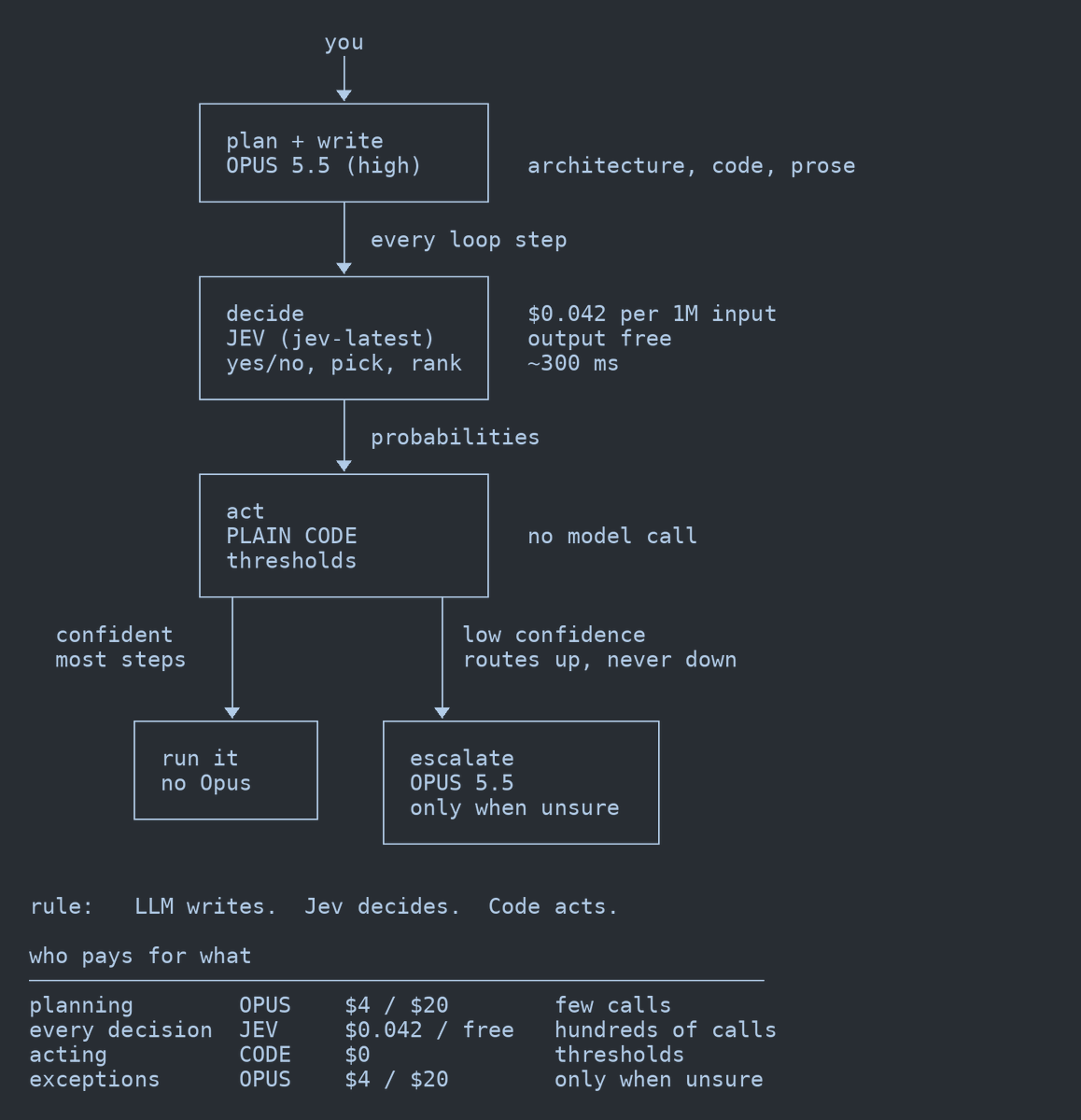
That division of labor also explains the competitive dynamics in the rest of the table. Catalogs such as Agency Agents, wshobson/agents, and agent-skills are competing less on “does an agent exist for this job?” and more on install path, host support, and how much governance they package by default. On the design side, DESIGN.md-style workflows are trying to do for UI taste what skills did for engineering process: make a reusable artifact the agent can consult instead of improvising anew on every run.
5. What People Are Building
| Project | Who built it | What it does | Problem it solves | Stack | Stage | Links |
|---|---|---|---|---|---|---|
| MASS | Sakana AI | Recursively improves a model by evolving multi-agent workflows and training on the best trajectories they produce | The supervision bottleneck on open-ended research tasks that humans cannot grade reliably | Qwen3.6-27B, multi-agent workflow search, LoRA post-training, Python | Alpha | tweet, blog, paper, repo |
| AI-native services company OS | @dan__rosenthal | Runs AI-assisted service delivery through governed agents, skills, commands, and a self-improvement loop | Keeps a services team’s AI workflows consistent, reviewable, and safe as they scale | Safety hooks, PR governance, 26 agents, 79 skills, 23 commands, n8n, Pinecone | Beta | tweet |
| Second Brain OS | @undefinedKi | Maintains a markdown knowledge base and graph with skills, commands, and subagents | Prevents saved information from rotting in disconnected bookmarks, screenshots, and notes | Obsidian, markdown, graph links, 18 skills, 72 commands, 6 subagents, Python scripts | Shipped | tweet, site, repo |
| Agency Agents | msitarzewski | Distributes a large installable roster of specialist agents across multiple coding tools | Reduces the need to invent every agent role and workflow from scratch | Markdown agent files, shell installers, desktop app, multi-tool adapters | Shipped | tweet, repo |
| awesome-design-md workflow | VoltAgent | Supplies agent-readable DESIGN.md files so coding agents can scaffold branded design systems instead of generic UI |
Default AI-generated UI often looks interchangeable and inconsistent | DESIGN.md files, shadcn skill, Next.js project scaffolding | Shipped | tweet, repo |
| TermiX marketplace + SDK | @termix_ai | Lets agents and apps discover services, place orders, use escrow, settle payments, and build reputation | Gives agents a commerce layer for discovery, hiring, trust, and payment | Onchain reputation, escrow, dispute resolution, TypeScript/Python/Go SDK | Beta | marketplace thread, hiring thread, SDK thread |
MASS stood out because it moved multi-agent discourse from runtime orchestration into training methodology. The public materials describe a loop where workflow search finds better coordination patterns and post-training absorbs those patterns into the shared model, which is a different ambition from simply wiring more subagents together at inference time.
Second Brain OS and Agency Agents point to a second pattern: builders are packaging the agent layer so other people can install it. One packages memory, retrieval, and workflow conventions into a starter vault and graph; the other packages a specialist roster and installers so teams can start with a curated catalog instead of a blank session.
The services-company OS and the TermiX threads show a third pattern: the serious builders are working on governance and settlement more than personality. One side is operational governance — hooks, PR review, skill propagation, and feedback loops inside a team. The other side is commercial governance — discovery, escrow, dispute handling, and SDKs that try to move agent commerce from a portal into the host app itself.
The awesome-design-md workflow adds a smaller but notable fourth pattern: builders are starting to externalize product taste into files an agent can read. That is the same move skills made for process, applied to UI instead of engineering procedure.
6. New and Notable
Typed decision layers became a concrete cost-control pattern
@cyrilXBT outlined (42 likes, 5 replies, 2,879 views, 9 bookmarks) a stack where Opus writes, Jev decides routine yes-no and ranking questions, and plain code enforces thresholds before uncertain cases escalate back upward. That matters because it is a more specific architecture than “use a cheaper model for some tasks”: it defines what kinds of judgments get offloaded, how confidence is handled, and why the expensive model stays reserved for the hard calls.
Personal-agent reporting focused more on context persistence than model prestige
@JJEnglert started (88 likes, 25 replies, 8,195 views, 128 bookmarks) a series on living with personal agents and, in replies, said that by week three the experience improved mainly because the context situation got better, not because a stronger model felt necessary. That is notable because it shifts evaluation away from launch-demo novelty and toward whether the agent stops making the user re-explain the same world.
Product analytics for agents started to separate delegated work from visible engagement
@mignano argued (40 likes, 13 replies, 2,755 views, 33 bookmarks) that active users, DAU/MAU, time spent, and even revenue retention all need reinterpretation once agents do work off-screen. The most useful reply did not pretend to solve it completely; it proposed DATS, MATS, and delegation growth, then immediately warned that token burn alone can reward inefficient agents. That makes the signal notable because people are starting to design replacement metrics, not just complain about the old ones.
Memory governance gained explicit owner, write-policy, and provenance language
@danizhu framed (8 likes, 11 replies, 439 views) multi-agent memory as a governance problem: what stays private, what becomes shared task state, what enters long-term memory, and who gets to write it. Replies then pushed the idea into implementation language — scoped stores, promotion gates, ratification, and temporal supersession — which makes this notable as a vocabulary upgrade from generic “memory matters” talk.
7. Where the Opportunities Are
| Rank | Opportunity | Why now | Evidence | GTM shape | Key risk | Type |
|---|---|---|---|---|---|---|
| 1 | Eval replay + judge stack | Builders now have enough harnessed workflow traces to want archived tasks, sandbox replays, model judges, code judges, and holdouts | @hammer_mt, @hardmaru, @sorenxet | Sell first to coding-agent teams, applied-research orgs, and enterprise AI platforms | Judge reliability and benchmark gaming | Direct |
| 2 | Memory governance + provenance layer | The conversation has shifted from “agents need memory” to who owns it, who can write, when it gets promoted, and how it expires | @danizhu, @JJEnglert, @undefinedKi | Start as an SDK or managed layer for scoped memory, approvals, and provenance logs inside agent products | Privacy, policy design, and integration burden | Direct |
| 3 | Team skill / harness registries with governance | Skills and agent catalogs are spreading, but install paths, permissions, and quality control remain fragmented across hosts | @aakashgupta, @slash1sol, @dan__rosenthal | Land with engineering teams that already run Claude Code, Cursor, or similar tools and need private distributions | Host fragmentation and thin differentiation vs open-source catalogs | Competitive |
| 4 | Agent-native analytics and ROI measurement | Founders are explicitly asking how to measure adoption, retention, and useful work when agents act in the background | @mignano, @JJEnglert | Sell instrumentation and benchmarking to agent-product teams, starting with delegated productivity apps | Hard to standardize metrics across products and vendors | Direct |
| 5 | Reputation, escrow, and dispute infrastructure for agent commerce | Marketplace discussions are converging on trust rails, but the demand proof is still weaker than the architectural ambition | @Shakilonchain, @Zakria_0987, @iam_islandboi, @elenalin01 | Embed into host apps and vertical marketplaces rather than launch another generic portal | Liquidity, fraud, and the chicken-and-egg problem of buyers vs agents | Competitive |
The clearest near-term openings were not “build another agent.” They were the layers that let many agents work safely: replayable evals, governed memory, packaged skills, and measurement. Commerce remained interesting, but compared with the tooling layers above it, the public proof on 2026-10-11 was still more conceptual than operational.
8. Takeaways
-
The category’s public vocabulary got sharper. Compared with looser agent talk from earlier in the week, 2026-10-11 was full of concrete nouns — harnesses, loops, checks, worktrees, judges, skills, design files, escrow, provenance. That usually signals a field moving from fascination to implementation.
-
The main bottleneck shifted from model access to system design. The most persuasive posts were not about a newly released foundation model. They were about how to route work, preserve context, verify outputs, and package repeatable behavior around the model.
-
Packaging became strategy. Skills, catalogs, starter vaults, and design specs all pointed to the same conclusion: whoever turns tacit agent-building know-how into portable files and installable systems will have an advantage over teams that keep re-prompting from scratch.
-
Trust is now the dividing line between demos and durable products. Whether the topic was evals, shared memory, or agent marketplaces, the recurring question was the same: who verifies this, who can change it, and what happens when it fails?
-
The strongest opportunities sit one layer below the flashy app. Replayable eval stacks, governed memory, internal registries for skills, and agent-native analytics all looked more immediately grounded than generic “marketplace for agents” claims, even though commerce infrastructure remained one of the day’s most discussed long-term themes.