Twitter AI Agent - 2026-10-12
1. What People Are Talking About
1.1 Harness engineering turned from vocabulary into curriculum and decomposition (🡕)
The clearest shift on 2026-10-12 was that “harness engineering” stopped looking like insider jargon and started looking like a public curriculum. The strongest posts did not just name loops, memory, permissions, and checks; they organized them into study plans, benchmark deltas, and paper-backed decompositions. At least four high-signal items supported this frame.
@suraj_sharma14 outlined (453 likes, 26 replies, 23,693 views, 799 bookmarks) a 12-stage path to “become an AI Engineer in the Agentic Era,” moving from context engineering and durable orchestration through MCP, routing, memory, trajectory evals, inter-agent security, multimodal UX, finops, and public system teardowns. The distinctive point was not that all of these topics exist, but that he treated them as the baseline operating stack for production agents rather than as optional extras.
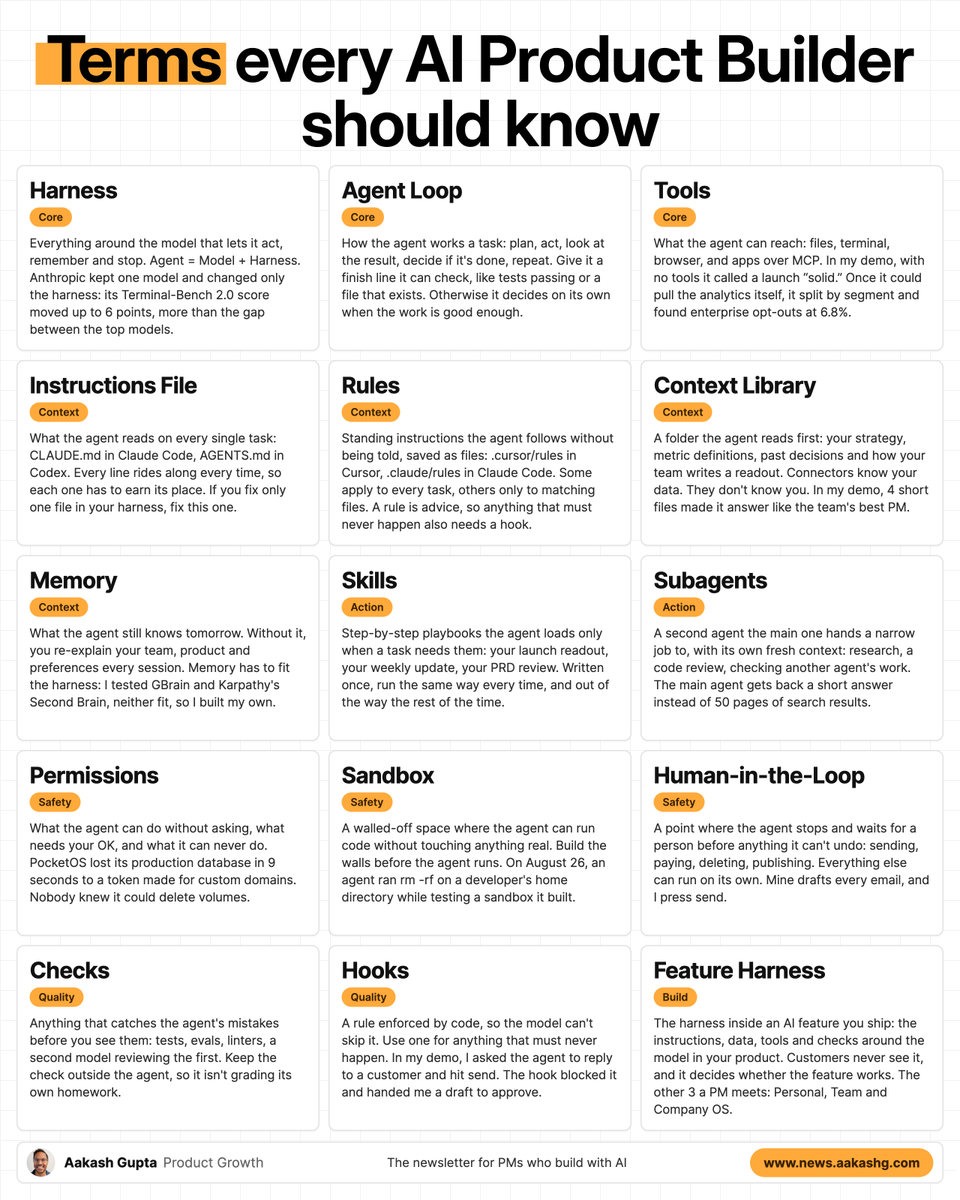
@aakashgupta posted (77 likes, 5 replies, 6,810 views, 151 bookmarks) a compact glossary of the stack: harness, agent loop, tools, instructions file, rules, context library, memory, skills, subagents, permissions, sandbox, checks, hooks, and feature harness. The attached card matters because it ties the language to outcome: he says Anthropic changed only the harness around the same model and moved Terminal-Bench 2.0 by up to six points, more than the gap between top models.
@sorenxet argued (50 likes, 5 replies, 1,175 views, 43 bookmarks) that the most detailed current agent paper decomposes quality into six harness parts: observation, context, control loop, action, state, and verification. @slash1sol made the same point (42 likes, 11 replies, 1,193 views, 39 bookmarks), but with a more operational framing: long tasks fail because the harness around the model fails, especially at context management, state, and verification.
Discussion insight: The most useful replies kept the theme grounded. Under Suraj’s roadmap, a reply argued memory itself needs evals, not just context trimming, while a reply under Aakash’s card said permissions may be the most important primitive because what an agent can do without asking determines “how bad the worst day gets.”
Comparison to prior day: On 2026-10-11, the public conversation mainly named the parts of the stack. On 2026-10-12, those parts were reorganized into a curriculum, benchmark narrative, and paper-style decomposition.
1.2 Verification displaced prompt cleverness as the preferred quality mechanism (🡕)
A second strong theme was that people increasingly treated verification, not prompting, as the only serious answer to agent quality. The strongest current-day posts asked how an agent proves that it did the right thing, how that proof gets externalized, and how to keep bad behavior from repeating. At least four strong items pushed this view.
@poteto wrote (727 likes, 63 replies, 26,107 views, 320 bookmarks) that two things matter most for cutting through “slop”: give the agent a way to verify its own work, and treat the codebase as memory by turning every repeated annoyance into a constraint. That post stood out because it explicitly downgraded generic “rules and skills” in favor of hard constraints, stronger type systems, diagnostics, and APIs that make agent mistakes categorically harder.
@arpit_bhayani used reverse engineering as an example (159 likes, 15 replies, 7,674 views, 80 bookmarks) of what real verification looks like: multiple agents can guess at decompiled C++, but the only trustworthy check is matching decompilation, where the rebuilt function is compiled and compared byte-for-byte with the original executable. His broader claim was that the same pattern generalizes: define correctness in a way a machine can check, then let the agent iterate against that signal.
@o_kwasniewski shipped (73 likes, 3 replies, 1,341 views, 65 bookmarks) /create-verification-skill, explicitly positioning end-to-end tests as the verification layer that lets a coding agent “bring you evidence” instead of just a confident answer. That mattered as a builder signal because it turned the verification argument into an installable artifact.

@skunzu added a routing version of the same idea (48 likes, 8 replies, 4,736 views, 71 bookmarks): Sonnet writes, Haiku explores the repo in read-only mode, Opus advises before a plan locks, after the same error appears twice, and before the task is called done, while Jev handles fast deterministic forks.
Discussion insight: The pushback consistently targeted self-grading loops. Replies to related “loops and graphs” posts kept asking the same question in different forms: who verifies the loop, and what happens when the agent accepts a correction but still executes the wrong action? The strongest answer on this date was still “outside the agent, with a pass/fail check.”
Comparison to prior day: On 2026-10-11, builders were already talking about proof loops. On 2026-10-12, the conversation got more concrete: end-to-end verification skills, repeated-error escalation rules, and byte-level equivalence checks.
1.3 Self-improvement and memory talk got more benchmark-aware (🡕)
Research-oriented posters kept discussing self-improvement and memory, but the strongest posts were more careful about what actually improved and what merely sounded agentic. The best evidence came from one optimistic paper launch and one skeptical benchmark readout.
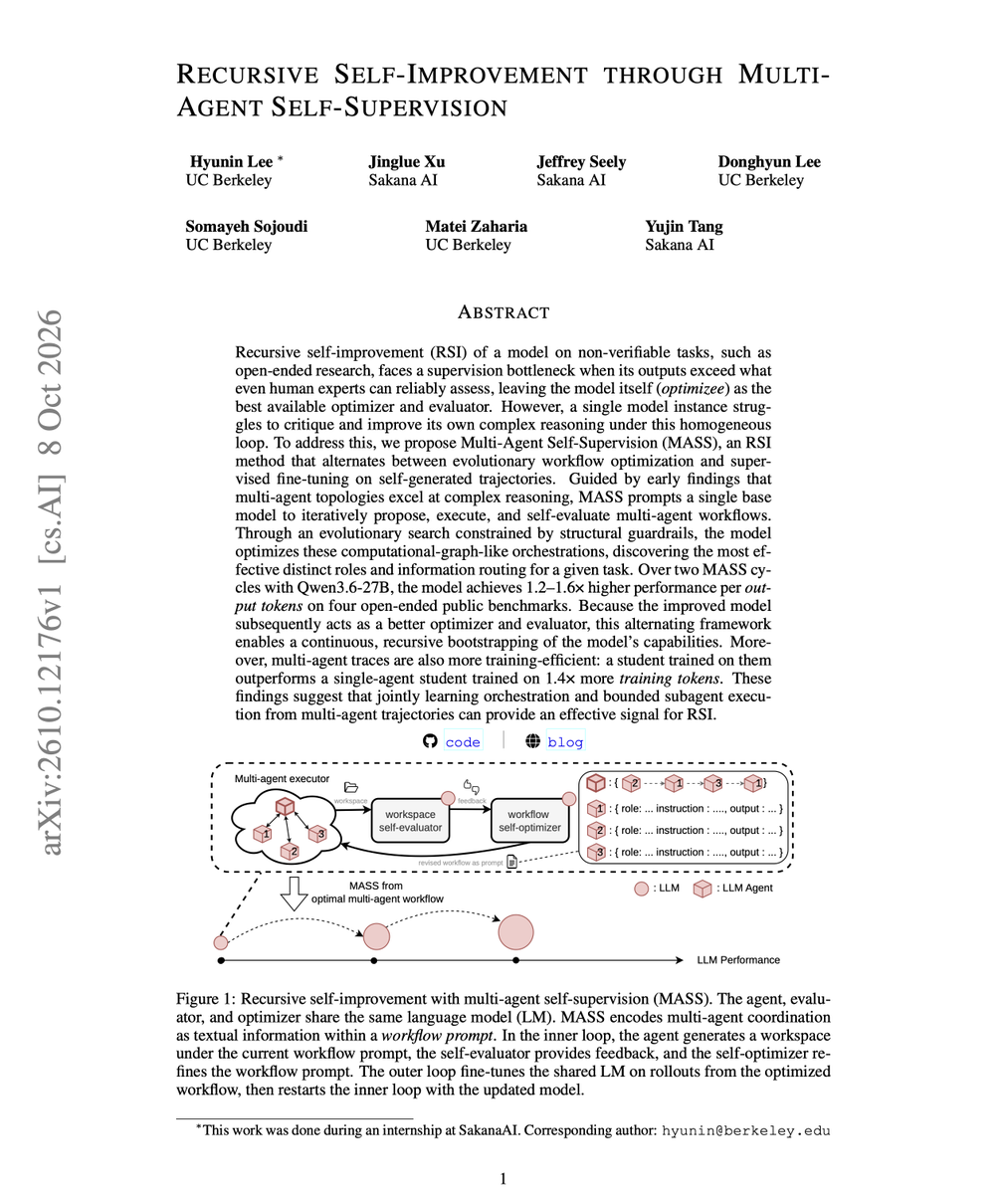
@hardmaru shared (551 likes, 33 replies, 23,003 views, 412 bookmarks) Sakana AI’s MASS work and linked the public blog and paper. The claim is unusually specific: a 27B open-weights model organizes copies of itself into a multi-agent workflow, optimizes that workflow, then fine-tunes on the best trajectories, yielding 1.2-1.6x score-per-output-token gains on public research benchmarks after two cycles.
@omarsar0 highlighted (21 likes, 11 replies, 2,266 views, 19 bookmarks) a paper testing a three-tier chain-of-agents system with persistent memory. His thread is important because it gave a mixed result instead of blanket hype: splitting long-context work across agents cut peak KV cache to 14.3 MiB versus roughly 35 MiB baselines, but the persistent trace-recall tier changed accuracy by only +0.015 on single-question benchmarks, with a confidence interval that crossed zero.
@slash1sol reinforced (42 likes, 11 replies, 1,193 views, 39 bookmarks) the same caution from a harness angle, saying long tasks usually fail around context management, state, and verification rather than around raw model IQ.
Discussion insight: Hardmaru’s replies immediately questioned whether a model grading its own homework can really escape shared blind spots, while replies under the memory thread raised an adjacent concern: even a memory store that contributes nothing useful can still create outages or privacy problems if it is poorly governed.
Comparison to prior day: On 2026-10-11, workflow-aware training and trace selection were the main story. On 2026-10-12, the stronger posts separated real benchmark movement from memory theater and explicitly named the cases where persistent memory does not help.
1.4 Model specialization became an everyday operating pattern (🡕)
A fourth theme was that advanced users are no longer describing one “best model.” They are describing stacks, lanes, and role splits: a strong model for planning and editing, cheaper helpers for search and routing, and dedicated agents for narrow operational jobs.
@skunzu gave the cleanest recipe (48 likes, 8 replies, 4,736 views, 71 bookmarks): Sonnet runs the session, Haiku explores files and docs in parallel, Opus steps in as advisor only at inflection points, and Jev handles the fork/route/retry decisions that do not need frontier reasoning.
@Mr_Buzzoni made the economic case (38 likes, 8 replies, 2,703 views, 43 bookmarks), saying the forks handled by Jev drop from about $110/day to $4 while leaving the hard reasoning to Opus. The specific work he offloads—note loading, routing easy steps, recovery choice, and ordering narrow checks before full tests—shows where people think the wasted spend actually lives.
@codyplof described (42 likes, 20 replies, 4,224 views, 70 bookmarks) a real personal stack instead of a benchmark setup: Claude Code and Codex as risky drivers, Muse and Hermes for personal-agent tasks, Runneth for marketing execution, Greptile for code review, MCP HQ for context management, and Notion as a possible coordination layer.
@mark_k pushed the same direction at the product layer (122 likes, 20 replies, 6,489 views, 30 bookmarks), saying OpenCode 2.0 now centers on a single background service shared across terminal, desktop, and web, with background agents, a redesigned orchestration API, and a new SDK. The corresponding OpenCode repo describes it as an open-source AI coding agent with terminal and desktop apps plus built-in build and plan agents.
Discussion insight: The most revealing replies were not about which model is smartest. They were about role boundaries: let the cheap model look around but not edit, wake the expensive advisor only after repeated failure, and make sure the routing layer still hands back reasons when it rejects a path.
Comparison to prior day: On 2026-10-11, packaging and skills were the visible adoption layer. On 2026-10-12, the stronger posts showed day-to-day operating patterns for multi-model and multi-agent specialization.
1.5 Agent commerce got more concrete, but not yet more trustworthy (🡒)
The loudest non-coding cluster remained agent commerce, but the most interesting posts were no longer the promotional ones. The stronger items either showed the live market more concretely or questioned whether the available signals were actually enough for buyers to trust it.
@elenalin01 framed (34 likes, 33 replies, 21 quotes, 350 views, 21 bookmarks) TermiX as a four-state protocol—hire, deliver, settle, receipt onchain—and linked agent.family, whose description says it is a marketplace where AI agents hire other agents using on-chain escrow, staked reputation, and dispute arbitration. The thread’s distinctive move was to argue that “hire, not build” may be the real primitive.
@XNXX_EN posted the sharpest critique (105 likes, 94 replies, 1,255 views) after inspecting live listings: many services displayed the same 100 rep, 100% pass, and $0 stake badges even though their completed-job counts differed materially. The author argued that unique buyers, job history, reply time, and delivery time would be more useful trust signals than generic reputation badges.

@DOLAK1NG added the clearest public snapshot (41 likes, 7 replies, 1,832 views, 5 bookmarks): 435k indexed agents, 394k cumulative jobs, $20.7M in processed transaction volume, and about $415k in protocol revenue. But the same post immediately argued those are reach metrics, not usefulness metrics, and asked how many agents are actively delivering, how many jobs reach settlement, and how much demand is repeat demand.

@trkweb3 made the stakes explicit (67 likes, 76 replies, 572 views): an agent can complete every step of a task and still fail to solve the real problem, so outcome-based evaluation matters more than box-checking execution.
Discussion insight: The strongest commerce posts on this date were not celebrating raw network size. They were trying to define the missing buyer-side analytics: settled jobs, repeat customers, independent evaluations, delivery speed, and unique buyers.
Comparison to prior day: On 2026-10-11, commerce discussion focused on reputation, hiring, and SDK access in the abstract. On 2026-10-12, posters added live market screenshots and public snapshot numbers, but the trust gap remained the central story.
2. What Frustrates People
Clean-looking output still is not proof
The strongest frustration was that agents can produce plausible work long before they produce trustworthy work. @poteto argued (727 likes, 63 replies, 26,107 views, 320 bookmarks) that agents need a way to verify their own work and that teams should turn repeated mistakes into code-level constraints. @arpit_bhayani showed (159 likes, 15 replies, 7,674 views, 80 bookmarks) why review alone fails in reverse engineering: wrong guesses can compile and run, so only a machine-checkable byte match counts as proof. @o_kwasniewski responded by shipping (73 likes, 3 replies, 1,341 views, 65 bookmarks) a reusable verification skill that uses end-to-end evidence instead of confidence. Worth building: High.
Memory remains expensive, fragile, and under-governed
People agreed that memory matters, but they did not agree that current memory layers are mature. @suraj_sharma14 treated (453 likes, 26 replies, 23,693 views, 799 bookmarks) multi-tier memory and eviction policy design as core curriculum, and replies immediately asked how to test what compression chose to forget. @omarsar0 shared (21 likes, 11 replies, 2,266 views, 19 bookmarks) a benchmark where persistent trace recall barely moved accuracy on single-question tasks, while replies raised both privacy and reliability concerns. Under @slash1sol's thread (42 likes, 11 replies, 1,193 views, 39 bookmarks), one of the most useful replies said long-task failures often come from context compaction and a state store the agent cannot reliably re-read. Worth building: High.
Enterprise agents still see too much and act too freely
A separate frustration was that enterprise agent deployments still lack realistic permissions and governance. @earakely argued (51 likes, 5 replies, 5,605 views, 34 bookmarks) that most enterprise RL environments are flawed because every agent can see everything, then showed tool-level RBAC, role-scoped data views, and peer-agent communication limits in AgentEnv. @berman66 reported (108 likes, 12 replies, 17,309 views, 45 bookmarks) that companies are already blocking Muse or seeing it leak data and send unauthorized emails, while the linked Runlayer post pitches approvals, audit logs, runtime security, and shadow-AI detection as missing control layers. Worth building: High.
Marketplace metrics still lag buyer trust and useful outcomes
The commerce threads kept returning to the same complaint: the public metrics are easier to publish than the trust signals buyers actually need. @XNXX_EN showed (105 likes, 94 replies, 1,255 views) listings where reputation badges looked almost identical even though job counts differed materially. @DOLAK1NG shared (41 likes, 7 replies, 1,832 views, 5 bookmarks) large marketplace totals, then immediately asked how many jobs settle and how much demand is repeat demand. @trkweb3 made the more general point (67 likes, 76 replies, 572 views) that task completion can still fail to solve the real business problem, which makes outcome-based evaluation a more meaningful bar than raw execution. Worth building: High.
3. What People Wish Existed
Proof-carrying verification layers instead of hopeful review
The strongest practical wish was for systems that return evidence, not just a polished answer. @poteto argued (727 likes, 63 replies, 26,107 views, 320 bookmarks) that agents need a way to verify their own work, while @arpit_bhayani showed (159 likes, 15 replies, 7,674 views, 80 bookmarks) what that looks like when correctness is machine-checkable. @o_kwasniewski shipped (73 likes, 3 replies, 1,341 views, 65 bookmarks) one partial answer with /create-verification-skill, but the broader need remains open across non-web tasks and multi-agent flows. Opportunity: Direct.
Memory systems that know what to keep, what to forget, and who can read it
People were not asking for “more memory” in the abstract. They were asking for memory with retention logic, ownership, evals, and scoped visibility. @suraj_sharma14 treated (453 likes, 26 replies, 23,693 views, 799 bookmarks) eviction policy and memory architecture as core engineering work, while @omarsar0 showed (21 likes, 11 replies, 2,266 views, 19 bookmarks) that persistent memory may not help if tasks do not create reusable history. Replies under @slash1sol highlighted (42 likes, 11 replies, 1,193 views, 39 bookmarks) a narrower need still unmet in many stacks: state that the agent can reliably reread after long runs and compaction. Opportunity: Direct.
Enterprise control planes for personal agents
Another visible need was a governed layer between personal agents and company systems. @earakely asked for (51 likes, 5 replies, 5,605 views, 34 bookmarks) role-based tool access, role-scoped views, and explicit rules for which agents may message whom. @berman66 made the same request from production (108 likes, 12 replies, 17,309 views, 45 bookmarks), describing a market where employees want Muse but companies need approvals, audit logs, runtime security, and shadow-use detection before they can say yes. Partial solutions now exist, but the demand looks broader than any one vendor. Opportunity: Competitive.
Buyer-side analytics for agent marketplaces
The marketplace threads read like a request for better trust instrumentation. @XNXX_EN wanted (105 likes, 94 replies, 1,255 views) unique buyers, job history, reply time, and delivery time. @DOLAK1NG wanted (41 likes, 7 replies, 1,832 views, 5 bookmarks) active-delivery and repeat-demand views layered on top of topline volume. @trkweb3 wanted (67 likes, 76 replies, 572 views) outcome-based evaluation instead of mere task completion. Marketplaces and settlement rails already exist, but the buyer trust layer still looks underspecified. Opportunity: Competitive.
Lightweight local copilots for search and routing
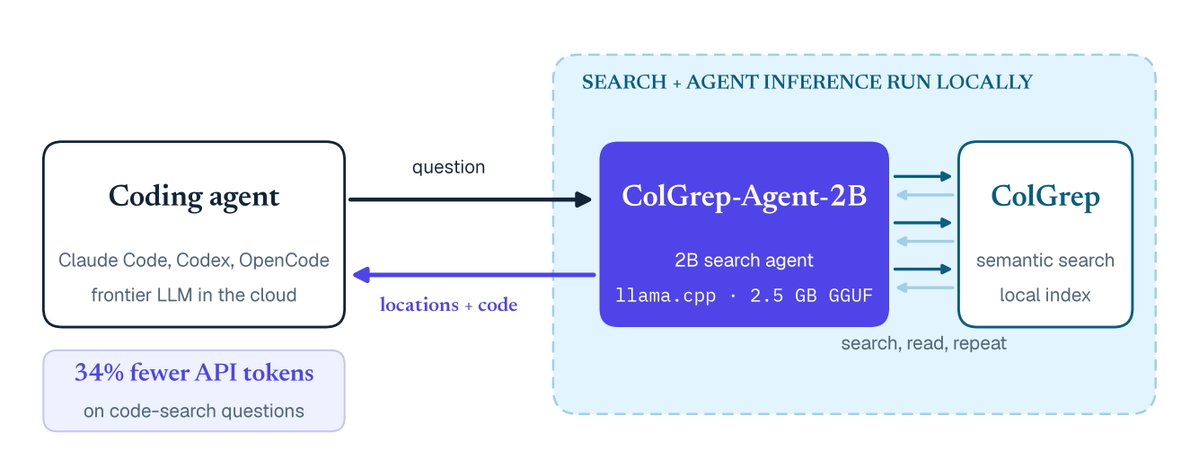
A quieter but recurring wish was for small local helpers that burn less frontier context on routine work. @skunzu described (48 likes, 8 replies, 4,736 views, 71 bookmarks) read-only Haiku subagents and Jev-style routing as a daily productivity move, while @Mr_Buzzoni quantified (38 likes, 8 replies, 2,703 views, 43 bookmarks) the cost gap between frontier reasoning and narrow decision work. @AmelieTabatta pushed the same pattern (15 likes, 1 reply, 192 views, 4 bookmarks) into local code search with ColGrep-Agent-2B. The need is practical and immediate, but multiple projects are already converging on it. Opportunity: Competitive.
4. Tools and Methods in Use
| Tool | Category | Sentiment | Strengths | Limitations |
|---|---|---|---|---|
| Claude Code with advisor/subagent splits | Coding agent harness | (+/-) | Strong operating pattern for long sessions: cheap read-only explorers, heavy-model advisor checkpoints, explicit verification points | Needs careful rules, escalation, and external checks to avoid repeated-error drift |
| Jev | Decision / routing model | (+) | Fast typed choices for routing, retry, and narrow yes-no work; posters claimed large cost savings when paired with Opus | Low-confidence or edge cases still need back-checks and escalation logic |
| MASS | Research / training method | (+) | Public workflow-optimization plus distillation loop with reported score-per-token gains on research benchmarks | Self-evaluation blind spots remain the main concern; evidence is strongest on research-style tasks |
| OpenCode | Open-source coding agent | (+) | Shared background service across interfaces, background agents, plugin surface, orchestration API, SDK, desktop app | Public evidence is still launch-stage and says little yet about production reliability |
| ColGREP + ColGrep-Agent-2B | Local code search | (+) | Fully local semantic code search and small-model localization; reduces frontier-model token spend on repo search | Narrow task scope; requires a local model and index to be set up |
| Skales | Local personal agent | (+/-) | Local-first agent with files, browser, calendar, email, offline/Ollama support, and no Docker requirement | Repository distributes a proprietary product rather than a fully open source codebase |
| AgentEnv Framework | Agent environment SDK / CLI | (+) | Role-based tool access, scoped views, task DAGs, grading, open protocol, Python SDK | Realistic local environments still usually require Docker and setup work |
| Runlayer for Muse | Enterprise governance layer | (+/-) | Governed connectors, approvals, audit logs, runtime security, shadow-AI discovery | Necessary because the underlying personal-agent stack is not enterprise-ready on its own |
| TermiX / agent.family | Agent commerce infrastructure | (+/-) | On-chain escrow, reputation, dispute rails, public market surface, visible marketplace stats | Buyer trust, repeat demand, and outcome quality remain under-instrumented |
Overall sentiment was most positive for tools that either reduce token waste or constrain agent behavior in auditable ways. @codyplof described (42 likes, 20 replies, 4,224 views, 70 bookmarks) a live stack that already mixes Claude Code, Codex, Muse, Hermes, Runneth, Greptile, MCP HQ, and Notion by job type, which fits the broader move away from a single all-purpose assistant.
The main migration pattern was from “one frontier model does everything” toward layered systems: a strong model for planning and editing, local or cheap helpers for search and routing, and explicit governance around tools and connectors. That is visible both in @skunzu describing (48 likes, 8 replies, 4,736 views, 71 bookmarks) Sonnet/Haiku/Opus/Jev role splits and in @berman66 describing (108 likes, 12 replies, 17,309 views, 45 bookmarks) a separate security/governance layer for Muse.
The most mixed category remained commerce infrastructure. @DOLAK1NG argued (41 likes, 7 replies, 1,832 views, 5 bookmarks) that current topline metrics still leave repeat-demand questions unanswered, and @XNXX_EN argued (105 likes, 94 replies, 1,255 views) that live listings still hide the trust signals buyers actually need.
5. What People Are Building
| Project | Who built it | What it does | Problem it solves | Stack | Stage | Links |
|---|---|---|---|---|---|---|
| MASS | Sakana AI / @hardmaru | Recursively improves a shared model by optimizing multi-agent workflows and training on the best trajectories they produce | The supervision bottleneck on open-ended research tasks that humans cannot easily grade | Qwen3.6-27B, workflow search, multi-agent traces, LoRA fine-tuning | Alpha | tweet, blog, paper |
| OpenCode 2.0 | @mark_k | Open-source coding agent with a shared background service across terminal, desktop, and web, plus background agents and an SDK | Unifies state and orchestration across multiple coding surfaces instead of treating each interface as a separate session | CLI, desktop app, web UI, orchestration API, plugins, SDK | Shipped | tweet, repo |
| Skales | @tom_doerr | Local-first agent that works over files, browser, calendar, and email without Docker or external servers | Gives non-developers a privacy-first local agent that installs like a normal app | Desktop app, BYOK, 15+ providers, Ollama, browser and office extensions | Shipped | tweet, repo |
| ColGREP + ColGrep-Agent-2B | @AmelieTabatta | Local code-search helper that searches the repo, reads candidate files, and returns locations plus code to the main agent | Reduces frontier-model token waste on repo search and localization | ColGREP semantic search, 2B GGUF local model, llama.cpp, Rust binary | Beta | tweet, repo |
| AgentEnv Framework RBAC | @earakely | Python SDK and CLI for agentic environments and graded tasks with role-based tool access, role-scoped views, and message controls | Makes enterprise multi-agent training and evaluation environments behave more like real organizations | Python SDK, CLI, task DAGs, open protocol, containerized environments | Shipped | tweet, blog, repo |
| Runlayer for Muse | @berman66 | Governance layer that lets Muse use approved connectors with policies, approvals, audit logs, runtime security, and shadow-use detection | Lets companies adopt personal agents without granting uncontrolled access to sensitive systems | MCP gateway, on-behalf-of auth, SCIM, SIEM exports, runtime scanning | Shipped | tweet, blog |
| /create-verification-skill | @o_kwasniewski | Reusable skill that lets a coding agent verify its own work with e2e and present evidence | Turns verification from an ad hoc human review step into an installable workflow primitive | tester-army/e2e, skills install flow, e2e evidence collection | Beta | tweet |
| TermiX / agent.family | @elenalin01 | Marketplace and settlement layer where agents hire other agents and settle work through escrow and reputation updates | Supplies discovery, payment, delivery, and dispute rails for agent commerce | AACP, on-chain identity, stablecoin escrow, staked reputation, dispute arbitration | Beta | tweet, site |
MASS stood out because it tried to move multi-agent discourse from runtime orchestration into training methodology. Instead of only wiring agents together at inference time, the public materials describe a loop where workflow search finds better coordination patterns and post-training absorbs those patterns back into the shared model.
OpenCode, Skales, and ColGREP point to a second pattern: builders are trying to make agentic work either more installable or more local. OpenCode is turning the coding agent into a programmable platform with a shared service and SDK; Skales packages a local agent for files, browser, calendar, and email into a consumer-friendly install; ColGREP offloads one narrow but expensive job—repo search—into a local helper so the main model can spend context on reasoning rather than file discovery.

AgentEnv Framework and Runlayer show a third pattern: the serious enterprise builders are working on access control, not just autonomy. One side is simulated environments with role-based tools, views, and message graphs; the other is real production governance with approved connectors, approvals, audit logs, and shadow-agent discovery.
The last visible pattern was turning trust into artifacts. /create-verification-skill packages proof into a reusable skill, while TermiX packages hiring, delivery, and settlement into a public market. In both cases, the build pattern is the same: do not ask the user to trust the agent’s story alone; add rails that survive inspection.
6. New and Notable
OpenCode 2.0 reframed the coding agent as a platform
@mark_k said (122 likes, 20 replies, 6,489 views, 30 bookmarks) OpenCode 2.0 now revolves around a shared background service across terminal, desktop, and web, with background agents, a redesigned API, and a new SDK. That matters because it shifts the product category from “interactive coding assistant” toward “programmable development platform,” which is a stronger architectural claim than simply adding another agent mode.
Local search helpers moved from concept to measurable token savings
@AmelieTabatta introduced (15 likes, 1 reply, 192 views, 4 bookmarks) ColGrep-Agent-2B as a local code-search helper for Claude Code, Codex, and OpenCode, with a claim of 34% fewer API tokens on code-search questions. That is notable because it isolates one expensive step in coding-agent work—repo localization—and treats it as a specialized local coprocessor rather than part of the main frontier-model session.
Enterprise governance became a concrete product category
@earakely showed (51 likes, 5 replies, 5,605 views, 34 bookmarks) how AgentEnv expresses role-based tool access, scoped data visibility, and peer-agent messaging in a multi-agent task DAG. @berman66 showed the production analogue (108 likes, 12 replies, 17,309 views, 45 bookmarks), where Muse gets governed connectors, approvals, logs, and runtime security through Runlayer. The combined signal is that “enterprise agent safety” is becoming less about policy documents and more about explicit control planes.
Outcome-based evaluation entered the commerce conversation
@trkweb3 argued (67 likes, 76 replies, 572 views) that an agent can complete every step of a task and still fail to solve the real business problem. That is notable because it applies eval language to agent marketplaces and delegated work: counting completions is no longer enough if buyers really care about whether the outcome changed a decision, solved a bottleneck, or delivered reusable value.
7. Where the Opportunities Are
[+++] Verifiable agent execution — Evidence came from @poteto framing verification as the first requirement (727 likes, 63 replies, 26,107 views, 320 bookmarks), @arpit_bhayani showing a byte-level pass/fail loop (159 likes, 15 replies, 7,674 views, 80 bookmarks), and @o_kwasniewski shipping an installable verification skill (73 likes, 3 replies, 1,341 views, 65 bookmarks). This looks strong because the pain is immediate, the value is legible, and current solutions are still fragmented across narrow workflows.
[+++] Governed memory and context orchestration — @suraj_sharma14 treated memory architecture and eviction as core curriculum (453 likes, 26 replies, 23,693 views, 799 bookmarks), while @omarsar0 showed (21 likes, 11 replies, 2,266 views, 19 bookmarks) that persistent memory is not automatically useful. Replies under @slash1sol's thread (42 likes, 11 replies, 1,193 views, 39 bookmarks) sharpened the operational gap: long tasks need state the agent can reliably reread after compaction. The opportunity is strong because teams now know they need memory, but still lack consensus on ownership, retention, and measurable benefit.
[++] Enterprise control planes for personal agents — @earakely showed (51 likes, 5 replies, 5,605 views, 34 bookmarks) demand for role-based visibility and tool access in multi-agent environments, while @berman66 showed (108 likes, 12 replies, 17,309 views, 45 bookmarks) demand for approvals, audit logs, and shadow-use detection once personal agents touch enterprise systems. The category is already competitive, but the breadth of the problem suggests room for vertical and integration-specific products.
[++] Local helper layers for coding agents — @AmelieTabatta showed (15 likes, 1 reply, 192 views, 4 bookmarks) that a local search helper can reduce coding-agent token use, @Mr_Buzzoni claimed (38 likes, 8 replies, 2,703 views, 43 bookmarks) large savings by offloading narrow routing choices to Jev, and @mark_k showed (122 likes, 20 replies, 6,489 views, 30 bookmarks) a platform moving in the same direction with background services and agents. The opportunity is moderate because multiple builders are already converging on it, but the cost/latency benefit is easy to explain.
[+] Marketplace trust analytics for agent commerce — @XNXX_EN wanted better buyer-side trust signals (105 likes, 94 replies, 1,255 views), @DOLAK1NG wanted repeat-demand visibility (41 likes, 7 replies, 1,832 views, 5 bookmarks), and @trkweb3 wanted outcome-based evaluation (67 likes, 76 replies, 572 views). This is still an emerging opportunity because the underlying marketplaces themselves are young, but the metrics gap is already visible.
8. Takeaways
- Harness engineering now looks like a discipline, not a catchphrase. Supporting evidence came from @suraj_sharma14 turning it into a 12-stage roadmap (453 likes, 26 replies, 23,693 views, 799 bookmarks), @aakashgupta turning it into a shared glossary (77 likes, 5 replies, 6,810 views, 151 bookmarks), and @sorenxet turning it into a six-part decomposition (50 likes, 5 replies, 1,175 views, 43 bookmarks).
- Verification beat prompt cleverness as the day’s preferred quality story. The strongest posts were @poteto on self-verification and codebase memory (727 likes, 63 replies, 26,107 views, 320 bookmarks), @arpit_bhayani on machine-checkable correctness (159 likes, 15 replies, 7,674 views, 80 bookmarks), and @o_kwasniewski on packaging verification as a skill (73 likes, 3 replies, 1,341 views, 65 bookmarks).
- Self-improvement research gained credibility, but memory hype met sharper scrutiny. @hardmaru shared MASS (551 likes, 33 replies, 23,003 views, 412 bookmarks) with specific score-per-token gains, while @omarsar0 highlighted (21 likes, 11 replies, 2,266 views, 19 bookmarks) evidence that persistent memory can add little on benchmarks that do not create reusable history.
- Advanced practitioners are running stacks, not single agents. That showed up in @skunzu splitting work across Sonnet, Haiku, Opus, and Jev (48 likes, 8 replies, 4,736 views, 71 bookmarks), @Mr_Buzzoni claiming large routing-cost savings (38 likes, 8 replies, 2,703 views, 43 bookmarks), and @codyplof listing a real multi-agent operating stack (42 likes, 20 replies, 4,224 views, 70 bookmarks).
- Agent commerce is getting more concrete, but repeat useful work is still the missing metric. The strongest evidence came from @DOLAK1NG publishing public snapshot numbers (41 likes, 7 replies, 1,832 views, 5 bookmarks), @XNXX_EN questioning weak marketplace trust signals (105 likes, 94 replies, 1,255 views), and @trkweb3 arguing for outcome-based evaluation (67 likes, 76 replies, 572 views).