Twitter AI Coding - 2026-06-26
1. What People Are Talking About
1.1 GitHub Copilot publishes harness benchmark data — the argument shifts from model to orchestration (🡕)
The highest-signal item of the day was GitHub publishing concrete benchmark data arguing that the agentic harness matters as much as the model. Three items supported the theme at high engagement: the original announcement from a verified GitHub product lead, an amplification from GitHub's VP of Developer Community, and supporting discussion.
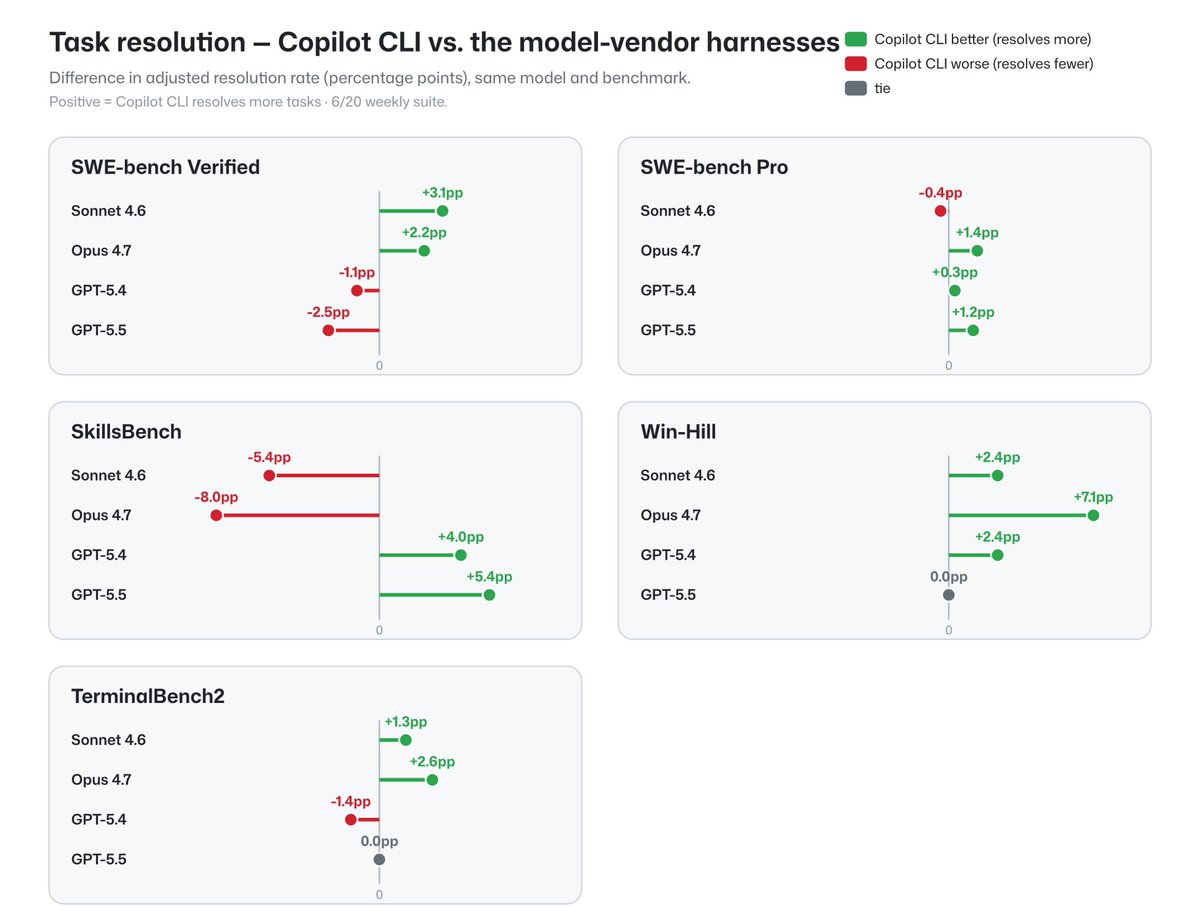
@pierceboggan published (62 likes, 14 retweets, 3 quotes, 18 bookmarks, 2,952 views) data from GitHub's public blog post showing Copilot CLI tested head-to-head against Claude Code (for Sonnet 4.6 and Opus 4.7) and Codex CLI (for GPT-5.4 and GPT-5.5) on five benchmarks: SWE-bench Verified, SWE-bench Pro, SkillsBench, Win-Hill, and TerminalBench2. The methodology held the model and task fixed and controlled for context window, reasoning effort, tool selection, and MCP servers. The task resolution chart shows Copilot CLI ahead of Claude Code on four of five benchmarks for both Sonnet 4.6 (+3.1pp SWE-bench Verified, +2.2pp SWE-bench Pro) and Opus 4.7 (+1.4pp SWE-bench Pro, +7.1pp Win-Hill), with mixed results vs Codex CLI on GPT models.
@martinwoodward amplified (12 likes, 5 retweets, 1 quote, 2 bookmarks, 1,656 views) the token efficiency angle with a separate chart. It shows Copilot CLI uses 31–65% fewer tokens than Claude Code when running the same Claude models: Sonnet 4.6 shows -65% on SWE-bench Verified, -46% on SWE-bench Pro, -41% on SkillsBench, -38% on Win-Hill, and -31% on TerminalBench2. For Opus 4.7 the savings range from -38% to -52%. Against Codex CLI with GPT models, Copilot CLI is mixed but still negative (fewer tokens) on most benchmarks.

The blog post notes the harness is a single shared component powering the Copilot CLI, Copilot app, code review, VS Code, and other GitHub/Microsoft surfaces — improvements to the harness propagate everywhere. One reply from @Thomas_Tao_1 (25 views) immediately challenged the framing: "Token efficiency is useful, but I keep getting burned by retry cost. An agent that misses context twice is expensive even if the benchmark says otherwise."
Discussion insight: The skeptical reply was the only substantive pushback in the thread. No counterdata was offered — only a qualitative complaint about retry behavior not captured in the benchmarks.
Comparison to prior day: June 25 established GitHub as platform-building rather than model-chasing. June 26 added the first published quantitative case for the Copilot harness as a competitive advantage over vendor-native alternatives.
1.2 Codex approaches universal internal adoption at OpenAI and starts behaving like a platform (🡕)
Multiple high-signal items converged on the same public dataset about Codex's internal trajectory. The data moved from summary claims on June 25 to more specific baseline comparisons and product evolution signals on June 26.
@PeterDiamandis stated (42 likes, 8 retweets, 1 quote, 5 bookmarks, 3,137 views) that 98% of OpenAI employees now use Codex agents, research usage is up 56x in seven months, and 8-hour task requests are up 10x. @Techmeme noted (8 likes, 2,625 views) the same public data with a baseline: Codex usage was at roughly 40% in August 2025 and reached 97.9% by June 2026, with non-developer individual user usage up 137x. The combination sets a 10-month adoption arc: from 40% to near-universal internal use.
@subinium shared (4 likes, 2 replies, 224 views) a screenshot from a Codex session showing "Subagents 638" — evidence that real-world Codex orchestration already involves hundreds of parallel subagents in a single task.
@gudanglifehack spotted (4 likes, 2,782 views) a new surface appearing in the Codex UI: a "Give the gift of Codex" banner that lets users send Codex credits to others. The screenshot shows Codex framing credits as a currency ("Send Codex credits to a friend to help them turn their ideas into reality"), alongside integration entry points for Slack, GitHub, and Linear.

Discussion insight: The Codex adoption data circulated without substantive disagreement or alternative figures. The most notable reply in the PeterDiamandis thread was spam; the meaningful replies were positive amplifications.
Comparison to prior day: June 25 had department-by-department charts and growth percentages from the Codex paper. June 26 added the 40%-to-98% baseline arc, the 638-subagent scale evidence, and the first product signal of Codex credits as a giftable currency — which suggests OpenAI is treating Codex as a consumer product, not just an internal tool.
1.3 Agent session memory surfaced as a solved problem with a very high adoption signal (🡕)
The strongest builder item was a persistent session memory tool that is simultaneously a top GitHub trending repository and confirms a frustration that replies called "the biggest productivity killer."
@VaibhavSisinty promoted (24 likes, 6 retweets, 19 bookmarks, 2,264 views) claude-mem, a persistent memory compression sidecar that works across Claude Code, Codex, Gemini CLI, Copilot, OpenCode, and Hermes. It runs silently, captures agent actions across sessions, compresses the context with AI, and injects relevant context back on the next session. Install is a single npx claude-mem install command. The GitHub repo shows 84K+ stars and an Apache 2.0 license, with the README screenshot confirming it was the #1 GitHub Trending repository of the day and showing a star growth chart rising steeply from October 2025.

Discussion insight: The reply from @JamesClawn (35 views) added important nuance: "Claude Code forgetting is annoying. Claude Code remembering the wrong thing is worse unless recovery can show the exact memory bundle it used." A separate reply from @benja_maker (30 views) asked whether any benchmarks exist for competing memory layers, noting multiple are already on the market. The frustration is validated, but the trust and debugging problem is real: compressed, injected context creates a new failure mode where wrong context is harder to trace than no context.
Comparison to prior day: June 25 showed builders wrapping Obsidian and email in agentic memory shells (My Brain Is Full — Crew). June 26 showed a memory-as-infrastructure tool at scale: 84K stars and #1 trending, suggesting the memory gap has now attracted a mainstream open-source solution rather than niche wrapper projects.
1.4 Free and local inference gained distribution channels and concrete use cases (🡕)
Three independent items showed the growing infrastructure for running AI coding agents without hitting quota or billing walls.
@dhruvtwt_ announced (34 likes, 24 bookmarks, 1,018 views) freeLLM.net, a directory of 224+ free AI APIs from 25 providers — Google, Groq, NVIDIA NIM, OpenRouter, Mistral, Cohere, and others — complete with rate limits, context windows, API key links, and one-click config snippets for Claude Code, Cursor, Codex, OpenCode, Hermes, and any OpenAI-compatible client. The site confirms 127 models are currently free and online. The 24 bookmarks against 1,018 views indicates a high save rate, suggesting people are storing it as a practical resource.

@edandersen shared (26 likes, 7 bookmarks, 1,951 views) a video of Qwen-Coder-Next running fully offline in GitHub Copilot in VS Code at 40 tokens per second on battery power on a Ryzen AI MAX 395 128GB laptop during a Shinkansen bullet train ride in Japan. The post framed it as "a glimpse of the future."
@RaidOwlTweets noted (12 likes, 610 views) running out of GitHub Copilot credits for the month with a screenshot showing a personal AI cluster dashboard — five compute nodes including three DGX clusters running at 96% GPU utilization, a Strix Halo with 32 cores, and a Mac Mini, with services including OpenWebUI, n8n, Ray, and SearXNG.

Discussion insight: The edandersen video generated replies about its ambition but no technical challenges. The implication across all three items is consistent: local inference is increasingly viable (40 tok/s offline on a prosumer laptop), free-tier API directories reduce friction for those without local hardware, and developers are already running personal clusters as a billing backstop.
Comparison to prior day: June 25 focused on unofficial bridges (Windows Copilot API) and quota complaints. June 26 showed more mature infrastructure: a public directory aggregating free-tier APIs and live demonstrations of offline-capable agent workflows on consumer hardware.
1.5 Ecosystem integrations extended into MCP stores, security skills, and desktop Git (🡒)
Three tool-release items confirmed steady expansion of the coding agent ecosystem through enterprise integrations, security capabilities, and desktop tooling.
@gitlab announced (39 likes, 7 retweets, 1 quote, 7 bookmarks, 5,810 views) GitLab Orbit's availability in the Google Antigravity MCP Store. Ultimate and Premium users can give agents governed, structured access to GitLab instances directly from their coding platform. Internal tests cited 11x faster responses, 4.5x fewer tokens, and 45x fewer hallucinations compared to standard API access. The screenshot shows Orbit being used inside an IDE to map project relationships and generate an architecture diagram.

@RituWithAI highlighted (7 likes, 6 retweets, 6 bookmarks, 118 views) Anthropic-Cybersecurity-Skills, an open-source skill library that gives AI coding agents 817 structured cybersecurity skills across 29 security domains, mapped to six frameworks: MITRE ATT&CK v19.1, NIST CSF 2.0, MITRE ATLAS, D3FEND, NIST AI RMF, and MITRE F3. Works with Claude Code, GitHub Copilot, Codex CLI, Cursor, Gemini CLI, and 20+ other platforms. The repo shows 21K stars and 2.5K forks. Apache 2.0.
@GHchangelog announced (12 likes, 2,160 views) GitHub Desktop 3.6, which moves Copilot in Desktop onto the Copilot SDK and adds a model picker plus BYOK support for every Copilot feature. Commit message generation now reads copilot-instructions.md and AGENTS.md. New merge conflict resolution uses AI to explain conflicts and suggest resolutions. Git worktree support lets users manage multiple branches simultaneously without branch switching overhead.
Discussion insight: The GitLab announcement was the day's most-viewed ecosystem item (5,810 views). The 45x fewer hallucinations claim is striking but presented without methodology details in the tweet.
Comparison to prior day: June 25 was GitHub-centric (Agent Finder, LSP Setup, Copilot app automations). June 26 broadened to include GitLab through the MCP store and extended BYOK to desktop Git tooling.
2. What Frustrates People
Codex and Copilot quota limits are tightening, and billing changes create unpredictable costs
Severity: High. The most concentrated frustration was around usage limits and billing unpredictability across multiple tools. @CtrlAltDwayne reported (34 likes, 2 retweets, 1,660 views) that Codex usage limits had tightened noticeably over the past few days, even on $200/month subscriptions, with a screenshot showing the 5-hour limit at 34% remaining and the 7-day limit at 39% remaining — implying abnormal burn. Reply @Suolar_ said "Dude codex is unusable now" and @kimkimbhhr reported "usage run out like over 10x on my end." @Oblivious9021 noted (5 likes, 4 retweets, 145 views) that GitHub Copilot had switched from flat pricing to token-based billing, with one developer's bill going from $29/month to $750/month. @RaidOwlTweets confirmed (12 likes, 610 views) running out of GitHub Copilot credits entirely with two weeks left in the month. The workaround pattern was consistent: fall back to local AI clusters, free-tier APIs, or unofficial bridges. This is worth building for because the failure mode is not abstract — it is a hard wall mid-workflow.

Session memory loss breaks agent continuity between work sessions
Severity: High. The 84K stars on claude-mem and its #1 trending position are themselves an evidence signal: a large population is experiencing session context loss as a recurring cost. The replies under the @VaibhavSisinty post (24 likes, 2,264 views) gave the frustration specific texture: "I lost like 2 hours once just re-explaining a project structure it already knew" (@hello_code_) and the secondary risk: "Claude Code remembering the wrong thing is worse unless recovery can show the exact memory bundle it used" (@JamesClawn). People cope by using context files, CLAUDE.md, and memory plugins; the more sophisticated users worry that compressed memory injection creates a harder-to-debug failure mode than simply having no memory.
Replacing cloud agents with local inference is harder than it looks
Severity: Medium. @evilseyee described (2 likes, 54 views) staying up from midnight to install Ollama as a partial drop-in for their Claude Code workflow and encountering model compatibility issues, context handling differences, and tool-use reliability gaps. The post did not resolve cleanly; it ended on "famous last words" with the setup still incomplete. The local AI path is viable (edandersen's 40 tok/s offline demo was the same day) but the tooling-compatibility gap between cloud and local is still real.
3. What People Wish Existed
Free, transparent usage dashboards that survive billing model changes
People want clear, upfront usage signals — not just retroactive billing shocks. The implicit ask across the CtrlAltDwayne limit report, the Oblivious9021 $29→$750 note, and the RaidOwlTweets credit exhaustion is a usage layer that makes token spend visible before it crosses a threshold. freeLLM.net and local clusters are manual workarounds for this gap. Opportunity: Direct.
Agent memory with inspectable, correctable context injection
The nuance from the claude-mem replies is that people do not just want persistent memory — they want memory they can audit. @JamesClawn (35 views) stated it directly: "Claude Code remembering the wrong thing is worse unless recovery can show the exact memory bundle it used." @benja_maker (30 views) asked whether benchmarks exist for memory-layer quality, implying the market already has multiple options but no way to compare them. The unmet need is a memory system that surfaces what context it injected and why, and lets users remove or correct it. Opportunity: Direct.
Offline-capable agent workflows on laptop-class hardware
@edandersen demonstrated (26 likes, 1,951 views) this was possible (40 tok/s on battery on a bullet train), but the setup required a high-end Ryzen AI MAX 395 laptop with 128 GB RAM running a custom local model in Copilot. There is no documented one-click path from "I ran out of Copilot credits" to "I am running the same workflow offline." That gap exists and freeLLM.net addresses the cloud end of it, but offline/local inference still requires nontrivial configuration. Opportunity: Competitive.
A deterministic or scripted mode for agent demos
@eliostruyf built (2 likes, 2 retweets, 251 views) copilot-mock-server precisely because this need was unmet: a proxy that intercepts Copilot Chat traffic and replays scripted responses, making demos fully deterministic. The fact that someone built a dedicated proxy rather than using a vendor feature suggests this is not an edge case — it is a practitioner workaround for every developer who demos AI coding tools and cannot afford a live hallucination. Opportunity: Direct.
4. Tools and Methods in Use
| Tool | Category | Sentiment | Strengths | Limitations |
|---|---|---|---|---|
| GitHub Copilot CLI | Coding agent harness | (+) | Published benchmark data showing better token efficiency than Claude Code on Claude models; single harness across CLI, app, code review, VS Code | Mixed results vs Codex CLI on GPT models; retry cost not captured in benchmarks |
| Codex (OpenAI) | Coding agent | (+/-) | Near-universal internal adoption at OpenAI, 638+ subagents in production, credits becoming giftable | Usage limits reported as tighter, multiple users hitting walls on $200/month subscriptions |
| Claude Code | Coding agent | (+/-) | Strongest ecosystem gravity (most tools built to integrate with it); claude-mem and cybersecurity skills both target it first | Session memory loss; higher token cost vs Copilot harness on same Claude model |
| claude-mem | Agent memory layer | (+) | 84K stars, #1 GitHub Trending, Apache 2.0, single install command, works across Claude Code, Codex, Gemini CLI, Copilot, OpenCode, Hermes | Risk of injecting wrong compressed context; no benchmark for memory quality yet |
| freeLLM.net | Free-tier API directory | (+) | 224+ free AI APIs from 25 providers, one-click config for all major agent clients, no credit card required for most | Coverage depends on provider uptime; free tiers have rate limits |
| GitHub Desktop 3.6 | Desktop Git / Copilot integration | (+) | Copilot SDK, model picker, BYOK support, commit-message alignment with repo instructions, AI conflict resolution, worktrees | Just released; adoption unknown |
| GitLab Orbit (in Antigravity MCP) | Enterprise source integration | (+) | 11x faster responses, 4.5x fewer tokens, 45x fewer hallucinations vs unstructured API; governed access | Ultimate and Premium tiers only; methodology for perf claims not detailed |
| Qwen-Coder-Next (local) | Local LLM for coding | (+) | 40 tok/s on battery on Ryzen AI MAX 395; works offline inside Copilot VS Code | Requires high-end NPU laptop and manual configuration; not plug-and-play |
| Google Antigravity | Coding platform / MCP store | (+/-) | Growing MCP ecosystem (GitLab Orbit, others); Gemini integration | Gemini 3.5 Pro delayed to July; course content demand suggests learning curve |
| Anthropic-Cybersecurity-Skills | Security skill library | (+) | 817 skills, 29 domains, 6 framework mappings, 21K stars; works with 26+ platforms; Apache 2.0 | Community project, not Anthropic-official; offensive skills require authorized use only |
The clearest shift in tool sentiment on June 26 was in how people frame the Copilot CLI. Before the benchmark post, replies treated Copilot as competing on model selection and UX. After it, the framing moved to the harness as an independent quality dimension — a tool can outperform the same model in a different harness. That argument benefits GitHub directly and complicates vendor-native harness marketing for Anthropic and OpenAI.
The local inference path remained messy. @evilseyee failed to reproduce their cloud agent setup locally, while @edandersen succeeded but under specialized hardware conditions. The gap between those two experiences captures where local inference currently stands: possible for the well-resourced, unreliable as a drop-in substitute.
5. What People Are Building
| Project | Who built it | What it does | Problem it solves | Stack | Stage | Links |
|---|---|---|---|---|---|---|
| claude-mem | thedotmack | Persistent memory compression sidecar for AI coding agents | Session context is lost when the agent window closes | Node.js, AI compression, CLAUDE.md injection, cross-agent support | Shipped | repo |
| Anthropic-Cybersecurity-Skills | mukul975 | 817-skill cybersecurity library for AI coding agents | Agents have no persistent security knowledge without per-session prompting | SKILL.md files, 6 framework mappings (MITRE ATT&CK, NIST CSF, ATLAS, D3FEND, AI RMF, F3) | Shipped | repo |
| copilot-mock-server | eliostruyf | Local proxy that intercepts Copilot Chat traffic and replays scripted responses | Live demos break when Copilot responds unpredictably | Local proxy, traffic interception, deterministic replay | Shipped | post |
| freeLLM.net | dhruvtwt_ | Directory of 224+ free AI APIs with one-click config snippets for agent clients | Developers hitting quota walls have no easy path to free alternatives | Web directory, per-model config generators | Shipped | site |
claude-mem is the clearest evidence of a demand signal maturing into infrastructure. @VaibhavSisinty described (24 likes, 2,264 views) it as a silent background process that compresses what the agent does and injects the relevant context at the start of the next session. The 84K stars and #1 trending status confirm it has crossed from niche tool to mainstream open-source infrastructure. The single-command install (npx claude-mem install) and multi-agent compatibility suggest the builder prioritized zero-friction adoption over configurability.
Anthropic-Cybersecurity-Skills filled a specific gap that the feed made visible: developers are building agents that write security-critical code without any standing security knowledge. @RituWithAI described (7 likes, 118 views) the problem as agents not knowing OWASP Top 10 or checking for SQL injection by default. The library addresses this by pre-loading 817 structured skills that auto-activate when the agent hits relevant tasks — IAM skills fire on authentication work, API security skills fire on API review. The 21K stars and 2.5K forks signal the security-skills gap is real and the structured SKILL.md format is becoming a packaging standard.
copilot-mock-server and freeLLM.net were both small-scale but filled genuine practitioner gaps. The mock server addresses a reliability problem specific to demo contexts. The freeLLM directory is a coordination layer that didn't exist but was immediately bookmarked at a 2.4% rate (24 bookmarks / 1,018 views).
6. New and Notable
GitHub's first published harness benchmark creates a new competitive frame
Before June 26, the primary axes for comparing coding agents were model quality, UX, and ecosystem. The pierceboggan benchmark post introduced a third axis: harness efficiency. By publishing token-consumption comparisons against Claude Code and Codex CLI at the same model, GitHub made it possible for the first time to separate model performance from harness performance. The token efficiency chart — showing 31–65% lower token use vs Claude Code with Claude models — is a concrete cost argument that did not exist publicly before this post. Whether the benchmarks hold in diverse production workloads is open, but the framing now exists and is available to reference in purchasing decisions.
Codex gift credits signal a consumer-monetization pivot
The Codex UI now shows a "Give the gift of Codex" interface for sending credits to other users. @gudanglifehack spotted (4 likes, 2,782 views) this feature in the Codex app interface. Making credits giftable moves Codex from a pure subscription product toward a social-gifting economy model, which is a different monetization surface. The screenshot confirms the UI also shows Linear as an integration endpoint alongside Slack and GitHub — extending the prior day's pattern of Codex operating as a cross-tool work layer.
Gemini 3.5 Pro delayed from June to July
@WesRoth reported (49 likes, 3,847 views) a Business Insider article confirming Google pushed Gemini 3.5 Pro from June to July, gathering more feedback from early testers and tweaking the model. The model had been previewed at Google I/O in May with an expected June launch. A reply speculated the delay was due to unfavorable comparisons with GLM 5.2.
7. Where the Opportunities Are
[+++] Transparent, quota-aware agent infrastructure — The billing shock ($29→$750), the abnormal Codex limit burn, and the Copilot credit exhaustion all point to the same gap: developers want real-time visibility into token spend before they hit walls, not after. freeLLM.net, local clusters, and unofficial bridges are workarounds. The direct opportunity is a spend-monitoring and failover layer that works across agent clients — switching to free-tier APIs or local inference automatically when quotas tighten, with a visible cost dashboard. This appeared across sections 2, 3, and 4.
[++] Agent memory with auditability, not just persistence — claude-mem at 84K stars confirms that memory persistence is now a commodity problem. The next gap is one layer up: @JamesClawn articulated it directly as the need to see and correct what context was injected before it causes a hard-to-trace error. An auditable memory layer — one that logs what it injected, why, and lets users edit or remove specific memory bundles — is a differentiated position above the current batch of silent-compression tools.
[+] Security-by-default skills packaging for AI agents — Anthropic-Cybersecurity-Skills at 21K stars and 2.5K forks suggests that skill libraries as a security delivery mechanism have traction. The same pattern could extend to other compliance domains (privacy, accessibility, licensing), especially for teams building agents that touch regulated code. The agentskills.io open standard provides a packaging format. The opportunity is in curated, maintained, enterprise-grade skill libraries for specific verticals.
[+] Deterministic and testable agent modes for enterprise adoption — copilot-mock-server was built because live demos are still too unpredictable for high-stakes presentations. That same need is more acute in regulated or client-facing contexts. The opportunity is a mode or protocol in the agent harness that supports scripted, deterministic responses for testing, auditing, and demonstration — rather than requiring a proxy workaround.
8. Takeaways
- The harness argument is now quantified. GitHub published token efficiency data showing Copilot CLI using 31–65% fewer tokens than Claude Code on Claude models at identical tasks. Whether this holds in production is debated, but the benchmark frame now exists and favors the harness-independent argument over vendor lock-in. (source)
- Codex has crossed from majority to near-universal internal adoption at OpenAI, and is adding consumer monetization. The 40%-in-August-2025 to 97.9%-in-June-2026 arc is the most complete public timeline of an enterprise AI agent going from experimental to standard operating procedure. The gift-credits UI suggests OpenAI is extending that trajectory outward. (source)
- Memory persistence is infrastructure, not a feature. claude-mem at 84K stars and #1 GitHub trending confirms that session continuity is now expected rather than optional. The next unsolved problem is memory auditability — knowing what was injected and being able to correct it before it causes downstream errors. (source)
- Free-tier and local inference are becoming a structured safety valve, not just a workaround. freeLLM.net, Qwen-Coder-Next running offline at 40 tok/s, and personal GPU clusters functioning as Copilot credit backstops all confirm the same pattern: the billing ceiling is real, the infrastructure to route around it is maturing, and developers are building it deliberately. (source)