Twitter AI Coding - 2026-07-16
1. What People Are Talking About
1.1 Google's coding stack kept expanding in public, but the Gemini 3.5 Pro story got shakier (🡒)
Google remained the loudest single vendor story, but the most concrete evidence came from ecosystem maps and workflow examples rather than from a confirmed flagship-model launch. Four different threads pushed the same broad idea: Google now has a connected coding-and-agents surface, yet users still do not have a stable public read on when the next flagship model actually lands or what its verified specs are.
@LuminaXspace posted (214 likes, 13 replies, 13,942 views, 24 bookmarks) a new Gemini 3.5 Pro rumor list that claimed a July 17 target, a rebuilt foundation, a rumored 2M-token context window, Deep Think reasoning, and stronger coding and long-horizon agent performance. The important evidence in the same thread was the pushback: one reply said Google had already ruled out the 2M context claim and that the launch had slipped again, so the item shows attention and uncertainty more than verified product detail.
@shubham_crazy08 argued (85 likes, 8 replies, 3,570 views, 48 bookmarks) that NotebookLM plus Antigravity is underused leverage. His reply thread is what makes the post useful: he claims the combo can spawn specialized NotebookLM research notebooks, encode custom business skills against local markdown context, build context-aware apps from NotebookLM knowledge, and trigger audio or report generation automatically.
@yourtechgirl24 framed (22 likes, 16 replies, 23,023 views, 10 bookmarks) Google as an end-to-end AI agent ecosystem rather than a single-model race. The attached infographic is the clearest artifact from the day because it puts Gemini, Gemma, Stitch, Whisk, NotebookLM, Gemini CLI, Antigravity, Jules, ADK, A2A, and FileSearch API on one page; a reply still warned that integration cannot fully compensate if the core model trails competitors.

@kenn_ronin listed (67 likes, 34 replies, 9,206 views, 18 bookmarks) a shipping stack priced at $40 per month: Claude Code, ChatGPT, free Google AI Pro access for Antigravity/Veo/Flow, free Grok Build/Imagine, and free-tier Groq keys. That matters because it shows Google's agent surface being treated as part of a practical multi-tool bundle, not just as rumor fuel.
Discussion insight: The strongest disagreement was not anti-Google sentiment; it was credibility and hierarchy. Leak-watchers argued over dates and specs, while ecosystem advocates got the more structural critique that a broad stack does not settle the question of whether Gemini itself is the best coding core.
Comparison to prior day: On 2026-07-15, the conversation had already widened from a single Gemini leak into a broader Google platform map. On 2026-07-16, that map persisted, but the evidence tilted further away from launch certainty and toward ecosystem positioning and practical Antigravity use cases.
1.2 Builders are favoring eval loops, skills, and work-order lanes over generic agent SDKs (🡕)
The most technical posts were not about another model launch. They were about how to make agents more reliable: separate judging from fixing, package reusable skills, and narrow delegation to tasks that are explicit enough to be treated like work orders. This was a stronger and more concrete form of yesterday's workflow-hardening theme.
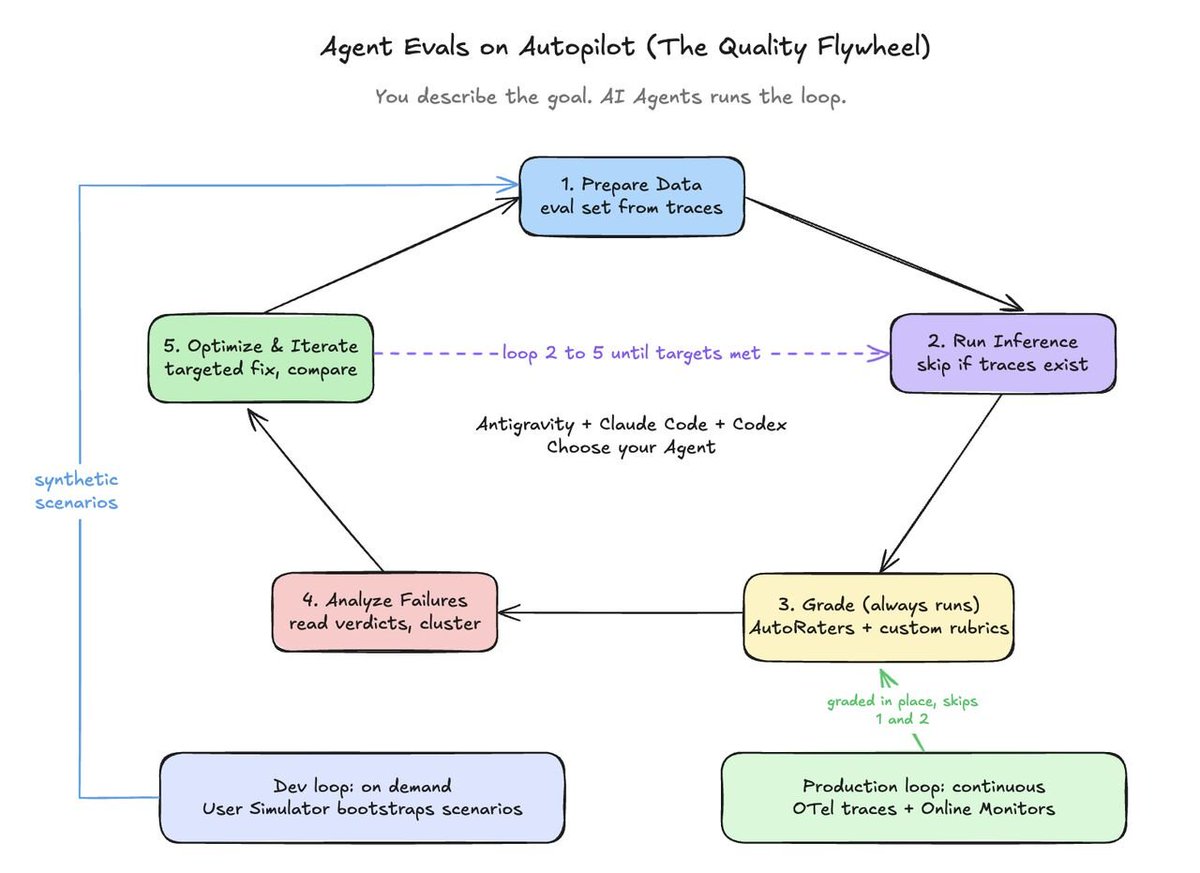
@Saboo_Shubham_ shared (62 likes, 15 replies, 4,010 views, 69 bookmarks) Google's new quality-flywheel skill for coding agents. Google's developer post says the skill turns agent QA into five stages: prepare datasets from traces or synthetic scenarios, run inference, grade with AutoRaters or custom rubrics, analyze failures, and iterate targeted fixes; the same post explicitly says the optimizer never grades its own work.
@gakonst complained (50 likes, 13 replies, 4,084 views, 25 bookmarks) that most agent SDKs are lagging reality and singled out Codex App Server over RPC as the only good open-source pattern. The replies are what make the complaint usable evidence: one respondent argued for separate sandbox, harness, and workflow storage layers, while another said they had migrated from hand-rolled systems to Pi ACP and then Codex App Server because generic SDKs still miss cross-thread and cross-agent communication needs.
@boringmarketer shared (3 likes, 5 replies, 746 views, 6 bookmarks) a kimi-first skill that routes frozen-spec implementation work to Kimi Code CLI while Claude keeps specs, architecture, review, testing, and merge approval. The repo's README makes the doctrine explicit: Kimi gets throughput, Claude keeps judgment, and delegation stops after repeated failures.
@WebStormIDE announced (52 likes, 3 replies, 2,145 views) WebStorm 2026.2, and JetBrains' release post says the IDE now has native GitHub Copilot integration plus an agent skills manager that can carry reusable stack knowledge across projects and even import skills already configured for Claude Code or Codex.
Discussion insight: The Saboo thread added the sharpest caution: practitioners said the proof step still needs human checking because agents can pass evals they effectively authored for themselves. The broader pattern is that people want more structure around delegation, not more generic wrapper code.
Comparison to prior day: On 2026-07-15, the main discipline signals were Spec Kit, MCP tool exposure, and token-compression tricks. On 2026-07-16, the pattern matured into repeatable products and doctrines: explicit grading loops, importable skills, and specialized implementation lanes.
1.3 Agent work is moving into Jira, external compute backends, and even physical controllers (🡕)
A third theme was expansion of the agent control surface. The important shift was not just that agents can be supervised from more places, but that they are now expected to keep working inside workflow tools, dispatch work into remote compute, or be steered through dedicated hardware.
@github announced (162 likes, 14 replies, 37,643 views, 51 bookmarks) that GitHub Copilot for Jira is generally available. GitHub's GA changelog says the release streams agent progress into the Jira issue, supports follow-up instructions in the Jira chat panel on the same draft pull request, and reduces setup friction when connecting GitHub orgs and repos.
@ONcompute announced (16 likes, 9 replies, 1,400 views) an MCP endpoint that lets agents discover compute providers, write algorithms, launch jobs, and manage storage using natural language. The images matter here because they show the intended architecture and a specific Shakespeare example that runs first on a free CPU and then on 8× H200, which turns a vague "agent can use compute" claim into an execution pattern.

@stufflistings posted (25 likes, 9 replies, 2,559 views) that the Codex Micro is a $230 controller for Codex agents. The reviewed photo set is informative rather than decorative: it shows a dedicated device plus a spec sheet listing Bluetooth/USB-C, Mac/Windows support, RGB lighting, 13 mechanical switches, a touch sensor, a rotary encoder, and a planar joystick.

Discussion insight: The Jira thread produced skepticism about ticket spam and auto-generated acceptance criteria, while the Ocean and Codex Micro posts leaned the other way: they sold more explicit control, more execution reach, and less app-switching.
Comparison to prior day: On 2026-07-15, the strongest evidence was about observing agents across Jira, mobile, desktop, and hardware. On 2026-07-16, that same expansion became more operational: Jira keeps the agent in the work item, Ocean pushes the agent into remote compute, and Codex Micro makes agent state into a physical control problem.
2. What Frustrates People
Proving that an agent actually improved is still a manual job
Severity: High. @Saboo_Shubham_ shared (62 likes, 15 replies, 4,010 views, 69 bookmarks) a workflow that promises to find bugs in an agent, fix them, and prove the fix worked, but the replies immediately narrowed the real pain point. One practitioner said the proof step still needs babysitting because an agent that writes or shapes its own evals can still pass them, and another said the sticking point is judging whether the fix was actually right. The Google blog itself reinforces that concern by explicitly separating the optimizer from the evaluator. This is worth building for because the workaround today is still human review of the most critical before/after claims.
Generic wrappers and community plugin glue still feel brittle
Severity: High. @gakonst said (50 likes, 13 replies, 4,084 views, 25 bookmarks) that most agent SDKs "suck," and the replies made the complaint more specific: users want separate sandbox, harness, and workflow-storage layers, plus standard cross-thread and cross-agent communication instead of shallow API wrappers. In a separate compatibility thread, @leerob answered (11 likes, 4 replies, 2,738 views, 5 bookmarks) that Cursor subscriptions can work in open harnesses through ACP or community plugins, but the person asking replied that they were hesitant to install a random npm plugin with subscription access given current npm security worries. The visible coping behavior is to fall back to the vendor CLI or to more opinionated harnesses. This is worth building for because integration convenience is currently in direct tension with trust.
Putting agents into Jira raises an immediate fear of process spam
Severity: Medium. @github announced (162 likes, 14 replies, 37,643 views, 51 bookmarks) that Copilot for Jira can now stream progress and accept follow-up instructions from the Jira chat panel, but the first visible responses were jokes about hallucinated acceptance criteria, auto-generated ticket floods, and AI-written excuses for stalled work. The changelog shows real workflow value, yet the public reaction makes clear that users expect management surfaces to accumulate noise faster than code quality unless the agent output is tightly summarized and constrained. This is worth building for if activity can stay legible instead of multiplying ticket clutter.
"Vibe coding" still reads as gambling when people cannot debug the result
Severity: Medium. @kapilansh_twt argued (24 likes, 24 replies, 349 views) that vibe coding is "just another form of gambling." The replies did not fully disagree; they mostly refined the complaint by saying it becomes gambling when people ship without understanding how to debug failures, or when token spend outruns engineering judgment. That makes the frustration more actionable than a pure anti-AI take. This is worth building for because the workaround people recommend is process discipline, not abandoning the tools.
3. What People Wish Existed
Independent agent grading that teams can trust
The Saboo thread and Google's quality-flywheel post point to a direct practical need: teams want agent improvements to be measurable without the fixer grading its own work. @Saboo_Shubham_ surfaced (62 likes, 15 replies, 4,010 views, 69 bookmarks) the workflow, the Google post says the optimizer and evaluator must stay decoupled, and replies still say the proof step often needs human judgment. The need is not aspirational; it is the missing confidence layer between “the demo looked better” and “production actually improved.” Opportunity: Direct.
One coherent map from flagship model to coding surface to agent infrastructure
Google's threads show demand for a product hierarchy people can actually reason about. @LuminaXspace shared (214 likes, 13 replies, 13,942 views, 24 bookmarks) another Gemini 3.5 Pro rumor burst, @shubham_crazy08 showed (85 likes, 8 replies, 3,570 views, 48 bookmarks) one concrete NotebookLM-plus-Antigravity workflow, and @yourtechgirl24 mapped (22 likes, 16 replies, 23,023 views, 10 bookmarks) the larger Google stack. What is missing is a stable public answer to which surface owns which job, which capabilities are preview versus durable, and how work moves between model, CLI, IDE, async coding tool, and agent framework. Opportunity: Direct.
Reusable skills with explicit permissions and fewer trust leaps
Several posts imply that skills are winning as the unit of agent capability, but not yet as the unit of trust. @gakonst criticized (50 likes, 13 replies, 4,084 views, 25 bookmarks) generic SDKs, @leerob confirmed (11 likes, 4 replies, 2,738 views, 5 bookmarks) that open harnesses can rely on community plugins, and the person asking immediately worried about installing an untrusted npm package with subscription access. At the same time, @WebStormIDE announced (52 likes, 3 replies, 2,145 views) an agent skills manager that treats reusable knowledge as a first-class product surface. The need is for skills that advertise scope, provenance, and access boundaries before they run. Opportunity: Competitive.
Stack planning that connects cost, control, and local alternatives
The visible stack conversations are still manual and anecdotal. @kenn_ronin shared (67 likes, 34 replies, 9,206 views, 18 bookmarks) a $40 monthly mix of Claude Code, ChatGPT, Google AI Pro, Grok Build, and Groq keys, while @comma_ai countered (30 likes, 1 reply, 1,645 views) that banning Anthropic had not hurt their agentic coding because they were using GLM 5.2 plus OpenCode locally. The practical need is a control plane that helps teams choose between paid closed tools, free tiers, and local/open alternatives without reconstructing the tradeoffs from scattered tweets. Opportunity: Competitive.
4. Tools and Methods in Use
| Tool | Category | Sentiment | Strengths | Limitations |
|---|---|---|---|---|
| Google agent-evals skill | Evaluation workflow | (+/-) | Gives a five-stage loop for dataset prep, inference, grading, failure analysis, and iteration across Antigravity, Claude Code, and Codex | Replies say the proof step still needs human judgment because agents can game self-authored evals |
| NotebookLM + Antigravity | Research/orchestration workflow | (+) | Claimed to spin up specialized notebooks, encode custom business skills, build apps from notebook context, and trigger report generation | Evidence is still one practitioner's thread rather than a broadly validated pattern |
| Codex App Server over RPC / Pi ACP | Agent harness / SDK pattern | (+/-) | Practitioners prefer it to generic SDK wrappers because it stays closer to real harness behavior and supports cross-thread or cross-agent work | The surrounding SDK ecosystem is still described as shallow orchestration glue that lags current practice |
| GitHub Copilot for Jira | Workflow integration | (+/-) | Streams agent progress into Jira, supports follow-up instructions on the same draft pull request, and reduces setup friction | Early replies predict ticket spam, AI-written comments, and hallucinated workflow noise |
| WebStorm 2026.2 | IDE | (+) | Ships TypeScript 7 support, native GitHub Copilot, and an agent skills manager that can import Claude Code or Codex skills | Skills still live inside the JetBrains environment, and the manager currently centers on Claude/Codex workflows |
| kimi-first | Multi-agent delegation method | (+) | Keeps Claude on specs, review, tests, and merge approval while routing frozen-spec implementation to Kimi Code CLI | Only applies once the spec is frozen, and the README says delegation stops after repeated failures |
| Tabby | Self-hosted coding assistant | (+) | Offers an on-prem alternative to GitHub Copilot with a self-contained server, OpenAPI interface, repo context, and consumer-GPU support | Teams still have to run their own server, and enterprise features are separately licensed |
| Mixed $40 AI stack | Budget stack method | (+/-) | One builder says Claude Code, ChatGPT, Google AI Pro, Grok, and Groq free tiers are enough to ship | The comparison set is anecdotal, and reply threads show many custom mixes rather than one standard stack |
The tool mix stayed plural and method-heavy. @Saboo_Shubham_ shared (62 likes, 15 replies, 4,010 views, 69 bookmarks) a workflow that explicitly separates grading from fixing, while @gakonst argued (50 likes, 13 replies, 4,084 views, 25 bookmarks) that generic agent SDKs still fail to capture how people actually run multi-threaded agent systems. @WebStormIDE announced (52 likes, 3 replies, 2,145 views) that skill reuse is now an IDE feature, which matches the broader shift from ad hoc prompts toward installable, repeatable operating procedures.
Budget and control conversations were equally visible. @kenn_ronin shared (67 likes, 34 replies, 9,206 views, 18 bookmarks) a $40 monthly stack, @comma_ai countered (30 likes, 1 reply, 1,645 views) that GLM 5.2 plus OpenCode had worked better locally after banning Anthropic, and @DanKornas positioned (7 likes, 2 replies, 966 views) Tabby as the self-hosted answer for teams that want code completion and chat without turning the whole workflow over to a managed assistant.

5. What People Are Building
| Project | Who built it | What it does | Problem it solves | Stack | Stage | Links |
|---|---|---|---|---|---|---|
| GitHub Copilot for Jira | @github | Streams coding-agent progress into Jira issues and lets users send follow-up instructions on the same draft pull request | Keeps ticket context and agent execution in one workflow instead of splitting them across apps | GitHub Copilot, Jira, draft PR workflow, setup/onboarding improvements | Shipped | Tweet · Changelog |
| Ocean MCP endpoint | @ONcompute | Connects agents to compute providers so they can write algorithms, launch jobs, and manage storage in natural language | Extends coding agents beyond code editing into remote compute orchestration | Hosted MCP endpoint, Ocean compute providers, job and storage management | Shipped | Tweet · Endpoint |
| kimi-first | @boringmarketer | Claude Code skill that sends frozen-spec implementation work orders to Kimi Code CLI while Claude keeps review, tests, and merge approval | Splits judgment work from high-throughput code typing | Claude Code, Kimi Code CLI, Fable 5, skill-based delegation | Shipped | Repo · Tweet |
| FlyAI skill | Alibaba FlyAI | Travel-search skill for Claude Code and OpenClaw that returns structured, bookable results from Fliggy | Lets an agent answer real-time travel queries without leaving the terminal | Node.js CLI, FlyAI skill, Fliggy inventory, Claude Code, OpenClaw | Shipped | Repo · Tweet |
| WebStorm 2026.2 agent skills manager | @WebStormIDE | Lets teams install or import reusable agent skills directly inside the IDE | Reduces repeated restating of stack conventions across sessions and projects | WebStorm, TypeScript 7, GitHub Copilot, external skill registries | Shipped | Tweet · Release |
The repeated build pattern was to narrow an agent's lane instead of asking one model to do everything. @boringmarketer shared (3 likes, 5 replies, 746 views, 6 bookmarks) a repo that literally codifies "Kimi types, Claude thinks and verifies," and the README says Claude keeps specs, architecture, review, and merge approval while Kimi only gets frozen-spec implementation work.

@tom_doerr showed (6 likes, 11 bookmarks, 1,558 views) a different pattern: domain-specific skills that make the agent useful beyond software editing. The FlyAI repo says it plugs Claude Code and OpenClaw into Fliggy with eight search commands and direct booking links, which turns an agent session into a structured travel-search interface rather than a browser macro.

The larger product teams were shipping the same idea at broader scope. @github announced (162 likes, 14 replies, 37,643 views, 51 bookmarks) that Copilot now stays inside Jira from progress streaming through post-session steering, @ONcompute announced (16 likes, 9 replies, 3 quotes, 1,400 views) an MCP surface for compute jobs and storage, and @WebStormIDE announced (52 likes, 3 replies, 2,145 views) an IDE-native skills manager. The common trigger is the same one visible elsewhere in the report: teams want agents to work inside an existing surface, with narrower responsibilities and clearer handoffs.
6. New and Notable
Kimi-K3 briefly became the headline model-comparison story
@arena reported (127 likes, 15 replies, 25 quotes, 6,955 views, 8 bookmarks) that Kimi-K3 reached 1,679 points in Frontend Code Arena, ahead of Claude Fable 5 at 1,631 and GPT-5.6 Sol at 1,618. The attached leaderboard made the jump from #18 to #1 concrete, but one of the first substantive replies argued the bar lengths visually overstated a 48-point lead, so the benchmark result and the way it was presented were both part of the story.

Local and open coding stacks got a sharper public defense
@comma_ai argued (30 likes, 1 reply, 1,645 views) that banning Anthropic had not hurt their agentic coding because they were using GLM 5.2 with OpenCode locally. That was a more concrete counterexample than generic open-source cheerleading, especially because it sat alongside @kenn_ronin sharing (67 likes, 34 replies, 9,206 views, 18 bookmarks) a cheap mixed stack and @DanKornas pitching (7 likes, 2 replies, 966 views) a self-hosted Tabby server. The notable shift was not that closed tools disappeared; it was that local and open alternatives were being described as production-usable rather than ideological.
Repository-attack drills are becoming part of agent-era operations
@BradGroux reported (11 likes, 1 reply, 20,281 views) winning GitHub's "Repository Under Attack" workshop and linked a sanitized after-action report. The diagram attached to the post shows a full attack chain through leaked PATs, repository SSH keys, malicious npm publication, workflow-dispatch misuse, and exposed secrets, which gave the day's security discussion a concrete operational shape instead of abstract "AI safety" language.

7. Where the Opportunities Are
[+++] Independent agent grading and approval layers — The strongest pain in the dataset was not missing model power; it was missing trust in whether an agent actually improved. Saboo's agent-evals thread, the Google quality-flywheel writeup, gakonst's harness complaints, and the Jira spam replies all point to the same gap: a separate system that can grade work, expose the real target of an action, and request approval only when the evidence is legible.
[++] Reusable skill registries with provenance and permission metadata — WebStorm's new skills manager, kimi-first, FlyAI, and the Cursor/OpenCode plugin thread all show that skills are becoming the unit of capability. The missing layer is trust: teams want installable skills that declare what they can access, who authored them, and when to stop delegating.
[++] Agent control planes that bridge tickets, compute, and local environments — GitHub Copilot for Jira, the Ocean MCP endpoint, and Tabby's self-hosted pitch show demand for agents that can move between project-management tools, remote compute, and on-prem workflows without losing state or traceability. The opportunity is in the handoff and supervision layer, not just the model.
[+] Budget-aware stack planning for multi-model teams — The $40 stack thread and comma.ai's GLM 5.2 plus OpenCode claim show that teams are already composing paid, free-tier, and local tools manually. A planner that compares cost, control, and task fit across those options would answer an increasingly common operational question.
8. Takeaways
- The clearest technical energy went into making agents measurable and governable. The Google quality-flywheel skill and its discussion centered on independent grading, failure analysis, and human approval rather than on a new autonomy claim. (source)
- Reusable skills are becoming a first-class packaging layer for agent capability. WebStorm shipped an in-IDE skills manager, kimi-first formalized a review-versus-implementation split, and FlyAI turned a travel workflow into an installable agent skill. (source)
- The competitive surface is widening beyond the editor. Jira progress streaming, remote compute via MCP, and Codex-control hardware all show that agent products are now competing on supervision and execution surfaces, not just model output. (source)
- Teams are actively keeping alternatives to single-vendor agent stacks alive. The mixed $40 stack, comma.ai's GLM 5.2 plus OpenCode setup, and Tabby's self-hosted pitch show that cost control and local ownership are part of the coding-agent conversation, not side topics. (source)