Twitter AI Coding - 2026-07-21
1. What People Are Talking About
1.1 Google's stack stayed central, but the discussion moved from launch hype to bundle economics and trust (🡒)
Google remained the center of gravity in AI-coding talk, but the conversation matured a notch. Instead of only celebrating Antigravity as a new coding agent, people were now spelling out exact NotebookLM workflows, tallying what a full Google bundle costs, and checking whether Antigravity has enough quality and product surface to earn real trust. The result was a split narrative: high curiosity, but no clean consensus that Google's stack is already a Codex-class default.
@shubham_crazy08 argued (260 likes, 9 replies, 19,692 views, 302 bookmarks) that NotebookLM plus Antigravity can run deep-research agents, codify business-specific skills, build context-aware dashboards, auto-generate reports, and even pipe Python-processed data into notebooks. The distinctive claim was not just faster coding; it was that NotebookLM becomes the grounded knowledge layer and Antigravity becomes the execution layer.
@ice_bearcute framed (82 likes, 52 replies, 1,132 views) Google AI Pro as a $20 bundle that includes Gemini, Nano Banana, Veo/Flow, Antigravity, Jules, NotebookLM, Chrome auto-browse, and 5TB of storage. That pricing post matters because it shifts the competition from one model against another into which vendor now offers the most usable all-in stack.
@Presidentlin pointed (8 likes, 541 views) to an updated Antigravity changelog page exposing separate Antigravity 2.0, CLI, SDK, and IDE surfaces. Even with low engagement, that screenshot is useful evidence that Google is packaging Antigravity as a broader platform surface rather than a single product demo.
@kapilansh_twt countered (77 likes, 66 replies, 3,172 views) that Antigravity still feels like a "poor man's Codex." The reply volume mattered more than the insult itself: the skeptical side kept returning to trust, execution quality, and whether free access means anything if the output still needs heavy hand-holding.
Discussion insight: The skepticism was concrete, not tribal. Even defenders and critics alike kept comparing Antigravity against task completion quality, debugging stamina, and whether it can hold enough context to be useful beyond the first impressive demo.
Comparison to prior day: July 20 made Antigravity the headline. July 21 kept it there, but widened the lens to bundle pricing, product-surface expansion, and sharper trust questions.
1.2 Verification, review, and context scaffolding kept hardening into the default answer to agent slop (🡕)
The strongest practical shift was away from raw prompting and toward systems that make agent work checkable. Posts about proof tooling, learning roadmaps, review separation, MCP-backed context, and PRD-to-task decomposition all pointed to the same conclusion: people increasingly assume models will drift unless a surrounding workflow constrains them.
@_chenglou introduced (207 likes, 7 replies, 13,443 views, 164 bookmarks) Freerange as a zero-API tool that deduces numerical ranges statically so TS layouts can be proven to respect sizing constraints, avoid NaNs and Infinity, and keep array indices in bounds. In replies, he added concrete examples such as division-by-zero progress bars, mobile-layout clashes, and a claim that Freerange found 12 bugs in Midjourney's codebase on its first day.
@iammukeshm argued (31 likes, 3 replies, 721 views, 18 bookmarks) that AI helps most when the developer already knows what good looks like. His attached .NET roadmap made that operational: fundamentals, data access, APIs, authentication, testing, DevOps, and only then AI-driven development as an accelerator rather than a substitute for judgment.

@Cris_DVM showed (1 like, 3 replies, 33 views) one of the clearest review patterns in the dataset: Claude Code implements, Codex from a separate vendor reviews diffs from its own clone, git stays the review channel, and the human adjudicates. That post is low reach, but it is unusually explicit about process boundaries.
@HashiCorp said (3 likes, 1 reply, 1,038 views) Terraform MCP works by giving coding agents live access to Registry docs, provider docs, modules, and policies so they hallucinate less. @DanKornas added (526 views) that Taskmaster turns a PRD into ordered, inspectable work through generated tasks, dependencies, and MCP/CLI access.
Discussion insight: The recurring answer to bad output was almost never "use a better model." It was "change the loop": prove more, split creator from reviewer, add live docs, or force the work into tasks that can be checked.
Comparison to prior day: July 19 and July 20 already elevated specs, skills, and loops. July 21 pushed that one step further into practical artifacts: static proof tools, explicit reviewer separation, MCP context injection, and task-decomposition systems.
1.3 Open-weight pressure and multi-provider harnesses moved from theory into product decisions (🡕)
A third major theme was how quickly model choice is becoming fluid. The conversation no longer treated routing as an enthusiast trick; it treated cheap switching, open-weight pressure, and provider flexibility as the natural direction of the market. At the same time, several posts reminded readers that this is still an early market with a much smaller user base than Twitter discourse implies.
@EnoReyes argued (80 likes, 10 replies, 6,532 views, 54 bookmarks) that models are becoming liquid, switching costs are near zero, and the durable value is shifting toward apps and infrastructure. Replies sharpened that thesis rather than merely agreeing: one said half his feed was already dropping Kimi K3 into Claude Code with zero code change, while another said workflow memory is becoming the real switching cost.
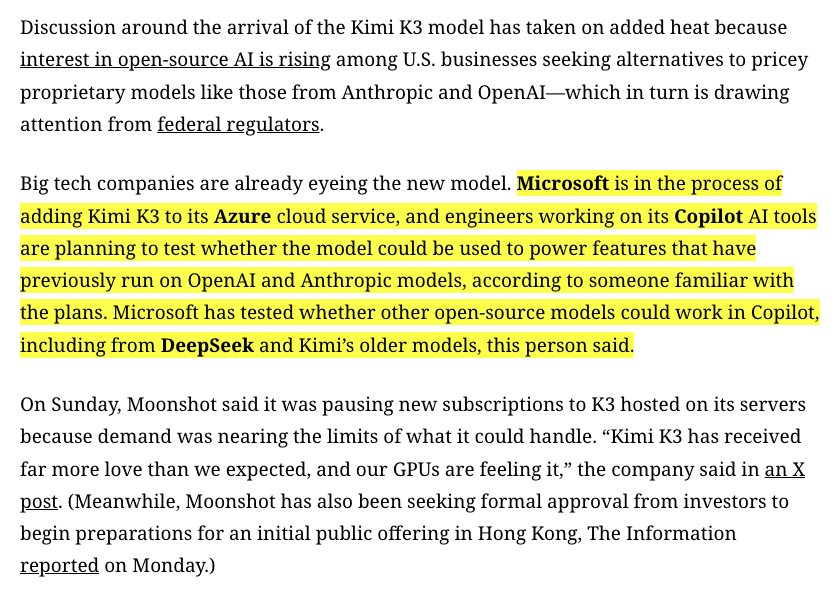
@EntelligenceAI reported (12 likes, 5 replies, 613 views) that Microsoft engineers are evaluating Kimi K3 for Copilot workloads, while a quoted article excerpt said Azure is also part of the story. @arrakis_ai reported (13 likes, 4 replies, 1,280 views, 8 bookmarks) that OpenCodex makes the Codex harness universal across providers, and the public open-codex repo confirms support for OpenAI, Gemini, OpenRouter, and Ollama.

@rohanpaul_ai summarized (8 likes, 1,835 views) linked evidence that open-weight models now trail frontier systems by only 4 to 7 months on long-horizon cyber ranges, while Kimi K3 is strong enough to create both cost pressure and compute shortages. @okaythenfuture added (323 views) a regulatory wrinkle: China may keep overseas service access open while tightening the release or transfer of model weights.
Discussion insight: The economic and political layers are now intertwined. Developers are thinking about lower-cost open weights and easier routing, but they are also watching which models can actually ship inside products such as Copilot, Azure, and other enterprise surfaces.
Comparison to prior day: July 20 made routing and harness choice feel like an emerging workflow. July 21 made it feel like a product and procurement issue: enterprise adoption, open-weight economics, and geopolitical constraints all entered the same conversation.
2. What Frustrates People
Free or cheap agent access does not matter if output quality still feels fragile
Severity: High. The clearest version came from @kapilansh_twt calling (77 likes, 66 replies, 3,172 views) Antigravity a "poor man's Codex," which turned a product critique into a trust critique. The low-budget counterpoint from @ice_bearcute showed (82 likes, 52 replies, 1,132 views) why this frustration matters: people are willing to test aggressively priced bundles, but they still judge the stack on whether it finishes work well.

@VedikaAPI complained (21 views) that Codex runs were taking 8 to 30 hours and producing "mostly slop," even after handing over tracker and memory context, while Claude handled the same kind of work faster. @0x_kaize warned (13 likes, 411 views) that popular token-saving tweaks such as disabling subagent spawning and capping tool output at 8KB can save tokens only by amputating useful orchestration and forcing retries. This is worth building for because the pain is not price alone; it is the feeling that cheap access often arrives with unstable quality or brittle tradeoffs.
Agents still need explicit context, review lanes, and technical judgment to stay trustworthy
Severity: High. The complaint is visible in the solutions people are building around it. @HashiCorp said (1 reply, 1,038 views) that coding assistants are only as good as the context they have, then positioned Terraform MCP as the fix for hallucinated infrastructure code. @_chenglou showed (207 likes, 7 replies, 13,443 views, 164 bookmarks) Freerange catching layout and bounds bugs that ordinary agent output misses, while @iammukeshm argued (31 likes, 721 views, 18 bookmarks) that AI only pays off when the developer can recognize broken validation, auth, and architecture.
@Cris_DVM answered (3 replies, 33 views) with a human-adjudicated two-model review loop, and @DanKornas pointed (526 views) to Taskmaster as a way to force PRDs into ordered tasks before an agent starts coding. This is worth building for because the frustration is structural: people keep inventing scaffolding layers because they do not trust raw agent output to stay aligned on its own.
Visible AI slop now creates a reputational cost, not just a code-quality cost
Severity: Medium. @ghostiesdagger complained (259 views, 4 bookmarks) that the poster could not browse a fandom tag without hitting obvious AI writing and "vibe-coding" fingerprints. The attached evidence focused on overly polished, repetitive prose patterns rather than a coding bug, which is exactly why it matters: bad AI output is now being noticed as a style problem in public-facing work, not only as a technical one.

That backlash sits uncomfortably beside the growth posts celebrating ever-faster output. It is worth building for because reputation-preserving review, editing, and provenance layers now matter for anyone shipping AI-generated code, content, or interfaces into public view.
3. What People Wish Existed
Memory that compounds instead of resetting every session
This was a practical need, not an abstract one. @undefinedKi described (13 likes, 6 replies, 133 views, 5 bookmarks) an Obsidian-based repo memory that audits duplicates, stale dependencies, and unused tools every 12 hours so Claude Code stops forgetting why repos matter. In the same lane, @habibicode shared (13 views) codekeel, which keeps a decision ledger, injects architectural choices into future Claude Code sessions, and can enforce them semantically.
@Cris_DVM showed (3 replies, 33 views) that even his human-reviewed dual-model setup depends on an Obsidian vault that both AIs read. The need is Direct: people do not want more chat history, they want persistent project memory and durable decisions that survive tool and session boundaries.
Autonomy that stays inside explicit bounds
This need showed up as a safety and governance problem. @realjohnny5i shared (25 views) TaskFence AI, and its public project page makes the motivation explicit: the user sets a machine-checkable fence around money, scope, merchant, deadline, and action limits, while the agent can propose but cannot authorize itself. @DanKornas pointed (526 views) to Taskmaster as the same instinct one layer earlier in the stack: constrain the work by turning a PRD into ordered tasks before the agent starts editing.
@HashiCorp added (1 reply, 1,038 views) that even infrastructure code needs grounded context, not just a stronger model. The opportunity is Direct because the evidence points toward control planes, approval rails, and policy enforcement rather than demand for another general-purpose chat box.
Cheap model switching inside the same workflow
This was one of the clearest practical wishes in the dataset. @EnoReyes argued (80 likes, 10 replies, 6,532 views, 54 bookmarks) that models are liquid and buyers of intelligence gain leverage as margins compress. @arrakis_ai reported (13 likes, 4 replies, 1,280 views, 8 bookmarks) that OpenCodex lets one Codex-style harness swap across providers by task, while @MetisL2 showed (7 likes, 2,079 views) how to reuse a ChatGPT subscription inside ClawUp agents.
The lower-budget Google angle pointed the same way: @ice_bearcute framed (82 likes, 52 replies, 1,132 views) Google Pro as one payment for many agent surfaces. Opportunity: Competitive. The need is not for one permanent winner; it is for a stable harness that can route across whichever models are cheapest, fastest, or best for a given task.
4. Tools and Methods in Use
| Tool | Category | Sentiment | Strengths | Limitations |
|---|---|---|---|---|
| Google Antigravity / NotebookLM | Agent platform | (+/-) | Turns research notebooks into execution workflows; broad Google bundle; growing CLI/SDK/IDE surface | Quality skepticism remains strong; trust still lags hype in many replies |
| Claude Code | Agent CLI | (+/-) | Strong terminal workflow, reusable playbooks, human-review lanes, and domain-specific operator packs | Still depends heavily on context, review discipline, and external memory/governance layers |
| OpenCodex / open-codex | Multi-provider coding harness | (+) | Keeps a Codex-style terminal workflow while switching among OpenAI, Gemini, OpenRouter, and Ollama | Community fork under active development; stability and safety still depend on operator choices |
| GitHub Copilot | Agent platform | (+/-) | Still appears in learning roadmaps and frontend workflows; central to the new GH-600 role framing | Current chatter still asks for clearer benchmark evidence versus Claude Code, Cursor, and Codex |
| Kimi K3 | Open-weight coding model | (+/-) | Strong cost-performance chatter; already being discussed for Azure/Copilot use cases | Regulatory uncertainty and supply constraints remain active questions |
| Taskmaster | Task orchestration | (+) | Parses PRDs into ordered tasks with dependencies and MCP/CLI access | Requires up-front structuring and another layer of workflow discipline |
| codekeel | Memory / governance | (+) | Decision ledger, semantic enforcement, and multi-session continuity without a hosted service | Early-stage footprint in the public conversation is still small |
| Terraform MCP Server | MCP / domain context | (+) | Adds live docs, modules, and policy context to reduce infrastructure hallucinations | Narrowly focused on Terraform and adjacent infra workflows |
| ClawUp | Agent platform / subscription relay | (+/-) | Reuses an existing ChatGPT subscription across agent workflows and avoids separate token fees | Setup depends on credential reuse and offloads costs to compute/storage |
| Octen AI Search | Agent infrastructure | (+) | Much lower published latency for agent search loops; lower quoted per-call cost | Evidence is still benchmark-first rather than broad production adoption |

The satisfaction spectrum was widest where tools added structure around models instead of asking a model to do everything raw. @G38Suzy mapped (73 views) a frontend stack where AI coding sits inside design, review, verification, deployment, and observability stages rather than replacing them. @MarcelVelica published (125 views) 32 Claude Code workflow tips, while @shushant_l packaged (459 views) Codex as a full build-debug-test-review-deploy agent and also packaged (14 likes, 706 views, 6 bookmarks) vibe coding into a guided loop with security checks and anti-drift rules.
The workaround market was just as visible as the model market. @CDGalpha highlighted (15 likes, 172 views) LibreChat, HyperFrames, and Open Generative AI as self-hosted or lower-cost alternatives to paid tool bundles, while @MetisL2 showed (7 likes, 2,079 views) how people are routing existing subscriptions into new agent surfaces. @ashen_one added (3 likes, 681 views, 3 bookmarks) a search-infrastructure angle with Octen's low-latency benchmark for agent loops. The visible migration pattern was not from one model to one new winner; it was toward layered workflows with routing, memory, verification, and explicit task structure.
5. What People Are Building
| Project | Who built it | What it does | Problem it solves | Stack | Stage | Links |
|---|---|---|---|---|---|---|
| Freerange | @_chenglou | Statically deduces numerical ranges so UI code can be proven to avoid layout, bounds, and Infinity/NaN failures | Catches agent-missed UI and numeric bugs before runtime | Zero-API static analysis for TypeScript-style layouts; exact implementation stack not publicly documented | Alpha | Tweet |
| Taskmaster | Eyal Toledano / RalphEcom | Turns PRDs into ordered, dependency-aware tasks for AI-driven development | Gives agents a structured execution plan instead of a raw requirement blob | MCP server, CLI, PRD parsing, task expansion, dependencies, tags | Shipped | Repo · Tweet |
| codekeel | HabibiCodeCH | Adds a decision ledger and enforcement layer to Claude Code sessions | Reduces context drift and contradictory architectural decisions across sessions | Local CLI, hooks, slash commands, YAML ledger, optional semantic checks via Anthropic API | Shipped | Repo · Tweet |
| TaskFence AI | @realjohnny5i | Enforcement gateway that lets an agent propose actions while a policy layer approves or blocks them | Keeps useful agents from exceeding user-defined spending, scope, merchant, and action limits | TypeScript monorepo, Bun, Next.js, Vercel, Cloudflare, Docker, SQLite authority ledger, Stripe test mode, n8n | Beta | Devpost · Tweet |
| open-codex | ymichael and open-source contributors | Extends a Codex-style terminal harness across multiple providers | Lets one workflow swap between OpenAI, Gemini, OpenRouter, and Ollama instead of retooling per model | Node CLI, sandboxed terminal agent, multimodal input, multi-provider chat-completions backend | Beta | Repo · Tweet |
| GreaterMalaysia + pengu.fun | @AaronTeng | Ships narrow live products ranging from Malaysian public-data utilities to a real-time token-holder map | Lets a solo founder validate and ship real utility products without a dev team | AI-assisted web apps; exact implementation stack not stated publicly | Shipped | GreaterMalaysia · pengu.fun · Tweet |
| Claude Fable 5 Meta Ads System | @HamptonAc_ | Connects Claude Fable 5 to Meta Ads MCP for campaign diagnosis, build, optimization, and scale decisions | Replaces manual media-buyer workflow with a repeatable AI operator pack | Claude Fable 5, Meta Ads MCP, prompts, skills, playbook, copy-paste setup | Shipped | Tweet |

Freerange stands out because it pushes directly against one of the biggest failure modes in vibe coding: mathematically plausible-looking UI code that is still wrong. No public repo surfaced during enrichment, so the public evidence is still the tweet thread itself, but the examples are concrete enough to matter.
TaskFence AI and codekeel show the same build pattern in two different layers. TaskFence fences what an agent may do in the outside world, while codekeel fences what an agent may decide inside a codebase. The repeated pain underneath both is not "how do I get more output," but "how do I stop useful output from drifting past my boundaries?"

GreaterMalaysia and pengu.fun show the opposite pattern: the fastest visible builder wins were narrow, live, and concrete rather than grand platforms. Aaron Teng's claim that a 2am idea could be live by 7am for all 16 Malaysian states is a strong signal that AI coding is already changing the economics of small utility products.
6. New and Notable
GitHub's GH-600 role framing is turning agent operations into a credentialed discipline
@cyrilXBT reported (69 likes, 18 replies, 6,610 views, 21 bookmarks) that GitHub has a beta certification for an "Agentic AI Developer." The attached credential screenshot matters more than the marketing copy around it because it defines the job as deploying, operating, integrating, and governing AI agents inside production SDLC workflows.

Replies added an important caution: several people argued that the role is early and that the real work is still writing exit conditions, catching tool errors, and supervising unstable pipelines. Even so, the credential itself is a notable sign that agent operations are being named and packaged as a formal role.
Anthropic's free course wave is turning AI-coding education into a structured catalog
@david_marco45 shared (3 likes, 4 replies, 111 views) an infographic of free Anthropic courses spanning Claude Code, Claude API, MCP, and AI fluency. The public Claude 101 page confirms that at least part of this curriculum is real, structured, and certificate-backed.

This is notable not because any one course is dominant today, but because the learning surface is broadening from one-off tutorials into a catalog that covers coding workflows, APIs, protocol tooling, and role-based fluency.
Codex Micro made the hardware edge of coding agents tangible
@kimocode argued (4 likes, 223 views) that OpenAI's $230 Codex Micro macropad should be read as an interface artifact rather than a gimmick. Whether or not that thesis holds, the image made one thing concrete: coding-agent workflows are now being explored at the hardware boundary too.

Claude Code is also leaking into debugging and investigation workflows
@n15647931 reported (13 views) using "Cowboy Claude Code" while investigating an exposed Redis database. The reach was tiny, but the screenshot is notable because it shows Claude Code being used in a live inspection workflow rather than a normal feature-building loop.

7. Where the Opportunities Are
[+++] Memory, governance, and review control planes for agent work — Freerange, Taskmaster, codekeel, TaskFence AI, Terraform MCP, and Cris_DVM's split creator-reviewer loop all address the same gap: useful agents still need explicit memory, policy, context, and review boundaries. This is the strongest opportunity because it shows up in core-topic discussion, frustration posts, and builder activity at the same time.
[+++] Cross-provider harnesses with cost and context telemetry — EnoReyes' "models are liquid" thesis, the Kimi K3 / Copilot chatter, OpenCodex, ClawUp subscription reuse, Google's bundle pricing, and Octen's latency claims all point in one direction: buyers want a stable workflow that can swap models underneath it. The winning layer is likely the control surface that makes cost, latency, policy, and memory consequences legible.
[++] Production hardening for AI-built apps and workflows — The .NET roadmap, HashiCorp's MCP framing, the vibe-coding security checklist, and Aaron Teng's live microproducts all show that shipping faster is no longer the only problem. There is room for tools that verify, test, secure, deploy, observe, and repair AI-built outputs after the first draft exists.
[+] Curriculum, certification, and onboarding for agent operators — GH-600 and Anthropic's course catalog show that education around agent operations is becoming productizable. The market signal is still early, but the role is clearly being named, taught, and packaged.
8. Takeaways
- Google kept attention, but not unquestioned trust. NotebookLM plus Antigravity drew the day's strongest workflow hype, yet the same conversation contained a high-reply backlash that treated Antigravity as unfinished relative to Codex. (source 1, source 2)
- The practical answer to AI-coding failure is more structure around the model, not more faith in the model. Freerange, Terraform MCP, Taskmaster, and split implementer-reviewer loops all exist because people want proof, context, and explicit review channels before they trust output. (source 1, source 2, source 3)
- Model choice is rapidly becoming a harness and procurement problem. OpenCodex, Kimi K3 for Copilot chatter, and EnoReyes' liquidity thesis all point to a market where developers expect to swap models without rewriting the rest of their workflow. (source 1, source 2, source 3)
- The most convincing builder activity is happening in narrow control layers and narrow utility products. TaskFence AI, codekeel, Taskmaster, and Aaron Teng's micro-sites all solve bounded, specific problems rather than promising a universal autonomous engineer. (source 1, source 2, source 3)
- The agent-operator role is being formalized before the market is fully mature. GH-600 and Anthropic's free course catalog show real movement toward credentials and curriculum, even while adoption stats still suggest coding-agent users are a small minority relative to general AI users. (source 1, source 2, source 3)