Twitter AI Coding - 2026-08-03
1. What People Are Talking About
1.1 Open-weight frontier models got interesting again because Qwen paired price, benchmarks, and resumable loops (🡕)
The clearest spike in today's dataset was Qwen3.8-Max. Multiple posts treated it as more than another benchmark drop: the signal came from the combination of open weights next week, explicit $2/$6 per million token pricing, and long-horizon autonomous-coding claims that people could translate into their own agent workflows. At least four high-signal items reinforced the same theme, with the derivative discussion focusing on checkpointed execution rather than on parameter count alone.
@Alibaba_Qwen announced (1,461 likes, 124 replies, 53,679 views, 250 bookmarks) Qwen3.8-Max as a 2.4T-parameter model with 10+ days of autonomous coding, 500+ turn chip-design optimization, and open weights for both Qwen3.8-Max and Qwen3.8-27B coming next week. The attached benchmark chart made the post materially stronger than a normal launch thread: it showed Qwen3.8-Max at 86.6 on TerminalBench 2.1 and 93.0 on PaperBench, alongside scores across SWE-Pro, FrontierSWE, CoWorkBench, and OSWorld-Verified. The tweet also made price part of the pitch by listing $2 input and $6 output per million tokens.

@codeglitch argued (2 likes, 2 replies, 122 views) that the reusable part of the Qwen announcement was the checkpoint structure around a long coding task, not the model size. The attached slide reduced the loop to issue -> change -> check -> state and explicitly mapped it to a Claude Code style handoff with DONE, NEXT, or BLOCKED, which turned a vendor demo into a concrete workflow suggestion.

Discussion insight: The official Qwen reply thread mostly expanded the evidence set with separate LM, VL, and 16-day coding follow-ups, but the strongest community response shifted to inspectability. The useful part people kept extracting was how to break a marathon run into small verified states.
Comparison to prior day: August 2 was dominated by gateways, free tiers, and routing layers. August 3 pushed the model layer back to the front because Qwen arrived with open-weight timing, explicit price, and workflow-ready artifacts.
1.2 Codex posts moved from "write code" to "run product and documentation workflows" (🡕)
Today's most important Codex posts were about operational work, not about coding benchmarks. The pattern repeated across product management, ad operations, documentation, and app scaffolding: users were treating Codex as a worker that can run a bounded business process and stop at approval points, rather than as an autocomplete surface.
@thsottiaux claimed (1,639 likes, 338 replies, 181,614 views, 115 bookmarks) you can "codex a PR into existence and ship an improvement to 1B users" after quoting a small OpenAI pull request. The replies made the useful counterpoint: multiple users pushed back with complaints about compressed-chat/image bugs, heavy credit burn, and Pro 5x quotas that do not last a full day, so the headline capability came bundled with real operator cost and reliability limits.
@gdb boosted (320 likes, 44 replies, 48,509 views, 172 bookmarks) a Codex skill that turns support tickets, interviews, surveys, and churn notes into an evidence-backed roadmap. The quoted tweet separated raw customer statements, underlying problems, what to validate next, and what can honestly be claimed, while replies immediately stressed the hard part: not clustering complaints, but deciding whether the loudest customers are also the most strategic ones. @gdb also highlighted (84 likes, 12 replies, 11,338 views, 32 bookmarks) a second workflow where Codex cut and published an ad campaign, built the audience, set the budget, and stopped at the payment step for approval.
@github reported (115 likes, 13 replies, 26,637 views, 70 bookmarks) the most concrete measured example: the Aspire team used GitHub Agentic Workflows to create 82 cross-repo docs pull requests, all 82 merged, with a 44.8-hour median time to merge. The linked article added the missing mechanics: draft-only PRs, scoped GitHub App permissions, safe outputs, and SME review instead of autonomous merge. @waynesutton added (26 likes, 2 replies, 2,139 views, 16 bookmarks) a smaller but similar pattern with a reusable Codex Sites + Convex skill that explicitly keeps frontend publishing and backend state management from bleeding into each other.
Discussion insight: The most substantive disagreement was not about whether these workflows are impressive. It was about control: gdb replies asked how a roadmap skill should weight loud feedback versus strategic value, GitHub replies singled out human review as the decisive guardrail, and the flagship Codex success thread turned into quota and bug complaints almost immediately.
Comparison to prior day: August 2 talked about the harness abstractly. August 3 attached that harness to measurable outputs like docs PR merge time, approval gates, and reusable business workflows.
1.3 Skills, harnesses, and orchestration surfaces kept turning into installable products (🡒)
The harness story did not disappear after August 2. It got more packaged. Today's posts showed skills as a product category, harness selection as an architecture choice, and orchestration and review tools as a visible repo cluster rather than a hidden implementation detail.
@FlowAltDelete argued (30 likes, 2 replies, 2,383 views, 24 bookmarks) that Copilot Studio now forces makers to choose a harness: Standard for structured conversations or GitHub Copilot for long-horizon business processes. The quoted Microsoft announcement and replies made the constraints concrete: GitHub Copilot harness work consumes Copilot Credits, the choice is not transferable later, and missing billing guardrails are already a concern.
@about_hiroppy surfaced (10 likes, 1,253 views, 5 bookmarks) Microsoft's Skill Recorder, whose repo says a recorded screen session can be turned into a reusable Skill or Automation through GitHub Copilot CLI. @AIatAMD introduced (55 likes, 3 replies, 2,105 views, 12 bookmarks) AMD Skills as an installable skill catalog for Cursor, Claude Code, Codex, and Gemini CLI, and @tom_doerr pointed to (1 like, 1,028 views) mimeographs, a repo of 80 persona-style agent skills built from SKILL.md and AGENTS.md files.
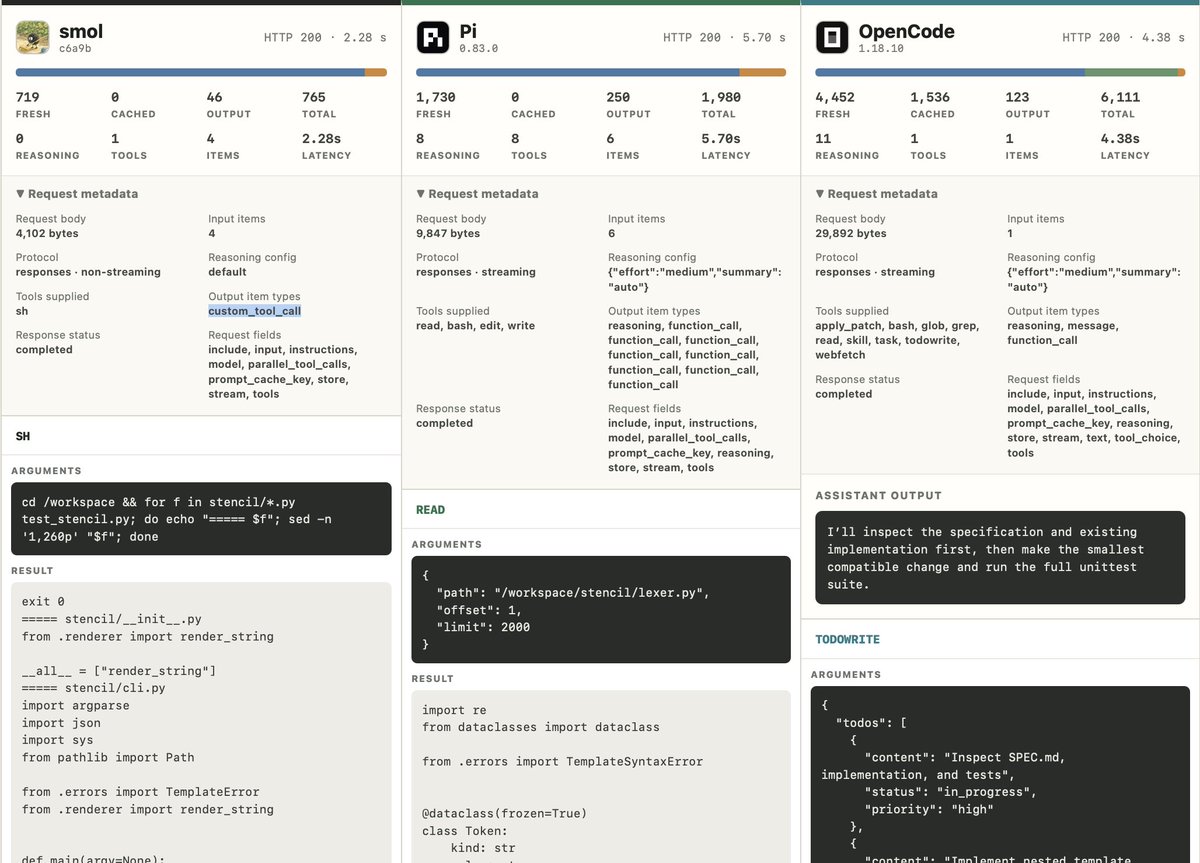
@DivyanshT91162 rounded up (109 views) the repo side of the same trend: mattpocock/skills, OmniRoute, Orca, and Alibaba's open-code-review all appeared in one trending list, with fetched repo metadata showing 201,741, 38,881, 36,743, and 18,493 GitHub stars respectively. @akshay_pachaar added (22 likes, 7 replies, 2,106 views, 25 bookmarks) a framework-side version with NOOA, arguing that agents should look like Python classes instead of a pile of prompts, schemas, and callbacks. @__tosh showed (45 views) what those surface differences look like in practice by comparing how smol, Pi, and OpenCode read the same eight Python files.
Discussion insight: The replies were mostly about operability, not raw model quality. NOOA replies praised getting rid of "50 different yaml files" but worried about inheritance and scale; the trending-repo reply that got traction said installation and marketplace distribution matter more than simply having more tools.
Comparison to prior day: August 2 mapped the harness stack conceptually. August 3 pushed the same stack into skill marketplaces, workflow recorders, repo roundups, and framework abstractions that people can actually install.
1.4 Trust and safety complaints stopped sounding theoretical (🡕)
The verification theme from earlier in the week turned concrete today. Instead of abstract arguments about separate verifier layers, the dataset had runtime control products, blocked security workflows, and one direct data-loss complaint. The trust problem is now showing up as both a product category and a support burden.
@_ar9av presented (19 likes, 7 replies, 576 views) Prismor as a runtime control plane that blocks destructive commands, secret exfiltration, and prompt injection across Claude Code, Codex, Copilot, and framework SDKs. The repo README aligned with the tweet on observe mode, HITL approvals, and an MCP gateway, while replies immediately asked about false positives, rollback semantics, and who maintains policies as repos change.
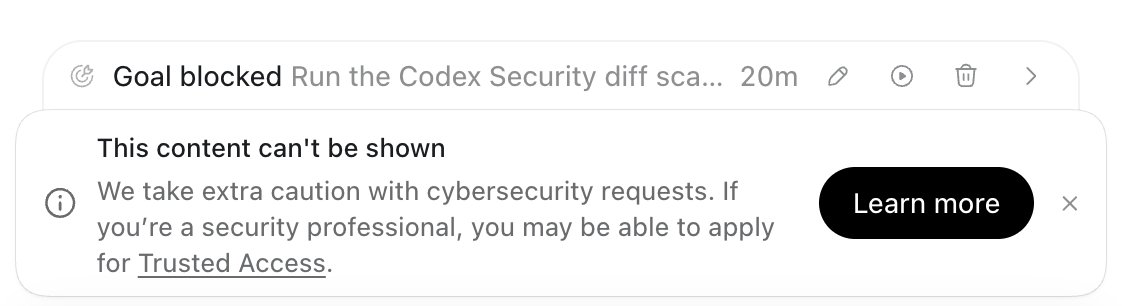
@paulbrigner reported (163 views) a failure from the other direction: Codex Security refused to scan his own diff and displayed a Trusted Access message instead of running the protective check. @zero_dovel reported (3 replies) a much harsher outcome, saying an Antigravity command left a Windows machine essentially empty; the photo showed an almost blank user directory, though the post remained a one-sided complaint at the time of capture. @stas_sorokin_ argued (82 views) that the difference between vibe coding and agentic engineering is verification before trust, not raw model intelligence.
Discussion insight: The Prismor replies captured the tension well. People want one policy layer across MCP servers and tool calls, but they also expect proof that the layer will not flag legitimate shell work or trap agents in unusable approval loops.
Comparison to prior day: August 2 emphasized verification as a design principle. August 3 added blocked scans, runtime policy products, and a concrete data-loss complaint, making the trust gap harder to dismiss.
2. What Frustrates People
Safety boundaries are failing in both directions
Severity: High. @paulbrigner reported (163 views) that Codex Security refused to scan his own diff and showed a Trusted Access message instead of running the protective check. @zero_dovel reported (3 replies) that an Antigravity command left a Windows machine essentially empty, and the attached photo showed an almost blank user directory, even though the complaint remained one-sided at capture time. @_ar9av pitched (19 likes, 7 replies, 576 views) Prismor for exactly this failure band: destructive commands, secret leaks, prompt injection, and approval gates around risky tool calls. The linked AISLE disclosure added external proof that these fears are not hypothetical by documenting a one-click RCE path in Cursor, VS Code, and Google Antigravity via malicious commit-message links. The visible coping behavior today was to add explicit policy layers or rethink which tasks should stay on closed hosted surfaces. Worth building for: yes.
Quota cliffs and model lock-in still shape day-to-day tool choice
Severity: High. The replies under @thsottiaux writing about Codex (1,639 likes, 338 replies, 181,614 views, 115 bookmarks) turned into a stream of complaints about compressed-chat and image bugs, heavy credit burn, and Pro 5x quotas that "cannot support a full day." @JustMicrock complained (8 likes, 4 replies, 374 views) that OpenAI remains the daily default because competitors pause subscriptions, lack comparable limits, or restrict where their models can be used, including Google's OAuth restrictions outside Antigravity CLI. @FReza1984 framed (93 views) OmniRoute as infrastructure for the same problem, arguing that provider churn, free-tier exhaustion, and changing model economics make routing more practical than loyalty. The coping pattern is clear in the posts themselves: route across providers, hunt cheaper or free models in surfaces like OpenCode, and save premium access for the jobs that truly need it. Worth building for: yes.
Existing agent surfaces still make simple tasks look too different
Severity: Medium. @__tosh showed (45 views) three agents reading the same eight Python files with very different tool-call shapes, token counts, and latency profiles. @0xQuantic summarized (14 likes, 4 replies, 656 views) the same friction from the operator side: Hermes + Codex feels simplest, Claude Code helps on specific tasks, cloud agents look promising mainly for software work, and local models still disappoint on ordinary hardware. @akshay_pachaar highlighted (22 likes, 7 replies, 2,106 views, 25 bookmarks) NOOA largely as an escape from prompt files, tool schemas, callbacks, and workflow graphs. The workaround today is to narrow the stack to one pairing or one framework that feels predictable rather than trusting the whole category. Worth building for: yes.
3. What People Wish Existed
A trust layer that can inspect risky code without blocking legitimate defensive work
Practical need. The strongest evidence is the contrast between @_ar9av selling (19 likes, 7 replies, 576 views) a runtime control plane and @paulbrigner failing (163 views) to get Codex Security to scan his own diff. The AISLE disclosure and the Antigravity data-loss complaint show why people want approvals, deny rules, and audit trails, but the blocked scan shows they do not want those controls to disable legitimate self-protection. Opportunity: direct.
Portable skill packs and workflow capture that survive tool switching
Practical need. Skill Recorder, AMD Skills, mimeographs, and mattpocock/skills all assume that reusable agent behavior should be installable, shareable, and cross-tool rather than trapped inside one chat or one demo. The most useful reply under the repo-roundup post said the key feature is not having more tools, but having skills that can actually be installed through a marketplace or command. Opportunity: direct.
Open, cheaper model access outside any vendor's home turf
Practical need. @Alibaba_Qwen put (1,461 likes, 124 replies, 53,679 views, 250 bookmarks) explicit low pricing and open-weight timing on the table, @JustMicrock described (8 likes, 4 replies, 374 views) OpenAI as a de facto default because rivals are paused, weaker, or blocked by platform rules, and @FReza1984 framed (93 views) OmniRoute as the practical answer when quotas, providers, and price-performance rankings keep shifting. @yacineMTB added (74 likes, 7 replies, 3,657 views) the surface-level version of the same need by celebrating a new free model appearing inside OpenCode's dropdown. Opportunity: direct.
Remote supervision that works from the devices people already carry
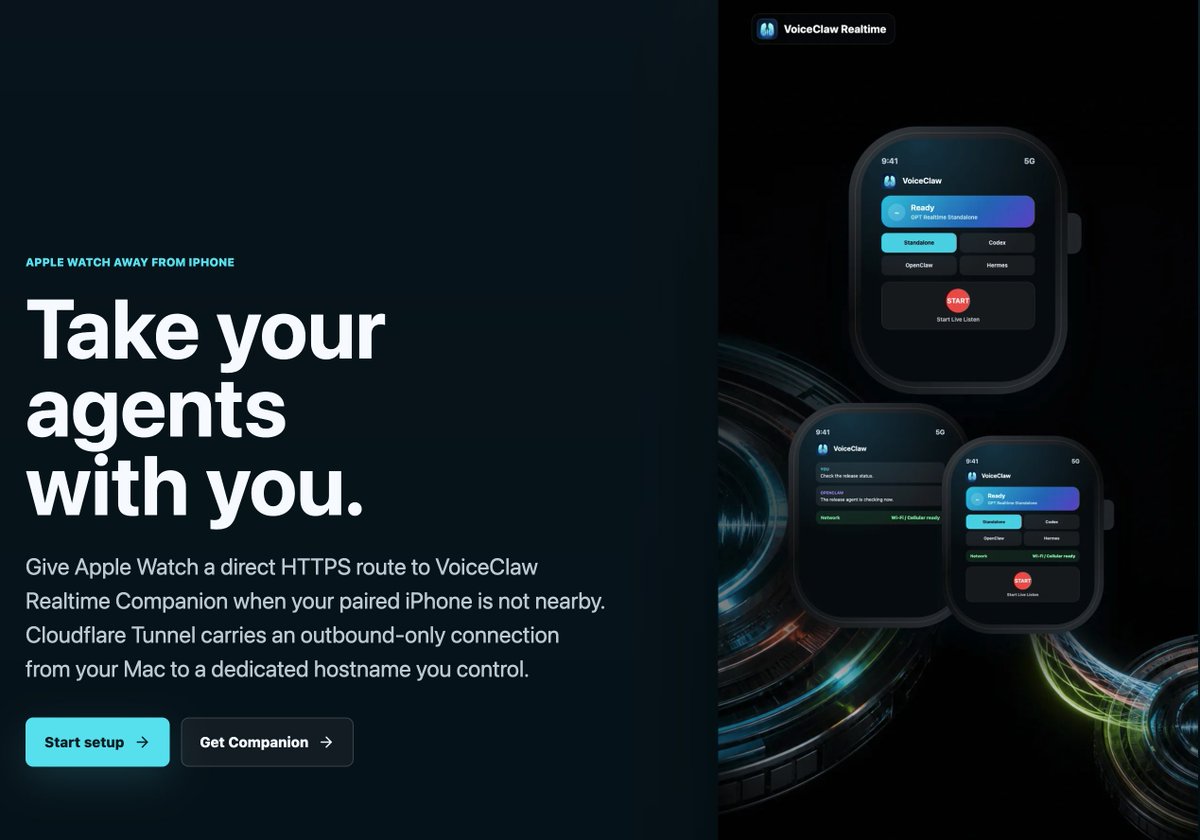
Practical need. @BenjaminBadejo presented (5 likes, 3 replies, 2,929 views) VoiceClaw as a way to start, steer, and check in on coding agents from an Apple Watch or iPhone through a direct connection to a Mac. The point was not novelty on its own; it was reducing the need to sit at the original machine while long-running work is underway. Opportunity: emerging.
4. Tools and Methods in Use
| Tool | Category | Sentiment | Strengths | Limitations |
|---|---|---|---|---|
| Qwen3.8-Max | LLM | (+) | Explicit low pricing, open-weight schedule, and strong benchmark claims across coding tasks | Public evidence today came mostly from Qwen's own launch materials and derivative posts |
| Codex / ChatGPT app | Agent workspace | (+/-) | Used for PRs, feedback roadmaps, ad ops, docs workflows, and site publishing | Reply threads complained about quota burn, compressed-chat/image bugs, blocked security scans, and memory issues |
| GitHub Agentic Workflows | Workflow automation | (+) | Cross-repo docs PRs with safe outputs, scoped GitHub App writes, and SME review | Requires careful branch routing and human review design |
| Copilot Studio GitHub harness | Business-agent platform | (+/-) | Long-horizon workflows with files, tools, connected agents, and model choice | Credit usage is a design constraint, and harness choice cannot be moved later |
| Skill packs (AMD Skills / mattpocock skills / mimeographs) | Skills distribution | (+) | Fast install, reusable knowledge, and hardware or persona specialization | Discovery, curation, and governance are becoming their own workload |
| NOOA | Agent framework | (+/-) | Python-class agent model, typed contracts, and pass-by-reference data access | Replies questioned readability and scale as projects grow |
| Prismor | Runtime security layer | (+) | Blocks destructive calls, secret leaks, and prompt injection; supports approvals | Policy tuning and rollback semantics remain open questions |
| OmniRoute | Gateway/router | (+) | One endpoint across 290+ providers, 90+ free tiers, auto-fallback, and token compression | Adds another dependency layer and still depends on outside provider quality |
| OpenCode | Open-source terminal agent | (+/-) | Broad model picker and improving UI kept users experimenting | Same-day complaints focused on device-code support and long-session memory leaks |
| Hermes + Codex | Working method | (+/-) | One hands-on user called it the simplest and most efficient pairing | The broader cloud-agent story was still described as not generally ready |
No single stack won outright. Business workflows pushed people toward Codex and GitHub-managed surfaces when human review was built in, while cost-sensitive experimentation pushed them toward Qwen pricing, OmniRoute fallback, and OpenCode's free-model menu.
The migration pattern was defensive rather than ideological. Narrow the task, install a skill pack, add a router or control plane, and keep a human approval or verification step near anything expensive or risky. OpenCode sentiment split sharply on the same day, and even optimistic cloud-agent users still described the category as strongest on bounded software tasks rather than as a universal default.
5. What People Are Building
| Project | Who built it | What it does | Problem it solves | Stack | Stage | Links |
|---|---|---|---|---|---|---|
| Startup Feedback Engine | @Kappaemme1926 | Turns support, interview, survey, and churn input into an evidence-backed roadmap and customer-proof map | Choosing what to build next from noisy feedback | Codex skill, evidence IDs, clustering, roadmap scoring | Shipped | quoted tweet, signal |
| GitHub Agentic Workflows docs pipeline | Aspire team | Drafts cross-repo documentation PRs after product merges | Docs lagging behind shipped features | GitHub Agentic Workflows, safe outputs, GitHub App, SME review | Shipped | article, tweet |
| Codex Sites + Convex | @waynesutton | Builds and publishes Codex Sites with a realtime Convex backend through one reusable workflow | Agents guessing backend boundaries or drifting between frontend and backend concerns | Codex Sites, Convex, reusable skill | Shipped | repo, tweet |
| Skill Recorder | Microsoft | Records a real task once and turns it into a reusable skill or automation | Repeating manual workflows and brittle UI replay | Desktop app, GitHub Copilot CLI, Scout/Cowork/Copilot Studio | Shipped | repo, tweet |
| Prismor | @_ar9av | Adds a runtime control plane around agent tool calls | Rogue commands, prompt injection, and secret exfiltration | Python hooks, HITL approvals, Slack/webhooks, MCP gateway, Ed25519 audit trail | Shipped | repo, tweet |
| AMD Skills | @AIatAMD | Packages AMD-specific workflows and best practices for coding agents | Re-teaching each agent how to work well on AMD hardware and software | Skills CLI, scripts, cross-agent skill packs | Beta | tweet |
| VoiceClaw Realtime | @BenjaminBadejo | Starts, manages, and checks in on agents from Apple Watch and iPhone | Supervising long-running work away from the original machine | Apple Watch/iOS, direct HTTPS, Tailscale/Cloudflare tunnel, bidirectional voice models | Shipped | tweet |
| Farm rainfall planner | @DanielSMatthews | Predicts rainfall and soil conditions for irrigation and nutrient planning | Farm scheduling based on local weather and forecast data | Grok Build, Google Antigravity, weather and radar UI | Beta | tweet |
| Mimeographs | K-Dense AI | Ships 80 expert personas as installable agent skills | Giving agents domain heuristics and decision discipline, not just more tools | Python, SKILL.md, AGENTS.md, Mimeo |
Shipped | repo, tweet |
The dominant build pattern was meta-infrastructure for AI coding itself. Startup Feedback Engine, Codex Sites + Convex, Skill Recorder, Prismor, AMD Skills, and Mimeographs all try to make the next agent run less brittle by packaging process, domain knowledge, or guardrails rather than by shipping another bare chat surface.
GitHub Agentic Workflows was the strongest proof that this layer is already producing measurable output. The Aspire pipeline did not merely draft text; it created cross-repo docs PRs under scoped permissions, kept them draft-only, and still got all 82 merged after SME review. That is a more demanding bar than a demo video.
VoiceClaw Realtime and the farm rainfall planner were the clearest outward-facing exceptions. One treats watch and phone surfaces as the place to supervise agents instead of the desktop, while the other uses Grok Build and Antigravity to assemble operational software for irrigation and nutrient timing rather than a developer-only tool.

6. New and Notable
AI-coding fluency appeared directly in a paid engineering listing
@LeadHerLogic posted (4 likes, 2 replies, 1,195 views) a Turing role that explicitly asked for daily use of Codex, Claude Code, Cursor, GitHub Copilot, or similar tools. The screenshots also framed it as Python + Docker work on AI-agent evaluation infrastructure and a $300-per-task contractor structure, which is more specific than generic "AI familiarity." It treats agent-assisted development as part of the baseline workflow rather than as a nice-to-have.

"Agentic engineering" crystallized into a verification-first checklist
@stas_sorokin_ framed (82 views) the difference between vibe coding and agentic engineering as context, permissions, stop conditions, and proof. That mattered less as branding than as a compact checklist that matched the rest of the day: blocked scans, runtime security hooks, and calls for explicit acceptance checks before trusting generated code.
Apple Watch control for coding agents reached the artifact stage
@BenjaminBadejo shared (5 likes, 3 replies, 2,929 views) VoiceClaw Realtime as a direct Apple Watch and iPhone surface for starting, steering, and checking in on agents running on a Mac. The notable part was not just a remote terminal; it was the attempt to make supervision, interruption, and status checks fit ambient devices instead of a fixed desktop session.
7. Where the Opportunities Are
[+++] Runtime trust layers that are strict enough to matter but permissive enough to be usable - Prismor, the blocked Codex Security scan, the Antigravity data-loss complaint, and AISLE's disclosure all point to the same gap: teams need approval, policy, and audit layers that still allow legitimate security and maintenance work to proceed.
[+++] Portable skill and workflow packaging - Skill Recorder, AMD Skills, mimeographs, mattpocock/skills, and Copilot Studio's harness choice all point to reusable behavior as a product category. The evidence spans vendor packs, open-source repos, and workflow-capture tools rather than one isolated launch.
[++] Approval-aware business workflows - Feedback-to-roadmap analysis, ad-campaign execution, docs PR automation, and Codex Sites + Convex all show demand for bounded agent workflows that stop at meaningful checkpoints instead of trying to auto-run an entire business process end to end.
[++] Open and cheaper frontier-model access with resumable loops - Qwen's launch, JustMicrock's competition complaint, OpenCode's free-model menu, and OmniRoute's fallback layer show a practical need for portable high-end capability that is not locked to one subscription or one provider policy.
[+] Mobile supervision surfaces - VoiceClaw shows early demand for approving and steering work from a watch or phone instead of staying at the original machine, but the evidence is still limited to a small number of posts.
8. Takeaways
- The most important model story was not just performance; it was inspectability. @Alibaba_Qwen combined open-weight timing, pricing, and benchmark claims, while @codeglitch translated the launch into a checkpointed
DONE/NEXT/BLOCKEDworkflow. - Codex is being evaluated on operational workflows, not only code generation. The strongest evidence came from @gdb pushing a feedback-to-roadmap skill, @gdb highlighting supervised ad execution, and @github showing 82 merged docs PRs with a 44.8-hour median time to merge.
- Skills and harness packaging is becoming its own competitive layer. @FlowAltDelete treated harness choice as an architecture decision, while Skill Recorder, AMD Skills, mimeographs, and the repo roundup all treated reusable agent behavior as a product.
- Trust still lags capability. The same day produced a runtime control plane pitch, a blocked Codex Security scan, a data-loss complaint tied to Antigravity, and AISLE's one-click RCE disclosure.
- AI-coding fluency is leaking into both devices and jobs. @BenjaminBadejo moved agent supervision onto a watch, while @LeadHerLogic shared a contractor listing that treated daily use of AI coding assistants as part of the baseline role.