Twitter AI Coding - 2026-08-04
1. What People Are Talking About
1.1 Coding agents became workflow surfaces, not just code generators (🡕)
The strongest theme was agents absorbing the process around code: specification, reusable procedures, event triggers, and approval gates. At least five substantive items showed the shift, led by Antigravity's guided build flow, Microsoft's Skill Recorder, GitHub comment-triggered automations, Career Ops, and Lettertrace.
@antigravity demonstrated (520 likes, 26 replies, 32,623 views, 257 bookmarks) a Chrome tab organizer and a background desktop-file tagger built with /grill-me design questions, voice prompting, and inline artifact comments. The useful detail was sequencing: make the agent challenge the design before it builds, then comment directly on the resulting artifact. One reply praised that protection against building the wrong thing, while another reported Antigravity had been stuck in a “working...” loop for seven days.
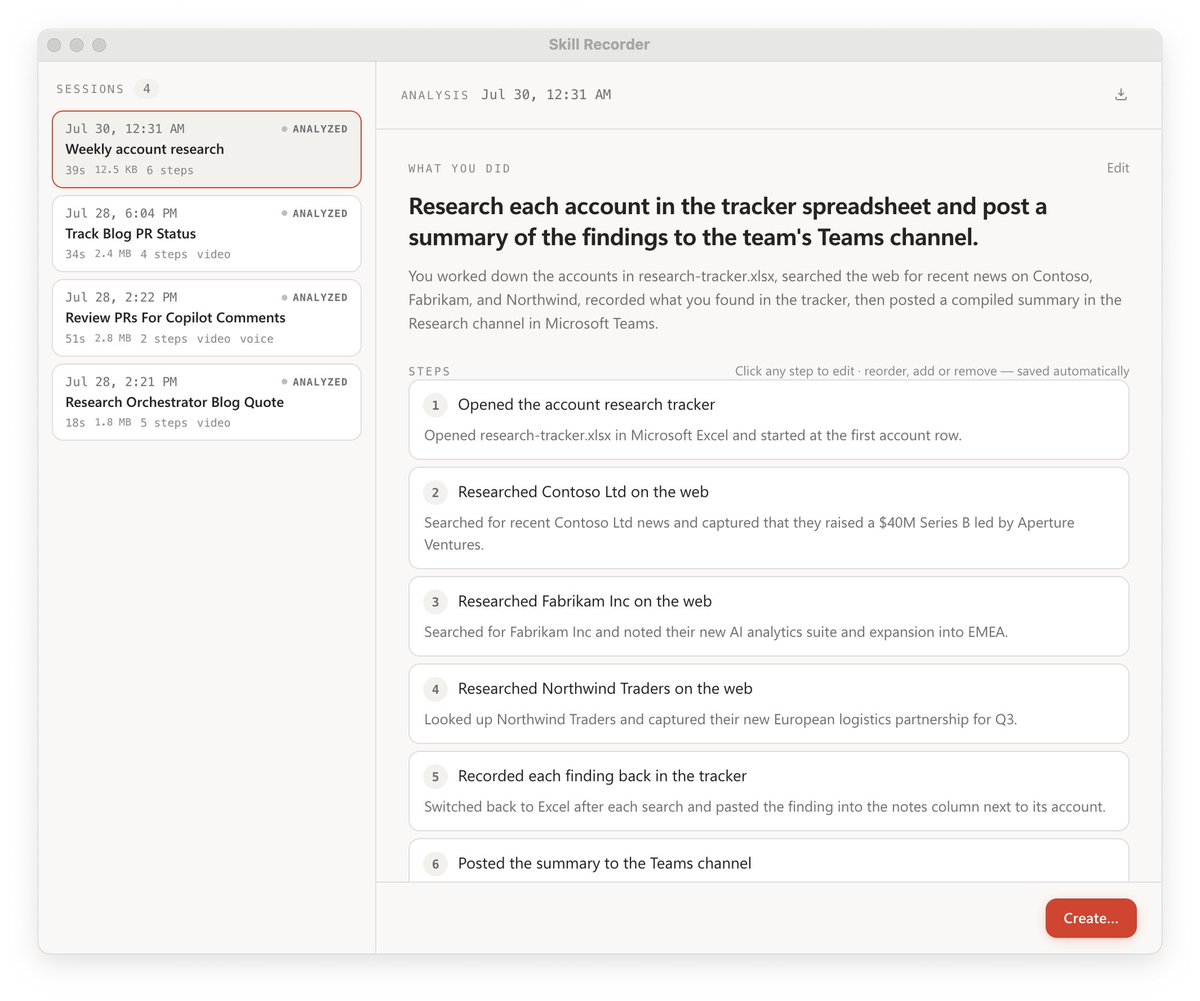
@0x_sakata surfaced (45 likes, 24 replies, 1,166 views) Microsoft's Skill Recorder, which captures one screen workflow and uses Copilot CLI to reconstruct its intent and ordered steps as a reusable SKILL.md or Automation. The repository adds an important caveat: capture stays local, but choosing Analyze sends event metadata, selected screen images, and narration text to GitHub's cloud.
@GHchangelog announced (16 likes, 1,885 views, 6 bookmarks) that Copilot automations can now start from issue or pull-request comments. GitHub's changelog names three bounded uses: generate documentation, investigate errors, and create follow-up issues when configured comment text appears.
Discussion insight: The strongest implementations retained human control. Career Ops filters and drafts but leaves submission to the user; Skill Recorder asks the user to review reconstructed steps; and GitHub's comment trigger makes the initiating event explicit. The weak point was not whether agents can perform the steps, but whether the workflow exposes enough control and privacy boundaries.
Comparison to prior day: August 3 emphasized installable skills and measurable GitHub documentation workflows. August 4 moved one layer outward: people recorded workflows from the desktop, triggered them from repository comments, and used them for job search and visibility telemetry.
1.2 Price, capacity, and latency drove model choice more than benchmark rank (🡕)
Four high-signal items made model economics operational. OpenCode reported a DeepSeek capacity constraint, one builder abandoned Qwen after rapid usage burn, a Cerebras user treated speed as protection against context switching, and the cloud-agent debate asked whether more compute actually fixes the binding problem.
@thdxr said (374 likes, 36 replies, 14,132 views) OpenCode Go users were spending $130,000 per day on DeepSeek and that DeepSeek had limited OpenCode traffic during recurring API failures. In replies, he said OpenCode has a zero-data-retention arrangement and is gradually moving more traffic to its own serving system; those figures remain attributed claims rather than independently audited numbers.
@MystiqueMide reported (11 likes, 4 replies, 564 views) that a few product tasks exhausted Qwen3.8-Max limits in OpenCode Go and prompted a switch to DeepSeek V4 Flash. The attached usage views make the complaint concrete, although they do not control for task difficulty or token volume.

@kelxyz_ argued (65 likes, 11 replies, 5,042 views, 28 bookmarks) that Cerebras inference around a claimed 750 tokens per second changes coding-agent UX because the response arrives before attention shifts elsewhere. A reply questioned whether serving capacity can support the growth thesis, making capacity the counterweight to latency.
Discussion insight: Faster and cheaper did not collapse into one winner. DeepSeek looked attractive enough to overload, Qwen drew a direct limit-burn complaint, and Cerebras drew enthusiasm for responsiveness but questions about capacity. The practical behavior was routing, self-serving a growing share, or switching models rather than committing to one provider.
Comparison to prior day: August 3 centered Qwen's open-weight schedule and low published token prices. August 4 supplied the operator-side correction: advertised price is only useful if quotas, serving capacity, and end-to-end latency hold under real agent workloads.
1.3 Context and harness infrastructure became the durable competitive layer (🡕)
At least five items addressed the same recurring cost: agents and tools repeatedly lose project knowledge, workflow lessons, or shared capabilities. The proposed answers were readable code graphs, cross-agent MCPs, multi-agent learning configs, shared ledgers, and evidence-bounded harness evaluation.
@QCXINT_ introduced (5 likes, 2 replies, 101 views, 5 bookmarks) Graft as a linked-Markdown graph that lets agents reuse codebase context instead of rediscovering imports and APIs every session. Graft's project-authored 162-run comparison reports equal 93% correctness with 42% fewer uncached input tokens, 46% fewer tool calls, and 60% lower latency; its separate eight-instance SWE-bench comparison reports 6/8 resolved versus 4/8 without Graft. The attached benchmark summarizes the controlled sweep, not independent validation.

@heynavtoor presented (29 likes, 11 replies, 3,011 views, 14 bookmarks) OpenWork as a free open-source desktop app and one MCP endpoint for reusing skills, plugins, and connected services across Codex, Claude Code, Cursor, and OpenCode. A reply made the local-first demand specific: financial records stay on self-hosted agents regardless of license price.
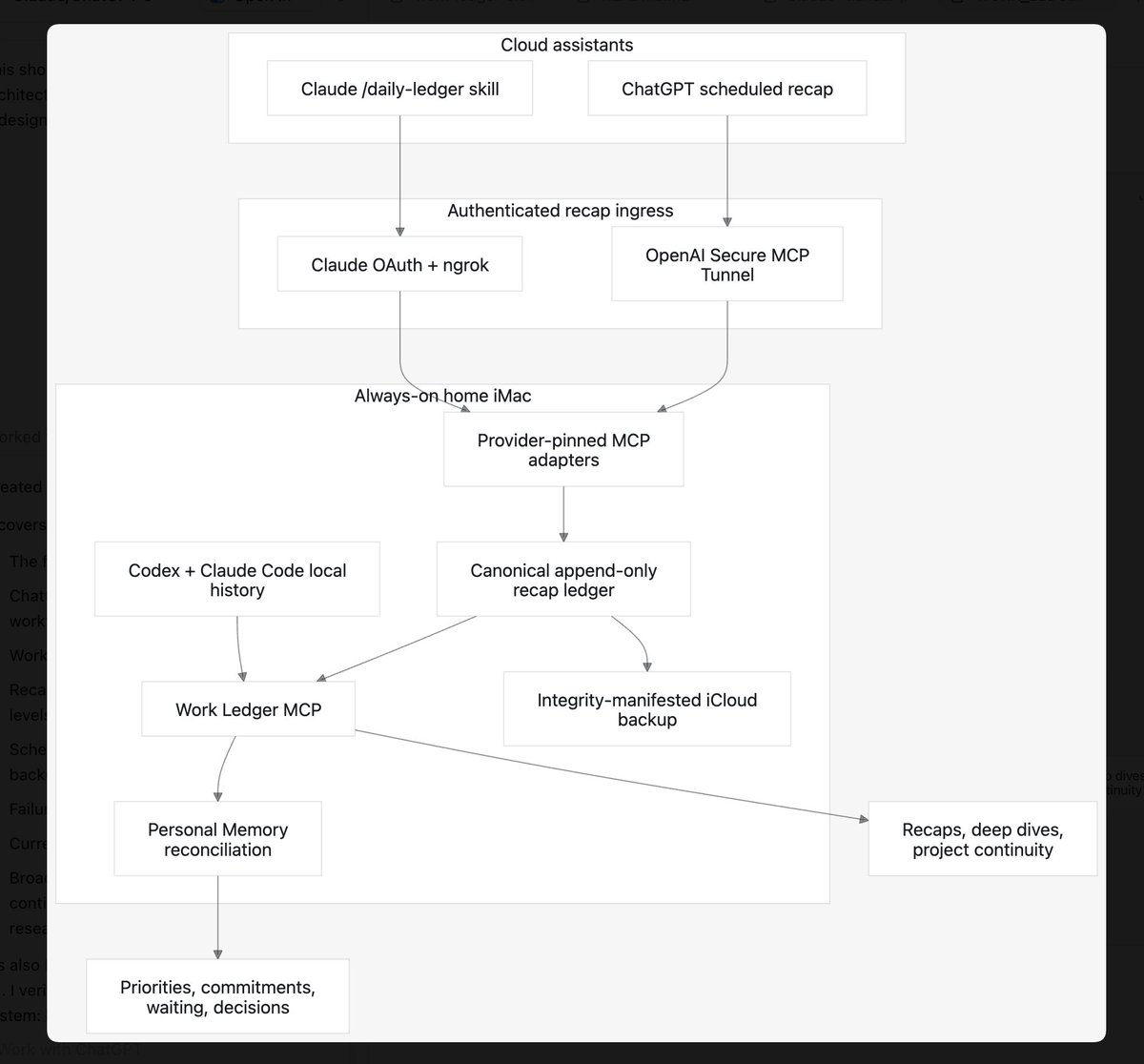
@yoheinakajima shared (6 likes, 3 replies, 1,330 views) a personal memory architecture combining local Codex and Claude Code history with nightly ChatGPT and Claude recaps. Provider-pinned MCP adapters feed an append-only ledger, reconciliation, and an integrity-manifested iCloud backup; the author still worried about inaccurate writes or accidental memory deletion.
@qoder_ai_ide reported (10 likes, 1 reply, 748 views, 8 bookmarks) that Better Harness expanded from four host adapters to ten in its first week. Its repository evaluates task understanding, controlled execution, validation, reliable delivery, and learning capture while explicitly marking missing evidence instead of inventing a score.
Discussion insight: The credible context products did not promise magical memory. Graft made its benchmark boundary visible, Better Harness kept unobserved evidence explicit, and the shared-memory design added reconciliation and backup. A Graft reply proposed going further with a “codebase receipt” containing repo SHA, file set, graph version, staleness, answered queries, and invalidation rules.
Comparison to prior day: August 3 packaged skills and harnesses for installation. August 4 focused on what persists after installation: codebase knowledge, workflow evidence, portable connections, and memory integrity across agents.
1.4 Safety moved from warning language into concrete controls (🡕)
The safety discussion combined one direct product request, a documented fixed vulnerability, local sandbox documentation, and a verification-on-stop pattern. The shared concern was fresh proof and constrained execution, not a generic instruction to “be careful.”
@ForwardEditor asked (66 likes, 20 replies, 6,730 views) why Codex does not ship default hooks that prevent accidental deletion of an entire computer. A reply broadened the product gap to editable shared documents, arguing that agent harnesses still behave like public experiments rather than complete products.
@github pointed (29 likes, 7 replies, 9,954 views, 12 bookmarks) to its Copilot CLI local-sandbox documentation. The public-preview feature gives the current workspace write access by default, makes home and system locations read-only, blocks other disk locations, and requires approval before a command leaves the sandbox.
@AISecHub linked (6 likes, 541 views, 5 bookmarks) AISLE's one-click RCE disclosure. AISLE says malicious commit-message links could execute arbitrary commands without confirmation, but also says Cursor, Google, and Microsoft fixed the issue; the actionable conclusion is to run current versions.
@julientalbot974 described (6 likes, 1 reply, 74 views) Hermes Agent's “verify-on-stop”: an agent cannot mark work done without a test or build result generated in the current task context, and stale or missing evidence pushes it back into the loop. The dataset did not include an external changelog, so this remains attributed reporting.
Discussion insight: Controls fail if they are merely present. Sandboxes need explicit escape approval, tests must be fresh rather than inherited from an earlier run, and memory systems need integrity checks against deletion or inaccurate writes.
Comparison to prior day: August 3 showed runtime security products, a blocked security scan, and a data-loss complaint. August 4 added primary documentation and a specific completion invariant: no “done” state without current verification evidence.
2. What Frustrates People
Capacity failures and limits arrive before the work is done
Severity: High. @thdxr reported (374 likes, 36 replies, 14,132 views) that unprecedented DeepSeek Flash demand caused errors and traffic limits for OpenCode Go, while @MystiqueMide said (11 likes, 4 replies, 564 views) Qwen3.8-Max exhausted usage after only a few product tasks. The coping methods were immediate: shift traffic onto infrastructure OpenCode controls, switch to DeepSeek V4 Flash, or retain multiple providers. Worth building for: yes, because failures affect active sessions rather than only monthly budgets.
Agents repeatedly reconstruct context that should persist
Severity: High. @QCXINT_ described (5 likes, 2 replies, 101 views, 5 bookmarks) agents repeatedly grepping files and following imports they already explored in a prior session. @yoheinakajima built (6 likes, 3 replies, 1,330 views) a shared-memory ledger across four assistants, but still worried that inaccurate writes or deletion could corrupt it. Graft and the ledger architecture are concrete workarounds; neither removes the need for freshness, provenance, and rollback. Worth building for: yes.
Safety controls are not default or sufficiently visible
Severity: High. @ForwardEditor asked (66 likes, 20 replies, 6,730 views) why destructive-command hooks are not built into Codex by default. AISLE's fixed RCE disclosure shows the broader exposure: links embedded in commit messages could execute arbitrary commands without a prompt in affected editor versions. GitHub's local sandbox and Hermes-style verify-on-stop are the day's clearest coping mechanisms. Worth building for: yes.
Product polish and reliability trail capability
Severity: Medium. @kimmonismus preferred (107 likes, 23 replies, 5,272 views) Codex over Claude's iOS surfaces because it felt cleaner and better organized. An Antigravity reply under the day's largest product demo reported a seven-day “working...” loop, and a reply to the Codex-hooks request asked why users cannot edit agent-produced documents on a shared surface. These are not model-quality complaints; they concern navigation, recoverability, and collaboration. Worth building for: yes, especially where long-running work crosses desktop and mobile.
3. What People Wish Existed
Provider-independent capacity with automatic, privacy-aware failover
Practical need. The OpenCode incident combined errors, provider-imposed traffic limits, a zero-data-retention question, and an incomplete migration to self-hosted serving in one thread. @thdxr confirmed (374 likes, 36 replies, 14,132 views) both the ZDR arrangement and the gradual shift of traffic onto OpenCode-controlled infrastructure. Routers such as OmniRoute partially address fallback, but capacity ownership and privacy guarantees still vary by hop. Opportunity: direct and competitive.
Memory that is portable, fresh, attributable, and reversible
Practical need. @yoheinakajima showed (6 likes, 3 replies, 1,330 views) that cross-assistant memory is possible with local histories, scheduled recaps, MCP adapters, an append-only ledger, and reconciliation. His own follow-up asked for protection against inaccurate or deleted memories, while a Graft reply proposed explicit repo SHA, graph version, stale_at, query history, and invalidation rules. Opportunity: direct.
Guardrails that ship on by default and require fresh evidence
Practical and urgent need. @ForwardEditor asked (66 likes, 20 replies, 6,730 views) for Codex hooks that make destructive deletion impossible, while @julientalbot974 described (6 likes, 1 reply, 74 views) a stronger completion rule: no “done” without a fresh passing test or build. GitHub's local sandbox partially addresses filesystem scope, but it remains a public-preview feature users must enable. Opportunity: direct.
Telemetry that turns into a prioritized audit
Practical need. @mathewpregasen launched (43 likes, 14 replies, 133,017 views) Lettertrace to measure LLM brand mentions, share of voice, sentiment, and competitors. A reply identified the missing layer for agencies: fixed conditions, evidence capture, prioritization, and a report that separates facts from hypotheses and recommends what to do next. Opportunity: direct but adjacent to a newly shipped free tracker.
One editable work surface across agents and devices
Practical need. A reply beneath the Codex safety-hooks thread asked why agent-produced documents cannot be edited collaboratively, and @kimmonismus said (107 likes, 23 replies, 5,272 views) Codex wins on organization across desktop and iOS. OpenWork provides a shared capability layer, but the evidence still shows demand for a common artifact surface with edits, status, and recovery that survives switching agents. Opportunity: competitive.
4. Tools and Methods in Use
| Tool | Category | Sentiment | Strengths | Limitations |
|---|---|---|---|---|
| Google Antigravity | Agent IDE | (+/-) | /grill-me, voice prompts, inline artifact comments, and visible end-to-end builds |
One reply reported a seven-day working loop; another asked for newer model choices |
| Codex | Coding agent / app | (+/-) | Praised for clean organization and iOS UX; used as a host for skills and MCPs | Users requested default destructive-command hooks and editable shared artifacts |
| OpenCode Go | Agent subscription / gateway | (-) | Makes several models available through one coding surface and reports rolling usage | DeepSeek capacity errors and Qwen limit burn disrupted active work |
| DeepSeek V4 Flash | Coding model | (+/-) | One builder preferred its price and usable output to Qwen | OpenCode reported unprecedented demand, errors, and provider traffic limits |
| Qwen3.8-Max | Coding model | (-) | Available through OpenCode Go and capable enough to attract product testing | A builder reported aggressive limit consumption and switched away |
| Cerebras | Inference platform | (+/-) | Very fast responses were said to reduce attention switching | The 750 tokens/second claim was user-reported; replies questioned capacity |
| OpenWork | Desktop workspace / MCP | (+) | Reuses skills, plugins, and connected services across several agents; local desktop option | Remote MCP and cloud-connected capabilities still require explicit data-boundary choices |
| Skill Recorder | Workflow capture | (+/-) | Converts a recorded task into reviewed steps, a Skill, or an Automation | Analyze sends selected capture data to GitHub's cloud; secrets must stay out of recordings |
| Graft | Codebase context graph | (+) | Readable Markdown graph; project benchmarks report fewer tokens, calls, and latency | Benchmark evidence is project-authored; freshness and invalidation remain important |
| Better Harness | Harness evaluation | (+) | Cross-host adapters and evidence-bounded findings across five workflow dimensions | A configured mechanism does not prove it was exercised or improved outcomes |
| Copilot CLI local sandbox | Runtime isolation | (+/-) | Workspace-scoped writes, read-only home/system paths, blocked other disk locations | Public preview, experimental, and broader command access can still be approved |
| Hermes verify-on-stop | Verification method | (+) | Requires current test or build evidence before completion | Evidence came from an attributed tweet without an external changelog in the review set |
| Agent Browser | Browser automation CLI | (+) | Native Rust CLI, accessibility snapshots, semantic finders, selectors, and extraction | Still requires a runnable local browser and explicit handling of obstructed controls |
Overall satisfaction split along operational lines. Codex won praise for interface organization, Antigravity for specification and artifact interaction, and Cerebras for responsiveness; model access drew the sharpest negatives when limits or serving capacity interrupted a build.
The common workaround was composability: keep more than one model, put a router or MCP between capabilities and the active agent, persist context outside the chat, then add sandboxing and a fresh verification gate. The migration evidence was concrete but narrow: one OpenCode Go user moved from Qwen3.8-Max to DeepSeek V4 Flash, while another cross-tool user shifted new work from Claude toward Codex.
5. What People Are Building
| Project | Who built it | What it does | Problem it solves | Stack | Stage | Links |
|---|---|---|---|---|---|---|
| Antigravity guided build flow | @antigravity | Builds and refines artifacts with design interrogation, voice prompts, and inline comments | Agents implementing underspecified ideas | Antigravity 2.0, /grill-me, voice, artifact comments |
Shipped | demo (520 likes, 32,623 views) |
| Skill Recorder | Microsoft | Converts one captured desktop workflow into reviewed steps and a reusable skill or automation | Repeating procedures and manually authoring instructions | Electron, GitHub Copilot CLI, SKILL.md |
Shipped | repo, tweet (45 likes, 24 replies) |
| OpenWork | different-ai | Shares skills, plugins, MCPs, and connected services across compatible agents | Capability duplication and agent lock-in | Desktop app, remote MCP, OAuth, Google Workspace, Microsoft 365 | Shipped | repo, tweet (29 likes, 3,011 views) |
| Career Ops | santifer | Filters listings, checks legitimacy, tailors applications, prepares interviews, and reviews offers | High-volume, low-signal job search | Agent skills, Node.js, Markdown, Playwright; multiple coding CLIs | Shipped | repo, tweet (21 likes, 16 bookmarks) |
| Lettertrace | @mathewpregasen | Tracks brand mentions, share of voice, sentiment, and competitors across LLM prompts | Expensive or inaccessible AI-visibility telemetry | CLI, Anthropic/OpenAI/Google APIs or model router | Shipped | site, tweet (43 likes, 133,017 views) |
| Better Harness | QoderAI | Audits the agent work loop and proposes evidence-linked improvements | Workflow weaknesses missed by final-diff review | Cross-host adapters, Markdown/HTML reports, agent skills | Beta | repo, tweet (10 likes, 8 bookmarks) |
| Graft | NanoNets | Builds a readable linked-Markdown graph of a codebase for reuse by coding agents | Repeated codebase rediscovery | TypeScript CLI, tree-sitter, Markdown graph, optional LLM summaries | Shipped | repo, tweet (5 likes, 5 bookmarks) |
| OpenCode learning config | joelhooks | Decomposes work, runs parallel workers, records outcomes, and promotes or retires patterns | Agents repeating failed strategies across sessions | OpenCode, swarmtools, CASS, Ollama, nomic-embed-text |
Beta | repo, tweet (4 likes, 1,162 views) |
| Agent Browser | Vercel Labs | Gives agents a native CLI for browser interaction and readable page state | Rebuilding browser automation per agent project | Rust CLI, Chrome for Testing, accessibility tree | Shipped | repo, tweet (5 likes, 4 bookmarks) |
| Unity AI Gateway | @databricks | Centralizes model access, cost attribution, observability, and policy across agents and apps | Uncontrolled enterprise AI spend and tool access | Databricks Unity AI Gateway, provider and agent telemetry | Shipped | tweet (10 likes, 424 views) |
Career Ops was the clearest example of a coding harness becoming an operational system outside software delivery. Its README reports 740+ listings evaluated, 100+ personalized CVs, and one role landed; its architecture deliberately rejects roles below a threshold and never presses Send. The distinction is important: the agent compresses the search space, while the human retains the consequential action.

Skill Recorder, OpenWork, Better Harness, Graft, and the OpenCode configuration all build infrastructure around the next run rather than another model. They capture process, expose capabilities, evaluate evidence, retain codebase structure, or learn from outcomes. The repeated trigger was information and control lost between sessions or between agent products.
Unity AI Gateway represented the enterprise version of the same pattern. @databricks claimed (10 likes, 424 views) general availability, thousands of customers, and more than a quadrillion tokens processed in the prior year; those scale figures are vendor-reported. Its attached chart is more concrete, separating daily spend by organization and by coding-agent identity.

6. New and Notable
Better Harness reached ten host adapters in one week
@qoder_ai_ide reported (10 likes, 1 reply, 748 views, 8 bookmarks) that four first-party adapters became ten after community additions for Qwen Code, GitHub Copilot, Pi, Grok, Kimi Code, and other hosts. The repository confirms that installation and output formats remain host-specific rather than pretending every agent has one universal integration.

Local and cloud execution became an explicit architecture choice
@haider1 interpreted (119 likes, 13 replies, 6,911 views) a forecast that “the next generation of models need more than your laptop” as a move toward stronger cloud agents. A reply supplied the useful counterpoint: context and judgment, not compute, remained that practitioner's bottleneck. The same day, OpenWork emphasized local execution and GitHub documented local sandboxing, so the signal is choice and boundary-setting rather than a settled migration to cloud.
Latency was described as attention infrastructure
@kelxyz_ described (65 likes, 11 replies, 5,042 views, 28 bookmarks) fast Cerebras inference as valuable because it prevents a context switch before the answer arrives. That is a different evaluation target from benchmark accuracy: response time matters insofar as it preserves a human's task state. The thread still contained capacity skepticism, so this is an emerging UX criterion, not proof that one serving platform wins.
7. Where the Opportunities Are
[+++] Capacity-aware routing with enforceable privacy guarantees - OpenCode's DeepSeek incident, the partial move to self-serving, the ZDR question, and the Qwen-to-DeepSeek switch all point to one need: fail over before a session fails, while exposing who serves the request, whether data is retained, and what each route costs.
[+++] Verifiable default safety for local coding agents - The request for destructive-command hooks, GitHub's opt-in local sandbox, AISLE's fixed one-click RCE, and Hermes-style verify-on-stop span prevention, containment, and proof. A strong product would make scoped execution and fresh validation the default rather than an expert configuration.
[+++] Provenance-first shared memory and codebase context - Graft, the four-assistant ledger, Better Harness, and the proposed codebase receipt independently converge on persistent context with source, version, freshness, and invalidation. The opportunity is not “more memory”; it is memory that can be audited, reconciled, and rolled back.
[++] Portable workflow and capability layers - Skill Recorder turns observed work into a reusable procedure, OpenWork exposes capabilities through one MCP, and GitHub comments trigger bounded automations. The evidence supports products that preserve one reviewed workflow across agent hosts without silently widening permissions.
[++] Action layers on top of agent telemetry - Lettertrace measures visibility and Unity AI Gateway attributes spend, but the Lettertrace reply asks for fixed conditions, evidence capture, prioritization, and a facts-versus-hypotheses report. Dashboards are present; trusted next-action systems remain a visible gap.
[+] Attention-preserving inference and interfaces - Cerebras enthusiasm tied latency to reduced context switching, while Codex praise tied tool choice to clean organization on desktop and iOS. The signal is promising but rests on a small number of practitioner reports.
8. Takeaways
- Workflow design carried more signal than raw code generation. @antigravity showed (520 likes, 26 replies, 32,623 views, 257 bookmarks) specification questions and artifact comments, while Skill Recorder and GitHub's comment automations turned procedures into reusable or event-driven work.
- Model economics were experienced as interrupted sessions, not abstract price tables. @thdxr reported (374 likes, 36 replies, 14,132 views) DeepSeek capacity limits, and @MystiqueMide reported (11 likes, 4 replies, 564 views) switching away from Qwen after rapid usage burn.
- Persistent context is useful only when its provenance and freshness are visible. Graft published project-authored token, latency, and correctness comparisons; @yoheinakajima added (6 likes, 3 replies, 1,330 views) an append-only ledger, reconciliation, and backup while still flagging inaccurate or deleted memories.
- Safety evidence got more specific. @github documented (29 likes, 7 replies, 9,954 views, 12 bookmarks) a local OS sandbox, AISLE documented a fixed one-click RCE, and @julientalbot974 described (6 likes, 1 reply, 74 views) fresh verification as a precondition for “done.”
- Cross-agent portability is becoming a product requirement. @heynavtoor presented (29 likes, 11 replies, 3,011 views, 14 bookmarks) OpenWork's shared MCP layer, while @qoder_ai_ide reported (10 likes, 1 reply, 748 views, 8 bookmarks) community growth from four to ten Better Harness adapters.
- The strongest builders preserved a consequential human decision. Career Ops rejects low-fit roles and drafts materials but never submits them, while Skill Recorder asks users to review reconstructed steps before creating a reusable workflow.