Twitter AI Coding - 2026-08-05
1. What People Are Talking About
1.1 Agent workspaces added voice, persistent instructions, and device control (🡕)
The strongest cluster was about the agent surface itself. At least five substantive items treated coding agents less like chat windows and more like workspaces with durable settings, voice input, live canvases, and visible artifact control.
@antigravity demonstrated (626 likes, 31 replies, 42,642 views, 307 bookmarks) a Chrome tab organizer and desktop-file tagger built with /grill-me, voice prompting, and inline artifact comments. The useful detail was not just that the agent produced code, but that the operator could challenge the spec before building and then comment directly on the result. Replies split between appreciation for that specification step and one concrete reliability complaint about a seven-day “working...” loop.
@OpenAIDevs showed (85 likes, 20 replies, 11,074 views, 23 bookmarks) Voice in Codex as a manager surface: talk through an idea, spin up a new Codex session when it becomes concrete, and check other threads later. Their follow-up examples pushed the pattern beyond dictation into feature planning, validation, pull requests, ticket creation, and research workflows.
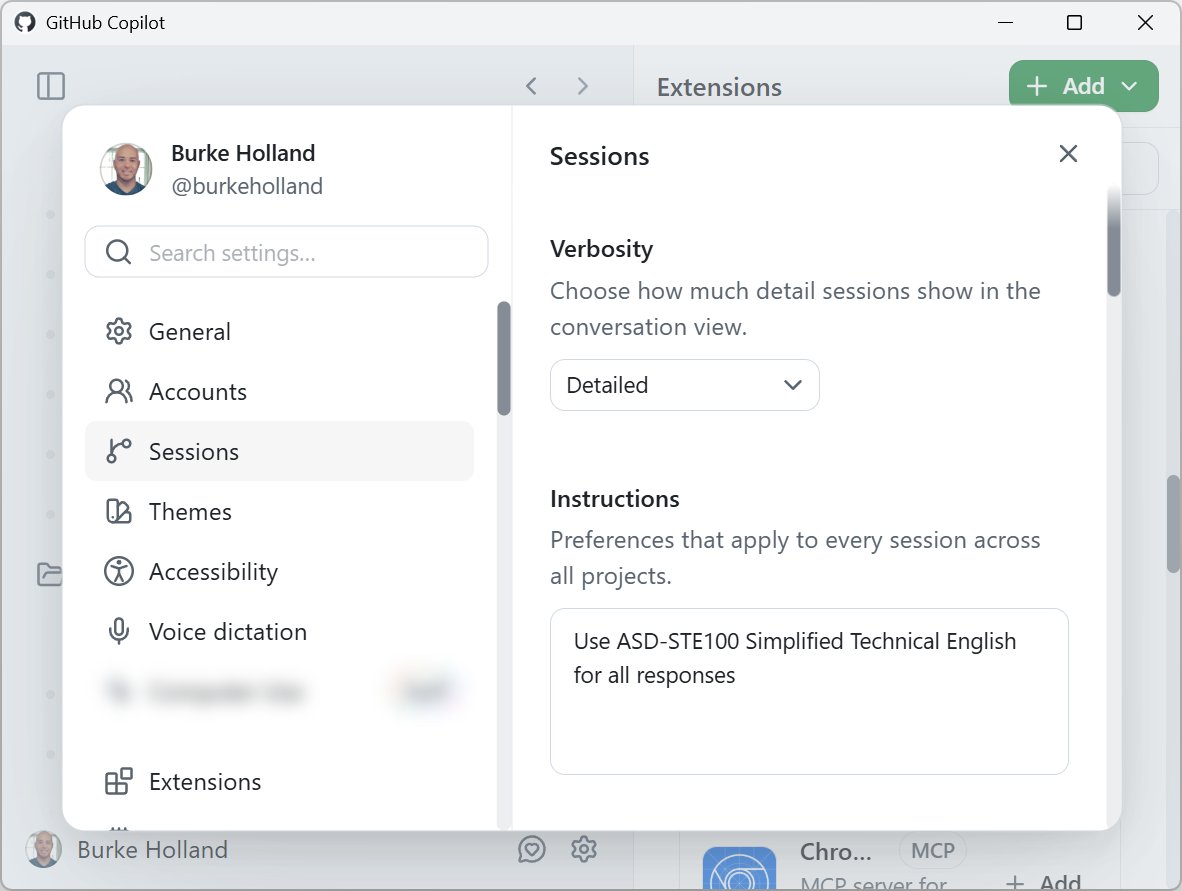
@burkeholland surfaced (21 likes, 1,490 views, 17 bookmarks) a GitHub Copilot app settings page for global instructions and session verbosity, turning house rules into a first-class product control instead of a repeated prompt ritual.
@JamesMontemagno highlighted (11 likes, 1,419 views, 18 bookmarks) mobile-canvas-ghcp, whose README says a Copilot plugin can expose local iOS simulators and Android emulators inside a canvas while mirroring the same actions through 24 MCP tools. That moved the app from planning code toward manipulating live devices in the same workspace.
Discussion insight: The recurring improvement was not “better generation” in isolation. It was more operator-visible state: persistent instructions, voice-to-session handoff, and explicit device controls. Even the most enthusiastic posts kept a human in the loop by making the workspace easier to steer rather than fully opaque.
Comparison to prior day: August 4 was about workflows becoming reusable and triggerable. August 5 pushed further into the interactive surface itself: voice, persistent settings, and device canvases inside the agent.
1.2 Meta's Muse launch landed as both a competitive move and a self-awareness test (🡕)
Muse Code was the day's clearest new entrant. The public reaction combined launch excitement, benchmark-sharing, and immediate scrutiny over whether the product even understood its own identity.
@Meta announced (14 likes, 7,229 views) that it released Muse Code in beta as a terminal coding agent powered by Muse Spark 1.2, with Mark Zuckerberg's quoted text describing large-repo planning, code writing, and validation. Community summaries quickly framed it as a direct rival to Claude Code and Codex.
@Jeremybtc claimed (46 likes, 43 replies, 3,851 views) Meta was shipping a smaller first model, with bigger ones coming, while attributing price and benchmark claims to Meta's own materials. That tweet mattered because it translated the launch into the operator questions people compare across tools: coding score, price, and whether Meta intends to keep shipping.
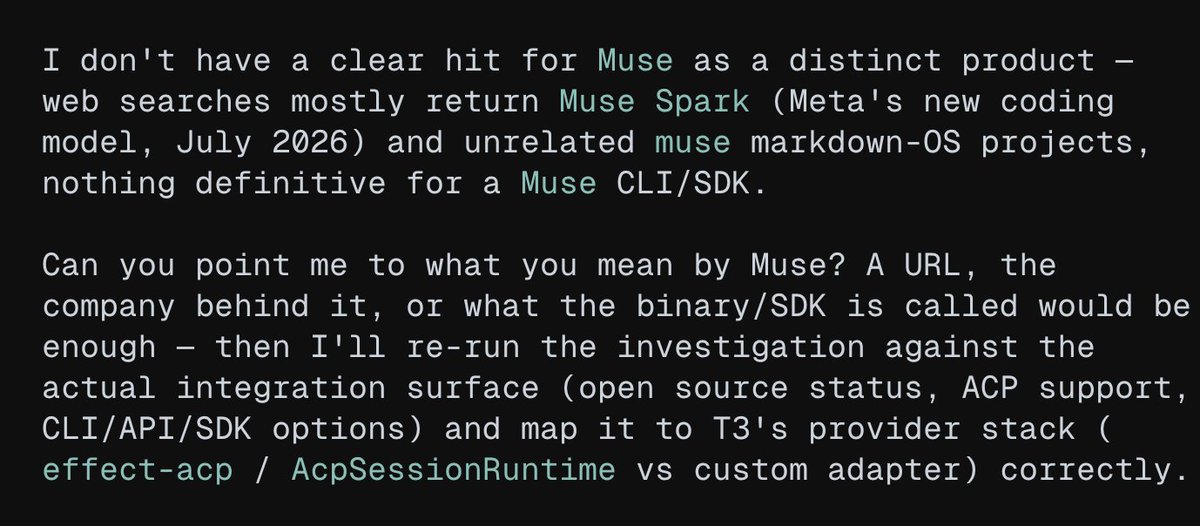
@theo mocked (181 likes, 21 replies, 18,325 views) Muse for having “literally no awareness” of Muse at all. The attached screenshot was the day's most concrete counterexample to launch polish: the agent said web results mostly returned Muse Spark or unrelated “muse” projects and asked for the actual company or binary name before it could investigate integration options.
@dkundel reminded (27 likes, 2,719 views) people that Codex CLI is open source, and one reply immediately turned that into a Muse comparison by complaining that Muse itself was not open source.
Discussion insight: The market did not stop at “new competitor shipped.” The fastest follow-up tests were whether the product could describe itself, whether the launch artifacts were concrete, and whether the openness model matched what users now expect from coding-agent tooling.
Comparison to prior day: August 4's dataset had no comparable Muse cluster. August 5 introduced a new named terminal-agent competitor and an immediate public critique of its discoverability.
1.3 The winning context pattern was smaller, structured, and loaded on demand (🡕)
Several of the most useful artifacts argued against giant prompts. The shared idea was to distill, compress, or stage knowledge so agents read less at startup and pull in only what a task needs.
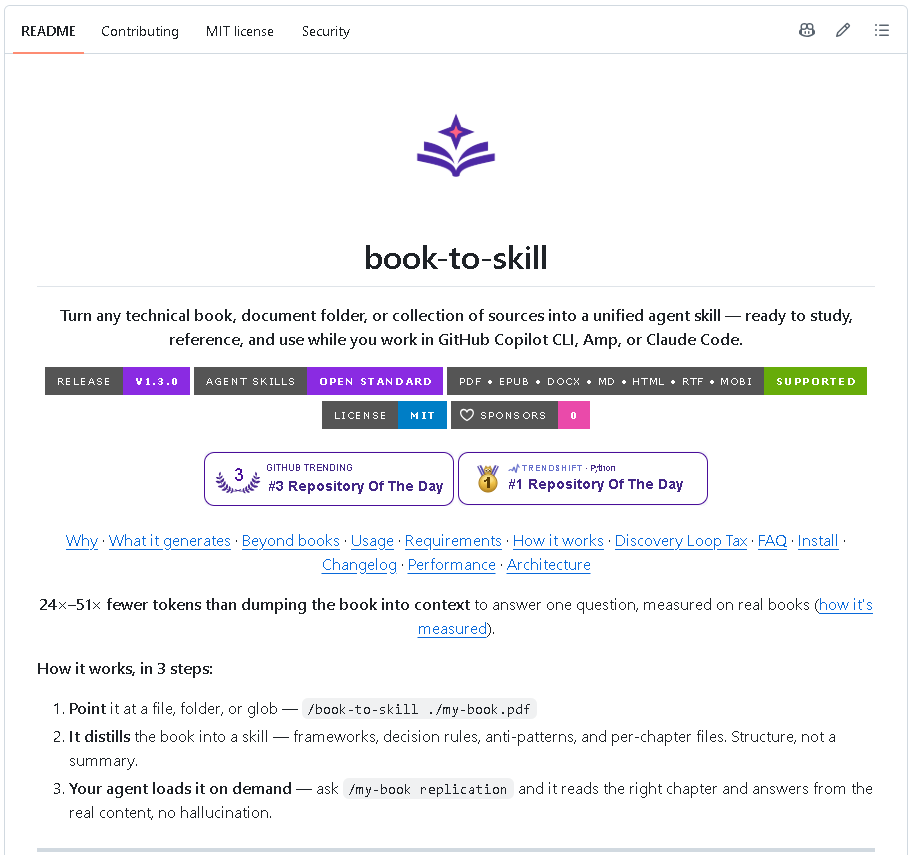
@alex_verem argued (10 likes, 1,799 views, 16 bookmarks) that whole technical books should not be re-ingested every session. The linked book-to-skill README makes the claim specific: convert a PDF or EPUB once, emit a SKILL.md plus per-chapter files, and answer from the right chapter later with reported 24x-51x fewer tokens than dumping the book into context.
@HelloVyom pointed to (6 likes, 252 views) Headroom, whose repository describes a local proxy, wrapper, and MCP server for compressing logs, files, tool outputs, and RAG chunks before they reach the model. The public README narrows the savings claim to 60-95% fewer tokens for JSON-heavy data and 15-20% fewer tokens for coding agents, with one demo cutting 10,144 tokens to 1,260 while finding the same fatal error.
@noclipepe summarized (6 likes, 88 views, 5 bookmarks) a Codex lesson in one sentence: “More context wasn't the fix. Better deletion was.” The specific claim was that a giant AGENTS.md made Codex worse, so OpenAI replaced it with a short map that loads the rest only when needed.
@NainsiDwiv50980 highlighted (3 likes, 358 views) mattpocock/skills, and the repo README reinforces the same pattern from a different direction: small installable workflows for alignment, TDD, debugging, and code review instead of one monolithic process blob.
Discussion insight: These posts converged on progressive disclosure. Compress the logs, split the book into chapters, keep the root instruction map short, and load the detailed material when a task actually calls for it.
Comparison to prior day: August 4 emphasized persistent context graphs and memory ledgers. August 5 moved the conversation toward cheaper, more disciplined context packaging and prompt deletion.
1.4 Routing, quota management, and local-first fallbacks stayed operationally central (🡒)
The model-choice conversation remained practical. The most detailed posts were not benchmark celebrations; they were about surviving quotas, routing around provider issues, and moving some work onto local or offline systems.
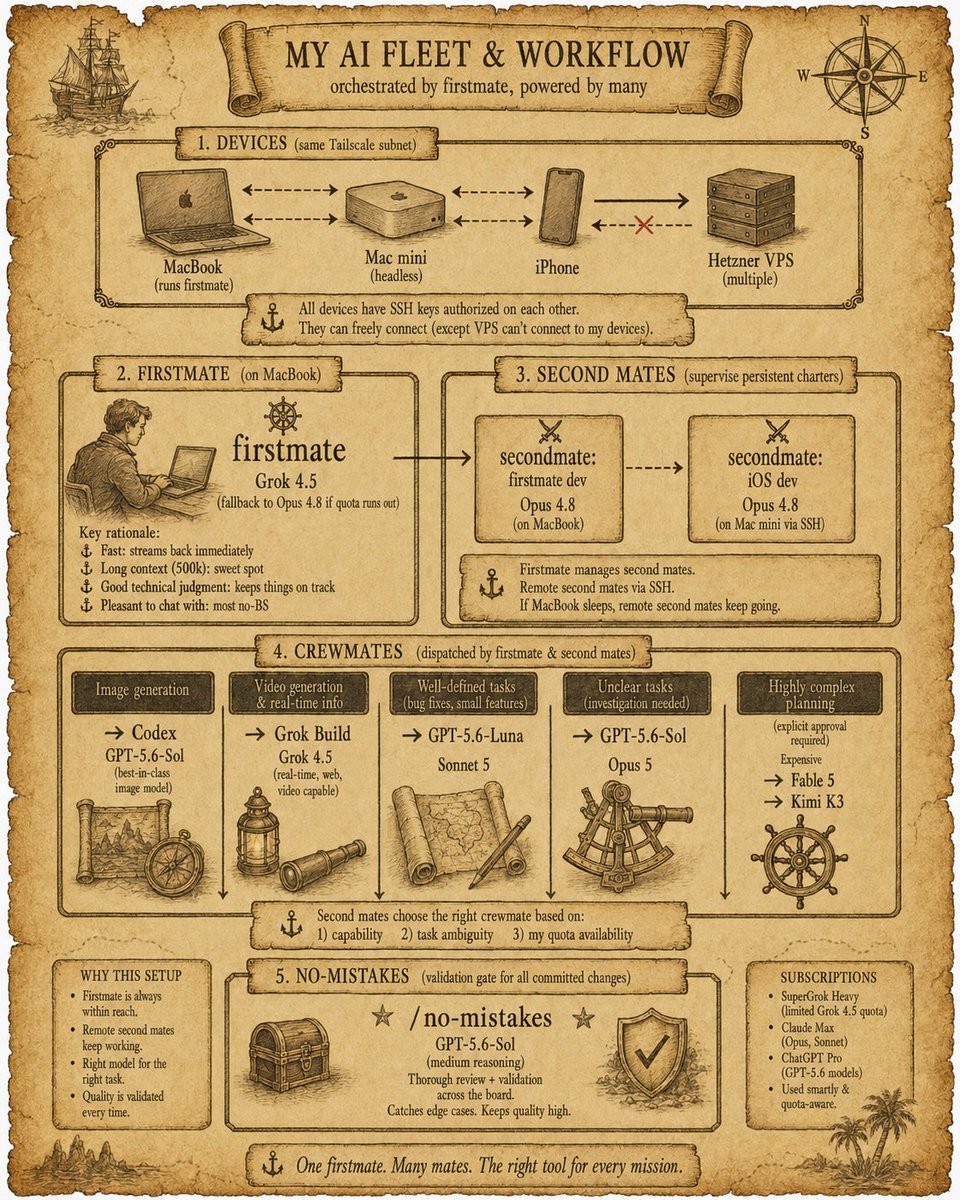
@kunchenguid walked through (28 likes, 12 replies, 1,214 views, 34 bookmarks) a multi-machine “firstmate” setup that routes tasks by capability, ambiguity, and quota. The accompanying diagram made the operating model explicit: Grok 4.5 as the orchestrator until quota runs out, Opus 4.8 for remote second mates, Codex for image tasks, Grok Build for web/video work, and a separate /no-mistakes validation pass on GPT-5.6-Sol.
@thdxr updated (166 likes, 18 replies, 7,480 views) users that OpenCode's 503s had been resolved, while the quoted earlier post tied the outage to unusual DeepSeek demand and provider traffic limits. @yacineMTB reported (65 likes, 21 replies, 4,611 views) the same 503 stream timeout, with replies adding one concrete token-burn complaint and another user saying direct DeepSeek API use avoided the issue.
@kushbhuwalka introduced (10 likes, 324 views) pattystack, a small router for multiple Codex subscriptions that keeps all accounts logged in and sends work to whichever one has the most quota left. @He1s_Sammy described (23 likes, 9 replies, 360 views) the broader vendor-plumbing pain behind products like APIMart: separate accounts, keys, rate limits, and invoices whenever a project uses more than one provider.
@antigravity presented (260 likes, 11 replies, 11,802 views, 71 bookmarks) Gemma Translator as a different answer to the same reliability question: a fully offline device. Its thread and public repo say the project runs Gemma 4 through LiteRT-LM with Moonshine/Kokoro speech models on Raspberry Pi hardware and requires no internet after setup.
Discussion insight: The common behavior was not loyalty to one model vendor. It was orchestration: route by quota and task type, keep provider options open, and move some jobs onto local or offline systems when the cloud path is fragile or too expensive.
Comparison to prior day: August 4 centered serving limits and price-performance. August 5 showed the operator response layer that sits above those issues: routers, subscription spillover, and offline devices.
2. What Frustrates People
Capacity limits and quota churn break the workflow
This was a High-severity complaint because it stopped people mid-session. @thdxr said an OpenCode 503 incident had been resolved but also said it looked like an “insane token volume day,” while the quoted earlier post tied the disruption to DeepSeek traffic limits. @yacineMTB reported the same 503 stream timeout and got corroborating replies, including one person saying the wrapper burned about $10 in tokens before failing and another saying the direct DeepSeek API path avoided the issue.
The frustration extended beyond outages to subscription policy. @jturntdev complained that unused Codex resets disappeared instead of being banked, posting a screenshot of the remaining reset counter and expiry date. Builders are already coping by adding routers such as pattystack or by spreading traffic across multiple providers and accounts. This looks worth building for because people are now creating explicit quota-management layers above the coding tools themselves.
Too much context still makes agents worse
This was a Medium-to-High frustration because it degraded quality even when the model remained available. @noclipepe said a giant AGENTS.md made Codex worse and that a short instruction map plus on-demand loading worked better. @alex_verem and the linked book-to-skill repo turned the same complaint into a concrete workaround by splitting books into chapter-level skill files instead of re-sending them whole.
The sharpest example came from the Muse launch reaction. @theo posted a screenshot where Muse could not identify Muse as a product without more grounding. That turned “context quality” from an abstract prompt-engineering debate into a visible product failure mode: users do not just want bigger windows, they want better starting knowledge and cleaner task scoping.
Recommendation and discovery layers still miss the actual job
This was a Medium frustration, but the examples were unusually concrete. @shannholmberg showed a Codex plugin picker surfacing irrelevant consumer tools, and the top reply argued the list looked alphabetical rather than truly curated. In the Muse thread, the problem was different but related: the system could not even ground the product name before trying to help.
These cases point to the same gap. The surrounding surfaces still do a weak job of understanding intent before they recommend tools, providers, or next actions. That makes discovery feel noisy at the exact moment users expect the agent stack to feel personalized.
Generation is faster than confidence
This was a High-severity strategic complaint because it questions whether more raw generation speed matters. @ATechAjay argued “fast code != fast confidence,” and the accompanying graphic framed the real bottleneck as checking routes, forms, edge cases, mobile layouts, and actual user journeys. @kunchenguid independently reinforced that point by inserting a separate /no-mistakes validation stage after model routing.
The coping pattern is revealing: people are not asking models to free-run longer. They are adding explicit validation passes, approval gates, and safer routing logic. That makes verification infrastructure look more defensible than another marginal speed boost.
3. What People Wish Existed
Quota-aware routing that feels native, not bolted on
People are already building this for themselves because they need it now. @kunchenguid described routing by capability, ambiguity, and remaining quota across Grok, Opus, GPT-5.6, and Kimi, while @kushbhuwalka built pattystack to choose among multiple Codex subscriptions automatically. @He1s_Sammy made the underlying pain explicit: multiple accounts, keys, rate limits, and invoices are now routine overhead.
What people seem to want is not another model picker. They want the routing layer to understand quotas, provider health, task type, and subscription economics by default. Opportunity rating: direct.
Context systems that load the right knowledge without stuffing the prompt
The request here is practical rather than aspirational. @noclipepe wanted a smaller instruction map that loads detail later; @alex_verem linked a tool that turns long books into chapter-addressable skills; @HelloVyom pointed to a compression layer for bulky logs and JSON.
The unmet need is a reliable middle layer between raw source material and the model: something that decides what to include, what to compress, and what to defer. Opportunity rating: direct.
Safer enterprise workspaces with explicit boundaries and approvals
The strongest evidence here came from builders shipping around the problem rather than complaining abstractly. @codeglitch highlighted Cloudflare OS as an agent workspace with governance and boundary controls built in, and the Cloudflare announcement centers secure internal connections and zero-trust defaults. @kunchenguid also kept explicit approval on expensive planning routes.
That suggests a need for systems where internal access, escalation rights, and approval gates are visible and policy-backed instead of hidden in prompts. Opportunity rating: competitive.
Better self-knowledge and workflow-aware discovery
The frustration around Muse and Codex exposed a more basic product gap. @theo showed Muse failing to ground its own product identity, while @shannholmberg showed Codex surfacing plugins that did not match the actual task. Both cases imply users want systems that know what they are, what tools they have, and which surface is appropriate for the current job.
This is partly a metadata problem and partly a UX problem, but the need is clear: discovery should feel situational, not generic. Opportunity rating: competitive.
4. Tools and Methods in Use
| Tool | Category | Sentiment | Strengths | Limitations |
|---|---|---|---|---|
| Antigravity | Coding agent workspace | (+/-) | Voice prompting, /grill-me, inline artifact comments, offline Gemma project examples |
One user reported a persistent "working..." loop; product rename/discovery still settling |
| Codex / Codex CLI | Coding agent + CLI | (+/-) | Voice workflows, open-source local CLI, strong image-task reputation in routing setups | Subscription-reset complaints, plugin recommendations felt irrelevant, some context setups degraded quality |
| GitHub Copilot app | Agent workspace | (+) | Persistent session instructions, adjustable verbosity, canvas plugins for rich surfaces | Value depends on plugins and surrounding MCP/canvas integrations |
| firstmate | Orchestration method | (+) | Multi-machine control, model specialization, quota-aware dispatch, explicit validation stage | Custom setup and ongoing quota management burden |
| OpenCode + DeepSeek path | Coding agent + inference provider | (+/-) | High usage and attractive economics drove heavy adoption | 503 timeouts, traffic limits, and token burn during failures |
| Muse Code | Terminal coding agent | (+/-) | Large-repo beta positioning, immediate market attention, benchmark and pricing discussion | Launch-day self-awareness confusion and open-source comparison pressure |
| book-to-skill | Context packaging | (+) | Chapter-level loading, reusable skill outputs, large token savings claim | Requires preprocessing source material before use |
| Headroom | Context compression layer | (+) | Local reversible compression, proxy/wrap/MCP modes, strong JSON savings claim | Adds another layer to the stack and is most compelling when data is structured |
| pattystack | Quota router | (+) | Routes to the Codex account with the most remaining quota | A workaround for subscription constraints rather than a full platform |
| Cloudflare OS | Enterprise agent workspace | (+) | Governance, internal-system access, and zero-trust framing built into the workspace | Early product signal with enterprise-heavy scope |
Overall sentiment was positive on capability and negative on operations. People liked voice control, richer workspaces, and reusable context layers, but they worked around outages and caps by adding their own routers, approval stages, compression layers, and offline fallbacks. The clearest migration pattern was away from single-provider dependence toward mixed stacks: one agent for orchestration, another for execution, a separate validator, and local or offline options for resilience.
5. What People Are Building
| Project | Who built it | What it does | Problem it solves | Stack | Stage | Links |
|---|---|---|---|---|---|---|
| Gemma Translator | @antigravity | A handheld offline translation device | Removes cloud dependence for speech translation and shows an on-device agent workflow | Gemma 4, LiteRT-LM, Moonshine, Kokoro, React, Python, Raspberry Pi 5 | Alpha | post, repo |
| mobile-canvas-ghcp | @JamesMontemagno / Redth | A GitHub Copilot canvas plus MCP for live mobile simulators | Lets agents inspect and control iOS and Android devices inside the Copilot app | GitHub Copilot plugin, canvas, MCP, iOS Simulator, Android Emulator | Beta | post, repo |
| book-to-skill | @alex_verem / virgiliojr94 | Converts books and docs into reusable agent skills with chapter-level loading | Cuts repetitive token spend when long references are needed repeatedly | Agent Skills format, Markdown outputs, PDF/EPUB ingestion | Beta | post, repo |
| Headroom | @HelloVyom | Compresses structured context before it reaches the model | Reduces token cost and prompt bloat for logs, JSON, RAG chunks, and coding-agent traffic | Local proxy, wrapper CLI, MCP server, reversible compression | Beta | post, repo |
| pattystack | @kushbhuwalka | Routes requests across several Codex subscriptions through one endpoint | Avoids idle time when one paid account hits its cap early | OpenAI-compatible API endpoint, multi-account Codex routing | Alpha | post |
| Cloudflare OS | @codeglitch / Cloudflare | An agent workspace built around secure internal access and governance | Gives enterprises a place to run agents with boundaries, approvals, and browser access | Cloudflare workspace, browser surface, internal connectors, zero-trust controls | Beta | post, announcement |
| skills | @NainsiDwiv50980 / Matt Pocock | A repository of installable coding-agent workflows | Replaces repeated manual prompting with reusable task-specific procedures | Markdown skills, GitHub repo, issue-tracker integration | Shipped | post, repo |
Gemma Translator stood out because it was not just a demo thread. The repo spells out the hardware and software path to an offline device: Gemma on LiteRT-LM, Moonshine/Kokoro for speech, React on the front end, and Raspberry Pi hardware. That made local-first agent behavior feel more like a build pattern than a slogan.
mobile-canvas-ghcp and Cloudflare OS pointed in different directions but solved the same broad problem: agent work needs a better container. One makes the container richer for developers by embedding live device surfaces in Copilot; the other makes it safer for companies by embedding governance and internal access controls into the workspace.
The repeated builder pattern was “thin layer above an existing model.” book-to-skill, Headroom, pattystack, and Matt Pocock's skills repo all sit between the raw model and the user workflow, adding routing, compression, packaging, or procedure instead of trying to replace the foundation model itself.
6. New and Notable
Antigravity became the visible front door for Google's coding-agent features
@buildwithhassan posted a Google sign-in flow that redirected Gemini CLI users to Antigravity, and the Antigravity site currently advertises subagents, hooks, scheduled tasks, agent management, and voice. That mattered because it turned a loose set of coding-agent capabilities into a more explicit product surface and name.
Cloudflare OS turned enterprise agent boundaries into a product category
@codeglitch called out Cloudflare OS as “the first AI workspace built around how companies actually work,” and the linked press release centers internal system access, governance, and zero-trust defaults. The notable part was not just another agent shell, but a direct attempt to define the secure enterprise container for agent work.
Muse Code gave Meta a clear entry in the terminal-agent race
@Meta formally introduced Muse Code in beta, and the community immediately compared it with Claude Code and Codex on pricing, openness, and coding performance. Even before consensus on quality, the product was notable because it added a new major-lab entrant to a category that had mostly been led in public by Anthropic and OpenAI.
7. Where the Opportunities Are
[+++] Native quota and reliability orchestration — Evidence came from outage reports, disappearing resets, firstmate's explicit routing rules, pattystack's multi-subscription spillover, and APIMart's multi-provider account pain. The strongest opportunity is to make provider health, quota runway, and task-aware routing automatic instead of forcing every serious user to build a router.
[+++] Context shaping and selective loading — book-to-skill, Headroom, Matt Pocock's skills repo, and the "delete context, don't just add it" Codex lesson all pointed the same way. A product that decides what to compress, what to split, and what to load on demand has direct evidence from both pain and active solutions.
[++] Validation and confidence infrastructure — Ajay's "fast code != fast confidence" post and kunchenguid's dedicated /no-mistakes gate both show that generation speed is outrunning trust. There is room for products that continuously test, inspect, and explain whether agent output is safe to ship.
[++] Secure agent workspaces for internal systems — Cloudflare OS and the approval-heavy firstmate setup both point to a need for policy-backed execution containers. The opportunity is moderate because enterprise trust is crowded, but the evidence is strong that teams want boundaries to be product features, not prompt text.
[+] Workflow-aware discovery and self-knowledge — The Muse self-awareness screenshot and Codex plugin-picker complaints show a smaller but important gap. Agents still need better metadata about themselves, their tools, and the user's immediate goal before recommendation layers can feel truly useful.
8. Takeaways
- The agent interface is becoming a workspace, not just a chat box. Voice handoff in Codex, global instructions in the GitHub Copilot app, and live device canvases all pushed control surfaces closer to the work itself. (source)
- A new terminal-agent competitor arrived, but discoverability immediately mattered as much as benchmarks. Meta's Muse Code beta drew attention quickly, and the sharpest public reaction was a screenshot showing Muse could not ground its own identity. (source)
- Context discipline beat context maximalism. The most substantive artifacts today were about splitting books into skills, compressing logs and JSON, and replacing giant instruction files with short maps plus on-demand loading. (source)
- Quota pain is now product-defining. OpenCode outage reports, Codex reset complaints, and subscription routers like pattystack show that usage limits are shaping workflow design as much as model quality is. (source)
- Builders are adding their own reliability layers above the models. firstmate's routing and validation graph, Headroom's compression layer, and APIMart's provider abstraction all fit the same pattern: thin operational middleware around existing models. (source)
- The next differentiation frontier is trust. Cloudflare OS emphasized governance, Ajay emphasized verification, and several workflow examples added explicit approval or validation steps, suggesting that safer execution is becoming a competitive feature. (source)