Twitter AI Coding - 2026-08-27
1. What People Are Talking About
1.1 Antigravity spent the day making agent work more visual and more collective (🡕)
The strongest single cluster was around Google Antigravity turning agent work into something easier to see, inspect, and coordinate. Three separate signals supported the theme: a launch for interactive artifacts, a long-horizon multi-agent research mode, and a reliability release that suggested these heavier workflows are already stressing real environments.
@antigravity introduced (811 likes, 40 replies, 38,617 views, 261 bookmarks) Interactive Generative UI Artifacts as a way for agents to produce more than markdown, static images, or Mermaid diagrams. The linked Antigravity blog post made the scope more concrete: agents can generate interactive HTML/CSS/JS components, live charts, diagrams, and zero-dependency visualizations that render locally and can be exported for offline use. The distinctive claim was that explanation and inspection now happen inside the artifact panel instead of in a separate dashboard or browser tab. (post link)
@antigravity said (261 likes, 10 replies, 10,901 views, 99 bookmarks) that Google Research and Google DeepMind teams were already using Teamwork in Antigravity for theoretical computer science, research mathematics, and systems engineering. The linked Teamwork post sharpened that into a real product surface: /teamwork-preview selects patterns such as Iterative Coding, Distributed Coding, Long Proof, Self-Verification, and Document Review, and the post claimed results ranging from seven solved open problems to a cycle-accurate RISC-V simulator that boots an operating system. The tweet's own caveat mattered too: Antigravity said the mode uses a lot of tokens and is overkill for everyday tasks, which made the positioning more specific than generic “multi-agent” hype. (post link)

@shengzheyao reported (87 likes, 14 replies, 3,638 views) that Antigravity CLI 1.1.22 tightened CPU usage, reduced dropped runs, and improved Windows behavior. That was a smaller post by engagement, but it was one of the clearest practitioner reminders that the flashier orchestration and artifact features still depend on basic runtime stability. (post link)
Discussion insight: Replies did not treat these launches as interchangeable. One response under the Teamwork thread said “that's a fleet, not a chat with extra tabs,” while another asked whether the preview/release boundary was already live. The questions were about evidence retention, versioning, and operational cost, not about whether multi-agent workflows sound exciting.
Comparison to prior day: Across the prior week, Antigravity and Copilot momentum had mostly been about new surfaces such as Xcode, WSL, Azure DevOps, and shared chat sessions. On 2026-08-27, the center of gravity shifted toward how agents express work and how multiple agents coordinate it over longer horizons.
1.2 GitHub Copilot kept collapsing device testing and organization control into the same agent layer (🡕)
A second theme was scope expansion inside GitHub's own agent surfaces. The posts were about different scales, but they pointed the same way: Copilot is being pushed downward into emulator-level testing and upward into organization-wide coordination rather than staying at the source-file layer.
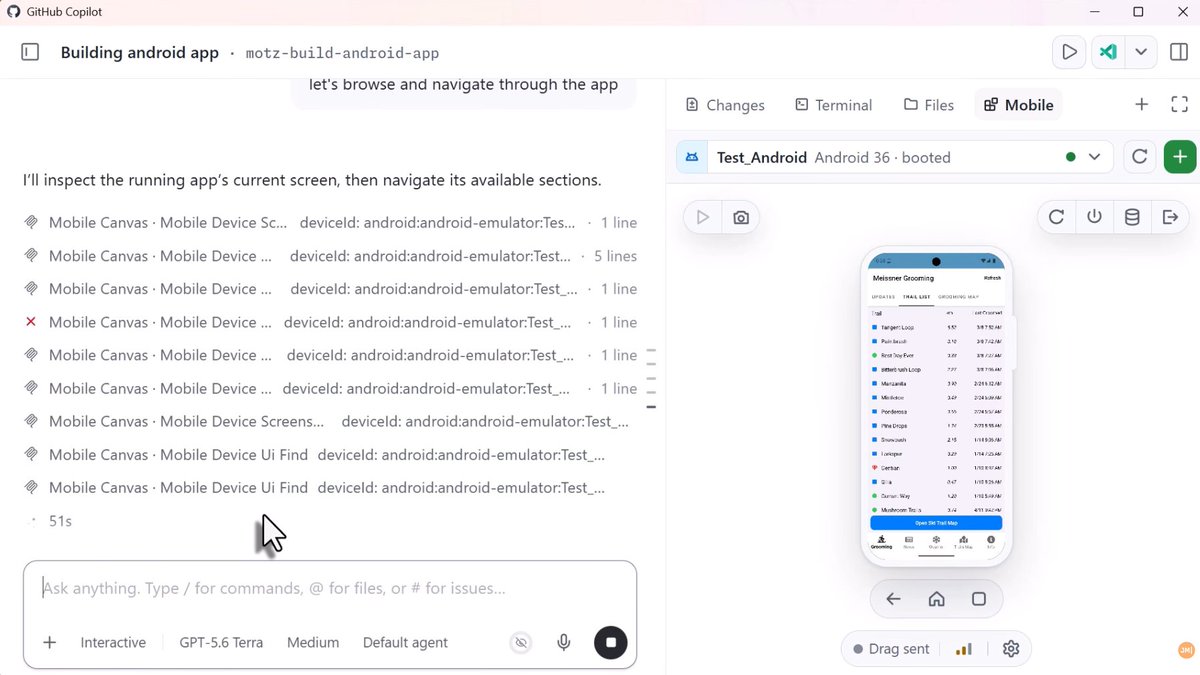
@pierceboggan announced (53 likes, 2 replies, 2,189 views, 14 bookmarks) that users can now build and test iOS and Android apps directly in the GitHub Copilot app. The screenshot was the most informative part of the evidence: it showed a Mobile tab, an Android 36 emulator, device-screen inspection, and a running sequence of mobile test/navigation actions in the same workspace. That made the feature read less like a remote trigger and more like a genuine in-surface device workflow. (post link)
@GitHubNext positioned (9 likes, 1 reply, 1,547 views, 5 bookmarks) GitHub Agentic Workflows as an enterprise control plane for rolling out org-wide changes, assessing code quality across hundreds of repositories, synchronizing dependency updates, propagating policy changes, and tracking AI token costs. The attached slide added the most useful specificity, including safe rollback, shared governance, and support across GitHub Enterprise Server and GitHub Enterprise Cloud. The common thread with the mobile-testing post was that GitHub is trying to keep more of the execution and review loop inside one managed surface. (post link)

Discussion insight: The most concise reply in this cluster was also the most revealing: one response to the mobile post simply said “complete the loop.” That matched the broader direction of the evidence better than any headline. Users are rewarding features that remove handoffs between coding, testing, review, and governance.
Comparison to prior day: The previous day's strongest GitHub signals were Azure DevOps review work, WSL support, and shared Slack/Teams sessions. On 2026-08-27, the scope widened into emulator-backed mobile testing and an explicit multi-repo enterprise control plane.
1.3 Autonomous agents were gaining support layers, not just more prompts (🡕)
The third theme was that people were not only asking agents to work longer; they were also packaging search, safety, and autonomy as explicit modules around the agent loop. The most useful evidence combined a high-visibility Codex autonomy rumor, concrete search-service pricing, and a low-volume but unusually explicit security-subagent example.
@kimmonismus reported (146 likes, 26 replies, 11,581 views, 31 bookmarks) that OpenAI is testing a “Persistent mode” for Codex that would let the agent continue working until put to sleep, create follow-up tasks for itself, carry context across sessions, and sometimes message the user first. The attached excerpt image made the claim more concrete than the tweet alone by tying it to Codex's reasoning-effort menu and to explicit “continue working until put to sleep” language. Replies immediately pushed on the practical question the launch did not answer: who pays the compute bill when the agent decides to keep going. (post link)

@ariskaa_ai described (3 likes, 2 replies, 139 views, 3 bookmarks) Keenable as an agent-oriented web-search layer spanning API, MCP, and CLI surfaces. The tweet was unusually evidence-dense for a small post, and the screenshot backed up the concrete operating details: 100,000 free requests per month after login, $4 per 1,000 requests after that, and a 10 requests/second rate limit. The important angle was not “free search” in the abstract, but that search and page fetch were being packaged as a reusable agent primitive with clean markdown output and tool-friendly interfaces. (post link)
@ntaylormullen showed (3 likes, 1 reply, 156 views, 1 bookmark) a security-review subagent with its own private vulnerability-scanning tool. The screenshot mattered because it made the boundary visible in code: a named security_reviewer subagent, its own tool list, and a private scan_vulnerabilities function. That is a stronger governance signal than a vague promise that “agents can help with security.” (post link)
Discussion insight: Even the autonomy boosters came wrapped in operational caveats. Persistent mode replies centered on unbounded bills, Keenable's pitch explicitly distinguished search credits from model credits, and the security example only felt credible because the special tool boundary was visible.
Comparison to prior day: The prior week already showed growing interest in wrappers, quotas, and portability. On 2026-08-27, that conversation got more concrete: persistent execution, search-as-infrastructure, and security-specialist subagents all appeared as named product or code surfaces.
1.4 Teams tried to formalize memory and cross-domain workflows instead of improvising them (🡕)
Another strong thread was formalization. Instead of treating memory and workflow as improvised prompting tricks, posts increasingly described explicit architectures, reusable parts, and even adjacent non-coding pipelines that borrow the same agent patterns.
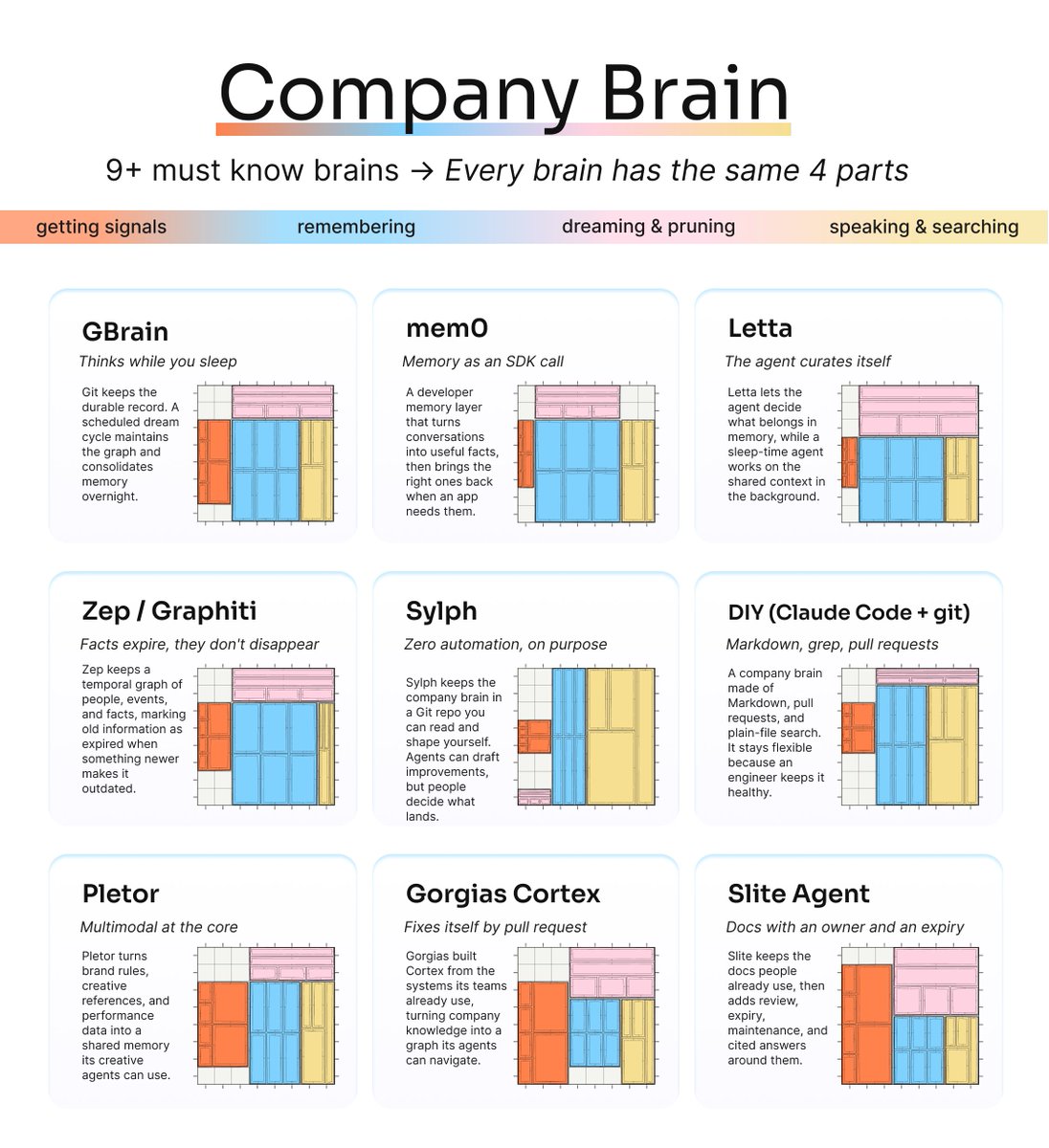
@femke_plantinga argued (12 likes, 2 replies, 304 views, 13 bookmarks) that nine different “company brain” systems all reduce to the same four parts: getting signals, remembering, dreaming/pruning, and speaking/searching. The attached image gave the claim real structure by mapping those parts across GBrain, mem0, Letta, Zep/Graphiti, DIY Claude Code + git, Gorgias Cortex, Pletor, and Slite Agent. The most useful reply added the practical warning: pruning matters more than remembering, because stale notes can look as confident as fresh ones. (post link)
@alex_verem shared (11 likes, 4 replies, 2,408 views, 15 bookmarks) OpenMontage as an open-source system that turns Claude Code into a full video-production studio. The public OpenMontage repo made the scope specific: 12 production pipelines, 100+ tools, reference-video analysis, and end-to-end research, scripting, footage selection, narration, subtitles, and final rendering, including examples with explicit low-cost outputs such as a $1.33 animated short. The important signal was that the agent stack is now being treated as orchestration infrastructure for adjacent production work, not just for code edits. (post link)
Discussion insight: The memory and builder posts both converged on the same lesson: the hard part is not only generating more output, but deciding what to keep, what to validate, and how to carry process forward without letting the system drift.
Comparison to prior day: Earlier reports in the week already highlighted skills, runbooks, and control planes. On 2026-08-27, those ideas appeared in more concrete forms: a four-part memory taxonomy and a shipped agentic workflow package far outside everyday coding.
2. What Frustrates People
Reliability work is still prerequisite work
This was High severity because even launch-day enthusiasm kept pointing back to runtime stability. @shengzheyao reported (87 likes, 14 replies, 3,638 views) that Antigravity CLI 1.1.22 needed less CPU, dropped fewer runs, and behaved better on Windows, which means those were still active pain points in daily use rather than old bugs. @antigravity admitted (261 likes, 10 replies, 10,901 views, 99 bookmarks) that Teamwork is token-heavy and “overkill for everyday tasks,” while @pierceboggan showed mobile build/test running inside Copilot, which raises the bar for emulator, device, and workflow reliability. The coping strategy visible in the data is to celebrate ambitious surfaces while still rewarding the teams that tighten CPU, Windows, and dropped-run behavior underneath them. This is worth building for directly because the most advanced workflows fail first when the runtime is noisy.
Nobody agrees how long-lived memory should be stored, pruned, or reviewed
This was also High severity because the disagreement was about core architecture, not preference. @femke_plantinga said (12 likes, 2 replies, 304 views, 13 bookmarks) that every “company brain” has the same four parts, but the examples in the image still ranged from repo-local markdown and pull requests to memory SDKs, temporal graphs, doc watchers, and self-curating agents. The strongest discussion nuance came from a reply that stale notes can be worse than missing notes because they read as confidently as fresh ones, so pruning matters more than simple accumulation. Teams are coping by keeping humans in the approval loop, using PRs as the review boundary, and making freshness explicit. This is clearly worth building for.
More autonomy means murkier budgets and guardrails
This was Medium-to-High severity, and the evidence was unusually concrete. @kimmonismus reported Persistent mode for Codex, but replies immediately asked who pays when an agent “keeps going indefinitely.” @ariskaa_ai described a search layer with a shared public pool, post-login limits, and explicit paid-overage pricing, while @ntaylormullen made a private security-review tool boundary visible in code. The common workaround was to add more explicit scaffolding around the agent: separate pools, named tools, and clear approval boundaries. That makes this frustration partly operational and partly a product-opportunity problem.
3. What People Wish Existed
Richer inline artifacts that explain work without forcing another context switch
The clearest practical need was for agents to show their work in forms that are easier to inspect than plain text. @antigravity introduced (811 likes, 40 replies, 38,617 views, 261 bookmarks) Interactive Generative UI Artifacts, and the linked blog described local interactive components, charts, diagrams, and offline export from the same workspace. The mobile-testing screenshot from @pierceboggan showing Copilot inspecting an Android emulator in-place reinforced the same underlying need: people want the evidence, not just the answer, to stay in the same surface. Opportunity: Direct.
Durable company memory that stays fresh instead of turning into stale lore
People clearly want long-lived memory, but they do not want a memory layer that silently rots. @femke_plantinga mapped systems across mem0, Letta, Zep/Graphiti, Slite Agent, and DIY git-plus-markdown approaches, while the strongest reply said old notes should have to “earn” their place or be dropped. The need is practical rather than aspirational: teams want signals, remembering, pruning, and search in one architecture with reviewable freshness rules. Opportunity: Competitive.
Plug-in support layers for autonomous agents: search, security, and budget control
The data also showed demand for reusable infrastructure around the agent loop rather than only for smarter base models. @ariskaa_ai described an agent search layer spanning MCP, CLI, and API with public and logged-in limits, @ntaylormullen showed a security-review subagent with a private tool, and @kimmonismus surfaced persistent execution without a matching budget answer. This is a direct opportunity because the missing pieces are already legible: searchable web context, governed specialist tools, and clearer spend boundaries.
One agent loop that survives the move from coding to testing to organization-wide rollout
A quieter but strong need was continuity across scales. @pierceboggan moved Copilot into device testing, while @GitHubNext framed GitHub Agentic Workflows around policy propagation, dependency coordination, and rollback across many repositories. The practical need is not “more features”; it is one reviewable loop that can keep context as work moves from a local app surface to fleet-scale automation. Opportunity: Direct.
4. Tools and Methods in Use
| Tool | Category | Sentiment | Strengths | Limitations |
|---|---|---|---|---|
| Antigravity | Agent workspace | (+) | Interactive artifacts, local visualizations, artifact-panel review, faster path from explanation to inspection | Heavier workflows still depend on runtime stability and can be overkill for routine tasks |
| Teamwork in Antigravity | Multi-agent orchestration | (+/-) | Pattern-based coordination across coding, proof, verification, and document review; explicit long-horizon positioning | Token-heavy and openly described as too much for everyday work |
| GitHub Copilot app | Agent workspace / mobile testing | (+) | In-app iOS/Android build-test flow, device inspection, and unified workspace context | Limited grassroots evidence today beyond the launch screenshot |
| GitHub Agentic Workflows | Enterprise automation | (+) | Multi-repo coordination, governance, rollback, cost tracking, and policy propagation | Enterprise-oriented, with low practitioner detail in this sample |
| Codex Persistent mode | Agent mode | (+/-) | Long-running follow-up work, cross-session continuity, and proactive task creation | No launch date, unclear budget controls, and immediate concern about runaway spend |
| Keenable | Search infrastructure | (+) | API, MCP, and CLI access; clean markdown fetch; concrete free-tier and post-free pricing | Founder-launch caveats, shared public pool limits, and no model credits included |
| mem0 / Letta / Zep/Graphiti / git-plus-PR memory | Memory stack / method | (+/-) | Makes memory architecture explicit; supports freshness, temporal history, or repo-local review | Staleness, pruning, and review boundaries remain unsettled |
| OpenMontage | Agentic workflow package | (+) | Turns coding assistants into a full research-to-render video pipeline with reference analysis and concrete cost examples | Broader and more complex than a normal coding workflow; depends on a large tool stack |
The satisfaction curve was highest when a tool removed a specific coordination tax. @antigravity made rich inline artifacts concrete, @pierceboggan showed Copilot staying with the work all the way into an emulator, and the OpenMontage repo turned a coding assistant into a full production pipeline rather than another chat shell.
Satisfaction fell whenever the support scaffolding stayed implicit. @kimmonismus surfaced a persistent agent mode without a clear bill boundary, @shengzheyao called out CPU, dropped-run, and Windows fixes, and @femke_plantinga showed that teams still disagree on how memory should be stored and pruned. The dominant workaround pattern was therefore explicit structure: repo-local docs, pull requests, named subagents, rate limits, and installable services around the agent.

5. What People Are Building
| Project | Who built it | What it does | Problem it solves | Stack | Stage | Links |
|---|---|---|---|---|---|---|
| Antigravity Generative UI Artifacts | @antigravity | Lets agents generate interactive artifacts, charts, diagrams, and local visual components inline | Markdown and static diagrams are often too weak for architecture, data, and workflow explanation | Antigravity, local HTML/CSS/JS rendering, artifact preview/export | Shipped | tweet, blog |
| Teamwork in Antigravity | @antigravity | Runs multi-agent patterns for coding, proof, verification, and document review over hours or days | Single-agent loops struggle on long-horizon, open-ended research and engineering tasks | Antigravity, Gemini models, pattern-based orchestration, /teamwork-preview |
Beta | tweet, blog |
| GitHub Copilot mobile build/test | @pierceboggan | Builds and tests iOS and Android apps inside the Copilot app | Keeps device testing and app navigation inside the same agent workspace instead of handing work to another tool | GitHub Copilot app, Mobile tab, Android emulator, mobile canvases | Shipped | tweet |
| OpenMontage | calesthio/OpenMontage | Turns a coding assistant into a full video-production system | Research, scripting, footage selection, narration, subtitles, and rendering are normally split across many tools | 12 pipelines, 100+ tools, 700+ skill files, local/cloud model support | Shipped | repo, tweet |
| GitHub Agentic Workflows | @GitHubNext | Coordinates repetitive multi-repo work such as dependency sync, policy propagation, and backlog reduction | Gives organizations a control plane for governed agentic work at repository-fleet scale | GitHub platform, auditing, cost controls, GitHub Enterprise Server/Cloud | Beta | tweet |
The projects were notable because they all tried to own a coordination layer rather than just expose another model endpoint. Antigravity's two launches focused on how work is represented and how multiple agents cooperate. GitHub's launches kept pushing the same direction from the opposite side: fewer handoffs between repository context, device testing, and governed organizational rollout.
OpenMontage was the clearest cross-domain builder signal. The repo frames the agent as a production team that can analyze a reference video, choose a pipeline, assemble assets, and render the result with explicit cost examples. That is a meaningful pattern because it shows the agent-workflow stack being reused in adjacent creative pipelines rather than staying trapped inside code review and bug fixing.
6. New and Notable
Agent-native search pricing became unusually explicit
@ariskaa_ai described (3 likes, 2 replies, 139 views, 3 bookmarks) Keenable as an agent-oriented search layer with API, MCP, and CLI surfaces, but the truly notable part was the operating detail visible in the screenshot: 100,000 free requests per month after login, $4 per 1,000 requests after that, and 10 requests per second. That matters because search and page fetch are often treated as invisible plumbing; here they were packaged and priced like a first-class part of the agent stack.
Security-specialist subagents became visible as code, not just product copy
@ntaylormullen showed (3 likes, 1 reply, 156 views, 1 bookmark) a security-review subagent wired to a private vulnerability scanner. The screenshot mattered because the boundary was explicit: a named subagent, a distinct tool list, and a scoped security purpose. That is a stronger signal than vague “AI for security” language because it shows how specialized agent roles may actually be enforced.

7. Where the Opportunities Are
[+++] Reviewable long-horizon orchestration — Teamwork, Codex Persistent mode, Copilot mobile testing, and GitHub Agentic Workflows all point to the same gap: agents are being asked to do more work over more time, but users still need artifacts, budgets, and rollback controls that make the work reviewable. (sources, 1, 2, 3)
[+++] Fresh company-brain infrastructure — The company-brain survey, repo-local DIY patterns, and human-approval examples all say memory is valuable only if it stays fresh, pruned, and reviewable. The need is strong because teams are already building the pieces, but not converging on one design. (sources)
[++] Richer inline explanation surfaces — Interactive artifacts and device-level Copilot screenshots both show the value of keeping evidence beside the work. The moderate signal is not about prettier UI; it is about reducing context switches while preserving inspectability. (sources, 1)
[++] Agent support services for search, security, and policy — Keenable's search layer, the security-reviewer subagent example, and GitHub's enterprise workflow framing all suggest a growing market for agent-adjacent services that teams can install without replacing their whole client. (sources, 1, 2)
8. Takeaways
- Antigravity's differentiation moved from “where the agent runs” toward “what the agent can show and coordinate.” Interactive artifacts, Teamwork patterns, and the reliability release together showed a platform maturing around explanation and orchestration, not only around another chat surface. (source)
- GitHub's agent story kept widening across both local testing and organizational control. The mobile build/test workflow and GitHub Agentic Workflows slide point to a single ambition: keep more of the execution, validation, and rollout loop inside managed agent surfaces. (source)
- Autonomy is arriving together with support infrastructure. Persistent execution, reusable search layers, and scoped security subagents all show that longer-running agents need explicit services around them, not just a better base model. (source)
- Memory architecture is becoming its own product category. The company-brain post made the tradeoffs legible: remembering is easy to promise, but freshness, pruning, and approval boundaries are what determine whether the system stays useful. (source)
- Builder energy is spreading beyond software delivery into adjacent production systems. OpenMontage was the clearest example of the day: a coding-assistant stack repurposed into an auditable, promptable video-production pipeline. (source)