Twitter AI Coding - 2026-08-29
1. What People Are Talking About
1.1 GitHub Copilot attention widened from collaboration features to acquisition and training surfaces (🡕)
The largest GitHub/Copilot signal was not a benchmark or model-comparison thread. It was a mix of distribution, onboarding, and surface expansion: student-only free access, GitHub’s own Copilot release thread, and tutorial content that packaged Copilot into an agent-ready Java workflow. Several posts supported the pattern, with the highest raw engagement going to student-pack access rather than to a new coding feature.
@alannnfx said (211 likes, 25 replies, 28,145 views, 361 bookmarks) that GitHub was giving students two years of Copilot Pro plus 100+ tools through the Student Developer Pack, and the attached screenshot showed the concrete bundle: Copilot Pro, free domains, and cloud credits. The replies were operational rather than skeptical, with people asking how to activate the .edu flow, which made the post read like a distribution play instead of ordinary product hype. (post link)

@github said (174 likes, 14 replies, 55,459 views, 40 bookmarks) that it had shipped “5 things” to Copilot recently, and the reply chain filled in the substance: shared Slack and Teams sessions, a Customize tab, more generally available models, and a Sessions sidebar in Copilot CLI. The public Customize tab changelog made the packaging explicit by putting MCP servers, plugins, skills, and canvases into one discovery surface rather than scattering them across separate docs and installers. (thread)
@github showed (24 likes, 3 replies, 3,696 views) Copilot working inside a shared chat thread, and the screenshot showed a code channel opened from the conversation, with the generated chart returned back into the same thread. That matters because the collaboration story is no longer only “Copilot in the editor”; it is shared agent work with visible artifacts in the team’s existing communication surface. (post link)

@code said (55 likes, 2 replies, 10,417 views, 16 bookmarks) that its latest VS Code Learn: Java series walks people from a Spring Boot app to MCP tools and Playwright tests with Copilot in the loop. Even though the destination link resolves to a public YouTube playlist, the tweet itself was the important signal: GitHub and VS Code are teaching agent-ready workflows as a curriculum, not only shipping features piecemeal. (post link)
Discussion insight: The day’s strongest Copilot engagement clustered around reach and usability. Student-pack replies asked how to get in, while GitHub’s own release posts emphasized where Copilot can be used, how it can be customized, and how it can stay visible in team chat.
Comparison to prior day: On 2026-08-28, GitHub Copilot already looked like a collaborative control plane. On 2026-08-29, that same story widened into acquisition and training: free student access, packaged learning content, and more surfaces for getting people into the workflow.
1.2 Builders kept packaging AI coding discipline as reusable skills, workflow engines, and repo policy files (🡕)
The clearest builder shift was away from “better prompting” and toward portable process layers. Three of the most useful items described reusable skill packs, shared repository instructions, and installable workflow systems that can travel across Copilot, Claude Code, Cursor, Codex, and other agent clients. The emphasis was on making good behavior repeatable rather than on squeezing one more trick out of a single session.
@DivyanshT91162 said (59 likes, 2 replies, 3,244 views, 69 bookmarks) that K-Dense’s Scientific Agent Skills gives agents 163 ready-to-use research skills, 100+ scientific databases, and broad client compatibility. The public Scientific Agent Skills repository confirmed the portability angle by positioning the package around the open Agent Skills and Agent Plugins standards, while also linking a local BYOK desktop co-scientist powered by the same skill library. (post link)

@stretchcloud argued (7 likes, 2 replies, 642 views, 8 bookmarks) that AGENTS.md has become the shared config layer for agents, with the format now under Agentic AI Foundation stewardship and surrounded by related markdown files such as SKILL.md, REVIEW.md, and MEMORY.md. Public AAIF project documentation and Linux Foundation reporting linked from the same ecosystem made the governance claim legible; the tweet’s distinctive contribution was the practical taxonomy of which markdown files now carry policy, procedure, and memory for coding agents. (post link)

@DanKornas said (8 likes, 2 replies, 435 views, 2 bookmarks) that Gem Team exists to turn AI coding into a structured engineering workflow with routing, planning, implementation, verification, learning, and model-tier selection. The public Gem Team repository backed that up with a route-plan-build-verify-learn loop, risk-based quality gates, and APM installs across Copilot, Claude, Cursor, Codex, Gemini, OpenCode, and Windsurf. (post link)
Discussion insight: These posts did not compete on raw model performance. They competed on structure: reusable skills, repo-level rules, model routing, and verification gates that can survive across tools and sessions.
Comparison to prior day: On 2026-08-28, builders were already exposing planners, evaluators, and loop structure. On 2026-08-29, that same instinct got packaged into standards and installable workflow kits that can move from one agent client to another.
1.3 Reliability work kept moving down into quotas, truncation, and browser grounding (🡕)
The most evidence-dense reliability posts were about what happens when the agent hits the real world: quota pools, oversized tool responses, and selectors that look right in theory but fail against the live DOM. Several posts supported this, and the strongest ones all replaced general advice with concrete instrumentation, diagrams, or measured findings.
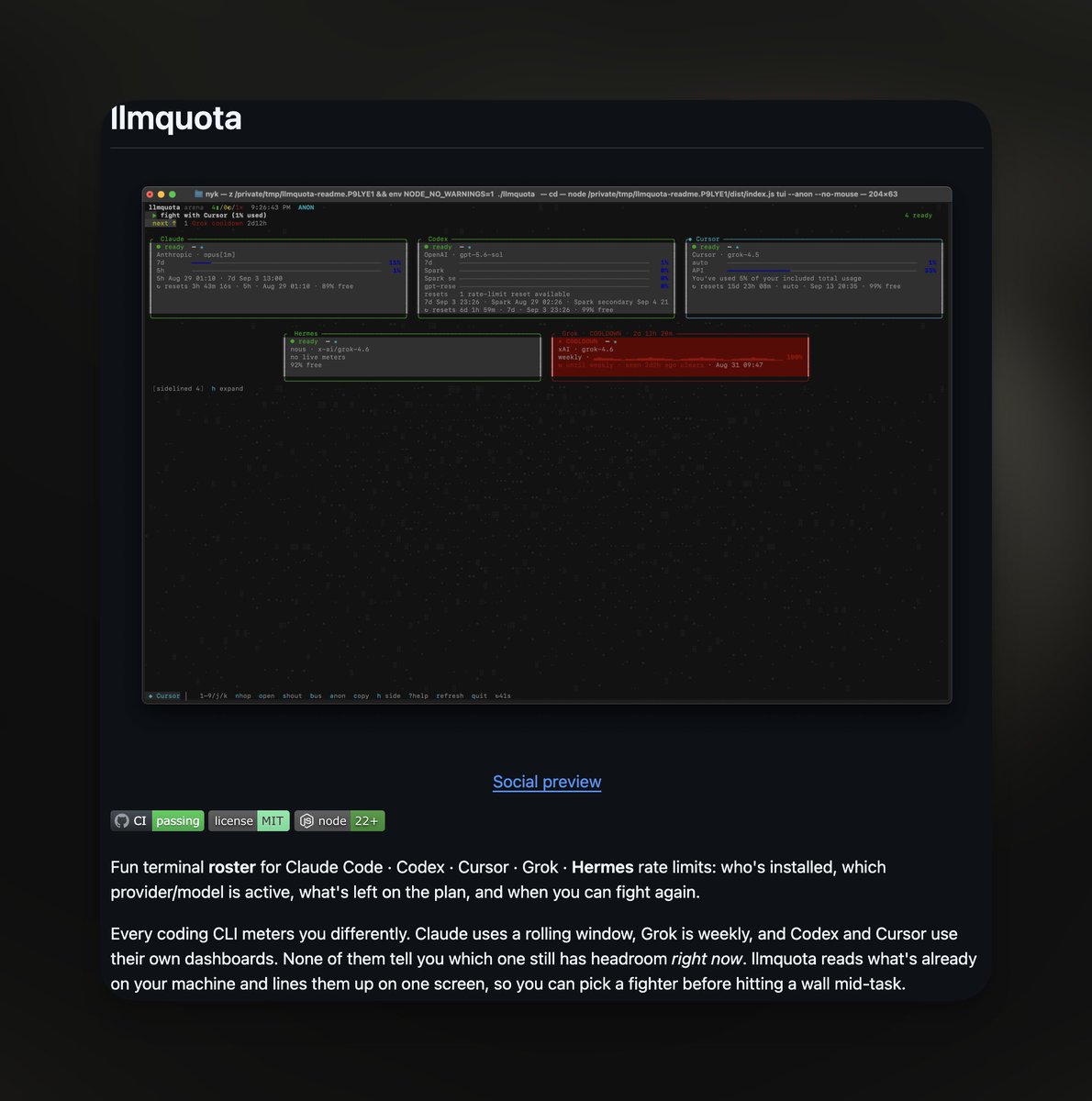
@nykdotdev said (16 likes, 1 reply, 811 views, 19 bookmarks) that running multiple coding agents creates two coordination problems: which agent still has quota, and what the other sessions are already doing. The public llmquota repository showed the proposed answer in detail: a local arena for live usage across Claude, Codex, Cursor, Grok, and Hermes, plus a repo-aware bus for direct messages, handoffs, and resumable work with no hosted coordinator. (post link)
@shivam74689 reported (13 likes, 7 replies, 356 views, 6 bookmarks) building a browser-based pricing extraction workflow that splits planning, execution, extraction, and validation into separate layers. The diagrams did the real work: one laid out the chain from goal to PricingExtractor, and another showed that a conceptually correct selector for GitHub Copilot pricing still failed because the expected element did not exist in the live rendered DOM, leading to a 30-second timeout. (post link)


@simplifyinAI said (13 likes, 1 reply, 1,568 views, 7 bookmarks) that University of Luxembourg researchers found coding agents effectively never ask for a second page of results once a tool response gets truncated. The linked public paper title on arXiv matched the screenshot, and the tweet’s quantified summary was the key takeaway for practitioners: 37% of get_epics calls and 28% of get_merge_request_diffs calls exceeded budget in production telemetry, but follow-up pagination requests were still observed zero times. (post link)
Discussion insight: Reliability work here was less about choosing a better frontier model and more about placing control where failures actually happen: quota dashboards, tool-response selection, DOM verification, deterministic extraction, and explicit handoff state.
Comparison to prior day: On 2026-08-28, people were reverse-engineering hidden routing and context behavior. On 2026-08-29, builders responded with local meters, public failure diagrams, and research that treats truncation as a correctness problem instead of just a cost problem.
1.4 Provider portability and quota structure stayed in the critical path (🡒)
The provider story remained strong, but the tone shifted from abstract debate to concrete operating details: resets, dedicated pools, and contract clauses. The items that landed were specific about what was changing and what users still could not see clearly.
@DanDr1s said (62 likes, 5 replies, 2,967 views, 4 bookmarks) that OpenAI had reset usage for paid Codex and ChatGPT Work users and claimed limits should now last 10% to 50% longer. The quoted public post from @thsottiaux mattered because it named the waste sources: compaction, lingering memory workers, runaway goals, over-frequent automations, unintended subagent escalation, repeated computer-history summaries, rolling task summaries, and double-encoded MCP results. (post link)
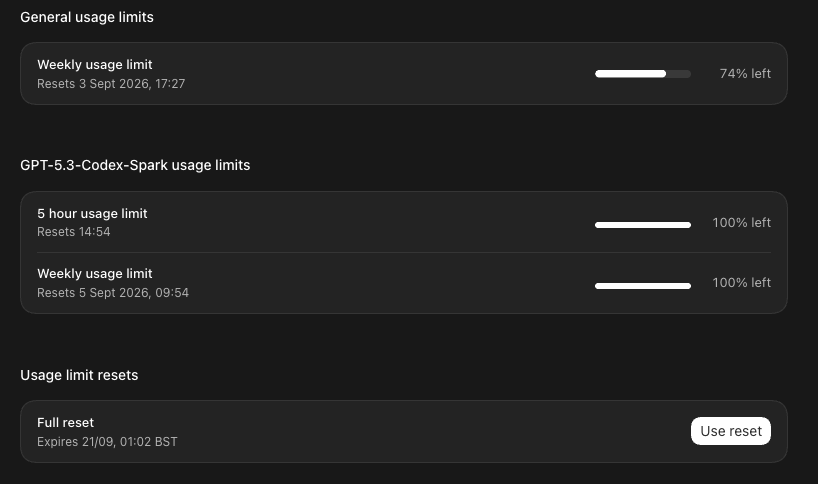
@LuminaBench said (20 likes, 1 reply, 1,179 views, 1 bookmark) that OpenAI should provide a dedicated Luna pool instead of Spark, framing the request around price and usefulness rather than brand loyalty. The attached screenshot made the pool structure visible by showing a general weekly bar, a separate Codex Spark allocation, and a reset control, which is exactly the kind of interface people were arguing about in public. (post link)
@shashib reported (5 likes, 2 replies, 358 views, 1 bookmark) that OpenAI proposed ending direct model access for Cursor on November 12 after SpaceX acquired Anysphere, while arguing the product could keep shipping because Claude, Gemini, and Grok were already in the menu and OpenAI carried only about 5% of Cursor traffic. The distinctive angle was not outrage but architecture: if a model supplier leaves, the coding product survives only if multi-provider routing is already real. (post link)
Discussion insight: These posts treated quotas and providers as product surfaces. Users were not only asking which model is best; they were asking which pool a task burns, how resets work, and how much of a coding tool can keep operating when one supplier exits.
Comparison to prior day: The previous day already centered on hidden configuration and economics. Today’s discussion kept the same theme alive, but with harder evidence: named bug fixes, visible pool boundaries, and an explicit cutoff date for a model-provider relationship.
2. What Frustrates People
Quota state is still too opaque for multi-agent work
This was High severity because the complaints were not generic price grumbling; they were about active work getting harder to route and predict. @nykdotdev said (16 likes, 1 reply, 811 views, 19 bookmarks) that the missing control plane is knowing both which CLI still has headroom and what the other sessions are doing, while the public llmquota repository exists specifically to stitch those views together. @DanDr1s said (62 likes, 5 replies, 2,967 views, 4 bookmarks) OpenAI had to reset usage and fix waste sources that could consume 15% to 70% of a weekly allowance, and @LuminaBench added (20 likes, 1 reply, 1,179 views, 1 bookmark) a direct request for a cheaper Luna pool instead of Spark. People are coping by tracking several tools at once, waiting for resets, or building local quota dashboards. This is worth building for directly because the frustration is operational, recurring, and already spawning its own tooling layer.
Agents still fail at the boundary between model reasoning and real tool or browser state
This was also High severity, and the evidence was unusually concrete. @shivam74689 showed (13 likes, 7 replies, 356 views, 6 bookmarks) that a browser agent could reason toward a[href='/copilot/pricing'] and still fail after a 30-second Playwright timeout because the expected element was not present in the live DOM. @simplifyinAI said (13 likes, 1 reply, 1,568 views, 7 bookmarks) production coding agents in the Luxembourg study never asked for a second page of results after truncation, even when 37% of get_epics calls and 28% of get_merge_request_diffs calls exceeded token budgets. The visible coping strategy is to add deterministic extraction, validation, ranking, and handoff rules around the model rather than trusting raw generation. This is worth building for directly because the failure modes are measurable and happen in normal workflows, not edge cases.
Low-signal AI slop and prompt-only workflows are burning reviewer attention
This was Medium severity, but the sentiment was strong. @0xbeans said (138 likes, 87 replies, 2,290 views) that they were getting buried in “ai slop” DMs, and the attached screenshot showed 597 other message requests waiting. @DanKornas said (8 likes, 2 replies, 435 views, 2 bookmarks) that AI coding needs a process instead of “another pile of prompts,” while @GohilHardy argued (10 likes, 11 replies, 170 views, 1 bookmark) that vibe coding works especially well for web and app work but not for all software development. The coping pattern here is stricter filtering and more explicit workflow gates. It is worth building for competitively because the pain is not only technical failure; it is human time being wasted on low-information outputs and uncontrolled iteration.
3. What People Wish Existed
A real control plane for quota and cross-agent coordination
The most explicit practical ask was for one place to see capacity and session state across tools. @nykdotdev said (16 likes, 1 reply, 811 views, 19 bookmarks) agents should know where capacity remains and where work left off, then backed that up with who, hop, and bus handoff examples in llmquota. This is a practical need, not an aspirational one, because the problem appears only after people are already using multiple coding agents in parallel. Opportunity: Direct.
Shared standards for repo instructions, reusable skills, and installable workflow packs
Today’s process-heavy posts all implied the same need: a portable way to carry policy and procedure across Copilot, Claude Code, Cursor, Codex, and neighboring tools. @stretchcloud said (7 likes, 2 replies, 642 views, 8 bookmarks) that AGENTS.md now sits inside a wider family of markdown control files, @DivyanshT91162 showed (59 likes, 2 replies, 3,244 views, 69 bookmarks) a research-skill library that works across several agent clients, and the public Gem Team repository packages route-plan-build-verify-learn as a reusable install. The need is practical because people already have pieces of the answer, but the ecosystem is still stitching them together by hand. Opportunity: Competitive.
Browser and tool pipelines that can prove they are grounded before they act
The browser-extraction and pagination posts both pointed to the same missing capability: agents need better ways to verify that the page, selector, or first chunk they are using is the right one before they continue. @shivam74689 showed (13 likes, 7 replies, 356 views, 6 bookmarks) the gap between conceptual correctness and live-DOM grounding, while @simplifyinAI reported (13 likes, 1 reply, 1,568 views, 7 bookmarks) that production agents in the Luxembourg study effectively never paginated for the missing second chunk. This is an urgent practical need because both failures happen during ordinary task execution, not only in advanced research demos. Opportunity: Direct.
Cheaper and clearer access pools for people who cannot live inside premium plans
The day’s strongest access signals came from two different directions. @LuminaBench said (20 likes, 1 reply, 1,179 views, 1 bookmark) OpenAI should expose a dedicated Luna pool instead of Spark, which is explicit wish-language around a cheaper and more legible quota structure. At the same time, @alannnfx said (211 likes, 25 replies, 28,145 views, 361 bookmarks) that the Student Developer Pack route unlocks two years of Copilot Pro, and the public Student Offers directory describes 589+ verified offers with 83 development tools. That combination suggests the need is both practical and urgent: people are actively chasing special pools, credits, and eligibility paths to get usable AI coding access. Opportunity: Direct.
4. Tools and Methods in Use
| Tool | Category | Sentiment | Strengths | Limitations |
|---|---|---|---|---|
| GitHub Copilot app and shared chat integrations | Agent workspace / collaboration surface | (+) | Shared sessions in Slack/Teams, model availability, customization, and session management across app and CLI surfaces | Value depends on plan access, budget, approvals, and what integrations a team has enabled |
| Scientific Agent Skills | Skill library / domain workflow pack | (+) | 163 research skills, 100+ databases, and portability through Agent Skills and Agent Plugins standards | Best fit is specialized scientific work; setup and scope are heavier than a simple coding assistant |
| Gem Team | Workflow orchestration pack | (+) | Route-plan-build-verify-learn loop, risk-based quality gates, and model-tier routing across multiple coding clients | Adds process and install overhead; strongest when teams want disciplined workflows rather than ad hoc chat |
| llmquota | Quota router / local control plane | (+) | Unifies live headroom across several coding CLIs and adds repo-aware handoff messaging without a hosted coordinator | Solves observability and coordination, not the underlying provider limits or pricing |
| Playwright + deterministic extractor + Pydantic | Browser-agent method | (+) | Separates browsing from extraction and validation; catches plan-name and schema errors before final output | Still brittle when the live DOM does not match the model’s conceptual selector |
| AGENTS.md | Repository instruction standard | (+/-) | Gives agents a shared markdown control layer for repo rules, procedures, review criteria, and memory conventions | Ecosystem conventions are still settling, with multiple adjacent files and scoping patterns |
| Codex / ChatGPT Work | Managed coding-agent service | (+/-) | Strong enough adoption that OpenAI is publishing detailed usage-fix notes and reset behavior in public | Pool structure, hidden waste, and reset semantics still create confusion and frustration |
| Cursor’s multi-model stack | Multi-provider coding surface | (+/-) | Can keep operating across Claude, Gemini, Grok, and OpenAI rather than depending on one supplier | Contract changes can still remove a model path overnight, exposing platform dependency |
Satisfaction was highest when a tool made process or state more explicit. @DivyanshT91162 brought (59 likes, 2 replies, 3,244 views, 69 bookmarks) Scientific Agent Skills into the discussion as a portable skill layer, @DanKornas framed (8 likes, 2 replies, 435 views, 2 bookmarks) Gem Team as a repeatable engineering loop, and @nykdotdev showed (16 likes, 1 reply, 811 views, 19 bookmarks) llmquota as a local control plane for capacity and handoffs.
Satisfaction dropped when the system state stayed hidden or brittle. @DanDr1s summarized (62 likes, 5 replies, 2,967 views, 4 bookmarks) usage waste inside Codex and ChatGPT Work, @shivam74689 documented (13 likes, 7 replies, 356 views, 6 bookmarks) live-DOM selector failure in browser automation, and @shashib used (5 likes, 2 replies, 358 views, 1 bookmark) the Cursor/OpenAI split to underline why multi-provider routing matters. The visible migration pattern was therefore away from single-surface assistants and toward cross-tool stacks that combine quotas, skills, workflow packs, repo policy files, and provider redundancy.
5. What People Are Building
| Project | Who built it | What it does | Problem it solves | Stack | Stage | Links |
|---|---|---|---|---|---|---|
| GitHub Copilot Customize tab | @github | Centralizes discovery and installation of MCP servers, plugins, skills, and canvases inside the Copilot app | Copilot customization was spread across separate docs and install paths, making tool discovery harder | GitHub Copilot app, MCP, plugins, skills, canvases | Shipped | tweet, changelog |
| GitHub Copilot in shared chat threads | @github | Lets teams start and review agent work from Slack and Teams conversations | Teams want agent work, diffs, and outputs to stay visible where coordination already happens | GitHub Copilot, Slack, Teams, shared agent sessions | Beta | tweet, thread |
| Scientific Agent Skills | K-Dense / @DivyanshT91162 | Turns a general agent into a research assistant with 163 skills, 100+ databases, and scientific integrations | Generic coding agents lack explicit workflows for research-heavy scientific tasks | Agent Skills standard, Agent Plugins, Python scientific packages, K-Dense BYOK | Beta | tweet, repo |
| llmquota | @nykdotdev | Adds a local TUI for quota routing plus repo-aware messaging and handoffs across coding CLIs | Multi-agent work breaks down when users cannot see remaining capacity or coordinate open sessions | Node 22+, local CLI state, repo-aware bus, multi-CLI quota probes | Beta | tweet, repo |
| Browser-based pricing extraction workflow | @shivam74689 | Plans a browser task, executes it through Playwright, extracts structured pricing data, and validates the result | LLM-only browser automation is too brittle for reliable structured extraction | Planner, PlanRunner, BrowserAgent, Playwright, deterministic extractor, Pydantic | Alpha | tweet |
| Gem Team | @DanKornas | Installs a cross-tool workflow that routes, plans, builds, verifies, and learns with risk-based quality gates | One-off prompting creates inconsistent quality, wasted tokens, and no durable engineering process | APM, model routing, orchestrator/specialist agents, harness installs for Copilot/Claude/Cursor/Codex/Gemini/OpenCode/Windsurf | Beta | tweet, repo |
The strongest build pattern was packaging process as a product. GitHub bundled collaboration and customization into Copilot surfaces; K-Dense bundled research workflows into portable skills; llmquota bundled quota visibility and handoff messaging into one local terminal; and Gem Team bundled workflow discipline into an installable cross-tool system.
The common trigger was hidden state. llmquota exists because capacity and session context are fragmented, the browser-pricing workflow exists because selectors and extraction fail at runtime, and Gem Team exists because ad hoc prompting does not preserve quality gates or learning. Multiple builders therefore converged on the same structure: explicit layers, shared rules, reusable procedures, and visible checkpoints.
6. New and Notable
OpenAI published a much more detailed public explanation of wasted Codex and Work usage
@DanDr1s said (62 likes, 5 replies, 2,967 views, 4 bookmarks) that OpenAI had reset usage for paid Codex and ChatGPT Work users and that limits should last 10% to 50% longer. The quoted public update from @thsottiaux matters because it named the specific waste sources in public: compaction bugs, background memory workers, runaway goals, overly frequent automations, unintended subagent escalation, repeated computer-history summaries, rolling task summaries, and MCP encoding issues. That is notable because usage complaints moved from vague frustration into an explicit engineering postmortem. (source)
AGENTS.md kept gaining weight as shared agent infrastructure rather than personal convention
@stretchcloud argued (7 likes, 2 replies, 642 views, 8 bookmarks) that AGENTS.md now functions as the global rule layer in a broader markdown stack around skills, memory, review criteria, and scoped rules. Public AAIF documentation plus Linux Foundation reporting tied from that ecosystem make the stewardship claim verifiable. That is notable because repository markdown is increasingly being treated like runtime configuration for agents, not only as human documentation. (source)
Provider redundancy became the concrete reason a coding product can survive a supplier breakup
@shashib reported (5 likes, 2 replies, 358 views, 1 bookmark) that OpenAI plans to end direct model access for Cursor on November 12 after the SpaceX acquisition, then used the product’s existing Claude, Gemini, and Grok support to argue Cursor can continue shipping. That is notable because it translates “multi-model support” from a marketing bullet into a resilience story with a real cutoff date and a real contract trigger. (source)
The Luxembourg pagination paper turned silent tool truncation into a named coding-agent failure mode
@simplifyinAI said (13 likes, 1 reply, 1,568 views, 7 bookmarks) that production coding agents never requested a second page of results after truncation in the underlying telemetry study. The public paper title on arXiv confirms the result space, and the tweet’s concrete numbers made the practitioner impact easy to understand. That is notable because it gives builders a sharper target than “context limits are annoying”: the first chunk effectively decides what the agent can see. (source)
7. Where the Opportunities Are
[+++] Unified multi-agent control planes — llmquota, the OpenAI reset thread, and the Luna-pool request all point to the same gap: people need one place to see remaining headroom, pool boundaries, reset timing, and session handoffs across several coding agents. This is strong because the frustration is operational and already severe enough that builders are shipping their own local coordination layers. (sources, 1, 2)
[+++] Portable process packs for AI coding — Scientific Agent Skills, AGENTS.md, and Gem Team all treat repeatable procedure as the real product. The opportunity is strong because multiple independent builders are converging on the same primitives: skills, repo rules, workflow depth, verification gates, and cross-tool installs. (sources, 1, 2)
[+++] Grounded execution layers for browsers and oversized tool outputs — The browser-pricing workflow and the Luxembourg pagination result both show that agents still break when they cannot prove what page element or tool chunk they are acting on. This is strong because the failure modes are concrete, recurrent, and attached to ordinary task execution. (sources, 1)
[++] Provider-portable coding products — The Cursor/OpenAI split shows why multi-model support matters after a contract changes, while GitHub’s Copilot thread shows the competing strategy of broadening available models and surfaces inside one product. This is a moderate opportunity because some platforms already have redundancy, but supplier dependence is still a visible risk. (sources, 1)
[++] Official access and onboarding funnels for cost-sensitive users — The Student Developer Pack post, the Student Offers directory, and the VS Code Learn Java series all drew attention by lowering the barrier to entry through free access, bundles, or guided workflows. The opportunity is moderate because the demand is obvious, but much of today’s traffic still routed through eligibility hacks, student-only paths, or third-party directories rather than a universal entry plan. (sources, 1, 2)
8. Takeaways
- Copilot attention widened into distribution and onboarding, not just product capability. The strongest Copilot engagement went to student access, while GitHub and VS Code pushed shared-chat workflows, customization, and tutorial packaging. (source)
- Reusable process beat one-off prompting as the day’s main builder instinct. Scientific Agent Skills, AGENTS.md, and Gem Team all treated skills, rules, and verification as portable infrastructure around the model. (source)
- Reliability work centered on real execution boundaries: quota pools, truncated tool output, and browser grounding. llmquota, the Luxembourg pagination result, and the browser-pricing workflow all exposed failures that happen after the model starts acting. (source)
- Quota policy and supplier dependence stayed visible parts of the AI coding experience. OpenAI’s reset-and-fixes post, the Luna-pool request, and the Cursor cutoff story all showed that provider configuration is still shaping day-to-day usability. (source)
- The ecosystem kept converging on explicit control planes. Whether the surface was Copilot’s app, llmquota’s terminal arena, or AGENTS.md in the repo, the common move was to make state, policy, and handoff more visible than the raw prompt. (source)