Twitter AI Coding - 2026-09-14
1. What People Are Talking About
1.1 Antigravity is being described as an execution surface, not a mystery model (🡕)
The strongest Google-related signal was not a new-base-model leak, but a series of public corrections about what antigravity-preview-09-2026 actually represents. Four separate high-signal items described Antigravity as an agent endpoint with sandboxed Linux execution, browser and file access, a layered permission system, and likely remote-workspace plumbing. That matters because the conversation moved away from "what weights are behind this?" toward "what can this runtime safely do?"
@HarshithLucky3 reported (205 likes, 7 replies, 9,266 views) that antigravity-preview-09-2026 is "not a model" but "the antigravity agent endpoint" hosted on a Linux sandbox with code execution, files, and browser access, and said Gemini 3.8 Flash is the default model behind it. The attached screenshot mattered because it grounded that claim in the public Google model surface rather than rumor alone.

@Soso_fun_yt published (70 likes, 8 replies, 39 bookmarks, 9,017 views) a long reverse-engineering thread arguing that Antigravity 2.13.0 already ships a compiled SSH remoting stack, including a Protobuf exa.remoting.RemotingService, live loopback endpoints returning HTTP 200, SOCKS5 tunneling, ~/.ssh/config autodiscovery, bastion support, and a hidden hideRemoteWorkspaceOption UI gate. @meteatamel added (6 likes, 907 views) a linked Medium guide showing that Antigravity's actual control surface is a permission hierarchy across global, project, and conversation scopes, with explicit rules for files, network, browser JavaScript, terminal execution, unsandboxed commands, and MCP tools.
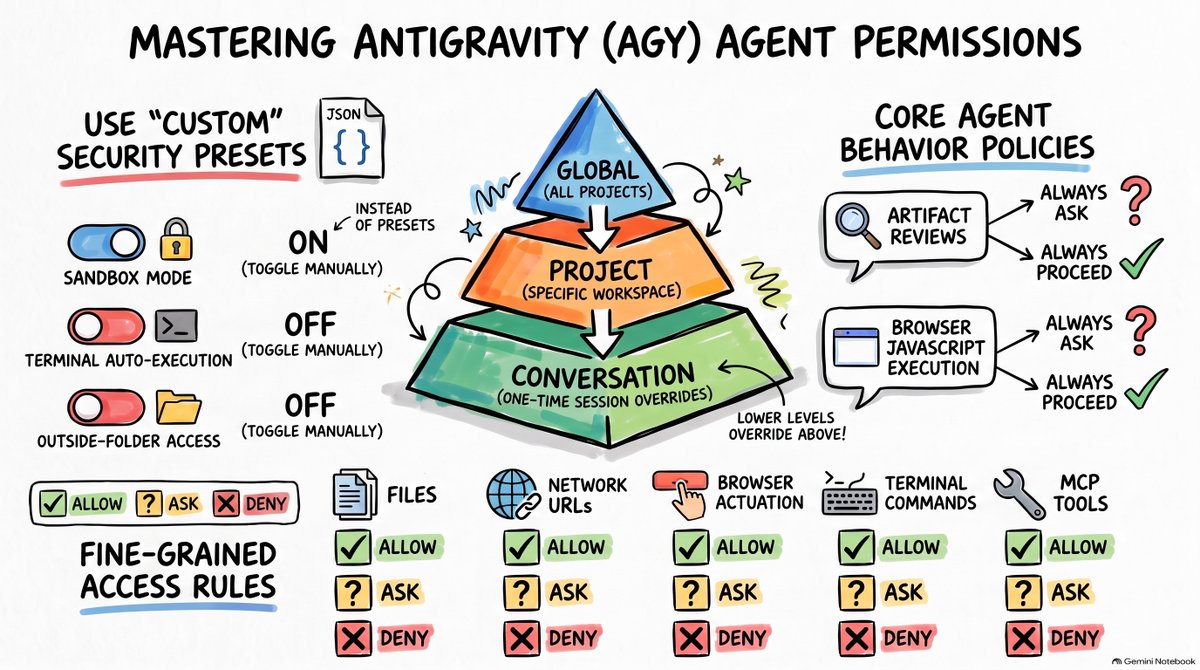
Discussion insight: The useful replies were corrective, not celebratory. Philipp Schmid replied under Harshith's thread that the listing is "related to our agent harness in the Gemini API," while another reply called it "an execution surface, not a weight." A skeptical reply under Soso's thread pushed back that "already in production" does not guarantee public release, which kept the speculation bounded.
Comparison to prior day: September 13 already treated harnesses and workspaces as the product surface. September 14 pushed that one level lower into API naming, permission boundaries, and hidden remoting infrastructure.
1.2 Cost and instruction overhead are being quantified, not merely complained about (🡕)
Quota pressure stayed central, but the tone shifted from generic frustration to operational measurement. Four retained items attached concrete numbers to the problem: depleted Astra/Codex usage, UI-limit mismatches, per-turn instruction-file cost, and model-specific guidance on which old rules now backfire. That made the day's cost theme stronger than a simple "this is expensive" narrative.
@DanDr1s wrote (223 likes, 45 replies, 7,998 views) that GPT-6 Astra is "amazing" but the usage limits are "killing it," adding that Codex drains quickly and that upgrading to Pro is not currently available even for people willing to pay more. @iliaa posted (6 likes, 3 replies, 483 views) a lower-volume but more technical example: a Whetstone-driven Antigravity review session that consumed about 1.259 billion total tokens on Gemini 3.8 Flash with about 96% cache reads, while the UI still showed 9% of the five-hour budget remaining despite plan-limit errors.

@undefinedKi measured (14 likes, 9 replies, 9 bookmarks, 1,012 views) the per-turn cost of instruction files, saying Airflow's AGENTS.md contributed 8,640 tokens per turn, or 345,600 tokens over a 40-turn session, and that deduplicating rules cut that by 22% without losing any rules. @Mnilax argued (27 likes, 20 bookmarks, 253 views) that Astra's new behavior makes older "never act without asking" rules land as real blockers, while topic-shaped skill descriptions, redundant test instructions, and "read these three docs before every edit" scaffolding now waste context or steer the model at the wrong moment.
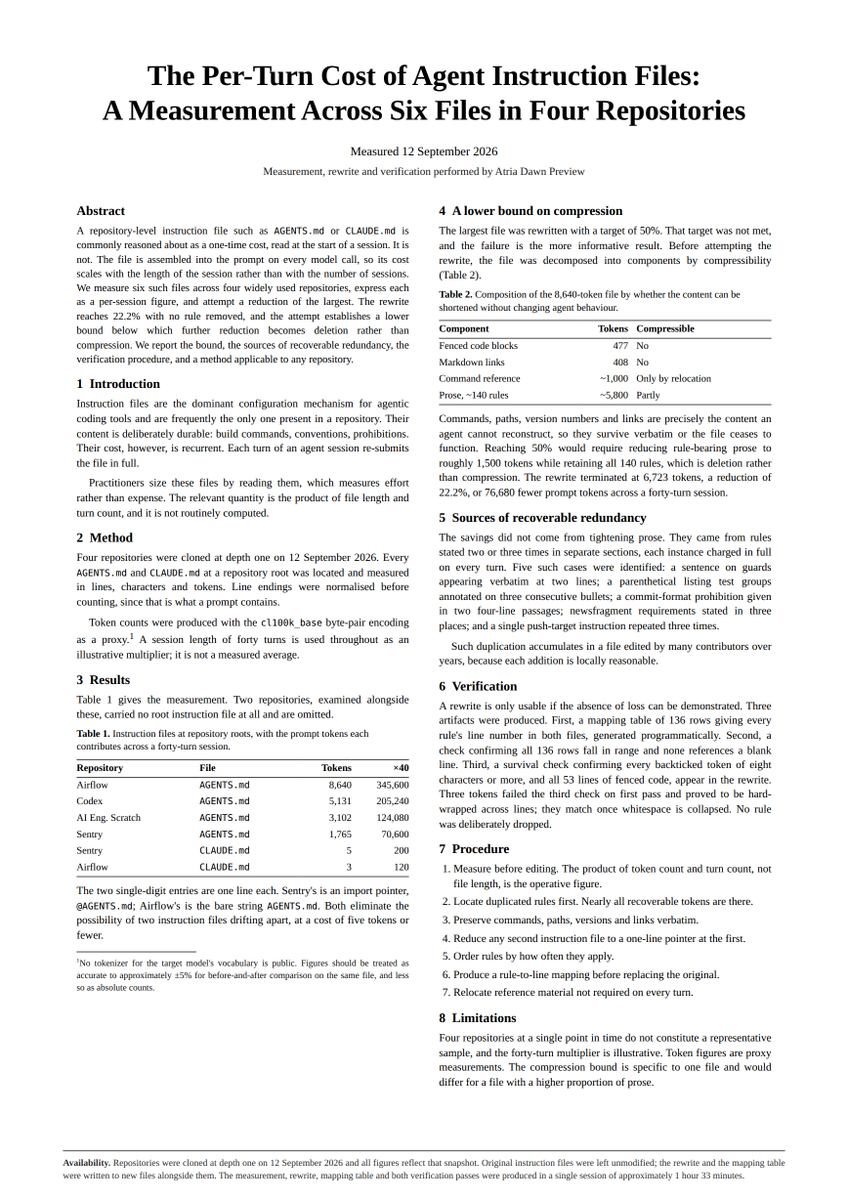
Discussion insight: Replies converged on the same workaround pattern: use cheaper models for broad implementation, keep the frontier model for architecture or final review, and prune duplicated instructions before paying for more quota. One reply to the AGENTS audit said their own stack had a 157k guide on every turn and 166 tool schemas opening a turn at 190k of a 200k context window.
Comparison to prior day: September 13 kept quota and billing friction near the top of the report. September 14 deepened that theme by making the hidden costs measurable at the level of tokens, cache reads, and recurring instruction files.
1.3 Hardening layers around agents are becoming products of their own (🡕)
Another strong pattern was that the most concrete builder energy sat around the discipline layer above the model: test harnesses, skill registries, behavioral evals, and grounded cloud plugins. Four retained items described ways to make agents more reviewable, more bounded, or easier to grade after the fact. That is a meaningful shift from generic "AI coding works" advocacy.
@OpenAIDevs shared (461 likes, 64 replies, 32,766 views) that GPT-6 Astra in Codex is helping Perplexity build end-to-end test harnesses and mock third-party API responses. The replies were useful because they immediately stressed where that pattern can fail: one reply argued that purely mocked responses can hide field renames, nulls, or 429-body changes, and recommended recording a real response and replaying it VCR-style on a schedule.
@DuncanRogoff promoted (1 like, 259 views) agent-skills, saying 13.4% of marketplace agent skills contain critical issues and positioning the project as a scanned registry for installable skills across Claude Code, Copilot, Cursor, Windsurf, and other agents. The linked public repo says the catalog is TypeScript-based, fetched on demand, and scanned with Snyk Agent Scan before publishing, which made this one of the day's more concrete supply-chain responses.

@DanKornas introduced (1 like, 1 reply, 1,129 views) Superpowers Evals, a public Quorum repo that drives real coding-agent CLIs, separates static checks from trusted live evals, and isolates each run inside a throwaway home directory. @RRweb3 framed (39 likes, 40 replies, 776 views) Google's new Google Cloud Developer Plugin as a way to stop coding agents from guessing about GCP auth, projects, and commands by bundling skills, official docs grounding, and guardrails into one installable package.
Discussion insight: The replies did not reject these hardening layers. They narrowed the bar for trusting them. In the Google Cloud plugin thread, the sharpest replies asked for read-only discovery by default, explicit elevation for mutations, and audit logs that name the acting principal.
Comparison to prior day: September 13 emphasized packaged context, maps, and bundles. September 14 turned that into a more operational stack: scanned skill registries, workflow-compliance evals, and cloud bundles with explicit guardrails.
1.4 Vendors are making routing and model-connection choices explicit (🡕)
The most product-like vendor updates were about operator control: who chooses the model, how much that choice costs, and where the agent sends its tokens. Two retained items made that explicit from different angles, and they matched the broader mood of developers wanting levers instead of black boxes.
@GHchangelog announced (17 likes, 3 replies, 1,717 views) that Copilot auto model selection now exposes efficiency, balance, and intelligence tiers across VS Code, Copilot CLI, and GitHub Copilot app. The linked changelog says the system still selects from the same model pool underneath, but now lets the user bias Auto toward lower cost, balanced tradeoffs, or higher-quality reasoning per prompt.
@alperebicoglu shared (1 like, 8 views) that ABP Studio's AI Agent added bring-your-own-key support. The linked article says Enterprise users can switch the same ABP-aware agent between built-in AI and provider connections for OpenAI-compatible services, Azure OpenAI, or Ollama, while keeping the product's project-aware tools and model-task routing surface.

Discussion insight: These are not just UI niceties. Both updates speak to the same operating concern visible elsewhere in the dataset: users want explicit control over cost, latency, quality, and data path without losing the surrounding workflow surface.
Comparison to prior day: September 11 already showed Copilot looking more like a routing and pricing layer. September 14 extended that pattern by making the routing tier and provider connection concrete product settings.
2. What Frustrates People
Quota telemetry that does not match real usage
The clearest frustration was that people can see the quality of Astra- or Gemini-backed workflows, but they do not trust the budget surfaces around them. @DanDr1s said (223 likes, 45 replies, 7,998 views) that Astra is "amazing" but its usage drains too fast and there is no working path to buy more. @iliaa added (6 likes, 3 replies, 483 views) a more technical mismatch: the UI still showed 9% of a five-hour Gemini budget remaining while plan-limit errors were already firing during a Whetstone code-review workload. The severity is High because the complaint is not abstract price sensitivity; it is the feeling that the remaining-budget display cannot be trusted during real work.
The coping strategies were visible in replies and adjacent builder posts. One reply to DanDr1s said the only sustainable setup is to route implementation to cheaper models and keep Astra for architecture or final review. @TheNwadikeLouis shipped (4 likes, 27 views) tokenmonitor, a local CLI that reads Claude Code, Codex CLI, and Gemini CLI logs to estimate usage and spend without telemetry. Worth building for: High, because the frustration spans UI truthfulness, overage paths, and self-service observability.
Instruction scaffolding that burns tokens or blocks newer models
A second frustration was that yesterday's "safe" instruction patterns can quietly become today's operational drag. @undefinedKi measured (14 likes, 9 replies, 9 bookmarks, 1,012 views) a repo-level instruction file that contributed 8,640 tokens on every turn, and said simply removing duplicated rules cut that cost by 22% with no loss of behavior. @Mnilax argued (27 likes, 20 bookmarks, 253 views) that Astra now treats old "never act without asking" phrasing as a literal stop condition, while topic-shaped skill descriptions and boilerplate test instructions make the model load the wrong guidance or pay for guidance it no longer needs.
This is Medium-High severity because it compounds invisibly. The user may think the issue is model quality or quota size when the real problem is repeated instructions, over-broad skill triggers, or a stale definition of done. The visible workarounds were to collapse duplicate instruction files, scope skills to the moment they apply, and replace blanket bans with explicit permissions for workflows that are safe. Worth building for: High, because the problem hits every turn until somebody measures it.
Cloud access and remoting are still ahead of the safety envelope
The third frustration was that capability is arriving faster than its control plane. @RRweb3 liked (39 likes, 40 replies, 776 views) the idea of a Google Cloud plugin that gives agents grounded docs and tools, but the strongest replies immediately asked whether it defaults to read-only discovery, how it scopes IAM permissions, and whether it can avoid inventing project state. @meteatamel showed (6 likes, 907 views) just how many Antigravity permission layers already exist, while @Soso_fun_yt argued (70 likes, 8 replies, 39 bookmarks, 9,017 views) that native SSH remoting infrastructure is already compiled but still hidden behind a UI gate.
The frustration is not "please give agents more power." It is "make the power legible and reviewable." People want clear permission scope, auditability, and safe escalation instead of discovering mid-run that the agent can do more than expected. Worth building for: Medium-High, because the need is obvious and repeated, but several vendors are already racing to supply partial answers.
3. What People Wish Existed
Honest spend controls and a real overage path
The strongest practical need was for budget surfaces that match lived usage. @DanDr1s said (223 likes, 45 replies, 7,998 views) people are ready to pay for higher Astra/Codex limits but cannot, while @iliaa showed (6 likes, 3 replies, 483 views) a case where visible remaining budget and actual plan-limit behavior diverged. This is a practical and urgent need. tokenmonitor partially addresses observability, but it does not solve quota policy or overage purchase inside the product itself. Opportunity: direct.
Trigger-shaped instruction systems instead of giant always-on prompt files
The dataset repeatedly implied a wish for instruction stacks that load only when useful. @undefinedKi measured (14 likes, 9 replies, 9 bookmarks, 1,012 views) the recurrent token tax of large instruction files, and @Mnilax argued (27 likes, 20 bookmarks, 253 views) that topic-shaped skills and old permission phrasing now actively misfire on Astra. The practical ask is not "fewer instructions" in the abstract; it is "load the right instruction at the right moment, and do not charge me for dead scaffolding on every turn." The Google Cloud plugin post and Google's own announcement reinforce that pattern by explicitly saying bundled skills can reduce context-window usage. Opportunity: direct.
Cloud plugins that know the docs but also know when not to act
People clearly want agents grounded in official cloud docs and tools, but they also want those agents to stop short of blind infrastructure mutation. @RRweb3 described (39 likes, 40 replies, 776 views) the Google Cloud Developer Plugin as a way to reduce guessing around auth, projects, and gcloud, while replies immediately asked for read-only discovery by default, explicit elevation for writes, principal-aware audit logs, and tighter scoping than "hand the agent your whole project." This is practical, not aspirational, and the urgency is Medium-High because the capability is already here but the trust model is still contested. Opportunity: competitive.
Native remote workspaces with visible permission boundaries
The reverse-engineering thread from @Soso_fun_yt showed (70 likes, 8 replies, 39 bookmarks, 9,017 views) that Antigravity users are actively looking for first-class SSH remoting, and @meteatamel mapped (6 likes, 907 views) the complexity of the permission model surrounding that power. The need is practical and increasingly urgent for people working on headless boxes, cloud VMs, and team infrastructure. There is no strong evidence today that a fully reviewable answer has already landed. Opportunity: direct.
4. Tools and Methods in Use
| Tool | Category | Sentiment | Strengths | Limitations |
|---|---|---|---|---|
| Antigravity | Coding agent / workspace | (+/-) | Publicly described as a sandboxed execution surface with Linux, browser, files, code execution, layered permissions, and likely SSH remoting under active development (HarshithLucky3 (205 likes, 7 replies, 9,266 views); Soso_fun_yt (70 likes, 8 replies, 9,017 views); meteatamel (6 likes, 907 views)) | Public naming is confusing enough that users mistake endpoints for new models; remoting appears gated; replies also complained about broken web search and unclear permission scope |
| GPT-6 Astra | Model / coding workflow | (+/-) | Strong enough to be used for Perplexity's end-to-end test harnesses and to motivate detailed operator guides about instruction design (OpenAIDevs (461 likes, 64 replies, 32,766 views); Mnilax (27 likes, 253 views)) | Repeated reports of fast quota burn, unavailable overage paths, and sensitivity to older "never act without asking" scaffolding (DanDr1s (223 likes, 45 replies, 7,998 views); Mnilax (27 likes, 253 views)) |
| Whetstone | Agent workflow plugin | (+) | Gives code-review and implementation workflows more structure; publicly positioned around planning, verification, and engineering discipline, and used in the Gemini mileage example (iliaa (6 likes, 3 replies, 483 views); repo) | The usage example itself surfaced how expensive disciplined review loops can become under current plan limits (iliaa (6 likes, 3 replies, 483 views)) |
| tokenmonitor | Observability CLI | (+) | Reads local Claude Code, Codex CLI, and Gemini CLI logs, estimates API-equivalent spend, and stays fully local with zero telemetry (TheNwadikeLouis (4 likes, 27 views); repo) | It improves observability, not the underlying quota policy; estimated spend is still separate from subscription enforcement |
| Google Cloud Developer Plugin | Plugin / cloud operations | (+/-) | Bundles Google Cloud skills, official-doc grounding, auth/project guidance, and gcloud guardrails for coding agents (RRweb3 (39 likes, 40 replies, 776 views); Google Cloud announcement) |
Replies questioned least-privilege defaults, mutation approval flow, and whether better docs grounding prevents project-state hallucinations |
| Agent Skills | Skill registry | (+) | Public registry with on-demand install, multi-agent support, and Snyk Agent Scan checks before publishing (DuncanRogoff (1 like, 259 views); repo) | Its very existence depends on the skill-marketplace trust problem; the headline stat was that 13.4% of marketplace skills contain critical issues |
| Superpowers Evals / Quorum | Evaluation framework | (+) | Grades workflow compliance, not just outputs; drives real coding-agent CLIs and isolates runs in throwaway homes (DanKornas (1 like, 1 reply, 1,129 views); repo) | Live evals still require permissive execution and a trusted local environment, so the framework narrows but does not remove operational risk |
| Copilot Auto model selection | Routing layer | (+) | Exposes efficiency, balance, and intelligence tiers while keeping per-prompt model selection automatic across VS Code, Copilot CLI, and the Copilot app (GHchangelog (17 likes, 3 replies, 1,717 views); changelog) | Billing still depends on whichever model Auto picks, so visibility improves without removing cost sensitivity |
| ABP Studio AI Agent BYOK | IDE agent / enterprise controls | (+) | Lets Enterprise users point the same ABP-aware agent at built-in AI, OpenAI-compatible endpoints, Azure OpenAI, or Ollama while keeping solution-aware tools (alperebicoglu (1 like, 8 views); ABP article) | BYOK is Enterprise-only, and the article says some conveniences such as Auto mode remain tied to the built-in connection |
Overall sentiment was best when a tool reduced ambiguity: better routing, clearer permissions, grounded cloud context, measurable spend, or explicit evaluation criteria. The common workaround pattern was to add another layer around the model rather than switch models outright: a plugin for process, a registry for skill trust, a local CLI for usage visibility, or a routing surface that decides when to spend on a stronger model. The main migration pattern remained "frontier model for the expensive part, cheaper or narrower layer everywhere else."
5. What People Are Building
| Project | Who built it | What it does | Problem it solves | Stack | Stage | Links |
|---|---|---|---|---|---|---|
| tokenmonitor | @TheNwadikeLouis | Local CLI that reads AI coding logs and reports token usage and estimated spend across Claude Code, Codex CLI, and Gemini CLI | Gives developers a way to see actual usage and API-equivalent cost when plan UIs feel opaque | JavaScript CLI, local log readers, zero dependencies, npm package | Shipped | repo, npm |
| Whetstone | @iliaa | Workflow/plugin layer for coding agents that emphasizes planning, verification, root-cause debugging, and review discipline | Counters the tendency of coding agents to skip process and declare work done too early | Plugin + skills, repo workflows, local installs for coding agents | Shipped | repo |
| Agent Skills | @DuncanRogoff highlighted Tech Leads Club | Scanned registry of installable agent skills for tools such as Claude Code, Copilot, Cursor, Windsurf, and Antigravity | Reduces the trust problem of installing opaque prompt packages from random links | TypeScript, Nx, npm CLI, Snyk Agent Scan, on-demand CDN catalog | Shipped | repo |
| Superpowers Evals / Quorum | @DanKornas | Behavioral evaluation lab for real coding-agent CLIs with evidence-based grading and deterministic post-checks | Tests workflow compliance, subagent behavior, and verification reflexes instead of just checking final answers | Bun/TypeScript, real CLI runners, isolated run homes, scenario checks | Shipped | repo |
| ABP Studio AI Agent BYOK | @alperebicoglu | Bring-your-own-key mode for ABP Studio's AI agent, including OpenAI-compatible, Azure OpenAI, and Ollama endpoints | Lets enterprise teams keep the same project-aware agent while controlling model vendor, billing path, and hosting location | ABP Studio, provider connections, OpenAI-compatible APIs, Azure OpenAI, Ollama | Shipped | article |
The strongest builder pattern was not "one more coding agent." It was building the control surfaces around coding agents. @TheNwadikeLouis shipped (4 likes, 27 views) a local spend-visibility tool, @DuncanRogoff highlighted (1 like, 259 views) a scanned skill registry, and @DanKornas outlined (1 like, 1,129 views) an eval lab built around workflow compliance and isolated agent homes.
Whetstone and ABP show the same pattern from different sides. @iliaa used (6 likes, 3 replies, 483 views) Whetstone in a real cost-heavy Antigravity review workflow, while the public Whetstone repo describes a process layer aimed at planning, verification, and code-review discipline. @alperebicoglu announced (1 like, 8 views) BYOK support in ABP Studio not as a generic chat feature, but as a way to keep the same project-aware agent while changing the billing and hosting boundary.
The shared motivation across these builds was governance. Builders were trying to make spend visible, skills safer to install, evals more realistic, or model routing more controllable. Multiple people attacked different pieces of the same gap independently, which is a stronger signal than one standout demo.
6. New and Notable
OpenAI's own infrastructure story became a coding-agent proof point
@imjustnewatai summarized (17 likes, 9 bookmarks, 1,098 views) OpenAI's linked storage article as a story where two engineers, working with Codex and GPT-5.5, rewrote the Habitat service in Rust. The tweet claimed 95% of Habitat traffic now runs on Rust, with 6x CPU efficiency and 15x memory efficiency versus Python, and the linked OpenAI page confirms the story is part of the company's "Rapidly scaling online storage to serve over 1 billion ChatGPT users" write-up. That mattered because it turned "AI coding can help with large systems" from a generic claim into a concrete internal infrastructure example.
The skill-supply-chain problem got a concrete public number
@DuncanRogoff claimed (1 like, 259 views) that 13.4% of marketplace agent skills contain critical issues, then tied that to a public Agent Skills repo built around pre-publish scanning and curated distribution. Even at low engagement, that number stood out because it is one of the few specific vulnerability-rate claims in the dataset, and it lines up with the wider shift toward eval labs, permission maps, and installation guardrails across the rest of the day.
7. Where the Opportunities Are
[+++] Spend-aware agent operations — Evidence shows up across sections 1, 2, 4, and 5. @DanDr1s reported (223 likes, 45 replies, 7,998 views) that people are ready to pay for more Astra/Codex capacity but cannot, while @iliaa showed (6 likes, 3 replies, 483 views) a UI budget mismatch during a real review workload. tokenmonitor shows the builder response, but the stronger opportunity is a product layer that combines truthful budget state, route selection, overage controls, and audit-quality usage breakdowns.
[+++] Instruction compaction and trigger-scoped guidance — @undefinedKi measured (14 likes, 9 replies, 9 bookmarks, 1,012 views) the per-turn cost of instruction files, and @Mnilax argued (27 likes, 20 bookmarks, 253 views) that older restriction patterns now actively interfere with Astra. The opportunity is strong because the pain is systemic, repeated every turn, and only partially solved by manual cleanup. A tool that audits duplicated guidance, rewrites topic-shaped skills into trigger-shaped ones, and simulates per-turn prompt cost would attack a visible gap.
[++] Secure skill and plugin supply chains — @DuncanRogoff surfaced (1 like, 259 views) the 13.4% critical-issues claim, @DanKornas pointed (1 like, 1,129 views) to workflow-compliance evals, and Google's plugin announcement explicitly framed plugins as a way to package related skills and MCP tools. This is a moderate opportunity because capable projects already exist, but the trust problem is still real and public.
[++] Remote execution with explicit permission boundaries — @Soso_fun_yt argued (70 likes, 8 replies, 39 bookmarks, 9,017 views) that Antigravity already contains serious SSH remoting plumbing, while @meteatamel documented (6 likes, 907 views) how layered and complex the permission model already is. The opportunity is moderate because infrastructure is visibly moving, but nobody in the dataset showed a complete answer that combines remote execution, least privilege, reviewability, and clean UI affordances.
8. Takeaways
- The Antigravity conversation moved from model gossip to runtime specifics. @HarshithLucky3 called (205 likes, 7 replies, 9,266 views)
antigravity-preview-09-2026an agent endpoint rather than a model, and @Soso_fun_yt added (70 likes, 8 replies, 39 bookmarks, 9,017 views) concrete remoting details. - Cost pressure is now being measured at the level of tokens, cache reads, and prompt scaffolding. @iliaa shared (6 likes, 3 replies, 483 views) a 1.259B-token mileage sample, while @undefinedKi measured (14 likes, 9 replies, 9 bookmarks, 1,012 views) a 345,600-token 40-turn cost from one
AGENTS.mdfile. - The hottest build category was governance around agents, not new agents themselves. @DuncanRogoff highlighted (1 like, 259 views) a scanned skill registry, @DanKornas presented (1 like, 1,129 views) a workflow-compliance eval lab, and @TheNwadikeLouis shipped (4 likes, 27 views) a local token monitor.
- Vendor updates are increasingly about explicit control over routing and billing boundaries. @GHchangelog announced (17 likes, 3 replies, 1,717 views) tiered auto model selection in Copilot, while @alperebicoglu added (1 like, 8 views) bring-your-own-key model connections to ABP Studio's AI agent.
- Concrete production-adjacent wins still matter most when people can inspect the workflow. @OpenAIDevs showed (461 likes, 64 replies, 32,766 views) Astra helping Perplexity build end-to-end test harnesses, and @imjustnewatai linked (17 likes, 9 bookmarks, 1,098 views) an OpenAI infrastructure story where Codex and GPT-5.5 reportedly helped two engineers rewrite a major storage service in Rust.