Twitter AI Coding - 2026-10-04
1. What People Are Talking About
1.1 Harness composition moved from theory to copy-pastable operator recipes (🡕)
The strongest theme was not a new model benchmark. It was concrete instructions for wiring agent surfaces together. At least five items backed that up: Argofowl's Codex browser bridge for Claude Code, HumanLayer's new Pi/OpenCode plugins, Dev Agrawal's durability comparison between Pi and OC++, Voxyz's diagrammed codex-cu loop, and Duyet's Herdr post about a master session spawning 50 worktree agents. Compared with the late-September feed, the evidence here was much more operational: repo links, hook instructions, recovery semantics, and screenshots from people already running the stack.
@argofowl showed (180 likes, 22 replies, 10,045 views, 286 bookmarks) that Claude Code can drive Codex's official Chrome extension and its underlying computer-use MCP in the background, with per-browser instance IDs and a stop hook that rotates turn IDs so tabs get released cleanly. The quoted earlier setup thread said the same local cua_repl stack could already drive Codex computer use headlessly, but this post added the official Chrome extension, multiple browser installs, and a more explicit browser-testing workflow. Replies supplied the important operational nuance: it can reuse an already logged-in browser session, and one response said avoiding repeated allow popups is the real unlock.
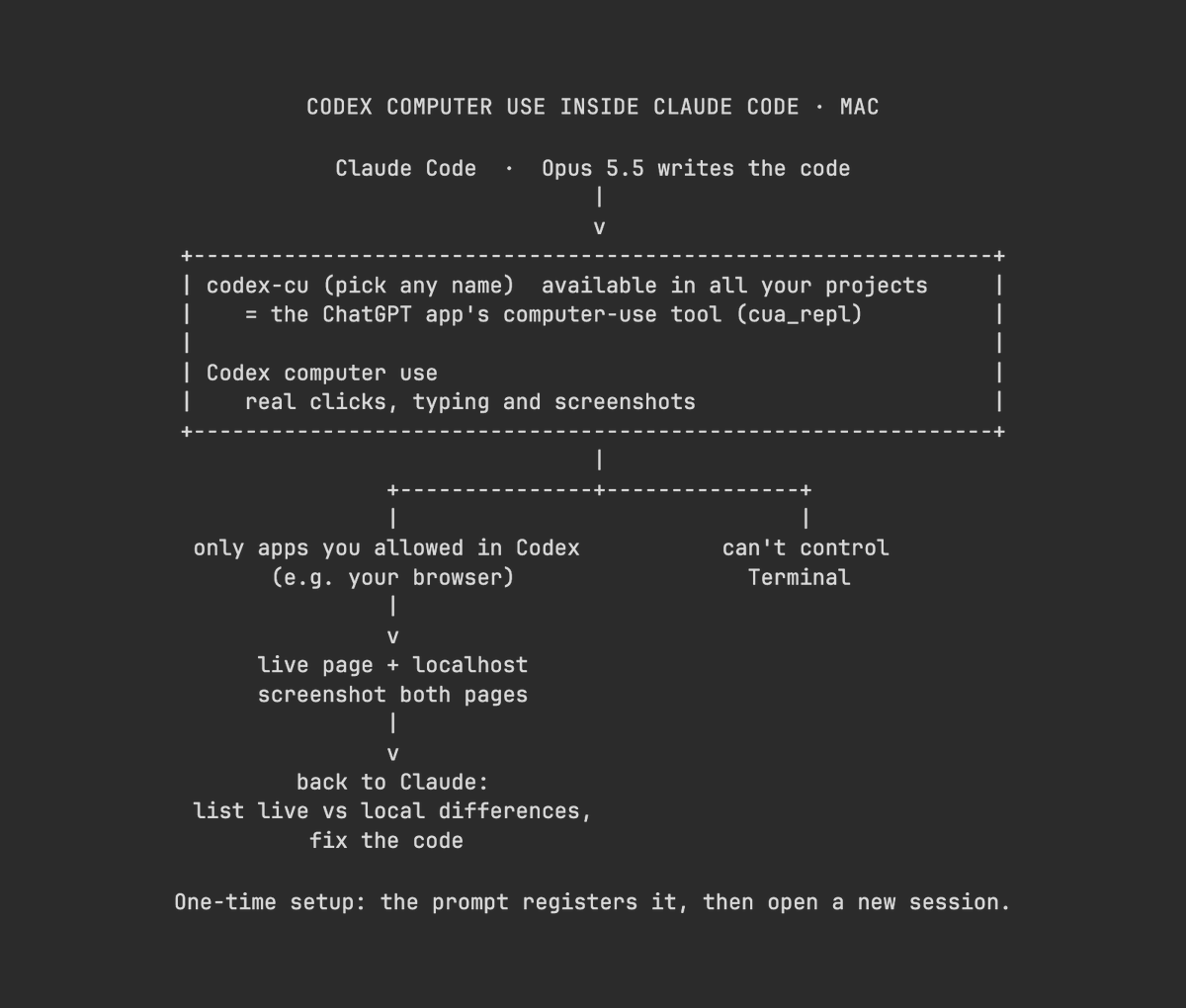
@Voxyz_ai drew (13 likes, 2 replies, 981 views, 19 bookmarks) a compact architecture diagram confirming the same pattern: Claude Code writes the code, a user-registered codex-cu MCP bridge proxies into Codex computer use, approved apps are the only controllable targets, and Terminal is blocked. That mattered because it turned an ad hoc hack into a legible workflow other people can copy for live-vs-local browser testing.
@dexhorthy announced (101 likes, 10 replies, 7,055 views, 81 bookmarks) that HumanLayer now works directly from Pi agent and OpenCode. The resolved repo links for Pi and OpenCode show shipped plugins that mirror sessions to the HumanLayer web app, sync task files and diffs, surface approvals, and let remote replies or stop signals flow back into the running session. One reply said users had been copying HumanLayer's hidden skills manually before this release, which is the clearest evidence that the feature is filling an active workflow gap.
@devagrawal09 said (53 likes, 5 replies, 4,066 views, 22 bookmarks) Pi Durable changed how the author thinks about harness design, to the point of considering a rewrite of OC++ around durability as an architectural guarantee. The useful part was in the replies, where the author spelled out the mechanics: durable variables and functions in codemode, completed tool calls that do not rerun, subagents that recover and reattach to the parent, external agents like Claude Code and Codex as recoverable subagents, and scheduled events that survive crashes. That is much more specific than saying a harness is simply “more reliable.”
@_duyet described (1 like, 2 replies, 46 views) using Herdr as a manager session that can spawn 50 child worktrees across Pi, Claude, Grok, OpenCode, and Devin. The linked Herdr write-up says the setup pairs a master session with herdr-desk, Telegram reporting, and carefully designed Tailscale ACL groups so cross-machine orchestration stays visible and isolated.

Discussion insight: Composability is starting to beat raw-model demos. The common ask was not “give me one best agent,” but “let me reuse the browser, keep sessions recoverable, and coordinate several harnesses without losing approvals or context.”
Comparison to prior day: Compared with the September 28 report's worktree and governance discussion, October 4 turned the control-plane conversation into concrete bridges, plugins, and recovery semantics.
1.2 Quota policy and bundle economics kept deciding which tools stayed open (🡕)
At least seven items supported the second major theme: Jeremybtc's massive subscription list, Buildwithhassan's unusable expiring reset, Kostastsale's highlighted x20-to-x10 notice, Presidentlin's banked-reset screenshot, Quipsy's Google bundle comparison, Rynorhn's complaint that the Codex illusion is ending, and TheBuoyantMan cancelling Copilot Pro+. Capability talk kept collapsing into allowance math.
@Jeremybtc listed (156 likes, 105 replies, 9,357 views) payments for ChatGPT Pro, Claude Max, Cursor Ultra, Google AI Ultra, GitHub Copilot, Vercel, Supabase, Railway, and more, then joked about still being underexposed to AI. The point was not the exact number of services; it was that serious users already assume no single plan will cover the whole workflow.
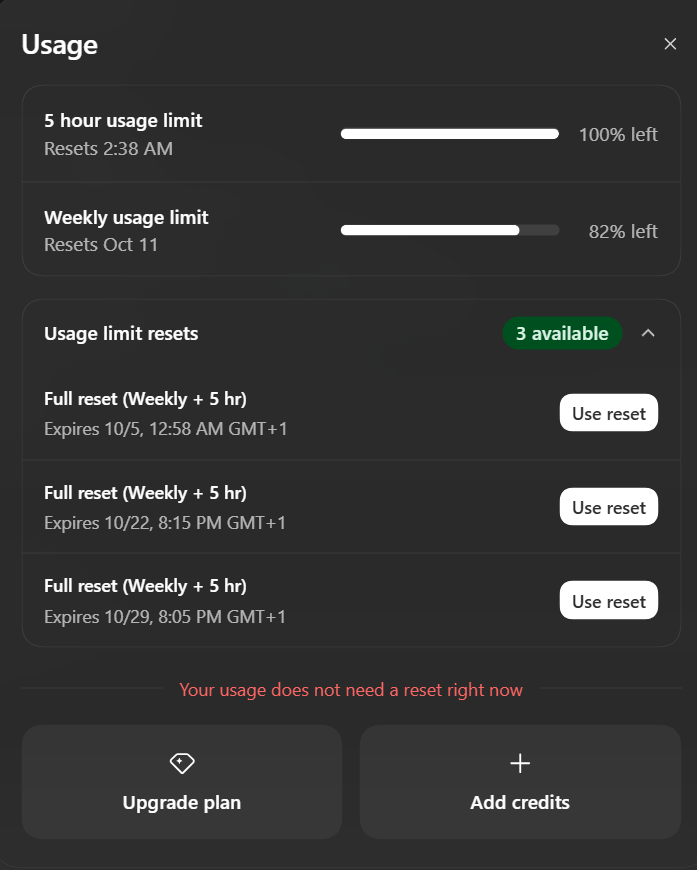
@buildwithhassan reported (15 likes, 7 replies, 1,833 views) losing a full Codex reset because the UI refused to apply it until usage was near the limit. The screenshot shows 100% of the 5-hour allowance still left, 82% of the weekly budget remaining, three banked resets, and the message “Your usage does not need a reset right now,” while replies show other users speed-running expiring headroom rather than working normally.
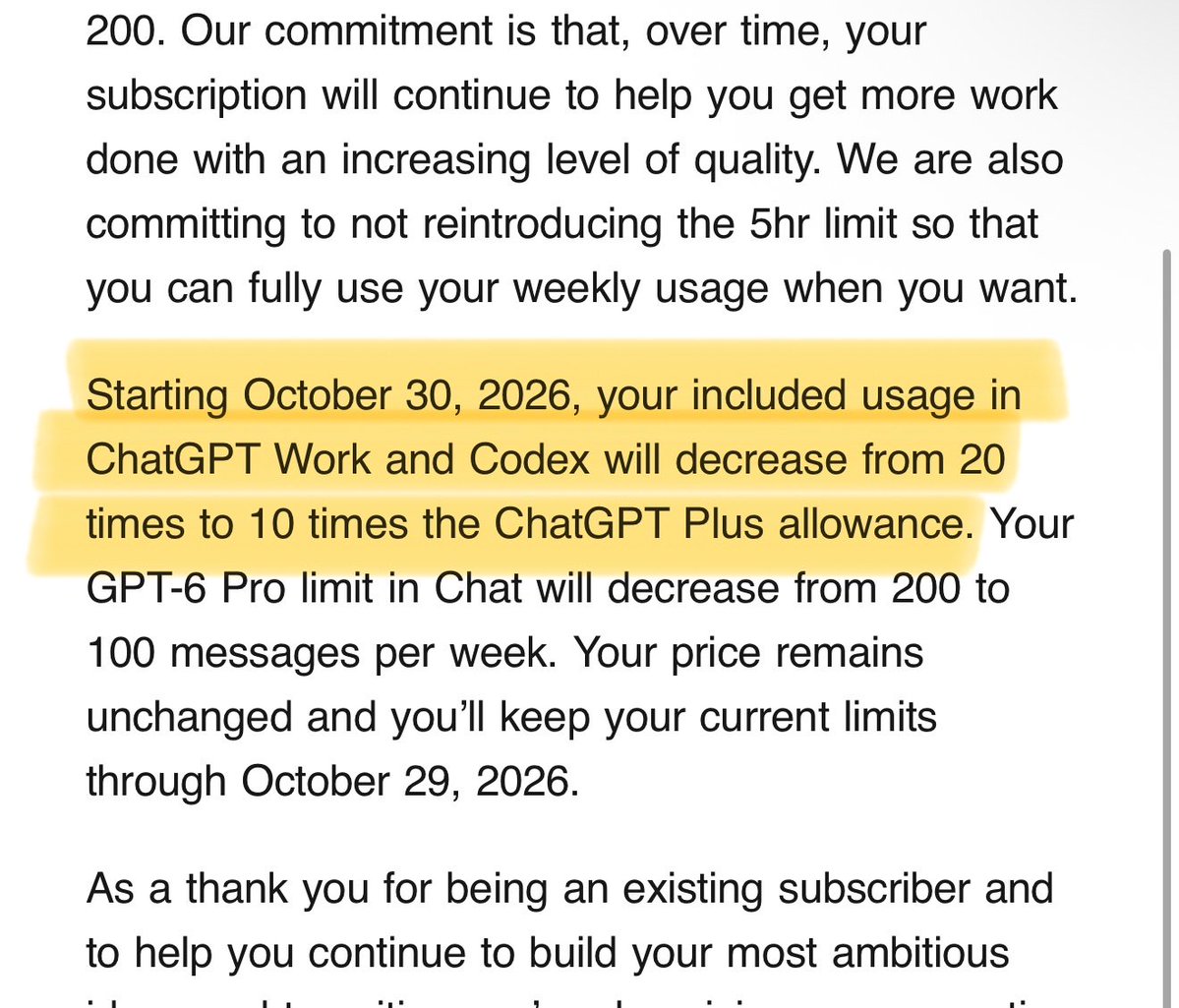
@Kostastsale said (6 likes, 2 replies, 577 views) 6.1 Sol on an x20 plan was already draining fast, then posted a screenshot highlighting the next cut: included ChatGPT Work and Codex usage falls from 20x to 10x the Plus allowance starting October 30. The complaint gets sharper because the same tweet says Dots effectively routes work through 6.1 Sol with high reasoning, so the expensive pool is shared.
@Presidentlin posted (7 likes, 3 replies, 556 views) a usage screen with 95% of the 5-hour limit, 90% of the weekly limit, 2,479 credits remaining, and three banked full resets, then said Astra burns the short window too quickly while 6.1 Sol remains the safer default. That is a more concrete version of the earlier “stress, not loyalty” theme from late September.

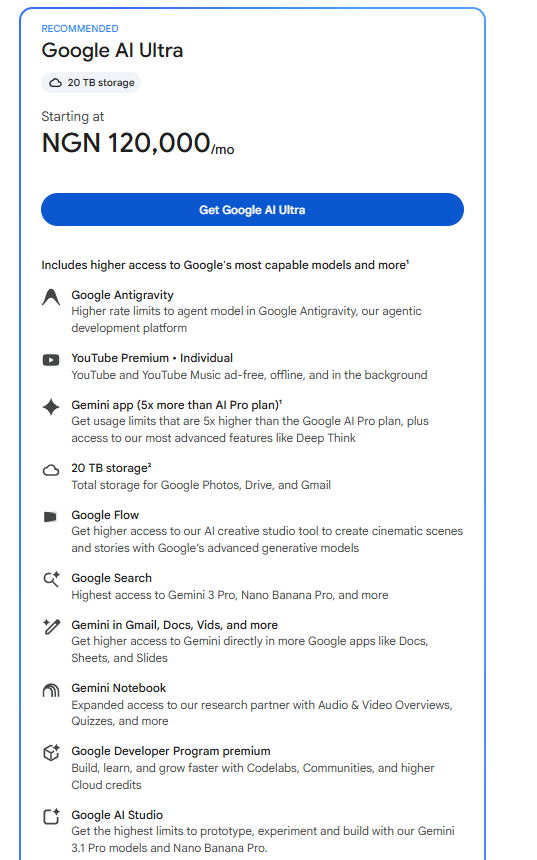
@quipsy argued (68 views) Google AI Pro may be the best deal because Antigravity, Gemini, Flow, NotebookLM, YouTube Premium, and 20 TB of storage are bundled together. The image makes the price comparison legible by showing the AI Ultra card at NGN 120,000 per month with the included products listed line by line.
A smaller but still concrete churn signal came from @theBuoyantMan saying (3 likes, 2 replies, 1,078 views, 7 bookmarks) they had cancelled GitHub Copilot Pro+ for DeepSeek Harness and OpenRouter because newer models were cheaper and better, while @rynorhn framed (31 likes, 5 replies, 1,118 views) the same shift as OpenAI no longer being able to hide its compute problem while Anthropic ships aggressively.
Discussion insight: The live debate was not only “which model is smartest?” It was “which allowance resets in time, which bundle includes the right tools, and which plan quietly got worse this week?”
Comparison to prior day: Compared with the September 28 report's generic limit fatigue, October 4 attached timestamps, screens, expiring banked resets, and a dated allowance cut.
1.3 Memory, skills, and prompt-budget discipline became standard infrastructure rather than nice-to-have add-ons (🡕)
Another cluster of posts assumed the default harness forgets too much and spills too much. At least six items supported that view: DanKornas on 365 Skills, Fucai's claude-mem tutorial, Yrevash's context-mode, Ap0cah0lics' “thin harness, fat skills” thread, Arkyyang's Mingbird paper summary, and Coldniko's Strata release.
@DanKornas shared (8 likes, 6 replies, 1,052 views, 11 bookmarks) 365 Skills, a public GitHub collection of reusable capabilities for Claude Code, Cursor, Copilot, and others. The repo shows both an agent-agnostic npx skills add path and a Claude Code plugin marketplace path, which is exactly the sort of portability people were asking for a week earlier.
@FucaiX62810 highlighted (6 likes, 4 replies, 543 views) claude-mem, and the README backs up the pitch with lifecycle hooks, a local worker, SQLite plus vector search, and a staged search -> timeline -> get_observations retrieval flow meant to keep memory lookups cheap. That is not just “add memory”; it is a concrete answer to compaction and session amnesia.
@yrevash pointed to (4 likes, 183 views, 2 bookmarks) context-mode, which claims its sandboxed tool routing can shrink one session's raw context from 315 KB to 5.4 KB while tracking continuity in SQLite/FTS5. The argument matches the replies in another thread that generic tools and exit codes beat schema-heavy custom tool sprawl.
@arkyyang translated (1 like, 2 replies, 33 views) the new Mingbird paper into three product rules: budget prefill like scarce memory, do not trust “I'm done” without artifact checks, and detect loops by repeated tool-call signatures rather than prose. Even without reading the paper, the thread makes the harness problem actionable for people shipping local or small-model agents.
@coldniko released (39 likes, 2 replies, 1,659 views) Strata v0.1.39, and the release notes plus repo README show why it mattered to AI-coding users: OpenAI Responses API support so Codex CLI can talk to a local runtime, several requests at once, and more multi-GPU or older-hardware paths for a model that otherwise wants datacenter-style resources.
@Ap0cah0lics argued (12 likes, 9 replies, 1,656 views) that “thin harness, fat skills” still holds even though loops are now built in. The best reply in the thread made the design case bluntly: every bespoke tool adds schema surface area, while bash gives infinite compositional primitives and deterministic exit codes.
Discussion insight: Whether the solution is memory, context compression, or local runtimes, the shared assumption is that raw frontier-model capability is wasted if the harness bloats context or drops state.
Comparison to prior day: Compared with the September 28 report's searchable and auditable infrastructure theme, October 4 zoomed into retrieval, compaction, and prompt-budget mechanics.
1.4 The human role is being reframed as operating agents, verifying them, and choosing the right autonomy level (🡕)
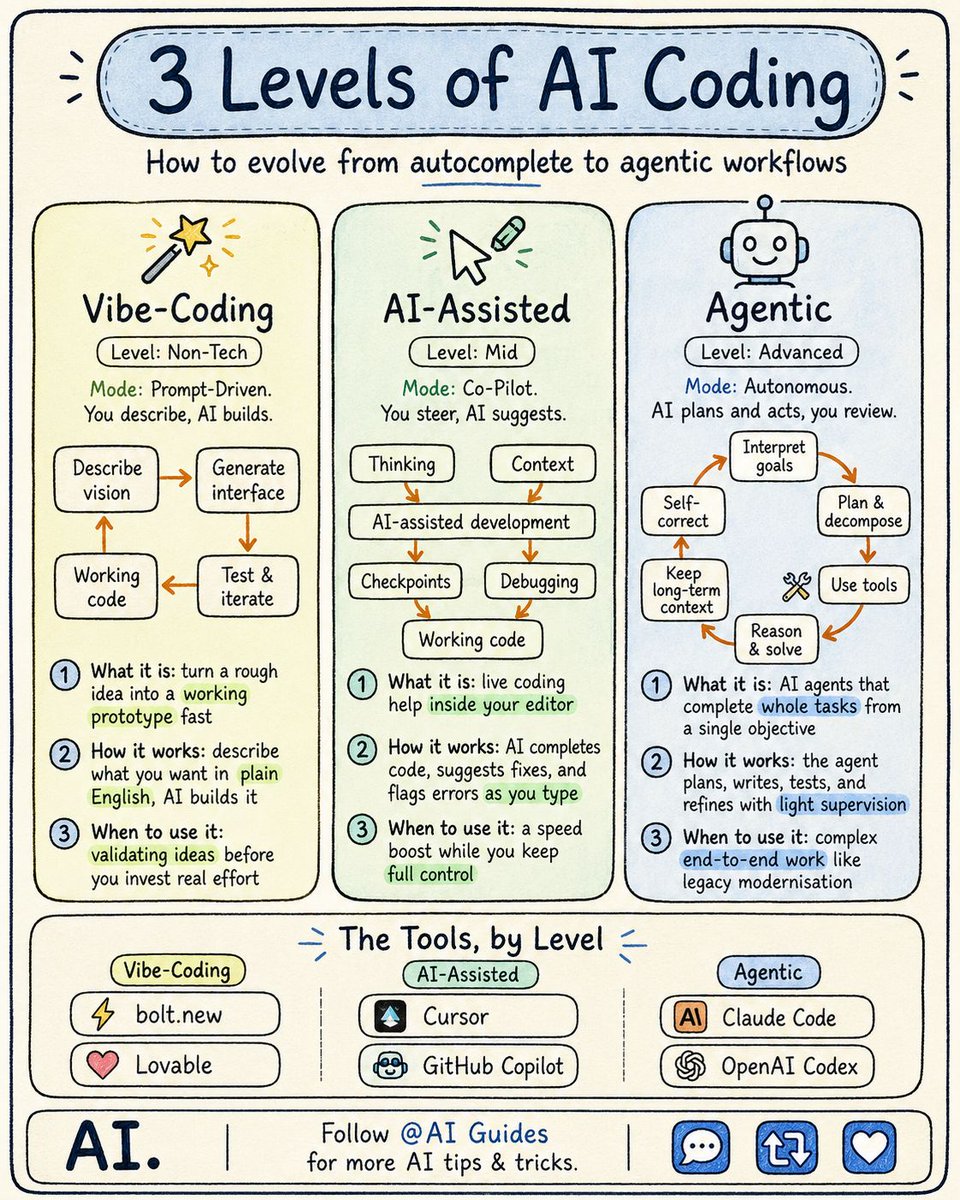
At least six items backed the last major theme. Free AI Guides' “3 Levels of AI Coding” graphic split vibe-coding, AI-assisted, and agentic workflows. Teka1900 turned OpenAI Dots into a workflow recipe with scheduled jobs, Codex handoff, and custom approval rules. Michael Fenech argued Copilot review should sit in a separate reviewer loop. Craig Weiss said the “new IC” manages 20 agents. Anilkalm argued computer use matters because many business workflows are GUI-only, while Neogoose's screenshot reminded everyone the UX still lags the ambition.
@free_ai_guides argued (18 likes, 8 replies, 2,256 views, 28 bookmarks) that the real failure mode is picking the wrong autonomy level, not picking the wrong brand. The infographic maps vibe-coding to bolt.new and Lovable, AI-assisted work to Cursor and GitHub Copilot, and agentic work to Claude Code and Codex, then explains why legacy migrations and quick prototypes fail when those levels are swapped.
@Teka1900 wrote (16 likes, 3 replies, 364 views, 10 bookmarks) that Dots only makes sense when treated as an always-on operator: scheduled jobs, GitHub-issue watching, Codex handoff, and four approval modes from “act without asking” to “hand off to me.” That is a more mature interface story than “chat with an agent and hope.”
@Michael_Fenech_ recommended (12 likes, 9 replies, 2,039 views) Builder -> Reviewer -> Fix -> Reviewer -> Merge, using GitHub Copilot's newly callable review API and giving the reviewer its own skills and MCP context. The post matters because it explicitly separates creation from verification instead of asking one agent to grade itself.
@anilkalm argued (2 likes, 2 replies, 82 views) that Copilot's new computer-use capability expands the addressable surface of automation because many business tools still expose only screens, forms, and buttons. In that framing, GUI control is not a gimmick; it is the fallback when no API, CLI, or MCP exists.
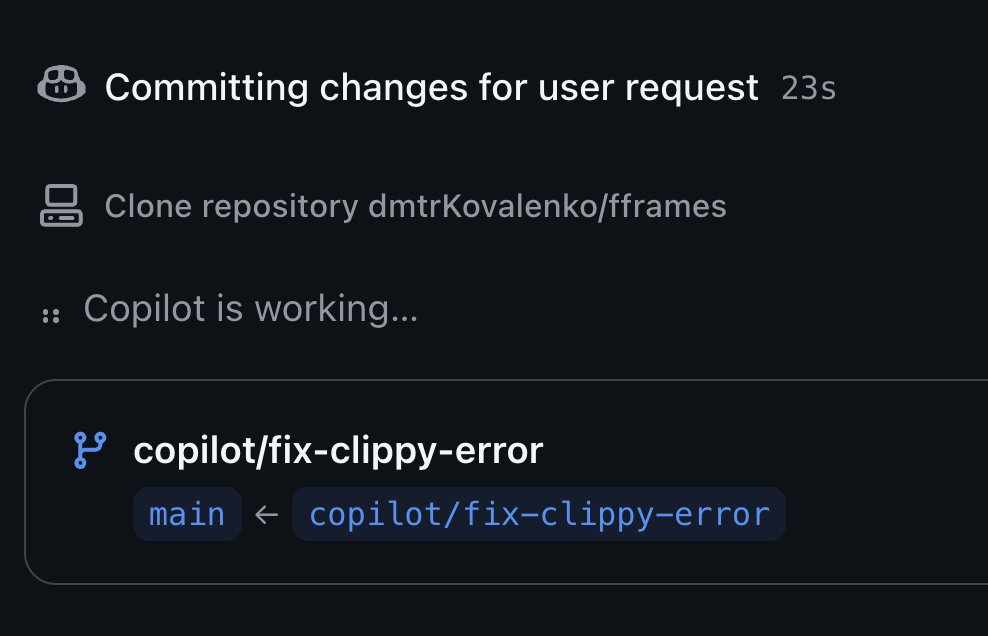
@neogoose_btw showed (18 likes, 4 replies, 1,840 views) the current UX ceiling: Copilot fixed the issue, but the lasting impression was four misaligned dots beside “Copilot is working...” That is the kind of polish gap that makes people hesitate even when the underlying output is acceptable.
@craigweiss said (34 likes, 10 replies, 879 views) the “new IC” manages 20 agents and only drops into code when necessary. The replies were the useful corrective because they showed some engineers do not want to manage anything at all, agents included.
Discussion insight: People are accepting higher autonomy only when they can classify the job, route verification separately, and keep intervention points obvious.
Comparison to prior day: Compared with the September 28 report's “can agents be trusted?” thread, October 4 translated trust into operating rules, reviewer roles, and visible UX rough edges.
2. What Frustrates People
Reset mechanics are turning usage into a clock-watching game
Users are not just running out of quota; they are spending time gaming the quota system. @buildwithhassan said (15 likes, 7 replies, 1,833 views) a full Codex reset expired because the product would not apply it while weekly usage was only 82% consumed, even though the reset would disappear that night. @Presidentlin showed (7 likes, 3 replies, 556 views) the same environment from another angle: banked resets, a short 5-hour limit that Astra can burn quickly, and a habit of timing model exploration around allowance behavior. @Kostastsale added (6 likes, 2 replies, 577 views) the upcoming x20-to-x10 cut, while @Jeremybtc turned (156 likes, 105 replies, 9,357 views) subscription hedging into a lifestyle. People are coping by hoarding resets, splitting work across plans, or churning to cheaper stacks such as DeepSeek Harness and OpenRouter. Severity: High. Worth building: High.
Default harnesses still forget too much or carry too much junk
The second frustration is state management. @devagrawal09 explicitly called (53 likes, 5 replies, 4,066 views, 22 bookmarks) most harnesses fragile, which is why Pi Durable and OC++ emphasize recoverable subagents, durable variables, and non-rerun tool calls. @FucaiX62810 pointed to (6 likes, 4 replies, 543 views) claude-mem, @yrevash pointed to (4 likes, 183 views, 2 bookmarks) context-mode, and @arkyyang summarized (1 like, 2 replies, 33 views) Mingbird because the same failure mode keeps reappearing: sessions forget yesterday's corrections, prompts overfill with tool scaffolding, and small models especially need prompt budgets, finish gates, and loop detectors. @Ap0cah0lics put (12 likes, 9 replies, 1,656 views) the architectural complaint underneath those symptoms by arguing that every bespoke tool schema pollutes attention, so people fall back to generic skills and bash-like primitives to cope. Severity: High. Worth building: High.
Verification and interface polish still lag generation
People increasingly accept that agents can generate code quickly. They are still frustrated by proving the output is safe and by awkward surfaces around that process. @Michael_Fenech_ proposed (12 likes, 9 replies, 2,039 views) a Builder -> Reviewer -> Fix -> Reviewer -> Merge loop because one agent grading its own work is no longer trusted. @neogoose_btw showed (18 likes, 4 replies, 1,840 views) how even a successful Copilot run can leave users focused on a confusing progress indicator instead of the outcome. @argofowl got traction (180 likes, 22 replies, 10,045 views, 286 bookmarks) partly because the setup removed repetitive allow prompts, and @anilkalm argued (2 likes, 2 replies, 82 views) that GUI-only workflows are now in scope for automation. Once agents touch software that has only buttons and forms, reviewer loops and clearer intervention points matter even more. Severity: Medium-High. Worth building: High.
3. What People Wish Existed
One coordination layer for many harnesses
What people want is a control plane that lets them bring Claude Code, Codex, Pi, OpenCode, Grok, and other shells into one workflow without losing approvals, diffs, or state. @dexhorthy launched (101 likes, 10 replies, 7,055 views, 81 bookmarks) HumanLayer support for Pi and OpenCode, @_duyet showed (1 like, 2 replies, 46 views) a Herdr manager pattern across 50 sessions, @argofowl bridged (180 likes, 22 replies, 10,045 views, 286 bookmarks) Codex browser control into Claude Code, and @devagrawal09 argued (53 likes, 5 replies, 4,066 views, 22 bookmarks) that durability has to be architectural. This is a practical need with immediate workflow value, not a speculative one. Opportunity: Direct.
Memory and context layers that stay small enough to trust
@FucaiX62810 highlighted (6 likes, 4 replies, 543 views) claude-mem, @yrevash highlighted (4 likes, 183 views, 2 bookmarks) context-mode, @arkyyang translated (1 like, 2 replies, 33 views) Mingbird's prompt-budget and finish-gate ideas, and @Ap0cah0lics defended (12 likes, 9 replies, 1,656 views) thinner harnesses with fatter skills. Taken together, those posts describe the same missing layer: agents that remember corrections, retrieve only the relevant past, and stop flooding the context window with raw tool output. Several projects partially address this today, but the volume of parallel posts suggests the need is still urgent. Opportunity: Direct, but competitive.
Independent review and approval systems for agent-written code
@Michael_Fenech_ spelled out (12 likes, 9 replies, 2,039 views) a Builder -> Reviewer -> Fix -> Reviewer -> Merge loop, and @craigweiss said (34 likes, 10 replies, 879 views) the new IC already manages 20 agents instead of writing every line. That implies the missing product is not another builder agent; it is a reviewer and control system that can challenge the builder, rerun checks, and decide when enough evidence exists to merge. @neogoose_btw added (18 likes, 4 replies, 1,840 views) the UX angle by showing how weak progress affordances still undermine confidence. Opportunity: Direct.
Plans that make headroom predictable before work starts
@buildwithhassan losing (15 likes, 7 replies, 1,833 views) an expiring reset, @Kostastsale warning about (6 likes, 2 replies, 577 views) the x20-to-x10 allowance cut, @Presidentlin tracking (7 likes, 3 replies, 556 views) banked resets and burn rates, and @quipsy shopping (68 views) bundle economics all point to the same need: visible expiry rules, trustworthy forecasts of how long a plan will last, and easier comparison across bundles. Some products already expose usage screens and bundle pages, but the public evidence still shows surprise, manual timing, and subscription churn. Opportunity: Direct, but competitive.
4. Tools and Methods in Use
| Tool | Category | Sentiment | Strengths | Limitations |
|---|---|---|---|---|
Codex computer use via codex-cu |
Computer-use / browser automation | (+/-) | Real clicks, screenshots, reusable from Claude Code, strong for live-vs-local browser comparison | Unofficial bridge, approved-app only, Terminal blocked, and a ChatGPT update could break it (source) |
| HumanLayer Pi / OpenCode plugins | Collaboration / session mirror | (+) | Mirrors sessions to the web app, supports remote replies and stops, approvals, task diffs, and bundled skills | Requires plugin setup and specific host support in Pi or OpenCode (source) |
| Pi Durable / OC++ | Agent harness | (+) | Durable variables, recoverable subagents, and scheduled events that survive crashes | Even proponents describe the rest of the market as fragile enough to justify rewrites |
| GitHub Copilot review API and computer use | Review / GUI automation | (+/-) | Enables separate reviewer loops and opens GUI-only workflows that lack APIs or MCP servers | UI polish is still rough and trust still has to be layered externally (source) |
| Google AI Pro/Ultra with Antigravity | Subscription bundle | (+/-) | Multiple frontier models plus Flow, NotebookLM, YouTube Premium, and large storage in one plan | Regional pricing varies and users still expect tighter or higher limits (source) |
| claude-mem | Memory layer | (+) | Persistent context across sessions, layered retrieval, searchable memory, and token-efficient lookup flow | Extra install and worker-service complexity, plus dependence on hooks and sidecar storage (source) |
| context-mode | Context-routing sidecar | (+) | Sandboxes raw tool output, keeps continuity in SQLite, and claims large context savings | Requires a routing layer and asks users to change how they think about tool execution (source) |
| Strata | Local model runtime | (+) | Local OpenAI-compatible endpoint, Codex Responses API support, multi-request serving, strong privacy story | Heavy RAM, VRAM, disk, and hardware-tuning requirements remain (source) |
| 365 Skills | Skill pack / plugin collection | (+) | Agent-agnostic install path, broad reusable capability set, and Claude Code marketplace support | Adds another layer of discovery, selection, and maintenance (source) |
| Herdr | Orchestration control plane | (+) | Master-child worktree management, cross-repo coordination, multi-machine dashboarding, and scheduled automation | Security isolation depends on careful Tailscale ACL design and public proof is still limited to one builder's write-up (source) |
Overall satisfaction was not split into “best model” versus “worst model.” It was split into tools that felt schedulable versus tools that still felt surprising. HumanLayer, Herdr, Pi Durable, claude-mem, and context-mode all drew attention because they reduce coordination or context loss around the model, while Strata drew attention because it gives users a local backend that still speaks the APIs their existing coding tools already understand.
The main workarounds were explicit routing and role separation. People used Codex's browser inside Claude Code, planned to route Dots through 6.1 Sol while watching the meter, canceled Copilot Pro+ for DeepSeek Harness and OpenRouter when the economics stopped making sense, and proposed separate builder-reviewer loops once one agent no longer seemed trustworthy enough to self-grade. The competitive dynamic looked less like one model winning outright and more like interfaces, allowances, memory layers, and orchestration features becoming the real moat.
5. What People Are Building
| Project | Who built it | What it does | Problem it solves | Stack | Stage | Links |
|---|---|---|---|---|---|---|
| HumanLayer Pi / OpenCode plugins | HumanLayer via @dexhorthy | Mirrors Pi and OpenCode sessions into HumanLayer with remote replies, approvals, and task diffs | Teams want collaboration and remote control without abandoning their preferred harness | Pi, OpenCode 2, HumanLayer web app, git, shared session SDK | Shipped | pi repo, opencode repo, post |
| 365 Skills | Agents365-ai via @DanKornas | Packages reusable agent skills and Claude Code plugins across coding, research, diagrams, notes, and media tasks | Builders keep rewiring the same capabilities from scratch | npx skills installer, Claude Code plugin marketplace, agent-agnostic plugin set |
Shipped | repo, post |
| Strata v0.1.39 | Niko1221 via @coldniko | Runs a strong local coding model on a gaming PC and exposes OpenAI-compatible endpoints, including Codex Responses API support | Users want local inference and privacy without giving up existing agent tooling | Qwen3.8-Flash-Next, local OpenAI-compatible server, MCP server, multi-GPU support | Shipped | repo, release, post |
| Herdr plus herdr-desk | @_duyet | Uses a master agent to spawn and supervise large numbers of worktree sessions across multiple agent shells and machines | Multi-repo, multi-agent work needs a visible coordinator and automation layer | Herdr, worktrees, Pi, Claude, Grok, OpenCode, Devin, Tailscale, Telegram reporting | Shipped | blog, site, post |
| Xeza | @salimteymouri | Turns raw Solana token and transaction activity into readable risk, behavior, and failure analysis | Users need on-chain intelligence without reading raw RPC responses | Next.js 16, React 19, TypeScript, Helius, Jupiter, DexScreener, CoinMarketCap, Netlify | Shipped | app, repo, post |
@dexhorthy made (101 likes, 10 replies, 7,055 views, 81 bookmarks) the clearest “bring your harness” case of the day. The Pi and OpenCode plugins do not ask users to switch shells; they wrap existing sessions with mirrored events, approvals, task diffs, and remote replies inside HumanLayer's web app. That matches the broader pattern in section 1: builders increasingly want a coordination layer around the agent, not a totally new agent identity.
@coldniko shipped (39 likes, 2 replies, 1,659 views) a different but equally practical layer: local infrastructure. Strata's repo says it can run Qwen3.8-Flash-Next on a gaming PC, while the v0.1.39 release notes add OpenAI Responses API support so Codex CLI can talk to it directly. That makes the project notable not just as another local-model experiment, but as a compatibility layer for the tools people already use.
@_duyet showed (1 like, 2 replies, 46 views) perhaps the most extreme orchestration pattern: a manager session supervising up to 50 child worktrees across several agent products and multiple machines. Combined with 365 Skills, that suggests a repeated build pattern: one layer installs reusable capabilities, another decides which harness should execute them, and a higher layer watches the fleet.
@salimteymouri offered (8 likes, 6 replies, 103 views) the clearest counterexample to the meta-tooling wave. Xeza is a user-facing product, not a control plane: a readable Solana intelligence app with deterministic scoring, explainable evidence, and a concrete modern web stack. The repo's README says it was built through AI-assisted vibe coding with Codex, which makes it useful evidence that the AI-coding audience still values real products when the scope is tight and the rules are explicit.
6. New and Notable
HumanLayer turned Pi and OpenCode into first-class remote sessions
@dexhorthy announced (101 likes, 10 replies, 7,055 views, 81 bookmarks) HumanLayer support for Pi agent and OpenCode, and the linked repos show approvals, remote replies, task diffs, and mirrored session events. That is notable because it treats “bring your harness” as a product principle rather than an unsupported hack.
Strata made Codex-compatible local inference much more practical
@coldniko released (39 likes, 2 replies, 1,659 views) Strata v0.1.39, while the release notes added OpenAI Responses API support for Codex, several requests at once, and more hardware paths. That matters because it lowers the switching cost for anyone who wants local inference without abandoning existing agent clients.
Mingbird made harness engineering feel like a research discipline, not just a hacker trick
@arkyyang surfaced (1 like, 2 replies, 33 views) the Mingbird paper, which frames small-model agent failures as harness problems and turns the fix into explicit mechanisms such as prefill budgeting, finish gates, and loop detection. That is notable because it gives builders vocabulary and testable rules for a problem the feed usually describes only anecdotally.
Copilot review API strengthened the case for separate verification agents
@Michael_Fenech_ used (12 likes, 9 replies, 2,039 views) GitHub Copilot's callable review surface to argue for Builder -> Reviewer -> Fix -> Reviewer -> Merge. The signal matters because it points away from “one super-agent” and toward specialized builder and verifier roles.
7. Where the Opportunities Are
[+++] Cross-harness control planes with durability, approvals, and remote observation — Evidence came from Argofowl's Codex browser bridge (source), HumanLayer's Pi and OpenCode plugins (source), Dev Agrawal's durability push (source), and Duyet's Herdr stack (source). The opportunity is strong because people already use several agent shells; what they still lack is one trustworthy layer that keeps them aligned.
[+++] Quota-aware routing and reset management — Jeremybtc's 51-service stack (source), Buildwithhassan's unusable reset (source), Kostastsale's x20-to-x10 notice (source), Presidentlin's reset-banking habit (source), and TheBuoyantMan's Copilot cancellation (source) all show that tool choice is still driven by allowance behavior more than ideology. A product that forecasts burn, routes work by headroom, and prevents wasted resets would meet an immediate need.
[++] Memory and context sidecars that reduce prompt waste without losing continuity — claude-mem (source), context-mode (source), Mingbird (source), 365 Skills (source), and the “thin harness, fat skills” thread (source) all point toward the same gap. The opportunity is moderate because several solutions already exist, but the demand is plainly real and multi-platform.
[++] Independent reviewer agents and trust layers — Michael Fenech's reviewer loop (source), Craig Weiss's “20 agents” framing (source), Neogoose's Copilot UI complaint (source), and Anilkalm's GUI-automation argument (source) all suggest that trust, not raw generation, is becoming the bottleneck. A reviewer stack that checks artifacts, diffs, and UI state separately could slot into many existing workflows.
[+] More end-user products built with AI coding rather than more meta-tooling — Xeza's shipped Solana analysis app (source) is a reminder that the feed still rewards real products when the scope is narrow and the evidence rules are explicit. The signal is smaller than the control-plane wave, but it points to room for teams that apply AI coding to concrete user problems rather than one more wrapper around wrappers.
8. Takeaways
- Harness composition is becoming a product category of its own. The highest-signal posts were about bridging Codex computer use into Claude Code, adding HumanLayer to Pi and OpenCode, and supervising large worktree fleets through Herdr. (source)
- Quota behavior still decides which tools people trust enough to keep open. Users posted expiring resets, banked reset strategies, and dated allowance cuts more often than benchmark screenshots. (source)
- Memory and context hygiene are now treated as core infrastructure, not optional polish. claude-mem, context-mode, Mingbird, and the “thin harness, fat skills” thread all attacked the same failure mode: too much forgotten state and too much wasted prompt budget. (source)
- Verification is peeling away from generation as a separate role. The strongest trust-oriented post of the day argued for a dedicated Builder -> Reviewer -> Fix -> Reviewer -> Merge loop instead of one agent auditing itself. (source)
- The clearest shipped product in the feed was a narrowly scoped app with deterministic rules, not another general meta-agent. Xeza's Solana analysis workflow stood out because its repo explains the evidence rules, stack, and limits instead of hiding them behind generic agent language. (source)