Twitter AI Coding - 2026-10-09
1. What People Are Talking About
1.1 Argon access clues eclipsed the launch itself (🡕)
Google still owned the loudest share of the AI-coding conversation, but on 2026-10-09 the center of gravity was not a new public workflow. It was rollout archaeology: credits, model-picker labels, context-window hints, and pricing breadcrumbs. At least four high-signal tweets supported the same point that users were learning more from surfaces around Antigravity than from an actual release.
@EvanOtero reminded (1,611 likes, 94 replies, 110,453 views, 1,976 bookmarks) Google AI Pro and Ultra subscribers to redeem monthly Gemini API credits for use in code, Antigravity CLI, and third-party harnesses. The most important evidence was in the replies, not the headline: one user called the redemption path “way too complicated,” and Evan answered that the flow should move into AI Studio in about two weeks and only needed to be redeemed once.
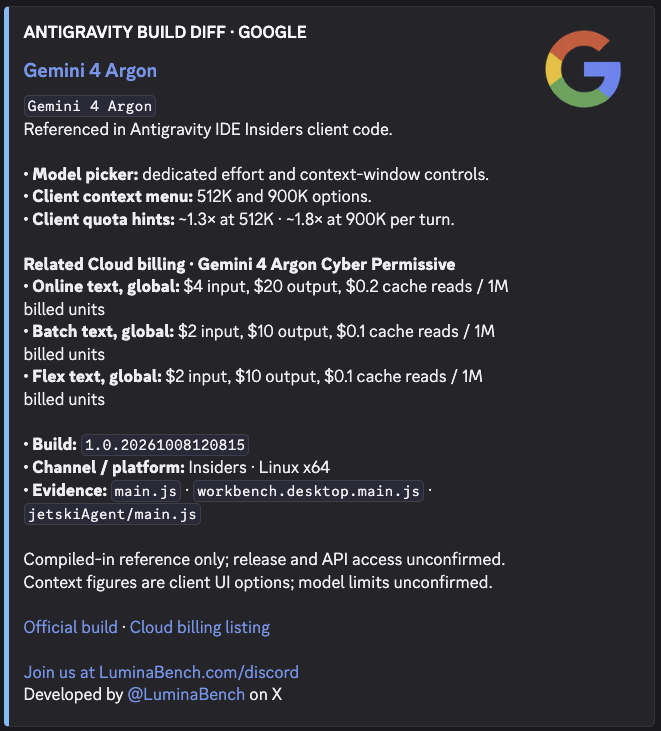
@LuminaBench argued (289 likes, 21 replies, 18,499 views) that Gemini 4 Argon was already sitting in Antigravity client code, and the attached build-diff card added concrete detail that the tweet text alone did not: dedicated effort controls, 512K and 900K context options, and cloud billing hints around $4 input and $20 output, while still stating that release and API access were unconfirmed.
@StatsWire reported (236 likes, 11 replies, 11,991 views) that Gemini 3.1 Pro was marked “Leaving Soon” inside Antigravity while Gemini 4 Argon still appeared locked behind Fairwind. That mattered because it turned rollout frustration into a product-state problem: older options looked closer to removal before the heavily discussed replacement was broadly available.

Discussion insight: Users were not mainly debating whether Argon would be good. They were trying to reconstruct when it would exist for them, which subscriptions and billing accounts mattered, and whether the old lineup was being removed too early.
Comparison to prior day: On 2026-10-08, Antigravity chatter already emphasized rollout friction. On 2026-10-09, that friction became even more explicit because people now had menu labels, pricing hints, and credits logistics to point at.
1.2 Faster agent loops were judged on task cost, steering, and consistency, not token prices (🡕)
The strongest OpenAI-side conversation was not “Ultrafast exists.” It was “what does the full loop cost, how does it feel in Codex, and what happens under different access paths?” That made the discussion more operational than the prior day’s speed-tier headlines.
@OpenAIDevs announced (728 likes, 66 replies, 23,135 views, 101 bookmarks) composer predictions in Codex for Pro users. The reply thread immediately reframed the feature as competition on workflow nuance rather than novelty: users said Claude Code had offered similar behavior earlier, and one reply asked whether rereading the conversation to predict the next message would create the same token overhead they had seen elsewhere.
@morganlinton shared (40 likes, 11 replies, 2,960 views) a VulcanBench Frontier v4 chart showing Claude Sonnet 5.5 with the best combined score at max effort, Opus 5.5 scoring strongly but becoming expensive at high effort, and GPT-6.1 Sol posting the cheapest cost per task across the displayed settings. That image turned “fast” into a cost-quality tradeoff instead of a single bragging-rights number.

@Vladic_ETH argued (28 likes, 17 replies, 1,683 views, 9 bookmarks) that “token price is not task price,” giving a concrete example where Sonnet 5.5 on max cost $7.67 per task while Opus 5.5 on xhigh cost $3.46 for the same score. A reply sharpened the point: a model that looks cheaper but needs several retries can end up costing more than a larger model that lands the task on the first try.
@Youssofal_ tested (13 likes, 5 replies, 1,813 views) GPT-6.1 Sol in Codex on a ChatGPT plan versus API-key access, and the attached table showed faster TPS on the API path in normal and fast modes while Ultrafast was closer. The tweet’s distinctive complaint was not just speed; it was that usage limits remained the bigger practical problem.

Discussion insight: People increasingly measure coding-agent value in completed-task economics and steering quality. A faster tier that reruns, stalls, or burns the weekly cap does not read as a better product.
Comparison to prior day: On 2026-10-08, speed-tier discussion centered on rollout and pricing access. On 2026-10-09, users and benchmark posters supplied fuller evidence about cost per task, route differences, and interaction design.
1.3 Open builders kept shipping control layers around the model, not just another model picker (🡕)
The open-source builder story remained one of the clearest recurring themes. The best-supported items were not frontier-model announcements from a major lab. They were releases that sit around the model: decision layers, harness routers, privacy-preserving deployments, and mobile companions.
@NaceAI open-sourced (81 likes, 24 replies, 54,198 views, 58 bookmarks) Drex 1.5 as a small decision model with a 128K context window and compatibility across Ollama, Unsloth, OpenCode, Claude, Codex, Cursor, and other agent surfaces. The public developer page added stronger context: Console pairs Drex with NDI document intelligence, works through API, CLI, and MCP paths, and can run in Nace’s cloud, a customer’s cloud, or an air-gapped environment.

@Aria_Nawi explained (37 likes, 14 replies, 21,443 views, 57 bookmarks) why that matters in practice: longer context lets a decision model read full documents, long agent histories, or an entire codebase in one pass, and existing Jev-style integrations can switch over by changing the base URL rather than rewriting the whole stack.
@CrazyShyyt highlighted (12 likes, 2 replies, 678 views, 12 bookmarks) HarnessRouter as an “OpenRouter for agent harnesses,” while the public repo page described a self-hosted Community Edition that exposes an OpenAI Responses-compatible API across Codex, Claude Code, Hermes, and other harnesses, with sessions, streaming, files, cancellation, and one-command Docker setup.
@thdxr opened (43 likes, 18 replies, 3,301 views) more TestFlight slots for the OpenCode iOS app. That was a useful builder signal because the replies immediately shifted from celebration to missing features such as effort-level controls and iPad support.
@near_ai framed (14 likes, 1 replies, 570 views) OpenCode as a shell for private inference, and its companion blog said OpenCode only syncs a session to its own servers when /share is used, while NEAR AI Cloud exposes confidential TEE-labeled models for privacy-sensitive work. @kaddisdeployed added (7 likes, 5 replies, 191 views) that Step 5 Preview was temporarily available through OpenCode with 1M context, multimodality, and zero data retention claims.
Discussion insight: The strongest open-source product work today was less about claiming the smartest model and more about giving users control over routing, privacy, portability, and specialized decision-making.
Comparison to prior day: On 2026-10-08, wrappers and registries already looked important. On 2026-10-09, the evidence got firmer because more of the conversation pointed to live repos, public docs, beta apps, and deployable workflows.
2. What Frustrates People
Launch-state ambiguity around Gemini coding surfaces
Severity: High. @EvanOtero posted (1,611 likes, 94 replies, 110,453 views, 1,976 bookmarks) about credits, but the replies turned into a complaint about redemption complexity and billing-account prerequisites. @LuminaBench showed (289 likes, 21 replies, 18,499 views) that Argon-related controls and pricing hints were already visible in insider code, while @StatsWire showed (236 likes, 11 replies, 11,991 views) older Gemini options marked “Leaving Soon.” Users are coping by watching model pickers, build diffs, and employee replies instead of the actual rollout surface. Worth building: High.
Agent economics still feel unpredictable at the task level
Severity: High. @Vladic_ETH argued (28 likes, 17 replies, 1,683 views, 9 bookmarks) that token price is not task price, and @morganlinton backed that up (40 likes, 11 replies, 2,960 views) with a benchmark chart where GPT-6.1 Sol was cheapest per task while Claude models still led on some quality scores. @Youssofal_ showed (13 likes, 5 replies, 1,813 views) that plan access versus API-key access can change throughput materially inside Codex, and said weekly usage remained the bigger issue. People are coping by comparing routes manually, switching shells, and treating free or open options as test beds before they commit spending. Worth building: High.
Review, billing, and audit work did not disappear when code got faster
Severity: High. @Paul_Bracht reported (16 likes, 5 replies, 2,018 views) that a VP at a 580-person organization felt they had “lost complete track” of audit visibility after rolling Copilot out broadly, and his thread said more AI output had turned into more PRs, more review load, and more context switching. GitHub’s own changelog confirmed the same pressure from the product side by adding org-level billing and review-request controls for Copilot code review after @GHchangelog announced (14 likes, 3 replies, 2,303 views) them. In the Copilot app feedback thread, @pierceboggan asked (18 likes, 38 replies, 4,546 views) what should improve, and replies quickly asked for Azure DevOps support, better repo organization, better billing, and in-house models. Worth building: High.
Mobile and local execution surfaces still feel incomplete
Severity: Medium. @thdxr opened (43 likes, 18 replies, 3,301 views) more TestFlight slots for OpenCode iOS, but the first follow-up questions were about missing effort controls and iPad support. @windowsdev announced (27 likes, 3,523 views) HydraFusion routing to local models on Windows, but the public article made clear this is still an upcoming preview surface rather than a fully settled default. Worth building: Medium-High.
3. What People Wish Existed
A live entitlement and availability dashboard for agent products
People want one place that explains what is live, what is leaving, what credits apply, and what account state is required before a session starts. @EvanOtero, @LuminaBench, and @StatsWire collectively show users piecing that answer together from tweets, reply threads, and leaked UI states instead of from the product itself. Opportunity: Direct.
Cost-per-task routing instead of token-price theater
The strongest practical ask was for routing that understands finished work, not list prices. @Vladic_ETH, @morganlinton, and @Youssofal_ all supplied evidence that model choice changes with retries, route, caps, and effort level. Opportunity: Direct.
Review and policy layers that match AI-generated output volume
Teams are asking for better review assignment, better auditability, better authorization, and clearer budget ownership once AI output volume rises. @Paul_Bracht, @pierceboggan, and GitHub’s new code review controls all point at the same need. Opportunity: Direct.
Private and portable agent sessions across phone, desktop, and local hardware
OpenCode iOS, NEAR AI Cloud private inference, and HydraFusion local/cloud routing each point to a narrower but real request: users want the same agent workflow to follow them across devices and trust boundaries. Today those pieces exist, but they still look like separate betas, integrations, or previews rather than one coherent experience. Opportunity: Competitive.
4. Tools and Methods in Use
| Tool | Category | Sentiment | Strengths | Limitations |
|---|---|---|---|---|
| Gemini 4 Argon / Antigravity | Agent IDE / model surface | (+/-) | Strong attention, visible effort/context controls, Pro credits apply | Release timing, eligibility, and old-model removal still unclear |
| Codex composer predictions + GPT-6.1 Sol | Agent IDE / model tier | (+/-) | Better next-prompt UX, cheap per-task results in some benchmarks, multiple speed modes | Pro-only beta, route-dependent performance, usage caps and token-overhead concerns |
| Claude Sonnet 5.5 / Opus 5.5 | Frontier coding models | (+) | Strong benchmark scores, especially at higher effort | Can become expensive per task depending on setting |
| GitHub Copilot HydraFusion | Local/cloud orchestration | (+) | Auto routing, explicit local-model selection, detailed sandbox story | Still rolling into preview; surface and policy questions remain |
| Copilot code review controls | Governance / review | (+/-) | Org billing and license rules match enterprise usage reality | Requires admin setup and paid-usage configuration for org billing |
| Drex 1.5 | Decision model | (+) | Open source, 128K context, under 10B parameters, broad harness compatibility | Evidence today is still concentrated in launch posts and early adopters |
| OpenCode | Open-source coding agent | (+) | Mobile beta, easy provider switching, temporary free model experiments | Mobile controls incomplete; privacy depends on provider and setup |
| HarnessRouter | Agent backend infrastructure | (+) | One API across harnesses, self-hosted, sessions/files/streaming/cancellation | Another layer to install and operate |
| Prismor | Runtime control plane / security | (+) | Visibility into extensions, network calls, failures, and policy hooks | Early-stage evidence in this dataset is builder-centric rather than broad-user validation |
The satisfaction spectrum was widest for the control-layer tools and narrowest for the big commercial launch surfaces. Users worked around uncertainty by switching between plan and API access, using OpenCode as a portable shell for temporary model experiments, or moving sensitive tasks toward private-inference setups.
The migration pattern was also notable: people were less often saying “I switched from vendor A to vendor B forever” and more often saying “I want a shell or router that lets me change the model, deployment mode, or billing path later.” Competitive pressure is increasingly about observability, routing, and trust boundaries, not only raw model branding.
5. What People Are Building
| Project | Who built it | What it does | Problem it solves | Stack | Stage | Links |
|---|---|---|---|---|---|---|
| Drex 1.5 + Console | @NaceAI | Open decision model plus document-intelligence API for routing, classification, and grounded extraction | Lets teams put a smaller decision layer in front of larger coding or document workflows | Drex 1.5, NDI, API, CLI, MCP, Ollama, Unsloth | Shipped | tweet, developers, GitHub |
| OpenCode iOS app | @thdxr | Mobile beta companion for the OpenCode coding agent | Extends agent access to phones instead of keeping coding sessions desktop-only | OpenCode, iOS, TestFlight | Beta | tweet, OpenCode |
| HarnessRouter Community Edition | HarnessRouter | Self-hosted unified API for multiple agent harnesses | Avoids building separate product integrations for Codex, Claude Code, Hermes, and others | Python, Docker, UHP, OpenAI Responses-compatible API | Shipped | tweet, GitHub |
| Prismor | PrismorSec | Runtime control plane for extensions, tool activity, network calls, and agent-session policy | Gives teams more visibility and control over autonomous agent behavior | Python, CLI, dashboard, hooks | Beta | tweet, GitHub |
| OpenCode + NEAR AI private inference | @near_ai | Provider integration that routes OpenCode through confidential or TEE-labeled models | Offers a privacy-preserving path for code-sensitive work while keeping the same shell | OpenCode, NEAR AI Cloud, confidential TEE models | Shipped | tweet, blog |
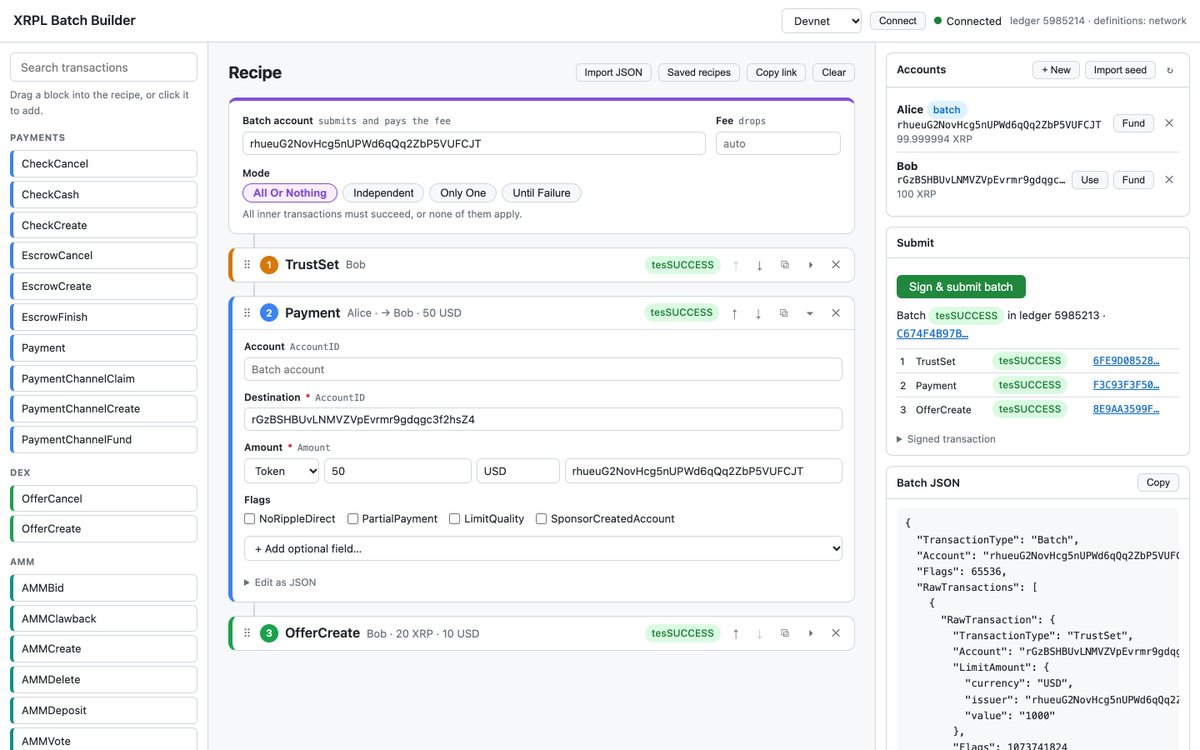
| XRPL Batch Builder | @msvadari | Drag-and-drop UI for composing and submitting atomic XRPL transaction batches | Reduces the complexity of assembling multi-step batch transactions manually | Browser UI, XRPL node definitions | Alpha | tweet, demo |
Drex 1.5 was the most important builder signal because it turns “decision model” into a separate product layer. The public material around the launch emphasized compatibility with existing coding-agent environments and keeping routing, classification, and extraction close to the data instead of sending every decision to a larger frontier model.
HarnessRouter, Prismor, and NEAR AI Cloud all fit a second repeated pattern: builders are wrapping existing agents with interoperability, policy, or privacy infrastructure rather than replacing them outright. That is a strong sign that the next product layer is often around the agent, not inside the base model.
The more lightweight build examples still mattered. OpenCode iOS pushed the coding-agent surface onto phones, while the XRPL Batch Builder showed a concrete “vibe-coding” output: a narrow transactional UI shipped fast, with the builder explicitly warning it was not yet production-grade.
6. New and Notable
Copilot local models on Windows got implementation detail, not just branding
@windowsdev announced (27 likes, 3,523 views) HydraFusion routing to models running locally on the device, and the public Microsoft article added the substantive details: GitHub Copilot will offer Auto orchestration across local and cloud inference, an explicit local-model selection path, and a local MAI Code 1.1 Flash build reduced to 53GB, an 80% reduction from the cited cloud variant, with 70.8% on SWE-Bench Verified and MXC-backed sandboxing on Windows. (article)
Copilot code review moved closer to budgeted enterprise infrastructure
GitHub’s changelog made two admin-level additions that matter for real teams: orgs can bill eligible reviews to the organization instead of a member quota, and they can restrict review requests from externally licensed users. That is notable because it acknowledges that code review is now a budgeted and governed workflow, not just an optional assistant feature.
Open-source agent access reached phones and confidential hardware on the same day
The pairing of @thdxr’s OpenCode iOS beta expansion and @near_ai’s private-inference setup guide showed two adjacent extensions of the same shell: one toward mobile access, the other toward confidential deployment. That combination makes portability and privacy feel like active product fronts rather than edge-case requests.
7. Where the Opportunities Are
[+++] Entitlement-aware agent control planes — The clearest pain today was not lack of models. It was lack of clear state across rollouts, credits, leaving-soon labels, billing prerequisites, and review quotas. Evidence appeared across Gemini Argon access chatter and GitHub’s own billing-control changes.
[++] Task-level cost and route observability — Users increasingly compare full-task economics across effort levels, plan versus API access, and retry behavior. Benchmark charts and hands-on tests show a real gap between token pricing and perceived cost.
[++] Review-load and policy tooling for AI-heavy teams — More generated code shifts work into review, authorization, and audit. The demand is visible both in field complaints and in product changes around Copilot code review policy.
[+] Private and portable agent companions — OpenCode iOS and OpenCode-on-TEE evidence suggest an emerging market for the same agent workflow across phone, laptop, local model, and confidential cloud contexts.
8. Takeaways
- On 2026-10-09, Google’s AI-coding conversation was still dominated by rollout mechanics rather than a public Argon launch. The strongest evidence came from credits logistics, insider-code screenshots, and “Leaving Soon” labels rather than a released workflow. (source)
- Speed claims are being normalized into task-level economics. Posters compared models by completed-task cost, retry behavior, and access path instead of raw per-token price. (source)
- Copilot discussion moved further toward policy and deployment surfaces. Local/cloud orchestration details and code-review billing controls were both treated as meaningful product changes. (source)
- The strongest open-source builder pattern was “add a control layer around the model.” Drex, HarnessRouter, Prismor, and private-inference OpenCode setups all fit that mold. (source)
- Portability and privacy are becoming expected extensions of the coding-agent workflow. Mobile beta access and confidential inference appeared as same-day product surfaces, not distant roadmap ideas. (source)