Twitter AI Coding - 2026-10-13
1. What People Are Talking About
1.1 Gemini 4 Argon stopped being a rumor and started being a judged product (🡕)
Argon discussion finally moved from leak-chasing into public evaluation and official rollout. At least six high-signal posts combined first-hand testing, product announcements, and Google-authored deployment metrics. The notable shift was that people were no longer just asking whether Argon existed; they were comparing how it behaved in Copilot, Antigravity, and other harnesses, and whether the surrounding product layers were good enough to let the model shine.
@emollick said (426 likes, 58 replies, 26,826 views, 99 bookmarks) that Gemini 4 was the first non-OpenAI/Anthropic model to clear his "Fable/Mythos/Astra bar," and that it was stronger than earlier Gemini models in creativity, writing, and general agentic behavior, even while still lagging in complex multi-agent work because the Antigravity harness was "not quite as good as the competition." The attached comparison mattered: the same brutalist city-builder prompt produced a denser UI and more complete architectural output in Argon than in Astra Max in Codex or Fable 5.1 Max in Code. (post link)

@github announced (236 likes, 35 replies, 22,953 views, 31 bookmarks) that Gemini 4 Argon was generally available in GitHub Copilot and said its largest benchmark gains showed up in Copilot CLI. The public GitHub changelog added the distribution detail: Argon was rolling out across VS Code, Visual Studio, Copilot CLI, the coding agent, the Copilot app, JetBrains, Xcode, and Eclipse for Pro+, Max, Business, and Enterprise users. (post link)
@antigravity reported (158 likes, 26 replies, 9,528 views, 38 bookmarks) that its team used Argon plus multi-agent workflows to calibrate translation across 17 languages. The linked Antigravity blog post made the rollout feel larger than a launch-day demo: Google said more than 100,000 Alphabet users were already relying on Argon in its internal Antigravity environment each month, with a 35% increase in agentic code, a 30% decrease in post-submit rollbacks over four weeks, and a 97-of-134 bug backlog burn-down in under three hours. (post link)
Discussion insight: The replies around all three posts converged on the same nuance: people were willing to grant that Argon looked strong, but they kept separating model quality from harness quality. Emollick's thread drew replies about the Antigravity UI and workflow layer, while the Antigravity launch thread immediately filled with users asking why Pro subscribers still could not access the model.
Comparison to prior day: On 2026-10-12, the strongest Argon signal was still leaked routing, plan tables, and hidden availability under older Gemini labels. On 2026-10-13, the conversation upgraded to first-hand reviews, official distribution in Copilot, and Google-authored evidence about how Argon was already being used at scale.
1.2 Users still reverse engineered Argon rollout from menus, binaries, and redirects (🡕)
Even after official launch posts appeared, a large share of the conversation still looked like product archaeology. At least eight public posts relied on binary diffs, model pickers, upgrade redirects, quota screens, and dated notices to work out who had access to which models and for how long. The model was becoming more visible, but the rules around it were still being pieced together by users rather than presented cleanly in-product.
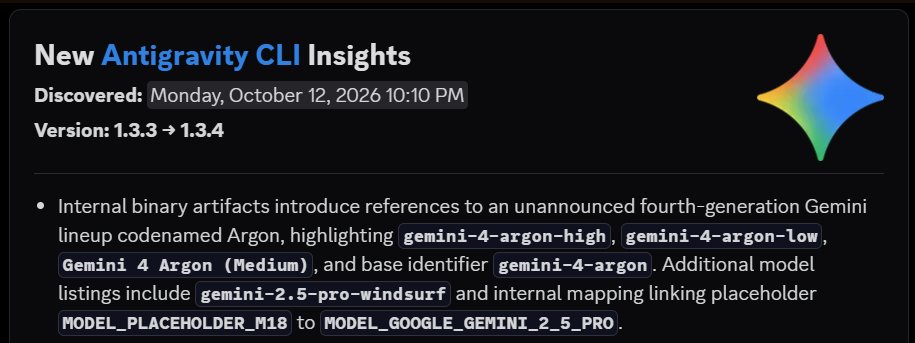
@lyraxana showed (198 likes, 10 replies, 7,526 views, 14 bookmarks) that the latest Antigravity CLI update exposed gemini-4-argon, gemini-4-argon-low, gemini-4-argon-medium, and gemini-4-argon-high directly in the surface users could inspect. @LuminaBench added (140 likes, 18 replies, 11,806 views, 11 bookmarks) desktop and CLI diff cards showing those native IDs in Antigravity 2.23.0 and CLI 1.3.4, while explicitly warning that compiled-in identifiers did not confirm account access. (post link)
@yoftahe noticed (1,042 views) that clicking upgrade in Antigravity redirected to antigravity.google/g1-upgrade?utm_campaign=ARGON_SETTINGS_PAGE, which made the rollout visible in a URL before it was explained in plain language. @blankspeaker attached (44 likes, 5 replies, 2,604 views) a notice saying third-party model access on the current Pro and Ultra plan would end on November 2, and @ishanxtwt argued (19 likes, 18 replies, 452 views) that people should use the current free access to Claude Opus 4.6, Sonnet 4.6, Gemini, and GPT-OSS while it still existed. @ash_twtz showed (11 likes, 8 replies, 688 views) another side of the same access story: a fully exhausted five-hour Gemini window with 58% of the weekly allowance still untouched. (post link)

@notjazii shared (59 likes, 18 replies, 5,057 views, 14 bookmarks) a practitioner workaround for the rollout opacity itself: ask 3.8 Flash about Tibo or model release dates without web search, and if it answers correctly you are probably being routed to Argon. That was not official verification, but it showed how far users were willing to go to infer which model they were actually talking to.
Discussion insight: The community did not treat menus, notices, and redirects as side chatter. Those surfaces were the product explanation. Users kept pulling policy and entitlement clues out of screenshots because the visible account state carried more usable information than the launch messaging.
Comparison to prior day: On 2026-10-12, users were decoding plan matrices and "Leaving Soon" notices. On 2026-10-13, the same behavior intensified into deeper inspection of binaries, upgrade URLs, and quota panels even after Argon was publicly acknowledged.
1.3 Codex trust remained tied to resets while Claude Code gained comparison wins (🡕)
Codex discourse stayed centered on resets, limits, and competitive comparison rather than on a new feature people clearly wanted to celebrate. At least five retained items treated resets as the main customer-facing event, while several others used the day to explain why they were standardizing on Claude Code or moving to model-agnostic alternatives. The result was a trust conversation more than a pure model conversation.
@codex_resets confirmed (44 likes, 1 reply, 5,771 views) that a new reset had landed, and the public Codex Resets tracker logged it as the 61st reset with a 6.5-day average reset interval. @ivanainai wrote (20 likes, 7 replies, 2,559 views) that two resets in three days suggested usage limits were the real product problem and that another reset would not count as a meaningful feature. (post link)
@CodexResets1 amplified (72 likes, 8 replies, 9,228 views, 8 bookmarks) a direct Claude-versus-Codex comparison from a user who said a hard crawler problem took roughly 10 hours in Codex but 30 minutes in Claude. @TweetsOfSumit said (28 likes, 18 replies, 2,591 views, 7 bookmarks) his entire engineering team had moved on from Cursor to Claude Code, while still using ChatGPT/Codex here and there and Gemini for non-coding work. @vvoyer argued (4 likes, 8 replies, 212 views) that relying on a frontier coding agent tied to a single lab is strategically risky because the best model keeps changing, and that users should get comfortable with model-agnostic shells plus a gateway such as OpenRouter or an AI gateway. (post link)
Discussion insight: The most durable defense of Codex in the feed was not a claim that the problems were imaginary. It was that resets and responsive communication were keeping people productive for now. That still left the deeper complaint intact: users wanted a path to steady capacity and clearer competitive wins, not a recurring social ritual around limit refreshes.
Comparison to prior day: On 2026-10-12, Codex complaints were focused on allowance math and whether launch framing matched the real value delivered. On 2026-10-13, the same dissatisfaction hardened into side-by-side tool comparisons and team-level migration language.
1.4 Builders wrapped agents with review layers, sandboxes, and business workflow structure (🡕)
The day's strongest builder signals were not new chat surfaces. They were control layers around existing agents: explain-before-ship teaching, repo-scoped sandboxes, human review gates, reusable diagram tooling, and concrete business workflows. At least seven public posts described systems where the model did useful work, but a human or policy layer still decided what counted as safe, understandable, or ready.
@dewanshranjan launched (8 likes, 9 replies, 243 views) Contral as a teaching layer that sits on top of Cursor, Claude Code, Copilot, Codex CLI, or a custom agent, explains every function and decision while code is being written, and adds a defense mode that asks the user to explain the code in their own words before shipping. @DanWahlin described (9 likes, 2 replies, 751 views, 7 bookmarks) a related pattern from course production: humans owned the outline, teaching level, and final decisions, while Copilot app and CLI scaffolded content, generated visuals, validated links, and supported review passes across Claude, Grok, and Codex. (post link)
@vipulnsward showed (3 likes, 1 reply, 238 views) a public workflow for building scoped websites and apps for Pune businesses with Codex, Dots, gbrain, and human review. The linked Saeloun case study described a repair CRM, a photography proofing flow, and a bakery site, all running through private GitHub repos, automated checks, and Hetzner/Cloudflare deployment. @sam_kececi said (20 likes, 6 replies, 486 views) the Sentience web app was built by a software factory while its human guide was fully out of office, which pushed the same idea into a stronger autonomy claim. @drawio added (18 likes, 1,103 views, 11 bookmarks) a smaller but very practical layer: ask Copilot for a diagram, then edit it through the official draw.io MCP repo, which now has 5,635 stars and explicit Copilot CLI support.
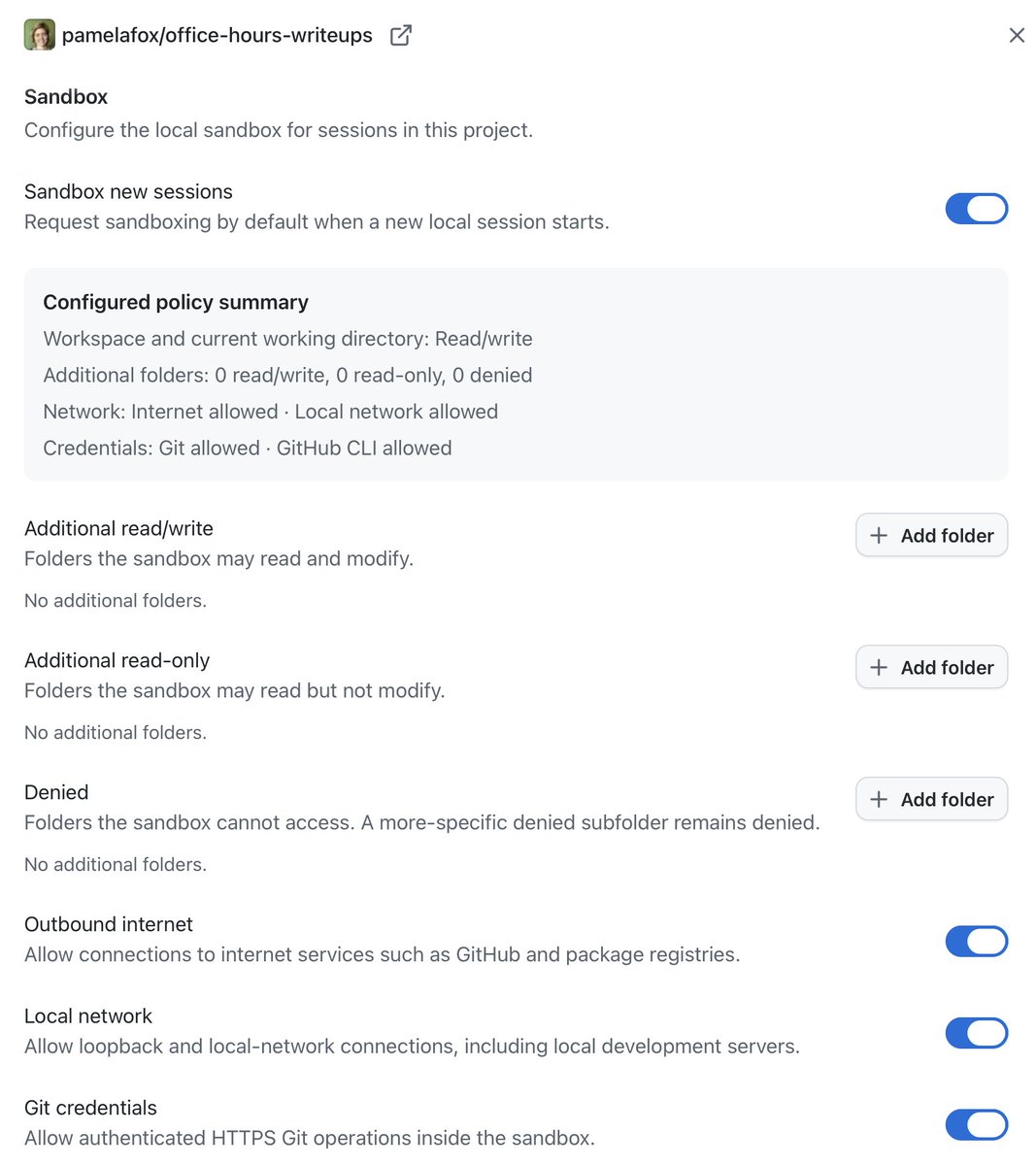
@pamelafox noted (2 likes, 2 replies, 391 views) that the Copilot app now has a per-repo sandbox option controlling read/write folders, outbound internet, and git credentials. The linked Microsoft article added that GitHub is using MXC on Windows, Seatbelt on macOS, and bubblewrap on Linux, while @DivyanshT91162 pitched (4 replies, 218 views, 2 bookmarks) PocketPaw as a local personal assistant with persistent memory, multiple backends, tool policies, and human approval. (post link)
Discussion insight: Across these posts, the repeated build pattern was not "better model, finished product." It was "use the model, then add the policy, artifact, or review surface that keeps the work understandable and governable." That is a very different kind of competitive layer.
Comparison to prior day: On 2026-10-12, wrapper projects were heavily about persistence and domain adapters. On 2026-10-13, the strongest builder examples leaned harder into human approval, repo-scoped policy, and workflow structures that turn agent output into something a person can actually verify.
2. What Frustrates People
Access policy kept showing up as clues instead of clear product communication
Severity: High. @blankspeaker showed (44 likes, 5 replies, 2,604 views) a dated notice that third-party model access on the current Antigravity plan ends on November 2, @yoftahe caught (1,042 views) an upgrade redirect to antigravity.google/g1-upgrade, and @ishanxtwt treated (19 likes, 18 replies, 452 views) the current free model picker as something to exploit before it disappears. Users were learning policy from menus, notices, and URLs rather than from a stable change log. Worth building: High.
Codex resets still looked like relief, not a durable fix
Severity: High. @codex_resets confirmed (44 likes, 1 reply, 5,771 views) another reset, while the public reset tracker logged it as the 61st recorded reset. @ivanainai said (20 likes, 7 replies, 2,559 views) that two resets in three days showed usage limits were the actual product problem, and @CodexResets1 amplified (72 likes, 8 replies, 9,228 views, 8 bookmarks) a report that a hard task took 10 hours in Codex but 30 minutes in Claude. The frustration was not just low allowance; it was the sense that the user experience still depended on manual intervention. Worth building: High.
The same model could feel very different depending on the harness around it
Severity: High. @emollick wrote (426 likes, 58 replies, 26,826 views, 99 bookmarks) that Argon itself was strong but the Antigravity harness still lagged the competition in complex multi-agent work. @notjazii resorted (59 likes, 18 replies, 5,057 views, 14 bookmarks) to no-web prompt tests just to infer whether 3.8 Flash was routing to Argon, and @vvoyer argued (4 likes, 8 replies, 212 views) that lab-tied coding agents are a bad long-term bet because the best model keeps moving. @al3rez added (2 likes, 3 replies, 141 views) a concrete research version of the same issue: Xiaomi saw duplicate tool calls differ between OpenCode and Codex on the same checkpoint. Worth building: High.
AI still wrote code faster than teams could comfortably explain or review it
Severity: Medium to high. @dewanshranjan framed (8 likes, 9 replies, 243 views) the problem plainly: AI writes code faster than humans can read it, and people often ship it anyway until something breaks. That is why Contral adds a teaching layer and a defense mode that asks the user to explain the code before shipping. @DanWahlin described (9 likes, 2 replies, 751 views, 7 bookmarks) the same pressure from another angle: even when Copilot handled scaffolding, screenshots, reviews, and link checks, humans still had to decide what "good" looked like for a course. Worth building: High.
3. What People Wish Existed
A public ledger for model access, sunsets, and quota rules
The combination of @yoftahe, @blankspeaker, @ishanxtwt, and @ash_twtz points to the same missing product: users want one page that says who gets which models, when access changes, what expires next, and how quota windows actually work. Right now they are piecing that together from redirects, pickers, and screenshots. Opportunity: Direct.
Agents that teach the code they write before anyone ships it
@dewanshranjan was explicit that the problem is not only generation quality but comprehension debt, and Contral's whole pitch is to explain the code as it is being written and force a human explanation before release. @DanWahlin described a similar workflow at course scale, where agents did the repetitive work but humans still owned quality, teaching, and final sign-off. The need here is practical rather than aspirational: teams want review surfaces that reduce blind shipping without throwing away speed. Opportunity: Direct.
Safe local agent sessions with understandable controls instead of blanket trust
@pamelafox highlighted per-repo sandbox controls for file access, network access, and git credentials, while @DivyanshT91162 described PocketPaw with local execution, tool policies, and human approval. The desire underneath both posts is clear: give users stronger boundaries than prompt instructions, but make those boundaries visible and adjustable enough that developers will actually keep them on. Opportunity: Direct.
Model-agnostic control planes that survive the next benchmark swing
@vvoyer argued that frontier coding agents are really harnesses attached to a lab's model roadmap, and that users should be ready to switch the moment the best model moves. @TweetsOfSumit and the Codex-versus-Claude switching posts show why that argument resonates: teams are already mixing multiple model providers in one workflow. The need is less "invent a new model" and more "make the shell portable when the leaderboard changes." Opportunity: Competitive.
4. Tools and Methods in Use
| Tool | Category | Sentiment | Strengths | Limitations |
|---|---|---|---|---|
| Gemini 4 Argon | Frontier coding model | (+/-) | Strong coding, reasoning, and creative performance; official benchmark leadership; visible gains in Copilot CLI | Product quality varies by harness; rollout and entitlement were still opaque; access remained plan-gated |
| Google Antigravity | Agent surface | (+/-) | Multi-agent workflows, multi-model access, strong internal adoption, real translation and enterprise workflows | Users kept reverse engineering access; third-party access sunsets on Nov. 2; five-hour windows still mattered |
| GitHub Copilot | Coding agent and IDE platform | (+) | Broad Argon rollout across IDEs, CLI, coding agent, and app; growing sandbox and plugin surfaces | Rollout is gradual; provider pricing and enterprise policies add complexity |
| Claude Code | Coding agent | (+) | Won direct speed-and-quality comparisons in hard tasks; strong enough for team-wide standardization in one post | Still tied to one lab's roadmap; users worried about long-term lock-in |
| Codex | Coding agent | (+/-) | Still widely used, heavily represented in auto-research, and supported by frequent resets | Trust remained tied to limit resets and usage policy rather than stable capacity |
| OpenCode and gateway-style shells | Model-agnostic agent shell | (+) | Lets users switch models as the leaderboard moves and route through broader provider ecosystems | Requires configuration discipline; cost-per-fix and routing quality still need validation |
| Contral | Teaching and verification layer | (+) | Explains generated code, adds plan approval, and forces user comprehension before shipping | Very early product with low public adoption evidence so far |
| draw.io MCP | Diagram MCP and plugin | (+) | Produces editable diagrams for Copilot CLI, Copilot app, Claude, Codex CLI, and OpenCode | Diagram quality still depends on prompting, and some export flows need local tooling |
| Custom auto-research harnesses | Research workflow method | (+/-) | Coordinated hundreds of PRs, mixed Codex and Claude, and turned X into a live collaboration layer over GitHub | Can overload coordination surfaces and still relies on expert intuition to guide the search |
Overall, satisfaction was highest when users could either inspect the output directly or switch models without rebuilding their whole workflow. Satisfaction was weakest where pricing, quotas, or access rules were hard to predict. The main workarounds were route-detection prompts, private custom agents, human review gates, gateway-style model switching, and a willingness to move from Cursor or Codex toward Claude Code or more portable shells when a task or budget demanded it.
5. What People Are Building
| Project | Who built it | What it does | Problem it solves | Stack | Stage | Links |
|---|---|---|---|---|---|---|
| Contral | @dewanshranjan | Adds a teaching layer to AI coding agents, explaining code as it is written and requiring user understanding before ship | Teams can generate code faster than they can confidently review it | IDE overlay, plan mode, defense mode, BYO model keys, integrations with Cursor, Claude Code, Copilot, Codex CLI, Antigravity, Windsurf, Kilo Code, and VSCodium | Beta | tweet |
| Vipul's AI for Pune businesses | @vipulnsward | Builds scoped websites and apps for local businesses with agent support and human review | Small businesses need practical software without starting from a formal spec | Codex, Dots, gbrain, private GitHub repos, automated checks, Hetzner, Cloudflare | Beta | tweet, blog |
| Sentience web app | @sam_kececi | Ships a web-based digital twin product that the team says was built autonomously by a software factory while a human guide was away | Tests how far agent-managed delivery can go without continuous operator presence | Autonomous software factory, web app, human steerage | Shipped | tweet |
| Draw.io MCP Server | @drawio | Lets AI assistants generate and edit diagrams as native draw.io artifacts | Diagram output often gets trapped as prose or screenshots instead of editable assets | JavaScript, MCP, Copilot CLI/app, Claude, Codex CLI, OpenCode | Shipped | tweet, repo |
| PocketPaw | @DivyanshT91162 | Runs a local personal assistant with persistent memory, policies, approvals, and chat-platform integrations | Users want their own agent on their own machine rather than a closed hosted one | Python 3.11+, desktop app, web dashboard, Ollama option, multiple backends, 50+ tools | Beta | tweet |
| Integer-multiplication auto-research harness | @RohanArun | Coordinates public agent-generated PRs and human ideas toward tighter research bounds | Researchers need a way to turn subscriptions and intuition into organized experimentation | Codex, Claude, custom harnesses, GitHub PRs, dashboards, shared prompts | Alpha | tweet |
@dewanshranjan showed (8 likes, 9 replies, 243 views) the cleanest expression of the day's builder mood: do not just generate code faster, add a layer that forces comprehension. Contral's screenshot makes that visible by placing explanation and approval around the coding agent rather than trying to replace the agent itself.

@vipulnsward showed (3 likes, 1 reply, 238 views) a second recurring pattern: start from one concrete business workflow instead of from a generic AI promise. The linked blog broke that into a repair CRM, a photography proofing flow, and a bakery site, all built with Codex, Dots, gbrain, and human review. @sam_kececi pushed (20 likes, 6 replies, 486 views, 3 bookmarks) the same direction with a stronger autonomy claim, saying the Sentience web app was built while the human guide was actually out of office.
Artifact-oriented projects also stood out. @drawio used (18 likes, 1,103 views, 11 bookmarks) Copilot as a diagram generator rather than just a text assistant, while @DivyanshT91162 framed (4 replies, 218 views, 2 bookmarks) PocketPaw as a local agent that users can own, configure, and approve. The community auto-research thread from @RohanArun added a different build pattern again: use coding agents as a public swarm, not just as a personal assistant, with 285 PRs from 110 contributors in one day.
The repeated trigger across these builds was not model novelty. It was operational pain: blind shipping, missing workflow structure, inaccessible artifacts, or the need to make a real business process easier. Multiple builders converged on the same answer independently: wrap the model with a narrower surface that people can actually inspect, approve, or reuse.
6. New and Notable
Google published internal-scale Argon adoption numbers instead of just a benchmark slide
The most novel Argon evidence did not come from a benchmark thread. It came from the public Antigravity blog, which said more than 100,000 Alphabet users already rely on Argon inside Google's internal Antigravity environment each month, that agentic code was up 35%, and that post-submit rollbacks were down 30% over four weeks. The same post also claimed a 97-of-134 bug backlog reduction in under three hours and documented non-engineering uses such as 17-language localization and finance workflows. (source)
Repo-scoped sandboxing became a visible product surface in Copilot
@pamelafox surfaced (2 likes, 2 replies, 391 views) a concrete per-repo sandbox UI in the Copilot app, and Microsoft's companion article explained the underlying controls: MXC on Windows, Seatbelt on macOS, and bubblewrap on Linux. That mattered because the feature was not described as abstract security posture; it was described in the operational units developers actually care about - folders, outbound internet, local network, and git credentials. (source)
Public auto-research looked more like a live swarm than a lone-agent demo
@RohanArun reported (97 likes, 1 reply, 2,454 views, 15 bookmarks) that the integer-multiplication community opened 285 PRs in 24 hours from 110 contributors, with 229 PRs mentioning Codex/OpenAI and 70 mentioning Claude. The notable part was not just the volume. It was the workflow: GitHub as execution surface, X as real-time coordination layer, human experts adding intuition in replies, and custom harnesses being built to absorb unused tokens at scale.
Xiaomi's harness paper made a small but useful point about agent metrics
@al3rez highlighted (2 likes, 3 replies, 141 views) a detail from Xiaomi's MiMo-V2.6-Pro research that is likely to age well: the same checkpoint showed different duplicate tool-call behavior in OpenCode and Codex, and Xiaomi chose a $90K distillation fix over an estimated $2.31M RL retune. That is a good example of why coding-agent evaluation is drifting away from pure benchmark scores and toward harness-specific efficiency metrics such as wasted calls and recovery behavior.
7. Where the Opportunities Are
[+++] Entitlement and quota observability for agent platforms - The clearest pain in the feed was not raw model weakness; it was users reverse engineering rollout, sunsets, and quota behavior from menus, notices, redirects, and screenshots. Antigravity's November 2 notice, upgrade redirect, free-tier model picker, and five-hour quota panel all point to a product gap that could be solved with better account-state visibility.
[+++] Safe local agent operations bundles - The Copilot sandbox UI, PocketPaw's approval and policy hooks, and Xiaomi's harness-specific tool-call findings all reinforce the same need: local agents need understandable defaults for files, network, credentials, and tool behavior. There is room for products that bundle those controls into something developers will actually keep turned on.
[++] Explain-before-ship review layers - Contral's whole pitch, Dan Wahlin's course workflow, and Vipul's human-reviewed business builds all show demand for systems that do more than generate code. The opportunity is to make agents legible enough that a human can confidently approve, teach, or audit the result without reading every raw tool trace.
[++] Model-agnostic agent control planes - Codex-versus-Claude switching stories and vvoyer's warning about lab-tied harnesses suggest that portability is becoming a product feature of its own. Developers increasingly want a durable shell that can swap models, pricing tiers, or providers without forcing a whole workflow rewrite.
[+] Vertical workflow packs for real business tasks - Antigravity's translation case study, the Pune business builds, draw.io MCP, and the public auto-research swarm all show the same pattern: attention concentrates when agents are wrapped around a narrow workflow with a clear artifact or measurable outcome. The strongest near-term wins look more vertical than general.
8. Takeaways
- Argon became a real product conversation, not just a leak-thread conversation. Public discussion on 2026-10-13 combined first-hand evaluation, official Copilot availability, and Google-authored deployment metrics, which is a materially different evidence base from the previous day's hidden-routing chatter. (source)
- Access policy is still doing too much product communication work. Users were learning what changed from an upgrade redirect, a November 2 sunset notice, a free-tier model picker, and a five-hour quota panel instead of from one canonical explanation. (source)
- Codex resets are buying time, not confidence. The 61st recorded reset kept the topic moving, but posts comparing Codex against Claude and calling limits the real problem showed that goodwill is still contingent on manual relief rather than durable trust. (source)
- The strongest builders are wrapping agents with judgment, policy, and artifact surfaces. Contral, Copilot sandboxing, draw.io MCP, and Pune business workflows all point in the same direction: the competitive layer is increasingly around reviewability and control, not just raw model choice. (source)
- Agent workflows are spreading into public research and concrete business operations. The same feed that discussed frontier models also documented a 285-PR auto-research swarm, translation workflows, repair and photography business software, and local personal agents, which is evidence of the topic broadening beyond solo coding assistance. (source)