Twitter AI - 2026-05-16
1. What People Are Talking About
1.1 Trust and evaluation are moving from abstract principles into concrete AI operations 🡕
The strongest AI conversation on May 16 was about trust becoming operational. Instead of another generic "AI needs guardrails" cycle, the most substantive posts were about specific test suites, benchmark venues, and public-private evaluation partnerships that make model behavior measurable rather than rhetorical. Three separate items supported the theme.
@AIHighlight summarized (99 likes, 14 replies, 6,047 views, 54 bookmarks) Garry Tan's "Agent Complexity Ratchet" argument and said an open-source tool called iFixAi now runs 32 checks against deployed AI systems, including two automatic-fail conditions. The post matters less for the YC framing than for the operational claim: AI testing is being described as something that belongs in a build process rather than in a policy memo.
@BradSmi said (24 likes, 5 replies, 1,809 views) Microsoft was pairing its frontline experience with CAISI in the U.S. and the U.K. AI Security Institute to improve advanced-AI risk understanding and protections. That adds a second lane to the same theme: the evaluation stack is expanding through institutions as well as tool builders.
@sahar_abdelnabi announced (22 likes, 2,748 views, 16 bookmarks) the AISec 2026 call for papers, and the workshop page now explicitly includes AI safety, dangerous-capability evaluations, multi-agent coordination risks, benchmark papers, and artifact-sharing requirements. The image is informative because it shows AI security and benchmarking presented as a formal ACM workshop track rather than a niche side topic.

Discussion insight: The two replies under the iFixAi thread that mattered were not hype replies. One said "everyone is racing to make their AI smarter. nobody is checking if it's honest," while another said "most failures will come from untested behavior." The common idea is that AI trust is no longer framed as a values problem alone; it is framed as a testing gap.
Comparison to prior day: May 15 already elevated agent evaluation through JetBrains patterns, Kaggle guides, and benchmark-credibility critiques. May 16 pushes further toward deployment: public test suites, formal workshop calls, and state-linked evaluation infrastructure.
1.2 Security capability is widening faster than the guardrails around it 🡕
The second theme was that more capable AI systems are being described not as safer assistants but as faster discovery engines for failure. The most visible examples came from security exploitation claims and the continuing institutional buildout around AI-and-security research.
@EvanLuthra claimed (155 likes, 18 replies, 30,133 views, 15 bookmarks) that Anthropic's unreleased Claude Mythos Preview helped security researchers route around Apple's Memory Integrity Enforcement on M5 chips in five days. The post is highly promotional, but it is still a real signal in the dataset because it ties frontier-model capability to exploit discovery, patch timelines, and the idea that hardware protections can be bypassed through higher-level logic.
@ai_for_success amplified (41 likes, 5 replies, 6,550 views, 12 bookmarks) a quote tweet from @IntCyberDigest making the same claim more narrowly: Mythos Preview was used to find the first public macOS kernel memory-corruption exploit on Apple's M5 silicon, and Calif handed the report to Apple after building a working exploit in five days. The replies turned that into a broader concern that AI-assisted vulnerability discovery is outpacing traditional defenses.
@sahar_abdelnabi shared the AISec call the same day, which is relevant here because the workshop now explicitly solicits work on AI misuse, automated hacking, truthfulness, dangerous capability evaluations, and containment for autonomous agents. The security conversation is no longer isolated from mainstream AI discourse; it is becoming one of the core places capability gets discussed.
Discussion insight: The most useful reply came from @ECLresearch under the Mythos post, which said the exploit story suggests AI-assisted vulnerability discovery is outrunning even well-funded legacy defense layers. That reply is more grounded than the headline itself because it translates the spectacle into an operational takeaway.
Comparison to prior day: May 15 centered on chain-of-thought hijacking and the claim that reasoning features can weaken safety. May 16 shifts from jailbreaks and evaluations to exploit discovery against real platforms and the institutions forming around that risk.
1.3 AI infrastructure is splitting into cheaper specialist models, edge inference, and labor-heavy data pipelines 🡕
The third cluster was not about one frontier model. It was about the stack underneath: specialized open models, small edge-oriented multimodal systems, and the human data-work layer that keeps many of these systems improving.
@pyquantnews contrasted (32 likes, 1 reply, 3,029 views, 35 bookmarks) BloombergGPT with FinGPT and claimed the open-source finance model could be fine-tuned for about $300 and 80 GPU hours versus BloombergGPT's $5 million and 1.3 million GPU hours. Even without a direct repo link in the dataset, the post clearly resonated as a cost-and-specialization story rather than a model-brand story.
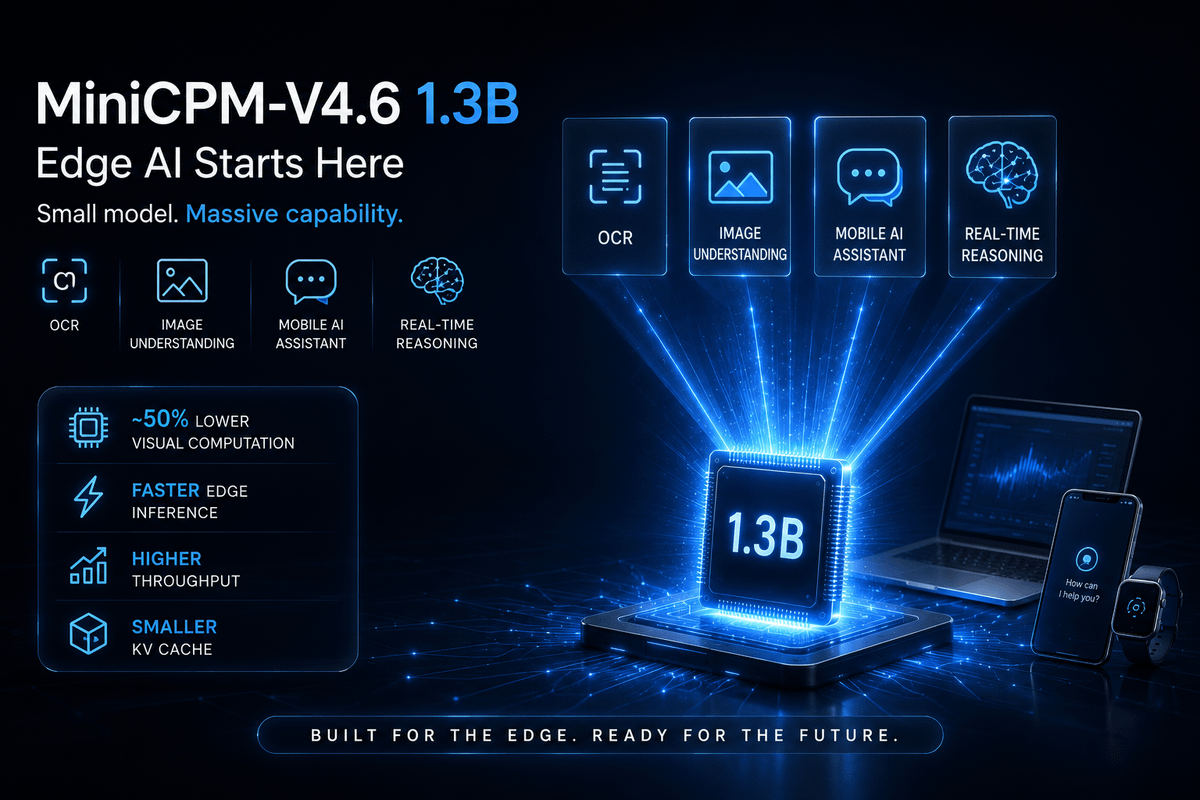
@nrqa__ posted (29 likes, 7 replies, 10,679 views, 13 bookmarks) that MiniCPM-V4.6 1.3B runs on edge devices, beats Qwen3.5-0.8B on key multimodal benchmarks, and cuts visual computation costs by about 50%. The poster image is informative because it spells out the pitch directly: OCR, image understanding, mobile assistant behavior, real-time reasoning, smaller KV cache, faster edge inference, and higher throughput from a 1.3B model.
On the labor side, @AmControo pointed (30 likes, 4 replies, 1,075 views, 30 bookmarks) to TransPerfect's DataForce platform for annotation, linguistic labeling, transcription, and content evaluation, while @justprotocol described (6 likes, 4 replies, 1,332 views, 7 bookmarks) Handshake AI as a data-annotation, chatbot-evaluation, and prompt-engineering platform with weekly payouts and advanced tasks paying up to $75 per hour. Those posts make the human-maintenance layer legible: even as small and open models improve, data and evaluation work still sit underneath them.
Discussion insight: The data-work posts were not framed as glamorous AI jobs. They were framed as recurring task markets: annotation, transcription, content evaluation, and prompt work. That is a useful contrast with the open-model posts because it shows cheaper model capability does not erase the need for labor-heavy curation and scoring.
Comparison to prior day: May 15's infrastructure conversation focused more on inference economics and chip positioning. May 16 is broader and more fragmented: open specialist models, edge multimodal models, and paid data-work platforms all coexisting in the same feed.
1.4 AI's physical footprint is becoming a governance fight, not just an infrastructure roadmap 🡕
The fourth theme was that AI compute is no longer discussed only as "more GPUs" or "more capex." It is increasingly discussed as a public-governance issue involving data centers, manufacturing policy, and who controls the physical substrate.
@democracynow posted (11 likes, 899 views, 3 bookmarks) a clip from Astra Taylor's interview, where she argued resistance to new AI data centers is not just NIMBYism but a push for "democratic governance over AI." The article adds specific numbers: a new Gallup poll showed seven in ten Americans oppose data centers near them, and Utah residents are fighting a proposed complex that could consume more energy than the entire state.
@Sanjay_Sriv argued (26 likes, 1 reply, 663 views, 5 bookmarks) that India's IT Hardware PLI 2.0 scheme could give AI a domestic manufacturing backbone by explicitly supporting AI servers and local supply chains. @chandrarsrikant separately reported (17 likes, 1,131 views, 3 bookmarks) on Indian startups trying to move compute into orbit through data-center-in-space projects.
Discussion insight: These posts do not agree on what the right compute future is, but they share one structural point: compute is now treated as a public-interest issue, whether the answer is slowing new data centers, building domestic AI-server capacity, or trying to escape terrestrial constraints entirely.
Comparison to prior day: May 15 talked about governance mainly through U.S.-China guardrails and access restrictions. May 16 brings the argument down to land, energy, factories, and local control.
2. What Frustrates People
Deployed AI still lacks simple trust checks people can run continuously
The iFixAi and AISec posts together point to the same frustration: many teams know their AI can fail, hallucinate, or behave inconsistently, but they still lack routine checks that fit normal engineering workflows. @AIHighlight describes iFixAi as a 32-test suite with automatic fails, and the AISec call now treats benchmark artifacts as serious research outputs rather than optional extras. The frustration is not absence of safety principles; it is the lack of easy, repeatable testing. Severity: High. Worth building for: yes.
Frontier capability is outrunning defensive comfort
The Mythos/Apple posts were the clearest sign. @EvanLuthra and @ai_for_success describe researchers using a frontier model to help find exploit paths around a flagship hardware security feature, and replies immediately translated that into a defensive-gap story rather than a model-demo story. Even if the exact public claims are promotional, the frustration they capture is real: more capable AI means defenders feel less sure that today's protections will hold. Severity: High. Worth building for: yes.
The AI data layer is still piecework-heavy and operationally messy
Annotation, content evaluation, and prompt work showed up repeatedly as paid task platforms rather than as stable product primitives. @AmControo surfaced TransPerfect/DataForce for annotation and labeling work, @justprotocol promoted Handshake AI for annotation and chatbot evaluation, and @OlatunjiAyokan2 promoted Sigma AI's search for Nigerian Fulfulde speakers for voice, transcription, and conversational tasks. The frustration is not only low glamour; it is that better models still depend on a scattered labor market underneath. Severity: Medium-High. Worth building for: yes.
AI compute expansion is creating backlash without obvious local upside
The Democracy Now interview gives the clearest language: communities are being asked to absorb noise, energy demand, land use, and emissions while getting few jobs back. That is a different kind of frustration from model safety, but it is now part of the AI conversation. Severity: High for affected communities. Worth building for: yes, particularly around compute transparency and governance.
3. What People Wish Existed
Continuous AI audits that work like ordinary engineering checks
The iFixAi story is effectively a demand signal for this category. People want deployed AI to have pass/fail checks for honesty, manipulation resistance, consistency, and uncertainty handling without hiring a specialized audit team every time. This is a practical need, and the engagement around iFixAi suggests there is appetite for tools that compress AI trust work into normal CI-like workflows. Opportunity: direct.
Defensive AI tooling that helps trusted teams find failures first
The Mythos exploit posts imply a specific wish: if advanced models can accelerate vulnerability discovery, defenders want access to equivalent or bounded capability before attackers do. The comments about AI-assisted vuln discovery outpacing legacy defense layers make this a direct security need rather than speculative futurecasting. Opportunity: direct.
Cheap specialist models for real domains and real devices
The FinGPT and MiniCPM-V4.6 posts are both demand signals for narrower capability at lower cost. People want finance-specific models that are not Bloomberg-priced, and they want multimodal systems small enough to run near the edge instead of in large hosted stacks. Opportunity: direct and competitive.
Better governance around the physical AI stack
The data-center backlash and sovereign-manufacturing posts point to a need that current product tooling barely addresses: communities, operators, and policymakers want clearer ways to reason about who bears the energy, land, and supply-chain costs of AI infrastructure. Opportunity: emerging.
4. Tools and Methods in Use
| Tool | Category | Sentiment | Strengths | Limitations |
|---|---|---|---|---|
| iFixAi | AI testing / audit tool | (+) | Frames AI trust as repeatable checks that can be run against deployed systems | Public evidence in the dataset is still tweet-led rather than deep product documentation |
| FinGPT | Domain model | (+) | Presents a finance-specific open alternative with dramatically lower fine-tuning cost than BloombergGPT | No direct repo or paper link surfaced in the captured tweet data |
| MiniCPM-V4.6 1.3B | Edge multimodal model | (+) | Small enough for edge-style deployment while still claiming OCR, image understanding, and realtime reasoning | Evidence today is launch-style promotion and benchmark claims, not field reports |
| TransPerfect DataForce | Data work platform | (+/-) | Offers annotation, labeling, transcription, and evaluation labor at scale | Makes visible how much AI progress still depends on outsourced task markets |
| Handshake AI | Data annotation / eval marketplace | (+/-) | Combines annotation, chatbot evaluation, and prompt-engineering work with weekly payouts | The public signup page is thin; the strongest evidence today is still social posting rather than product detail |
| AISec | Research / benchmark venue | (+) | Treats AI security, safety, and benchmark artifacts as first-class research outputs | Academic venue, not an operational product |
| Generative AI for Beginners | Curriculum | (+) | Free, large, multilingual course surface for AI app building and agent fundamentals | Educational resource rather than a runtime or tool |
| IDLE Inference Network | Distributed inference network | (+/-) | Pushes the idea of running open models locally and earning per completed job | Public evidence today is launch-oriented and token-adjacent rather than usage-heavy |
Overall satisfaction was fragmented by layer. Specialized models and edge systems drew optimism because they promise lower cost and more control, while data-work platforms and security posts made it clear how much invisible labor and evaluation still sit underneath "AI magic." The most obvious migration pattern was away from monolithic "frontier model solves everything" thinking and toward narrower stacks: domain models, edge inference, formal benchmarks, and human evaluation loops.
5. What People Are Building
| Project | Who built it | What it does | Problem it solves | Stack | Stage | Links |
|---|---|---|---|---|---|---|
| IDLE Inference Network | @IdleProtocol | Distributed network for running open-source AI models locally and earning USDC per completed job | Reduces dependence on centralized cloud inference | Local open-source models, user hardware, USDC settlement | Alpha | post |
| Handshake AI | Handshake AI (shared by @justprotocol) | Platform for data annotation, chatbot evaluation, and prompt-engineering gigs | Helps teams source human evaluation and data work quickly | Web task platform, human labeling/eval workflows | Beta | post, site |
| MiniCPM-V4.6 1.3B | MiniCPM team (shared by @nrqa__) | Small multimodal model for edge devices with OCR and image understanding | Makes multimodal AI cheaper to deploy near devices | 1.3B multimodal model, lower visual-compute path | Shipped | post |
The strongest builder pattern was infrastructure with a constraint attached to it. IDLE Inference Network is about local execution rather than cloud reliance, Handshake AI is about feeding annotation and evaluation work into the system rather than pretending the human layer is gone, and MiniCPM-V4.6 is about shrinking the model enough to live on edge hardware. This is a more grounded builder mix than a feed dominated by frontier-model launch hype.
6. New and Notable
Resistance to AI data centers is becoming a mainstream political signal
The Astra Taylor interview is notable because it treats AI data centers as a democracy and public-harm issue, not just an infrastructure investment story. The article cites seven in ten Americans opposing nearby data centers and frames the argument around energy, water, land, and local governance rather than around benchmark performance.
7. Where the Opportunities Are
[+++] Continuous trust and audit tooling — The clearest unmet need is repeatable, build-friendly evaluation for deployed AI. iFixAi's engagement and AISec's benchmark emphasis point in the same direction.
[++] Defensive AI security workflows — The exploit-discovery posts show demand for bounded access, trusted-team scanning, and faster defensive feedback loops before attackers or casual users get similar capability.
[+] Specialist and edge AI stacks — FinGPT, MiniCPM-V4.6, and local inference ideas all show appetite for narrower, cheaper, more controllable AI systems rather than one-size-fits-all frontier APIs.
8. Takeaways
- AI trust is being reframed as something teams should test, not merely debate. The iFixAi and AISec posts both move the conversation from principle to repeatable evaluation. (source)
- Security is now one of the main lenses through which AI capability gets discussed. The most viral capability-adjacent claims were about exploit discovery and AI-security infrastructure, not about general productivity wins. (source)
- The infrastructure layer is splintering into smaller, cheaper, and more human-maintained pieces. Edge models, open finance models, annotation platforms, and local inference networks all appeared in the same day, which is evidence of a more specialized market. (source)