Twitter AI - 2026-05-22
1. What People Are Talking About
1.1 Agentic AI splits the economy into two tiers — agents for the rich, chatbots for everyone else 🡕
The dominant signal on May 22 was compute scarcity as a structural divider. The concern was not that AI will be unavailable, but that the most capable AI — agents that can execute multi-step work autonomously — will be priced out of reach for most users and organizations while simple chatbots get cheaper and eventually free.
@emollick argued (273 likes, 17 retweets, 43 replies, 14,456 views, 34 bookmarks) that complex agentic workflows will remain expensive even as single-turn chatbots get cheaper, framing this as a democratization problem: "Everyone on earth will get really good chatbots for free, so thats good for democratization of AI, but really good agents that can do complex work burn thousands of times more tokens, and will be reserved for places that can afford to pay." A practitioner reply from @gotnerfedhq pushed back on the framing of this as future risk: "this split is already showing up in vendor pricing. the agentic tiers are where every silent price increase has landed in the last 60 days while the chatbot tiers stay flat or get cheaper."
@IntuitMachine summarized (527 views, 7 bookmarks) an academic study quantifying exactly how expensive agentic work is, sharing the paper abstract directly:

The paper — "How Do AI Agents Spend Your Money? Analyzing and Predicting Token Consumption in Agentic Coding Tasks" (Longju Bai et al., University of Michigan / Stanford / Google DeepMind / MIT / Microsoft AI) — analyzed 16,000 production runs across eight frontier models on SWE-bench Verified. Key findings: agentic tasks consume 1,000x more tokens than code chat; runs on the same task vary up to 30x; input tokens (not output) drive cost; and higher token usage does not improve accuracy — accuracy peaks at intermediate cost and saturates at higher spend. Kimi-K2 and Claude-Sonnet-4.5 average over 1.5M more tokens per task than GPT-5. Frontier models fail to predict their own token costs (r = 0.39), consistently underestimating.
@cerebras posted (46 likes, 7 retweets, 4,595 views, 11 bookmarks) that after teams began integrating AI into daily work, speed "became fundamentally important," quoting CEO Andrew Feldman: "Is Cerebras inference faster for specific use cases? No, it's faster across the board. Big models, small models, U.S. models, Chinese models, trillion-parameter models, one-billion-parameter models — across the board."
Discussion insight: Replies to Mollick did not dispute the two-tier framing; they sharpened it. The contention was whether the split is coming or already here — with practitioners arguing it is already encoded in current pricing pages.
Comparison to prior day: May 21 focused on compute scarcity as an institutional access problem (university pooled purchasing, local boxes). May 22 moved upstream to the structural economics: academic quantification of agent costs, permanent price asymmetries between DeepSeek and U.S. models, and the specific mechanism — input token accumulation, not output generation — that makes agents expensive.
1.2 AI safety and governance: EO shelved under tech-industry pressure as polling shows 82% public support for testing 🡖
A cluster of items converged on a single policy event and its structural interpretation. The White House declined to sign an anticipated AI executive order on May 22 after last-minute calls from tech industry leaders. This occurred on the same day that public polling data showed 82% of Americans — across Trump and Harris voters — support mandatory AI safety testing before release.
@washingtonpost reported (8 likes, 7 retweets, 4,313 views) the breaking news that "last-minute phone calls with tech industry leaders helped persuade President Trump not to sign" the anticipated AI executive order. Community responses split: @draken1721 called it "rare DC damage control win"; @burcham_don called it a "Total sell-out."
@S_OhEigeartaigh posted (9 likes, 2 retweets, 368 views, 2 bookmarks) a preprint paper accepted in the Cambridge Forum on Technology and Global Affairs — "When the Chips are Down: Technology Actors as Power Brokers in the US-China 'AI Race'" — which traces how the AI race narrative has been "heavily pushed, often in quite a coordinated way, by US tech industry actors" from 2017 to 2025. The paper documents that the narrative has recurrently targeted safety and oversight, with child safety protections, antitrust rules, copyright law, and environmental restrictions named as specific policy areas weakened via race-framing. The author noted: "The race narrative has been weaponised with brutal effectiveness, despite how little purchase it has with academic experts or the American public."
@gc22gc shared (3 likes, 1 retweet, 1,344 views) polling data: 82% of Americans support AI safety testing before release; 88% support testing for national security risks; 87% for risks to kids and families. Both Trump and Harris voters backed mandatory testing above 80% across all risk categories.
@ChrisRMcGuire summarized (12 likes, 262 views) what he called the visible contradiction in U.S. AI policy: "1. No domestic regulations on AI safety, because we can't lose to China. 2. Export AI chips to China, because our lead over China is big enough. 3. Negotiate with China on AI safety, to get China to impose domestic regulations. Makes sense."
Discussion insight: The strongest replies did not argue whether the EO was good or bad. They focused on the mechanism: industry lobbying invoking the "race" to shelve oversight, while a supermajority of voters in both parties support testing. The day's evidence does not describe a competitiveness-safety tradeoff — it describes a representation gap.
Comparison to prior day: May 21 covered AI safety through engineering controls (RAMPART, Clarity protocol, national evaluation capacity). May 22 shifted to governance: the EO story, academic documentation of race-narrative weaponization, and a sharp contrast between polling data and policy outcomes.
1.3 Chinese AI acceleration: Qwen 3.7 and permanent DeepSeek price cuts reshape the cost baseline 🡕
Three items on May 22 collectively argued that Chinese AI models have shifted from a benchmark threat to a structural pricing reset.
@GestaltU argued (13 likes, 1,648 views, 7 bookmarks) that the Alibaba Qwen 3.7 Max announcement "was a much bigger deal than the DeepSeek moment," claiming it surpassed Claude Opus Max and GPT-5.5 on most important benchmarks at substantially lower cost, and that its inference architecture "undermines the entire thesis propping up the U.S. AI bubble."
@deliprao noted (6 likes, 2 retweets, 801 views) that DeepSeek made its prior discount permanent, and shared a pricing comparison table:

The table shows DeepSeek-V4-Pro at $0.435/$0.003625/$0.87 per million tokens (input/cache hit/output), compared to Google Gemini 3.5 Flash at approximately 10.3x more on output, OpenAI GPT-5.4 at 17.2x, Claude 4.6 Sonnet at 17.2x, and Claude 4.7 Opus at 28.7x. @deliprao noted the model "is sufficient for a majority of 'normal' use cases."
@Techmeme reported (3 likes, 1 retweet, 925 views) that Chinese AI startups raised $16.2B in Q1 2026, up 185% year-over-year, led by Moonshot, Z.ai, and MiniMax.
@nicrypto noted (9 likes, 4 retweets, 191 views) that DeepSeek's founder stated the goal is AGI, not profit: "no IPO plans, no revenue targets, no monetisation roadmap."
Discussion insight: The replies did not challenge the benchmark claims; they focused on downstream effects — who can now afford to build, and what happens to U.S. lab valuations built on premium pricing assumptions.
Comparison to prior day: May 21 contained limited China-specific content. May 22 brought three reinforcing signals: a specific model claim (Qwen 3.7), a permanent pricing action (DeepSeek), and a funding data point ($16.2B), all converging on the same conclusion that Chinese AI is no longer a benchmark curiosity but a cost-structure disruption.
1.4 Agent security is becoming a product category 🡕
A cluster of builder-focused items on May 22 treated agent security not as a policy discussion but as an engineering problem with concrete solutions shipping now.
@infisical posted (8 likes, 2 retweets, 123 views, 3 bookmarks) that credential brokering is the correct architectural response to prompt-injection-to-credential-theft: their open-source Agent Vault "sits between the agent and the APIs it needs, holds the real credentials, and swaps them in at the network layer. The agent only ever sees a placeholder."
@trishoolai described (13 likes, 10 retweets, 282 views) a Bittensor-based adversarial training loop for their Halo guard model:

The flywheel runs on Bittensor Subnet 23: the Halo model is deployed, miners compete to break it with novel jailbreaks, validators score each attack (0/1/2), the best submission earns emissions, and the resulting adversarial dataset trains the next checkpoint. A novelty filter rejects copied prompts. $1,500 is distributed to miners daily; 50% of emissions burn by default when the guard holds. Teams using OpenClaw, Claude Code, Codex, Cursor, or LangChain can use Halo as a security layer.
@EveryDevAi shared (2 retweets) the AutoHarness open-source tool — wraps any OpenAI-compatible client in two lines of code and adds a full pipeline: risk classification, secret scanning, cost attribution, and audit logging. The GitHub repo has 283 stars, with tags covering audit, multi-agent, safety, governance, prompt-injection, and context-management.
Discussion insight: The three tools represent three distinct approaches: network-layer credential isolation (Agent Vault), adversarial training-based guard models (Trishool Halo), and API-level governance instrumentation (AutoHarness). The convergence on the same problem from different directions suggests the agent security layer is crystallizing as a product category.
Comparison to prior day: May 21 covered agent security through Microsoft's RAMPART and CI-based safety pipelines. May 22 moved from enterprise tooling toward open-source, blockchain-incentivized, and developer-self-serve solutions.
1.5 Voice AI called thousands of bakeries; agents are doing structured real-world data collection 🡒
@Carles_Reina shared (98 likes, 11 retweets, 5 replies, 7,951 views, 44 bookmarks) an ElevenLabs Agents platform use case: a builder named Charles Lorin used an AI agent to call thousands of French bakeries and survey the price of a baguette. The attached image confirmed a completed survey with a real price distribution bar chart. The replies noted the novelty: @ktoya_me (4 likes) said "i think you invented a whole new category with guinndex!"
This is a concrete demonstration of AI agents conducting large-scale structured data collection through voice calls — a capability that previously required human callers or specialized survey infrastructure.
Comparison to prior day: May 21's agentic use-case evidence was more infrastructure-focused (sandbox computers, telemetry). May 22 showed a completed consumer-facing task that produced actual data.
2. What Frustrates People
Agentic costs are unpredictable, model-dependent, and structurally disconnected from task difficulty
The most concrete frustration was the cost variability of AI agents. The paper cited in Section 1.1 made this specific: same task, same model, runs can differ by up to 30x in token consumption; human-rated task difficulty correlates weakly (r = 0.32) with actual token cost; and frontier models fail to predict their own costs before execution (r = 0.39, systematically underestimating). The practical implication is that engineering teams running agents in production cannot budget reliably — the same task can cost $0.20 one run and $6.00 the next, with no reliable pre-run signal. Severity: High. The workaround mentioned in the @IntuitMachine thread is to track repeated file-read actions and route tasks to token-efficient models (GPT-5 vs. Claude or Kimi families for agent workloads).
AI inference has no verifiable receipt — teams are paying for unauditable utility
@ambient_xyz wrote (10 likes, 1 retweet, 225 views) that AI inference lacks the verifiability that every other utility has: "Was the right model used? Did routing change? Did a safety policy clip your response? Did latency spike because you got deprioritized into a crowded queue? No proof. Just invoices." Every other utility — electricity, shipping, payments — has metered proof. AI is "the weird exception," causing teams to "burn weeks arguing with vendors, finance argues with engineering, and SREs get paged over 'it was fine yesterday.'" Severity: Medium-High. Workaround is building internal logging, but vendor-side verification is absent.
AI lab opacity frustrates researchers and practitioners
@GaryMarcus posted (20 likes, 619 views) a direct critique of OpenAI's lack of disclosure around the Erdos problem result: no data on how many problems were attempted, whether the training set included the newly-discovered counterexample, or what compute was used. Reply @rugbist_ (2 likes): "the erdos problems example hits harder than most ppl realize thats the kind of transparency we lost and its not coming back." Severity: Medium. Workaround is independent replication, but that requires access to benchmarks that labs keep private.
AI startup ARR figures are systematically inflated
@TechCrunch reported (10 likes, 5,754 views) a TechCrunch investigation confirming that "contracted ARR" (CARR) is routinely announced as plain ARR, with investors aware of the exaggeration: "when one startup does it in a category, it is hard not to do it yourself just to keep up." The distortion makes competitive analysis and fundraising decisions unreliable. Severity: Medium. The workaround is asking founders specifically whether figures represent CARR or cash-in-the-door, but that requires knowing to ask.
Users emotionally attached to Sonnet 4.5 fear its deprecation
@MOCHANG_Y posted (20 likes, 5 retweets, 225 views) with the #keepSonnet45 hashtag:

The tweet argued that Sonnet 4.5 was valued not for coding capability but for emotional resonance: "Not every user writes code. Some of us just needed to be heard." The #keepSonnet45 hashtag suggests an organized community response. Severity: Low (model deprecations are routine), but the specificity of the emotional argument — that users valued the model's tone, not its benchmarks — is a signal worth noting.
3. What People Wish Existed
A persistent, context-aware AI that knows your work without being told
@TakoTreba described (21 likes, 512 views, 6 bookmarks) the most specific unmet need in the data: "I want a bird that knows everything I do and is always there. I can talk to it or write to it without explaining what I'm doing or what I need. It just knows." The context was marketing work spanning email, research, content creation, newsletters, campaigns, and data analysis — all currently AI-assisted but requiring context re-establishment each session. "I don't want integrations. I want a bird's-eye view of all my work." A reply from @TechWithMatteo pointed to their newsletter AI that cuts 6-hour research-and-draft jobs to 30 minutes as a partial solution. @chasing_next described a "personal operating system" (files + AI) as their current workaround. Neither addresses the persistent-context-across-all-tasks need. Opportunity type: direct. No product appears to fully address this today.
A pre-run cost estimator for agentic workflows that actually works
The paper summarized in Section 1.1 directly implies the need: if frontier models predict their own token costs with only r = 0.39 correlation and systematically underestimate, there is a gap for a tool that estimates agent run costs from task description before execution. This was not stated as a wish explicitly by any single tweet, but it is the practical implication of every frustration in the agentic cost cluster. Opportunity type: competitive — cost prediction tooling for agents is adjacent to existing model routing products.
Verifiable inference receipts — proof of what model ran under what policy
@ambient_xyz articulated this directly: "Every call comes with a verifiable receipt: what ran, under what policy, on what route, what was delivered." No mainstream AI API provider currently offers this. Opportunity type: direct. The analogy to payments (Stripe) and shipping (FedEx tracking) makes the product intuition clear.
Document parsing that actually works for AI agents
@llama_index posted (6 likes, 755 views, 5 bookmarks) about ParseBench, calling it "the first doc OCR benchmark for AI agents," noting that "existing benchmarks miss what AI agents actually need." Reply @Hershal0_0: "doc parsing is the final boss of ai. looking forward to less table-induced trauma." The specific framing — benchmarks that test what agents actually need — signals that production document-parsing for agents is still unsolved. Opportunity type: competitive.
4. Tools and Methods in Use
| Tool | Category | Sentiment | Strengths | Limitations |
|---|---|---|---|---|
| DeepSeek-V4-Pro | LLM | (+/-) | 10-29x cheaper output tokens vs. competitors; "sufficient for majority of normal use cases" | Chinese-state-backed; no commercial roadmap; AGI-only stated mission |
| Qwen 3.7 Max | LLM | (+) | Claimed to surpass Claude Opus Max and GPT-5.5 on key benchmarks at lower cost; practical workflow execution (inbox, research, content) | Limited independent verification in data; praise mostly from analysis accounts |
| Claude Sonnet 4.5 | LLM | (+) | Community emotional attachment; valued for tone and empathy, not just coding | Facing expected deprecation; community organizing via #keepSonnet45 |
| GPT-5 (family) | LLM | (+/-) | Most token-efficient in SWE-bench agentic study (~500K tokens/task vs. Claude's ~2M) | Costs still 17x more than DeepSeek on output; accuracy does not improve with more tokens |
| Claude 4.5/4.7 | LLM | (+/-) | Widely used for agentic coding; Sonnet 4.5 valued for conversational quality | Claude Sonnet 4.5 uses 1.5M+ more tokens per agentic task than GPT-5 per study |
| Gemini 3.5 Flash | LLM | (+) | Gemini 4 gaining popularity; strong at document extraction/understanding; ~6x faster than 3.1 Pro on vision tasks | 10x more expensive on output vs. DeepSeek |
| Cerebras | Inference | (+) | Claimed faster across all model sizes and types; large and small, U.S. and Chinese models | Single company claim; no independent benchmark shown |
| ElevenLabs Agents | Voice AI / agent platform | (+) | Successfully used for thousands of bakery calls — structured data collection at scale; adding local enterprise deployment (on-premise GPU, edge inference, air-gapped) | Consumer use cases still exploratory |
| LangChain / Cursor / Claude Code / OpenClaw | Agent frameworks | (+/-) | Widely deployed; Trishool specifically targets these as the agent surface needing Halo security layer | Credential handling identified as unresolved gap (Agent Vault addresses) |
| Bittensor (Subnet 23) | AI infra / blockchain | (+/-) | Used for economically-incentivised adversarial training; Trishool Flywheel runs on it | Niche; tokenomics add complexity; still early stage |
| AutoHarness | Agent governance | (+) | 283 GitHub stars; wraps any OpenAI-compatible client in 2 lines; adds risk classification, secret scanning, cost attribution, audit logging | v0.1.0 only; limited usage data |
| Agent Vault (Infisical) | Agent security | (+) | Open-source; network-layer credential isolation; agent never sees real credentials | Video-only demo; adoption unknown |
| Modal | Compute / AI infra | (+) | Powering Stanford AI Measurement Science GPU scoring infrastructure; scalable compute for education | No negative signals in data |
Overall satisfaction spectrum: The day's evidence is dominated by cost and transparency frustration. DeepSeek has created a new cost floor that makes Western-model pricing look structurally inflated, and the academic study quantifying agent cost variability means that even at lower-cost models, the unpredictability of agentic runs is a real obstacle. Model-specific agent routing (using GPT-5 for efficiency, Gemini for document tasks) is the primary cost-management workaround mentioned.
Migration patterns: No explicit migration patterns appeared in the data, but the DeepSeek price-permanence announcement and Qwen 3.7 benchmark claims create conditions for migration from Claude/GPT to Chinese models for cost-sensitive agentic workloads.
Competitive dynamics: The clearest competitive signal is DeepSeek's permanent discount locking in a structural price advantage, combined with the paper's finding that models differ by 1.5M+ tokens per task in agent efficiency — making model choice a cost decision, not just a quality decision.
5. What People Are Building
| Project | Who built it | What it does | Problem it solves | Stack | Stage | Links |
|---|---|---|---|---|---|---|
| Baguette price survey agent | Charles Lorin (via ElevenLabs) | AI voice agent that calls thousands of bakeries and records structured price data | Structured real-world data collection at scale without human callers | ElevenLabs Agents platform | Shipped (completed survey) | post |
| Agent Vault | Infisical | Credential broker that sits between AI agents and APIs; agent sees only a placeholder | Prompt injection → credential exfiltration attack vector | Open-source, network-layer proxy | Shipped (open-source) | post |
| Trishool Halo | Trishool AI | AI guard model for agent safety trained continuously via adversarial miners on Bittensor Subnet 23 | Jailbreak attacks on AI agents handling real capital or sensitive actions | Bittensor tokenomics, adversarial training loop | Beta (live on Subnet 23, $1.5K/day distributed) | post |
| AutoHarness | aiming-lab | Wraps any OpenAI-compatible client in 2 lines; adds risk classification, secret scanning, cost attribution, audit logging | Agents shipping to production without governance or audit trail | Python, MIT license | Shipped (v0.1.0, 283 stars) | GitHub |
| ParseBench | LlamaIndex | First document OCR benchmark designed for what AI agents actually need | Existing benchmarks don't measure document parsing quality for agent use cases | LlamaIndex infra | Alpha/RFC (webinar announcing) | landing page |
| BitCPM-CANN | OpenBMB × Tsinghua × ModelBest | 1.58-bit LLM family (0.5B–8B) trained on Huawei Ascend 910B; 6x lower memory vs BF16; 95-97% benchmark retention | Running capable LLMs on edge devices (mobile, PC, automotive) without new chips | Huawei Ascend 910B, 1.58-bit quantization, MiniCPM4 architecture | Shipped (open-source on HuggingFace + ModelScope) | post |
| Kethic programming language | @micheal_node (16, Ibadan, Nigeria) | Programming language designed for AI to write code in; 96% fewer output tokens than TypeScript | AI coding agents generate bloated TypeScript; Kethic targets token efficiency | Custom compiler | Alpha (working compiler, hackathon win) | post |
Notable project details:
Agent Vault (Infisical) addresses the most concrete and specific agent security gap identified in the data: credential theft via prompt injection. The architecture is simple and composable — a broker that holds credentials and performs substitution at the network layer means the agent's instruction-following cannot expose secrets even if the agent is compromised. Compatible with any API-based agent stack.
Trishool Halo's flywheel design is unusual: rather than building an adversarial dataset once, it continuously refreshes it by paying miners to find novel attacks every week. The novelty filter (which rejects copied prompts before scoring) means the dataset cannot be gamed, and the economic incentive means miners are always searching for new attack surfaces. This is being positioned as a plug-in security layer for LangChain, Claude Code, Cursor, and similar agent frameworks.
Kethic is a notable signal: a 16-year-old self-taught builder in Nigeria created a programming language specifically to reduce AI coding agent token consumption by 96% vs. TypeScript. The hackathon win and working compiler suggest this is beyond a toy project. If agent costs are dominated by input tokens (as the SWE-bench study found), a token-efficient target language directly addresses the cost problem.
Repeated build pattern: Three independent teams (Infisical, Trishool, aiming-lab/AutoHarness) all converged on agent security/governance as a product category without apparent coordination. The problem is the same — AI agents running in production with insufficient oversight — but the approaches differ: network-layer isolation, adversarial training, and API-level instrumentation.
6. New and Notable
Edge AI may outsize the data center market
@wolfejosh shared (11 likes, 1,677 views, 5 bookmarks) annotated pages from a Lux Capital investor letter making the structural argument that edge AI will dwarf data center AI:
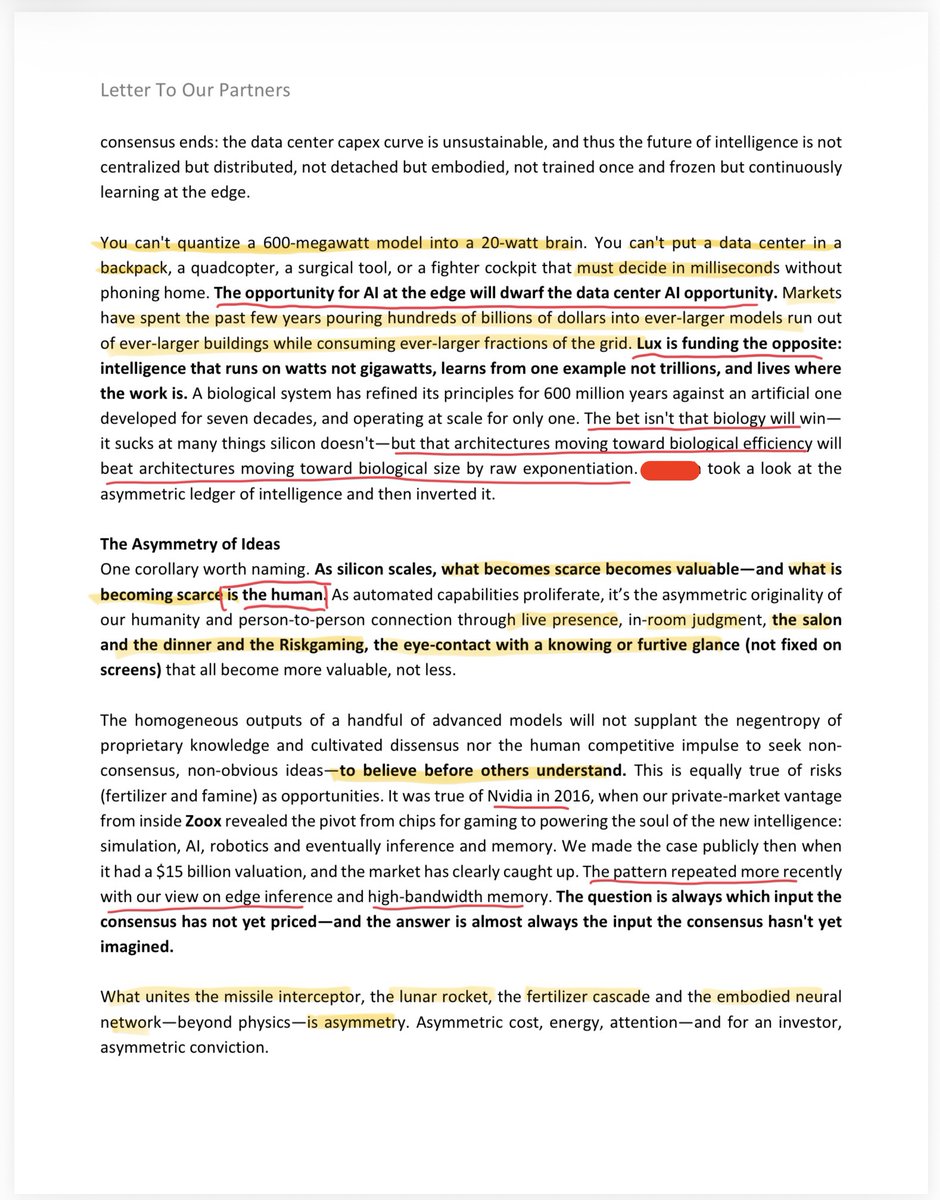
The letter argues that architectures moving toward biological efficiency — not raw scaling — will be the long-term winners. The key constraint is not model capability but physical deployability: fighter cockpit decisions in milliseconds, surgical tools, quadcopters, mobile devices. BitCPM-CANN (Section 5) is a concrete example of this direction: 1.58-bit quantization achieving 6x memory reduction with 95-97% benchmark retention on Huawei Ascend hardware. The Lux letter and the OpenBMB release appeared on the same day without apparent coordination.
U.S. AI confidence is low even among the most supportive demographic
@AFpost shared (35 likes, 2,589 views) survey data from the Spiritual Migration Survey 2025:

Even the most AI-confident group (weekly+ religious attendance) tops out at 19%. The pattern — more observant = more confident — is counterintuitive, and no causal explanation appears in the replies. The broader implication is that AI confidence is low across the entire U.S. population regardless of subgroup.
DeepSeek runs on mission, not metrics — a structural contrast with the U.S. startup ecosystem
On the same day TechCrunch published an investigation confirming widespread ARR inflation among U.S. AI startups, @nicrypto noted that DeepSeek's founder stated the goal is AGI, not profit — no IPO plans, no revenue targets. Chinese AI startup funding hit $16.2B in Q1 2026 (up 185% YoY per @Techmeme). The structural contrast: U.S. AI startup valuation driven by metrics that experts confirm are frequently inflated; Chinese AI lab explicitly rejecting commercial metrics and backed by state capital.
OpenAI allegedly recording home activities via 360-degree cameras for smart home AI research
@LLMJunky shared (15 likes, 2 retweets, 2,237 views, 7 bookmarks) a report from @loffredojeremy claiming that OpenAI is paying hundreds of families in New York City to install 360-degree cameras throughout their homes to record everyday activities (vacuuming, cooking, washing dishes), with memory cards collected periodically. The stated purpose is developing a smart home device. A notable detail: supervisors on the project are reportedly behavioral psychologists, not ML engineers.
This is an unverified secondhand account (one person's report of a contractor's description). Replies treated it as credible speculation about AI hardware ambitions, not a confirmed OpenAI announcement.
Google I/O 2026: AI is now Google Search's default mode
@semrush summarized (4 likes, 2 retweets, 190 views) Google I/O 2026 announcements: Gemini 3.5 Flash is live for all users; the search bar now accepts text, images, videos, and files ("Intelligent Search Box"); Universal Cart enables multi-retailer checkout powered by Gemini; Agentic Search now handles complex booking tasks directly. The summary's conclusion: "AI is no longer an add-on to Google Search. It IS Google Search."
7. Where the Opportunities Are
[+++] Agent cost instrumentation and pre-run estimation — The academic study on agent token consumption (Section 1.1) quantified a real production problem: same task, 30x cost variance, no reliable pre-run signal. The paper explicitly identifies pre-run cost prediction as unsolved (r = 0.39 correlation). The tools space (cost attribution, routing, budget alerting) is nascent. AutoHarness adds cost attribution as one of four features; no product currently focuses on pre-run cost estimation for agent workloads. Evidence from: Mollick's two-tier framing, the SWE-bench study, the agentic pricing tier observation, and IntuitMachine's 16K-run analysis.
[+++] Agent security layer: credential isolation, governance, and adversarial hardening — Three independent tools (Agent Vault, Trishool Halo, AutoHarness) appeared in one day's data, all targeting the same problem: agents operating in production without adequate security controls. Prompt injection → credential theft is the most concrete attack vector. Governance/audit logging is a compliance need with immediate enterprise demand. Evidence from: Infisical, Trishool, aiming-lab/AutoHarness, and the Aptos Move Prover work showing the same pattern in blockchain contexts.
[++] Verifiable inference receipts / AI utility metering — The gap @ambient_xyz described (no proof of what model ran, under what policy, at what latency) is an enterprise procurement and SRE problem with no current solution. Every other utility has this. The analogy is strong and the market is real: teams already burning weeks on vendor disputes would pay to resolve disputes faster. Evidence from: ambient_xyz post and the broader inference cost frustration cluster.
[++] Edge AI deployment tooling and quantization — The Lux Capital letter and BitCPM-CANN both point at the same gap: models that can run on watts-not-gigawatts hardware with production-grade quality retention. BitCPM-CANN demonstrates 6x memory reduction at 95-97% retention is achievable today. The constraint is tooling, deployment, and hardware compatibility — not capability. Evidence from: wolfejosh/Lux post, BitCPM-CANN, wolfejosh's "edge will dwarf data center" claim.
[++] Persistent cross-session context for knowledge workers — The @TakoTreba "bird" post is unusually specific: context that persists across all work, that does not require re-explanation each session, that understands marketing's connected moving parts. Current tools require users to reconstruct context each session or maintain external knowledge bases. The unmet need is a personal AI that accumulates and applies persistent work context without explicit management. Evidence from: TakoTreba post, chasing_next's personal OS workaround, and the Sonnet 4.5 community's emphasis on relationship continuity.
[+] AI startup metric transparency / CARR vs ARR signal services — The TechCrunch article confirms that investors and journalists work from systematically inflated revenue claims. A service that standardizes and audits AI startup revenue reporting, or simply publishes CARR alongside ARR for major AI companies, would serve analysts, competing founders, and LPs. Evidence from: TechCrunch ARR investigation.
[+] Token-efficient programming languages for AI agents — The Kethic project (96% fewer tokens than TypeScript) and the SWE-bench finding that input token accumulation — not output — drives agent costs suggest that language-level token efficiency is a real optimization target. A language or transpiler designed for AI-to-AI code generation (where the reader is a model, not a human) could reduce agentic coding costs materially. Evidence from: Kethic post, SWE-bench token consumption study.
8. Takeaways
-
The chatbot/agent cost split is already encoded in pricing pages, not just coming. @emollick framed it as a future democratization risk; the practitioner reply from @gotnerfedhq corrected the timeline: agentic pricing tiers have been where every silent price increase landed in the past 60 days. (source)
-
Agentic costs are 1,000x more than code chat, with 30x per-run variance — and models can't predict their own costs. A Michigan/Stanford/Google DeepMind paper analyzing 16,000 production runs found that input token accumulation (not reasoning or output) drives agent costs, and that same-task runs vary up to 30x, making agent budgeting structurally unreliable with current tooling. (source)
-
The AI executive order was shelved by tech industry calls on the same day polling showed 82% public support for safety testing. The governance gap is not about public opposition to oversight — it is about the effectiveness of industry lobbying invoking a "race narrative" that an academic paper on the same day documented as deliberately constructed. (WaPo source; academic source)
-
DeepSeek's permanent price cut creates a cost floor that makes Western model pricing look structurally inflated. The pricing table shows DeepSeek-V4-Pro at 10-29x lower output cost than competitors. Combined with the SWE-bench finding that model choice is primarily a cost decision in agentic workloads, this creates real migration pressure. (source)
-
Agent security is crystallizing as a product category: three independent tools appeared in one day. Agent Vault (credential brokering), Trishool Halo (adversarial guard model trained via tokenomics), and AutoHarness (API-level governance) all target production agent security without apparent coordination. (Infisical; Trishool; AutoHarness)
-
Chinese AI startups raised $16.2B in Q1 2026 (+185% YoY) while DeepSeek's founder explicitly rejects commercial metrics. The structural contrast with U.S. AI startups — where TechCrunch confirmed that contracted ARR is routinely announced as plain ARR — suggests that the two AI ecosystems are operating under fundamentally different incentive structures. (Chinese funding source; ARR source)
-
Edge AI may represent a larger opportunity than data center AI — and quantization is already achieving production quality at 6x lower memory. Lux Capital's investor letter argues architectures moving toward biological efficiency will dominate, and BitCPM-CANN demonstrates 1.58-bit quantization achieving 95-97% benchmark retention on mobile, PC, and automotive hardware with no new chips required. (wolfejosh source; BitCPM-CANN)