Twitter AI - 2026-05-25
1. What People Are Talking About
1.1 Institutional governance and rights took center stage 🡕
The clearest new cluster on May 25 treated AI as an institutional governance problem, not just a lab problem. The evidence came from a papal encyclical, a large higher-education study, and a live lawsuit over synthetic voice use.
@cnnbrk reported (15 likes, 10 replies, 1,636 views) that Pope Leo XIV said control of artificial intelligence must not remain in the hands of “a few,” and the linked Magnifica Humanitas outline shows dedicated sections on AI governance, work, freedom, and weapons. @metlifepaul threaded (1 reply, 115 views, 2 bookmarks) concrete excerpts from the same document, including warnings that AI-mediated decisions in employment, credit, public services, and reputation can create exclusion, while manipulation, privacy violations, and designer bias remain active risks.

The image matters because it turns a headline-level governance story into specific policy language.
@ScienceMagazine argued (31 likes, 4 replies, 6,692 views, 13 bookmarks) that higher education must rethink assessment in response to generative AI. The linked Berkeley/Science abstract says that conclusion comes from survey data on 95,513 students across 20 major public research universities and supports discipline-specific assessment reform rather than blanket bans or universal detectors.

The chart matters because it shows misuse varies materially by discipline rather than rising evenly across campus.
@NHKWORLD_News reported (42 likes, 2,105 views) that voice actor Tsuda Kenjiro sued over at least 188 TikTok videos that allegedly imitated his voice without permission, while NHK added that Japan’s Justice Ministry launched an expert panel in April on AI-generated voices and civil liability.
Discussion insight: The strongest reactions in these threads were less about raw model capability than about concentration of power, media integrity, and whether institutions still provide an appeal path when AI-mediated decisions go wrong.
Comparison to prior day: Prior-day evidence leaned on evaluation, security, and hardware. May 25 widened the frame to church doctrine, university policy, and a live court fight over synthetic identity.
1.2 Evaluation kept moving from benchmark talk to real environments 🡕
The strongest engineering theme was evaluation under realistic conditions. Across healthcare, coding agents, enterprise tooling, finance, and video generation, the day favored environments, tests, and process controls over headline benchmark scores.
@ycombinator shared (70 likes, 9 replies, 109,377 views, 42 bookmarks) BioStack, which it described as simulation environments where healthcare AI models practice on messy clinical data through a post-training loop of data, evals, rewards, and benchmarks. BioStack’s site adds that the company is building RL environments for post-training, ML-ready healthcare datasets, and multi-agent reasoning infrastructure, while one reply argued the real unlock is training against delayed outcomes instead of demo-friendly tasks.
@pben4ai pointed (31 likes, 4 replies, 10,696 views, 30 bookmarks) to the “constraint decay” paper, which studies how coding-agent performance drops as structural requirements pile up. In that thread, @unclebobmartin replied (226 likes, 17 replies, 6,570 views, 105 bookmarks) that natural-language rule files are a “fools errand” and that acceptance, unit, mutation, and property tests work better as physical constraints because agents cannot overturn them.
@AlphaBalzer highlighted (1 like, 2 replies, 23 views) Microsoft’s Copilot Studio Agent Evaluation preview, which now supports imported and AI-generated test sets, multiple scoring methods, custom thresholds, and explicit pass/fail summaries inside the builder workflow.

The image matters because it shows evaluation becoming a first-class product surface instead of an off-platform QA ritual.
@PreyWebthree argued (38 likes, 7 replies, 657 views) that Sentient’s Grounded Reasoning Challenge matters because it uses Databricks’ OfficeQA benchmark, Treasury Bulletins from 1939 to 2025, and numerical reasoning under grounded retrieval rather than lightweight prompt tests. @metatronics_ wrote (7 likes, 10 replies, 1,615 views) that frontier models lost money in a live trading test because of overtrading, sloppy sizing, and stops set after the fact, while @jiqizhixin introduced (8 likes, 1 reply, 448 views, 4 bookmarks) EvalVerse as a video-evaluation framework that scores cinematic quality, acting, aesthetics, sequencing, and audio-visual integration instead of prompt adherence alone.
Discussion insight: The most useful reply of the day did not ask for better prompts. It asked for tests that execute, environments that look like the real task, and scoring that can fail a system for bad process rather than pretty language.
Comparison to prior day: May 24 already questioned benchmark legitimacy. May 25 pushed that one step further into built-in evaluation products, domain simulators, and explicit process-layer failure analysis.
1.3 AI work is formalizing around titles, fellowships, and builder curricula 🡕
A smaller but clear cluster focused on how AI work itself is being organized. The signal was not mass hiring hype. It was role design, governance training, and production-oriented learning paths.
@Yuchenj_UW argued (212 likes, 27 replies, 25,850 views, 48 bookmarks) that “Member of Technical Staff” is spreading from Bell Labs heritage into OpenAI, Anthropic, xAI, Thinky, and Databricks AI. The thread’s replies said the appeal is that MTS shifts incentives away from ladder-maxxing and toward output.

The screenshot matters because it adds outside validation from an influential practitioner rather than leaving the point as an isolated org-chart opinion.
@ImadeIyamu shared (42 likes, 3,941 views, 94 bookmarks) the BASE AI Safety & Ethics Fellowship, whose program page describes a 13-week remote track structure across AI Alignment, AI Security, and AI Governance, with weeks 1-5 focused on training and weeks 6-13 on mentored research projects. @akjsal posted (7 likes, 1 reply, 361 views, 5 bookmarks) about joining LLM Zoomcamp 2026, whose 5,297-star repo lays out a 10-week curriculum on RAG, agents, orchestration, evaluation, monitoring, and a capstone project, with no GPU required and typical API costs around $1-5.
Discussion insight: The practical labor-market response here was to create structures around impact, safety, and deployable systems rather than generic “learn AI” branding.
Comparison to prior day: May 24 had a stronger vendor-course signal. May 25 added something more structural: role titles, fellowships, and hands-on builder curricula tied to evaluation and governance.
1.4 Builders kept shipping workflow-native systems instead of generic chat 🡒
The build signal stayed concentrated on products that compress data, training, evaluation, and deployment around a narrow workflow. This was the steadiest carryover from the previous day.
@DanKornas shared (27 likes, 2 replies, 1,747 views, 18 bookmarks) FluxVLA Engine, an open-source VLA platform for training, evaluation, inference, and real-robot deployment. The repo had 425 stars when checked, and the project site describes one modular VLA spine across OpenVLA, LlavaVLA, GR00T, Pi0, and Pi0.5, with RLDS/Parquet data pipelines, LIBERO evaluation, and real-robot inference.

The image matters because it shows the stack compression visually: not one model demo, but a full engineering loop.
@jiqizhixin highlighted (9 likes, 1 reply, 1,093 views) X2SAM, whose project page says the model unifies image and video segmentation, supports conversational and visual prompts, adds a Mask Memory module for temporal consistency, and introduces a new V-VGD benchmark. The linked GitHub repo had 74 stars when checked.

The figure matters because it makes the “one model, many segmentation tasks” claim concrete.
@thecableng reported (5 likes, 2 replies, 569 views) that GovGuide Nigeria is a multilingual government chatbot built with the Meta Llama ecosystem across English, Hausa, Igbo, and Yoruba, while the attached dashboard image showed visible product usage rather than a policy memo. @anindyadeeps pointed (7 likes, 2 replies, 203 views) to an open-source physical-AI data visualizer from fpv_labs whose image exposed RGB, depth, 3D-scene, annotation, and IMU layers at once.
Discussion insight: The shared pattern was not “launch another assistant.” It was to bundle the missing workflow: robotic deployment, multimodal perception, multilingual public access, or multimodal physical-AI data tooling.
Comparison to prior day: This theme stayed steady. May 24 already favored workflow-native systems, and May 25 kept that shape rather than reverting to generic model hype.
1.5 Local-first and sovereign AI shifted from hardware talk to ownership and language 🡕
The prior day’s local-AI conversation was mostly about throughput, memory, and hardware mix. On May 25 the more interesting question was who owns the assistant and what local context it actually carries.
@iamfakhrealam argued (10 likes, 4 replies, 2,551 views) that today’s assistants are “rented” because they live on someone else’s server, quoting OpenBMB’s MiniCPM5-1B launch and framing the MiniCPM Desk Pet as a fundamentally different relationship to AI. OpenBMB’s Hugging Face page describes MiniCPM5-1B as a 1.08B-parameter on-device model with 131,072 context, GGUF and MLX variants, and a local-first desktop companion whose normal chat runs on-device after setup.
@OmarKamali argued (21 likes, 5 replies, 1,568 views) that AI sovereignty in Morocco requires more than local hosting: it needs local data, speech, NLP, embeddings, evaluation, infrastructure, legal alignment, and cultural context. His conference slide claimed a first LLM in Darija and then Amazigh, making the thread much more concrete than a generic sovereignty slogan.
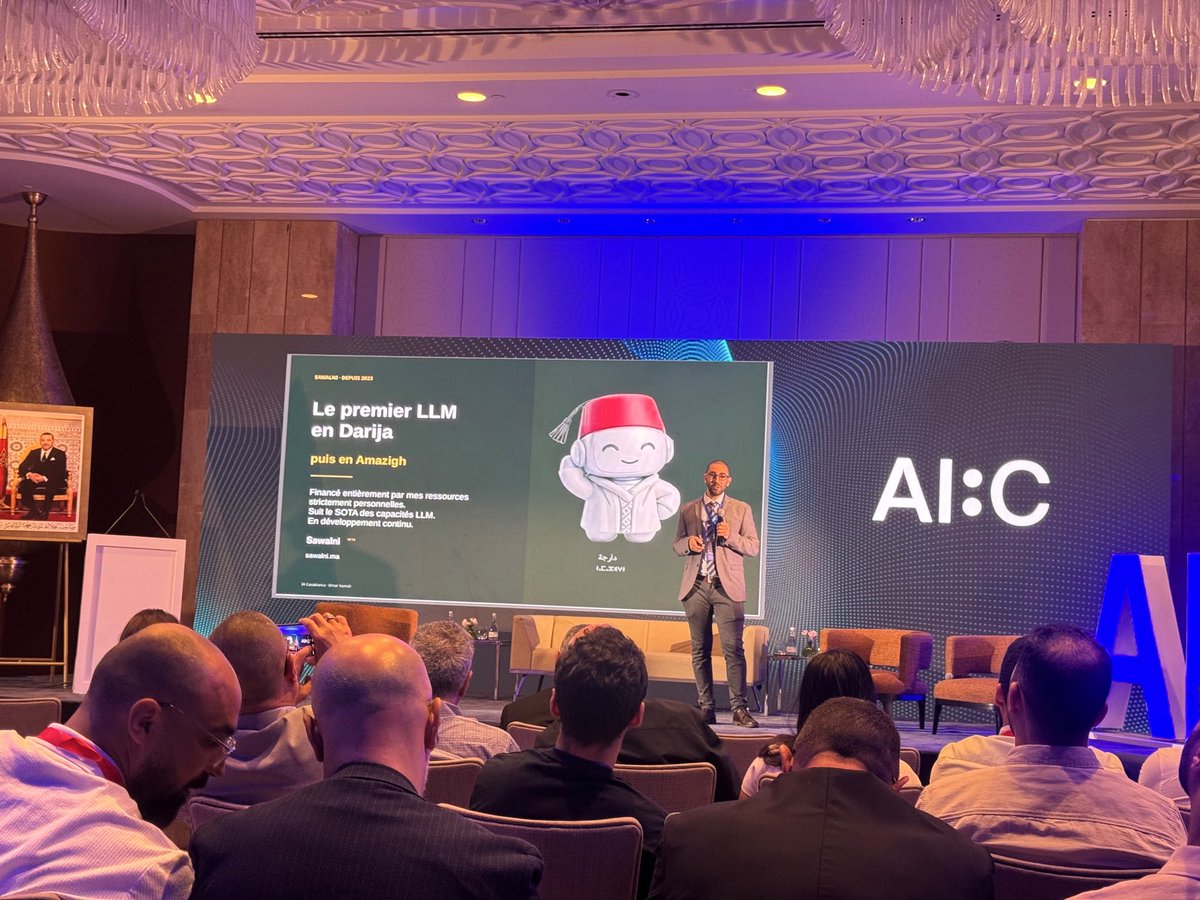
The image matters because it anchors a broad sovereignty argument in a specific local-language artifact.
Discussion insight: The common demand was not just faster local inference. It was continuity of access, linguistic fit, and systems that match local law and public institutions.
Comparison to prior day: Compared with May 24’s hardware-share and memory-bottleneck posts, today’s local signal was more about ownership, language, law, and institutional fit.
2. What Frustrates People
Benchmark wins still fail when the task has real process constraints
The most repeated operational frustration was that agents still break once the task requires disciplined execution instead of good-looking output. @pben4ai pointed (31 likes, 4 replies, 10,696 views, 30 bookmarks) to “constraint decay” in coding agents, and @unclebobmartin replied (226 likes, 17 replies, 6,570 views, 105 bookmarks) that natural-language rule files fail where acceptance, unit, mutation, and property tests keep agents inside hard boundaries. @metatronics_ wrote (7 likes, 10 replies, 1,615 views) that frontier models lost money in live trading because they overtraded, sized badly, and set stops after the fact, while @PreyWebthree argued (38 likes, 7 replies, 657 views) for grounded reasoning benchmarks built on real Treasury documents instead of lightweight prompt tests. The coping behavior visible in the feed was to make evaluation more explicit: structured test suites, grounded benchmarks, and productized agent-evaluation tooling such as Copilot Studio. Severity: High. Worth building for: yes — the data still points to a missing process-control layer for agents.
Institutions still do not have clean controls for cheating, voice cloning, or AI-mediated exclusion
The second frustration cluster was institutional and legal. @ScienceMagazine argued (31 likes, 4 replies, 6,692 views, 13 bookmarks) from a 95,513-student study that higher education needs assessment reform because both use and misuse of generative AI differ by discipline. @NHKWORLD_News reported (42 likes, 2,105 views) a lawsuit over at least 188 AI-generated imitation-voice videos on TikTok, and NHK noted that Japan’s Justice Ministry has already convened an expert panel on unauthorized synthetic voices. The AI sections of Magnifica Humanitas, surfaced by @cnnbrk reporting (15 likes, 10 replies, 1,636 views) and @metlifepaul excerpting (1 reply, 115 views, 2 bookmarks), add the same complaint in another register: important decisions are drifting into automated systems that can amplify bias, privacy violations, and exclusion. The coping behavior here was institutional rather than technical — redesign assessment, file lawsuits, form panels, and write governance texts — which is itself evidence that product-level controls remain weak. Severity: High. Worth building for: yes — rights management, provenance, and appeal workflows are still thin.
Useful AI still depends on local data and context that many teams do not have
A third frustration was infrastructural. @ycombinator shared (70 likes, 9 replies, 109,377 views, 42 bookmarks) BioStack because healthcare AI still needs messy real clinical data, delayed outcomes, rewards, and benchmarks assembled into one loop. @OmarKamali argued (21 likes, 5 replies, 1,568 views) that Moroccan AI still lacks much of the stack needed for underrepresented languages: data, speech tooling, embeddings, evaluation, infrastructure, and legal alignment. @anindyadeeps wrote (7 likes, 2 replies, 203 views) that many physical-AI startups are effectively data vendors, calling the category “a problem of ops and scale,” and then highlighted an open-source multimodal visualizer as evidence of how much infrastructure still has to be built. The visible workaround was to build bespoke stacks, release open data or visualizers, and narrow scope to one domain or language at a time. Severity: Medium-High. Worth building for: yes — but the market is already competitive because teams are building internal substitutes.
3. What People Wish Existed
Auditable agent evaluation and control planes
The clearest missing layer is a system that makes agent behavior reviewable before it causes damage. @pben4ai raised (31 likes, 4 replies, 10,696 views, 30 bookmarks) the “constraint decay” problem, @unclebobmartin answered (226 likes, 17 replies, 6,570 views, 105 bookmarks) with executable tests instead of rule files, @AlphaBalzer pointed (1 like, 2 replies, 23 views) to Microsoft’s built-in evaluation tooling, and both @PreyWebthree and @metatronics_ showed why bad process still defeats strong models. This is a practical need with high urgency. Partial answers exist in benchmark suites, Copilot Studio, and homegrown test harnesses, but the data still shows a fragmented stack rather than one dependable control plane. Opportunity: direct.
Rights, consent, and appeal layers for synthetic media and automated decisions
People also want AI systems that make consent, authorship, and recourse explicit. @NHKWORLD_News reported (42 likes, 2,105 views) a lawsuit over AI voice imitation, @ScienceMagazine surfaced (31 likes, 4 replies, 6,692 views, 13 bookmarks) integrity problems that vary by discipline, and @metlifepaul excerpted (1 reply, 115 views, 2 bookmarks) an encyclical warning that AI-mediated decisions can normalize exclusion while looking neutral. This is both a practical and emotional need: people want proof, consent, and an appeal path when identity or status is affected. Partial answers today are lawsuits, policy panels, and institutional guidance rather than productized safeguards. Opportunity: direct.
Local-first, language-native AI that does not disappear with a pricing or policy change
The ownership theme was unusually explicit. @iamfakhrealam wrote (10 likes, 4 replies, 2,551 views) that server-hosted assistants are “rented,” while the quoted MiniCPM release positioned local on-device inference as a different relationship to the tool. @OmarKamali argued (21 likes, 5 replies, 1,568 views) that sovereign AI for Morocco must include not just hosting, but language, law, infrastructure, and cultural context. @thecableng added (5 likes, 2 replies, 569 views) a public-sector version of the same ask with GovGuide Nigeria’s multilingual chatbot. This is a practical need with medium-high urgency. Partial answers exist in MiniCPM, multilingual government bots, and local-language LLM projects, but the feed still shows more pieces than finished stacks. Opportunity: direct.
Domain-specific post-training and data pipelines
The day also showed a quieter need for environments and datasets that look like real work. @ycombinator shared (70 likes, 9 replies, 109,377 views, 42 bookmarks) BioStack because healthcare AI needs real records, delayed outcomes, rewards, and benchmarks in one loop. @anindyadeeps pointed (7 likes, 2 replies, 203 views) to a physical-AI visualizer that makes multimodal sensor data inspectable on the web. This is a practical need with medium urgency, and it is already spawning real companies and open-source tools. Opportunity: competitive.
4. Tools and Methods in Use
| Tool | Category | Sentiment | Strengths | Limitations |
|---|---|---|---|---|
| BioStack | Healthcare data/eval platform | (+) | RL environments for post-training, ML-ready clinical data, multi-agent reasoning infrastructure | Privacy and data-governance questions remained open in replies |
| FluxVLA Engine | Robotics/VLA platform | (+) | One-config workflow from data to deployment; multiple VLA families and backbones; LIBERO plus real-robot support | Early open-source project with a still-forming ecosystem |
| X2SAM | Vision segmentation model | (+) | One interface across image/video segmentation; conversational and visual prompts; new V-VGD benchmark | Research-stage system with early adoption |
| Copilot Studio Agent Evaluation | Agent evaluation tool | (+/-) | Imported and AI-generated test sets, multiple scoring methods, thresholds, pass/fail summaries, source inspection | Public preview and tightly tied to Microsoft’s stack |
| MiniCPM5-1B / Desk Pet | On-device LLM | (+) | Local-first chat after setup, long context, small deployment footprint, desktop companion UX | First-launch setup and hardware limits still matter |
| Sentient Arena / OfficeQA | Grounded reasoning benchmark | (+/-) | Large-document retrieval plus numerical reasoning, closer to real enterprise tasks than prompt-only tests | Competition framing is stronger than independent validation |
| Executable tests | Agent control method | (+) | Acceptance, unit, mutation, and property tests act as hard constraints agents cannot easily evade | Can be rigid and only work as well as the test suite itself |
| EvalVerse | Video evaluation framework | (+/-) | Scores cinematic quality, acting, aesthetics, sequencing, and audio-visual integration instead of prompt fit alone | Still an early research benchmark, not a deployment standard |
Overall, the day’s tool sentiment was positive for integrated stacks and mixed for evaluation infrastructure. People liked tools that compress missing workflow layers — BioStack for clinical loops, FluxVLA for robotics, X2SAM for multimodal segmentation, MiniCPM for local ownership — but they were less satisfied with how evaluation is currently stitched together. The visible workarounds were to replace rule files with executable tests, move from generic benchmarks to task-specific harnesses, and shift from cloud-only assistants toward smaller local models when continuity of access mattered more than frontier capability.
5. What People Are Building
| Project | Who built it | What it does | Problem it solves | Stack | Stage | Links |
|---|---|---|---|---|---|---|
| BioStack | @ycombinator | Simulation environments for healthcare AI post-training on messy clinical data | Healthcare models need realistic outcomes, rewards, and eval loops instead of demo tasks | Clinical data, evals, rewards, benchmarks, RL environments | Shipped | tweet · site |
| FluxVLA Engine | @DanKornas | Full-stack VLA engineering platform from data to real robot deployment | Robotics teams were gluing training, eval, and deployment together from separate scripts | Python, OpenVLA/LlavaVLA/GR00T/Pi0, LLaMA/Gemma/Qwen, RLDS/Parquet, LIBERO | Alpha | tweet · repo |
| X2SAM | @jiqizhixin | Unified image/video segmentation model with text and visual prompts | Image, video, referring, and reasoning segmentation were split across separate tools | LLM, Mask Memory, segmentation decoder, V-VGD benchmark | Alpha | tweet · repo |
| MiniCPM Desk Pet | @iamfakhrealam | Local-first desktop companion built on MiniCPM5-1B | Cloud assistants feel rented, mutable, and discontinuable | MiniCPM5-1B-GGUF, local runtime, macOS/Windows desktop app | Beta | tweet · repo · HF |
| GovGuide Nigeria | @thecableng | Multilingual government-information chatbot | Citizens need easier access to public information across major local languages | Meta Llama ecosystem, English/Hausa/Igbo/Yoruba chatbot | Beta | tweet |
BioStack and FluxVLA were the clearest examples of the day’s builder pattern: package the whole loop instead of asking users to assemble missing infrastructure by hand. BioStack wraps messy records, rewards, and benchmarks into healthcare post-training, while FluxVLA unifies data pipelines, training, evaluation, and real-robot deployment inside one VLA spine.
X2SAM applies the same compression logic to multimodal perception by handling image and video segmentation under one conversational interface. MiniCPM Desk Pet turns local inference into a user-facing product instead of a developer-only setup, and GovGuide Nigeria suggests multilingual public-sector AI is moving past concept decks and into visible usage — the attached dashboard showed 1,969 users and 5,804 conversations.
The repeated build trigger was a workflow gap: clinical ambiguity, robotics integration, segmentation fragmentation, cloud dependence, or public-service accessibility. Even the fpv_labs visualizer post fit this pattern by making multimodal physical-AI data inspectable rather than merely collectable.
6. New and Notable
Magnifica Humanitas turned AI into a full social-doctrine topic
@cnnbrk reported (15 likes, 10 replies, 1,636 views) that Pope Leo XIV’s first major theological document warned against leaving AI in the hands of a few. The official Vatican text is notable because it does not treat AI as a sidebar: it has explicit sections on AI governance, work, freedom, and weapons, and the excerpt thread from @metlifepaul surfaced (1 reply, 115 views, 2 bookmarks) concrete warnings about automated exclusion, privacy harms, and designer bias.
Copilot Studio moved agent evaluation into the builder workflow
@AlphaBalzer highlighted (1 like, 2 replies, 23 views) Microsoft’s public-preview Agent Evaluation feature for Copilot Studio. The product is notable because it bundles imported and AI-generated test sets, flexible scoring methods, thresholds, and source-aware result review into the same interface where the agent is built.
EvalVerse widened video evaluation beyond prompt following
@jiqizhixin introduced (8 likes, 1 reply, 448 views, 4 bookmarks) EvalVerse as a framework from HKUST, Tencent, and Stanford that treats video evaluation as more than prompt alignment. The notable shift is the criteria set itself: cinematic quality, acting, aesthetics, multi-shot sequencing, and audio-visual integration, which points toward richer evaluation targets for generative video systems.
GovGuide Nigeria made public-sector multilingual AI visible
@thecableng reported (5 likes, 2 replies, 569 views) on GovGuide Nigeria as an AI-powered government chatbot built with the Meta Llama ecosystem for English, Hausa, Igbo, and Yoruba access. It stood out because the attached screenshot looked like an active service rather than a concept announcement, showing visible usage counts in the product dashboard.
7. Where the Opportunities Are
[+++] Agent evaluation and process-control infrastructure — Evidence appeared across healthcare, coding agents, enterprise tooling, finance, and video generation. BioStack, Constraint Decay plus Uncle Bob’s test-first reply, Copilot Studio Agent Evaluation, Sentient’s grounded reasoning challenge, and the Alpha Arena trading failure all point to the same gap: teams still lack dependable ways to prove that an agent will behave correctly in a real environment before it matters.
[++] Rights, provenance, and appeals for synthetic media and automated decisions — The NHK voice-cloning lawsuit, the Science assessment-reform study, and the Vatican’s warnings about privacy, bias, and exclusion all show the same institutional pain. This is a moderate-to-strong opportunity because the need is explicit, but the current responses are still mostly legal and policy driven rather than productized.
[++] Sovereign and local-first AI stacks for underserved languages and institutions — MiniCPM Desk Pet, Morocco’s Darija/Amazigh LLM effort, and GovGuide Nigeria all push toward AI that remains available, language-native, and institutionally legible. The opportunity is moderate because open-source and public-service efforts are already moving, but integrated stacks are still rare.
[+] Workflow-native vertical AI infrastructure — FluxVLA, X2SAM, BioStack, and the fpv_labs multimodal visualizer all show builders compressing missing workflow layers into usable systems. This is an emerging opportunity because the pattern is clear, but most of the artifacts are still early enough that standards and winners have not settled.
8. Takeaways
- Institutional actors shaped the day’s AI narrative as much as builders did. Church doctrine, higher-education policy, and a synthetic-voice lawsuit all became primary evidence, not background context. (source)
- The practical frontier is evaluation under real constraints, not bigger benchmark headlines. BioStack, Constraint Decay, Copilot Studio Agent Evaluation, and Alpha Arena all converged on the same point: the hard problem is keeping systems correct inside real workflows. (source)
- AI work is getting more structured around impact, safety, and production systems. The spread of MTS, the BASE fellowship, and LLM Zoomcamp all pointed toward more explicit pathways into AI work than generic “learn AI” messaging. (source)
- The strongest builders kept shipping complete loops instead of generic assistants. FluxVLA, X2SAM, BioStack, and GovGuide Nigeria all packaged data, evaluation, and deployment around a narrow job. (source)
- Local ownership and local language are becoming product requirements. MiniCPM’s local-first framing and Morocco’s sovereignty thread both argued that availability, linguistic fit, and lawful deployment matter as much as raw model capability. (source)