Twitter AI - 2026-06-18
1. What People Are Talking About
1.1 Model access became a governance product (🡕)
The biggest policy shift was not a new benchmark score. It was the idea that frontier access now needs formal scoring, employee-level controls, and permission tiers. Four separate posts supported the same point: access to strong models is being treated as a governed resource, not a default SaaS entitlement.
@SophiaCai99 reported (320 likes, 17 replies, 44,345 views, 82 bookmarks) that the White House and Anthropic are working on a formal technical assessment framework for jailbreaks, including common benchmarks for bypass severity, exposed capabilities, and real-world consequences. The strongest signal was not just the investigation itself, but the move toward a reusable methodology for future incidents.
@shensi said (191 likes, 19 replies, 13,123 views, 56 bookmarks) that the U.S. government ordered Anthropic to cut off Fable 5 and Mythos 5 for foreign nationals, then used the reply thread to pitch employee-attribute access controls tied to citizenship, role, location, and team. That made “model governance” look operational rather than rhetorical.
@HeyAnjula argued (23 likes, 2 replies, 203 views, 5 bookmarks) that the real Anthropic story is “the same model with different levels of access”: one intelligence tier, different permissions. @robrombach told (76 likes, 7 replies, 7,202 views, 11 bookmarks) G7 leaders that open innovation should remain the norm, but paired that with support for evaluation standards and targeted regulation for misuse-prone visual models.
Discussion insight: Replies turned the White House/Anthropic story into a “CVSS for jailbreaks” analogy, while the open-model side argued that suppression-only policy would centralize infrastructure in a handful of firms.
Comparison to prior day: June 17 already had G7 and DOJ signals. June 18 made the mechanics more concrete: formal benchmarkable jailbreak scoring, foreign-national cutoff enforcement, and productized permission layers.
1.2 Evaluation moved closer to live workflows (🡒)
Evaluation stayed one of the dominant topics, but the center of gravity kept moving away from generic leaderboards and toward workflows that fail in production: turn-taking in voice agents, scientific research tasks, and long noisy medical files. The common pattern was open or semi-open harnesses that measure latency, uncertainty, artifacts, or filler noise instead of single-answer trivia.
@livekit announced (57 likes, 12 replies, 2,175 views, 44 bookmarks) eot-bench, an open end-of-turn benchmark with 5,000+ real human-to-agent turns across 14 languages, a live leaderboard, and a public latency-vs-false-cutoff tradeoff. The attached chart showed LiveKit Turn Detector v1 at a 9.9% false cut-off rate versus 12.9% for Deepgram Flux and 49.4% for AssemblyAI, which explains why the tweet framed timing as an evaluation problem, not just a model problem.

@OpenAI announced (142 likes, 8 replies, 40,388 views) LifeSciBench as a seven-workflow life-science benchmark aimed at evidence handling, analysis, design and optimization, scientific reasoning, validation and operations, translation, and scientific communication. OpenAI’s public announcement says the benchmark contains 750 expert-authored tasks, 1,062 artifacts, and 19,020 rubric criteria, and that GPT-Rosalind still passes only 36.1% of tasks (announcement).
@ArtificialAnlys highlighted (70 likes, 2 replies, 5,662 views, 13 bookmarks) Wisedocs’ new MLCR benchmark for long medical and insurance files. The quoted launch thread says MLCR spans 250 questions across six difficulty tiers, open-sources 10 synthetic cases and the lower three tiers, and stress-tests models by adding irrelevant filler context to mimic real record review (repo).
Discussion insight: Replies kept asking for reproducibility and operational edge cases—silence gaps, barge-ins, hidden binaries, and realistic artifacts—so the conversation rewarded evals that publish harnesses and datasets, not just headline scores.
Comparison to prior day: June 17 already leaned hard into benchmarks through LifeSciBench and voice quality. June 18 kept that pressure steady, but shifted further toward open evaluation infrastructure and long-context robustness under noisy conditions.
1.3 Agent builders focused on control planes, not just smarter models (🡕)
The most practical builder posts were about everything around the model: source control, orchestration, approvals, traces, and tests. The shared claim was that generic agents are already useful, but the real bottleneck is managing them safely and repeatably.
@_xjdr wrote (153 likes, 13 replies, 3,282 views, 67 bookmarks) that git, GitHub, and a single-model coding harness had become two major systemic risks once they were running dozens to hundreds of agents on large repos. Their answer was NCode: shallow virtual checkouts, JJ draft-state persistence, Sapling commit stacks, cloud sync, per-file ACLs, and a terminal UI built around scoped workspaces and cloud agents.

@praedico open-sourced (16 likes, 52 views, 13 bookmarks) Arasaka, a Rust runtime for “governed AI agents” that treats LLM output as a proposal rather than authority. The runtime pitch emphasized policy-gated tool calls, approval checkpoints, auditable RunTrace output, tenant-aware memory, and GraphRAG-backed lineage for business agents.
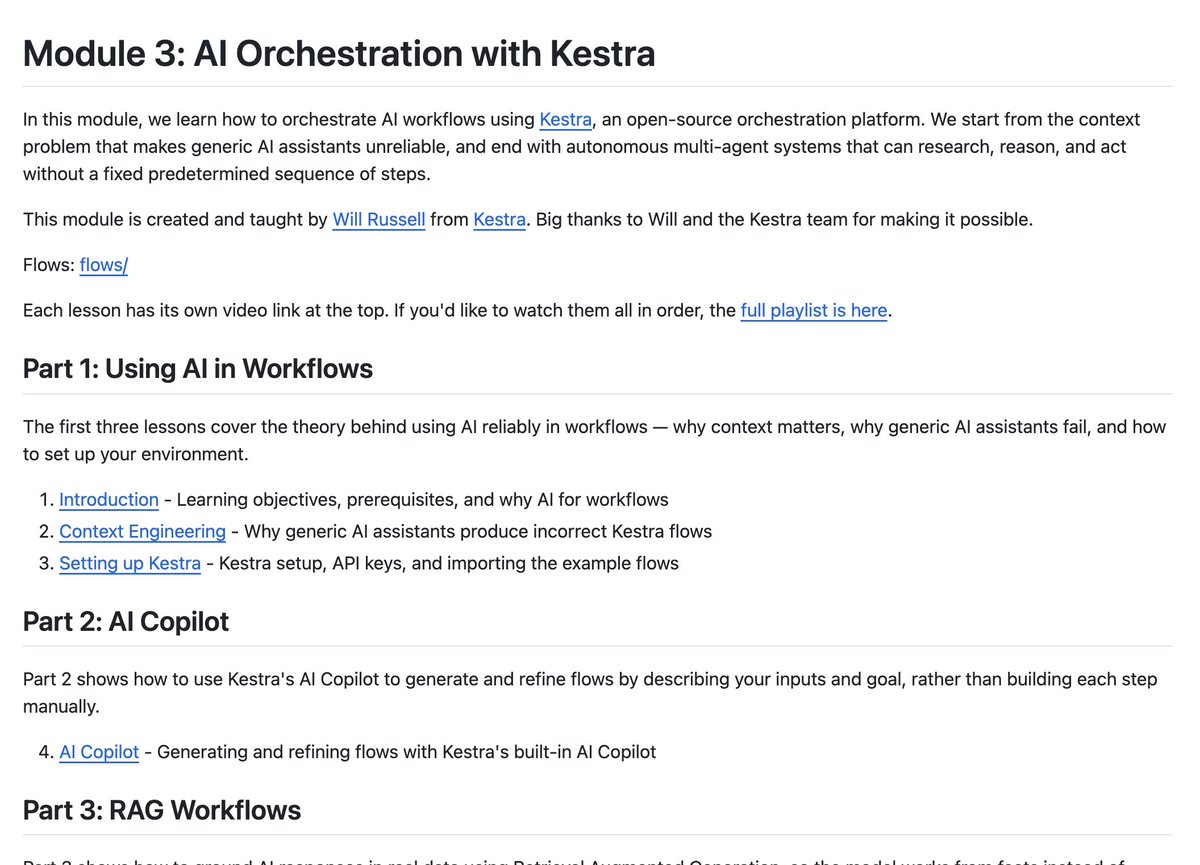
@Al_Grigor said (13 likes, 1 reply, 435 views, 8 bookmarks) that orchestration is the missing layer between a notebook demo and a real LLM workflow. The attached Zoomcamp module page on Kestra made the point concrete: ordering steps, passing state, handling retries, and making failures observable are now teaching material, not edge concerns.
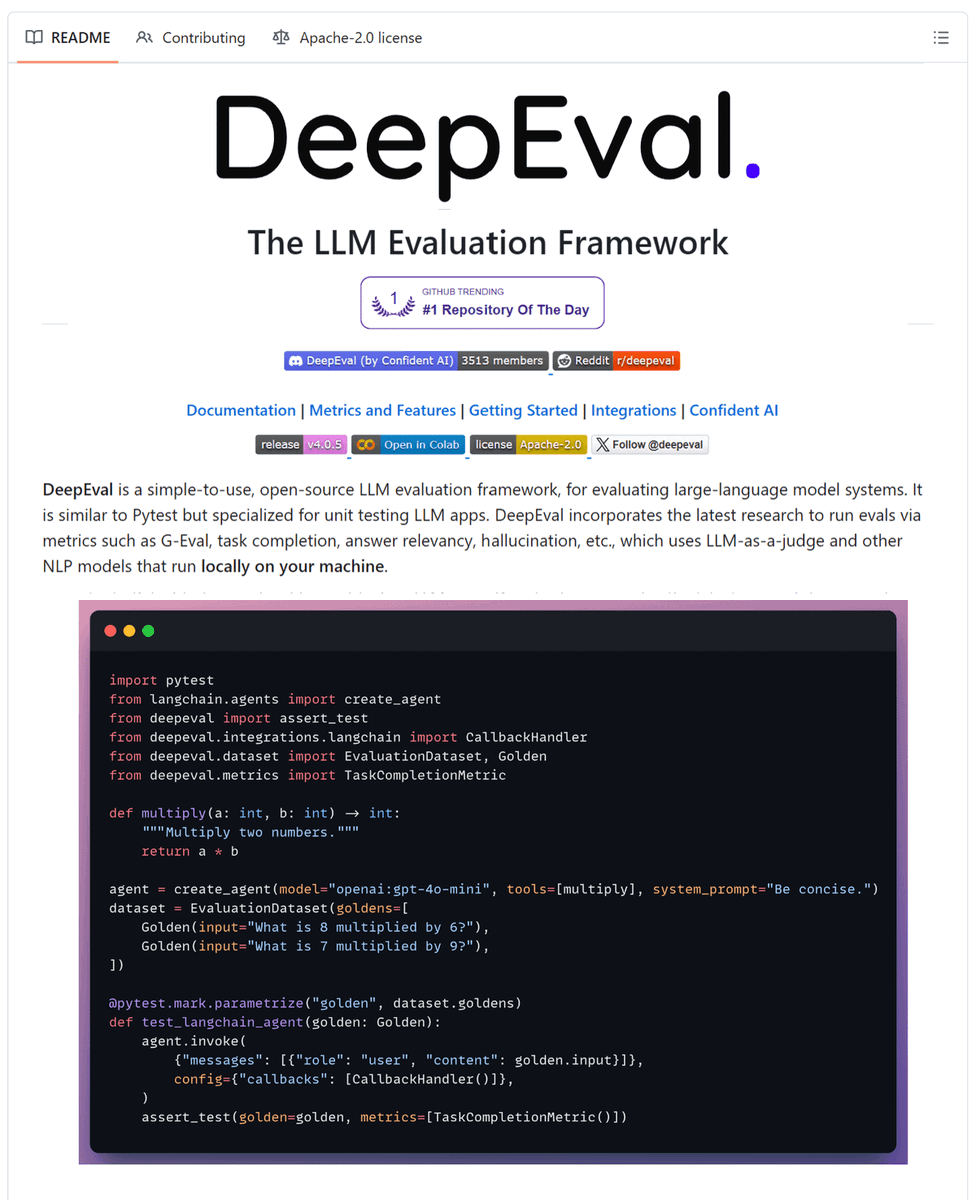
@Sumanth_077 showed (9 likes, 2 replies, 144 views, 5 bookmarks) DeepEval’s Pytest-style integration for LangChain agents, with CallbackHandler traces, end-to-end and component-level checks, and GitHub Actions integration. The screenshot reinforced the direction of travel: test harnesses for agents are being packaged to look and feel more like normal software engineering (repo).
Discussion insight: Across these posts, the model itself was rarely presented as the full solution. Reliability came from boundaries, retries, audits, traces, and faster ways to coordinate many agents at once.
Comparison to prior day: June 17 emphasized specialist systems in medicine, robotics, and macro research. June 18 shifted toward the shared infrastructure layers those systems will need to run safely at scale.
2. What Frustrates People
Access to frontier models can disappear or fragment by policy
Severity: High. @shensi said (191 likes, 19 replies, 13,123 views, 56 bookmarks) that Anthropic had to cut off Fable 5 and Mythos 5 for foreign nationals, and the follow-up reply immediately turned that into a product pitch for employee-attribute access controls. @SophiaCai99 reported (320 likes, 17 replies, 44,345 views, 82 bookmarks) that the White House and Anthropic are now trying to standardize how jailbreak severity gets scored. @HeyAnjula argued (23 likes, 2 replies, 203 views, 5 bookmarks) that the real shift is not smarter models but smarter permissioning. The emerging workaround is another layer of admin software—attribute-based controls, benchmarkable incident scoring, and permissioned product tiers—which makes this worth building for because teams clearly expect more restrictions, not fewer.
Git-native workflows look brittle once many agents are involved
Severity: High. @_xjdr wrote (153 likes, 13 replies, 3,282 views, 67 bookmarks) that branches and worktrees become stale, reviews diverge, giant repos and environment setup become a full-time job, and dependence on one model plus one harness becomes a systemic risk. @Al_Grigor said (13 likes, 1 reply, 435 views, 8 bookmarks) that orchestration is the missing piece between notebook demos and real workflows because production systems need ordered steps, retries, state passing, and observability. The coping strategy today is custom infrastructure: shallow virtual checkouts, cloud sync, per-file ACLs, and orchestration layers. This is worth building for because the pain appears before the model fails; it appears while trying to manage the work.
Teams still do not trust default evaluation setups for agents
Severity: High. @livekit said (57 likes, 12 replies, 2,175 views, 44 bookmarks) that voice datasets are proprietary, methods are opaque, and there is no shared ground truth for turn detection. @Sumanth_077 showed (9 likes, 2 replies, 144 views, 5 bookmarks) why traditional unit tests break once LangChain-style agents mix LLMs, tools, and retrieval. OpenAI’s public LifeSciBench announcement adds the hardest reality check: even GPT-Rosalind passes only 36.1% of 750 expert-authored life-science tasks (announcement). Teams are coping by open-sourcing harnesses, publishing leaderboards, and moving tests into CI, which makes this worth building for as core infrastructure rather than optional research.
Sensitive security work still clashes with cloud-model privacy and dual-use risk
Severity: Medium. @7h3h4ckv157 shared (26 likes, 1,259 views, 18 bookmarks) Michos, an automated pentesting agent that connects Ollama-hosted models to Kali over MCP. The public README says local deployment matters because client data, regulated environments, and air-gapped systems cannot assume third-party processing, while also warning that open-weight security agents are already capable enough to matter even if proprietary models still lead (repo). The workaround today is local or self-hosted model deployment, which makes this worth building for wherever security teams need auditable autonomy without sending target data to an external API.
3. What People Wish Existed
Auditable model permissions and incident scoring
People appear to want model access that can be granted, withheld, and explained at the level of role, citizenship, task, and breach severity. @SophiaCai99 surfaced the push for a formal jailbreak-severity framework, @shensi pointed to employee-attribute controls, and @HeyAnjula framed the new world as one model with multiple permission tiers. This is a practical need with direct demand. Opportunity: direct.
An agent-native workspace stack beyond git plus ad hoc scripts
@_xjdr described git and GitHub as poorly suited to dozens or hundreds of simultaneous agents, while @Al_Grigor made orchestration the missing production layer between prototype and workflow. What people want is not another chat pane; it is a runtime that handles state, retries, review boundaries, and startup time like first-class concerns. Opportunity: direct.
Shared evaluation systems that survive real-world noise
@livekit asked for common ground on voice turn-taking, @OpenAI pushed evaluation toward research workflows, @ArtificialAnlys and Wisedocs tested long noisy files, and @Sumanth_077 moved agent evaluation into Pytest and CI. The need is both practical and urgent because teams do not trust private or toy evals anymore. Opportunity: direct.
Local and governed security agents
The Michos stack and Arasaka runtime point to a need for agents that can act in sensitive environments without treating the model as final authority. That means local inference, approval gates, audit trails, scoped tools, and reversible actions. The market is likely competitive, but the need is concrete. Opportunity: competitive.
4. Tools and Methods in Use
| Tool | Category | Sentiment | Strengths | Limitations |
|---|---|---|---|---|
| eot-bench | Voice benchmark | (+) | 5,000+ real turns, 14 languages, live leaderboard, direct latency-vs-cutoff tradeoff | Some reply traffic still questions how easily the top local model setup can be reproduced |
| LifeSciBench | Scientific benchmark | (+) | 750 expert-authored tasks across seven workflows with artifact-heavy grading | Best disclosed model still passes only 36.1% of tasks |
| MLCR | Long-context benchmark | (+) | Tests filler-noise resilience, six difficulty tiers, open harness and synthetic cases | Hardest holdout tiers remain private and the initial use case is narrow |
| DeepEval | Evaluation framework | (+) | Pytest-style agent tests, local metrics, LangChain traces, CI integration | Still depends on teams designing good datasets and choosing the right metrics |
| NCode | Agent workspace / SCM | (+/-) | Shallow checkouts, JJ persistence, Sapling stacks, cloud agents, per-file ACLs | Early rollout and no broad usage evidence yet |
| Arasaka | Governed agent runtime | (+) | Policy-gated tools, approval checkpoints, auditable traces, tenant-aware memory | Very early project with limited public adoption signal |
| Kestra | Orchestration platform | (+) | Explicit state passing, retries, observability, workflow composition | Evidence here came through a course module rather than a production postmortem |
| Michos | Security agent stack | (+/-) | Local privacy, MCP access to Kali tools, concrete offensive workflow | Sensitive dual-use domain and the README still says proprietary models perform better |
Overall sentiment was strongest when a tool turned implicit agent work into explicit infrastructure. The clearest migration pattern was away from “one model in one chat window” toward layered stacks: workspace or runtime, orchestration, evaluation, then model.
Competitive pressure now looks strongest in governance runtimes and evaluation tooling. The dataset also suggests that local-security stacks are emerging as a separate category, where privacy requirements and offensive capability matter as much as raw model quality.
5. What People Are Building
| Project | Who built it | What it does | Problem it solves | Stack | Stage | Links |
|---|---|---|---|---|---|---|
| NCode / code app | @_xjdr | Agent-native coding workspace and SCM layer | Reduces stale branches, slow repo setup, and reviewer drift when many coding agents work at once | Shallow virtual checkouts, JJ persistence, Sapling stacks, cloud sync, per-file ACLs | Beta | tweet |
| eot-bench | @livekit | Open benchmark and dataset for end-of-turn detection in voice agents | Gives voice teams a shared way to measure false cutoffs and latency | Python benchmark, 14-language dataset, live leaderboard | Shipped | tweet, repo |
| MLCR | @Wisedocsai | Long-context medical-document benchmark with noisy filler-context testing | Measures whether models can reason over realistic medical and insurance files instead of clean toy prompts | Config-driven harness, synthetic cases, filler injection, LLM-as-judge scoring | Shipped | tweet, repo |
| Arasaka | @praedico | Governed runtime for business agents | Adds policy, approval, audit, and tenant boundaries around tool-using agents | Rust, policy-gated ReAct, approval checkpoints, RunTrace, GraphRAG | Alpha | tweet |
| Michos | @7h3h4ckv157 | Automated web-app pentesting agent using local or cloud open models | Lets security teams run autonomous assessments without defaulting to third-party model processing | OpenCode, Ollama, Kali Docker, MCP server, web security tools | Beta | tweet, repo |
NCode stood out because it attacked the source-control and workspace layer directly instead of promising a smarter model. The core claim was that coding agents need faster startup, better state tracking, and tighter review boundaries before teams can safely scale them.
The most repeated builder pattern was evaluation infrastructure. eot-bench and MLCR both package testing itself as the product: one for live conversational turn-taking, the other for noisy long-context document reasoning. That is a different kind of “AI app” from the usual chat wrapper, and it appeared repeatedly across the day’s strongest posts.
Michos and Arasaka attacked the trust problem from opposite ends. Michos shows how open-weight agents can already automate sensitive offensive workflows, while Arasaka argues that business agents need runtime layers where the model proposes actions but policy decides what is allowed.

6. New and Notable
Jailbreak scoring entered public policy
@SophiaCai99 reported (320 likes, 17 replies, 44,345 views, 82 bookmarks) that the White House and Anthropic are working on a formal technical assessment framework for jailbreak severity. That matters because it turns “model safety” into a benchmarkable operating layer with standardized consequences instead of a lab-specific incident narrative.
Multi-vendor AI compute became easier to imagine
@CryptoTweets reported (41 likes, 10 replies, 4,105 views, 6 bookmarks) that Amazon is exploring external sales of Trainium chips instead of keeping them only inside AWS. The replies immediately centered on the real constraint—whether anything can dent CUDA’s moat—which made the post a useful snapshot of how people think about AI infrastructure competition today.
7. Where the Opportunities Are
[+++] Model governance and governed-agent control planes — Evidence shows up in multiple layers: White House–Anthropic jailbreak scoring, employee-attribute model access controls, tiered model permissions, Arasaka’s policy-gated runtime, and NCode’s per-file ACL mindset. This is strong because the need is already visible in policy, enterprise admin, and builder tooling at the same time.
[+++] Workflow-grounded evaluation infrastructure — eot-bench, LifeSciBench, MLCR, and DeepEval all point to the same gap: teams do not trust toy benchmarks or deterministic unit tests once real agents, artifacts, and noisy context are involved. This is strong because people are not asking for more dashboards; they are asking for infrastructure they can use before production breaks.
[++] Agent-native developer workflow and orchestration — NCode and Kestra both argue that model quality is only part of the work, while @_xjdr explicitly described git and environment management as systemic risks. This is moderate because the pain is clear, but the space will be crowded with IDEs, source-control layers, and orchestration platforms.
[+] Local security agents with auditable guardrails — Michos demonstrates real demand for private, local, tool-using security agents, and its README makes the privacy case explicit for regulated or air-gapped environments. This is emerging because the need is concrete, but the category is dual-use and will face stronger scrutiny than general productivity tools.
8. Takeaways
- Governance shifted from abstract safety talk to benchmarkable access control. The strongest June 18 policy signals were a formal White House–Anthropic jailbreak framework, foreign-national access cutoffs, and direct arguments that “who gets access” may matter more than raw model IQ. (source)
- Evaluation keeps moving toward messy, real workflows rather than clean benchmark trivia. Voice turn-taking, life-science reasoning, and long noisy medical files all got public benchmark pushes, and OpenAI’s own announcement still says the best model passes only 36.1% of LifeSciBench tasks. (source)
- The builder energy was around control planes, not just better models. NCode, Arasaka, Kestra, and DeepEval all focused on boundaries, orchestration, auditability, and testing—the software around the model instead of the model alone. (source)
- Open-weight and local stacks are becoming more serious in sensitive domains. Michos framed local deployment as a privacy and compliance requirement for pentesting, not just a hobbyist preference, which is a meaningful step toward agentic AI in regulated work. (source)