Twitter AI - 2026-07-02
1. What People Are Talking About
1.1 The commercial edge discussion moved above the base model (🡕)
The highest-signal conversation was not just about which model won a benchmark. It was about where durable value sits once models are good enough to be swapped, priced differently, and selectively constrained. Four strong items pushed the same direction: route models by task, build an application layer above them, and expect access policy to shape product design.
@anandmahindra argued (366 likes, 47 replies, 67,505 views, 170 bookmarks) that AI has three layers—compute, model, and application—and that critical infrastructure will not run safely on a model alone. The distinctive angle was not “apps matter”; it was that application-layer ownership means owning workflow knowledge, data controls, auditability, and model choice, which is where he sees the durable commercial edge.
@aiwithsally framed (193 likes, 42 replies, 11,447 views) a quoted four-model contest as proof that there is no single best AI model: Fable 5 led on output quality, GPT 5.5 made the strongest value case, and GLM 5.2 was cheapest. The evidence mattered because the quoted numbers made the tradeoff concrete rather than rhetorical, and the replies immediately added latency as a fourth routing variable.
@slash1sol highlighted (37 likes, 15 replies, 827 views, 26 bookmarks) Mike Krieger’s claim that Claude Fable 5 reaches 80.3% on SWE-Bench Pro and 88.0% on Terminal-Bench 2.1, then translated that into an “idea -> whole-project handoff -> review” workflow. The replies were useful because they did not dispute the jump so much as ask when the jump is worth the price and whether the current release feels more constrained than before.
@deredleritt3r reported (96 likes, 6 replies, 16,380 views, 32 bookmarks) that US officials were discussing voluntary frontier-model release standards with benchmarks for cyber-capable systems, clearer release timelines, and access rules. That post turned the model-routing conversation into an operating constraint: model availability, not just model quality, is now part of product planning.
Discussion insight: Replies kept pulling the conversation away from leaderboard tribalism and toward routing logic: latency for voice and trading use cases, cost per successful outcome, whether “voluntary” standards will bite, and how much application-layer controls matter once models are interchangeable.
Comparison to prior day: On 2026-07-01, the main frontier-model story was regulated re-entry and fallback behavior. On 2026-07-02, the conversation moved one level up: model choice became a routing problem inside a governed application stack.
1.2 Evaluation kept expanding from benchmarks into institutions and open-world tests (🡕)
Evaluation remained one of the strongest recurring themes, but it broadened again. Instead of stopping at regression checks or benchmark screenshots, the feed now talked about external auditing bodies, week-long open-world tests, trace-based skill profiling, and even evaluators that improve alongside the systems they judge.
@prpaskov announced (58 likes, 9 replies, 4,639 views) that he was joining AVERI as its first Director of Standards, explicitly describing the nonprofit as an effort to make third-party frontier-AI auditing effective and universal. The launch material behind AVERI sharpened the point: frontier labs should not be grading their own homework.
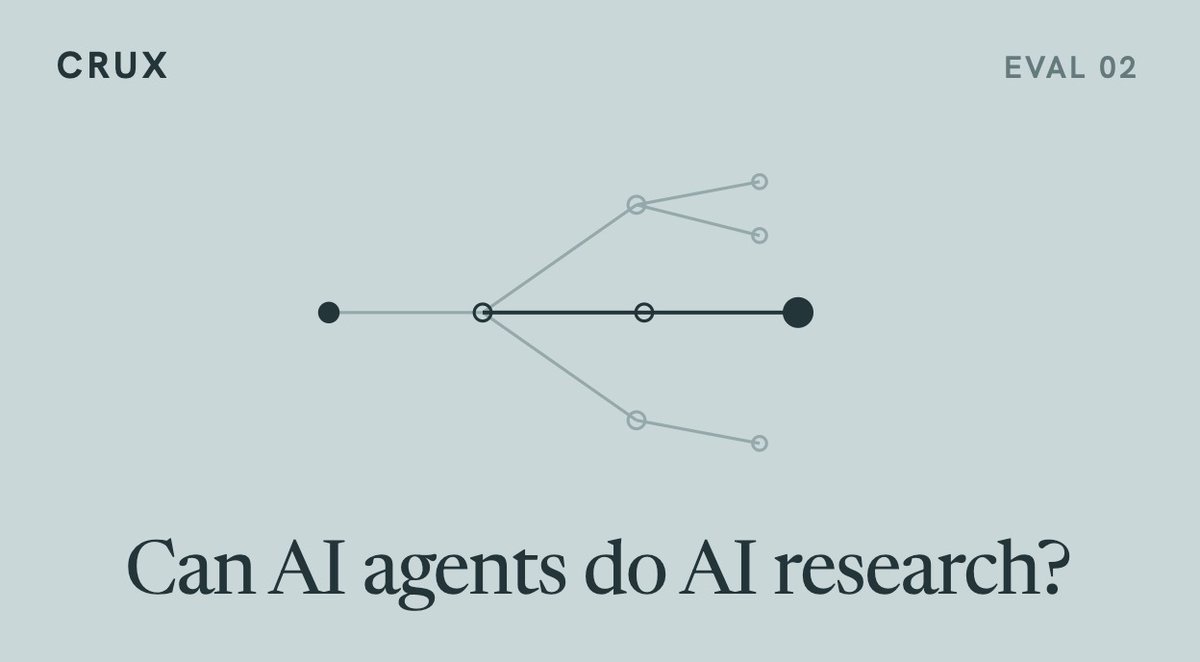
@sayashk outlined (7 likes, 426 views, 4 bookmarks) CRUX #2, an open-world evaluation asking whether agents can do novel AI research over week-long horizons with unpublished-paper questions, VM/GPU budgets, and trajectory review. That made the evaluation target much harder than toy benchmarks or scaffold-specific tasks.
@junfanzhu98 argued (4 likes, 192 views) that the deeper idea in Red Queen Godel Machine is recursive evaluation: not just evolving the task agent, but co-evolving the evaluator while protecting against reward hacking and stale scoring criteria. Even at low engagement, the post mattered because it attacked the assumption that the judge can stay fixed while the agent improves.

@Steve_Yegge praised (49 likes, 8,010 views, 50 bookmarks) SkillBench as a way to scan coding-agent traces and build a skills profile, with token efficiency treated as a fine-grained skills-discovery problem rather than a vague heuristic. The public repo reinforced that this is a real benchmark effort with runnable tasks, not just a hot take about agent productivity.
Discussion insight: The shared belief was that benchmark scores are no longer enough. People want external audits, trace-level evidence, contamination controls, week-long tasks, and evaluator designs that can survive systems getting better at gaming the test.
Comparison to prior day: On 2026-07-01, evaluation was already moving toward regression discipline and production monitoring. On 2026-07-02, it expanded again into institutions, open-world research tasks, and theory about how evaluators themselves should evolve.
1.3 Builders kept narrowing agents into workflows with budget, context, and approvals (🡕)
The practical builder discussion kept favoring narrower operating systems over grand claims. The repeated message was that useful agents need a budgeted workflow, persistent context, recovery paths, and explicit approval gates, not just a better prompt.
@startupideaspod argued (35 likes, 4 replies, 5,217 views, 69 bookmarks) that the best AI-agent ideas start with an existing paycheck: repetitive human work with clear finish lines, known edge cases, and visible business loss when it breaks. The strongest reply added the missing guardrail: only sell the workflow if the agent can survive intake, escalation, and follow-up without becoming another tool to babysit.
@TheEddyEth said (28 likes, 31 replies, 130 views) that repeating context to AI over and over changed how he evaluates tools: long-term context matters more than raw intelligence in daily work. The replies were unusually consistent, with multiple people explicitly choosing persistent context over better reasoning.
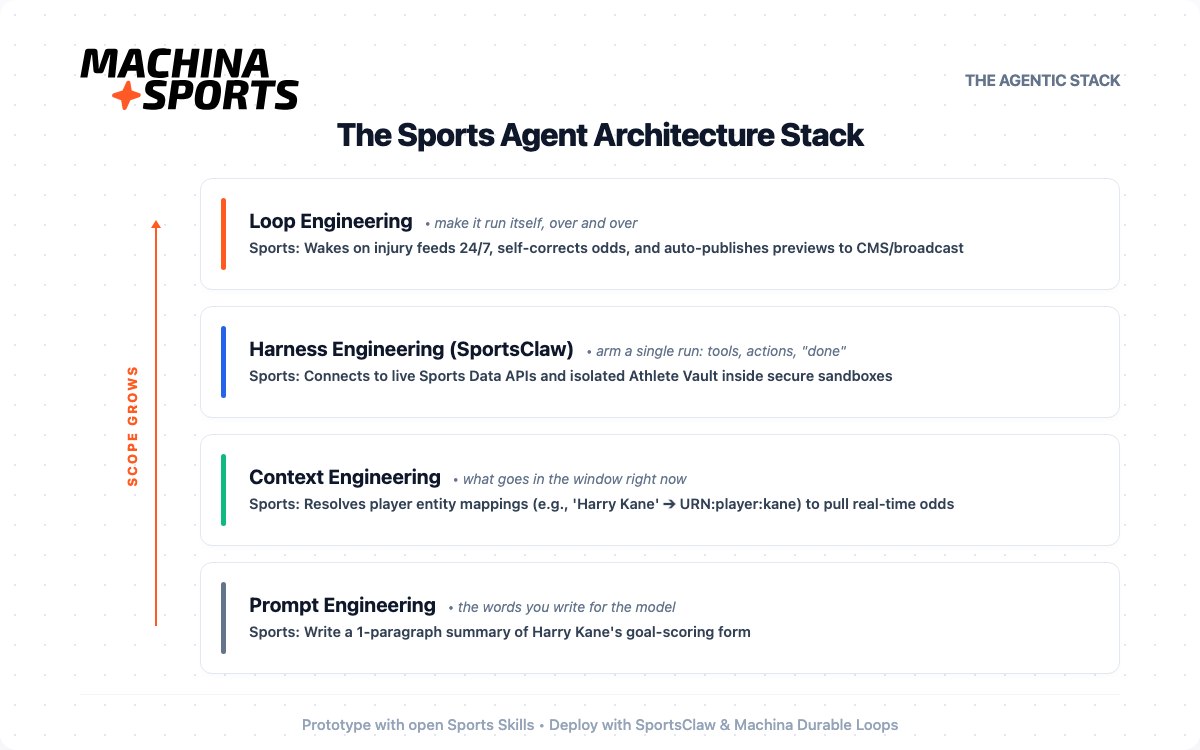
@_andreantonelli shared (4 likes, 111 views) a “Sports Agent Architecture Stack” that split agent work into prompt, context, harness, and loop engineering. The image made the claim concrete by showing where live entity resolution, secure sandboxes, and 24/7 background loops actually sit in a vertical workflow.
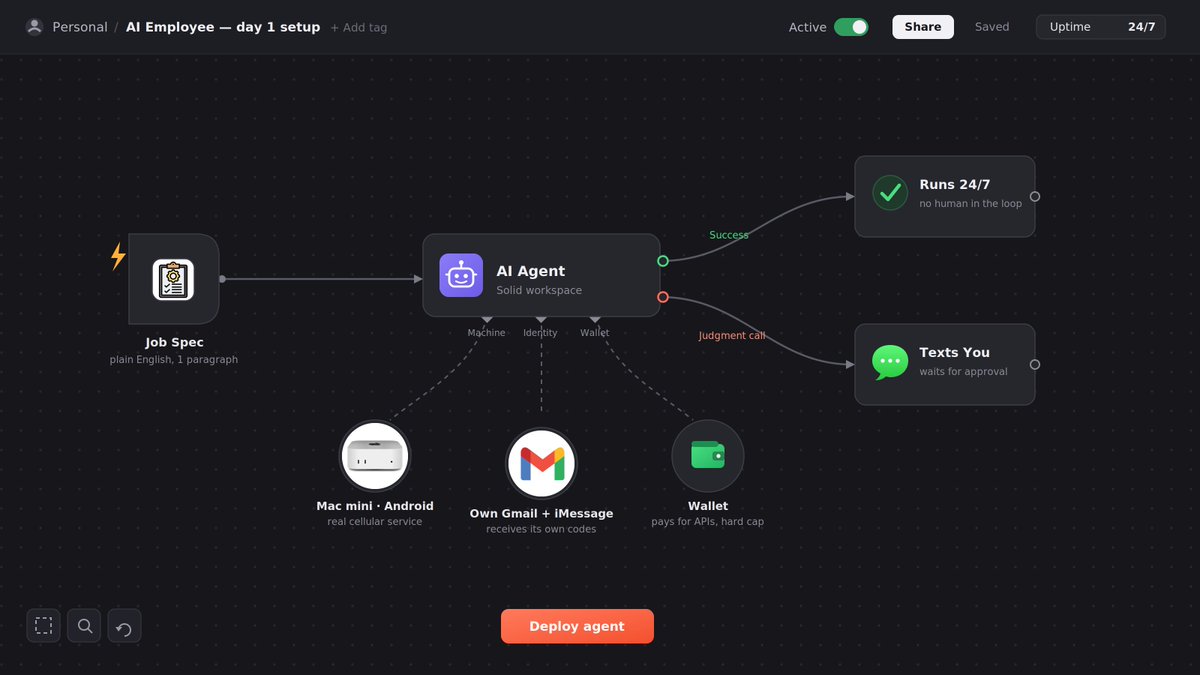
@MyWestLord showed (2 likes, 2 replies, 322 views) a more operational agent-workspace design: give the agent a machine, an identity, a wallet, an approval gate, and a 24/7 run path. The attached workflow diagram was the key evidence because it translated “AI employee” language into concrete components like Gmail/iMessage ownership, capped spending, and escalation-by-text.
@Jason opened (111 likes, 27 replies, 23,495 views, 30 bookmarks) a group chat for startup builders working on AI. The replies were the real signal: one person said they were building a situational marketing agent, another a Twitter-attention tracker, and another “observability for MCP servers,” which is exactly the kind of workflow-and-infrastructure mix dominating the day’s builder chatter.
Discussion insight: The loudest practical bias was toward boring reliability: budgeted workflows, long-term context, clear approval boundaries, and recoverable failure states. “Can it run unattended without creating more work?” showed up more often than “is it the smartest model?”
Comparison to prior day: On 2026-07-01, builders were already packaging AI around privacy, memory, and narrow workflows. On 2026-07-02, that packaging got more explicit: loops, harnesses, identity, wallets, and approval gates became first-class building blocks.
1.4 Open-source kits kept showing up in every layer of the stack (🡕)
A separate cluster of posts showed builders publishing concrete kits instead of generic inspiration. The domain spread mattered: education, investigations, mobile AI, robotics, and on-chain agent auditing all showed up as runnable or browsable public artifacts.
@amitiitbhu shared (11 likes, 433 views, 7 bookmarks) an open tutorial repo that walks from function calling through agent loops, ReAct, memory, orchestration, observability, and evaluation. The README made it clear this was not a single blog post but a growing scaffold for people trying to learn how the pieces fit together.
@VivekIntel introduced (7 likes, 818 views, 10 bookmarks) OSINT-D2, an open-source agentic-OSINT tool that turns usernames and emails into structured dossiers through autonomous investigation, breach checking, trust anchors, and cognitive profiling. The public README added the missing implementation detail: this is a CLI-first tool with multilingual support and PDF or JSON report export, not just a concept thread.
@GithubProjects featured (10 likes, 2 replies, 4,067 views, 9 bookmarks) OpenArm, an open-source 7DOF humanoid arm for contact-rich physical-AI research. The linked project materials made the pitch unusually concrete for this feed: standardized evaluation cell, ROS2 and simulation repos, and a quoted $6,500 price for a complete bimanual system.
@GithubProjects also featured (8 likes, 3,251 views, 7 bookmarks) iOS GenAI Sampler, a public collection of Swift examples for GPT-4o chat, image and video understanding, Perplexity search, and local Phi-3, Gemma, and Mistral models. That is a strong signal that the builder surface is no longer just backend agent tooling; mobile integration kits are becoming part of the everyday stack.
@wumpothere shared (15 likes, 13 replies, 311 views) Kansa Agent, a Mantle-focused auditor that checks whether ERC-8004 agent registration files are complete and honest. The public README mattered because it showed deterministic checks for schema completeness, endpoint health, on-chain activity, and registry cross-references instead of vague “AI trust” claims.
Discussion insight: The open-source surface is fragmenting in a good way. Instead of one giant general framework dominating the day, people were shipping narrower kits that solve one concrete slice of the stack well.
Comparison to prior day: On 2026-07-01, open builder energy centered on agent catalogs and vertical tools like legal AI. On 2026-07-02, the open artifacts spread wider across learning, mobile, robotics, investigations, and on-chain verification.
1.5 Infrastructure talk stayed focused on deployment economics, not just bigger models (🡒)
Infrastructure never left the conversation, but the emphasis shifted from symbolic “AI demand” talk toward deployment mechanics: CPU attach, memory footprints, runtime maturity, and hardware-specific inference economics.
@Jadzo1_ compiled (18 likes, 60,715 views) 13 sell-side notes on the “agentic CPU” thesis and said three separate frameworks were now landing above $170 billion in server CPU TAM by 2030. The attached BofA table made the claim legible by breaking the scenario into revenue, units, ASP, and ARM or x86 share rather than leaving it as a slogan.

@TheValueist argued (1 reply, 422 views) that NVIDIA’s Qwen3.6-35B-A3B-NVFP4 artifact is important less as a model event than as deployment packaging for Blackwell-class hardware. The attached slide and public model card lined up on the core point: about 3.06x lower disk and GPU-memory requirements, but with real deployment complexity and a moat that sits in runtime tooling and hardware fit more than in the model itself.

Discussion insight: The strongest infrastructure posts did not say “more parameters win.” They said inference economics depend on the whole path: CPU to GPU ratios, quantization format, runtime flags, hardware generation, and how much of the workflow can actually be packaged and served reliably.
Comparison to prior day: On 2026-07-01, infrastructure discussion leaned toward sovereign stacks and memory supply. On 2026-07-02, it became more operational: CPU demand models, Blackwell-specific packaging, and the economics of real deployment.
2. What Frustrates People
Model access, pricing, and release rules keep shifting under real workflows
Severity: High. @deredleritt3r reported (96 likes, 6 replies, 16,380 views, 32 bookmarks) that frontier-model release standards and access rules were being actively negotiated, which means availability is no longer a background assumption. @aiwithsally showed (193 likes, 42 replies, 11,447 views) that quality, cost, and latency now pull model choice in different directions, and @slash1sol captured (37 likes, 15 replies, 827 views, 26 bookmarks) the follow-on frustration: even a stronger model still has to justify price and possible workflow constraints. The coping pattern is task routing rather than commitment to one provider. This is worth building for because the pain combines policy risk, latency, pricing, and workflow reliability.
Raw intelligence is not enough when tools forget the job between turns
Severity: High. @TheEddyEth wrote (28 likes, 31 replies, 130 views) that repeating context to AI over and over is what changed his evaluation criteria, and the replies overwhelmingly chose long-term context over stronger reasoning. @startupideaspod argued (35 likes, 4 replies, 5,217 views, 69 bookmarks) that the winning agent workflows are the ones with clear finish lines and tolerable recovery paths, while one reply added that draft-plus-confirm patterns are safer when blast radius is high. @MyWestLord showed (2 likes, 2 replies, 322 views) that builders are compensating with explicit identity, wallet, and approval layers. This is worth building for because people are already stitching memory and handoff controls around the gap instead of trusting the base assistant.
Real agent evaluation is still expensive, slow, and easy to get wrong
Severity: High. @sayashk described (7 likes, 426 views, 4 bookmarks) week-long CRUX evaluations with unpublished-paper tasks precisely because simpler setups are too easy to contaminate or overfit. @Steve_Yegge said (49 likes, 8,010 views, 50 bookmarks) that SkillBench matters because token efficiency and agent quality should be understood through trace-level skill profiling, not loose heuristics. @junfanzhu98 argued (4 likes, 192 views) that fixed evaluators themselves become a bottleneck as agents improve, and @prpaskov tied (58 likes, 9 replies, 4,639 views) the same pain to standards for third-party auditing. This is worth building for because multiple independent posts point to the same operational burden: measuring real capability is now a system problem.
Hidden or unverifiable AI use creates immediate trust backlash
Severity: Medium to High. @beaubyler claimed (1,437 likes, 5 replies, 13,392 views, 41 bookmarks) that AI traces were visible in the HTML of fiction presented as human-written, and the replies treated that as hard evidence rather than a stylistic suspicion. On the builder side, @wumpothere built (15 likes, 13 replies, 311 views) Kansa Agent to test whether on-chain agent registration files are complete and honest, which is the same trust problem in another domain. The workaround is verification: logs, public checks, deterministic audits, or public artifacts that can be inspected. This is worth building for because once trust slips, the social penalty arrives faster than any model-quality debate.
3. What People Wish Existed
Stable model access with clear task-routing economics
The most obvious practical need was not a single champion model. It was stable access to strong models with enough pricing, latency, and policy clarity to route work confidently. @aiwithsally showed that model choice already depends on quality, cost, and latency, while @deredleritt3r showed that access rules themselves are becoming variable. This is a practical need with direct workflow and budget consequences. Opportunity: direct.
Persistent context that survives real work instead of one-off chats
@TheEddyEth made (28 likes, 31 replies, 130 views) the need explicit: a tool that understands what the user is already doing is more valuable than one that is only better at isolated reasoning. The replies strongly reinforced that preference, and @startupideaspod added that agent workflows need manageable failure and recovery paths. This is a direct operational need, not an aspirational one. Opportunity: direct.
Agent operating systems with identity, payments, and approval gates
The strongest builder posts implied that “agent” still underspecifies the real need. @MyWestLord showed an agent setup built around its own machine, communications identity, wallet, and escalation path, while @_andreantonelli decomposed sports agents into prompt, context, harness, and loop engineering. What people appear to want is not just more intelligence, but a runtime with permissions, state, and safe human checkpoints. Opportunity: direct.
Third-party audit and evaluation systems that people can trust
@prpaskov joined AVERI specifically to build standards for independent frontier-AI audits, @sayashk pushed open-world research evals, and @Steve_Yegge pointed to trace-based skill profiling. The need is practical and urgent: people want evidence that survives optimization pressure, contamination, and product marketing. Opportunity: direct.
Structured upskilling that turns “AI engineer” from a vibe into a sequence
The feed also showed a softer but persistent need: clear learning ladders. @ai_explorer25 posted (54 likes, 30 retweets, 891 views) a roadmap from programming and data work through ML, NLP, GenAI, MLOps, and systems design, while @amitiitbhu linked a public tutorial series on agent foundations, loops, memory, orchestration, and evaluation. This is partly practical and partly competitive because many people want the path, but the winning format is still open. Opportunity: competitive.

4. Tools and Methods in Use
| Tool | Category | Sentiment | Strengths | Limitations |
|---|---|---|---|---|
| Claude Fable 5 | LLM | (+/-) | Strong coding and long-horizon benchmark results; treated as the quality ceiling in several posts | Expensive, possibly more constrained than before, and subject to release-policy friction |
| GPT 5.5 | LLM | (+) | Strong value argument relative to Fable 5 in quoted side-by-side tests | Not always treated as the top-quality option |
| SkillsBench | Benchmark / eval | (+) | Trace-based skill profiling and task-based evaluation for agent behavior | Early benchmark surface; strongest claims still come from advocates in this dataset |
| CRUX + OpenClaw + Opus 4.8 | Open-world eval harness | (+) | Week-long tasks, contamination controls, trajectory review, and research-grade difficulty | Expensive and slow; public outcome data was not yet shared |
| AVERI | Auditing standards | (+) | Pushes independent audits and formal standards for frontier AI | Institution-building phase rather than a turnkey operator tool |
| SportsClaw / Machina Sports stack | Vertical agent harness | (+/-) | Clear split between prompt, context, harness, and loop layers for a real vertical | Evidence today is still mostly one builder’s framing |
| Solid workspace | Agent operations platform | (+/-) | Real machine, identity, payments, approvals, and 24/7 execution path | Product claims are concrete but still lightly validated in this dataset |
| OSINT-D2 | Agentic OSINT | (+) | Multi-source identity correlation, breach checks, trust anchors, cognitive profiling, and report export | Operational complexity and investigative-risk concerns remain |
| Qwen3.6-35B-A3B-NVFP4 | Quantized open-weight model | (+/-) | Lower memory footprint, long context, multimodality, and Blackwell-oriented deployment packaging | Runtime complexity and hardware specificity limit easy portability |
| OpenArm | Physical AI platform | (+) | Reproducible evaluation environment, open hardware stack, and relatively low system cost | Research platform rather than turnkey commercial robot deployment |
| iOS GenAI Sampler | Mobile dev kit | (+) | Concrete Swift examples spanning GPT-4o and local models on iOS | Sample-oriented rather than a production framework |
| AI Agents Tutorial | Learning resource | (+) | Clear sequence from function calling through loops, memory, orchestration, and evaluation | Educational scaffold, not a runtime system |
| Kansa Agent | Agent auditing app | (+) | Deterministic checks for agent metadata honesty against live Mantle activity | Narrow scope and network specificity |
The overall satisfaction spectrum was pragmatic. People were positive about tools that made one layer of the problem concrete—benchmarking, auditing, mobile integration, robotics, OSINT, or workflow packaging—and mixed on anything that still depended on unstable model access or unproven product claims. The clearest migration pattern was from prompt-centric thinking to context, harness, loop, and approval design. Competitive dynamics also looked sharper: model choice is increasingly routed by cost, latency, and task fit, while deployment stacks are competing on runtimes, hardware fit, and trust guarantees rather than on raw model mystique alone.
5. What People Are Building
| Project | Who built it | What it does | Problem it solves | Stack | Stage | Links |
|---|---|---|---|---|---|---|
| SkillsBench | @Steve_Yegge | Benchmarks how well AI agents use skills and analyzes trace behavior | Loose agent-quality heuristics and poor visibility into token efficiency | BenchFlow, task packages, agent traces | Beta | post · repo |
| AI Agents Tutorial | @amitiitbhu | Stepwise public learning path from function calling to evaluation | Lack of a clear sequence for learning modern agent systems | GitHub docs, blogs, videos | Shipped | post · repo |
| OSINT-D2 | @VivekIntel | Agentic OSINT CLI that turns usernames and emails into dossiers | Manual, fragmented identity correlation across platforms | Python, Poetry, LLM providers, ScrapingAnt proxies | Beta | post · repo |
| OpenArm | @GithubProjects | Open-source 7DOF humanoid arm and reproducible evaluation cell | Need for affordable, reproducible physical-AI research hardware | Open hardware, ROS2, Isaac Lab, MuJoCo | Beta | post · repo |
| iOS GenAI Sampler | @GithubProjects | Swift examples for GPT-4o and local-model features on iOS | Rebuilding basic mobile GenAI integrations from scratch | Swift, GPT-4o, Phi-3, Gemma, Mistral, Perplexity | Shipped | post · repo |
| Kansa Agent | @wumpothere | Audits ERC-8004 agent registration files against live Mantle activity | Agent claims can be incomplete or dishonest | Next.js, TypeScript, viem, @mantleio/mantle-core | Beta | post · repo |
| Machina Sports / SportsClaw stack | @_andreantonelli | Vertical stack for sports agents with context, harness, and loop layers | Generic prompting fails on fragmented live sports data and workflows | Sports data APIs, secure sandboxes, loop orchestration | Beta | post |
| Solid workspace | @MyWestLord | Agent workspace with its own machine, identity, wallet, and approval flow | Sandbox agents cannot verify, pay, or run unattended in production | Real device or server, Gmail/iMessage, wallet, approval routing | Beta | post |
SkillsBench stood out because it reframed token efficiency as a measurement problem, not just a pricing complaint. The repo makes the tweet more credible by exposing the task-and-trace structure behind the claim that agent skills can be benchmarked and composed rather than guessed at.
OSINT-D2 and Kansa Agent pointed in the same direction from different domains: verification and evidence. OSINT-D2 packages autonomous identity investigation into a CLI workflow, while Kansa checks whether an agent’s public claims match its live endpoints and on-chain activity. Both are examples of builders trying to replace trust-me AI with inspectable outputs.
OpenArm and iOS GenAI Sampler showed the stack widening outward. OpenArm packages physical-AI research into an open, reproducible hardware and simulation surface, while iOS GenAI Sampler packages mobile integration patterns for both cloud and local models. The repeated build pattern was clear: people are shipping narrower, concrete kits for one environment at a time instead of another abstract “AI platform.”
SportsClaw and Solid represented the other recurring build trigger: agents stop being interesting at the demo layer and start needing runtime structure. Both posts converged on the same operating primitives—context, harnesses, loops, identity, payments, and approvals—even though one came from a vertical sports workflow and the other from a more general “AI employee” framing.
6. New and Notable
Forecasts are still ahead of public benchmark reality
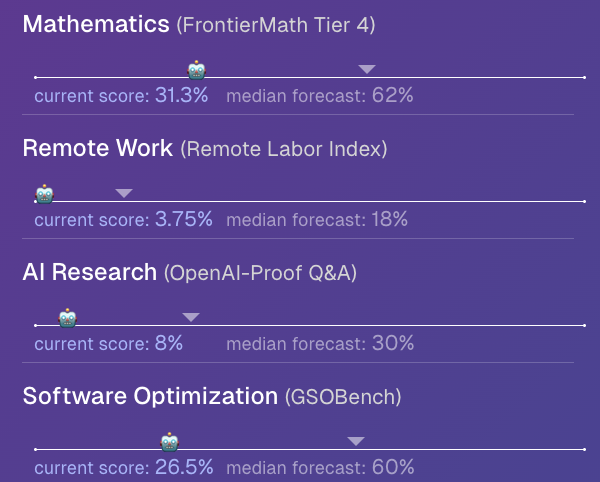
@GregHBurnham checked (15 likes, 2 replies, 540 views) how current public results compare with the AI 2026 forecasting survey and attached a compact benchmark-gap chart. The image is the signal: FrontierMath sat at 31.3% versus a 62% median forecast, Remote Labor Index at 3.75% versus 18%, OpenAI-Proof Q&A at 8% versus 30%, and GSOBench at 26.5% versus 60%. That is a useful counterweight to the day’s stronger “whole-project handoff” and infrastructure excitement.
AI was used to measure how much scientific claims change before publication
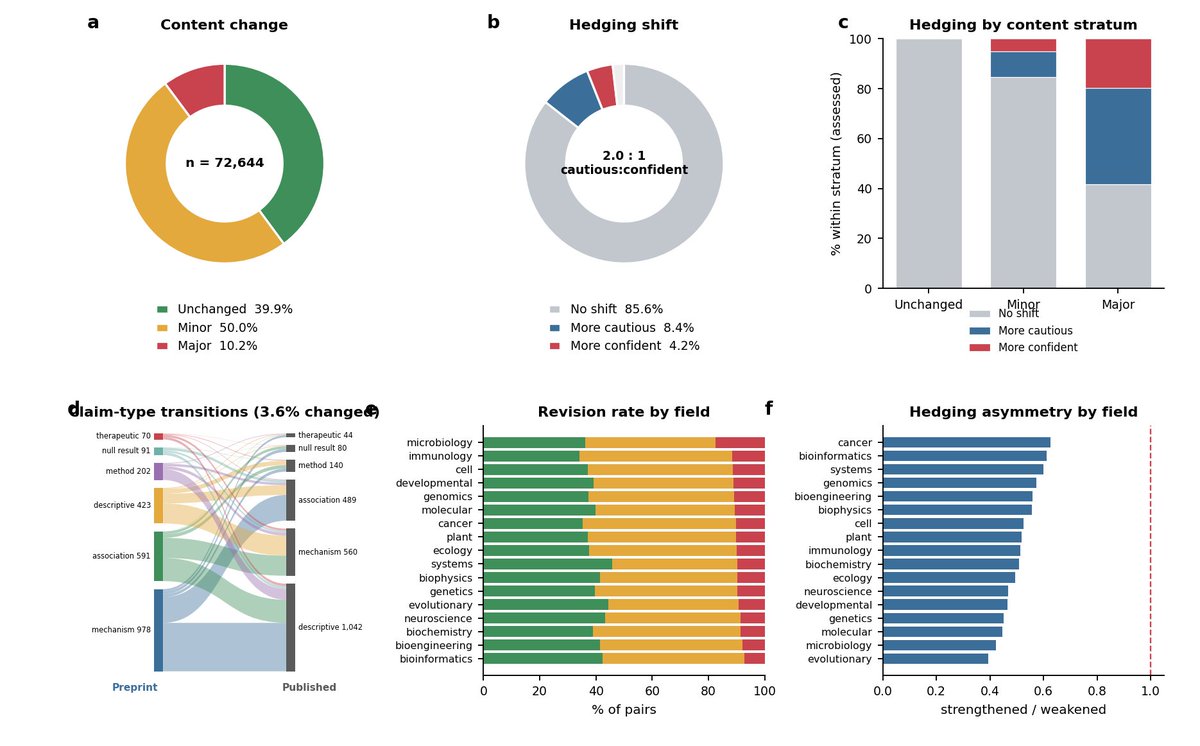
@rust_ruslan reported (43 likes, 4 replies, 16,364 views, 14 bookmarks) a study that used a large language model to compare all available 72,644 bioRxiv-to-journal pairs from 2018 to 2025. The attached figure carried the core evidence: 39.9% of claims were unchanged, 50.0% changed in minor ways, and 10.2% changed in major ways, while cautious revisions outnumbered confidence increases about two to one.
Brand authority in LLM memory got a public measurement framework
@dejanseo shared (23 likes, 863 views, 9 bookmarks) a methodology for measuring brand authority in model memory using recall surveys and PageRank over an association graph. The linked article added the substantive detail that the system used 200,000 Gemini recall runs, built a graph over 2.9 million brand nodes, and manually removed 2,163 junk artifacts from the seed set before computing authority scores. That is a notable example of people treating model memory as something measurable, queryable, and rankable.
7. Where the Opportunities Are
[+++] Real-world agent evaluation and audit infrastructure — This signal showed up everywhere: AVERI standardizing external audits, CRUX testing week-long research tasks, SkillsBench profiling trace behavior, RQGM arguing for evolving evaluators, and Kansa checking whether public agent claims are honest. The opportunity is strong because the pain is cross-cutting and already expensive.
[++] Context-preserving, approval-gated agent workspaces — TheEddyEth’s thread, the startupideaspod replies, the Solid workflow diagram, and Anand Mahindra’s application-layer framing all point to the same gap: people need systems that remember context, respect controls, and escalate safely. This is a moderate opportunity because it is clearly demanded, but the space will be competitive.
[++] Narrow open kits for specific environments and workflows — AI Agents Tutorial, OSINT-D2, OpenArm, iOS GenAI Sampler, and SportsClaw all gained traction by packaging one usable slice of the stack instead of promising a universal platform. The opportunity is moderate because demand is visible across mobile, robotics, investigations, and vertical agents, but differentiation will depend on distribution and execution.
[+] Deployment-economics observability for model and hardware routing — The Fable-vs-GPT tradeoff posts, the agentic CPU TAM thread, and the NVFP4 deployment discussion all point to a growing need for tools that connect benchmark quality to latency, runtime fit, memory use, and cost. This is still emerging, but the evidence suggests it will matter more as teams route across multiple models and hardware paths.
8. Takeaways
- Model choice is becoming routing, not loyalty. The strongest posts treated quality, price, latency, and policy access as separate variables, not as one leaderboard winner. (source)
- Evaluation is hardening into its own layer of the stack. Third-party audit standards, open-world research evals, and trace-based skill profiling all appeared in one day’s feed, which is stronger evidence than a single benchmark debate. (source)
- Builders are packaging agents around context, identity, and approvals. The most practical builds were not generic copilots; they were systems with loops, harnesses, wallets, communications identities, and explicit human checkpoints. (source)
- Open-source builder energy remains highest where the artifact is concrete. Public repos for tutorials, OSINT workflows, mobile GenAI, robotics, and on-chain agent auditing carried more signal than vague platform claims. (source)