Twitter AI - 2026-07-04
1. What People Are Talking About
1.1 Frontier models are being used like architects inside cheaper, structured workflows (🡕)
The strongest conversation was not about a single benchmark winner. It was about where expensive frontier-model time is actually worth spending: planning, judgment, and hard decisions, with cheaper models and tighter harnesses handling the repetitive execution around them.
@aniketapanjwani reported (254 likes, 12 replies, 45,046 views, 219 bookmarks) that Fable gave unusually strong product-level and strategic advice across software, economics, and career-planning repos, but that the best workflow was still to hand implementation to Opus or Codex. The distinctive angle was that the model's value was not raw typing speed; it was high-level judgment once enough context had been supplied.
@RoundtableSpace argued (88 likes, 14 replies, 52,495 views, 63 bookmarks) that Fable 5 should be treated like a CTO rather than a default worker: drop effort level for routine work, let cheaper models do research and execution, and use advisor-style escalation only when the cheaper model gets stuck. Replies made the pain concrete: one user said subscription products now force people to become part-time optimization engineers just to avoid getting “robbed” by their own usage.
@tbrownio summarized (37 likes, 4 replies, 2,753 views, 30 bookmarks) AI Engineer World's Fair as a move away from “let the agents rip” and toward structure: define the end state, keep humans in the outer loop, evaluate models on price per task, and treat skills, evals, and wikis as portable assets. The practical message matched the other two threads: autonomy without boundaries creates slop faster than leverage.
Discussion insight: The disagreement was not over whether frontier models are strong. It was over how much of the workflow should ever touch the expensive model, and how much human review remains necessary when the system runs for long stretches.
Comparison to prior day: On 2026-07-03, the feed focused on loops, memory, and bill reduction as runtime components. On 2026-07-04, that matured into explicit operating playbooks: planner-executor splits, effort tuning, and human-centered workflow governance.
1.2 Context, memory, and richer inputs are becoming more important than raw model switching (🡕)
A second cluster treated memory and context as the real product surface. The repeated complaint was that starting from zero on every turn wastes both money and judgment, so builders are looking for ways to preserve work across sessions and feed agents much richer task state.
@omarsar0 explained (32 likes, 1 reply, 5,189 views, 34 bookmarks) a multimodal prompting workflow that records voice, screen annotations, and click traces, preprocesses them, and turns them into reusable skills. His distinctive claim was that even older models become less frustrating when they receive richer task context instead of a bare text prompt.
@vladuah described (18 likes, 3 replies, 391 views, 12 bookmarks) Hermes Agent plus NotebookLM as a “24/7 self-improving research system” that can read a personal source library, cross-reference documents, and build cumulative understanding instead of restarting from zero on each task. The signal was smaller, but the product shape was unusually concrete.
@tbrownio added (37 likes, 4 replies, 2,753 views, 30 bookmarks) that the most effective memory systems now use explicit save-memory tools plus a synthesis step, and that portable skills, evals, data, and wikis matter more than tying yourself to one harness.
Discussion insight: The feed treated “better prompting” as a solved framing. The harder problem is durable context: how to capture task state once, preserve it, and make it reusable across long-running work.
Comparison to prior day: On 2026-07-03, memory showed up mainly as a failure mode in long sessions. On 2026-07-04, it showed up as product design: multimodal task capture, persistent knowledge bases, and portable context assets.
1.3 Open and general-purpose models kept gaining credibility against specialized stacks (🡕)
The open-model and general-purpose-model case became more concrete. Instead of abstract claims about commoditization, the feed had one ecosystem-scale adoption signal and one domain-specific benchmark signal showing why people are increasingly reluctant to commit to narrow vertical stacks.
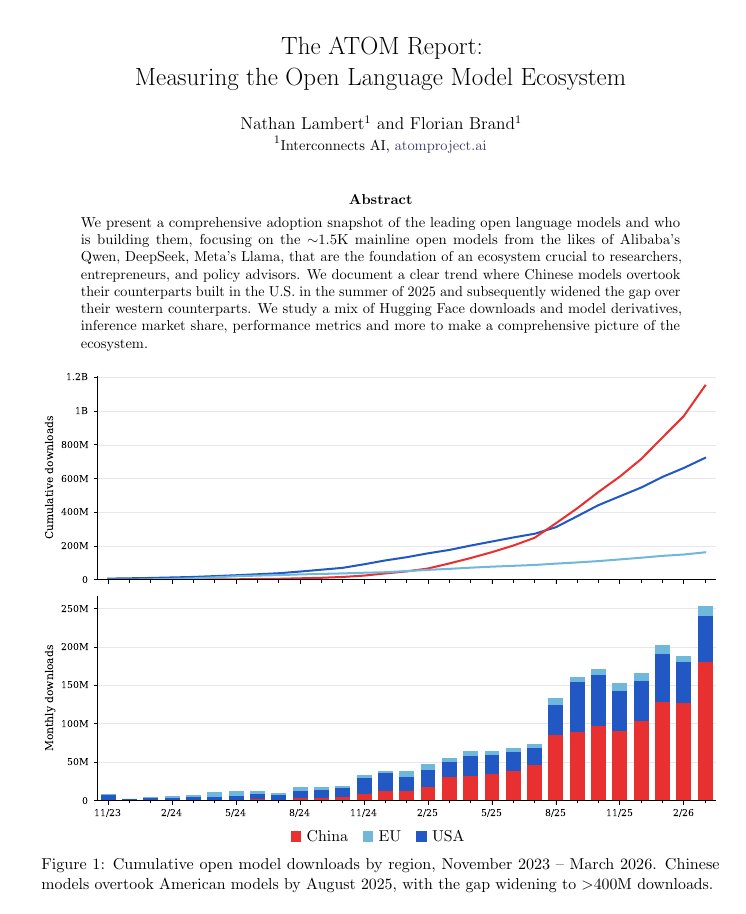
@rohanpaul_ai shared (22 likes, 4 replies, 2,951 views, 9 bookmarks) the ATOM Report's claim that Chinese open models passed U.S. models in cumulative downloads in summer 2025 and reached 1.15B tracked downloads by March 2026 versus 723M for U.S. models. The post's distinctive argument was that Qwen won not through one blockbuster model, but by becoming the default reusable family across many sizes.
@DrEliDavid pointed (186 likes, 16 replies, 14,824 views, 63 bookmarks) to a Nature Medicine result stating that general-purpose LLMs outperformed specialized clinical AI tools on MedQA, HealthBench, and a real clinical queries benchmark built from 100 de-identified physician queries. Replies made the nuance more valuable than the headline alone: one responder argued that stronger base models do not solve automation bias, and that frozen specialized checkpoints remain easier to validate than constantly shifting frontier services.

@tbrownio also noted (37 likes, 4 replies, 2,753 views, 30 bookmarks) that open-source models are now close enough to frontier systems to handle less intensive work in tandem with more expensive models.
Discussion insight: The evidence for open or general-purpose strength got stronger, but the replies showed that capability wins do not eliminate governance questions. Validation, deployment discipline, and model drift still matter.
Comparison to prior day: On 2026-07-03, the open-model story was mainly about sovereignty, application-layer value, and pricing pressure. On 2026-07-04, it was backed by adoption curves and specialty-domain benchmark evidence.
1.4 Cost pressure stayed visible at both the GPU and token layers (🡒)
The economics story did not cool down. The feed showed that people are now optimizing two different scarcity surfaces at once: the cost of raw compute underneath the model stack, and the cost of the tokens and context moving through the stack.
@Silicon_Data argued (36 likes, 1 reply, 18,780 views, 35 bookmarks) that rumors of Meta selling compute should not be read as a demand collapse because H100 rental term curves have risen and flattened rather than pricing in a glut. The attached chart made the point tangible: the plotted 12-month term rate rose from roughly $1.80 per GPU-hour in late 2025 to roughly $2.38 by July 2, 2026.

@sairahul1 highlighted (19 likes, 10 replies, 3,218 views, 26 bookmarks) an open-source compression layer that he said can cut Claude API costs by up to 95% by shrinking logs, JSON, and code locally before they reach the model. The public Headroom repo backs the broader point even if the exact social claim needs independent replication: context compression is becoming a shared infrastructure category rather than a one-off prompt trick.
Discussion insight: Nothing in the feed suggested “abundance.” Instead, the optimization frontier moved outward: first control which model does which work, then cut the context footprint that ever reaches the model, while the GPU market underneath still looks tight.
Comparison to prior day: On 2026-07-03, economics showed up through visible model-picker prices and session-compression benchmarks. On 2026-07-04, it widened into both datacenter rental curves and local-first token-compression tooling.
2. What Frustrates People
Paying for frontier intelligence now means micromanaging spend, caps, and routing
Severity: High. @RoundtableSpace wrote (88 likes, 14 replies, 52,495 views, 63 bookmarks) that Fable users must actively lower effort, split planning from implementation, and avoid using the expensive model for research. @aniketapanjwani reported (254 likes, 12 replies, 45,046 views, 219 bookmarks) a similar planner-first pattern from real usage, while one reply there pushed for more than the temporary 50% availability cap. @sairahul1 added (19 likes, 10 replies, 3,218 views, 26 bookmarks) that compression tooling has become compelling enough to attract mass attention around Claude cost reduction. The coping pattern is clear: route tasks aggressively, compress context, and reserve the most expensive model for high-leverage decisions. This is worth building for because the pain blends pricing, UX friction, and wasted operator attention.
Agents still lose too much context between tasks, sessions, and modalities
Severity: High. @omarsar0 said (32 likes, 1 reply, 5,189 views, 34 bookmarks) that multimodal task capture has reduced frustrating interactions by giving agents more complete task state up front. @vladuah proposed (18 likes, 3 replies, 391 views, 12 bookmarks) a NotebookLM-backed research stack precisely because agents otherwise start from zero too often. @tbrownio summarized (37 likes, 4 replies, 2,753 views, 30 bookmarks) the same pain at conference scale: memory systems, portable skills, and persistent context are now first-class workflow components. People are coping by building personal knowledge layers and reusable skills around the model. This is worth building for because the problem appears across research, coding, and agent operations.
Benchmark wins still do not settle deployment risk in high-stakes domains
Severity: High. @DrEliDavid claimed (186 likes, 16 replies, 14,824 views, 63 bookmarks) that specialized medical LLMs are already losing to generic frontier models, backed by a public Nature Medicine artifact. But the strongest reply pushed the frustration one layer deeper: if clinicians rubber-stamp outputs and models drift after deployment, capability gains alone do not create a trustworthy clinical workflow. The workaround today is independent evaluation, frozen artifacts where possible, and cautious human review. This is worth building for because the pain is not only “which model is better,” but “what exactly can be validated and held constant?”
There is still no trusted way to resolve ambiguous agent-to-agent disputes
Severity: Medium. @lami_thefirst argued (35 likes, 11 replies, 1,412 views, 9 bookmarks) that an agent economy needs a fast adjudication layer once one automated party says “you scammed me” and the other says “read the contract.” The replies immediately stressed the failure cases: biased validators, gamed data feeds, collusion, and agents optimizing for judges instead of the deal terms. The current coping strategy is mostly avoidance: keep contracts narrow and deterministic. This looks worth building for, but it remains an early and heavily contested market.
3. What People Wish Existed
Durable context layers that survive model changes and compound knowledge
The clearest practical need was not “a smarter model” in isolation. It was a dependable context layer that can retain task state, reuse prior work, and keep knowledge available even when the underlying model changes. @omarsar0 showed (32 likes, 1 reply, 5,189 views, 34 bookmarks) one path through multimodal task records, while @vladuah showed (18 likes, 3 replies, 391 views, 12 bookmarks) another through NotebookLM-backed research memory. @tbrownio reinforced (37 likes, 4 replies, 2,753 views, 30 bookmarks) the same idea by treating skills, evals, data, and wikis as portable assets. Opportunity: direct.
Orchestration that automatically decides when to use the expensive model
People are openly asking for systems that know when to spend on frontier reasoning and when not to. @aniketapanjwani described (254 likes, 12 replies, 45,046 views, 219 bookmarks) a workflow where Fable handles judgment and cheaper models handle implementation. @RoundtableSpace made (88 likes, 14 replies, 52,495 views, 63 bookmarks) that architecture explicit with low-effort mode, cheaper research workers, and advisor escalation. This is an urgent operational need rather than a speculative one. Opportunity: direct.
Independent, version-pinned evaluation for regulated AI
The Nature Medicine thread made a narrower but important need visible. @DrEliDavid surfaced (186 likes, 16 replies, 14,824 views, 63 bookmarks) evidence that generic frontier models can beat specialized clinical tools, but the reply discussion shifted toward the missing infrastructure for model drift, automation bias, and repeatable validation. What people seem to want is not only a better medical model, but a way to pin behavior, audit changes, and validate deployments against a stable artifact. Opportunity: competitive.
Fast dispute-resolution layers for autonomous transactions
This was a smaller but distinctive need. @lami_thefirst framed (35 likes, 11 replies, 1,412 views, 9 bookmarks) the gap as “trustless adjudication” for an agentic economy, and replies supplied concrete cases around model licensing, logistics spoilage, and privacy disputes. The need is real in the data, but still heavily contested in design. Opportunity: aspirational.
4. Tools and Methods in Use
| Tool | Category | Sentiment | Strengths | Limitations |
|---|---|---|---|---|
| Claude Fable 5 | Frontier LLM | (+/-) | Strong product-level judgment, planning, and high-context reasoning | Expensive, capacity-limited, and often treated as too costly for routine execution |
| Planner-executor routing | Workflow method | (+) | Preserves expensive reasoning for architecture while cheaper models do implementation or research | Requires orchestration discipline and can shift complexity onto the user |
| Headroom | Context compression | (+) | Local-first compression for logs, JSON, code, files, and history; reversible retrieval; library, proxy, and MCP modes | Savings claims are compelling but still need broader independent verification across workloads |
| Qwen family / open models | Open LLM family | (+) | Broad size coverage, strong ecosystem reuse, and cheap deployment options | Still commonly paired with frontier models for harder judgment-heavy work |
| Hermes Agent + NotebookLM | Research memory stack | (+) | Gives agents persistent access to a personal source library and cumulative research context | Evidence today is mostly practitioner-led and setup-dependent |
| Multimodal task capture | Workflow method | (+) | Richer task state reduces ambiguity and makes reusable skills possible | Adds preprocessing, recording, and organization overhead |
| DeepZero | Security research framework | (+) | YAML-defined pipelines, parallelism, resumable runs, LiteLLM integration, and reusable processors | Framework only; still needs corpora, rules, and pipeline design to create value |
| Generic frontier LLMs in clinical evaluation | Medical AI method | (+/-) | Strong benchmark performance against specialized tools in a public paper | Validation, drift control, and clinician oversight remain unresolved |
The overall satisfaction spectrum was pragmatic. People liked tools and methods that either preserved scarce context or reduced scarce spend. The migration pattern was consistent: use open or cheaper models for parsing, searching, and bulk execution; keep the strongest frontier model for planning or edge-case reasoning; then wrap both with compression, memory, and reusable skills. The competitive dynamic is moving above the base model into routing, context management, and infrastructure layers that decide what the model ever sees.
5. What People Are Building
| Project | Who built it | What it does | Problem it solves | Stack | Stage | Links |
|---|---|---|---|---|---|---|
| Headroom | headroomlabs-ai via @sairahul1 | Compresses tool outputs, logs, files, code, and conversation history before they hit the LLM | Token-heavy workflows make strong models too expensive for routine use | Local-first context compression, library/proxy/MCP modes, content-aware compressors, reversible cache | Shipped | repo |
| DeepZero | 416rehman via @VivekIntel | Runs long vulnerability-research workflows as YAML pipelines instead of ad hoc scripts | Large-scale software analysis is brittle without resumable orchestration and reusable stages | Python 3.11+, LiteLLM, Jinja2, Ghidra, Semgrep, REST API, YAML pipelines | Beta | repo |
| Hermes Agent + NotebookLM skill | @vladuah | Connects an agent to a persistent NotebookLM-backed personal knowledge base | Research agents restart from zero too often and lose accumulated context | MCP, NotebookLM skill, source-library retrieval, cumulative memory | Beta | - |
| GenLayer adjudication flow | @GenLayer via @lami_thefirst | Uses intelligent contracts and validator consensus to resolve ambiguous agent disputes | Deterministic smart contracts cannot easily adjudicate fairness or live-data disagreements | Intelligent contracts, live data pulls, validator consensus, appeals | Beta | - |
Headroom and DeepZero were the clearest support-layer builds of the day. @sairahul1 highlighted (19 likes, 10 replies, 3,218 views, 26 bookmarks) a compression layer that he said can drastically reduce Claude costs, and the public repo describes proxy, wrap, library, and MCP deployment modes rather than a single narrow integration. @VivekIntel introduced (25 likes, 2 replies, 914 views, 17 bookmarks) DeepZero as a pipeline engine for vulnerability research, and its public README confirms YAML-defined stages, resumable per-sample state, and example processors for Ghidra, Semgrep, and loldrivers filtering.

The lighter-signal builds still pointed at the same missing layers. @vladuah showed (18 likes, 3 replies, 391 views, 12 bookmarks) a research-memory integration so the agent can keep building on prior sources, while @lami_thefirst argued (35 likes, 11 replies, 1,412 views, 9 bookmarks) that autonomous commerce will need an adjudication layer before it can scale. The repeated build trigger was not “make another assistant.” It was fill a control gap around spend, memory, or accountability.
6. New and Notable
General-purpose models beating specialized clinical tools is now a public medicine story
@DrEliDavid amplified (186 likes, 16 replies, 14,824 views, 63 bookmarks) a Nature Medicine paper whose title and abstract explicitly state that general-purpose LLMs outperformed specialized clinical AI tools on multiple medical benchmarks. That matters because it raises the bar for vertical-model vendors while also exposing the next problem: replies immediately shifted from capability to validation, drift, and automation bias rather than celebrating the leaderboard result alone. Public artifact: Nature Medicine paper.
The ATOM Report made the open-model power shift visible in one chart
@rohanpaul_ai summarized (22 likes, 4 replies, 2,951 views, 9 bookmarks) the ATOM Report's claim that Chinese open models reached 1.15B tracked downloads by March 2026 versus 723M for U.S. models, with Qwen leading much of the shift. That is notable because it turns “open models are catching up” into an ecosystem-scale adoption fact rather than a vibes-based claim. Public artifact: ATOM Report.
Local-first context compression graduated from trick to product layer
@sairahul1 flagged (19 likes, 10 replies, 3,218 views, 26 bookmarks) a repository that he said had already reached 56K stars for shrinking logs, JSON, and code before they reach Claude. The Headroom README matters more than the hype wording: it describes library, proxy, wrap, and MCP modes, which means cost control is being packaged as shared infrastructure that multiple agents and tools can sit on top of. Public artifact: Headroom repo.
7. Where the Opportunities Are
[+++] Cross-model context and memory infrastructure — Evidence ran through sections 1, 2, 3, and 5: multimodal task capture, NotebookLM-backed agent memory, portable skills and wikis, and repeated frustration with agents restarting from zero. This is strong because the problem shows up across research, coding, and long-horizon agent use.
[+++] Cost-aware orchestration and compression for frontier-model workflows — The Fable planner-executor pattern, Headroom's compression layer, and the ongoing GPU-rental tightness all point to the same gap: strong models are valuable, but too expensive to use carelessly. This is strong because both token spend and infrastructure scarcity are visible in the data.
[++] Validation, pinning, and audit layers for regulated AI — The medical-AI thread showed that capability gains do not solve deployment trust. The opportunity is moderate because the need is clear, but the product surface spans benchmarking, governance, change control, and clinician workflow.
[+] Reproducible AI-assisted research pipelines for technical teams — DeepZero shows one concrete security-research example, and the broader feed kept rewarding workflows that turn long manual procedures into resumable pipelines. This is emerging, but the build pattern is already clear.
[+] Adjudication and audit layers for agent-to-agent commerce — GenLayer's dispute-resolution thread exposed a real gap once contracts become ambiguous, but the replies also showed how many failure modes remain unresolved. The opportunity exists, but it is still early and highly contested.
8. Takeaways
- Frontier models are increasingly valued for judgment more than bulk execution. @aniketapanjwani reported (254 likes, 12 replies, 45,046 views, 219 bookmarks) that Fable's strongest contribution was strategic advice, while implementation still got delegated to cheaper models.
- The agent UX battle is moving from prompts to persistent context. @omarsar0 showed (32 likes, 1 reply, 5,189 views, 34 bookmarks) that richer multimodal task capture reduces friction, and @vladuah showed (18 likes, 3 replies, 391 views, 12 bookmarks) a concrete memory layer for research work.
- Open and general-purpose model strength is now backed by both ecosystem and domain evidence. @rohanpaul_ai shared (22 likes, 4 replies, 2,951 views, 9 bookmarks) ecosystem-scale adoption data for open models, while @DrEliDavid shared (186 likes, 16 replies, 14,824 views, 63 bookmarks) a public medical benchmark result favoring general-purpose systems.
- AI cost pressure is still visible at both the datacenter and API layers. @Silicon_Data argued (36 likes, 1 reply, 18,780 views, 35 bookmarks) that H100 rental pricing still looks tight, while @sairahul1 highlighted (19 likes, 10 replies, 3,218 views, 26 bookmarks) rising demand for local-first token compression.
- Builders are shipping support layers around the model instead of just another chat wrapper. @VivekIntel introduced (25 likes, 2 replies, 914 views, 17 bookmarks) DeepZero as a reusable research pipeline engine, and the public repo confirms that orchestration, recovery, and extensibility are now product features of their own.
- Autonomous commerce still lacks a credible dispute layer. @lami_thefirst argued (35 likes, 11 replies, 1,412 views, 9 bookmarks) that agents need adjudication as soon as transactions become ambiguous, and the replies showed how quickly the edge cases pile up.