Twitter AI - 2026-07-05
1. What People Are Talking About
1.1 Value kept moving above the base model into orchestration, application layers, and durable context (🡕)
The most repeated strategic claim was that raw model quality is no longer the only place to win. People kept pointing to the layer around the model: orchestration, distillation, enterprise control layers, and persistent context that survive across sessions.
@karlmehta argued (92 likes, 19 replies, 11,615 views, 44 bookmarks) that Alex Karp's real point was not that the model itself is scarce, but that the application layer between the model and enterprise data is where safety and precision are created. The specific claim was that Palantir's ontology matters because it keeps the model from directly touching the underlying business data while making outputs useful in regulated and operational settings.
@MilkRoadAI explained (51 likes, 7 replies, 8,426 views, 60 bookmarks) Meta's distillation story as a deployment economics shift: train a giant teacher model, then ship much cheaper descendants that retain most of the capability. The distinctive angle was not a new benchmark chart, but a cost structure argument that smaller open models can inherit frontier intelligence without carrying frontier serving costs.
@murtuza_merc argued (115 likes, 15 replies, 2,215 views) that Hermes MoA 2.0 makes the orchestration layer itself the product by running GPT, Claude, and DeepSeek in parallel and synthesizing the outputs. His framing was that if an open ensemble can beat any one constituent model on hard reasoning, premium pricing power shifts away from the single model and toward the coordination engine above it.
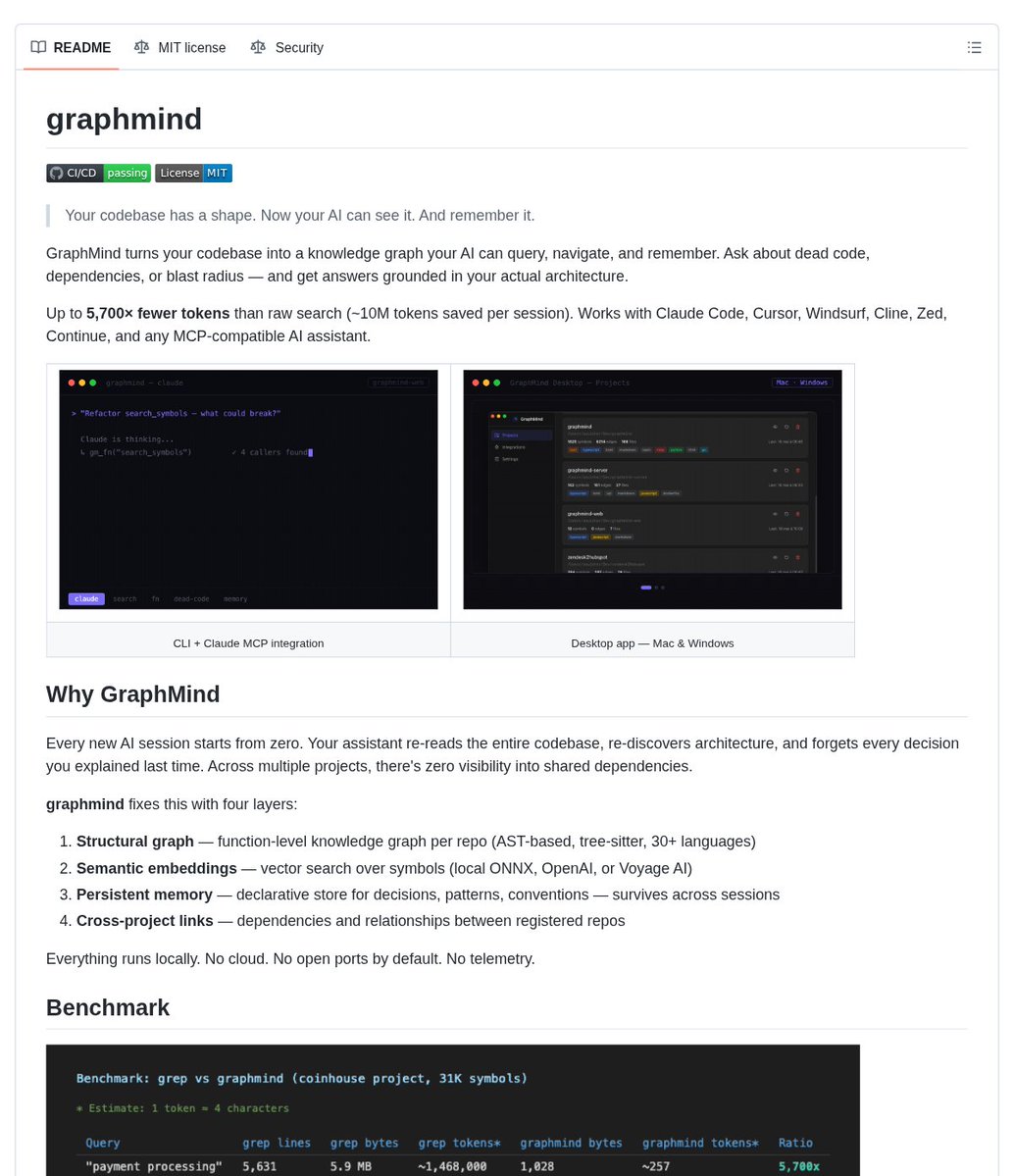
@DanKornas shared (1 like, 1 reply, 644 views) GraphMind, a local-first code intelligence layer that turns a repo into a knowledge graph with persistent memory and cross-project links. The attached README screenshot claimed up to 5,700x fewer tokens than raw search, which made the point concrete: people are increasingly treating codebase context as a product layer of its own rather than something to reconstruct every session.
Discussion insight: The replies did not reject model progress. They kept pushing on what happens after the model is strong enough: who owns the routing, who owns the memory, who owns the enterprise safety boundary, and whether orchestration gains survive latency and cost overhead.
Comparison to prior day: On 2026-07-04, the feed treated frontier models as high-value planners inside cheaper workflows. On 2026-07-05, that logic hardened into a business thesis: the moat is increasingly described as the layer above the model, not the model alone.
1.2 Specialized agent infrastructure kept getting more concrete and more domain-specific (🡕)
The agent discussion kept moving away from generic "AI assistants" and toward purpose-built operating surfaces. The most important examples were not prettier chat UIs; they were control panels, tool arsenals, approval boundaries, and memory structures for specific jobs.
@elder_plinius introduced (1,298 likes, 78 replies, 63,986 views, 1,353 bookmarks) T3MP3ST as a self-hosted offensive-security harness around Claude Code, Codex, Hermes, and local models. The tweet and public repo were unusually evidence-dense: a browser War Room, a 95-tool arsenal view, an eight-operator roster, and benchmark claims that can be re-derived with npm run verify-claims, including 90.1% pass@1 on XBOW's 104-challenge suite and 8 of 10 held-out 2026 CVEs pinned to file, line, and CWE.

@AnatoliKopadze summarized (44 likes, 13 replies, 4,798 views, 52 bookmarks) an Anthropic Managed Agents talk by claiming that more than 90% of Anthropic engineers already use self-improving loops and that useful loops can run for hours at low cost. The replies made the practical boundary sharper than the original claim: the useful part of agent engineering is loops, evals, tool calls, retries, logs, and explicit approval on actions that touch the outside world.
@DanKornas also shared (1 like, 1 reply, 644 views) GraphMind's repo screenshot as a second example of the same pattern. Instead of trying to make a model "remember" a codebase implicitly, the product materializes structure, memory, and dependency links so the assistant stops rereading the same repository from zero.
Discussion insight: The strongest nuance was that nobody in the thread treated autonomy as magic. Even the bullish posts kept collapsing into the same boring requirements: tool boundaries, replayable benchmarks, memory, approval gates, and logs.
Comparison to prior day: On 2026-07-04, the feed emphasized richer inputs and durable context. On 2026-07-05, those ideas showed up as concrete interfaces and repos for red teaming, code memory, and self-improving loops.
1.3 Physical AI was framed as a shipment, deployment, and supply-chain race rather than a demo race (🡕)
A distinct cluster treated robotics as an AI deployment story with hard numbers rather than a vibes story about humanoids. The useful evidence came from shipment comparisons, deployment verticals, and explicit sourcing bottlenecks.
@aleabitoreddit shared (516 likes, 126 replies, 87,972 views, 342 bookmarks) screenshots from SVRC Research's State of Robotics 2026 report arguing that the United States leads where robotics is heading but is losing where it is shipping today. The screenshots made that concrete: one card listed Figure, Agility, Apptronik, Tesla, Boston Dynamics, Physical Intelligence, 1X, Amazon Robotics, Covariant, and Skild AI as U.S.-side champions, while another showed 2025 humanoid shipments of 5,500 for Unitree and 5,168 for AgiBot against 150 each for Tesla, Figure, and Agility.

A separate SVRC table in the same thread showed where commercial deployment is already concentrated: 780,000+ deployed units in logistics and e-commerce, around 85,000 in automotive manufacturing, and lower but faster-growing bases in agriculture, food service, and healthcare/lab support. That gave the thread a more grounded shape than generic humanoid excitement because it tied robotics demand to actual verticals and named deployers such as Amazon, Walmart, FedEx, GXO, Tesla, GM, Intel, TSMC, and Samsung.

Discussion insight: Replies pushed the debate toward operational reality. One responder pointed out that Amazon already uses more than 1 million robots in its warehouses and that roughly 75% of its deliveries touch a robot somewhere in the process, while another asked what U.S. robots can actually do today that makes them comparable to Unitree's public demos.
Comparison to prior day: Physical AI was not a major organizing theme on 2026-07-04. On 2026-07-05, it became one of the clearest new clusters because the evidence was no longer just model talk; it was shipment tables, deployment counts, and supplier dependence.
1.4 Evaluation kept shifting from headline benchmarks to interpretable checks and real software tasks (🡕)
The feed treated evaluation as a design problem rather than a scoreboard problem. Benchmark parity claims still circulated, but the more durable signal came from posts about how to diagnose failure and how to test agents on work that actually looks like work.
@WhaleInsider reported (431 likes, 110 replies, 52,598 views, 22 bookmarks) that Meta's upcoming Watermelon model matches OpenAI's GPT-5.5 on key benchmarks. The replies immediately moved the conversation away from the headline: people asked whether it was too late, whether it would translate into revenue, and whether real-world performance would match the benchmark language.
@IntuitMachine argued (24 likes, 4 replies, 1,839 views, 29 bookmarks) that holistic one-number LLM judging is broken and that BinEval's yes/no decomposition is the better pattern. The post's concrete example was that instead of asking a model to rate a summary from 1 to 5, you ask whether specific requirements were met and aggregate the answers into an interpretable score that can be debugged and improved.
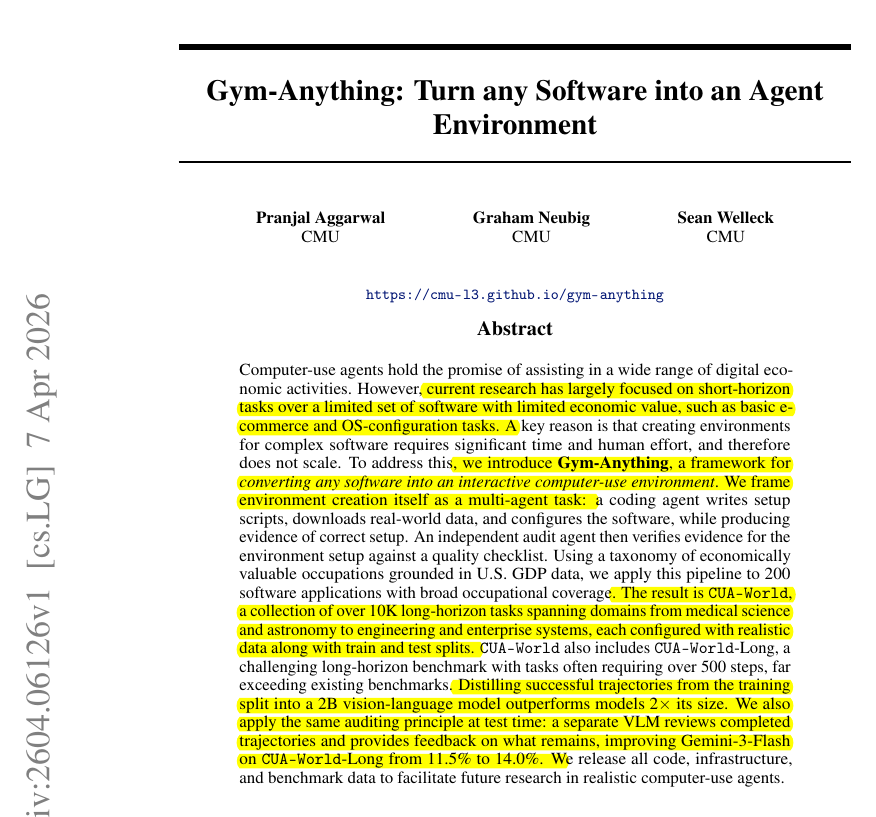
@rohanpaul_ai highlighted (30 likes, 14 replies, 3,699 views, 14 bookmarks) CMU's Gym-Anything work, whose abstract says current agent research focuses too heavily on short-horizon tasks and introduces CUA-World with more than 10,000 long-horizon tasks across 200 applications. The same abstract also says strong models still solve only a small share of the hardest tasks, which turned the post from a benchmark release into a reality check on how far computer-use agents still have to go.
Discussion insight: The common complaint was not that benchmarks are useless. It was that single scalar scores hide why systems fail, while short toy tasks hide how often they fail once software becomes long, messy, and stateful.
Comparison to prior day: On 2026-07-04, evaluation showed up as evidence that open or general-purpose models were improving. On 2026-07-05, the focus shifted to evaluation methodology itself: question-level diagnosis, realistic software environments, and skepticism toward unsupported parity claims.
1.5 AI economics widened from token spend to hardware inputs, compute finance, and local acceleration (🡕)
Cost pressure stayed central, but the surface area widened again. The feed was not only talking about token bills or model pricing; it was also talking about passive components, datacenter financing structures, and local open-source tools that make whole categories of cloud spend look avoidable.
@jukan05 reported (248 likes, 21 replies, 43,947 views, 82 bookmarks) that AI-use MLCC prices had jumped by 3x to 10x, that more than 20 semiconductor companies began raising prices on July 1, and that distributors in Huaqiangbei were seeing quotes change within hours. The post's distinctive angle was that AI cost inflation is not confined to GPUs; it is spreading across the bill of materials that surrounds AI servers.
@InTheAssembly argued (206 likes, 41 replies, 68,920 views, 83 bookmarks) that Nvidia's new revenue-share compute model lets startups and neoclouds expand without first raising giant sums of equity for hardware purchases. The examples in the thread were Sharon AI's planned 40,000 Grace Blackwell GPUs and Firmus's planned 170,000-GPU campus, with replies immediately reframing Nvidia as not only the shovel seller but also a landlord on top of the workloads.
@Faazsh highlighted (22 likes, 10 replies, 591 views, 7 bookmarks) Insanely Fast Whisper as a local open-source CLI that, according to the repo screenshot, can transcribe 150 minutes of audio in about 98 seconds with Whisper Large v3 plus Flash Attention 2 on an A100. That was a smaller post socially, but it made a broader coping pattern visible: local acceleration is increasingly being used to route practical workloads away from paid APIs and cloud dependency.
Discussion insight: The replies kept returning to the same scarcity: compute, capital, and the parts around the compute. Even supportive replies framed the problem as access and utilization, not as an abundance story.
Comparison to prior day: On 2026-07-04, cost pressure was visible in GPU rental curves and token-compression tooling. On 2026-07-05, it spread further down the stack into components and further up the stack into compute financing and local open-source acceleration.
2. What Frustrates People
Benchmark claims still do not tell practitioners what will break
Severity: High. @WhaleInsider posted (431 likes, 110 replies, 52,598 views, 22 bookmarks) a clean headline that Meta's Watermelon matches GPT-5.5 on key benchmarks, but the replies immediately asked the harder questions about rollout, revenue, privacy, and real-world performance. @IntuitMachine argued (24 likes, 4 replies, 1,839 views, 29 bookmarks) that scalar LLM judging is itself part of the problem because it hides which requirement failed, while @rohanpaul_ai pointed (30 likes, 14 replies, 3,699 views, 14 bookmarks) to a benchmark built around 10,000-plus long-horizon tasks precisely because toy tasks do not resemble real work. People cope by decomposing evaluation into smaller checks, using longer-horizon task suites, and refusing to trust parity slogans on their own. This looks worth building for because the pain cuts across model selection, prompt iteration, and agent deployment.
AI infrastructure is getting more expensive before it gets easier
Severity: High. @jukan05 reported (248 likes, 21 replies, 43,947 views, 82 bookmarks) that AI-use MLCC prices jumped by 3x to 10x and that component quotes could move within hours, which is a very different frustration from ordinary token-bill complaints. @InTheAssembly argued (206 likes, 41 replies, 68,920 views, 83 bookmarks) that Nvidia's revenue-share compute program exists because the upfront hardware burden has been choking builders for two years. The workaround pattern is visible in @Faazsh sharing (22 likes, 10 replies, 591 views, 7 bookmarks) a local Whisper CLI that makes cloud transcription spend look optional for some workloads. This is worth building for because users are feeling cost pressure at the component, financing, and workflow layers at once.
Raw assistants still waste too much context unless builders add memory and control layers
Severity: High. @DanKornas shared (1 like, 1 reply, 644 views) GraphMind specifically to stop assistants from rereading and rediscovering the same codebase every session. @AnatoliKopadze said (44 likes, 13 replies, 4,798 views, 52 bookmarks) Anthropic engineers rely on self-improving loops, but the replies immediately translated that into the missing pieces most users still feel: retries, logs, cost control, and approval gates. @karlmehta made (92 likes, 19 replies, 11,615 views, 44 bookmarks) the enterprise version of the same complaint explicit by asking what stands between the model and your data. People are coping by adding knowledge graphs, explicit memories, ontologies, and domain-specific harnesses. This is worth building for because the frustration appears before the model even fails semantically; it appears when the workflow forgets too much.
Physical AI still looks supply-constrained and unevenly deployed
Severity: Medium. @aleabitoreddit shared (516 likes, 126 replies, 87,972 views, 342 bookmarks) a robotics report that named rare-earth exposure, actuator dependency, manufacturing velocity, and regulation as live bottlenecks, while also showing China far ahead of U.S. players on 2025 humanoid shipments. Replies sharpened the practical discomfort: one asked what U.S. robots can do today that matches Unitree's visible capabilities, while another said six well-funded companies may collide in 2027 before the market is even mature. The current coping strategy is to anchor on logistics and warehouse deployments where the economics are already legible. This looks worth building for, but the market is still capital-heavy and contested.
3. What People Wish Existed
Interpretable evaluation stacks that explain failures instead of hiding them
The clearest practical need was not another generic benchmark headline. It was a system that says exactly why an answer or an agent run failed. @IntuitMachine described (24 likes, 4 replies, 1,839 views, 29 bookmarks) BinEval as a way to break evaluation into atomic yes/no questions, and @rohanpaul_ai showed (30 likes, 14 replies, 3,699 views, 14 bookmarks) why that matters by pointing to a 10,000-task benchmark where real software work still defeats strong agents. The Watermelon thread from @WhaleInsider added (431 likes, 110 replies, 52,598 views, 22 bookmarks) the social version of the same request: show the failure modes, not just the parity slogan. Opportunity: direct.
Persistent local memory for coding agents that survives across sessions and projects
People were repeatedly reaching for products that stop assistants from starting over. @DanKornas shared (1 like, 1 reply, 644 views) a repo that turns code into a queryable knowledge graph with persistent memory, while @AnatoliKopadze pointed (44 likes, 13 replies, 4,798 views, 52 bookmarks) to Anthropic's internal use of self-improving loops as the boring but useful reality of agent work. What people seem to want is not mystical memory, but reusable structure, stored decisions, and predictable context transfer. Opportunity: direct.
Safer application layers between strong models and private operational data
The enterprise-side need was stated unusually plainly. @karlmehta argued (92 likes, 19 replies, 11,615 views, 44 bookmarks) that any serious enterprise AI pitch should be judged by what sits between the model and the company's data, not only by which model is underneath it. That makes the missing product less about "best model access" and more about safe, precise routing, memory, and policy enforcement around the model. Opportunity: competitive.
Compute access models that remove giant upfront hardware commitments
The cost conversation showed a more structural wish than cheap tokens alone. @InTheAssembly framed (206 likes, 41 replies, 68,920 views, 83 bookmarks) Nvidia's new revenue-share program as a release valve for builders who do not have a $500 million war chest, while @jukan05 showed (248 likes, 21 replies, 43,947 views, 82 bookmarks) that even the components around the server are inflating. The wish here is for financing, allocation, and routing products that lower the upfront burden of serious AI work. Opportunity: direct.
4. Tools and Methods in Use
| Tool | Category | Sentiment | Strengths | Limitations |
|---|---|---|---|---|
| T3MP3ST | Security agent harness | (+/-) | Self-hosted War Room, reproducible benchmarks, 35 default tools with a larger opt-in arsenal, works with Claude Code/Codex/Hermes/local models | Coordinated swarm path is still experimental and the whole system is limited to authorized security testing |
| GraphMind | Code intelligence / MCP | (+) | Local knowledge graph, persistent memory, cross-project links, large claimed token savings over raw search | Requires indexing and setup, and today's signal is still repo-led rather than mass-adoption-led |
| BinEval | LLM evaluation method | (+) | Breaks quality into atomic yes/no checks, makes failures inspectable, supports prompt and evaluator improvement | Still depends on good question generation and disciplined prompt versioning |
| Gym-Anything / CUA-World | Agent benchmark | (+/-) | Turns arbitrary software into agent environments and tests long-horizon work across 200 applications | The benchmark itself shows current agents still fail many of the hardest realistic tasks |
| Hermes MoA 2.0 | Multi-model orchestration | (+/-) | Parallel GPT/Claude/DeepSeek routing makes the coordination layer explicit | Adds orchestration complexity and likely latency, and gains depend on the aggregator design |
| Palantir ontology / application layer | Enterprise AI harness | (+/-) | Puts a safety and precision layer between the model and business data | Proprietary, deployment-heavy, and not independently benchmarked in the thread |
| Llama distillation | Model deployment method | (+) | Promises cheaper deployment by transferring capability from a giant teacher model to smaller descendants | The economic and quality gap still needs verification outside vendor-aligned examples |
| Insanely Fast Whisper | Local ASR CLI | (+) | Very fast local transcription, diarization, timestamps, and no cloud dependency | Benchmarks are hardware-specific and the optimized path assumes CUDA or Apple Silicon |
The satisfaction spectrum was pragmatic rather than emotional. People liked tools that either made failures explainable or made costs survivable. The recurring migration pattern was to add more structure around the model: explicit eval questions instead of holistic scores, knowledge graphs instead of repeated file search, multi-model councils instead of one monolith, and local acceleration where cloud spend felt wasteful. The competitive dynamic kept moving away from "which model is best" and toward "which layer around the model makes the workflow cheaper, safer, or more inspectable."
5. What People Are Building
| Project | Who built it | What it does | Problem it solves | Stack | Stage | Links |
|---|---|---|---|---|---|---|
| T3MP3ST | @elder_plinius | Turns an existing coding agent into a self-hosted red-team workflow with recon, exploit, and reporting surfaces | Generic coding agents do not come with offensive-security harnesses, tooling, or benchmark discipline | Claude Code/Codex/Hermes/local models, browser War Room, CLI, HTTP API, MCP, nmap, nuclei, semgrep, ffuf | Beta | tweet · repo |
| GraphMind | aouicher via @DanKornas | Turns a codebase into a local knowledge graph that AI assistants can query, navigate, and remember | Coding assistants keep rereading repos and forgetting prior architectural decisions | Rust, tree-sitter, SQLite/FTS5, embeddings, MCP, desktop app, CLI | Beta | tweet · repo |
| Insanely Fast Whisper | Vaibhavs10 via @Faazsh | Runs Whisper transcription locally as a fast CLI with timestamps and diarization | Cloud transcription is slower, billable, and less private than local accelerated inference | Transformers, Optimum, Flash Attention 2, Whisper Large v3, Pyannote diarization, CUDA/MPS | Shipped | tweet · repo |
| Hermes MoA 2.0 | Nous Research via @murtuza_merc | Exposes a virtual model that consults multiple models in parallel and synthesizes the answer | Builders want better reasoning without waiting for one bigger monolithic model | Hermes Agent, GPT, Claude, DeepSeek, aggregator model, multi-provider routing | Beta | tweet · repo |
| Gym-Anything / CUA-World | CMU researchers via @rohanpaul_ai | Converts arbitrary software into agent environments and packages long-horizon evaluation tasks | Existing computer-use benchmarks overrepresent short, clean tasks and underrepresent real software work | Setup agent, audit agent, real-data app configuration, long-horizon task splits | Alpha | tweet · paper |
T3MP3ST and GraphMind were the clearest examples of the day's build pattern: do not ship another generic assistant, ship the missing layer around the assistant. T3MP3ST adds task-specific operators, benchmarking, and tool gating around a coding agent, while GraphMind adds structure and memory so a coding agent stops rediscovering the same repo on every run.
Insanely Fast Whisper made the local-acceleration pattern tangible instead of rhetorical. The repo screenshot backed the headline with a benchmark table, showing that the project is not just packaging Whisper behind a nicer UI; it is selling speed, privacy, and cost control as the product.

The repeated trigger behind these builds was operational pain. Some builders wanted agents that could do security work with real tools, some wanted assistants that stop forgetting architecture, some wanted local inference fast enough to avoid paid APIs, and some wanted evaluation worlds that look more like the software people actually use.
6. New and Notable
Gym-Anything made long-horizon computer-use evaluation much harder to ignore
@rohanpaul_ai highlighted (30 likes, 14 replies, 3,699 views, 14 bookmarks) CMU's Gym-Anything paper as a framework for turning arbitrary software into agent environments. What makes it notable is the scale of the released benchmark shape described in the abstract: CUA-World spans more than 10,000 tasks across 200 applications, and the same abstract says strong models still solve only a small share of the hardest tasks. Public artifact: Gym-Anything paper.
Z.ai's GLM-5.2 entered the open-weight challenger conversation
@the_hindu reported (4 likes, 8,036 views) that Zhipu AI's GLM-5.2 and its companion coding product ZCode are now being discussed as serious challengers to Anthropic on some software-engineering and cybersecurity tasks. The linked article is what made it notable: it says Semgrep tests found GLM-5.2 outperforming Claude Opus 4.8 on some software-engineering tasks, and it frames the launch as another important moment for China's open-weight ecosystem. Public artifact: The Hindu article.
AI governance kept becoming a formal international venue rather than an abstract debate
@MCoeckelbergh noted (7 likes, 177 views) his arrival in Geneva for the Global Dialogue on AI Governance, where the Independent International Scientific Panel on Artificial Intelligence report would be presented. The UN page matters more than the small tweet metrics: it explicitly says the dialogue is the place where every country has a seat at the table on AI governance under the Global Digital Compact. Public artifact: UN Global Dialogue on AI Governance.
7. Where the Opportunities Are
[+++] Agent evaluation and control planes — Evidence ran through sections 1, 2, 3, 4, and 5 together: BinEval's binary checks, Gym-Anything's long-horizon tasks, the Watermelon skepticism, Anthropic-style loops, and DataScienceDojo-style RAG evaluation all point to the same gap. This is strong because people want diagnostics, approvals, and failure localization, not just another leaderboard.
[+++] Persistent local memory and code intelligence for assistants — GraphMind, Anthropic loop talk, and the repeated complaint about assistants restarting from zero all point to a durable need for architecture-aware context layers. This is strong because the pain appears across coding, enterprise deployment, and long-running agent use.
[++] Compute-access, utilization, and cost-observability layers — MLCC inflation, Nvidia's revenue-share compute program, and local tools like Insanely Fast Whisper all show that cost pressure is now structural, not cosmetic. This is a moderate opportunity because the need is obvious, but the solutions span financing, routing, hardware supply, and local acceleration.
[++] Physical-AI deployment software and supplier intelligence — The robotics thread showed a clear split between where robots are being shipped, where they are being deployed, and where critical parts still come from. This is moderate because the evidence is strong, but the market remains capital-heavy and crowded.
[+] Open-weight orchestration and enterprise harness layers — Palantir's application-layer argument, Meta distillation commentary, and Hermes MoA 2.0 all point toward value capture above the base model. This is emerging rather than settled, but the day supplied multiple examples of builders treating that layer as the product.
8. Takeaways
- The layer above the model was discussed more often than the model itself. Palantir's application-layer argument, Hermes MoA 2.0, and Meta distillation commentary all pointed to orchestration, routing, and data control as the place where value is increasingly captured. (source)
- Agent builders are shipping domain-specific operating layers instead of generic copilots. T3MP3ST and GraphMind were the clearest examples: one wraps a coding agent in a red-team workflow, and the other wraps it in structure and memory. (source)
- Physical AI looked like a deployment race with a China shipment lead, not just a humanoid hype cycle. The most useful evidence was the SVRC screenshot set showing both the U.S. champion roster and the shipment gap between Unitree/AgiBot and U.S. humanoid players. (source)
- Evaluation is being treated as a diagnosis problem, not a grading problem. BinEval's yes/no decomposition and Gym-Anything's long-horizon environments both attacked the same failure mode: benchmarks that look clean but explain too little. (source)
- AI cost pressure is spreading into components, financing, and local acceleration. MLCC inflation, Nvidia's revenue-share compute program, and the Insanely Fast Whisper benchmark all showed that builders are now optimizing the whole stack around the model, not just the API call. (source)
- Open-weight challengers and international governance both kept advancing in the background. GLM-5.2's reported progress and the UN Global Dialogue on AI Governance showed that today's AI race is simultaneously technical, commercial, and institutional. (source)