Twitter AI - 2026-07-06
1. What People Are Talking About
1.1 Data coverage and cost-per-solve became the dominant constraint story (🡕)
The clearest strategic shift was away from raw model IQ and toward what it costs to cover real work. People kept tying future progress to proprietary data, cheaper open models, and the ability to run long-lived workloads without exploding API spend.
@willdepue argued (665 likes, 63 replies, 231,470 views, 883 bookmarks) that labs are heading toward more than $100 billion a year of data spend by 2030 and that AI is moving from a compute-limited regime to a data-limited one. His concrete claim was that frontier models now fail most visibly in domains where data is private, scarce, or never digitized, which turns data collection itself into the new bottleneck.
@aiwithsally argued (214 likes, 44 replies, 13,750 views) that the next model race is shifting to cost per task rather than benchmark prestige. The attached chart made that argument legible by placing DeepSeek V4 Pro Max at $0.04 per task, GLM-5.2 Max at $0.37, and GPT-5.5 at $0.88.

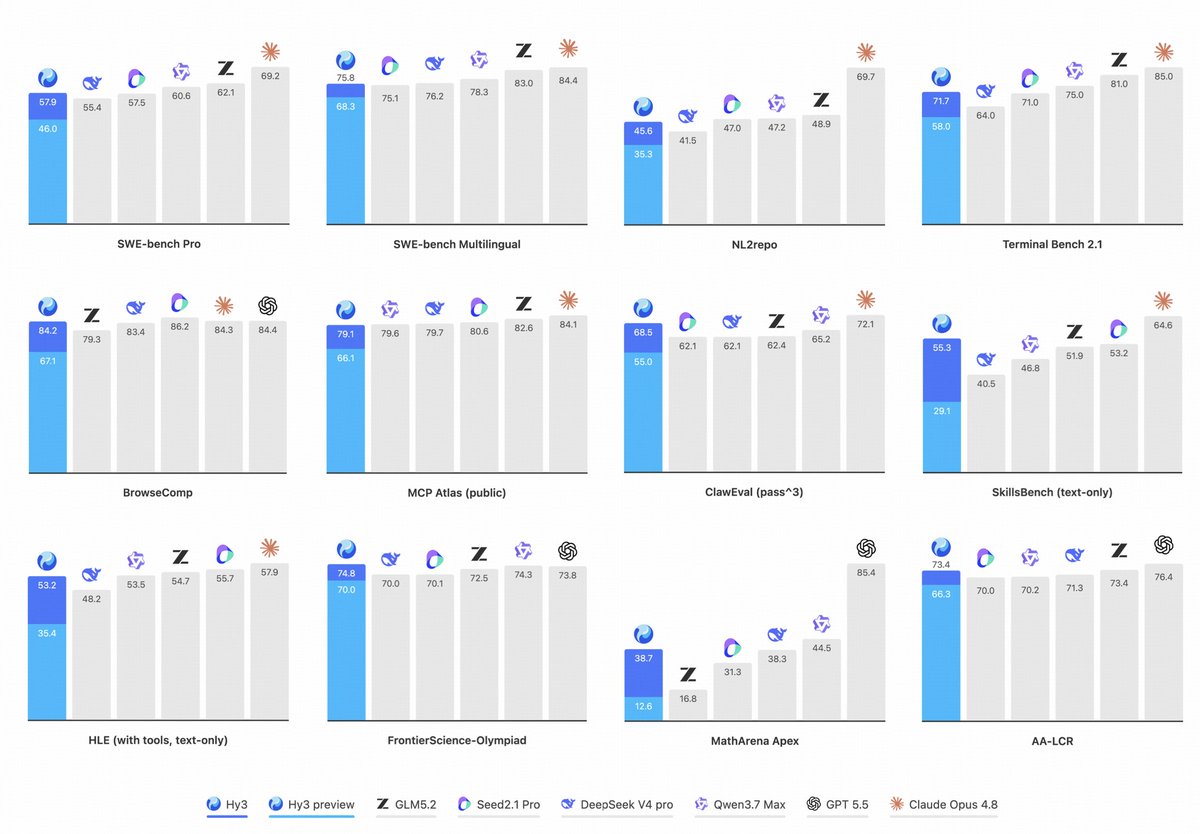
@testingcatalog highlighted (72 likes, 3 replies, 8,229 views, 16 bookmarks) Tencent's Hy3 release as a 295B-parameter MoE whose benchmark edge over GLM-5.1 was strongest in frontend development, CI/CD, and data and storage work. That mattered because the public Hy3 repo frames the model as an open-weight competitor for practical engineering workloads, not just a research curiosity.
@AlexFinn showed (186 likes, 47 replies, 14,787 views, 135 bookmarks) what the local-model version of that economics shift looks like in practice: four models running on six computers around the clock for security scans, code optimization, competitive monitoring, anomaly detection, and idea generation. The distinctive angle was not that local models beat frontier models; it was that always-on background work becomes affordable once the marginal token bill disappears.


Discussion insight: Replies on the cost-per-task thread added the important caveat that cheap list prices can be erased by retries, so people increasingly care about cost per completion, not cost per attempt. Replies to Alex Finn's post pushed the same story toward privacy and owned compute: local models are attractive not only because they are cheap enough to leave running, but because they keep logs, files, and internal context off third-party systems.
Comparison to prior day: On 2026-07-05, economics widened into hardware parts and compute finance. On 2026-07-06, the center of gravity moved further up the stack to proprietary data coverage and cost per completed task.
1.2 Reliability talk moved from generic benchmark skepticism to concrete stateful failure modes (🡕)
The eval conversation got more operational. Instead of arguing abstractly about benchmark quality, posts focused on stale memory, hostile web inputs, harness efficiency, and proxy evaluation for expensive agent benchmarks.
@omarsar0 summarized (26 likes, 9 replies, 3,071 views, 21 bookmarks) the A-TMA paper as a direct answer to "ghost memory": agents confidently repeating facts that stopped being true because old, current, and transitional records all get retrieved together. The useful detail was methodological as much as architectural: the post argued that builders should evaluate the memory bank, retrieval, and answer stage separately instead of trusting final QA accuracy alone.

@rohanpaul_ai warned (9 likes, 2 replies, 1,106 views, 5 bookmarks) that DeepMind's AI Agent Traps work turns the open web itself into the threat model for autonomous agents. His concrete examples were hidden HTML instructions, image steganography, persistent memory poisoning, and cited attack success rates as high as 86% for partial hijacking in benchmark settings.
@mattlam_ introduced (5 likes, 4 replies, 307 views, 4 bookmarks) OpenBench as an attempt to benchmark harnesses, not just models. The first result compared seconds per solve across Pi, Cursor, Codex, and OpenCode on typed coding tasks, which aligned with openbench.dev's broader framing of evaluation as provider-agnostic, reproducible infrastructure.

@gurtej__gill_ highlighted (6 likes, 1 reply, 116 views, 5 bookmarks) the PACE paper, whose proxy benchmark reportedly predicts full agentic benchmark performance with under 4% MAE and roughly 85% ranking accuracy at about 100x lower cost. That made evaluation cost itself part of the product problem.
Discussion insight: Replies named the pain more precisely than the headlines did: stale-context poisoning, agents treating page content as instructions, and teams needing cheaper filters before they pay to run full end-to-end benchmarks.
Comparison to prior day: On 2026-07-05, the feed mostly argued that single scalar scores hide failure causes. On 2026-07-06, it got more concrete about where those failures live: memory, environment, harness, and eval budget.
1.3 Physical AI stayed grounded in shipments, deployment counts, and supplier bottlenecks (🡒)
This was a narrower cluster than the software and eval conversation, but the evidence was unusually concrete. The strongest post was not a robot demo; it was a bundle of shipment, deployment, and supply-chain tables.
@aleabitoreddit shared (964 likes, 155 replies, 193,580 views, 650 bookmarks) screenshots from SVRC Research's State of Robotics 2026 report arguing that the United States leads where robotics is heading but is losing where it is shipping today. The screenshots made that thesis concrete by pairing a U.S. champion roster with explicit bottlenecks around rare earths, actuators, manufacturing velocity, and regulation.

The same thread also showed where deployments are already real: more than 780,000 units in logistics and e-commerce, around 85,000 in automotive manufacturing, and smaller but faster-growing bases in agriculture, food service, and healthcare or lab support. That turned the thread from a humanoid race narrative into a vertical-by-vertical deployment map.

Discussion insight: Replies pushed the thread toward operational reality by pointing to Amazon's 1 million-plus robots and warning that actuator dependency can still choke U.S. leaders even if they win the model race.
Comparison to prior day: This theme stayed consistent with 2026-07-05, but the new emphasis was less about humanoid excitement and more about where robots are already deployed and what components still bottleneck scale.
1.4 Builders kept responding with local-first, specialized, and auditable tools (🡕)
The builder signal was not another generic assistant. Projects that earned attention were specialized, local, or unusually transparent about evidence and failure modes.
@VivekIntel shared (10 likes, 525 views, 5 bookmarks) T3MP3ST as an open-source offensive-security harness around existing coding agents. The public repo makes the pitch unusually testable by emphasizing self-hosted operation, a status table for live versus roadmap features, and benchmark claims that can be recomputed.

@doodlestein shared (9 likes, 1 reply, 941 views, 10 bookmarks) FrankenOCR, whose repo describes a pure-Rust, CPU-only OCR engine that runs offline without Python, CUDA, or a GPU. That made it a clean example of the day's local-first coping pattern: route a practical workload away from paid APIs and heavyweight ML stacks.

@DanKornas shared (1 like, 2 replies, 784 views, 3 bookmarks) Meetily, a privacy-first meeting assistant whose repo says recordings, transcripts, and transcription models stay on-device while summaries can run through local or user-chosen providers.

@DanKornas also shared (4 likes, 2 replies, 1,200 views, 6 bookmarks) ai-memory-comparison as a source-backed matrix of 79 memory systems across 79 features. The underlying project site is less a flashy product than an audit surface, which fit the day's broader preference for explicit evidence over vague agent-memory claims.

Discussion insight: Even bullish builders kept converging on the same trust surfaces: local processing, explicit memory, reproducible claims, or evidence files people can audit.
Comparison to prior day: On 2026-07-05, builders mostly chased orchestration and context layers above the model. On 2026-07-06, they leaned harder into privacy, specialized operating surfaces, and verification.
2. What Frustrates People
Private-domain data is still the hard wall
Severity: High. @willdepue argued (665 likes, 63 replies, 231,470 views, 883 bookmarks) that the main blocker between current methods and broader economic automation is not more compute alone but missing coverage of private workflows, tacit knowledge, and non-digitized domains. A reply that singled out healthcare data as a bottleneck drew explicit agreement from him, and @Ivywen_W noted (15 likes, 2 replies, 184 views) that the Global Dialogue on AI Governance also raised non-discriminatory access to training data. People are coping with licensing, expert labeling, and domain-specific collection, but the frustration remains severe because the missing data is precisely the part that cannot be scraped for free. This looks worth building for because the complaint sits underneath model performance, not on top of it.
Strong models still break once memory, environment, or workflow state gets messy
Severity: High. @omarsar0 described (26 likes, 9 replies, 3,071 views, 21 bookmarks) long-running agents repeating facts that stopped being true, while @rohanpaul_ai pointed (9 likes, 2 replies, 1,106 views, 5 bookmarks) to hidden web content, memory poisoning, and cross-agent hijacking as a separate class of failure. @rohanpaul_ai made (2 likes, 2 replies, 1,743 views) the same complaint in healthcare form: a model can look brilliant on a normal benchmark prompt and then collapse when inputs are perturbed or partially removed. The workaround pattern is consistent: decompose evaluation into stages, treat the web as untrusted input, and add cheaper proxy screens like PACE before running expensive end-to-end tests. This is worth building for because the pain shows up across agents, enterprise evals, and high-stakes domains.
Frontier-model economics are still painful in routine use
Severity: High. @aiwithsally framed (214 likes, 44 replies, 13,750 views) the issue as pure deployment economics, with replies immediately pushing from per-task price to per-completion cost once retries are counted. @AlexFinn responded (186 likes, 47 replies, 14,787 views, 135 bookmarks) by running local models continuously across six computers, explicitly because doing the same background work with cloud frontier models would cost thousands per month. Even a small post from @kathrynwu1 sharpened (2 likes, 1 reply, 397 views, 1 bookmark) the practitioner complaint: hitting product limits after a few minutes of non-coding work makes a strong benchmark leader feel bad in practice. People cope by routing persistent work to local models and by watching cheaper open challengers such as Hy3 and GLM-5.2, which makes this a direct product opportunity rather than a temporary annoyance.
Physical AI is blocked by components and deployment realities, not just software
Severity: Medium. @aleabitoreddit surfaced (964 likes, 155 replies, 193,580 views, 650 bookmarks) rare-earth exposure, actuator dependency, and manufacturing velocity as live bottlenecks at the same time that the thread showed China far ahead on current humanoid shipments. Replies pointed to Amazon's installed robot base as the kind of deployment context that actually matters, which is a useful contrast to demo-driven hype. The current coping strategy is to focus on logistics and automotive deployments where the economics are already visible. This is worth building for, but it remains a capital-heavy and supply-chain-sensitive problem.
3. What People Wish Existed
Better data-acquisition and licensing rails
The strongest unmet need was a way to turn missing private-domain knowledge into trainable or evaluable assets without waiting for a new algorithmic breakthrough. @willdepue effectively asked (665 likes, 63 replies, 231,470 views, 883 bookmarks) for a "Stargate for data," while @Ivywen_W surfaced (15 likes, 2 replies, 184 views) the governance version of the same request through access-to-data and local-context language. This is a practical need, not an aspirational one: people want collection, licensing, redaction, and rights-management infrastructure that can unlock domains where current models still underperform. Opportunity: direct.
Memory systems that know when facts have changed
People were not asking for vague "better memory." They were asking for memory that distinguishes current facts from superseded ones and makes failure diagnosis visible. @omarsar0 made (26 likes, 9 replies, 3,071 views, 21 bookmarks) the need explicit with ghost memory, and @DanKornas indirectly showed (4 likes, 2 replies, 1,200 views, 6 bookmarks) the same demand by promoting a source-backed matrix of 79 memory systems because picking one is still too opaque. Some solutions exist, but today's evidence suggests they are still too hard to compare, audit, and trust. Opportunity: direct.
Cheap proxy evaluation and harness comparison for real agent work
The feed repeatedly asked for evaluation loops that are fast enough to guide development and specific enough to explain failure. @gurtej__gill_ framed (6 likes, 1 reply, 116 views, 5 bookmarks) PACE as a way to predict expensive agent benchmarks at roughly 100x lower cost, while @mattlam_ asked (5 likes, 4 replies, 307 views, 4 bookmarks) for harness comparisons instead of more model-only scoreboards. This is an urgent practical need because teams are already paying real money for evals that still do not tell them whether the failure came from the model, the harness, the memory layer, or the environment. Opportunity: direct.
Private, always-on local AI workspaces
A second clear need was for AI that can run continuously without sending sensitive work to the cloud or turning every background task into an API bill. @AlexFinn described (186 likes, 47 replies, 14,787 views, 135 bookmarks) the workload pattern, while projects like Meetily, FrankenOCR, and FreeLattice show that builders are already shipping partial answers. The need is both practical and emotional: users want lower cost, better privacy, and a stronger sense of ownership over how AI runs around their work. Opportunity: competitive.
4. Tools and Methods in Use
| Tool | Category | Sentiment | Strengths | Limitations |
|---|---|---|---|---|
| Hy3 | LLM | (+) | Open-weight 295B MoE; strongest cited gains were in frontend development, CI/CD, and data/storage work | Discussion today stayed benchmark-heavy rather than production-heavy |
| GLM-5.2 | LLM | (+) | Low-cost open-weight alternative; long-context positioning made it part of the cost-per-task discussion | Thin direct practitioner evidence in today's feed |
| Local model fleets | Deployment pattern | (+/-) | Cheap enough for always-on background work; strong privacy and control story | Slower and weaker than frontier cloud models; requires owned hardware |
| A-TMA | Agent memory | (+) | Separates stale, current, and transitional evidence; makes memory failure modes more diagnosable | Still a research-stage overlay rather than a standard product |
| OpenBench | Eval harness | (+) | Compares harness efficiency and seconds-per-solve, not just raw model scores | Early first iteration with limited public results so far |
| PACE / PACE-Bench | Proxy eval | (+) | Makes agentic model triage dramatically cheaper before full benchmark runs | Proxy benchmarks cannot replace final end-to-end validation |
| FrankenOCR | Local OCR | (+) | CPU-only, offline, static binary; avoids Python/CUDA/GPU overhead | Narrowly scoped to OCR and adjacent document tasks |
| T3MP3ST | Security harness | (+) | Reproducible red-team workflow around existing coding agents; self-hosted and keyless options | Specialized for authorized offensive-security use cases |
The overall satisfaction spectrum was pragmatic rather than euphoric. @testingcatalog treated (72 likes, 3 replies, 8,229 views, 16 bookmarks) Hy3 positively, and @KanikaBK did the same (6 likes, 2 replies, 433 views, 3 bookmarks) for GLM-5.2, because both looked deployable at better economics rather than because people suddenly stopped caring about model quality.
The clearest migration pattern was workload splitting. @AlexFinn showed (186 likes, 47 replies, 14,787 views, 135 bookmarks) that he still kept frontier cloud models in the loop for top-end work, but moved persistent background tasks to local models. @doodlestein showed (9 likes, 1 reply, 941 views, 10 bookmarks) and @VivekIntel showed (10 likes, 525 views, 5 bookmarks) the same instinct in software form: ship narrower local or self-hosted tools that remove an entire class of cloud dependency rather than trying to replace every frontier model call.
5. What People Are Building
| Project | Who built it | What it does | Problem it solves | Stack | Stage | Links |
|---|---|---|---|---|---|---|
| T3MP3ST | elder-plinius | Multi-agent red-teaming framework around existing coding assistants | Gives security teams a reproducible, self-hosted AI testing surface instead of ad hoc prompting | TypeScript, MCP, HTTP API, Claude/Codex/Ollama integrations | Beta | tweet, repo |
| FrankenOCR | Dicklesworthstone | CPU-only OCR CLI and library | Lets OCR run offline on laptops, CI runners, and edge boxes without Python/CUDA or GPUs | Rust, static binary, quantized VLM kernels | Shipped | tweet, repo |
| FreeLattice | Chaos2Cured | Local-first browser AI platform in a single HTML file | Keeps chat, memory, and creative workflows on-device with no backend | HTML/JS, browser runtime, Ollama/WebRTC options | Beta | tweet, repo |
| Meetily | Zackriya Solutions | Local meeting transcription and summary desktop app | Removes privacy and compliance risk from cloud meeting assistants | Tauri, Rust, Next.js, Whisper/Parakeet, Ollama/Claude/Groq/OpenRouter | Shipped | tweet, repo |
| ai-memory-comparison | carsteneu | Source-backed comparison table for coding-agent memory systems | Saves builders from manually auditing dozens of memory repos | Static site, evidence files, GitHub Actions | Shipped | tweet, repo |
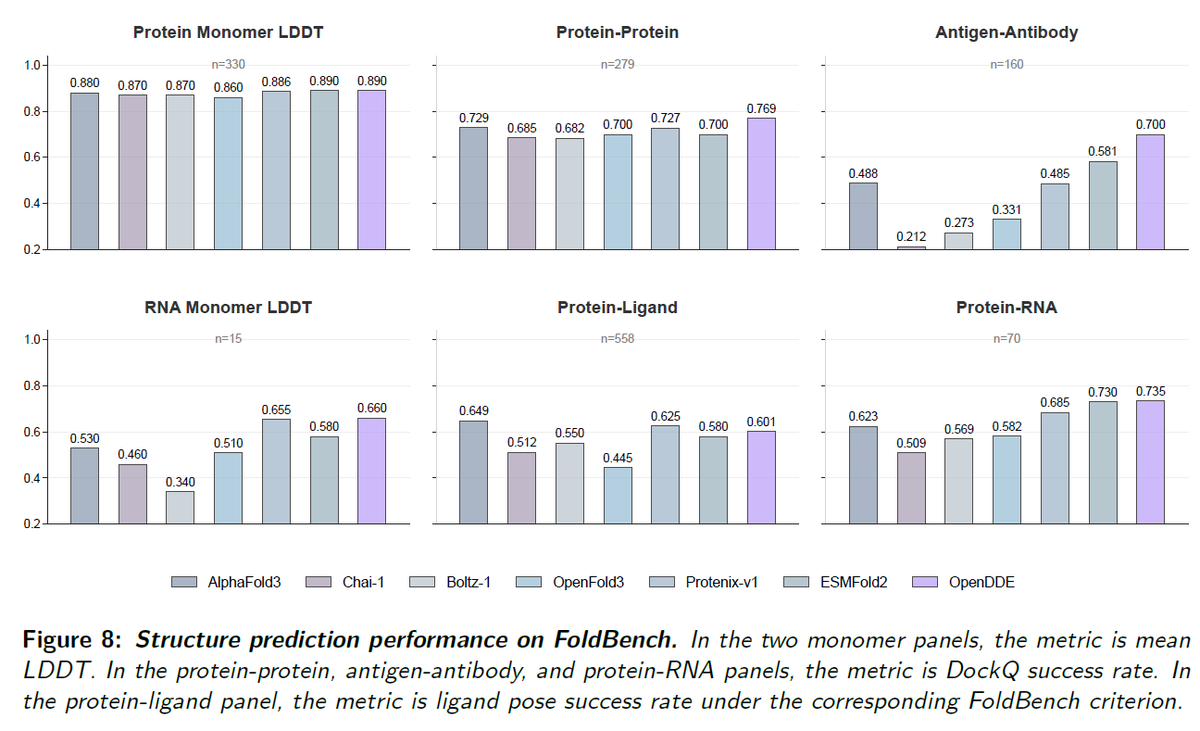
| OpenDDE-preview | Aureka Research | Open-source all-atom co-folding model for drug discovery | Makes AlphaFold-like biomolecular modeling more inspectable and hackable | Python, PyTorch, released checkpoints, Docker | Alpha | tweet, repo |
| OKX.AI | OKX | Agent marketplace with onchain settlement | Gives agents a place to find work, hire services, and get paid | Web app, onchain payments, agent identity and escrow | Shipped | tweet, site |
@VivekIntel shared (10 likes, 525 views, 5 bookmarks) T3MP3ST as a red-team operating surface rather than a chatbot feature. What distinguishes it is not just the attack tooling; it is the insistence that benchmark claims be re-derived from committed data, which matches the day's broader demand for auditable evaluation.
@doodlestein shared (9 likes, 1 reply, 941 views, 10 bookmarks), @DanKornas shared (1 like, 2 replies, 784 views, 3 bookmarks), and @BitmanTW shared (19 likes, 7 replies, 2,822 views, 5 bookmarks) all converged on the same build pattern from different angles: keep the data local, keep the interface simple, and make practical workloads cheap enough to run continuously. That is a stronger pattern than any one repo because it connects OCR, meeting intelligence, and browser-native AI under the same privacy-first economic logic.
@miangoar highlighted (29 likes, 1 reply, 1,414 views, 17 bookmarks) OpenDDE-preview as an open-source "AlphaFold 4"-like co-folding release, and the public OpenDDE repo explicitly labels it a preview for structure prediction, design, and optimization rather than a production pipeline. That makes it an unusually concrete open-science builder signal: a real repo, real weights, and a declared maturity boundary.
@okx announced (46 likes, 21 replies, 27,979 views) OKX.AI as a live marketplace where agents discover work, hire services, and settle payments onchain. Whether or not that pattern becomes durable, it was one of the day's clearest examples of builders testing agent labor-market and payment-rail ideas rather than just better copilots.
6. New and Notable
Governance language caught up with the feed's openness and local-context concerns
@Ivywen_W reported (15 likes, 2 replies, 184 views) notes from Day 1 of the Global Dialogue on Artificial Intelligence Governance that echoed several themes already visible elsewhere in the feed: open models and open standards as a way to reduce dependency and cost, non-discriminatory access to training data, and the claim that AI benefit depends on local context from design through evaluation. What made the post notable was not scale but convergence: the institutional governance language was starting to sound much closer to practitioner complaints about access, privacy, and control.


Health-AI benchmark wins were explicitly separated from clinical readiness
@rohanpaul_ai summarized (2 likes, 2 replies, 1,743 views) a Nature Medicine study as a warning that frontier models can look medically strong on ordinary tests while remaining brittle under stress tests, missing inputs, or altered image-text setups. The important signal was the framing itself: benchmark success was presented as evidence of capability, but not as evidence of readiness for live clinical use.

Agent marketplaces crossed from idea into live product language
@okx announced (46 likes, 21 replies, 27,979 views) OKX.AI as a live marketplace where agents can discover work, hire each other, and settle payments onchain, and the site describes it as an A2A agent economy. Even if today's evidence does not show sustained demand yet, it was a real product launch around agent coordination and payment rails rather than another conceptual thread about what agents might do someday.
7. Where the Opportunities Are
[+++] Domain-data acquisition and rights infrastructure — The most strategic bottleneck in today's feed was missing private-domain coverage, not lack of model ambition. The evidence came from @willdepue's thread and the governance-side data-access discussion in @Ivywen_W's notes: whoever makes licensing, redaction, provenance, and expert-data generation easier stands directly in the path of model deployment.
[+++] Stateful agent memory, verification, and environment safety — Ghost memory, hostile web inputs, and brittle medical stress tests all pointed at the same gap: agents still need better state handling and clearer runtime trust boundaries. The evidence spans @omarsar0's A-TMA post, @rohanpaul_ai's AI Agent Traps thread, and his Nature Medicine summary, which makes this stronger than a single-paper curiosity.
[++] Cheaper eval loops and model-routing infrastructure — PACE, OpenBench, cost-per-task charts, and Hy3-style challenger releases all point to the same operating question: what is the cheapest reliable path to a solved task? There is room for products that combine proxy evals, harness benchmarks, and routing by cost, latency, and completion quality rather than by brand alone.
[++] Local-first background AI for real work — Alex Finn's six-computer setup, Meetily, FrankenOCR, and FreeLattice all show demand for AI that can run continuously under user control. This is a competitive opportunity because some solutions already exist, but the pattern is broad enough that better packaging, easier setup, and stronger local model management could still win.
[+] Physical-AI deployment tooling and supply-chain intelligence — The robotics evidence was narrower than the software discussion, but it was concrete about where pain lives: actuators, rare earths, manufacturing velocity, and deployment verticals. The opportunity is emerging rather than immediate because the market is real, but capital intensity and hardware dependencies still slow software-style iteration.
8. Takeaways
- The AI bottleneck was framed as data coverage, not just compute. The day's highest-signal thread argued that frontier progress is becoming rate-limited by access to private and domain-specific data rather than by cluster size alone. (source)
- Deployment economics are being judged at the task level. Cost-per-task comparisons, open-weight challengers such as Hy3, and local-model fleets all pointed to the same operating question: what solves the work cheaply enough to stay on? (source)
- Reliability discourse got much more concrete. The most useful posts were about ghost memory, hostile web inputs, harness efficiency, and proxy evaluation, which is a sign that teams are now diagnosing where agents fail instead of only arguing about whether they are good. (source)
- Local-first tooling is the preferred coping pattern for cost and privacy pressure. FrankenOCR, Meetily, FreeLattice, and local model fleets all made the same bet: keep the workload close to the user and remove recurring cloud dependence where possible. (source)
- Physical AI remained real, but in a harder-nosed way than software AI. The strongest robotics evidence came from shipment gaps, deployment tables, and component bottlenecks rather than from demos, which keeps the market legible but still constrained. (source)
- Institutional governance language is converging with practitioner concerns about openness, access, and safeguards. The Global Dialogue notes and the clinical-readiness warning both showed public discussion moving beyond benchmark celebration toward who can use AI safely and under what conditions. (source)