Twitter AI - 2026-07-10
1. What People Are Talking About
1.1 GPT-5.6 was judged on routing, rework, and task fit more than on launch-day hype (🡕)
The strongest cluster was not a simple “best model wins” argument. It was a much more operational discussion about when to use Sol versus Terra or Luna, whether GPT-5.6 actually saves rework on long tasks, and how much quality teams still give up when they optimize for speed and cost. At least seven retained items supported this theme across power-user anecdotes, secondary AMA notes, benchmark charts, and out-of-distribution work tests.
@theo said (593 likes, 34 replies, 31,081 views) that he burned more than $200,000 in GPT-5.6 Sol tokens over the past month and wanted to show what he actually built rather than react to benchmarks. The replies mattered almost as much as the post: skeptics attacked the framing, while supporters argued that the real test is what a model helps people ship after sustained use.
@btibor91 summarized (141 likes, 12 replies, 11,575 views) the OpenAI Codex AMA as a routing guide: Sol Medium for most work, Sol Ultra for expensive-to-be-wrong tasks, Terra for cheaper non-coding or lighter work, and Luna for subagents. The same summary also claimed Codex has more than 5 million weekly users and highlighted that there is still no true “Auto” model, which is exactly the friction point many replies focused on.
@bindureddy posted (61 likes, 17 replies, 3,262 views) her own use-case matrix — Fable for the master agent, Grok 4.5 and GPT-5.6 Sol for subagents, Terra for chat, and GLM 5.2 for open-source — and a reply immediately asked for a CLI that would switch automatically so builders could stay focused on shipping. That turned model selection itself into a product gap.
@LearnInvest2026 reported (1 like, 2 replies, 179 views) that a 12-hour GPT-5.6 Sol test felt smoother than GPT-5.5 because Sol spent more effort aligning early and then required less repair later. The attached screenshots made the economics more concrete by showing 84% of the five-hour cap and 66% of the weekly cap still remaining, plus a separate cache-hit chart from Claude Code showing how much long-running agent work depends on repeated context reuse.

@sayashk tested (8 likes, 240 views) whether frontier agents can convert hand-drawn architectural sketches into CAD floor plans and found GPT-5.6 Sol Ultra clearly ahead of older models, while also noting that the worst failure mode was silently changing the plan. That mattered because it was not another software benchmark; it was a messy, domain-specific visual-reasoning task with a human expert grading the output.

@QCXINT_ argued (5 likes, 2 replies, 279 views) that GPT-5.6 changed the frontier race into “intelligence per dollar,” and the attached charts made that claim specific by plotting BrowseComp latency, Terminal-Bench 2.1 cost, and Agents' Last Exam cost across the Sol, Terra, and Luna lineup. @sergeykarayev added (8 likes, 1 reply, 530 views) the most useful counterweight: on Superconductor's private Ruby on Rails benchmark, GPT-5.6 variants dominated the speed and cost frontier, but Fable 5 still won clearly on quality.

Discussion insight: Replies across the AMA summary and routing threads kept converging on the same complaint: OpenAI still expects users to be model and reasoning routers. The most specific criticism came in replies to btibor91, where posters called the naming scheme confusing and questioned platform support, while Bindu's thread produced an explicit ask for an automatic routing layer in the terminal.
Comparison to prior day: On 2026-07-09, people were still debating work-layer agents in the abstract. On 2026-07-10, the conversation moved into concrete operating rules: model ladders, cost classes, cache behavior, real task evals, and silent-failure edge cases.
1.2 Cheaper models widened the competitive field, but browser-use and quality gaps stayed visible (🡕)
Price pressure broadened beyond the usual open-versus-closed argument. Today's stronger framing was that Meta, Tencent, DeepSeek, and other lower-cost options are changing how people buy models, but those lower prices only matter if the systems still hold up on real work. At least six retained items supported this theme across pricing posts, enterprise-adoption claims, and negative browser-use tests.
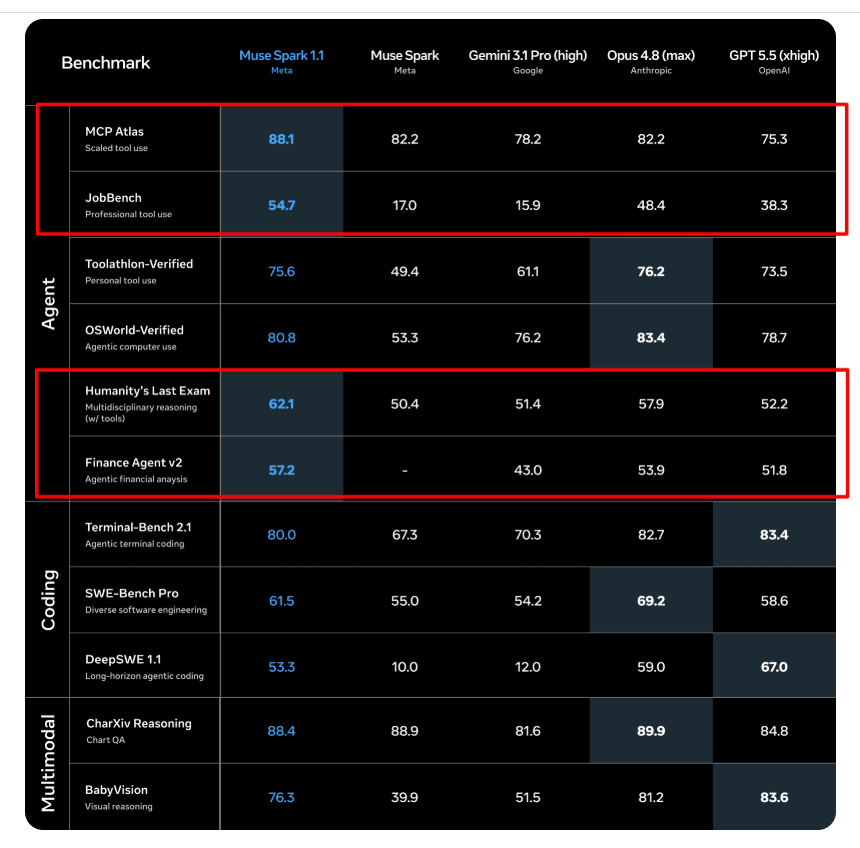
@rohanpaul_ai said (6 likes, 3 replies, 1,873 views) that Muse Spark 1.1's $1.25 per million input and $4.25 per million output tokens put direct pressure on OpenAI and Anthropic in agentic coding, especially on the benchmarks where agents actually spend money. The attached comparison table highlighted exactly the benchmarks he thought mattered most: MCP Atlas and JobBench.
@kimmonismus recommended (32 likes, 10 replies, 5,498 views) Tencent's Hy3 as a 295B MoE with only 21B active parameters, a 256K context window, an Apache 2.0 license, and OpenRouter pricing of $0.14 input and $0.58 output per million tokens. Replies sharpened the tradeoff: one user cited heavy real-world agent traffic and low tool-call error rates, while others said the model still felt weaker than DeepSeek V4 Pro on context or multimodality.
@unusual_whales reported (147 likes, 51 replies, 64,648 views) that Amazon's CTO said companies are moving toward cheaper open-source models to control spend. @AiTechHubs extended (2 likes, 2 replies, 102 views) that claim with a more concrete migration story: token share from Chinese models among US businesses rising from roughly 4% in early 2025 to 30% in February and 46% at peak, DeepSeek V4 Flash priced at $0.18 per million tokens versus Claude Opus 4.7 at $25, and Lindy reportedly switching note-generation workloads to DeepSeek for identical performance at much lower cost.
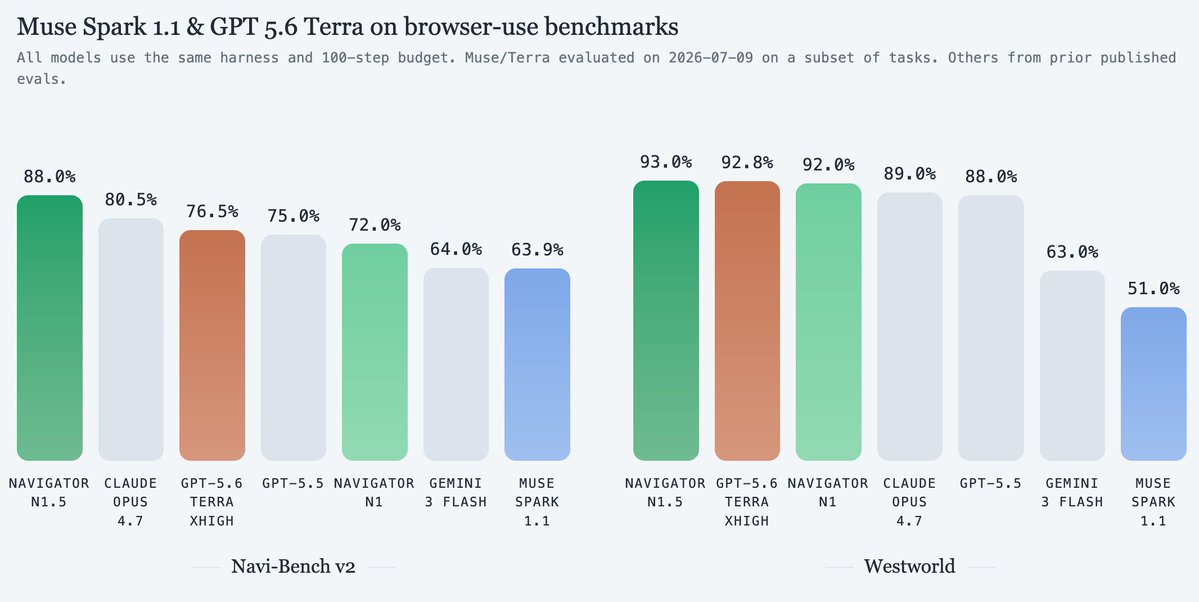
@DhruvBatra_ supplied (3 likes, 183 views) the most useful cautionary result. On yutori.ai's browser-use benchmarks, he found GPT-5.6 Terra solid and token-efficient, while Muse Spark 1.1 got stuck in loops, refused checkout scenarios for safety reasons, and ran into 100-step limits.
@Daniel_Farinax claimed (128 likes, 15 replies, 4,573 views) that Grok 4.5 had already become his daily driver because of its speed, to the point that he was comfortable canceling Claude Max. But even in a favorable thread, replies still called out the weaker UI and less generous usage limits, which fits the broader pattern: buyers are rewarding price and speed, but they still notice workflow rough edges immediately.
Discussion insight: The most consistent pro-cheap-model argument was not ideology. It was economics. Replies in the Hy3 and open-source migration threads repeatedly reduced the decision to price-performance, with one poster summarizing the pattern as US labs shipping the ceiling and Chinese labs shipping close to the ceiling at a fraction of the price. The strongest pushback came from browser-use results and from practitioners who still preferred higher-quality models for hard tasks.
Comparison to prior day: On 2026-07-09, open-model talk centered on ownership and provider escape hatches. On 2026-07-10, it became a more direct procurement debate about per-token pricing, benchmark efficiency, and whether cheaper systems can survive real browser-use or coding workloads.
1.3 Evaluation and trust moved closer to the product surface (🡕)
The day's third strong cluster was about what it takes to trust agent outputs at all. That ranged from open-ended creativity research, to explicit hiring for frontier-eval work, to accusations that a published economics paper had been written by a language model. At least five retained items supported this trust-and-evaluation theme.
@SakanaAILabs published (248 likes, 18 replies, 35,248 views) its AI Picbreeder experiment, which recreated collaborative image evolution with VLM agents. The linked blog made the result more specific: human Picbreeder archives still outperform VLM-only runs, diverse agent personalities narrow the gap, zero memory causes repetitive selection, and too much memory degrades performance through context overload.
@sayashk posted (28 likes, 2 replies, 4,543 views) that CRUX is hiring a senior researcher for open-ended frontier-AI evaluations, and the screenshot added the details that made it notable as a labor-market signal: remote role, $150,000 to $220,000 salary band, and a mandate to evaluate long-horizon tasks that cannot be neatly auto-graded. That is a stronger sign of evaluation maturing into an operational function than a generic “we care about safety” statement.
@JesusFerna7026 argued (614 likes, 19 replies, 90,100 views) that an economics paper by Javier Milei and Demian Reidel looked LLM-written, and his four attached screenshots made the accusation concrete by showing Pangram returning 100% AI-generation probability on sampled passages and, in a follow-up, on the whole paper.

@N0V4Dev shared (2 likes, 1 reply, 13 views) OpenDataLoader PDF as document infrastructure for RAG and accessibility work. The linked repo is more substantial than the tweet alone suggests: it currently shows 26,964 GitHub stars, converts PDFs to Markdown or JSON with bounding boxes, supports Python, Node.js, and Java, and claims 0.907 extraction accuracy with local-mode throughput around 0.015 seconds per page. @mattlam_ added (3 likes, 1 reply, 177 views) a related trust lesson from open-model agent testing: some systems reached the right answer and then kept exploring until they turned a pass into a failure.
Discussion insight: Replies to Sakana's post said the hard part is not producing novelty but recognizing which accidents are worth pursuing. Replies to JesusFerna7026 asked whether the issue was prose quality or the underlying model itself. Together they point to the same trust problem from different directions: evaluation is increasingly about judgment under ambiguity, not just binary correctness.
Comparison to prior day: On 2026-07-09, trust debates focused on missing benchmark disclosures and private evals. On 2026-07-10, the trust conversation widened into research authorship, long-horizon evaluation hiring, and data-pipeline quality for production systems.
2. What Frustrates People
Manual model routing is still a product tax
Severity: High. @btibor91 summarized (141 likes, 12 replies, 11,575 views) an OpenAI position where users still need to think in terms of Sol, Terra, Luna, and reasoning levels because there is no true Auto mode. @bindureddy reinforced (61 likes, 17 replies, 3,262 views) the same reality with her own per-use-case routing map, and one reply asked bluntly for a CLI that would switch models automatically. The coping pattern today is to maintain personal routing heuristics, but the repeated complaint is that this is focus-breaking overhead rather than product value. This looks worth building for because the demand is explicit and tied to daily work.
Cheap models still break in the exact workflows buyers care about
Severity: High. @sayashk showed (8 likes, 240 views) that even GPT-5.6 Sol Ultra's strongest result on hand-drawn floor plans still included small errors, and that the worst failure mode was silently changing the plan. @DhruvBatra_ reported (3 likes, 183 views) that Muse Spark 1.1 loops on browser tasks, refuses checkout flows, and hits step ceilings. @sergeykarayev added (8 likes, 1 reply, 530 views) that GPT-5.6 can still emit invalid code and trails Fable 5 on taste in his private benchmark. The workaround is human review plus narrower task choice, but the gap is still large enough that users notice immediately.
Trust in AI-generated research and evidence is fragile
Severity: High. @JesusFerna7026 argued (614 likes, 19 replies, 90,100 views) that a policy paper looked LLM-written and backed that with four Pangram screenshots returning 100% AI-generation probability on sampled passages. @mattlam_ reported (3 likes, 1 reply, 177 views) a different but related failure mode in agent evaluation: some models solved the task and then kept going until they made themselves wrong. @N0V4Dev shared (2 likes, 1 reply, 13 views) a PDF parser precisely because bad document extraction corrupts RAG and evaluation pipelines before the model even answers. This is worth building for because provenance, stopping rules, and source quality are becoming part of the product, not just part of QA.
Physical AI is still blocked by batteries, data, and actuation economics
Severity: High. @pequityresearch said (85 likes, 4 replies, 10,929 views) that commercialization is moving forward, but data scarcity, skilled-labor shortages, battery life, edge-compute constraints, and deployment cost still dominate. The same thread said many systems operate closer to four hours than eight and that actuation accounts for roughly half of total system cost.
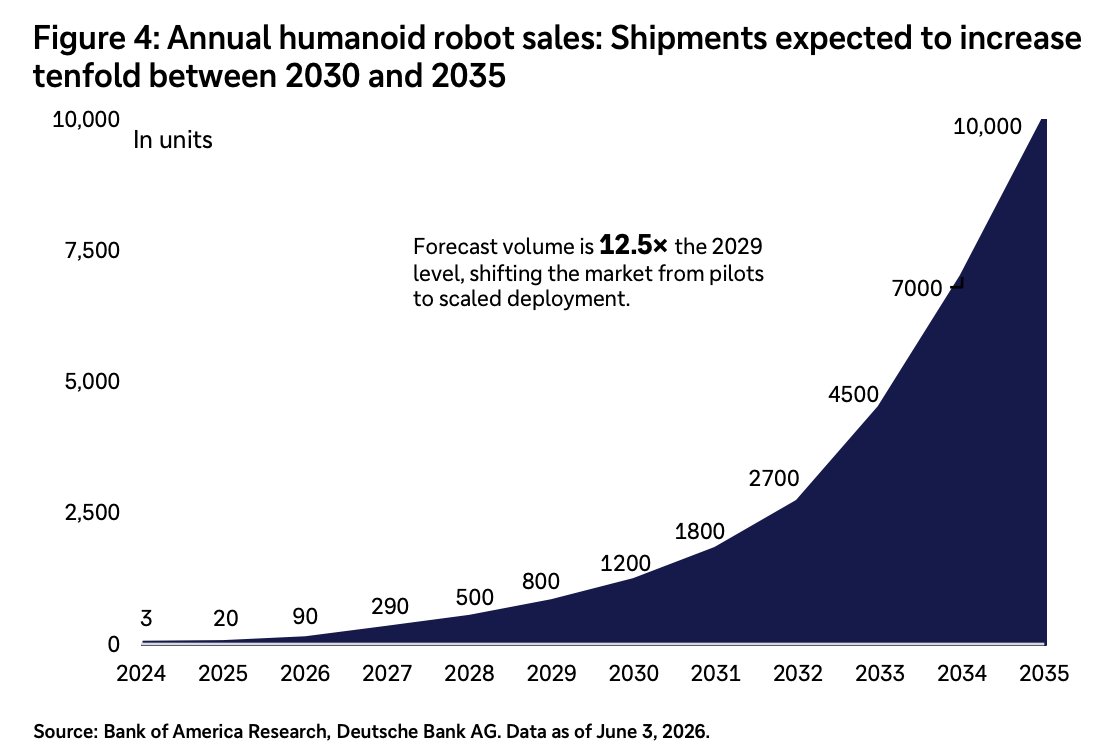
Current coping strategies are narrow: task-specific systems, RaaS deployment, and upstream component bets instead of assuming general-purpose humanoids are ready. This looks worth building for because the gating problems are concrete and repeated.
3. What People Wish Existed
Automatic task-aware routing
The clearest unmet need was not a better benchmark score. It was a system that chooses the right model, effort level, and price band without forcing the operator to think about it. @btibor91 summarized (141 likes, 12 replies, 11,575 views) that there is still no Auto mode, and replies in @bindureddy's thread (61 likes, 17 replies, 3,262 views) asked for a CLI that handles switching automatically. Opportunity: direct.
Real AI products that ordinary end users actually use
@thdxr asked (145 likes, 50 replies, 24,425 views) for the best AI-startup products in San Francisco that end users genuinely use, then clarified he meant products with more than 5 million MAUs. Replies struggled to name even dev-focused examples, which is a stronger signal than a generic “consumer AI is hard” opinion. Opportunity: competitive.
Better evaluation infrastructure for long-horizon deployments
@sayashk is hiring (28 likes, 2 replies, 4,543 views) to run open-ended CRUX evaluations on frontier AI, @mattlam_ showed (3 likes, 1 reply, 177 views) that harness design changes open-model outcomes materially, and @JesusFerna7026 showed (614 likes, 19 replies, 90,100 views) how quickly trust collapses when source quality looks synthetic. The common ask is for better measurement, better provenance, and better failure detection over time rather than one-off benchmark victories. Opportunity: direct.
Cheap private inference without infrastructure guesswork
@HowToPrompt__ highlighted (7 likes, 3 replies, 821 views) LiteRT.js as a way to run models in the browser with no server or API bill, while @pixeL_laugh argued (2 replies, 14 views) that local hardware should be treated as a payback calculation rather than a vibe. Today's partial answers are browser runtimes, local boxes, and hybrid setups, but people still lack a clear default stack for private, production-grade inference. Opportunity: direct.
4. Tools and Methods in Use
| Tool | Category | Sentiment | Strengths | Limitations |
|---|---|---|---|---|
| GPT-5.6 Sol / Terra / Luna | LLM family | (+/-) | Strong routing ladder for coding, long-context, and agent benchmarks; several users reported lower rework on long tasks | Still forces users to route manually; can silently change outputs or emit invalid code; usage limits remain a concern |
| Claude Fable 5 / Opus 4.8 | LLM family | (+/-) | Still wins some private quality benchmarks and design-heavy work; strong long-run context depth | Slower or more expensive than new rivals; users are hitting scarcity and plan changes |
| Grok 4.5 | LLM | (+/-) | Fast, aggressively priced, and praised as a daily driver by some heavy users | Weaker UI, tighter-than-expected limits, and mixed evidence outside favorable benchmarks |
| Muse Spark 1.1 | LLM | (+/-) | Aggressive price point and strong score-per-dollar marketing; competitive on some agentic and coding benchmarks | Browser-use evals showed looping, checkout refusals, and 100-step ceilings |
| Tencent Hy3 | Open-weight LLM | (+) | Very low price, Apache 2.0 license, strong agentic/coding positioning | Practitioners still question context depth and multimodal strength |
| DeepSeek V4 Flash and other Chinese open models | Open-weight LLM | (+/-) | Massive cost advantage and rising enterprise adoption | Geopolitical and access-risk concerns remain part of the decision |
| LiteRT.js / LiteRT | Runtime / web inference | (+) | Browser-side ML via WebGPU/WASM, private by default, no server bill | Constrained by client hardware and model size; replies questioned whether tiny local models are enough |
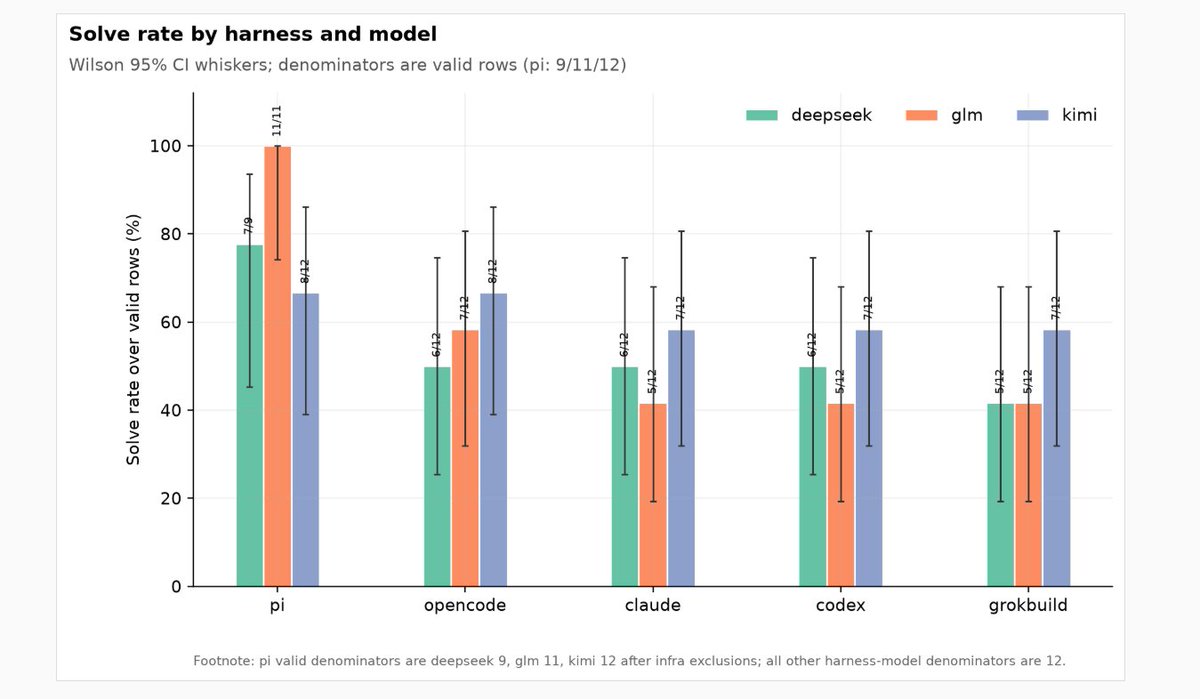
| Pi + GLM 5.2 / open harnesses | Agent harness + open model | (+) | Strongest result in the posted OpenBench comparison; shows harness quality matters | Results are workload-specific, and some agents overrun correct answers instead of stopping |
The satisfaction spectrum ran from “this is my daily driver” to “this is cheaper but still not trustworthy enough.” @LearnInvest2026 used (1 like, 2 replies, 179 views) GPT-5.6 Sol as the long-context workhorse and Fable 5 as the design finisher, which is effectively a workflow-level ensemble. @sergeykarayev showed (8 likes, 1 reply, 530 views) why that split exists: GPT-5.6 sits on the cost or speed frontier, while Fable still occupies the quality corner on his internal benchmark.

@mattlam_ showed (3 likes, 1 reply, 177 views) that model choice is only part of the story by plotting solve rate across Pi, Opencode, Claude, Codex, and Grok Build with GLM, Kimi, and DeepSeek. @ArtificialAnlys added (36 likes, 5 replies, 2,654 views) another dimension entirely: output polish, where GPT-5.6 Sol max led its AA-Briefcase Presentation Elo chart.
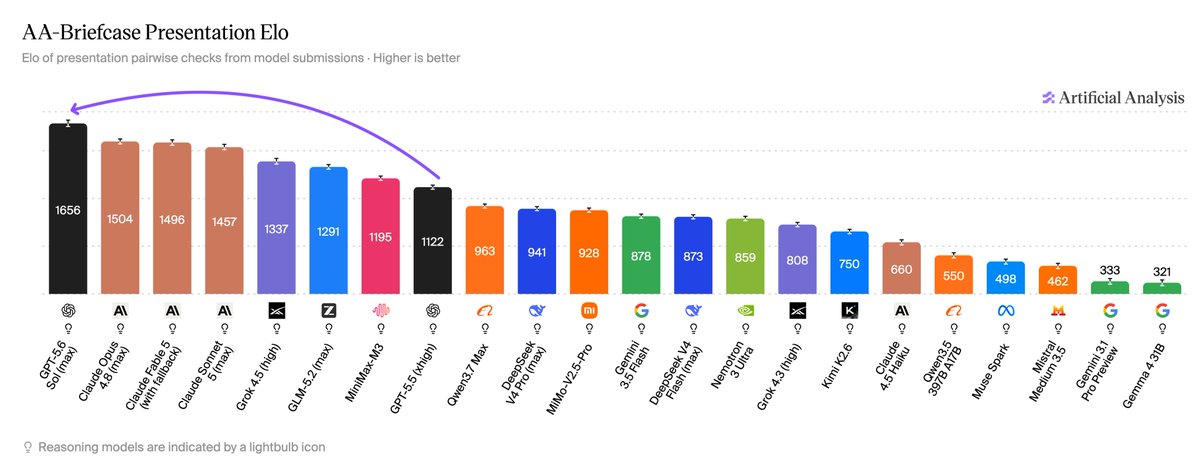
Workarounds today are becoming more sophisticated. People are routing cheap models to high-volume classification or agent loops, reserving frontier models for ambiguous work, leaning on prompt caching for long sessions, and increasingly treating local hardware as a financial decision. @pixeL_laugh showed (2 replies, 14 views) that some local setups pay back in months at heavy usage, while @LearnInvest2026 argued (1 like, 2 replies, 179 views) that cache hits and rework matter at least as much as raw token price. Competitive dynamics are now clearly stack-shaped: model, harness, routing layer, cache behavior, and deployment surface all matter.
5. What People Are Building
| Project | Who built it | What it does | Problem it solves | Stack | Stage | Links |
|---|---|---|---|---|---|---|
| Claude for Financial Services | Anthropic, shared by @cyrilXBT | Agent and plugin templates for investment banking, equity research, private equity, fund admin, and wealth management workflows | Automates repetitive analyst work while keeping explicit human sign-off | Python, Claude Cowork plugins, Managed Agents API, financial MCP connectors | Shipped | post, repo |
| LiteRT.js / LiteRT | Google AI Edge, shared by @HowToPrompt__ | Runs ML and GenAI workloads on-device and in the browser via WebGPU and WASM | Cuts server, privacy, and inference-cost overhead for client-side AI apps | C++, JS, WebGPU, WASM, LiteRT toolchain | Shipped | post, repo, docs |
| OpenDataLoader PDF | OpenDataLoader Project, shared by @N0V4Dev | Converts PDFs into structured Markdown or JSON with bounding boxes and Tagged PDF output | Fixes broken PDF ingestion for RAG, document AI, and accessibility pipelines | Java core, Python/Node/Java bindings, XY-Cut++, local and hybrid extraction | Shipped | post, repo |
| AI Picbreeder | @SakanaAILabs | VLM-agent recreation of collaborative Picbreeder-style image evolution | Studies what current agents can and cannot do in open-ended creative search | VLM agents, CPPNs, NEAT-style evolution, shared archive, public code and dataset | Alpha | post, blog, code |
The most interesting builder pattern was not “another chat wrapper.” It was turning high-friction professional workflows into structured agent systems with explicit scaffolding. Anthropic's financial-services repo is the clearest example: the README frames the output as analyst work product for human review, not autonomous execution, which is exactly how trust-sensitive enterprise automation is being productized.
@N0V4Dev shared (2 likes, 1 reply, 13 views) the most practical infrastructure layer in the set. The repo screenshot and README together make the point that “clean PDF data” is not a nicety; it is a prerequisite for trustworthy RAG and document automation.
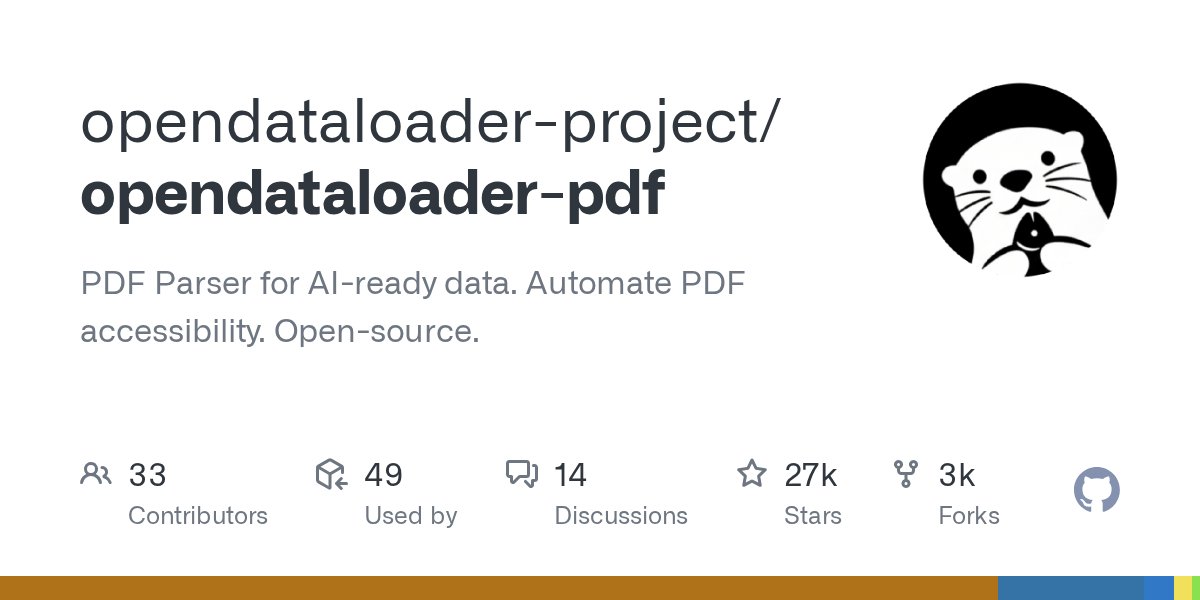
LiteRT.js and AI Picbreeder point in two different directions for builders. LiteRT.js is about shifting inference to the client and making privacy or cost part of the architecture. AI Picbreeder is about treating agent creativity and open-ended search themselves as the artifact, with public code and data for follow-up work.
6. New and Notable
Frontier-eval hiring became concrete
@sayashk posted (28 likes, 2 replies, 4,543 views) a senior-researcher opening for CRUX, focused on open-ended evaluations of frontier agents. The screenshot mattered because it turned a vague safety or eval narrative into an actual hiring profile with a remote role, $150,000 to $220,000 salary band, and a mandate to study long-horizon real-world tasks.

Local-AI hardware economics stopped being fuzzy
@pixeL_laugh argued (2 replies, 14 views) that local LLM hardware should be evaluated against API cost using actual payback periods rather than vibes. The attached tables made that concrete by comparing different Mac and Ryzen setups against API-equivalent model spend and showing that heavy usage can pay back quickly while light usage still favors renting tokens.

Apple versus OpenAI made frontier AI look like a classic hardware trade-secret fight
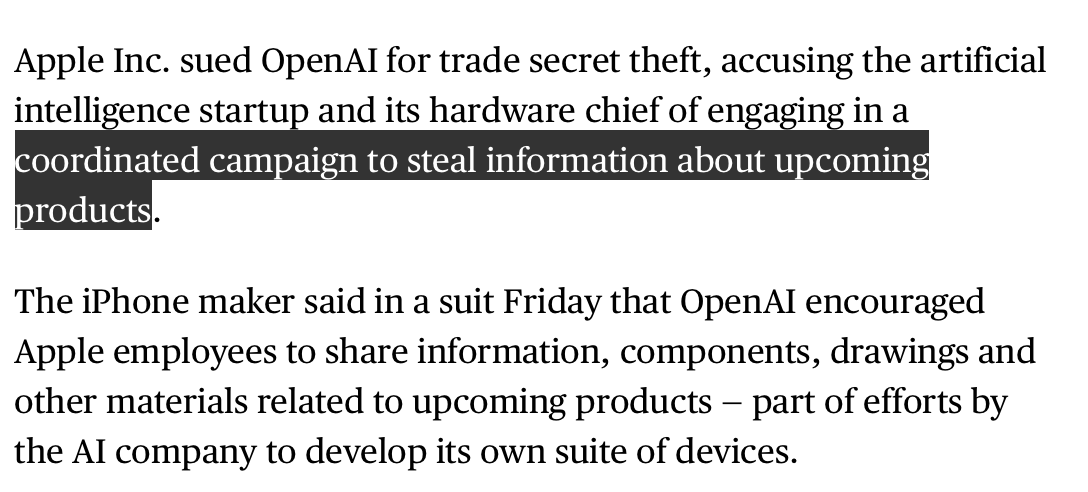
@kimmonismus said (10 likes, 4 replies, 1,332 views) that Apple sued OpenAI over trade-secret theft tied to unreleased hardware plans, naming Tang Tan and Chang Liu. The screenshot that circulated most widely highlighted Apple's claim that OpenAI's hardware effort rests on misappropriated trade secrets, while replies emphasized that the dispute is about the hardware roadmap, not ChatGPT's model weights.
7. Where the Opportunities Are
[+++] Automatic routing and deployment-economics layer — Evidence runs through sections 1, 2, and 4. People are publishing their own routing heuristics, asking for CLI auto-switching, comparing finished-task economics instead of token price, and weighting cache reuse and rework alongside raw benchmark scores.
[+++] Evaluation, observability, and provenance for long-horizon agents — CRUX hiring, the Pangram paper accusation, OpenDataLoader PDF, and the OpenBench “solved it then kept going” failure all point at the same gap: teams need better ways to know when an agent is right, when its sources are clean, and when it should stop.
[++] Client-side and local inference infrastructure — LiteRT.js, local-hardware payback tables, and open-model cost pressure all support a strong opportunity around private inference stacks that make cost, privacy, and deployment simplicity legible to non-experts.
[++] High-trust professional workflow agents — Anthropic's financial-services repo shows that vertical agents become much more credible when they expose connectors, review steps, and explicit sign-off boundaries instead of promising full autonomy.
[+] Physical-AI bottleneck tooling — Shipment forecasts, battery constraints, and actuation-heavy cost structures suggest room for products around perception reliability, deployment uptime, component efficiency, and RaaS operations rather than just better model weights.
8. Takeaways
- GPT-5.6's real competition was not benchmark hype but routing burden, rework, and quality tradeoffs. Power users, secondary AMA notes, and custom benchmarks all treated the launch as an operating decision rather than a leaderboard event. (source; source)
- Cheaper models are reshaping procurement, but low price does not erase workflow failures. Meta, Tencent, DeepSeek, and Grok all gained attention on economics, yet browser-use loops, UI complaints, and quality gaps kept showing up immediately. (source; source; source)
- Evaluation work is becoming a staffed function, not just a research slogan. CRUX hiring, private benchmark sharing, and repeated discussion of provenance and stopping rules all point to evaluation moving into the operating core of AI products. (source; source)
- Document, accessibility, and financial workflow infrastructure stayed unusually concrete. OpenDataLoader PDF, LiteRT.js, and Anthropic's financial-services agents all shipped specific mechanisms — not just vibes — for improving real workflows. (source; source; source)
- Trust remains fragile wherever outputs are hard to verify. That showed up in an alleged AI-written policy paper, browser agents changing or refusing tasks, and physical-AI systems still being bounded by batteries, actuation, and deployment constraints. (source; source; source)