Twitter AI - 2026-07-13
1. What People Are Talking About
1.1 Benchmark charts were still the headline, but people kept asking what they meant in practice (🡕)
Benchmark culture dominated the surface area of Twitter AI on 2026-07-13, but the conversation underneath it was more skeptical than the charts alone suggested. At least seven retained items supported the pattern: leaderboard movement still mattered, yet deployability, user frustration, and model drift kept interrupting the victory laps.
@elonmusk claimed (5,849 likes, 927 replies, 1,125,137 views) that Grok 4.5 ranked slightly above Claude Fable on some software benchmarks. The attached chart made that claim concrete by putting Grok 4.5 at 84 on SWE-Atlas-QnA, just above Fable code variants, but the replies immediately split the signal: one user said Grok was excellent for C++ computer vision work, while others said it still hallucinated obvious impossibilities or lagged Sonnet/Fable in real coding sessions.

@arena reported (444 likes, 28 replies, 41,622 views) that GPT-5.6 Sol ranked #2 on Agent Arena across 7.8K real-world agentic sessions, with the biggest gap to Claude Fable 5 showing up in a "praise vs complaint" satisfaction signal rather than raw task completion alone. That mattered because it shifted the benchmark conversation from simple pass rates toward how users felt about the artifacts an agent produced.
@bnjmn_marie said (118 likes, 15 replies, 8,028 views) that ThinkingCap-Qwen3.6-27B was much faster than base Qwen3.6-27B thanks to shorter thinking while preserving accuracy, and praised the evaluation package behind it. Replies added the missing texture: one practitioner said the model was already running eight concurrent 250k-context sessions on an RTX 6000, while another said the same model repeatedly failed to enter the tool loop on deepSWE tasks.
@yunta_tsai argued (191 likes, 17 replies, 8,814 views) that usefulness matters more than benchmarks because old metrics can miss paradigm shifts. The same skepticism showed up more bluntly in frustration posts from @n2parko joking (102 likes, 11 replies, 5,603 views) about having to test five new models per week across multiple harnesses, and @ns123abc saying (87 likes, 9 replies, 3,618 views) that launch-week benchmarks are marketing if the model changes a week later.
Discussion insight: The disagreement was not anti-benchmark. It was about benchmark scope. People wanted deployment fit, stable behavior across updates, and personal evals that survive model churn before treating a launch chart as settled truth.
Comparison to prior day: On 2026-07-12, benchmark and leaderboard talk mostly served to rank models. On 2026-07-13, the same topic became more self-aware: people explicitly questioned launch-week numbers, benchmark drift, and whether a coding harness or hospital deployment would agree with the chart.
1.2 Inference efficiency moved from abstract optimization talk into concrete build work (🡕)
A second major theme was that inference economics had become specific enough for builders to act on directly. At least five retained items supported this: quantization, backend unification, cheap local hardware, and cluster scripts were all discussed as levers that change what kinds of AI systems people can actually run.
@waterloo_intern explained (173 likes, 120 bookmarks, 10,202 views) why a new quantization method mattered for serving frontier-scale models like GLM 5.2. The post walked through the memory math from bf16 to fp8 to fp4, argued that bad quantization can visibly damage model quality, and claimed the new method was both faster and more aggressive than current state of the art while still scoring better on benchmarks.

@ClementDelangue said (142 likes, 24 replies, 14,606 views) that Hugging Face Transformers models can now run in vLLM at native speed, removing the need to reimplement every new architecture twice. The benchmark image showed the Transformers backend reaching roughly 100% to 102% of native vLLM throughput on example Qwen-3 models, and replies said the bigger win was deleting an entire layer of duplicate engineering.

@lagerskoy argued (130 likes, 17 replies, 1,388 views) that local AI had become weirdly competitive because an older RTX 3060 box was shown running around 52 tokens per second against roughly 38 tokens per second on a Mac Mini M4 Pro. In the same practical vein, @thelichhh summarized (49 likes, 23 bookmarks, 1,941 views) Jeff Geerling's four-mainboard Framework cluster and pointed readers to the public Beowulf AI Cluster repo, while also noting where prompt processing still choked and where efficiency still lost to Apple silicon.
Discussion insight: The shared message was not that local automatically beats cloud. It was that inference is now a practical tuning surface: quantization level, backend duplication, memory stack, cluster topology, and prompt-processing overhead all showed up as variables people can change.
Comparison to prior day: On 2026-07-12, local-control discussion was broader and more product-level. On 2026-07-13, it became much more engineering-heavy: less ideology, more memory math, throughput charts, and reproducible cluster scripts.
1.3 The agent conversation moved further toward harnesses, owned learning loops, and post-deployment adaptation (🡕)
The strongest systems conversation of the day treated agents as long-running operations problems, not prompt tricks. At least six retained items supported this theme across orchestration research, architecture advice, recursive large-codebase methods, enterprise knowledge ownership, and persistent evaluation environments.
@IntuitMachine summarized (11 likes, 13 bookmarks, 951 views) research showing that changing only the orchestration layer around six foundation models cut cost by 33% to 61%, lowered median latency 44%, and reduced tokens per task 38% while holding quality roughly flat. The thread's core claim was that agent bills are dominated by harness choices like prompt caching, transcript compaction, offloading bulky tool outputs, and failure governance, not just by which model name sits behind the API.
@lagerskoy argued (51 likes, 14 replies, 1,191 views) that agents do not need more tools as much as they need cleaner architecture: rails, scoped tools, fallback paths, and orchestrated subagents that keep the main context clean. @qyromat0 made a similar point (29 likes, 20 bookmarks, 1,648 views) through recursive language models, where a coding agent loads a giant repository into a programmable REPL and recursively calls focused sub-queries instead of drowning one context window in the whole codebase. The public RLM repo turns that pattern into a concrete artifact.
@aiwithsally argued (122 likes, 37 replies, 12,918 views) that the real enterprise question is not just which model a company uses but who owns the learning generated through prompts, corrections, workflows, and evaluations. On the evaluation side, @Rixhabh__ highlighted (17 likes, 7 replies, 3,279 views) Skyfall AI's open-source Morpheus environment as a way to test whether frontier models adapt after deployment in persistent, evolving enterprise worlds rather than static benchmark tasks.
In vertical AI, @DataChaz highlighted (19 likes, 4 replies, 3,044 views) ActAVA's CURA as a healthcare-specific model with strong speed, cost, and privacy claims, while @KaiteeShiks replied (59 likes, 9 replies, 1,699 views) that the real test was whether a hospital could deploy it, protect data, and make daily work easier.
Discussion insight: The shared concern was duration: how to keep agents reliable after the demo, after the model switch, and after deployment changes the environment.
Comparison to prior day: On 2026-07-12, orchestration and evaluation were already important, but mostly as role-routing and trust-layer topics. On 2026-07-13, the conversation moved one step further toward ownership: own the harness, own the learning loop, and test systems in environments that do not reset.
2. What Frustrates People
Benchmark churn and personal eval overload
Severity: High. @n2parko joked (102 likes, 11 replies, 5,603 views) that keeping up now means testing five-plus new models per week across different thinking settings and harnesses while also building personal evals and working around moving usage limits. @ns123abc put it more bluntly (87 likes, 9 replies, 3,618 views): launch-week benchmarks are marketing if the model changes a week later. Even positive model posts carried the same stress signal, as one reply under @bnjmn_marie's post reported that ThinkingCap-Qwen3.6-27B looked great on paper but repeatedly failed to enter the tool loop on deepSWE. People are coping by running their own evals and treating public leaderboards as provisional. This is worth building for because the pain hits both buyers and builders, and it blocks trust before deployment even begins.
Deployment reality still breaks the benchmark story
Severity: High. @KaiteeShiks said (59 likes, 9 replies, 1,699 views) that what mattered in healthcare was whether a hospital could deploy a model, protect its data, and make everyday work easier. That directly pushed back on @DataChaz highlighting CURA (19 likes, 4 replies, 3,044 views), which led with CURA's benchmark wins but also had to foreground in-infrastructure deployment and lower inference cost to sound enterprise-ready. @aiwithsally added (122 likes, 37 replies, 12,918 views) that the deeper enterprise risk is losing ownership of the knowledge created while using AI, and @Rixhabh__ highlighted Morpheus (17 likes, 7 replies, 3,279 views) precisely because static benchmarks were not capturing post-deployment adaptation. Teams are coping with private deployments, domain-specific evals, and stricter workflow framing. This is worth building for because privacy, workflow fit, and learning ownership are showing up as first-order buying criteria.
Inference plumbing still burns time and compute
Severity: Medium-High. @waterloo_intern described (173 likes, 120 bookmarks, 10,202 views) today's quantization algorithms as both slow and often suboptimal, and argued that serving giant models cheaply depends on getting that layer right. @ClementDelangue framed (142 likes, 24 replies, 14,606 views) the need to implement each architecture twice - once for Transformers and again for vLLM - as an ecosystem tax that slows releases and introduces divergence. At the hardware level, @thelichhh showed (49 likes, 23 bookmarks, 1,941 views) that even a working consumer-hardware cluster still hits prompt-processing choke points. People are coping with more aggressive quantization work, backend unification, and Ansible-based cluster automation. This is worth building for because every improvement compounds across cost, latency, and model choice.
AI-search measurement is still disconnected from revenue systems
Severity: Medium. @alexgroberman reported (25 likes, 2,083 views) that only 22% of surveyed teams had fully integrated SEO and AI Search, while 40% still mainly checked visibility by manually asking ChatGPT, 49% struggled to connect AI Search to pipeline or revenue, and 45% struggled to measure visibility inside AI answers. The same post argued that disconnected content, PR, and SEO systems leave brands inaccurately described, vaguely positioned, or outranked by clearer competitors inside assistant answers. Builders are coping with visibility tools, AI-search-specific content packages, and manual monitoring across ChatGPT, Claude, Perplexity, Google AI, and Grok. This looks worth building for because the pain is operational and measurable, but the current fixes are still pieced together.
3. What People Wish Existed
Workflow-grounded evaluation that survives model churn
@yunta_tsai argued (191 likes, 17 replies, 8,814 views) that usefulness, not benchmark prestige, should be the target. @IntuitMachine then made that concrete by showing that orchestration alone can change cost and latency more than swapping model vendors, while @Rixhabh__ pushed Morpheus as a way to test post-deployment adaptation in non-resetting environments. The common need is a reusable eval layer that follows the actual workflow, preserves comparable results across model updates, and captures quality per dollar or per task rather than only launch scores. Opportunity: direct.
Enterprise-owned learning loops that survive provider switches
@aiwithsally framed (122 likes, 37 replies, 12,918 views) the core enterprise asset as the knowledge generated through prompts, corrections, workflows, and evaluations. That need aligns with @lagerskoy's clean-architecture post, @qyromat0's RLM post on recursive large-codebase reasoning, and @OpenCodeLog detailed provider/model routing and clearer local context. What people seem to want is not just agent autonomy, but a control layer that keeps memory, context discipline, and workflow knowledge portable across model changes. Opportunity: competitive.
Private, affordable inference stacks without duplicated engineering
@waterloo_intern showed (173 likes, 120 bookmarks, 10,202 views) demand for better quantization, @ClementDelangue pushed for single-implementation model backends, and both @lagerskoy argued and @thelichhh argued that cheap local hardware is already good enough to be worth serious tuning. The need here is practical: fewer duplicated ports, better memory efficiency, simpler cluster orchestration, and clearer guidance on which workloads fit which local hardware. Opportunity: direct.
AI-search visibility and landing-page intelligence
@alexgroberman described (25 likes, 2,083 views) a world where businesses can talk about AI Search all day and still fail because nobody connects content, authority, visibility, and reporting. The images and quoted numbers point to a specific need: teams want to know whether assistants cite them, which pages are surfaced, which competitors are named instead, and whether those visits convert. This is a practical need with immediate commercial value, especially for SaaS, finance, health, legal, and local services where trust and page specificity matter. Opportunity: direct.
4. Tools and Methods in Use
| Tool | Category | Sentiment | Strengths | Limitations |
|---|---|---|---|---|
| Grok 4.5 | LLM | (+/-) | Strong top-line coding benchmark claim; some users report useful coding help | Multiple replies said it still hallucinates and trails Claude models in real workflows |
| GPT-5.6 Sol + Agent Arena | LLM + evaluation | (+/-) | Strong agent ranking, steerability, and a measurable user-satisfaction metric | Still behind Claude Fable 5 on Arena; benchmark skepticism remained active |
| ThinkingCap-Qwen3.6-27B | Open LLM fine-tune | (+/-) | Shorter thinking, faster responses, preserved accuracy, good long-context concurrency reports | At least one practitioner reported tool-loop failures outside the fine-tuning scope |
| Transformers backend in vLLM | Inference framework | (+) | One model implementation can flow from training to production, with near-native throughput | Coverage questions remain for newer architectures and inference-stack choices |
| Quantization tooling (GLM 5.2 FP8/NVFP4, Waterloo method) | Inference optimization | (+) | Shrinks memory footprint and serving cost while preserving more quality | Wrong quantization still damages capability; the best methods are still emerging |
| Local GPU rigs and Framework clusters | Local infrastructure | (+/-) | Cheap private inference on reused hardware; clusterable consumer setups | VRAM, prompt-processing, and setup complexity still constrain real workloads |
| OpenCode + models.dev | Coding agent / model routing | (+) | Provider routing, clearer local context, public comparison pages, flexible model choice | Fast-moving provider limits and accounting details create maintenance overhead |
| Morpheus / persistent enterprise sims | Evaluation / continual learning | (+/-) | Tests post-deployment adaptation in non-resetting environments | Evidence is early, and stronger models still appear to hit capability floors |
| GTM automation stack (n8n, Claude Code, Supabase, Clay, HubSpot) | Revenue automation | (+) | Concrete production stack spanning agents, RAG, CRM, and outreach execution | Maintenance burden rises quickly as the number of tools grows |
| SEO Stuff / AI-search visibility tooling | Search analytics | (+/-) | Gives teams a way to check how brands appear across assistant surfaces | Evidence is promotional and many teams still rely on manual checks |
The overall satisfaction spectrum ran from optimism about cheaper open/local stacks to clear fatigue with benchmark churn and integration overhead. Common workarounds were personal evals, role-specific model routing, prompt caching, aggressive quantization, and moving from no-code automation toward code where control matters more. The migration pattern was less "switch from model A to model B" and more "put a better harness, backend, or routing layer around whatever model you already use."
5. What People Are Building
| Project | Who built it | What it does | Problem it solves | Stack | Stage | Links |
|---|---|---|---|---|---|---|
| Beowulf AI Cluster | Jeff Geerling | Clusters multiple small machines to run and benchmark larger local LLM workloads | Single consumer boxes struggle with very large models and private inference experiments | Ansible, llama.cpp, distributed-llama, Framework Desktop boards | Shipped | repo, post |
| Morpheus | @skyfallai | Persistent enterprise simulation environment for continual-learning and adaptation research | Static benchmarks do not show whether agents stay useful after deployment | Open-source simulator, Python SDK, Gymnasium-style RL interface | Beta | repo, post |
| OpenCode / models.dev | anomalyco / @OpenCodeLog | Open-source coding agent plus a provider-agnostic model catalog and comparison surface | Teams need provider-flexible coding workflows and clearer model selection | CLI, TUI, desktop app, OAuth, model catalog | Shipped | OpenCode, models.dev, post |
| SEO Stuff | @alexgroberman | Visibility and content package aimed at AI-search discovery and citation surfaces | Businesses cannot tell how assistants describe them or which pages get cited | AI-search monitoring, content production, authority placements | Shipped | post |
| M3 repo health reviewer | @FareaNFts | Streams a full GitHub repo into a 1M-context model and returns a code-health report plus a first PR | Chunked repo-chat tools miss whole-codebase context and cross-file issues | MiniMax M3, long-context prompting, GitHub repo ingestion | Alpha | post |
| AI Red Teaming: The Complete Guide | requie | Public GitHub guide for adversarial testing and security evaluation of AI systems | Teams lack a reusable, framework-aligned playbook for AI security testing | Markdown guide, NIST AI RMF, OWASP, MITRE ATLAS | Shipped | repo, post |
The notable builds were mostly not new foundation models. They were control layers, benchmark environments, search-visibility tools, local clusters, and security playbooks wrapped around existing models. Repeated triggers were cost of inference, instability of model behavior, inability to measure production quality, and lack of visibility into how assistants surface a product or workflow. Multiple builders attacked the same meta-problem from different angles: if the model layer is volatile, value moves into orchestration, evaluation, routing, and measurement.
6. New and Notable
Agnes 2.5 Pro joined the coding-model race from outside the usual US-China framing
@BrianRoemmele said (30 likes, 10 replies, 4,089 views) that Singapore-based Agnes 2.5 Pro was delivering frontier-level coding performance and attached an internal evaluation chart. The image showed Agnes 2.5 Pro at 82.7 on SWE-bench Verified, 78.7 on SWE-bench Multilingual, and 77.3 on Terminal-Bench 2.1, with reply discussion focusing on the unusual combination of strong scores and immediate free access claims. External announcement coverage described 2.5 Pro as a preview and 2.5 Flash as currently available.

AI red teaming is crystallizing into a reusable operating manual
@tom_doerr shared (9 likes, 13 bookmarks, 2,512 views) the public AI Red Teaming: The Complete Guide, which organizes adversarial testing and security evaluation around NIST, OWASP, and MITRE frameworks. The repo reads less like a blog post and more like a practical deployment artifact: a sign that AI security testing is maturing into reusable operational documentation instead of scattered prompt-injection lore.
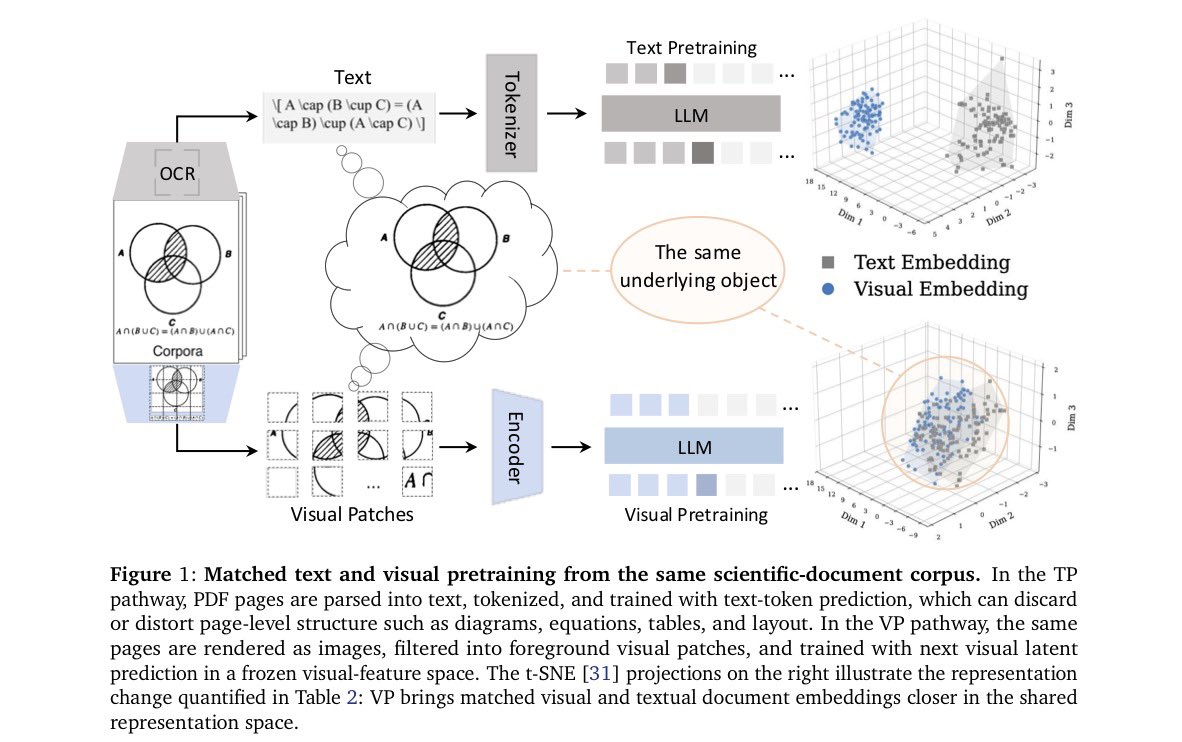
Visual pretraining on document images got a sharper public proof point
@BrianRoemmele pointed to (81 likes, 14 replies, 26,243 views) a paper titled Exploring Visual Pretraining for Learning Language Intelligence, arguing that pretraining directly on visual documents beats flattening the same corpus into plain text. The figure he attached is informative on its own: it contrasts an OCR-to-text path with a visual-patch path over the same scientific-document corpus, making the "layout and equations matter" thesis legible even before reading the paper.
Single-camera physical AI kept advancing
@CyberRobooo highlighted (43 likes, 4 replies, 2,688 views) Mistral's Robostral Navigate as an 8B vision-language-action model for embodied navigation. The noteworthy part was not just another robotics model, but the claim that it can navigate unseen environments from plain-language instructions with only one RGB camera, without LiDAR or depth sensors, which lowers the hardware bar for physical AI deployments.
7. Where the Opportunities Are
[+++] Workflow-grounded eval and orchestration platforms - Evidence came from multiple directions at once: @IntuitMachine showed harness changes cutting agent cost by 33% to 61%, @Rixhabh__ pointed to persistent post-deployment environments, and @KaiteeShiks filtered healthcare models through deployability and privacy. This is strong because the same need appears in coding agents, enterprise ops, healthcare, and security.
[+++] Private inference optimization and local deployment tooling - @waterloo_intern showed, @ClementDelangue reported, @lagerskoy argued, and @thelichhh showed all pointed to different parts of the same opportunity: better quantization, fewer duplicated backends, clearer hardware-fit guidance, and simpler cluster orchestration. This is strong because it saves money immediately and broadens who can run serious models privately.
[++] AI-search visibility and landing-page intelligence - @alexgroberman showed explicit demand for tools that connect assistant visibility, page specificity, authority signals, and revenue reporting. This is moderate rather than strong only because today's evidence was concentrated in one commercial thread, even though the pain looked real and measurable.
[+] Model-portable knowledge ownership layers - @aiwithsally framed the need to own the learning loop, while @OpenCodeLog showed and @dan__rosenthal showed pieces of the control plane that teams are already assembling. This is emerging because the need is clear, but the product category is still fragmented across agents, routing, memory, and ops tooling.
8. Takeaways
- Twitter AI spent the day arguing with its own scoreboards. The biggest posts still led with rankings, but the strongest follow-on discussion was about hallucinations, benchmark drift, deployability, and usefulness rather than leaderboard bragging alone. (Grok 4.5 benchmark claim, usefulness over benchmarks, launch-week skepticism)
- Inference work is becoming one of the fastest-moving builder layers. Quantization advances, backend unification, old-GPU local boxes, and consumer-hardware clusters all pointed to the same thing: cost and deployment shape what kinds of AI products get built next. (Waterloo quantization thread, Transformers in vLLM, Framework cluster summary)
- Harness design is turning into a P&L topic, not just an engineering preference. The most concrete systems post of the day showed orchestration changes cutting cost by as much as 61% while holding quality roughly flat, which is a much bigger deal than a small headline model delta. (orchestration-layer research summary)
- Enterprise buyers are filtering frontier AI through ownership, privacy, and workflow fit. That showed up in the learning-loop thesis, the hospital-deployment reaction to CURA, and the push toward persistent post-deployment test environments. (learning-loop ownership, hospital deployment filter, Morpheus)
- A new software layer is forming around the model layer itself. Open coding-agent control planes, AI-search visibility tooling, security playbooks, and public benchmark environments all suggest value is moving into routing, measurement, and operational discipline. (OpenCode release, AI-search integration thread, AI Red Teaming Guide)