Twitter AI - 2026-07-16
1. What People Are Talking About
1.1 Open-weight launches were judged on deployable capability, not just size (🡕)
Twitter AI spent much of 2026-07-16 on two open-weight stories: Kimi K3 as the potential new coding and front-end challenger, and Thinking Machines' Inkling as a deliberately broad but not "best overall" foundation model. The important shift was that people were not stopping at parameter counts. They kept tying these launches to concrete coding output, product surfaces, benchmark gaps, and trade-offs between large and small variants.
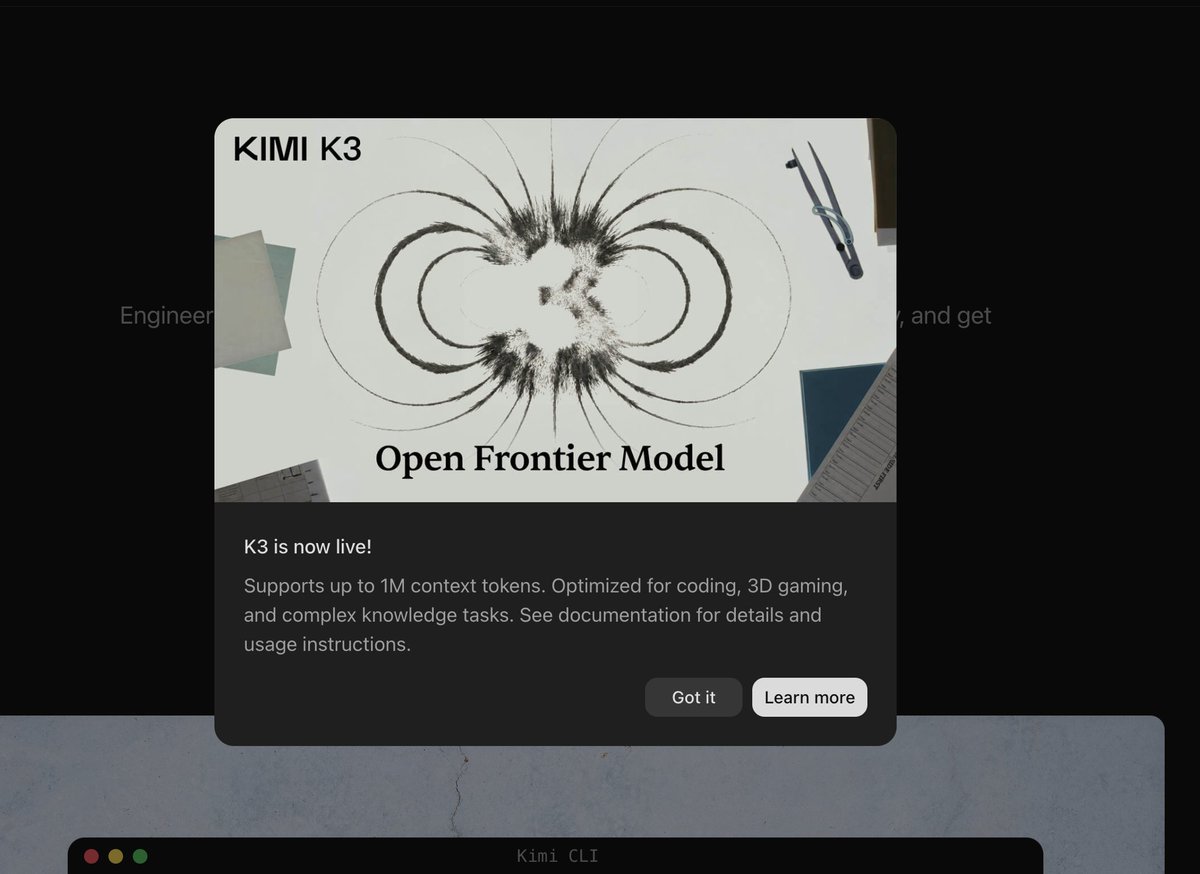
@chetaslua reported (553 likes, 20 replies, 52,494 views) that Kimi K3 was on par with, and sometimes better than, Claude Fable on the coding and 3D cases he had tested. That was reinforced by @VaibhavSisinty showing (13 likes, 1,213 views) a Kimi launch dialog saying K3 was live with up to 1M context tokens and positioning it around coding, 3D gaming, and complex knowledge tasks. The social signal was large, but the replies also injected an immediate caveat: one respondent asked whether strong three.js-style results really generalize across most other axes.
@rasbt highlighted (213 likes, 8 replies, 15,746 views) Inkling's architecture rather than just its headline size, pointing to short convolution layers, RMSNorm on embeddings, and relative position bias instead of RoPE. The official Inkling release says the model has 975B total parameters, 41B active, a 1M-token context window, 45T-token multimodal pretraining, and is meant to be a customizable broad foundation rather than the top-scoring model on every benchmark. That honest framing became part of the story too: replies explicitly praised the fact that the release did not pretend to be the strongest overall model.
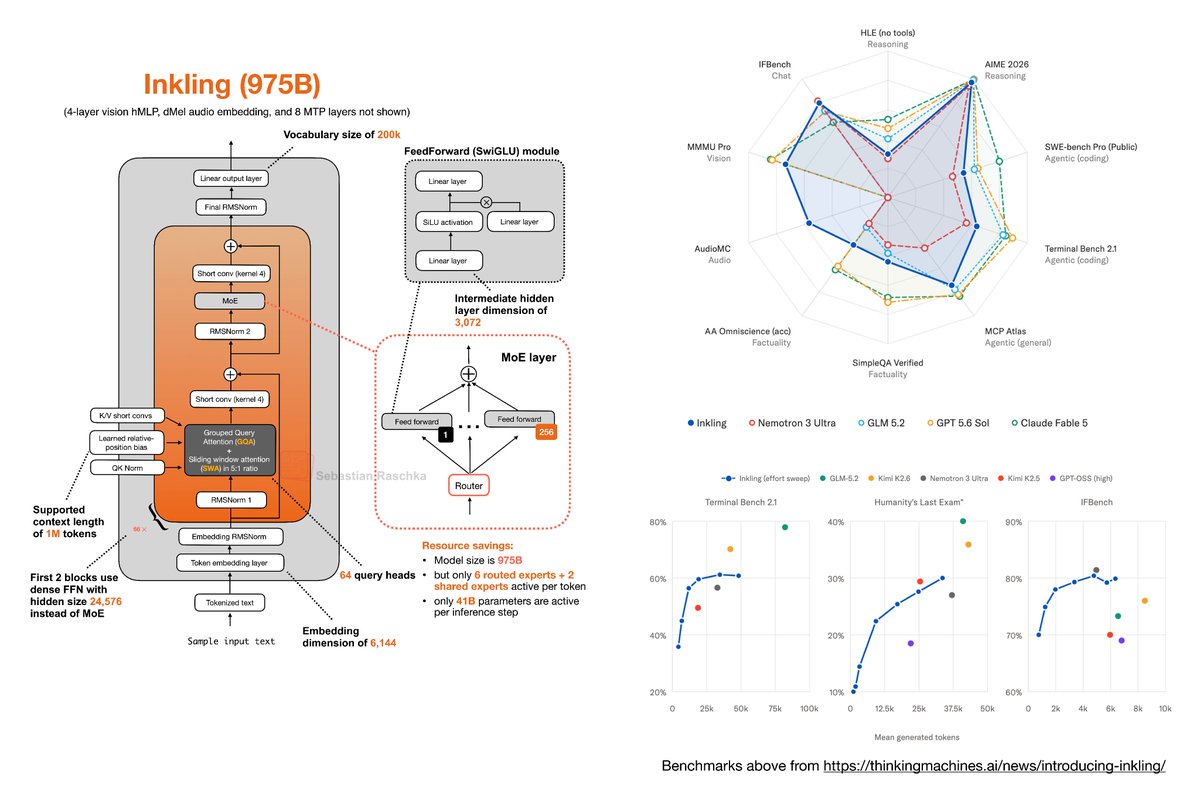
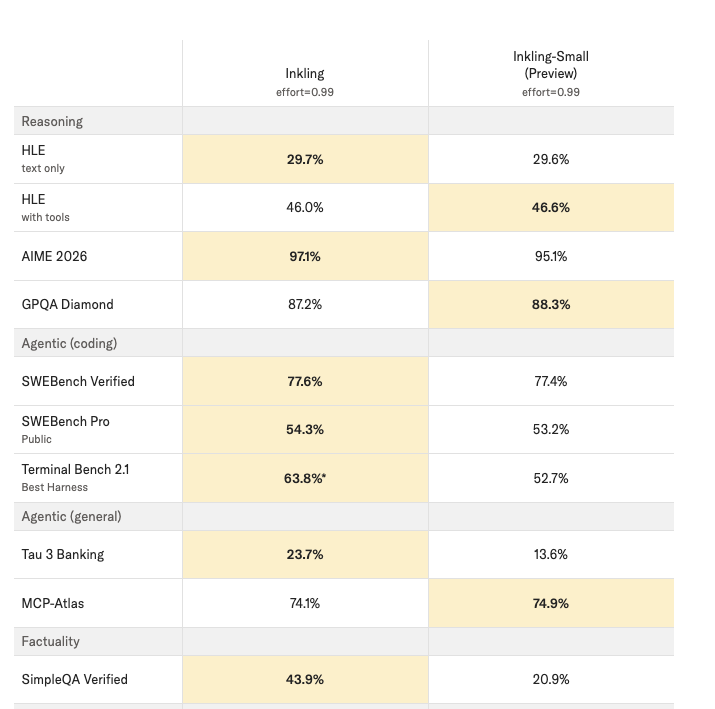
That optimism was still tempered. @ValsAI reported (12 likes, 2 replies, 736 views) that Inkling debuted only #8 in its open-weight category, and @nrehiew_ showed (14 likes, 2,757 views) that Inkling-Small stayed close to full Inkling on several reasoning and SWE rows while leaving bigger gaps on Terminal Bench and SimpleQA. The result was a more mature launch discussion: people were separating "interesting architecture" from "current leaderboard position" and from "what a smaller variant can preserve."
Discussion insight: The Kimi replies questioned whether coding and 3D showcase wins imply broad superiority, while the Inkling replies asked why a very large model still trailed competitors on some public results. The shared mood was not skepticism about open weights themselves; it was skepticism about overgeneralizing from a narrow slice of evidence.
Comparison to prior day: On 2026-07-15 the benchmark conversation was mostly about what kinds of evidence deserve trust. On 2026-07-16 that same concern turned into launch-day behavior: people wanted product surfaces, benchmark placement, and explicit limitations, not just a giant parameter number.
1.2 Evaluation attention moved up from model names to full system configuration (🡕)
The most technical posts treated the main unit of optimization as the entire agent pipeline, not the model label. Cost, accuracy, retrieval, tool use, and environment were discussed as variables that need to be selected together.
@diamai_ argued (15 likes, 2 replies, 176 views) that one benchmark Melissa Pan's team profiled cost about $11,000, and that nearly identical questions could require very different retrieval settings, summarization behavior, or even an agent loop at all. The linked BRANE paper says the system routes each query to a pipeline configuration chosen for its predicted correctness and cost, matching the best fixed configuration's accuracy at up to 89% lower cost across MuSiQue, BrowseComp-Plus, and FinanceBench. That is a much sharper claim than "pick the best model": it says the route itself is the thing being optimized.
@DOE_CESER announced (2 likes, 1 reply, 156 views) Stormbreaker for critical-infrastructure evaluation. The accompanying DOE CESER article says the testbed supports configuration transfer and limit discovery so users can vary instructions, prompts, skills, tools, and environments instead of holding everything constant except the base model. The article explicitly contrasts that with static benchmarking, which it says only changes one of several important variables.
Discussion insight: Both items point to the same boundary: teams do not merely need a better leaderboard, they need a way to decide which configuration to run, where it breaks, and how much accuracy they are buying with extra cost.
Comparison to prior day: The 2026-07-14 report focused on G-Eval, DeepEval, and blind arenas. The 2026-07-15 report questioned whether public benchmarks can remain trustworthy. Today the conversation went one layer deeper and treated evaluation as a query-routing and environment-testing problem.
1.3 Operational surfaces mattered more than model novelty: search, memory, voice, and vertical deployment (🡕)
A third cluster of posts focused on where AI systems actually touch workflows: recommendation search, note access, real-time calls, and country-specific enterprise deployment. The common thread was scope control: what the model can search, what it can read, how fast it can interrupt, and which local domain it can be customized for.
@alexgroberman claimed (49 likes, 5 replies, 4,674 views) that a captured GPT-5.6 Sol system prompt reveals how commercial recommendations are assembled. The useful part of the thread is concrete: it says recommendation queries that risk time or money should trigger live web search, and that more than half of citations should come from widely recognized authoritative sources. But the same thread also markets the author's own SEO service, and one screenshot shows that service ranked first in a ChatGPT-generated list, so its claimed business outcomes should be treated cautiously.
@0xMoysei surfaced (21 likes, 8 replies, 434 views) Obsidian Headless as a way to give agentic tools access to a vault without giving them access to a full computer. The official docs and repository back up the operational part of that claim: CLI sync and publish, Node.js 22+, and machine-readable --json output for automation. In parallel, @nick_white argued (4 likes, 1 reply, 44 views) that the biggest voice-AI bottleneck is architectural, not model quality, contrasting a cascaded STT → LLM → TTS pipeline with a single audio-to-audio loop that keeps tools and database access local.

The same operational emphasis showed up at a larger scale in @StockMKTNewz summarizing (136 likes, 5 replies, 27,181 views) NVIDIA's Nemotron deployments in Japan. The official NVIDIA announcement names Swallow, Sarashina, ENEOS, NTT DATA, and Sakana AI's Fugu routing platform as examples of Japanese-language and sector-specific adaptation. Here the point was not another general assistant; it was local control over finance, telecom, energy, and workflow orchestration.
Discussion insight: The shared design pressure is least-privilege, workflow-shaped access. Search should pull current evidence; note automation should stop at the vault boundary; voice systems should collapse latency hops; and national or industry deployments should adapt open models to local language and regulation.
Comparison to prior day: On 2026-07-15 the agent conversation stressed adjudication and machine-readable primitives. On 2026-07-16 those ideas landed in more concrete surfaces: recommendation search rules, CLI note access, telephony loops, and localized open-model stacks.
2. What Frustrates People
Whole-pipeline evaluation is expensive enough to distort decisions
Severity: High. @diamai_ said (15 likes, 2 replies, 176 views) that one benchmark profile cost Melissa Pan's team about $11,000, and that similar questions could demand different retrieval, summarization, and agent-loop choices. The BRANE paper strengthens that frustration rather than softening it: if per-query routing can match the best fixed configuration at up to 89% lower cost, then static tuning is leaving a lot of money on the table. The DOE CESER write-up makes the same pain explicit from another angle by saying static benchmarks change only one of several variables that matter after deployment. People are coping with manual routing logic, fixed task cards, and environment-specific testbeds. This is worth building for because cost, trust, and release speed are all getting trapped in the same configuration problem.
AI-search guidance is visible, but independent proof is weak
Severity: Medium. @alexgroberman claimed (49 likes, 5 replies, 4,674 views) that a captured GPT-5.6 Sol prompt explains why some businesses are recommended and others are ignored. The concrete parts are useful: live web search for high-stakes recommendations, source-quality rules, and strict product-attribute matching. The problem is that the same thread also sells an SEO package and shows the author's own product at the top of an AI-generated tool list, so the causal business claims cannot be independently trusted from this evidence alone. Teams are left manually inferring what assistants value without a neutral measurement layer. This is worth building for because the demand is clearly commercial, but the current evidence is tangled up with promotion.
Voice and memory automation still break at the architecture boundary
Severity: Medium. @nick_white argued (4 likes, 1 reply, 44 views) that most production voice agents still inherit latency hops, brittle state handoffs, and poor interruption handling from the STT → LLM → TTS pattern, even when wrappers like Vapi, Retell, Bland, or n8n make the demo look polished. On the memory side, @0xMoysei surfaced (21 likes, 8 replies, 434 views) Obsidian Headless precisely because builders want an agent to touch a vault without touching the whole machine. The coping pattern is architectural narrowing: unify the loop, keep tools local, and reduce privileges. This is worth building for because the pain is not a missing frontier model; it is a missing systems boundary that stays fast and safe at the same time.
3. What People Wish Existed
Query-level control planes for agent systems
The strongest practical need was not another model release; it was a way to decide which full configuration to run for a given task. @diamai_ pointed to (15 likes, 2 replies, 176 views) per-query routing because exhaustive profiling is too expensive to repeat manually, and the BRANE paper formalizes that need as a cost-quality routing problem. Stormbreaker extends the same wish into deployed environments by testing limits across prompts, skills, tools, and settings rather than assuming one fixed benchmark can stand in for production. Opportunity: direct.
Least-privilege memory surfaces for agents
The Obsidian Headless discussion is effectively a request for a safer middle ground between "agent can touch nothing" and "agent can touch the whole computer." @0xMoysei wanted (21 likes, 8 replies, 434 views) vault access, sync, and automation without widening the trust boundary, and the official docs show why that matters: the product surface is a CLI with JSON output, not a full GUI session. The emotional need underneath it is control - keep the agent useful, but keep the machine legible and recoverable. Opportunity: direct.
AI-search observability that separates source rules from sales hype
The captured GPT-5.6 Sol prompt thread supplied a concrete wish even though it was commercially entangled: businesses want to know when assistants search, which sources they trust, what product attributes get checked, and why one company gets short-listed while another disappears. @alexgroberman showed (49 likes, 5 replies, 4,674 views) that people are reverse-engineering these rules from prompt archives and screenshots because they do not have a better instrument. The need is practical, immediate, and already monetized by service providers, which means the gap is real even if the current evidence is noisy. Opportunity: competitive.
Localized, governable open-model stacks
The Nemotron-in-Japan thread showed a more institutional wish: open models that can be adapted to local language, sector, and governance requirements without surrendering control to a foreign frontier API. @StockMKTNewz summarized (136 likes, 5 replies, 27,181 views) uses spanning telecom, finance, energy, and model routing, while the official NVIDIA announcement frames open models as infrastructure countries and enterprises can inspect, adapt, secure, and deploy themselves. Opportunity: competitive.
4. Tools and Methods in Use
| Tool | Category | Sentiment | Strengths | Limitations |
|---|---|---|---|---|
| Kimi K3 | Open-weight LLM | (+/-) | 1M-context launch framing, strong coding and front-end chatter, multi-agent "Swarm" positioning | Most evidence here is launch-week and self-reported; broad generality was questioned in replies |
| Inkling | Open-weight multimodal LLM | (+/-) | Full weights, 975B/41B active design, multimodal pretraining, explicit customization story | Official release itself says it is not the strongest overall model; third-party rankings were mixed |
| BRANE | Agent configuration router | (+) | Per-query cost/quality routing, up to 89% lower cost at matched accuracy in the paper | Requires a predefined pipeline catalog and profiled query history |
| Stormbreaker | Evaluation testbed | (+) | Dynamic testing through configuration transfer and limit discovery | Framed around critical infrastructure, not yet a general self-serve product |
| Obsidian Headless | Knowledge / memory CLI | (+) | Vault sync and publish from the command line, JSON output, narrower trust boundary than full-device access | Requires Node.js 22+ and an Obsidian account; does not solve higher-level agent orchestration by itself |
| Unified audio-to-audio loop | Voice agent architecture | (+/-) | Collapses STT/LLM/TTS hops, keeps tools and DB access local, supports interruption handling | Evidence is self-reported from one builder thread rather than an external benchmark |
| NVIDIA Nemotron + NeMo | Open-model customization stack | (+) | Supports local adaptation across Japanese telecom, finance, energy, and routing workflows | Enterprise integration burden remains high and the stack is still vendor-centered |
| Captured GPT-5.6 Sol prompt playbook | AI-search / recommendation method | (+/-) | Makes web-search triggers, source-quality rules, and retail constraint matching concrete | Based on one captured configuration and wrapped inside a service pitch |
The day's methods split into two layers. Kimi K3 and Inkling supplied the model layer, but BRANE, Stormbreaker, Obsidian Headless, and the unified voice loop supplied the control layer that decides how those models are routed, tested, scoped, and surfaced. Even the AI-search thread was really a control-layer story: not "which model is smartest," but "what evidence does it search, trust, and cite."
The biggest migration pattern was away from single-model thinking. The dataset repeatedly favored methods that narrow or reshape the workflow around a model - per-query routing, environment-specific testing, vault-only access, local tool execution, or sector-specific customization. Satisfaction rose when the tool made those boundaries explicit, and fell when the claims blurred into launch hype or promotion.
5. What People Are Building
| Project | Who built it | What it does | Problem it solves | Stack | Stage | Links |
|---|---|---|---|---|---|---|
| Inkling | Thinking Machines | Releases a multimodal open-weights base model intended for customization and fine-tuning | Need a broad foundation model teams can adapt instead of only consume behind an API | 975B MoE, 41B active, 1M context, Tinker fine-tuning | Shipped | official release |
| Obsidian Headless | Obsidian | Syncs and publishes vaults from the command line without the desktop app | Give automations and agents controlled note access instead of full-device access | Node.js 22+, npm CLI, Obsidian Sync/Publish, JSON output | Shipped | GitHub, docs |
| BRANE | Melissa Z. Pan et al. | Routes each query to the cheapest retrieval-agent configuration likely to meet an accuracy target | Static one-size pipeline tuning wastes money and misses per-query differences | LLM-derived query characteristics plus per-configuration predictors | Alpha | paper |
| Stormbreaker | DOE CESER + LLNL | Dynamically tests LLMs and agentic AI in power-system and OT environments | Static benchmarks miss robustness limits in real operational settings | Mjölnir extension, configuration transfer, limit discovery | Alpha | article |
| Nemotron-based Japan deployments | NVIDIA with Swallow, Sarashina, ENEOS, NTT DATA, Sakana AI and others | Localizes open models for Japanese-language and sector-specific workflows | Need governable national and industry AI instead of generic global assistants | Nemotron, NeMo, Megatron-LM, Agent Toolkit, Fugu routing | Shipped | official announcement |
The build pattern was mostly scaffolding around models rather than another general chatbot. Inkling and Nemotron supplied adaptable bases; BRANE and Stormbreaker decided how those systems should be routed or tested; Obsidian Headless narrowed the memory surface an agent is allowed to touch. That is a much more operational pattern than "launch a smarter assistant."
Kimi K3 drew more excitement than documentation in the public evidence here. By contrast, the lower-engagement items - BRANE, Stormbreaker, and Obsidian Headless - were the ones that supplied the clearest implementation detail. The repeated trigger for building was not lack of raw model power, but lack of cost control, evaluation realism, or safe workflow boundaries.
6. New and Notable
Dugout AI use got big enough for MLB to stop it
@UnderdogMLB reported (268 likes, 26 replies, 32,719 views) that MLB had effectively outlawed the use of league-provided dugout iPads to access generative AI for in-game strategy, and @TheAthletic separately posted (46 likes, 5 replies, 26,537 views) the same crackdown. That matters because it is unusually concrete evidence that generative AI had already crossed from office experimentation into live operational decision support in professional sports, and that league governance reacted immediately.
Inkling-Small staying close to the big model on several reasoning rows
@nrehiew_ showed (14 likes, 2,757 views) a comparison table where Inkling-Small stayed close to full Inkling on HLE, AIME 2026, GPQA Diamond, SWE-Bench Verified/Pro, and MCP-Atlas, while leaving larger gaps on Terminal Bench and SimpleQA. That is notable because it turns a vague "small models are catching up" feeling into a more specific claim: some reasoning and coding capability compresses well, while long-tail retrieval and tool-heavy tasks still appear to need more capacity.
7. Where the Opportunities Are
[+++] Query-level evaluation and routing control planes — BRANE and Stormbreaker attack the same problem from different ends: one chooses the cheapest configuration likely to hit the target, and the other finds where a deployed configuration breaks. That opportunity is strong because it is supported by section 1's configuration theme, section 2's benchmark-cost frustration, and section 5's most concrete build artifacts.
[++] Least-privilege agent memory and interface boundaries — Obsidian Headless and the unified voice-loop diagram both treat system scope as the product: what the agent can read, where tools run, and how much of the machine or stack it has to touch. The evidence suggests a real need for agents that stay useful while remaining fast, scoped, and recoverable.
[++] Independent AI-search observability — The captured GPT-5.6 Sol prompt gave operators enough detail to know what to optimize - current information, authoritative sources, complete product attributes - but not enough neutral evidence to know whether a claimed optimization actually works. The opportunity is to turn prompt lore and screenshots into auditable citation, ranking, and conversion traces.
[+] Localized open-model deployment programs — Nemotron's Japan rollout and the day's Kimi and Inkling attention both show demand for models that can be adapted to local language, policy, and workflow constraints. The opportunity is real, but it is more capital-intensive and more crowded than the control-layer gaps above.
8. Takeaways
- Open-weight launches were evaluated like products, not abstract research events. Kimi K3 discussion centered on coding output, context length, and launch surfaces, while Inkling discussion centered on architecture, benchmark placement, and customization scope. (source)
- The cost frontier moved from model pricing to pipeline configuration. BRANE's per-query routing claim and Stormbreaker's dynamic environment testing both say the expensive mistake is fixing one configuration too early. (source)
- Agents are getting narrower trust boundaries instead of broader blanket access. Obsidian Headless makes vault-only automation explicit, and the voice-loop post keeps tools and data local to reduce latency and state breakage. (source)
- Country- and sector-specific AI stacks are becoming a concrete deployment story. The Nemotron-in-Japan announcement tied open models to telecom, finance, energy, and routing workflows rather than to another generic assistant launch. (source)
- Operational adoption is already strong enough to trigger policy reactions. MLB's dugout restriction is evidence that generative AI is no longer just an office productivity topic; it has already reached live, high-stakes decision environments. (source)