Twitter AI - 2026-07-19
1. What People Are Talking About
1.1 Open-weight model claims met a stronger demand for independent scope checks (🡕)
Kimi K3 remained the day’s dominant model story, but the useful conversation was not a clean victory lap. High-engagement claims positioned it as a frontier open-weight security model, while practitioners separately argued that a strong showing in a narrow domain or creative front-end task should not be generalized into broad superiority.
@rauchg reported (1,549 likes, 57 replies, 161,537 views) internal evaluations in which Kimi K3 was “top-tier” at cybersecurity, Sol was stronger but more expensive, and Fable refused to complete the run. Replies narrowed that claim: one commenter said K3 still trailed Sol and Fable on broader reasoning benchmarks, and another contested the stated price comparison because token usage can change the cost.
@stalkermustang countered (46 likes, 9 replies, 8,849 views) with a retrospective compilation claiming that earlier Chinese-model launch comparisons weakened on subsequently released benchmarks. The author did not dismiss K3, but separated possible strength in three.js-style front ends and simple web games from broad programming performance; the charts are the author's own compilation, not an independent benchmark release.


@CommandCodeAI shared (1 like, 127 views) a public Kimi K3 design comparison. Its linked benchmark artifact documents one three-prompt Tailwind/Three.js landing-page run, 1,168 lines of output, and a modeled $0.77 session cost, explicitly not a metered bill. That is a useful reproducibility move, but still a narrow test rather than a broad ranking.
Discussion insight: The strongest correction was about boundaries: security performance, front-end generation, broad reasoning, token use, and model refusals are different measurements.
Comparison to prior day: The July 18 discussion already had unusually high Kimi and benchmark volume. On July 19, attention shifted from launch positioning toward whether the visible demonstrations and internal tests hold after wider evaluation.
1.2 Usage signals put price-performance and provider choice beside leaderboards (🡕)
@KobeissiLetter said (955 likes, 123 replies, 137,486 views) that Chinese models accounted for about 58% of OpenRouter tokens used by US firms, after a brief 63% peak in early July. The post framed this as a sharp change from less than 10% at the start of 2025; replies repeatedly attributed the movement to price-performance, but one response correctly noted that OpenRouter excludes direct-provider traffic and is not a proxy for total AI spend.

This was therefore a real adoption signal rather than a complete market-share measurement. The chart and its caveat make the practical point: a multi-provider routing surface can reveal rapid switching, but cannot establish total market usage on its own.
1.3 AI engineering discussion concentrated on routing, validation, and release controls (🡕)
@adxtyahq described (59 likes, 14 replies, 3,597 views) cutting a website-builder product’s reported average LLM cost from roughly $3-4 to $1-1.50 per prompt after an initial design rose to nearly $5. The self-reported system uses custom orchestration on Vercel AI SDK: classify request complexity, split work into features, validate and regenerate file by file, route models, and load only relevant context. Replies supplied the key warning: misclassification and expensive retries can erase apparent routing savings.
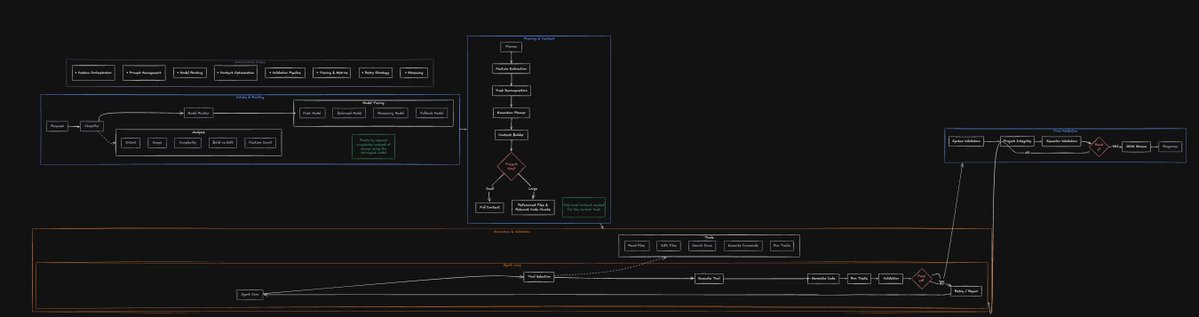
@dosco built (16 likes, 1,067 views) a DSPy/Ax reasoning router that learns from the cheapest evaluation-passing mode, changing reasoning budget, self-consistency width, and use of refinement. @shivam74689 documented (57 likes, 3 replies, 1,458 views) a CI/CD pipeline that makes AI evaluations, latency, cost, hallucination, tool use, health checks, rollback, and observability release criteria rather than afterthoughts.

Discussion insight: The thread on cost routing identifies a tension that the CI/CD post operationalizes: a cheaper path is only useful when validation catches classifier mistakes and degraded outputs before release.
Comparison to prior day: Prior reports emphasized configuration-aware evaluation. Today’s examples made that operational: per-request routing, feature-level validation, evaluation gates, rollback, and monitoring.
2. What Frustrates People
Evaluation claims that outrun their scope
Severity: High. The K3 discussion shows why launch-day assertions remain hard to act on. @rauchg shared (1,549 likes, 57 replies, 161,537 views) favorable internal cybersecurity results, but replies questioned broader reasoning performance, cost accounting, and deployment guardrails. @stalkermustang argued (46 likes, 9 replies, 8,849 views) that post-launch benchmarks can reverse initial comparisons. Neither post is an independent evaluation release, which is precisely the problem for teams deciding what to deploy.
The coping pattern is public, narrow, reproducible artifacts such as Command Code’s Kimi K3 design run, but that still leaves teams assembling coverage across real task types. This is worth building for: model comparisons need stated workloads, cost assumptions, and a clear line between a demonstration and a general capability claim.
Low-cost routing can fail through retries and misclassification
Severity: Medium. @adxtyahq reported (59 likes, 14 replies, 3,597 views) a difficult iteration from nearly $5 to $1-1.50 per prompt, explicitly crediting routing, validation, and context selection rather than a prompt tweak. Replies identified the operational risk: send a complex request down a cheap route, trigger several retries, and the savings disappear. The post’s answer is more pipeline control - classify, generate in pieces, validate, and loop - which also adds implementation complexity.
Adoption data that are useful but incomplete
Severity: Medium. @KobeissiLetter used (955 likes, 123 replies, 137,486 views) OpenRouter activity to describe changing US-firm usage of Chinese models. The image itself says the data exclude direct traffic and cover only a fraction of total consumption, while a reply made the same representativeness objection. Teams can observe switching on a routing layer, but not infer the complete market from it. This is worth building for as provider-neutral adoption and cost observability, with explicit coverage bounds.
3. What People Wish Existed
Comparable evaluation that preserves task and cost context
The direct need is for evidence that says what a model did, on which task, at what cost, and where the result stops generalizing. @stalkermustang asked (46 likes, 9 replies, 8,849 views) whether K3 would repeat earlier launch-to-later-benchmark slippage, while @CommandCodeAI published (1 like, 127 views) a small, inspectable design benchmark. The second is a partial answer to the first: publish the artifact and methodology, but broaden coverage beyond a single design task. Opportunity: direct.
Routing controls that optimize for valid output, not cheap first passes
@adxtyahq described (59 likes, 14 replies, 3,597 views) the practical version of this need: classify work, choose a model path, validate each feature, and control context. @dosco implemented (16 likes, 1,067 views) an evaluation-derived router that chooses the lowest effort likely to pass. The remaining gap is a control plane that exposes route choice, retry cost, quality gates, and the reason a route failed. Opportunity: direct.
Consent-preserving community memory
@sascha_daemgen announced (4 likes, 212 views) Cinderella, an alpha archive for public SimpleX communities in which both a community and each member opt in. Its repository documents capture, PostgreSQL persistence, consent gating, an admin foundation, and later work on public embedding and moderation. The practical need is not generic chat summarization; it is searchable collective memory with revocable member consent. Opportunity: competitive.
4. Tools and Methods in Use
| Tool | Category | Sentiment | Strengths | Limitations |
|---|---|---|---|---|
| Kimi K3 | Open-weight LLM | (+/-) | Strong cybersecurity and front-end claims; widely discussed | Evidence is largely internal, self-reported, or task-specific; replies dispute generalization and price |
| OpenRouter | Multi-provider model router | (+/-) | Reveals routed token-share switching and lets users compare providers | Its traffic is explicitly incomplete market coverage |
| Vercel AI SDK | AI application framework | (+) | Used as a base for custom routing, tracing, prompts, evaluations, and context control | The reported implementation bypassed LangChain and LangSmith for tighter control, implying work beyond the base SDK |
| DSPy + Ax | Prompt/program optimization | (+) | Supports an evaluation-derived reasoning router and configurable effort | One builder implementation; no public aggregate outcome was supplied |
| Docker + GitHub Actions | Delivery / CI-CD | (+) | Connects tests, AI evals, images, deployment, health checks, rollback, and monitoring | Pipeline quality still depends on the tests and evaluation data it has |
| Cinderella | Consent-first community archive | (+) | Explicit per-member publication controls, searchable storage, documented TypeScript/Node.js and PostgreSQL stack | Public embeds and moderation remain planned work |
The strongest satisfaction signal was for methods that make hidden system choices observable: route complexity before choosing a model, split work before generation, treat evaluation as a gate, and monitor after release. @adxtyahq reported (59 likes, 14 replies, 3,597 views) migrating away from LangChain and LangSmith toward custom control on Vercel AI SDK; the stated reason was tighter control of the execution flow, not a claim that those tools cannot work.
The day’s competitive dynamic was therefore less “one best model” than “who can route, validate, observe, and revoke access around a model.” The clearest caution is that routing quality and market-usage data both depend on the boundaries of what they measure.
5. What People Are Building
| Project | Who built it | What it does | Problem it solves | Stack | Stage | Links |
|---|---|---|---|---|---|---|
| Cinderella | @sascha_daemgen | Archives opted-in public SimpleX community content into a searchable record | Preserves useful public-community knowledge without publishing non-consenting members | TypeScript, Node.js, SimpleX SDK, PostgreSQL, filesystem media | Alpha | GitHub |
| Kimi K3 design showcase | @CommandCodeAI | Publishes a reproducible one-prompt design comparison | Lets builders inspect a concrete open-model front-end result rather than only see a claim | Command Code /design, Kimi K3, Tailwind CSS, Three.js |
Shipped | benchmark |
| Evaluation-derived reasoning router | @dosco | Selects the least costly reasoning configuration likely to pass | Avoids spending high-effort inference on every request | DSPy, Ax, GEPA | Alpha | No public project URL supplied |
| AI CI/CD pipeline | @shivam74689 | Gates deployment on software tests, AI evaluations, health checks, and rollback | Detects behavior, latency, cost, hallucination, and tool-use regressions before or after release | GitHub Actions, Docker, evaluations, observability | Alpha | No public project URL supplied |
Cinderella is the most complete documented build: its repository says core message/file capture, PostgreSQL persistence, consent gating, and admin foundations are done, while public embeds and moderation are deferred. The design showcase is a different kind of builder signal: it makes a bounded benchmark inspectable and discloses that its cost is modeled.
The repeated build pattern is control around generation. The router changes reasoning effort based on evaluation outcomes, and the CI/CD example moves model behavior into deployment gates. Both are responses to the same failure mode: an application can run while still being too costly or producing invalid output.
6. New and Notable
Enzyme-specific foundation models reached a concrete discovery workflow
@BiologyAIDaily highlighted (23 likes, 1 reply, 1,232 views) EnzGFM, describing a Mamba-Transformer protein language model trained first on general protein sequences and then enzyme data. The post said its EnzGFM-Agent prioritizes mutagenesis candidates and linked code and a paper; it is notable because it connects an enzyme representation model to a concrete screening and variant-selection workflow rather than stopping at a leaderboard claim.
Local AI hardware marketing drew a memory-capacity correction
@RetroChainer warned (26 likes, 6 replies, 1,450 views) that a $70 Raspberry Pi kit promoted for local LLMs uses a vision-oriented Hailo-8L without dedicated memory, whereas the post identified a more expensive Hailo-10H board as able to run only very small models. The post’s useful contribution is the purchasing heuristic: TOPS alone does not establish LLM viability; model size and available memory matter.
7. Where the Opportunities Are
[+++] Reproducible, cost-aware model evaluation — K3’s broad capability narrative, the retrospective benchmark counterexample, and the public but narrow Command Code artifact all show demand for comparisons that disclose task coverage, inference configuration, and cost. This is strong because both launch advocates and skeptics are asking for more specific evidence.
[++] Validated routing and release control for AI applications — The cost-cutting architecture, DSPy/Ax router, and AI CI/CD workflow all place routing, evaluation, rollback, and observability in the critical path. The opportunity is moderate-to-strong: the evidence comes from concrete implementations, but their reported results are mostly individual builder accounts.
[++] Consent-aware community knowledge systems — Cinderella’s per-community and per-member opt-in publication design addresses a distinct trade-off: retain public conversation without turning private participation into an archive by default. The documented stack and alpha status make this more than an idea, while public embedding and moderation leave room for competitors.
[+] Provider-neutral adoption intelligence — OpenRouter’s visible token mix prompted a large discussion about price-performance switching, even as commenters stressed its incomplete market coverage. A measurement product that makes coverage, direct traffic, unit cost, and workload mix explicit would address that limitation.
8. Takeaways
- The Kimi K3 story was about verification boundaries as much as capability. High-engagement internal cybersecurity claims were immediately qualified by replies about broader reasoning, token-driven cost, and safety; a separate retrospective argued against extrapolating narrow wins. @rauchg reported (1,549 likes, 57 replies, 161,537 views).
- Routed usage is a meaningful but partial signal of provider switching. The OpenRouter chart put Chinese-model use by US firms at about 58%, while its own note and replies limited what that says about total consumption. @KobeissiLetter said (955 likes, 123 replies, 137,486 views).
- Builders are treating routing and validation as product architecture. One website-builder account attributed reported cost reductions to classification, feature-level generation, validation, and selective context; another built a router that learns the cheapest mode that passes evaluation. @adxtyahq described (59 likes, 14 replies, 3,597 views).
- AI release processes are expanding beyond software tests. The CI/CD example explicitly included evaluations for quality, latency, cost, hallucination, and tool use, alongside health checks, rollback, and monitoring. @shivam74689 documented (57 likes, 3 replies, 1,458 views).
- Useful AI memory products can make consent a core data-model constraint. Cinderella’s alpha design records an opt-in decision before public archiving and documents that model in its repository. @sascha_daemgen announced (4 likes, 212 views).