Twitter AI - 2026-07-29
1. What People Are Talking About
1.1 Agents are being packaged as workspaces, not chat windows (🡕)
Today's highest-signal agent posts were about interface and workflow shape, not raw model IQ. The common promise was that agents should own context, build software, publish it, and persist knowledge across sessions. Four different items supported the theme, ranging from team-chat replacement to reusable agent skills.
@gregisenberg argued (214 likes, 20 replies, 24,680 views, 375 bookmarks) that Jack Dorsey's Buzz is a plausible "Slack killer" because it combines model swapping, live audio huddles, agent-built apps, a context loop that feeds live application data back to agents, and even shared local compute so several people can split one machine running a local model. He also hedged that it is "alpha software" and "slow in places," which makes the enthusiasm more concrete than generic hype.
@JayminSOfficial framed (248 likes, 27,858 views, 47 bookmarks) Grok's new Build Mode as a shift from asking AI for answers to asking it to create products. xAI's launch page says Build Mode now creates working websites, apps, games, and dashboards live in chat and can publish them to a shareable link or custom domain, though it is still an Early Beta limited to SuperGrok Heavy users.
@pirroh said (64 likes, 11 replies, 21,013 views, 13 bookmarks) Replit now hides model selection behind recommended versions and effort levels based on internal benchmarks so users can focus on "Outcome-Maxxing." The strongest reply immediately asked for token costs to be shown at selection time, suggesting that "abstract away the model" is attractive until budgets matter.
@RituWithAI highlighted (8 likes, 3 replies, 166 views, 6 bookmarks) book-to-skill, a small open-source tool that turns a book, PDF, EPUB, markdown file, or scraped site into a reusable SKILL.md for Claude Code, Cursor, or Codex. That is a low-engagement post, but it contributes a distinct builder pattern: not just giving agents more context today, but packaging outside knowledge so the same context can be reused tomorrow.
Discussion insight: The replies did not reject these products; they pressed on friction. Buzz was called early and slow by its own advocate, and the clearest Replit reply asked not for more autonomy but for explicit token-cost visibility.
Comparison to prior day: July 28's Twitter AI report was still dominated by model launches, benchmark arguments, and policy fights. July 29 pushed one level closer to workflow: context loops, publishing, skill packaging, and model-selection UI became the product surface.
1.2 Cost-aware routing and procurement are overtaking raw benchmark bragging (🡕)
The strongest operator signal in the dataset was not "which model won," but "what does this cost to run, and can I switch without rewriting my stack?" The same day OpenAI publicized internal efficiency gains, independent builders shipped routing tools and argued many agent benchmarks fall apart once price is visible.
@OpenAIDevs reported (421 likes, 30 replies, 17,975 views, 34 bookmarks) that GPT-5.6 Sol was used inside Codex to optimize its own infrastructure. The quoted OpenAI text makes the claim concrete: 20% lower serving costs from production GPU kernel improvements and 15%+ better token-generation efficiency from improved speculative decoding. The top replies did not dispute the direction of travel; they asked what "more useful work" means and why users are not yet feeling the improvement directly.
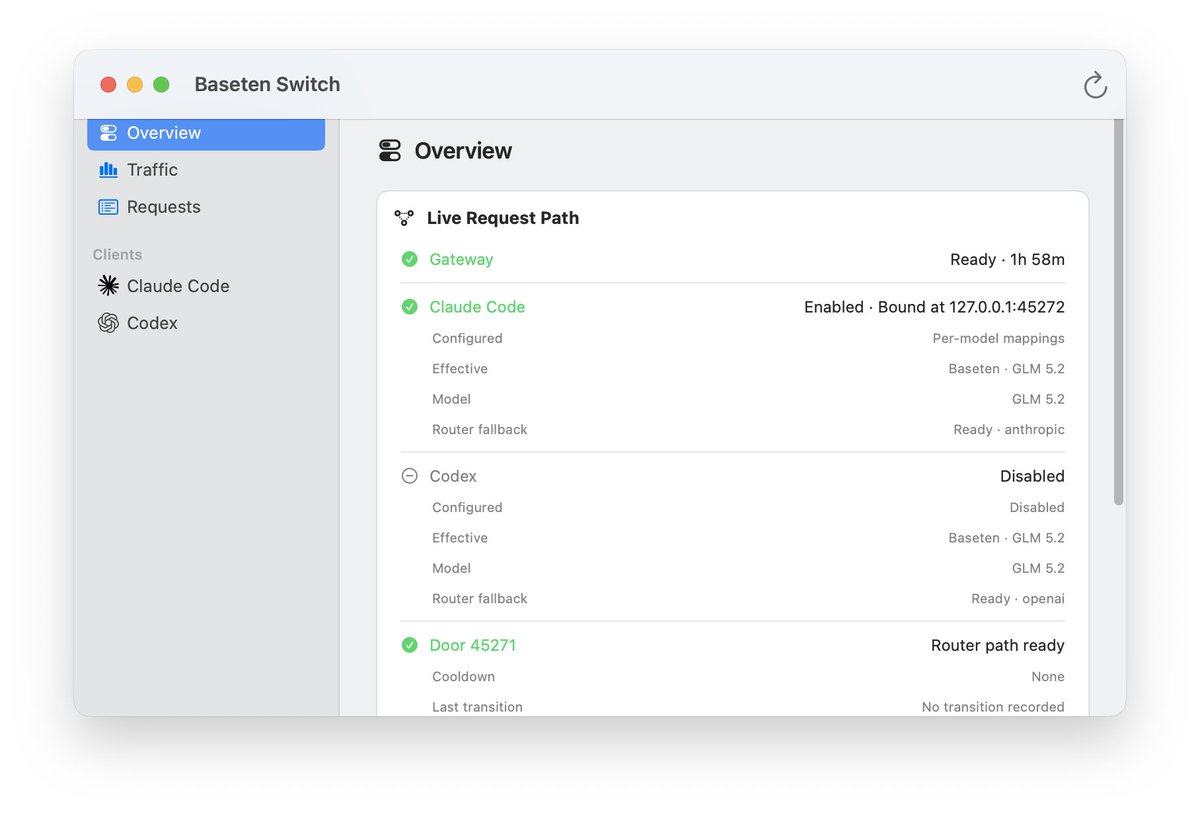
@ahmetb launched (56 likes, 8 replies, 5,801 views, 43 bookmarks) baseten-switch, a local gateway that diverts Claude Code and Codex requests to models such as Kimi K3 and GLM 5.2 while keeping the harness unchanged. The public README calls it a beta macOS app/gateway, and the screenshot below shows why it resonated: one window surfaces live request paths, per-client model mappings, traffic views, request logs, and readiness state in one place.
@lagerskoy argued (20 likes, 114 views, 14 bookmarks) that coding-agent papers look less impressive once cost is added as a first-class column: in the comparison he cited, the most expensive architecture cost over 50x more than a retry loop without a significant accuracy gain, and 12 of 17 agent benchmarks failed proper holdout criteria. That is a sharper complaint than generic "benchmarks are bad"; it says price and experimental design are both being hidden.
@neil_xbt summarized (50 likes, 11 replies, 2,616 views) the procurement angle most directly: "knowledge per dollar" now matters more than benchmark scores once agents run for hours instead of turns. His replies pushed the same reading from another angle, saying the real buyer has shifted from researchers picking a winner to operators managing an ongoing cost curve.
Discussion insight: The replies around routing and selection were practical rather than philosophical: users asked about licensing, cache hits, and whether UI should show token costs. The friction is no longer "can models do this?" but "can teams observe and govern the bill when they do?"
Comparison to prior day: July 28's benchmark skepticism was mostly about whether public tests matched hands-on performance. July 29 moved the conversation into production finance: routing layers, spend views, retry baselines, and cost-per-work framing.
1.3 The open-source push fragmented into deployable voice, vision, and CPU-first components (🡕)
The open-weight story was less about one gigantic flagship and more about smaller parts that can actually ship. Current-day posts clustered around on-device vision, open voice infrastructure, and compressed ASR that lowers hardware requirements.
@qvac introduced (61 likes, 6 replies, 460,506 views, 12 bookmarks) VisionPsy-Nano, a 460M-parameter vision-language model small enough to run on a phone, open-weight under Apache 2.0, and claimed to beat other ~0.5B models on 16 of 17 benchmarks. The linked Hugging Face blog adds the more useful deployment detail: the Flash variant keeps about 99% of full-model quality while reaching first token roughly 19-23x faster than some peers on Pixel and Galaxy phones and up to 36x faster on iPhone 15. A reply immediately asked for real latency in milliseconds and for the SigLIP encoder cost to be disclosed, which is exactly the kind of scrutiny edge-model launches now face.

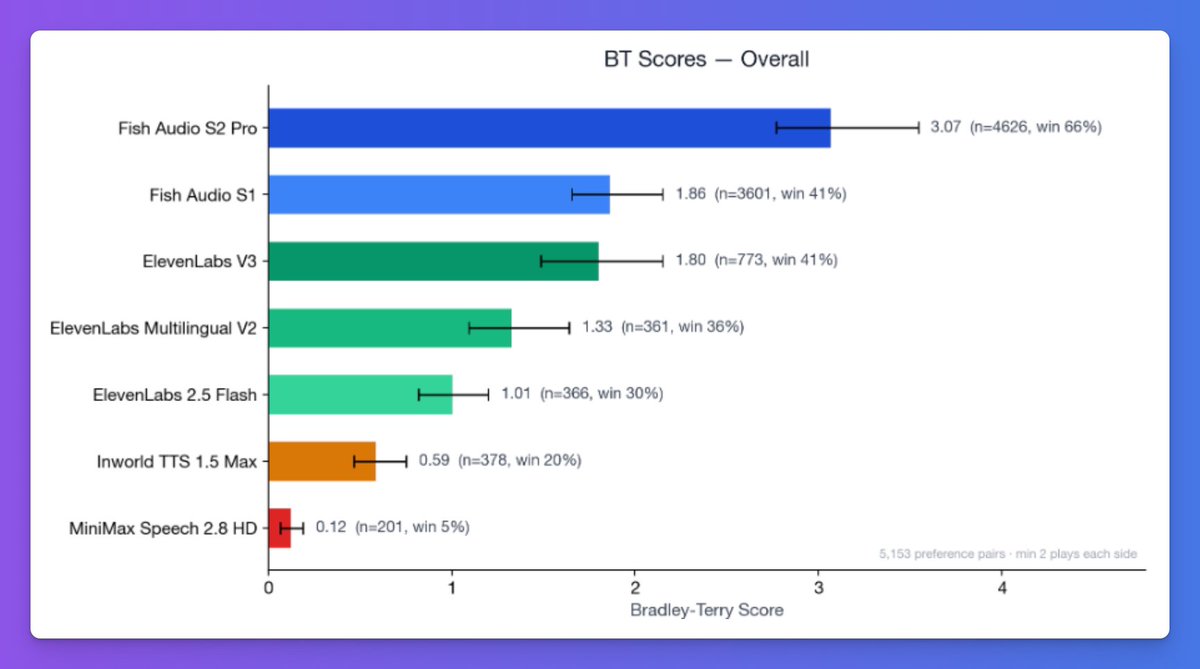
@JayminSOfficial said (223 likes, 22,025 views, 39 bookmarks) that Fish Audio's S2.1 Pro shows the "open-source as growth engine" playbook extending into enterprise voice AI. A separate same-day chart shared by @DataChaz showed (21 likes, 3 replies, 607 views) Fish Audio S2 Pro posting the highest Bradley-Terry score in the visible comparison set at 3.07, ahead of ElevenLabs V3 at 1.80 and the older Fish Audio S1 at 1.86, reinforcing the launch claims about quality rather than only price.
@HuggingApps highlighted (24 likes, 2 replies, 1,055 views, 24 bookmarks) Microsoft's VibeVoice-ASR-BitNet as a 1.58-bit multilingual transcription model built for real-time CPU inference. The linked Hugging Face Space makes the positioning explicit: "Multilingual CPU-only ASR with a 1.58-bit BitNet decoder."
@onton_ai announced (28 likes, 13 replies, 1,474 views, 15 bookmarks) Ontology 1 as a "successor architecture for search." Onton's public benchmark page says the system won 52 of 90 intent-heavy e-commerce queries outright and reached 63.0% top-10 accuracy versus Google Shopping's 54.3% and Amazon's 46.9%, despite indexing only 1% of their catalog. That is a different path to AI leverage than general-purpose frontier models: tighter scope, better problem framing, and domain-specific evaluation.
Discussion insight: The sharpest response to these launches was not anti-open-source. It was demands for reproducibility and deployment realism: actual phone latency, actual encoder cost, and observable quality differences rather than brand-level claims.
Comparison to prior day: July 28's open-weight storyline was still centered on Kimi K3 as a single frontier event. July 29 spread the same energy across deployable components: phone VLMs, CPU ASR, open voice stacks, and vertical search systems.
1.4 Frontier governance moved from abstract safety rhetoric into Washington process (🡕)
The day's policy conversation was less about general AI-safety sentiment and more about concrete federal timing: model previews, executive-branch process, and a public pacing request from insiders.
@imjustnewatai argued (77 likes, 6 replies, 6,832 views, 22 bookmarks) that Sam Altman's Washington visit mattered because he said OpenAI was in DC to preview a new model while also agreeing with many principles in the "Pacing the Frontier" letter. The linked materials make the post more than speculation: the Pacing the Frontier site explicitly asks government to help develop the technical and governance tools needed to deliberately pace frontier-wide automated AI development, and the reply links a White House page describing federal work around advanced-model evaluation and security.
@CNN reported (8 likes, 6 replies, 12,642 views) the same open-letter story independently: top staffers from major AI and tech companies urged the U.S. government to slow the pace of AI development so safety and security measures can catch up. That second source matters because it shifts the theme from one user's synthesis into a broader public narrative.
@OpenAIDevs and @prathamgrv made the backdrop harder to dismiss as theater. One showed GPT-5.6 Sol improving the economics of its own serving loop; the other pointed (31 likes, 1 reply, 1,236 views, 14 bookmarks) to an execution-grounded automated AI research paper where an LLM proposes model-improving ideas, code turns those ideas into experiments, GPUs run them, and results feed back into future idea generation. The governance question is no longer only whether models get stronger; it is how quickly automated systems start helping drive that strengthening.
Discussion insight: The replies were split between excitement about an imminent new model and uncertainty about the positive case for more caution. The disagreement was not whether the signaling was deliberate, but what concrete vision lies on the other side of "pace the frontier."
Comparison to prior day: July 28's policy fight centered on open weights versus restrictions. July 29 shifted from philosophy to process: Washington meetings, named public letters, federal benchmark channels, and public arguments about deliberate pacing.
2. What Frustrates People
Benchmark numbers keep arriving without the context needed to trust them
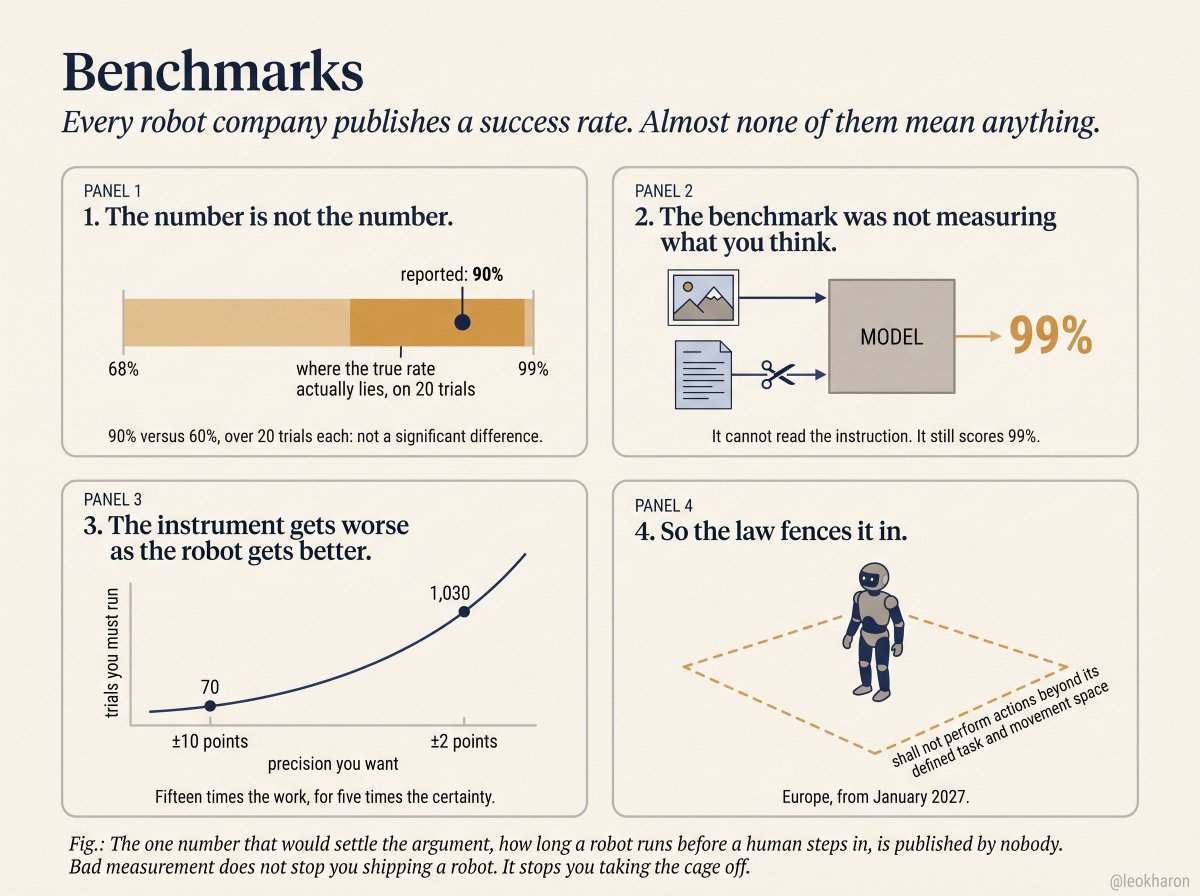
Severity: High. The clearest frustration in the dataset is not that benchmarks exist, but that they omit the details that would make them decision-useful. @lagerskoy argued (20 likes, 114 views, 14 bookmarks) that some coding-agent architectures look state-of-the-art only until someone adds cost and proper holdouts, at which point one architecture becomes 50x more expensive than a retry loop for no significant gain and 12 of 17 benchmarks fail proper holdout design. In robotics, @LeoKharon argued (4 likes, 146 views, 2 bookmarks) that a reported 90% success rate on 20 trials hides a true-rate range of 68-99%, that a model can score 99% on one benchmark split without reading the instruction, and that tightening precision from plus/minus 10 points to plus/minus 2 points requires roughly 1,030 trials instead of 70. Even the compact-model launches were hit with the same complaint in miniature: a reply to @qvac's VisionPsy thread asked for real phone latency in milliseconds and the encoder cost rather than a broad “best in class” claim. People cope by demanding retry baselines, asking for benchmark breakdowns, and treating vendor-friendly scorecards as incomplete until cost and deployment details are visible. This is worth building for because the pain spans LLM agents, robotics, and edge models rather than one subcommunity.
Agent usefulness still depends on everything around the model
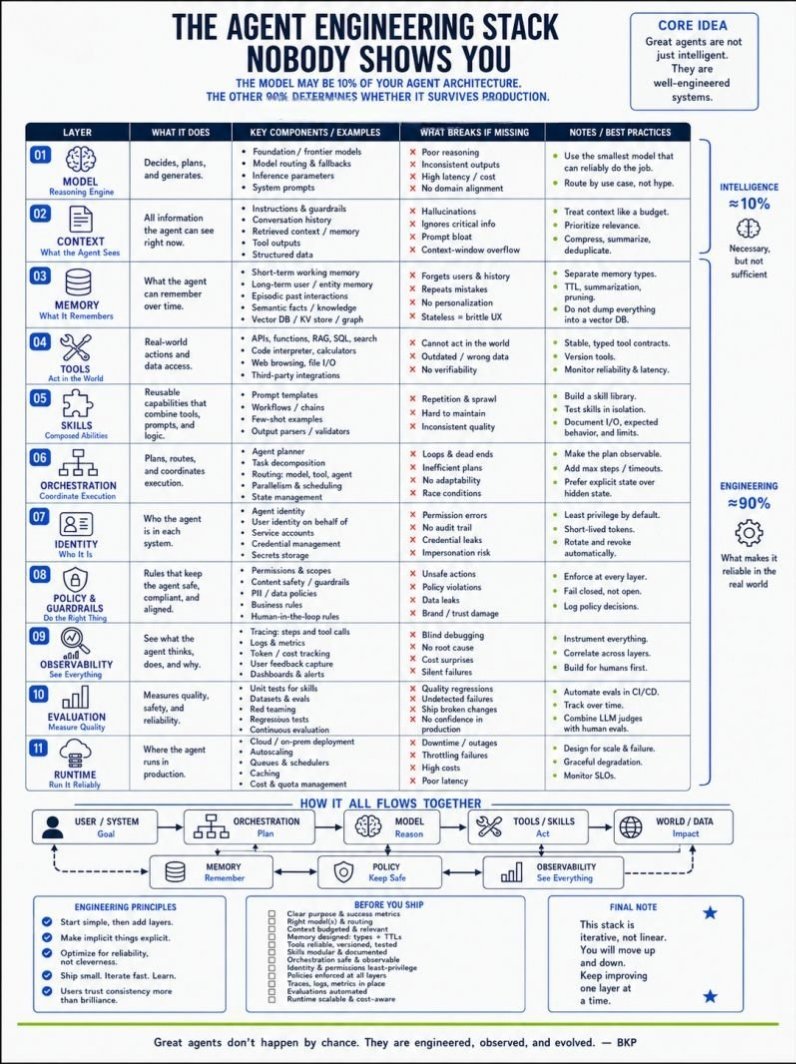
Severity: High. Several posts converged on the same systems complaint: a powerful model is not enough to make an agent reliable. @gregisenberg said Buzz is “alpha software” and “slow in places” even while praising its underlying context-first design, which is a direct admission that product shape and runtime quality are lagging behind ambition. @HeyAnjula argued (4 likes, 198 views) that the model is only about 10% of a production agent system and the other 90% is context, memory, tools, orchestration, identity, guardrails, observability, evaluation, and runtime. The existence of tools like baseten-switch, Replit's selector, and book-to-skill points to the same gap from different angles: teams do not want to keep rewriting harnesses, manually re-explaining context, or choosing models one workflow at a time. The workaround today is layering more software around the model; the opportunity is making those layers boring, reliable, and reusable.
Metered AI economics are hard to see before they become a budget problem
Severity: Medium-High. @OpenAIDevs reported internal efficiency gains because 20% lower serving cost and 15%+ better token-generation efficiency now count as product news, not back-office implementation detail. @neil_xbt framed this at the buyer level as “knowledge per dollar,” arguing that the model which is slightly worse but much cheaper wins long-running agent workloads. The replies around Replit's selector and Baseten Switch made the frustration operational: users asked for token-cost displays, licensing clarity, cache-hit handling, and easy rollback to the native model. People are already coping with routing layers and cheaper upstream models, but the repeated requests for visibility suggest the pain is not choosing a model once — it is monitoring spend continuously after the choice.
3. What People Wish Existed
Durable context that agents can reuse instead of relearning every session
What people are asking for, implicitly and explicitly, is not just a larger context window but a context layer that survives. Buzz's whole selling point is that "context is the foundation" and that live application data should keep flowing back into the agent, while @RituWithAI highlighted (8 likes, 3 replies, 166 views, 6 bookmarks) book-to-skill precisely because it turns long-form documents into a reusable SKILL.md that Claude Code, Cursor, and Codex can carry forward. @HeyAnjula treats context, memory, and skills as separate missing layers, which suggests this is a practical need rather than a philosophical one. Rated: direct opportunity, because current posts already show both the pain and early attempts at a productized fix.
Routing that optimizes for capability and cost at the same time
The Replit selector, baseten-switch, and the “knowledge per dollar” framing all imply the same wish: let me keep my workflow while the system picks the right model and shows me what it costs. @pirroh promised model recommendations and effort levels, but the sharpest reply immediately asked to see token costs. @ahmetb built a routing layer that preserves Claude Code and Codex while swapping the upstream model, which only makes sense if model choice and spend control remain painful enough to justify extra infrastructure. Rated: competitive opportunity, because multiple solutions already exist, but users still want better visibility and less manual tuning.
Evaluation and pacing mechanisms that still work when systems improve themselves
The day's posts reveal a wish for benchmarks and governance that do not break as soon as agents become cheaper, more autonomous, or more self-improving. @OpenAIDevs showed one model improving its own serving economics; @prathamgrv shared an execution-grounded automated AI research loop; the Pacing the Frontier site asks for technical and governance tools to deliberately pace frontier-wide progress; and both @lagerskoy and @LeoKharon argue current benchmarks are too weak to anchor major decisions. Rated: aspirational opportunity, because the need is clear but the full solution spans tooling, standards, and policy.
4. Tools and Methods in Use
| Tool | Category | Sentiment | Strengths | Limitations |
|---|---|---|---|---|
| Buzz | Agent workspace | (+/-) | Context-first design, live app-data loop, audio huddles, local compute sharing | Still described as alpha and slow by a same-day advocate |
| GPT-5.6 Sol in Codex | Frontier LLM / coding agent | (+/-) | Demonstrated 20% lower serving cost and 15%+ token-efficiency gains inside OpenAI's own stack | Users asked what “more useful work” means and why the gains are not obvious to them |
| Grok Build Mode | Prompt-to-app builder | (+) | Builds and publishes websites, apps, games, and dashboards directly in chat | Early Beta, limited to SuperGrok Heavy |
| Baseten Switch | Routing gateway | (+) | Keeps Claude Code/Codex workflow intact while swapping upstream models; adds request-path and spend-oriented controls | Beta macOS app; replies asked about licensing, cache hits, and endpoint behavior |
| Replit model selector | Model-routing UI | (+/-) | Hides choice overload with recommended versions and effort levels | Users still want explicit token-cost visibility |
| VisionPsy-Nano | On-device VLM | (+/-) | Open weights, strong ~0.5B benchmark results, phone-oriented Flash variant | Replies demanded concrete latency milliseconds and encoder-cost transparency |
| Fish Audio S2.1 Pro | Voice model / TTS | (+) | 83+ languages, ~90ms latency, open-weight/on-prem positioning, strong visible BT score | Current-day evidence is still launch-era and comparison-heavy rather than broad field usage |
| VibeVoice ASR BitNet | Speech recognition / ASR | (+) | Multilingual CPU-only deployment with a 1.58-bit decoder | Evidence today is mostly the HF demo and announcement, not many user reports |
| Ontology 1 | Vertical search model | (+/-) | Beats Google/Amazon on intent-heavy queries despite tiny catalog; domain-specific reasoning | Benchmark still depends on judge-based scoring and a narrow domain |
| book-to-skill | Agent knowledge packaging | (+) | Turns books and long documents into reusable SKILL.md artifacts for coding agents |
Very early project with minimal observed adoption so far |
Overall satisfaction was highest where tools reduced switching cost or deployment cost without asking users to abandon their existing workflow. The most common workaround was not “pick one best model,” but “keep the harness stable and route, compress, or package around it”: cheaper open models behind Claude Code/Codex, reusable SKILL.md knowledge instead of re-prompting, and smaller voice/vision components that move work off the cloud. The competitive dynamic is increasingly split between frontier labs selling flagship capability, and a layer of products above and below them selling routing, packaging, domain focus, or hardware efficiency.
5. What People Are Building
| Project | Who built it | What it does | Problem it solves | Stack | Stage | Links |
|---|---|---|---|---|---|---|
| Buzz | Jack Dorsey's team, via @gregisenberg | Agent workspace positioned as a Slack alternative with model swapping, audio huddles, app building, and live context loops | Collaboration tools do not keep agent context, live product state, and local-model workflows in one place | Buzz workspace, swappable models, live app-data loop, local compute sharing | Alpha | post, video |
| Grok Build Mode | xAI | Builds websites, apps, games, and dashboards live in chat and publishes them to links | Turns prompt-based ideation into shareable software without setup | Grok, web/iOS/Android, in-chat code generation, link publishing | Beta | launch, post |
| Baseten Switch | @ahmetb | Local gateway that reroutes Claude Code and Codex to Baseten-hosted models | Lets teams keep the same coding harness while arbitraging model cost/performance | macOS app, Baseten, Claude Code, Codex, GLM 5.2 / Kimi K3 | Beta | post, GitHub |
| VisionPsy-Nano | @qvac | 460M on-device vision-language model family with quality and Flash variants | Brings OCR, visual perception, and reasoning onto phones and offline workflows | SigLIP2, SmolLM2, GGUF, llama.cpp, vLLM | Shipped | post, blog |
| Fish Audio S2.1 Pro | @FishAudio | Open-weight voice model with fast cloning and controllable delivery | Cuts cost and latency for real-time voice agents while preserving self-hosting/on-prem options | Open-weight TTS, on-prem deployment | Shipped | post, site |
| VibeVoice ASR BitNet | Microsoft | CPU-only multilingual ASR demo | Real-time transcription without GPU dependency | 1.58-bit BitNet decoder, CPU-only Hugging Face Space | Beta | post, demo |
| Ontology 1 | @onton_ai | Neurosymbolic search model for intent-heavy and multimodal shopping queries | Keyword and vector search miss taste-heavy, negated, and multi-constraint search intent | Neurosymbolic model, Ograph graph database | Shipped | post, research, benchmarks |
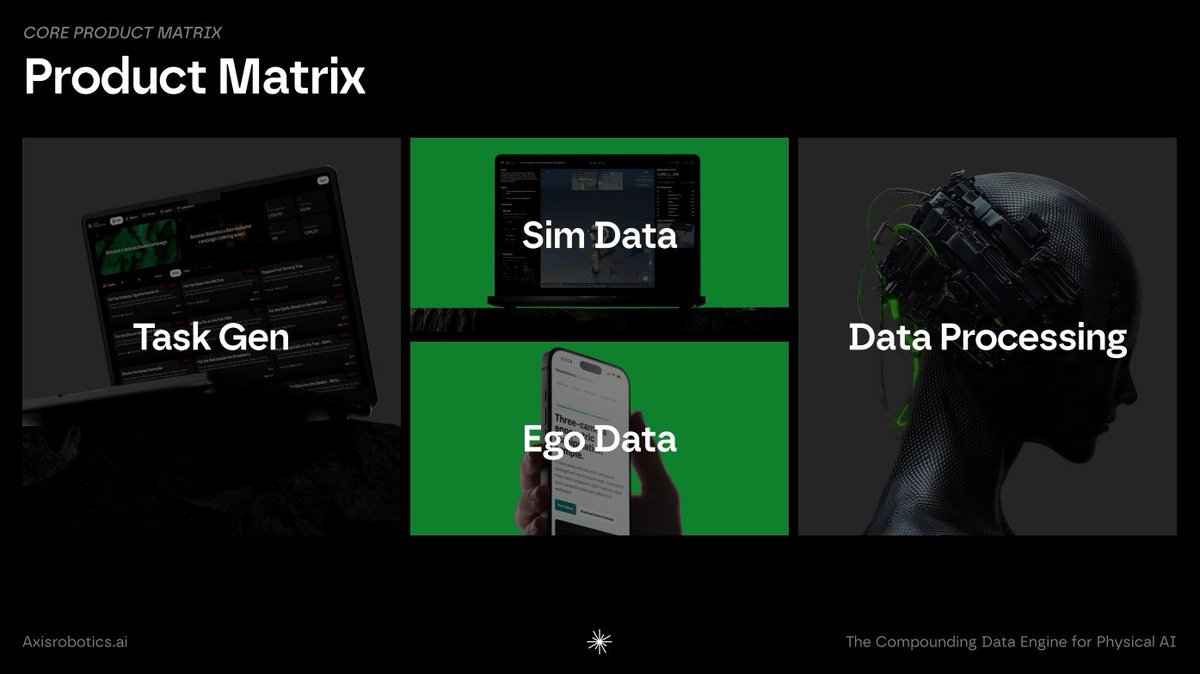
| Axis data engine | @axisrobotics | Task generation, simulation collection, egocentric capture, and data processing loop for robotics | Turns robotics data collection and corrective post-training into a compounding pipeline | Browser teleop, HG-DAgger, open-source infrastructure | Beta | post, GitHub |
The repeated build pattern was not “invent a new foundation model from scratch.” It was “change the economics or usability around an existing workflow”: Grok and Buzz shorten the path from idea to live artifact; Baseten Switch and Replit-style selectors keep the coding harness fixed while the upstream model changes; VisionPsy, Fish Audio, and VibeVoice reduce the hardware footprint enough to move work onto phones, CPUs, or on-prem voice stacks.
Onton's Ontology 1 and Axis Robotics point to a second pattern: domain-specific compounding loops. Ontology claims better search quality by reasoning over a tighter domain and learning from intent-heavy queries, while Axis explicitly connects task generation, simulation collection, egocentric data, and deployment feedback into one improvement flywheel. Those are materially different from general chatbot products because the value comes from structured data feedback, not only from a stronger base model.
6. New and Notable
Training-data contamination became observable instead of hypothetical
@DropSiteNews reported (176 likes, 4,995 views, 13 bookmarks) that sites tied to a propaganda campaign had already been archived 912 times by Common Crawl, one of the repositories used to train large language models. The attached chart is what makes the claim notable: it shows the archive count ramping from effectively zero in January to roughly 280 in April and roughly 350 in May before staying elevated in June, turning “future model influence” from an abstract poisoning worry into a visible ingestion pattern.

Execution-grounded automated AI research moved from slogan to paper diagram
@prathamgrv shared (31 likes, 1 reply, 1,236 views, 14 bookmarks) a paper on automating AI research where an LLM proposes improvements, a system turns those ideas into code, GPU experiments run them, and the results feed back into future idea generation. The paper screenshot matters because it surfaces more than a vague “agents can do research” claim: the abstract and figure describe a concrete implementer-scheduler-worker loop and visible result deltas, including 69.4% vs 48.0% on post-training and 19.7 minutes vs 35.9 minutes on one pre-training recipe.

Packaging books into reusable agent skills emerged as a small but revealing pattern
@RituWithAI surfaced (8 likes, 3 replies, 166 views, 6 bookmarks) book-to-skill, a tiny open-source project that turns books and long documents into a reusable SKILL.md file for Claude Code, Cursor, and Codex. It is notable less because of its current size than because it reveals where agent builders think leverage will come from next: not one more prompt template, but durable, portable knowledge packaged in the format agent runtimes already know how to load.
7. Where the Opportunities Are
[+++] Cost-visible routing and observability for multi-model agent stacks — Evidence from multiple sections points the same way: baseten-switch exists to reroute Claude Code/Codex without changing the harness, Replit users explicitly asked to see token costs before choosing models, @neil_xbt reframed the decision as “knowledge per dollar,” and @lagerskoy argued some published agent architectures become indefensible once price is shown. This is the strongest opportunity because the demand is already phrased in operational terms, not just theory.
[++] Durable context, memory, and skill packaging for agents — Buzz sells a live context loop, book-to-skill tries to turn documents into reusable SKILL.md assets, and @HeyAnjula explicitly names context, memory, skills, and orchestration as the missing 90% of agent systems. The market need is direct, but it is still early enough that no dominant product pattern has won.
[++] Local voice and multimodal components for privacy-sensitive production workloads — VisionPsy-Nano, Fish Audio S2.1 Pro, and VibeVoice ASR BitNet all push the same direction: smaller models that can run on phones, CPUs, or on-prem voice stacks while keeping useful capability. The opportunity is strong because the demand drivers are tangible — lower latency, lower hardware cost, and less cloud exposure — rather than aspirational.
[+] Benchmark hardening for agents and robotics — The dataset includes coding-agent complaints about absent holdouts, robotics complaints about meaningless success rates, and edge-model complaints about missing real-device latency numbers. This looks like a durable need, but it is more fragmented than the cost-routing opportunity because it spans many subdomains with different evaluation failure modes.
[+] Training-data provenance and crawl monitoring — The Common Crawl archive chart shared by @DropSiteNews is only one item, but it is unusually concrete. It suggests an emerging niche for tooling that tracks what public data is entering future training corpora and flags manipulation before it hardens into model behavior.
8. Takeaways
- The strongest AI product pitch on July 29 was “ship with context,” not “ship the smartest model.” Buzz, Grok Build Mode, and
book-to-skillall sold persistent context, live state, or reusable knowledge as the thing that makes agents feel useful. (source) - Cost-per-outcome is overtaking benchmark prestige as the operative buying metric. OpenAI highlighted serving-cost reductions,
baseten-switchshipped routing and spend controls, and “knowledge per dollar” was treated as more decision-useful than a one-shot leaderboard result. (source) - Open-weight momentum is dispersing into smaller, deployable components rather than one giant flagship narrative. VisionPsy-Nano targeted phones, VibeVoice targeted CPU-only ASR, and Fish Audio targeted real-time voice economics. (source)
- Vertical and domain-specific systems are carving out credible ground against general incumbents. Ontology 1's public benchmark page claims better top-10 accuracy than Google Shopping and Amazon on intent-heavy queries despite indexing only 1% of their catalog. (source)
- Washington-facing frontier governance is becoming more procedural and less abstract. The pacing letter, White House policy page, and same-day DC model-preview chatter all show a shift from generic safety debate toward named public processes and benchmark channels. (source)
- Training-data provenance is starting to become a first-class concern. The Common Crawl archive chart gave a concrete example of how influence campaigns can move from search manipulation into future model-training inputs. (source)