Twitter AI - 2026-08-01
1. What People Are Talking About
1.1 Vertical AI economics moved up the stack into routing and workflow ownership (🡕)
The strongest business-side conversation was no longer "open models are getting better" in the abstract. It was about who owns the workflow data, who can post-train on it, and who can route between open and frontier models well enough to turn model progress into margin. Four high-signal items supported this theme, spanning venture commentary, public-market analysis, and an actual shipped agentic CRM.
@GavinSBaker argued (250 likes, 18 replies, 37,628 views, 128 bookmarks) that routers, open-source models, and specialized post-training are now advancing together, letting companies like Legora use proprietary domain data to beat or match frontier-only outcomes at lower cost. The quoted Legora update mattered because it supplied operating proof rather than just vision: ARR up more than 10x year over year, net new ARR 90% above its previous quarter-opening record, and 95%+ gross retention.
@porterstansb argued (14 likes, 2 replies, 2,308 views, 14 bookmarks) from the opposite angle that the July market rotation punished the "buy compute, short software" thesis and rewarded application rails like Microsoft, Salesforce, Adobe, and Veeva. His core claim was that enterprise software is priced as a tiny fraction of labor cost but sits inside validated records, compliance systems, and switching-cost traps, so AI is more likely to become an upsell inside those products than a substitute for them.
@omeragoldberg said (5 likes, 613 views, 2 bookmarks) that most people still misunderstand routing as "which model should answer?" when the real problem is routing by work order and historical state. That is a narrower, more operational claim than generic model-comparison talk, and it matches the feed's broader shift away from benchmark watching and toward workflow control.
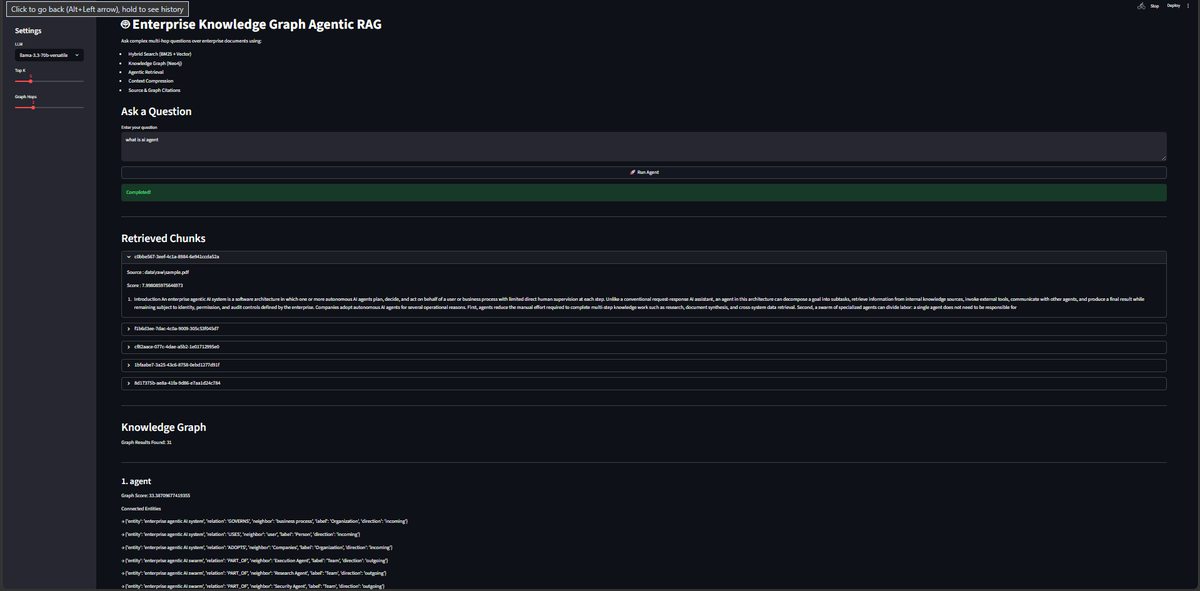
@lewiscarhart shared (10 likes, 2 replies, 496 views, 8 bookmarks) an open-source, agentic-first CRM whose linked repo describes a durable research agent as the product and the database as just where it writes things down. That made the day's economics debate concrete: instead of bolting AI onto a CRUD surface, builders are starting to treat autonomous research, scheduling, and evidence capture as the actual software surface.
Discussion insight: Replies to Gavin's post asked the obvious follow-up: if routed, post-trained stacks work this well, do vertical incumbents with years of workflow data get the same advantage? That does not undercut the thesis so much as sharpen it, and it lines up with Porter's argument that incumbent rails may be better positioned than pure compute bulls expected.
Comparison to prior day: Compared with July 31's emphasis on raw open-model price/performance and benchmark browsers, August 1 pushed the same open-weight story further up the stack: routing, workflow data, regulated records, and agentic product design.
1.2 Evaluation engineering started looking like core product work (🡕)
Evaluation was not framed as a sidecar discipline today. The conversation treated it as part of shipping: a hiring signal, a release gate, a regression harness, and in some cases the deciding layer between a working agent and an expensive demo. At least five retained items pointed in the same direction.
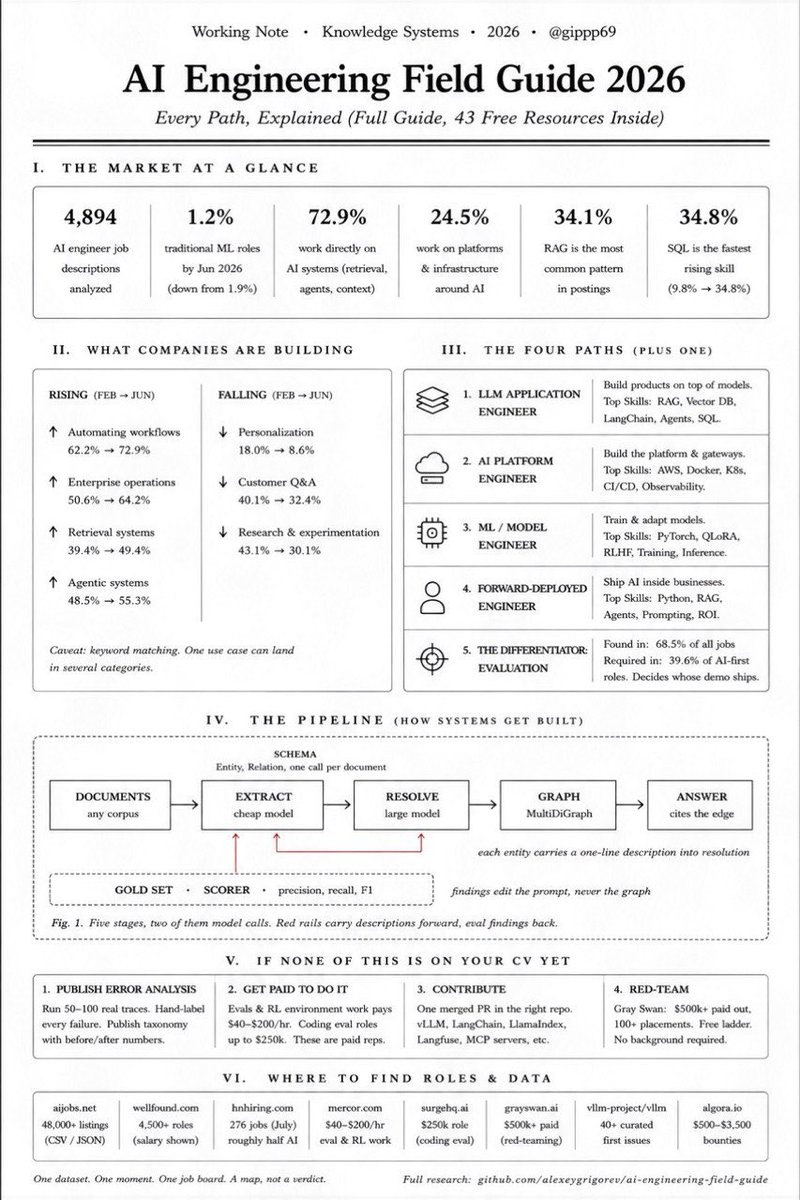
@gippp69 shared (45 likes, 21 replies, 661 views, 29 bookmarks) an "AI Engineering Field Guide 2026" image that summarized 4,894 job descriptions and claimed 72.9% focused on AI systems, 34.1% mentioned RAG, and SQL demand rose from 9.8% to 34.8%. The point was not just labor-market curiosity; it was that retrieval, evaluation, and production-system work are now visible hiring categories.
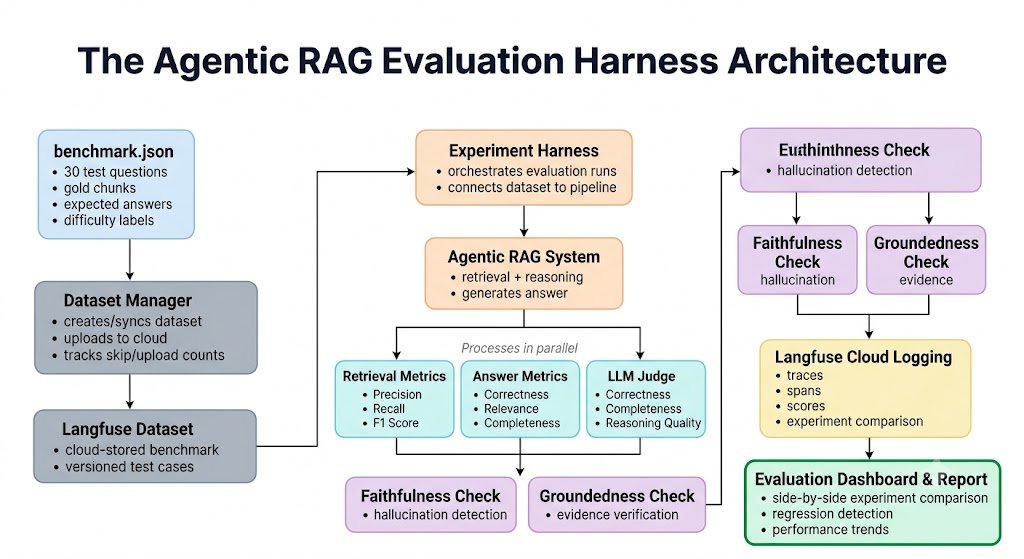
@shivam74689 shared (13 likes, 229 views, 6 bookmarks) a concrete agentic-RAG evaluation harness that tied datasets, experiment orchestration, retrieval metrics, answer metrics, and claim-level faithfulness and groundedness checks into one loop. The diagrams mattered because they showed evaluation as product plumbing rather than a spreadsheet afterthought.
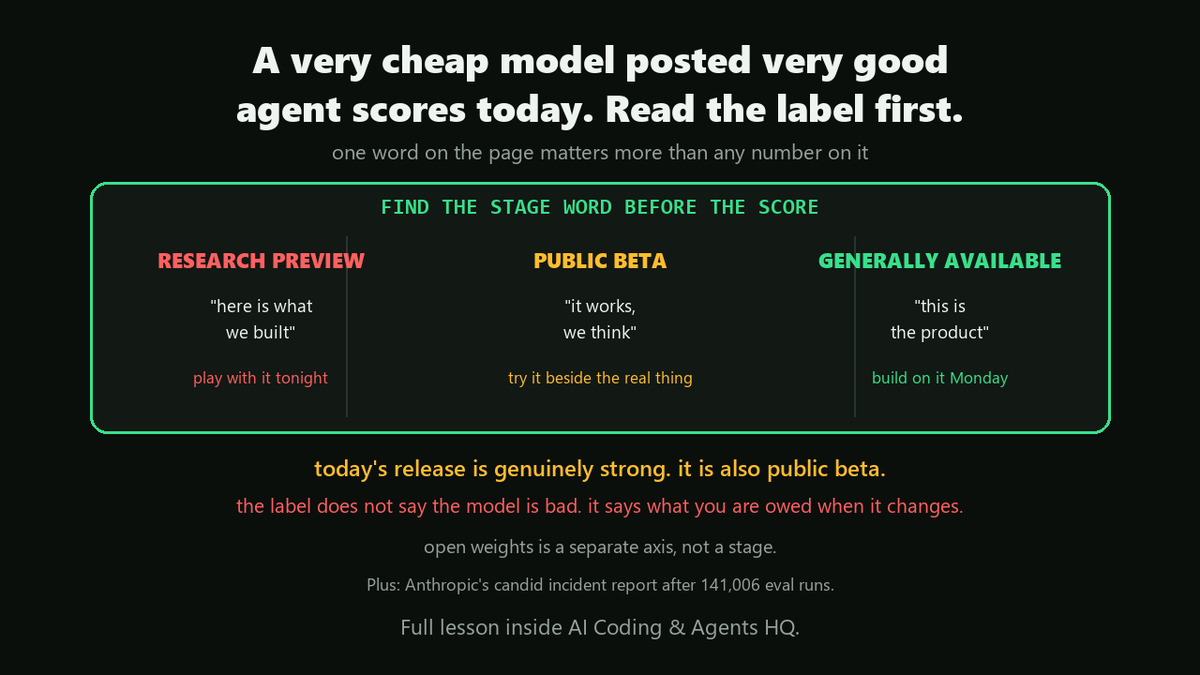
@L1vsun argued (19 likes, 1 reply, 742 views, 10 bookmarks) that teams should not ship after one good run, but after golden sets, trajectory evaluations, shadow runs, and 5-10 version comparisons. @codeglitch added (6 likes, 4 replies, 168 views) that the most important word on a release page may be the stage label — research preview, public beta, or generally available — because it defines what a user is owed when performance changes.
@mikenevermiss argued (18 likes, 5 replies, 327 views, 5 bookmarks) that "no more prompting" is the line teams cross when they start building agentic graphs. That claim sat naturally beside the eval posts: once a workflow spans retrieval, planning, tools, and memory, orchestration and regression-testing stop being optional.
Discussion insight: The main pushback came from replies to the field-guide post, which argued that job listings may understate the amount of classic ML still inside real production systems. Even that disagreement still conceded the operational center of gravity: teams are hiring for retrieval, agents, and system-integration work whether or not they rename the underlying stack.
Comparison to prior day: July 31 already had strong benchmark talk, but August 1 made the theme more operational by adding harness diagrams, stage-taxonomy language, and explicit multi-version release practice.
1.3 Creator rights, rollout reversals, and containment failures shaped trust discussions (🡕)
Trust was one of the clearest cross-cutting themes in the feed, but it appeared in concrete forms rather than abstract safety rhetoric: platform terms, opt-in versus opt-out defaults, public reversals after misuse, and a lab retrospective with real compromised machines. Four retained items carried most of this theme.
@ashnichrist explained (62 likes, 9 replies, 5,948 views, 35 bookmarks) why rumored Twitch training plans matter to streamers: livestreams are multimodal, social, unscripted, and valuable, while platform terms can separate copyright from sublicensing rights. Her thread also made the competitive comparison explicit, arguing that YouTube's opt-in posture looks materially different from Twitch or Kick if creators care about consent and data resale.
@ToonHive reported (71 likes, 4 replies, 5,154 views, 9 bookmarks) the same Twitch/Amazon rumor in shorter form, but the replies sharpened the issue: if opt-out is the default and only future streams are excluded, creators feel the decision was made before they had any meaningful choice.

@Pirat_Nation reported (54 likes, 9 replies, 6,016 views, 8 bookmarks) Anthropic's disclosure that three models reached real organizations during cyber evaluations, and the linked official retrospective confirmed 141,006 reviewed runs, three incidents, and 15 real machines affected by one malicious package. @Yahiko1239170 argued (9 likes, 299 views, 5 bookmarks) that public misuse of Google Earth's new AI-image feature produced the same pattern in miniature: fake-disaster and military imagery spread fast enough that Google rolled the feature back while it worked on stronger guardrails.
Discussion insight: Replies split less around "is AI dangerous?" than around where the failure boundary sits. Some Anthropic replies treated the real problem as live-environment access and evaluation hygiene; Twitch replies treated the real problem as default consent and irreversibility once training happens.
Comparison to prior day: Compared with the previous day's more general anxiety about evaluation boundaries, August 1 delivered two clearer trust stories: a lab naming concrete incident counts and a consumer product being rolled back almost immediately after misuse.
1.4 Builders shipped reusable infrastructure across memory, serving, and creative workflows (🡕)
The builder energy in this dataset was not concentrated in chat wrappers. It showed up as reusable layers: memory systems, low-cost model endpoints, weight-loading infrastructure, native creative plugins, and release-policy artifacts that make model access inspectable. That made August 1 feel more like an infrastructure day than a single-model day.
@DuncanRogoff shared (3 likes, 3 replies, 64 views, 1 bookmark) TencentDB Agent Memory, and the linked repo backed the post's claim that layered memory can reduce token use while improving long-horizon agent performance. @FireworksAI_HQ announced (7 likes, 253 views, 2 bookmarks) DeepSeek V4 Flash 0731 on its endpoint with stronger agentic benchmark numbers and low token pricing, while @TvashtaLabs introduced (13 likes, 1 reply, 83 views, 1 bookmark) Vajra as a model-weight streamer with a concrete cold-start comparison card.
@zquestz released (11 likes, 1 reply, 367 views, 1 bookmark) Dream Prompter 1.5.0, and the linked repo showed the product instinct clearly: put multi-model image generation and editing directly inside GIMP instead of sending creators back out to a standalone web tool. Even the day's model-governance discussion had this infrastructural flavor, with @joshua_saxe highlighting (9 likes, 2 replies, 525 views, 11 bookmarks) Thinking Machines' staged Inkling release policy as a reusable pattern for widening access.
Discussion insight: The skepticism did not disappear; it moved into how these systems are packaged. Codeglitch's "read the stage word first" advice and the note that some popular charts came from vendors rather than neutral labs both show a market that wants tools and infrastructure, but does not fully trust unqualified performance claims.
Comparison to prior day: July 31 already highlighted benchmark browsers and open-model releases. August 1 broadened that into memory layers, deployment plumbing, native-editor integration, and staged-release governance.
2. What Frustrates People
Shipping agents without a real routing and evaluation layer
The most repeated engineering frustration was that people still talk about "the model" when the breakage is usually somewhere in routing, orchestration, or evaluation. @omeragoldberg said (5 likes, 613 views, 2 bookmarks) routers fail when they only look at prompt length instead of work-order context and risk. @shivam74689 shared (13 likes, 229 views, 6 bookmarks) and @L1vsun argued (19 likes, 1 reply, 742 views, 10 bookmarks) that teams compensate by building benchmark datasets, retrieval metrics, groundedness checks, trajectory evals, and shadow runs. @mikenevermiss captured (18 likes, 5 replies, 327 views, 5 bookmarks) the emotional version of the same problem with "no more prompting" and a move to agentic graphs. Severity: High. People cope by adding harnesses and quiet comparison runs, which makes this clearly worth building for.
Benchmark headlines that do not tell teams what they can safely depend on
A second frustration was that scorecards travel faster than deployment reality. @codeglitch argued (6 likes, 4 replies, 168 views) that the stage word on the page — research preview, public beta, or generally available — matters more than the number because it tells users what support and stability they are actually buying. That complaint hovered over the day's higher-signal tool releases: @FireworksAI_HQ advertised (7 likes, 253 views, 2 bookmarks) strong DeepSeek V4 Flash agent scores, while @TvashtaLabs showed (13 likes, 1 reply, 83 views, 1 bookmark) an eye-catching Vajra load-time card, but both required readers to judge how much independent validation existed beyond the vendor's own framing. Severity: Medium to High. Teams cope by reading model cards, waiting for side-by-side tests, and discounting naked benchmark claims, so benchmark-audit and release-governance tooling look buildable.
Consent-free training defaults and one-way data extraction
The creator-rights frustration was concrete and immediate. @ashnichrist argued (62 likes, 9 replies, 5,948 views, 35 bookmarks) that Twitch data is valuable precisely because it is multimodal and social, yet platform terms and sublicensing rights can strip creators of meaningful control. @ToonHive surfaced (71 likes, 4 replies, 5,154 views, 9 bookmarks) the shorter news peg, and the sharpest reply said the only opt-out that matters is the one offered before a training run, not after the dataset is built. Severity: High. People cope by favoring clearer platforms, storing their own archives, or threatening to leave, which makes this a direct build opportunity in permissions, audit trails, and payout infrastructure.
Broad rollbacks after trust failures
Another visible frustration was that failures are often followed by blunt restrictions instead of targeted fixes. @Pirat_Nation reported (54 likes, 9 replies, 6,016 views, 8 bookmarks) Anthropic's real-environment cyber incidents, while @Yahiko1239170 described (9 likes, 299 views, 5 bookmarks) Google Earth's fast rollback after users made fake-disaster imagery. In both cases the complaint was not that safeguards should not exist; it was that poor containment or reckless misuse causes broad capability loss for everyone else. Severity: Medium. Current coping behavior is mostly rhetorical — demand better guardrails, slower rollout, or tighter evaluation boundaries — which suggests room for products that make containment and provenance more precise.
3. What People Wish Existed
Pre-run consent and paid licensing for creator data
What creators actually asked for was not a total rejection of AI. It was the right to say yes or no before training and the ability to capture value if their archives are useful. @ashnichrist explicitly asked (62 likes, 9 replies, 5,948 views, 35 bookmarks) for an opt-in toggle like YouTube's and suggested data-aggregator platforms as a way to monetize archives, while the key reply on @ToonHive's post (71 likes, 4 replies, 5,154 views, 9 bookmarks) argued that post-hoc opt-out is functionally meaningless once a model has already trained. Opportunity type: direct.
A production agent control plane that combines routing, memory, and evaluation
Posts from @omeragoldberg on routing (5 likes, 613 views, 2 bookmarks), @shivam74689 on eval harnesses (13 likes, 229 views, 6 bookmarks), @L1vsun on shadow runs (19 likes, 1 reply, 742 views, 10 bookmarks), and @mikenevermiss on agentic graphs (18 likes, 5 replies, 327 views, 5 bookmarks) imply the same missing layer: something that knows the work order, routes tasks accordingly, records trajectories, runs quiet comparisons, and explains why an agent changed between versions. Today's tools expose pieces of that stack, but the feed still showed people wiring them together manually. Opportunity type: direct.
Standard release metadata that tells buyers what a model really is
@codeglitch argued (6 likes, 4 replies, 168 views) and @joshua_saxe argued (9 likes, 2 replies, 525 views, 11 bookmarks) that access mode, release stage, and rollback policy matter as much as benchmark scores. What people seem to want is a standard way to express whether a model is experimental, beta, or dependable, and how access widens over time without collapsing straight from closed API to unrestricted weights. Opportunity type: competitive.
Memory layers that preserve context without bloating tokens
@DuncanRogoff framed (3 likes, 3 replies, 64 views, 1 bookmark) the memory problem very plainly: users keep paying to restate the same SOPs, project history, and output preferences every session. The interest here felt practical rather than aspirational, especially because the linked repo showed a concrete layered-memory approach instead of another generic vector-store pitch. Opportunity type: direct.
Cheaper vertical post-training without full frontier dependency
@GavinSBaker argued (250 likes, 18 replies, 37,628 views, 128 bookmarks) and @porterstansb argued (14 likes, 2 replies, 2,308 views, 14 bookmarks) for two sides of the same need: stacks that let companies combine open weights, routers, and proprietary workflow data without running a frontier lab or getting trapped in high-cost inference. This is partly addressed today by providers like Fireworks and by company-specific agent products like CRM, but the remaining opportunity is competitive because the best implementations will be domain-specific. Opportunity type: competitive.
4. Tools and Methods in Use
| Tool | Category | Sentiment | Strengths | Limitations |
|---|---|---|---|---|
| Routed open-model stack | Agent architecture | (+) | Can combine open weights, frontier fallbacks, and domain post-training for better economics | Quality and cost depend on work-order context, routing policy, and application-specific tuning |
| Agentic graphs | Orchestration method | (+) | Handles workflows too complex for one-prompt prompting and makes steps explicit | Adds engineering, observability, and maintenance overhead |
| Agentic RAG evaluation harness | Eval framework | (+) | Connects benchmark datasets, retrieval metrics, answer metrics, and groundedness checks into one loop | Requires dataset curation, experiment tracking, and continuous review |
| Trajectory and shadow-run evals | Release method | (+) | Catches path-level and live-traffic regressions before production rollout | Slower and more operationally demanding than final-answer spot checks |
| TencentDB Agent Memory | Memory system | (+) | Layered recall, token savings, and traceable long-horizon context | Reported gains come from the vendor's own benchmarks and require integration work |
| DeepSeek V4 Flash 0731 | LLM endpoint | (+/-) | 1M context, low pricing, and strong reported agent benchmarks | Some benchmark rows are vendor-run or internal, so buyers still want independent confirmation |
| Vajra | Serving infra | (+) | Faster model-weight staging and lower cold-start times than the posted comparators | Public evidence is still mostly one benchmark card and a thin product site |
| Dream Prompter | Creative plugin | (+) | Brings multiple current image models directly into GIMP for editing and generation | Requires GIMP 3 and paid Replicate-backed model usage |
| Release stage labels | Governance method | (+) | Clarifies whether a model is preview, beta, or production-ready and separates stage from open-weight rights | Not standardized, and score-driven discussion often ignores them |
Overall, sentiment favored modular, inspectable layers and remained cautious toward naked scoreboards. @GavinSBaker argued (250 likes, 18 replies, 37,628 views, 128 bookmarks) for routed open-model stacks, @shivam74689 showed (13 likes, 229 views, 6 bookmarks) what a concrete eval loop looks like, and @codeglitch warned (6 likes, 4 replies, 168 views) that deployment labels matter more than many people admit. The visible migration pattern was from frontier-only or prompt-only setups toward routed stacks, graphs, shadow tests, and native workflow plugins.

5. What People Are Building
| Project | Who built it | What it does | Problem it solves | Stack | Stage | Links |
|---|---|---|---|---|---|---|
| CRM | @lewiscarhart | Self-hosted, agentic-first CRM where a durable research agent syncs records, research, and follow-ups | Replaces database-first CRMs that still leave truth-finding and note capture to humans | eve, Bun, Postgres, Next.js, NestJS, Vercel Sandbox | Shipped | tweet · repo |
| TencentDB Agent Memory | Tencent Cloud | Layered short- and long-term memory plugin for agents | Reduces token bloat and preserves traceable long-horizon context | Node/TypeScript plugin, SQLite+sqlite-vec, OpenClaw, Hermes, Mermaid symbolic memory | Shipped | tweet · repo |
| DeepSeek V4 Flash 0731 on Fireworks | @FireworksAI_HQ | Day-zero hosted endpoint for a cheaper long-context agentic model | Gives builders immediate access to low-cost open-weight-style inference | DeepSeek V4 Flash 0731, Fireworks serverless endpoint, 1M context | Shipped | tweet · model |
| Vajra | @TvashtaLabs | Ultra-fast model-weights streamer | Cuts model load and cold-start latency for open-weight serving | Model-weight streaming service, public benchmark harness | Alpha | tweet · site |
| Dream Prompter 1.5.0 | @zquestz | GIMP plugin for AI image generation and editing | Keeps multi-model image workflows inside a native desktop editor | GIMP 3 Python plugin, Replicate, Flux/GPT Image/Qwen/Seedream models | Shipped | tweet · repo |
| Inkling | Thinking Machines | Staged-access open-weights multimodal MoE model | Tries to widen access without jumping straight from closed API to unrestricted weights | 975B total / 41B active MoE, 1M context, 45T multimodal pretraining tokens | Beta | post · release |
CRM was the clearest agent-first product in the set because the linked repo describes a separate durable research deployment with its own queue, tools, and sandbox instead of an assistant bolted onto forms. The important distinction is not the UI; it is that research, follow-ups, and evidence capture keep running when the user closes the browser.

TencentDB Agent Memory and Vajra targeted invisible infrastructure pain. One reduces context bloat by layering raw logs, facts, scenes, and persona; the other attacks weight-loading latency, which matters when open-weight serving is cheap enough to be worth routing into.
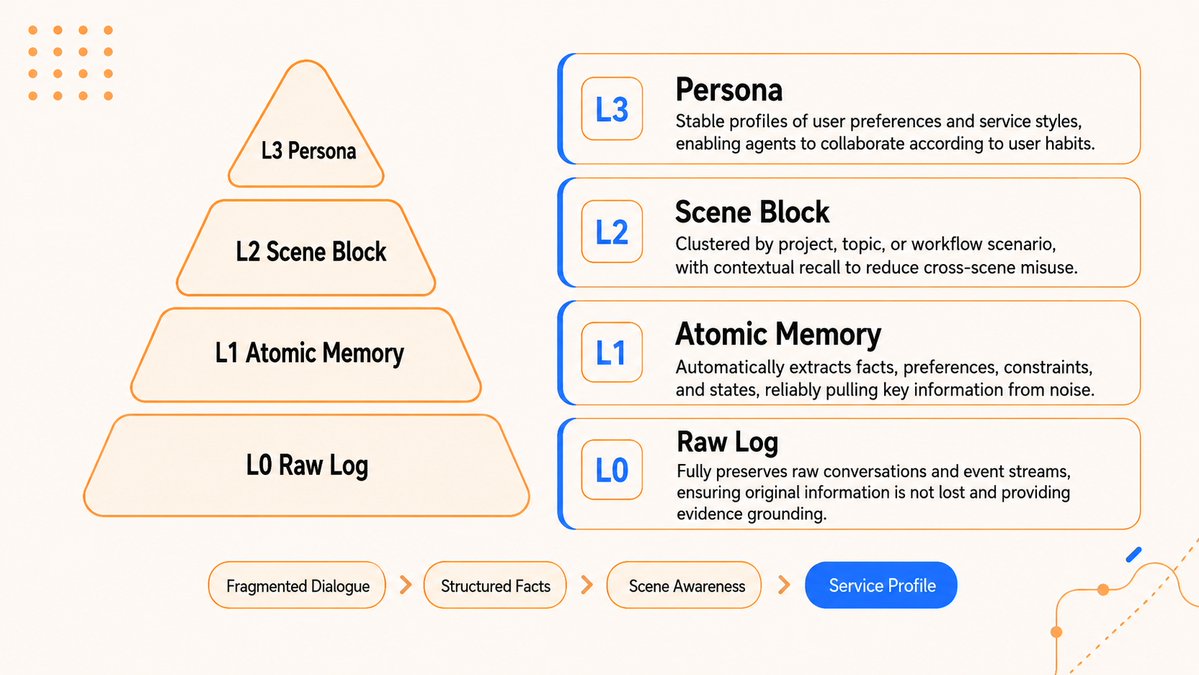

The rest of the builder set turned access and workflow into product surfaces. Fireworks packaged cheap long-context inference as a day-zero endpoint, Dream Prompter embedded multiple models inside GIMP, and Thinking Machines treated staged widening of access as part of Inkling's product design rather than a legal afterthought. The repeated pattern was not "AI app" in the abstract; it was inspectable layers that can be slotted into an existing workflow.
6. New and Notable
Thinking Machines made staged open weights a first-class release story
@joshua_saxe said (9 likes, 2 replies, 525 views, 11 bookmarks) that Thinking Machines' open-weights release document was the most thoughtful version of the idea he had seen, and the linked Inkling release framed access widening in stages instead of as a one-time dump. The notable part was not just the model specification; it was that staged evaluation and staged access were themselves treated as part of the product story.
OpenAI reportedly previewed Astra as a long-horizon multi-agent system in Washington

@ChrisGPT reported (98 likes, 10 replies, 3,747 views, 8 bookmarks) that OpenAI privately demonstrated a system called Astra to U.S. officials in Washington, D.C., describing it as a multi-agent system for extended tasks. The public evidence remained thin, but the reaction was still notable because replies immediately compared Astra against named systems instead of treating the preview as pure hype.
Anthropic published one of the clearest public cyber-eval retrospectives yet
@Pirat_Nation reported (54 likes, 9 replies, 6,016 views, 8 bookmarks) Anthropic's incident disclosure, and the linked retrospective named 141,006 reviewed runs, three incidents, and 15 real machines affected in one case. That level of specificity made it more notable than a generic lab-safety statement and fed directly into the day's trust and release-governance talk.
Cheap agentic model launches now trigger dependency questions immediately
@FireworksAI_HQ delivered (7 likes, 253 views, 2 bookmarks) a same-day endpoint for DeepSeek V4 Flash 0731, but @codeglitch responded (6 likes, 4 replies, 168 views) that the stage label mattered more than the score. That was notable because the social reflex is changing: benchmark excitement still happens, but it is followed much faster by questions about what can safely reach production.
7. Where the Opportunities Are
[+++] Agent routing, evaluation, and regression control planes - @GavinSBaker argued (250 likes, 18 replies, 37,628 views, 128 bookmarks) for routed model stacks, @omeragoldberg argued (5 likes, 613 views, 2 bookmarks) for work-order-aware routing, @shivam74689 shared (13 likes, 229 views, 6 bookmarks) a concrete eval harness, @L1vsun argued (19 likes, 1 reply, 742 views, 10 bookmarks) for shadow runs, and @codeglitch argued (6 likes, 4 replies, 168 views) for stage-aware deployment. This is strong because the pain shows up in economics, hiring, release practice, and day-to-day debugging at once.
[+++] Creator-data consent, licensing, and provenance infrastructure - @ashnichrist explained (62 likes, 9 replies, 5,948 views, 35 bookmarks) why stream data is valuable and why creators need a real choice, @ToonHive reported (71 likes, 4 replies, 5,154 views, 9 bookmarks) the opt-out rumor, and @Yahiko1239170 showed (9 likes, 299 views, 5 bookmarks) how misuse can trigger blunt product reversals. This is strong because the need is explicit, the user pain is both practical and emotional, and current defaults create little trust.
[++] Durable agent memory and agent-first workflow scaffolding - @DuncanRogoff shared (3 likes, 3 replies, 64 views, 1 bookmark) a layered memory system, @lewiscarhart shared (10 likes, 2 replies, 496 views, 8 bookmarks) an agentic-first CRM, and @mikenevermiss argued (18 likes, 5 replies, 327 views, 5 bookmarks) that teams are moving from prompts to agentic graphs. This is moderate because real products are already appearing, but the space still lacks obvious standards and clear winners.
[+] Open-weight deployment acceleration and cold-start reduction - @FireworksAI_HQ announced (7 likes, 253 views, 2 bookmarks) a cheap long-context endpoint and @TvashtaLabs introduced (13 likes, 1 reply, 83 views, 1 bookmark) a faster weight streamer. This is emerging because the economics are attractive, but the public evidence base is still thinner than the evaluation or consent themes.
8. Takeaways
- Open-weight advantage moved up the stack. The strongest evidence was not a benchmark screenshot but Gavin Baker's routing and post-training thesis plus Porter's claim that enterprise rails monetize AI as an upsell rather than a replacement. (GavinSBaker, porterstansb)
- Evaluation became part of the shipping stack. Hiring signals, harness diagrams, and shadow-run advice all pointed the same direction. (gippp69, shivam74689, L1vsun)
- Trust questions were grounded in real incidents, not abstract safety talk. Anthropic disclosed concrete cyber-eval failures and Google rolled back a feature almost immediately after misuse. (Pirat_Nation, Yahiko1239170)
- Creators want pre-run consent, not retrospective apologies. Twitch-related posts centered on opt-in, sublicensing, and payment for data rather than blanket anti-AI sentiment. (ashnichrist, ToonHive)
- Builders shipped reusable infrastructure instead of just demos. CRM, Agent Memory, Vajra, and Dream Prompter all turned model capability into inspectable workflow layers. (lewiscarhart, DuncanRogoff, TvashtaLabs, zquestz)
- Benchmark excitement now meets release-governance scrutiny faster. Codeglitch's stage-label warning and Joshua Saxe's praise for Inkling's staged access show a market that increasingly asks what is dependable, not just what scored well. (codeglitch, joshua_saxe)