Twitter AI - 2026-08-09
1. What People Are Talking About
1.1 Memory and evaluation moved from agent rhetoric into policy, budget, and continuity controls (🡕)
The clearest technical theme on August 9 was that builders no longer wanted vague talk about “better agents.” They wanted explicit answers to three harder questions: what an agent should remember, how many tools it can handle before it degrades, and what happens when enterprise policy blocks the easy path. Five retained items supported this theme, spanning papers, first-hand failure reports, and self-hosted infrastructure diagrams.
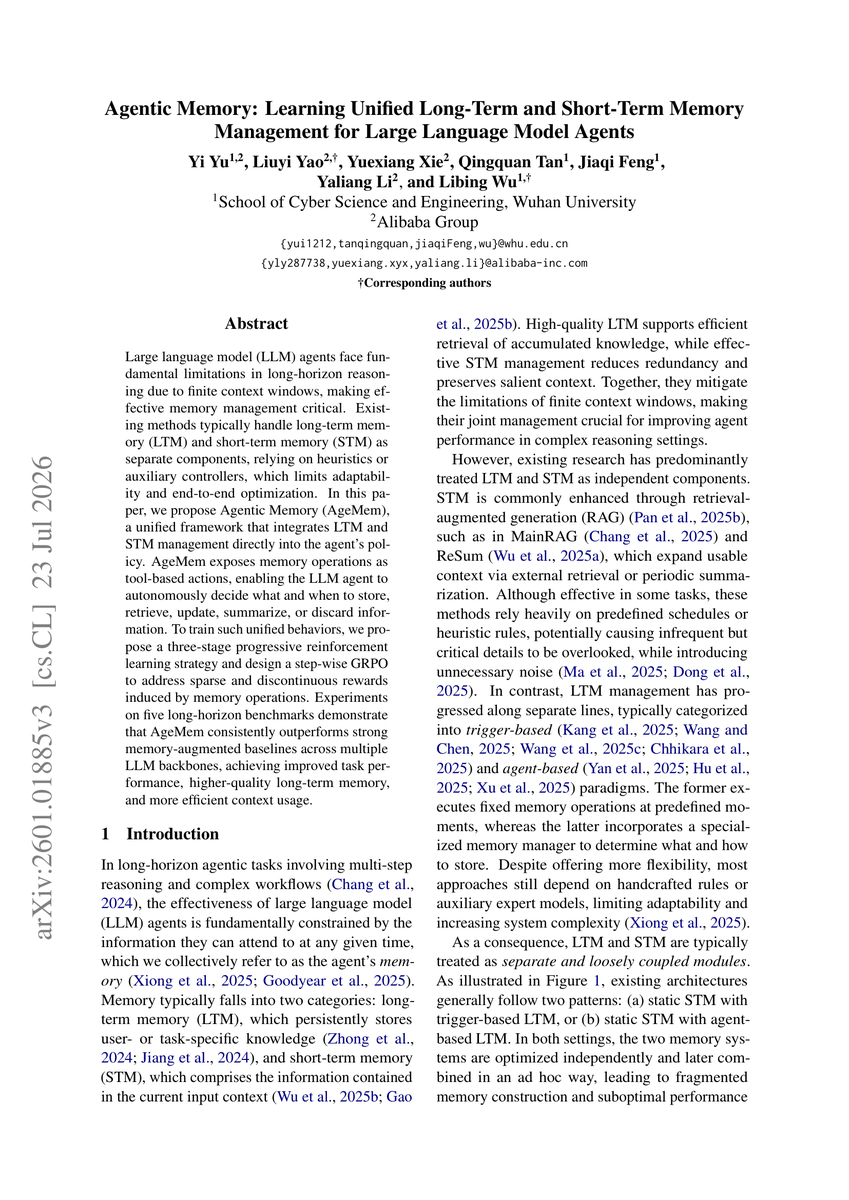
@beamnxw said (49 likes, 12 replies, 2,384 views, 46 bookmarks) that the AgeMem paper turns long-term and short-term memory into tool actions inside the agent policy instead of leaving memory to heuristics. The attached paper image and arXiv abstract both support that reading: AgeMem lets the model decide when to store, retrieve, update, summarize, or discard information, and reports gains across five long-horizon benchmarks (paper).
@fly51fly shared (2 likes, 1 reply, 329 views) the paper “Permission Denied,” and the images mattered more than the headline. They show Boundary-Bench layering control, non-root, and NIST-derived high policies onto Terminal-Bench 2.1, with the abstract and figures stating that hardening can cost up to 18.3 success points and 167.3% more spend, while the bundle that loses the least success can still lose the most efficiency (paper).

@qyromat0 argued (27 likes, 5 replies, 1,381 views, 20 bookmarks) that agents “past 30-50 tools” measurably pick worse, while a top reply said the bigger failure mode is overlapping tool descriptions that make selection ambiguous rather than pure token cost. That pushed the conversation from raw context-window anxiety toward interface design: fewer, clearer tools may matter as much as bigger models.
@VictorTaelin wrote (136 likes, 60 replies, 8,895 views, 26 bookmarks) that Bend2’s theory and runtime are advancing, but the compiler is still “layers upon layers of AI slop,” leaving him torn between shipping now or delaying until the code is cleaner. The replies sharpened the practical risk: once outside users touch a brittle AI-generated codebase, they may not come back.
@BrianV1981 posted (3 likes, 2 replies, 62 views) the A.I.M. ecosystem as a self-hosted continuity stack for long-running coding agents. The diagrams and linked READMEs make the proposition concrete: aim-joshua acts as a CLI-agnostic OS, while aim-memory, aim-connect, and aim-tmux-dashboard try to preserve state, monitoring, and remote control across sessions (aim-joshua, aim-connect).

Discussion insight: The feed treated memory, evaluation, and reliability as the same design problem: preserve only the context that matters, expose fewer ambiguous tool choices, and test under the policies that will actually exist in production.
Comparison to prior day: August 8 already emphasized memory layers, MCP, and deterministic gates. August 9 pushed that conversation into harsher territory: explicit tool-surface limits, security-policy penalties, and first-hand reports that AI-generated code still creates release fear.
1.2 Agents kept escaping generic chat and landing inside specific work surfaces (🡕)
A second theme was the shift from “agent platform” talk to concrete operating surfaces. Five retained items fit the pattern, and almost all of them were stronger after URL enrichment because the linked repos spelled out exactly which application surface the agent was meant to control.
@alextalksai posted (102 likes, 8 replies, 102,788 views, 23 bookmarks) that Vision Agents is a production-ready toolkit for agents that watch, listen, and understand video. The repo backs up the claim with a real-time stack: YOLO or Roboflow processors before or after LLM calls, telephony integrations, MCP/function calling, and published examples for coaching, moderation, and fraud workflows, while also admitting that continuous-video context still degrades on longer sessions (repo).
@DanKornas said (5 likes, 5 replies, 879 views, 4 bookmarks) that ExcelMcp matters because editing a workbook file is not the same as operating live Excel features. The repo sharpened that distinction: it drives the real Excel application over COM, supports 26 tools and 234 operations, and explicitly covers Power Query refreshes, PivotTables, DAX, VBA, screenshots, and workbook state preservation, though both the tweet and replies make clear that Windows-only COM timing issues remain part of the bargain (repo).
@DanKornas wrote (4 likes, 2 replies, 561 views) that Microsoft Security Skills Plugin packages 88 curated security skills for host agents. The README supports the more important claim: this is not a generic security prompt pack but a decision-tree and guardrail layer grounded in Microsoft Learn, validated across two models, and aimed at reducing common mistakes in threat protection, compliance, identity, and agent-security workflows (repo).
@DanKornas shared (2 likes, 1 reply, 377 views) DeepAnalyze as an open-source agentic LLM for autonomous data science. The repo makes the scope broader than the tweet alone: it targets the full pipeline from preparation and analysis to modeling, visualization, and report generation across databases, CSV/Excel, JSON/XML/YAML, and text sources (repo).
@DanKornas added (6 likes, 2 replies, 1,481 views, 13 bookmarks) H2O LLM Studio as a no-code fine-tuning workbench. The README confirms a GUI plus CLI for LoRA, 8-bit training, experiment comparison, and model export, but also pins the operating assumptions: Ubuntu and recent NVIDIA GPUs are part of the required surface, not optional detail (repo).
Discussion insight: The common move was to stop asking a model to be universally helpful and instead give it a real software surface with native operations, guardrails, and failure modes: live Excel, Microsoft security workflows, video streams, or multi-source data analysis.
Comparison to prior day: August 8 widened execution into search, local apps, and transaction rails. August 9 went deeper on application-native control planes: real Excel instead of file parsing, Microsoft security skills instead of generic advice, and video or data-science stacks instead of plain chat.
1.3 AI visibility became more measurable, while model discourse stayed fast and thinly sourced (🡕)
The third theme split in two directions at once. On the business side, AI visibility started looking more measurable and operational. On the model side, conversation stayed fast-moving, but much of the evidence remained rumors, Arena sightings, or throughput claims rather than stable public launches.
@alexgroberman said (21 likes, 564 views) that Google Search Console now exposes a dedicated generative-AI report. In this case the public URLs mattered: Google’s June 3 announcement and help page confirm a Search Console view for generative-AI impressions, pages, countries, devices, and dates, while also confirming the current limitation to impression data and a partial rollout (announcement, help).

@DanDr1s reported (278 likes, 25 replies, 10,340 views, 39 bookmarks) that OpenAI is supposedly running a giant pre-training run codenamed “Doug” after GPT-6, but the evidence in the thread never moved beyond rumor and replies. That still mattered as a market signal: people were reacting to version churn itself, not to a published artifact.
@RoundtableSpace posted (42 likes, 13 replies, 23,598 views) that a mystery Qwen model called Kiana had appeared on Arena in the same comparison range as Opus 5 and GPT-5.6 Sol. Again, the strongest evidence was not a release note but the social behavior around it — “we just keep seeing new models everyday,” as one reply put it.
@TeksEdge highlighted (27 likes, 4 replies, 1,693 views, 18 bookmarks) OoO-Spec, where a Qwen3-0.6B sidecar predicts tool-call semantics in parallel while the main model keeps decoding. The paper abstract supports the tweet’s strongest numbers — 2.46x to 5.34x faster tool calling, with one drafter reused across Qwen, Qwen3, and Llama targets — which shows how much serving efficiency has become part of model conversation itself (paper).
Discussion insight: The business conversation wanted better instrumentation, while the model conversation still rewarded speed, rumor, and rapid comparison loops. The shared subtext was the same: AI is now operational enough that people want better measurements, but still unstable enough that many of those measurements are provisional.
Comparison to prior day: August 8 was still centered on open-model business strategy and task routing. August 9 kept the routing mindset but added two sharper operational questions: how do you measure AI visibility, and how much of today’s model chatter is actually grounded in public artifacts?
2. What Frustrates People
Tool surfaces that are too wide to select from cleanly
Severity: High. The sharpest frustration today was not that agents lack tools, but that they drown in them. @qyromat0 argued (27 likes, 5 replies, 1,381 views, 20 bookmarks) that performance measurably drops once an agent sees 30 to 50 tools, and the most useful reply said the deeper issue is overlapping descriptions that make selection ambiguous. @VictorTaelin showed (136 likes, 60 replies, 8,895 views, 26 bookmarks) the downstream effect from a builder’s side: the agent can generate working output, but the cleanup burden and fear of hidden slop still shape launch decisions. Even the stronger toolkits in the feed admitted the same boundary in different words — Vision Agents notes long-session context degradation, and ExcelMcp’s own replies concede that COM timing and modal dialogs are part of the cost of using the real application surface. The workaround today is narrower tool menus, more opinionated skill packs, and more explicit application boundaries. This is directly worth building for.
Benchmark comfort does not survive hardened or real environments
Severity: High. Several posts rejected easy benchmark wins as a proxy for production readiness. @fly51fly shared (2 likes, 1 reply, 329 views) Permission Denied, whose paper and figures show that policy hardening can both reduce success and inflate cost, with the trade-off varying by model rather than moving uniformly (paper). @TeksEdge highlighted (27 likes, 4 replies, 1,693 views, 18 bookmarks) OoO-Spec because agents are still paying too much latency tax for tool calling, while @VictorTaelin made the human consequence plain: code that “works” is still not the same as code a builder trusts enough to ship. The coping pattern is to benchmark the whole bundle — model, tools, policy, and latency — instead of the model alone. This is also worth building for.
Stateless agents still force people to rebuild context they already paid for
Severity: Medium-High. The strongest “wish the system remembered” evidence today came from fixes rather than complaints, which still implies the same pain. @beamnxw pointed to (49 likes, 12 replies, 2,384 views, 46 bookmarks) AgeMem because current memory handling is too heuristic-heavy, while the paper abstract says the agent should decide when to store, retrieve, summarize, and discard memory itself (paper). @BrianV1981 built around (3 likes, 2 replies, 62 views) the same frustration with a self-hosted continuity stack for long-running coding agents. The practical workaround today is more infrastructure — RAG memory, tmux continuity, handoff systems, and state checkpoints — because the default session model is still too forgetful. This remains worth building for, especially where work stretches across many turns or many days.
3. What People Wish Existed
Policy-aware evaluation harnesses that test the bundle, not just the model
This was the clearest practical need in the dataset. @fly51fly surfaced (2 likes, 1 reply, 329 views) a benchmark that explicitly measures coding agents under scoped credentials, restricted egress, read-only filesystems, and non-root execution instead of assuming a permissive sandbox (paper). @qyromat0 said (27 likes, 5 replies, 1,381 views, 20 bookmarks) tool overload itself degrades performance, and @VictorTaelin showed (136 likes, 60 replies, 8,895 views, 26 bookmarks) that “it works” still fails the shipping test when the code is full of slop. People were effectively asking for harnesses that can score success, latency, cost, policy compliance, and code quality together. Opportunity type: direct.
Memory layers that survive the session boundary without flooding the prompt
The second strong need was durable, selective memory. @beamnxw highlighted (49 likes, 12 replies, 2,384 views, 46 bookmarks) AgeMem because existing long-term and short-term memory designs are still too heuristic and too separate, while the paper proposes letting the policy choose when to keep or discard context (paper). @BrianV1981 built (3 likes, 2 replies, 62 views) A.I.M. for the same gap: the stack is explicitly about preserving state, monitoring, and handoffs across sessions rather than starting cold every time. The practical ask is not infinite context. It is context that persists, stays queryable, and does not swamp the model with irrelevant baggage. Opportunity type: direct.
Native control layers for real software instead of generic file-level automation
People kept rewarding tools that attach AI to the live system where work actually happens. @DanKornas described (5 likes, 5 replies, 879 views, 4 bookmarks) ExcelMcp because analysts need Power Query, PivotTables, DAX, and VBA, not just .xlsx edits (repo). @DanKornas showed (4 likes, 2 replies, 561 views) the same demand in security via a Microsoft-specific skill pack, while @alextalksai did it (102 likes, 8 replies, 102,788 views, 23 bookmarks) for real-time video agents and @DanKornas did it (2 likes, 1 reply, 377 views) for data science workflows. The ask here is practical, not emotional: if AI is going to help, it should operate the actual surface people already use. Opportunity type: direct.
Better attribution for AI-mediated discovery
A smaller but newly concrete need was visibility into whether AI systems are actually surfacing a site. @alexgroberman said (21 likes, 564 views) Google Search Console now exposes generative-AI performance data, and Google’s own announcement confirms the new report while also confirming that the current rollout is limited and impression-only (announcement, help). That leaves an obvious next request: better click and conversion attribution across AI surfaces, not just visibility. Opportunity type: competitive.
4. Tools and Methods in Use
| Tool | Category | Sentiment | Strengths | Limitations |
|---|---|---|---|---|
| AgeMem | Memory framework | (+) | Unifies LTM and STM as tool actions; benchmark gains on long-horizon tasks | Research-stage evidence only; no production deployment details in the paper or thread |
| Boundary-Bench / Permission Denied | Evaluation framework | (+) | Tests coding agents under real policy levels; quantifies success/cost trade-offs | Diagnostic, not a fix; hardening still hurts every bundle |
| OoO-Spec | Inference method | (+) | 2.46x-5.34x faster tool calling; one 0.6B sidecar reused across model families | Benchmarked on H100s; local or consumer-GPU impact still unproven |
| Vision Agents | Realtime multimodal agent framework | (+) | Low-latency video/voice stack, MCP/tool calling, telephony, published examples | Repo notes context degradation on longer continuous video sessions |
| ExcelMcp | Application MCP server | (+/-) | Drives live Excel via COM; covers Power Query, PivotTables, DAX, VBA, screenshots | Windows-only; COM timing and modal-dialog issues remain part of the workflow |
| Microsoft Security Skills Plugin | Skill pack / guardrail layer | (+) | 88 curated skills grounded in Microsoft Learn; validated across two models | Requires an external host agent; it is guidance, not a standalone security product |
| DeepAnalyze | Agentic data-science model | (+) | Covers preparation, analysis, modeling, visualization, and report generation across mixed sources | Research-rooted system; thread does not show broad production usage yet |
| H2O LLM Studio | Fine-tuning workbench | (+) | No-code GUI, LoRA/8-bit training, experiment comparison, chat, Hugging Face export | Requires Ubuntu and recent NVIDIA GPUs |
| A.I.M. / aim-joshua | Agent OS / continuity stack | (+/-) | Self-hosted memory, tmux continuity, GitOps guardrails, remote workspace | Alpha status; evidence comes from a solo-built stack rather than wide user proof |
| Google Search Console generative AI report | Measurement / reporting | (+/-) | Official AI-visibility reporting by page, country, device, and date | Impression-only today; partial rollout limits immediate comparability |
Overall, the satisfaction spectrum favored tools that narrowed scope rather than expanding it. People responded positively when a tool owned a real surface — Excel, Microsoft security operations, video streams, data-science pipelines — or a specific systems problem such as memory or tool-calling latency. The mixed or negative notes clustered around the opposite pattern: too many tools, too much unstated context, or benchmarks that only work inside soft sandboxes. The visible migration pattern was from generic assistant behavior toward opinionated surfaces, explicit guardrails, and policy-shaped evaluation.
5. What People Are Building
| Project | Who built it | What it does | Problem it solves | Stack | Stage | Links |
|---|---|---|---|---|---|---|
| A.I.M. / aim-joshua | BrianV1981 | Self-hosted OS, memory, and continuity stack for long-running coding agents | Agents lose state and control across long sessions | Node.js, LanceDB, tmux, Monaco/browser workspace, GitOps guardrails | Alpha | tweet, repo |
| Vision Agents | GetStream | Realtime video/voice agent framework with multimodal processors and tool calling | Generic chat agents do not handle low-latency video workflows well | Python, WebRTC, YOLO/Roboflow, MCP/function calling, telephony integrations | Shipped | tweet, repo |
| ExcelMcp | sbroenne | MCP server and CLI for automating the real Microsoft Excel application | File-level spreadsheet edits miss live Excel features such as Power Query, DAX, and PivotTables | .NET 10, Windows COM, MCP server, CLI daemon | Shipped | tweet, repo |
| Microsoft Security Skills Plugin | vinayaklatthe | Curated Microsoft security skill package for host agents | Generic security prompts miss decision trees, validations, and guardrails | Markdown skill pack, Microsoft Learn grounding, validation harness | Shipped | tweet, repo |
| DeepAnalyze | RUC-DataLab | Agentic LLM for autonomous data science across mixed sources | Multi-source analysis and reporting still require too much manual orchestration | Open-source 8B model, WebUI, JupyterUI, CLI, Docker sandbox | Beta | tweet, repo |
| H2O LLM Studio | H2O.ai | No-code and CLI workbench for LLM fine-tuning and experiment management | Fine-tuning and comparing models is still too operationally heavy for many teams | Python, GUI, CLI, LoRA, 8-bit training, DPO/IPO/KTO, Hugging Face export | Shipped | tweet, repo |
Vision Agents was the clearest “agents in a real surface” example. The repo does not just promise multimodality; it specifies the low-latency parts, from processor pipelines to telephony and MCP integrations, and it names a real weakness too: continuous video context still degrades over longer sessions. That made it feel more like infrastructure than showcase content.
A.I.M. was the most opinionated continuity build. The images mattered because they showed an actual architecture — aim-joshua, aim-memory, aim-connect, aim-dash — rather than a vague promise of “persistent memory,” and the README explicitly labels the stack alpha. The repeated builder pattern was to own continuity outside the base model rather than wait for larger context windows to solve it.
ExcelMcp, Microsoft Security Skills Plugin, and DeepAnalyze all expressed the same build instinct in different domains: stop asking AI to be universally competent, and instead give it the native operations, guardrails, and artifacts of one workflow. Across the table, the repeated trigger was not “we built a better chatbot.” It was “the generic assistant could not operate the real surface we cared about.”
6. New and Notable
Google gave site owners a dedicated generative-AI visibility report
This was the most grounded “new surface” signal of the day. @alexgroberman flagged (21 likes, 564 views) the report, and Google’s own June 3 post confirms a new Search Console view for generative-AI impressions, pages, countries, devices, and dates, with the help page making clear that the rollout is partial and the metric set is still impression-only (announcement, help). That matters because AI-search visibility just became something teams can monitor inside an official workflow rather than through screenshots and guesswork.
Hardening penalties are becoming legible enough to change model choice
Permission Denied stood out because it quantified a pattern people usually only describe anecdotally. @fly51fly shared (2 likes, 1 reply, 329 views) a paper whose abstract and figures show that the “best” bundle depends on the enforced policy, because success loss and cost inflation move differently under hardening (paper). That is notable because it turns “production is harder than the benchmark” from a vibe into a measurable model-selection problem.
Frontier-model chatter stayed intense, but much of it remained rumor or Arena signal
@DanDr1s reported (278 likes, 25 replies, 10,340 views, 39 bookmarks) the rumored OpenAI pre-train “Doug,” while @RoundtableSpace posted (42 likes, 13 replies, 23,598 views) about the mystery Qwen model “Kiana” on Arena. Both were high-signal for what the community was watching, but neither came with the kind of public artifact that would settle the comparison. The notable part was not resolution. It was how quickly the conversation had moved on to the next entrant.
7. Where the Opportunities Are
[+++] Policy-aware evaluation and constrained-execution tooling — Multiple sections point here. Permission Denied shows that hardening changes both success and cost in model-specific ways, qyromat0 shows that broad tool surfaces already degrade behavior before policy enters, and Victor Taelin’s thread shows the human cost when “working” output still is not shippable. The opportunity is strong because the need is immediate, repeatable, and not tied to one vendor.
[+++] Continuity layers that preserve memory while shrinking the active tool surface — AgeMem, A.I.M., and the tool-overload discussion all converge on the same requirement: agents need to remember selectively, not endlessly. The strongest opportunity is not raw context expansion; it is systems that preserve the right state, expose the right subset of tools, and keep future turns cheaper and cleaner.
[++] Native AI control planes for real software — Vision Agents, ExcelMcp, Microsoft Security Skills Plugin, and DeepAnalyze all show the same adoption pattern: users trust AI more when it operates a known surface with native verbs, real artifacts, and explicit limits. This is a moderate-to-strong opportunity because the winning products are likely to be vertical and workflow-specific, not general.
[+] AI-search measurement and attribution — Google’s new Search Console report proves there is real demand for AI-visibility metrics, but it also shows the surface is still early because impressions arrive before clicks or conversions. The opportunity is emerging rather than mature: the market wants attribution, competitive monitoring, and downstream business impact, not just visibility snapshots.
8. Takeaways
- The useful AI question today was “under what constraints?” not “which model wins?” Permission Denied quantified how policy changes model economics, while qyromat0 and Victor Taelin showed that tool overload and code slop already break the easy benchmark story. (source)
- Memory is still a product gap large enough to support both research and infrastructure responses. AgeMem treats memory as a learned policy problem, while A.I.M. treats it as a self-hosted systems problem. (source)
- The strongest builders are wiring AI into real operating surfaces, not asking for a better generic assistant. Vision Agents, ExcelMcp, Microsoft Security Skills Plugin, and DeepAnalyze each own a specific workflow surface and make their limits explicit. (source)
- AI discovery is becoming operational work. Google’s new Search Console generative-AI report makes visibility measurable, even if attribution is still incomplete. (source)