Twitter AI - 2026-08-13
1. What People Are Talking About
1.1 Cheaper coding models were judged by completed work, not token counts (🡕)
The strongest product talk treated price as meaningful only when it changed what a model could finish in real work. The feed cared less about abstract “frontier” status than about coding benchmarks, first-pass reliability, and whether a smaller or cheaper model could clear production tasks without extra retries.
@_philschmid announced (193 likes, 10 replies, 8,055 views) Gemini 3.7 Flash as generally available and tied the launch to real-world coding and agent benchmarks, a 50% introductory discount, and rollout into Managed Agents, Google AI Studio, Antigravity, and Gemini Spark. Google’s public launch post confirms the same benchmark jumps across FrontierCode, DeepSWE, and AutomationBench, which made the tweet read less like hype and more like a workhorse repositioning.

@StasBekman reported (7 likes, 540 views) that Snowflake trained a new 4B SQL autocomplete model with higher precision, higher user acceptance, and 71% lower latency than its previous 30B-A3B MoE. Snowflake’s public engineering write-up makes the point explicit: latency-sensitive AI surfaces need schema grounding, calibrated abstention, and task-specific post-training more than raw scale.
@levie argued (22 likes, 4 replies, 3,854 views) that same-day DeepSeek and Grok updates matter because cheaper capable models widen the enterprise budget for agents that scan codebases, review documents, and process workflows continuously. The useful reply tightened the caveat: lower cost clears budget, but the reliability tail still decides whether a use case actually ships.
Discussion insight: The feed kept reframing model progress in task economics: better first-pass completion, lower retry cost, and narrower surfaces where specialization beats raw size.
Comparison to prior day: August 12 already emphasized cheaper private and specialized models. August 13 pushed that logic further into direct task-cost comparisons and smaller domain-specific models.
1.2 Evaluation shifted from leaderboard talk to deployment-grade measurement (🡒)
Evaluation stayed central, but the emphasis moved from generic model ranking toward hard-to-game setups that look more like real deployment. The strongest posts were about binary reverse engineering, workflow outcomes, CI/CD gates, and the coordination topology of agent teams rather than one more abstract reasoning score.
@ValsAI introduced (60 likes, 5 replies, 6,542 views) SRE-Bench as a reverse-engineering benchmark for AI agents working on binaries rather than source code. The public ReverseEngBench page explains why that matters: 19 in-house programs, 262 contamination-free instances, and 1,572 deterministically graded tasks across network protocols, firmware, games, file-format recovery, and malware.

@freeCodeCamp shared (39 likes, 6,207 views) Ayobami Adejumo’s handbook on building a production-grade LLM evaluation platform, and the article is explicit about the missing discipline: golden datasets, RAG failure-mode coverage, LLM-as-judge, CI/CD eval gates, and production monitoring. @nykdotdev argued (39 likes, 3 replies, 197 views) from a coding-agent angle that “two agents fail when both own the same work,” pointing to the paper An Empirical Study of Coordination Mode as the First-Class Citizen in From-Scratch Multi-Agent Coding, which says coordination topology can swing results sharply even when models and tasks stay fixed.
Discussion insight: Evaluation talk was no longer “which model is smartest?” It was “what environment, grading loop, and coordination diagram actually predicts production behavior?”
Comparison to prior day: August 12 focused on trajectories, lifecycles, and skepticism toward single benchmarks. August 13 translated that concern into named benchmarks, deterministic graders, and workflow-level eval practice.
1.3 Memory and local execution became core reliability infrastructure (🡕)
Another strong thread treated memory and local execution as system primitives rather than optional add-ons. The interesting question was not whether an agent can remember in theory, but how to preserve traceability, reduce latency, and keep useful context close to the device or operator.
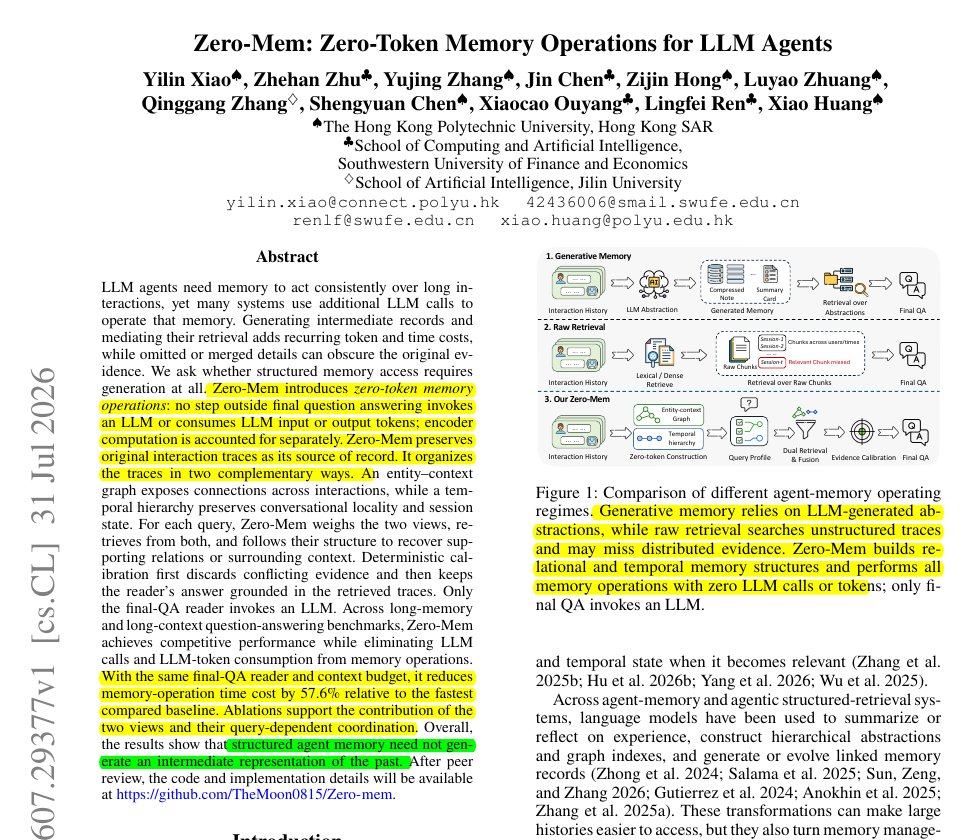
@rohanpaul_ai highlighted (17 likes, 5 replies, 1,829 views) the paper Zero-Mem, which keeps original traces, builds an entity-context graph plus temporal hierarchy, and performs memory operations without spending LLM tokens until final QA. The paper’s public HTML version says this zero-token regime cut memory-operation latency by 57.6% versus the fastest comparable generative-memory baseline.
@Kautukkundan showed (59 likes, 4 replies, 1,521 views) a 70M-parameter small language model running on an Apple Watch, and a reply from teammate @TslShahir said they trained a ternary MoE from scratch to fit the app’s roughly 70MB ceiling. @AtharvaXDevs shared (44 likes, 6 replies, 532 views) a quantized-model homelab on an L4 GPU using kind, NVIDIA plugins, Bifrost, OpenWebUI, Prometheus, and KEDA, with replies immediately moving to KV-cache tuning and concurrency limits rather than model ideology.

Discussion insight: The preferred fix for brittle agents was not “just add more context.” It was structured memory, local state, and explicit infra boundaries.
Comparison to prior day: August 12 leaned toward private-model ownership and deployment control. August 13 drilled down into memory layers, wearable inference, and self-hosted serving details.
1.4 Builders kept shipping narrow AI work surfaces instead of general chatbots (🡕)
Builder energy stayed high, but the most convincing launches were narrow surfaces with obvious operating constraints: voice output, SQL autocomplete, collaborative research records, or exportable code. The feed rewarded products that made one workflow faster and easier to trust rather than promising one agent for everything.
@aleximarkett said (167 likes, 39 replies, 9,004 views) Soniox TTS v2 looked built for production voice work rather than benchmark theater. Soniox’s public announcement backs that up with 60+ languages, low-latency streaming, voice cloning, audio tags, and $0.70 per generated hour pricing. @doodlestein announced (77 likes, 15 replies, 3,063 views) ASImposium, a public scientific ledger for frontier agents that separates private workshops from public promotion and sponsorship. @hasantoxr argued (10 likes, 1 reply, 4,174 views) that AI app builders should copy the “export the code and deploy anywhere” model instead of trapping prototypes inside the platform.
Discussion insight: A recurring test emerged: the more a product specified its interface, handoff, or data boundary, the more credible it sounded.
Comparison to prior day: August 12 focused on inbox, PR, and enterprise-task automation. August 13 expanded that surface area into voice, research coordination, SQL tooling, and exportable app builders.
2. What Frustrates People
Benchmark wins still leave too much uncertainty at deployment time
Severity: High. The clearest frustration was that generic public scores still fail to answer whether an agent can do the actual job safely and repeatably. @ValsAI introduced (60 likes, 5 replies, 6,542 views) SRE-Bench precisely because source-code security benchmarks miss binary-first work, and the public benchmark page shows current frontier models still solve only a minority of tasks. @freeCodeCamp shared (39 likes, 6,207 views) a handbook built around golden datasets, CI/CD eval gates, and production monitoring, while @nykdotdev argued (39 likes, 3 replies, 197 views) that multi-agent coding results change dramatically when the coordination topology changes. The workaround today is more task-specific grading, private eval suites, and explicit orchestration tests. This is directly worth building for.
Agents still lose continuity when memory and ownership are implicit
Severity: High. Several high-signal items described the same underlying problem from different angles: the agent may be capable, but the system around it forgets, collides, or drops context. @rohanpaul_ai summarized (17 likes, 5 replies, 1,829 views) Zero-Mem, which exists specifically to stop memory management from becoming a recurring LLM-generation tax. @nykdotdev said (39 likes, 3 replies, 197 views) two coding agents fail when both own the same work, and @AtharvaXDevs showed (44 likes, 6 replies, 532 views) that even a personal homelab quickly runs into cache and concurrency constraints. The workaround is explicit file ownership, structured memory, and tighter local-state control. This is directly worth building for.
Users still resent lock-in and opaque AI surfaces
Severity: Medium. The anti-lock-in complaint was more practical than ideological. @hasantoxr argued (10 likes, 1 reply, 4,174 views) that AI builders should export code so a cancelled subscription does not kill the product, while @doodlestein designed (77 likes, 15 replies, 3,063 views) ASImposium around named human sponsors and a public ledger rather than a black-box agent swarm. Even the Gemini 3.7 Flash enthusiasm came with emphasis on where the model is deployed and how it behaves in loops, not on raw model identity alone. The workaround is visible ownership, export paths, and narrower permissions. This is worth building for.
3. What People Wish Existed
Task-cost-aware model routing that teams can trust
The feed kept asking for a system that picks the cheapest model that can still finish the job reliably, rather than treating all model comparisons as price-per-token trivia. @_philschmid presented (193 likes, 10 replies, 8,055 views) Gemini 3.7 Flash as a lower-cost coding and agent default, @levie argued (22 likes, 4 replies, 3,854 views) that cheaper frontier updates expand enterprise agent budgets, and Snowflake’s public SQL autocomplete write-up shows a smaller specialized model outperforming a larger one on a narrow task. The need is practical and immediate: routing by task economics, latency, and failure cost. Opportunity type: direct.
Shared memory and local state that stay traceable
People clearly want agents that remember across sessions without turning memory itself into another noisy generative layer. @rohanpaul_ai highlighted (17 likes, 5 replies, 1,829 views) Zero-Mem’s zero-token memory operations, @Kautukkundan showed (59 likes, 4 replies, 1,521 views) an Apple Watch SLM meant for local personal context, and @AtharvaXDevs mapped (44 likes, 6 replies, 532 views) a low-cost self-hosted inference stack. The shared request is continuity with provenance, not just a bigger context window. Opportunity type: direct.
Review and coordination layers for multi-agent work
The day’s evaluation posts point to a broader need: teams want agent collaboration systems that make ownership, grading, and handoff rules explicit. @nykdotdev argued (39 likes, 3 replies, 197 views) that agent teams fail when both own the same work, @ValsAI built (60 likes, 5 replies, 6,542 views) a benchmark around real reverse-engineering tasks, and @doodlestein proposed (77 likes, 15 replies, 3,063 views) a public ledger for frontier-agent science. The urgency is high because more agent seats without better coordination just multiplies confusion. Opportunity type: direct.
Exportable AI builders with real code ownership
The anti-platform-lock-in theme was smaller than the evaluation theme, but it was concrete. @hasantoxr wanted (10 likes, 1 reply, 4,174 views) app builders that generate exportable code, while ASImposium’s public repo and named-sponsor model implied the same instinct for user-visible control. This is a competitive need rather than a blank-space fantasy: several products are circling it already, but users are clearly still not satisfied. Opportunity type: competitive.
4. Tools and Methods in Use
| Tool | Category | Sentiment | Strengths | Limitations |
|---|---|---|---|---|
| Gemini 3.7 Flash | LLM / agent model | (+) | Better coding and agent benchmark results at lower launch price; broad deployment into Google surfaces | Launch metrics are vendor-reported; still needs task-specific evals |
| Soniox TTS v2 | Voice model/API | (+) | 60+ languages, low-latency streaming, voice cloning, natural language mixing, $0.70/hour | Vendor launch claims dominate evidence; proprietary service |
| ReverseEngBench / SRE-Bench | Benchmark | (+) | Binary-focused, contamination-free, deterministic grading, realistic RE toolchain | Current model scores are still low; narrow to reverse engineering |
| Eval-driven LLM evaluation stacks | Method / evaluation workflow | (+) | Golden datasets, RAG metrics, LLM-as-judge, CI/CD gates, production monitoring | High setup cost; eval coverage quality depends on dataset design |
| Zero-Mem | Memory layer / method | (+) | Zero-token memory operations, trace preservation, lower memory latency | Research-stage approach; final QA still depends on an LLM |
| Snowflake 4B SQL autocomplete | Small specialized model | (+) | Higher precision and user acceptance with 71% lower latency than a larger MoE baseline | Narrow domain scope: Snowflake SQL only |
| Lattice-style homelab stack | Self-hosted inference infra | (+/-) | Local control, observability, quantized serving, explicit scaling and guardrail components | GPU memory/KV-cache limits and operational complexity show up quickly |
| ASImposium | Collaboration platform | (+/-) | Shared ledger, sponsor oversight, explicit public/private split for agent work | Still early; verification rules for non-formal claims remain unsettled |
| Marlow-style exportable builders | AI app builder | (+/-) | Fast generation with code ownership and exportability | Limited public technical detail; product quality evidence is still demo-led |
Overall sentiment skewed positive toward cheaper and more specialized systems, but the enthusiasm was conditional. People liked Gemini 3.7 Flash, Soniox, and Snowflake because they looked like deployable work surfaces, not because they were “bigger.” The common workaround pattern was the same across threads: route by task, add explicit memory, keep ownership visible, and evaluate the workflow rather than trusting a model label. The main migration pressure was away from one-size-fits-all frontier usage and toward a stack of cheaper models, domain-specific models, routing layers, and self-hosted or user-controlled state.
5. What People Are Building
| Project | Who built it | What it does | Problem it solves | Stack | Stage | Links |
|---|---|---|---|---|---|---|
| ASImposium | @doodlestein | Public scientific ledger where frontier agents work privately, then promote claims publicly under sponsor oversight | Frontier-agent research currently disappears into local chats and lacks shared review | Bun monorepo, Next.js 16, Workers, Google sign-in, agent harness integrations | RFC | site · repo |
| Soniox TTS v2 | Soniox | Multilingual text-to-speech, voice cloning, and low-latency streaming for voice agents | Voice products need cleaner interruption handling, language switching, and lower serving cost | Proprietary TTS model, audio tags, streaming API, voice cloning | Shipped | announcement · product |
| Snowflake 4B SQL autocomplete | Snowflake AI Research | Schema-grounded SQL autocomplete inside the editor | Large general models are too slow and too noisy for interactive SQL suggestion | 4B dense model, context-grounded post-training, RL | Shipped | blog |
| ReverseEngBench / SRE-Bench | @ValsAI | Reverse-engineering benchmark for agents working on protected binaries | Source-code benchmarks miss real binary-first security work | Clean-room binaries, anti-analysis suite, deterministic grader, Ghidra/radare2/GDB/angr toolchain | Shipped | benchmark |
| Apple Watch SLM app | @Kautukkundan | Small on-watch language-model app with local inference | Wearable and personal-agent workflows need private, low-latency execution | 70M-parameter ternary MoE, Apple Neural Engine, watch app packaging | Shipped | tweet |
| Lattice homelab | @AtharvaXDevs | Minimal self-hosted inference environment for quantized LLM serving and ops practice | Teams need a cheap, production-like place to learn LLM day-2 operations | JarvisLabs L4, kind, NVIDIA toolkit/DCGM, Bifrost, OpenWebUI, kube-prometheus-stack, KEDA | Alpha | tweet |
ASImposium stood out because it is trying to build social infrastructure around agent work, not just another agent itself. The public site explicitly says it runs no models; the product is the shared record, the sponsor controls, and the validator-gated public surface.
Soniox TTS v2 and Snowflake’s SQL autocomplete both reflect the same builder pattern: narrow task surface, strong latency requirements, and specialization over scale. One optimizes real-time speech with multilingual control; the other optimizes schema-grounded completion and abstention inside a very specific editor workflow.
The smaller personal projects pointed in the same direction. The Apple Watch SLM and the Lattice homelab were not trying to prove general intelligence; they were trying to make local inference and low-cost operator control practical. That same ownership instinct also showed up in the exportable-code builder thread.
6. New and Notable
Anthropic exposed a silent reasoning workspace inside Claude
@heynavtoor pointed (14 likes, 2 replies, 2,083 views) to Anthropic’s new global workspace research, which says Claude has an emergent J-space: internal representations that can be reported on, modulated, and used in multi-step reasoning without being spoken aloud. Anthropic says this lets researchers catch concepts like fabricated data, prompt injection, or hidden goals before they appear in output, which is materially different from post-hoc moderation.
Frontier-model governance started looking like an industry-standard problem, not just a lab policy problem
@kimmonismus reported (62 likes, 17 replies, 4,611 views) that Demis Hassabis had discussed an independent body to set safety standards for advanced AI, and the attached screenshot highlighted a proposal to codify guardrails and best practices for AGI-class systems. The interesting part was not consensus; replies immediately raised the risk that a standards body becomes either a clear bar for everyone or a moat for incumbents.
A 4B specialized model beating a larger autocomplete baseline became a more important signal than one more general-model release
@StasBekman reported (7 likes, 540 views) that Snowflake’s new SQL autocomplete model improved both precision and user acceptance while cutting latency sharply. Snowflake’s public engineering post makes that notable because it frames specialization, grounding, and abstention as the winning formula instead of more scale.
7. Where the Opportunities Are
[+++] Deployment-grade agent evaluation and orchestration — Evidence came from multiple directions at once: SRE-Bench, AutomationBench, the freeCodeCamp eval handbook, and the MSEval coordination paper. The strongest opportunity is not “another benchmark” by itself, but workflow-aware grading, routing, and handoff systems that tell teams whether an agent setup is actually ready to ship.
[++] Persistent memory plus local-state infrastructure — Zero-Mem, the Apple Watch SLM demo, and the Lattice homelab all point to the same gap: continuity, provenance, and low-latency local control still need better primitives. This is a strong opportunity because it touches agent reliability, privacy, ownership, and serving cost at the same time.
[++] Narrow, outcome-specific AI work surfaces — Soniox TTS v2, Snowflake’s SQL autocomplete model, and exportable-code builder demand all suggest people will pay for systems that solve one work surface extremely well. The opportunity is moderate because it is already competitive, but the evidence says specialization is winning attention.
[+] Shared audit layers for collaborative agent work — ASImposium, Anthropic’s global workspace, and the Demis standards-body discussion all point toward a thinner but real need: systems that make agent reasoning, review, and public accountability easier to inspect. This is still early, but the signal is emerging.
8. Takeaways
- Completed-task economics beat raw model prestige. Gemini 3.7 Flash, Snowflake’s 4B SQL model, and the broader price-war discussion all framed value in terms of finished work, latency, and retry reduction rather than token price alone. (source)
- Evaluation is becoming a product layer of its own. Binary reverse-engineering benchmarks, workflow outcome benchmarks, and CI/CD eval handbooks all showed that teams no longer trust generic model scores to predict deployment behavior. (source)
- Memory moved from “nice to have” to explicit infrastructure. Zero-Mem, on-device watch inference, and self-hosted homelab diagrams all treated continuity and local state as design primitives rather than prompt tricks. (source)
- The strongest builders shipped narrow surfaces, not universal copilots. Voice generation, SQL autocomplete, collaborative scientific ledgers, and exportable app builders all looked more credible than generic “AI for everything” claims. (source)
- Governance and interpretability rose with capability, not after it. Anthropic’s J-space work and the standards-body discussion around advanced AI both suggested that labs and observers expect stronger systems to require better visibility and shared rules. (source)