Twitter AI - 2026-08-14
1. What People Are Talking About
1.1 Agent performance was framed as orchestration design, not model shopping (🡕)
The most repeated lesson was that teams now judge agents by wiring, supervision, and feedback loops rather than by the raw model alone. At least three high-signal items made the same point from different angles: coordination topology, harness design, and closed-loop evaluation all change outcomes materially even when the model stays fixed.
@Argona0x argued (166 likes, 4 replies, 312 bookmarks, 36,535 views) that a Google Research and MIT Nature study held prompts, tools, and compute constant and saw the same jobs swing from 70% worse than a solo agent to 80.8% better depending only on the agent graph. The operational advice was unusually concrete: benchmark the single agent first, add a supervisor only when the solo baseline is weak, stop workers from reading one another’s drafts, and re-run the comparison after model upgrades.
@0xClodex summarized (17 likes, 10 replies, 18 bookmarks, 553 views) Harrison Chase’s breakdown that the model is only one-third of an agent stack, with the rest sitting in context, harness, evals, observability, and a trace-driven improvement loop. The strongest reply distilled the community sentiment: teams often stop at evals and never build the flywheel that turns failures into better routing and context.
Discussion insight: Replies did not dispute that better models matter; they narrowed the question to where supervision, context timing, and error isolation matter more.
Comparison to prior day: August 13 already emphasized deployment-grade measurement. August 14 pushed one step deeper into the coordination diagram itself.
1.2 Open-weight progress was credible again because post-training and local execution both moved (🡕)
Open models were not discussed as ideology today. They were discussed as workable local systems that got measurably better through post-training, released weights, and implementation tricks on commodity hardware.
@kimmonismus reported (173 likes, 17 replies, 31 bookmarks, 12,121 views) that GLM-5.3 kept the same 743B base model as GLM-5.2 and got its gains entirely from scaling post-training across longer, tool-using tasks. Z.ai’s public GLM-5.3 documentation repeats the same claim and lists jumps from 4.6 to 28.3 on Terminal-Bench 3.0, 46.2 to 66.9 on DeepSWE v1.1, and 24.4 to 54.4 on ExploitBench, with weights held back pending safety evaluation.


@sudoingX showed (159 likes, 12 replies, 122 bookmarks, 6,709 views) that Qwen 3.8 27B’s multi-token prediction head was already present in the shipped GGUF and could be activated in llama.cpp with one flag, taking an RTX 3090 from 31 to 41.3 tok/s and a 5090 laptop from 36.7 to 50.9 tok/s. Replies added more public replication data, including a 4090 report at 106.2 tok/s over 18,000 generated tokens and an RX 9060 XT user saying speed roughly doubled.
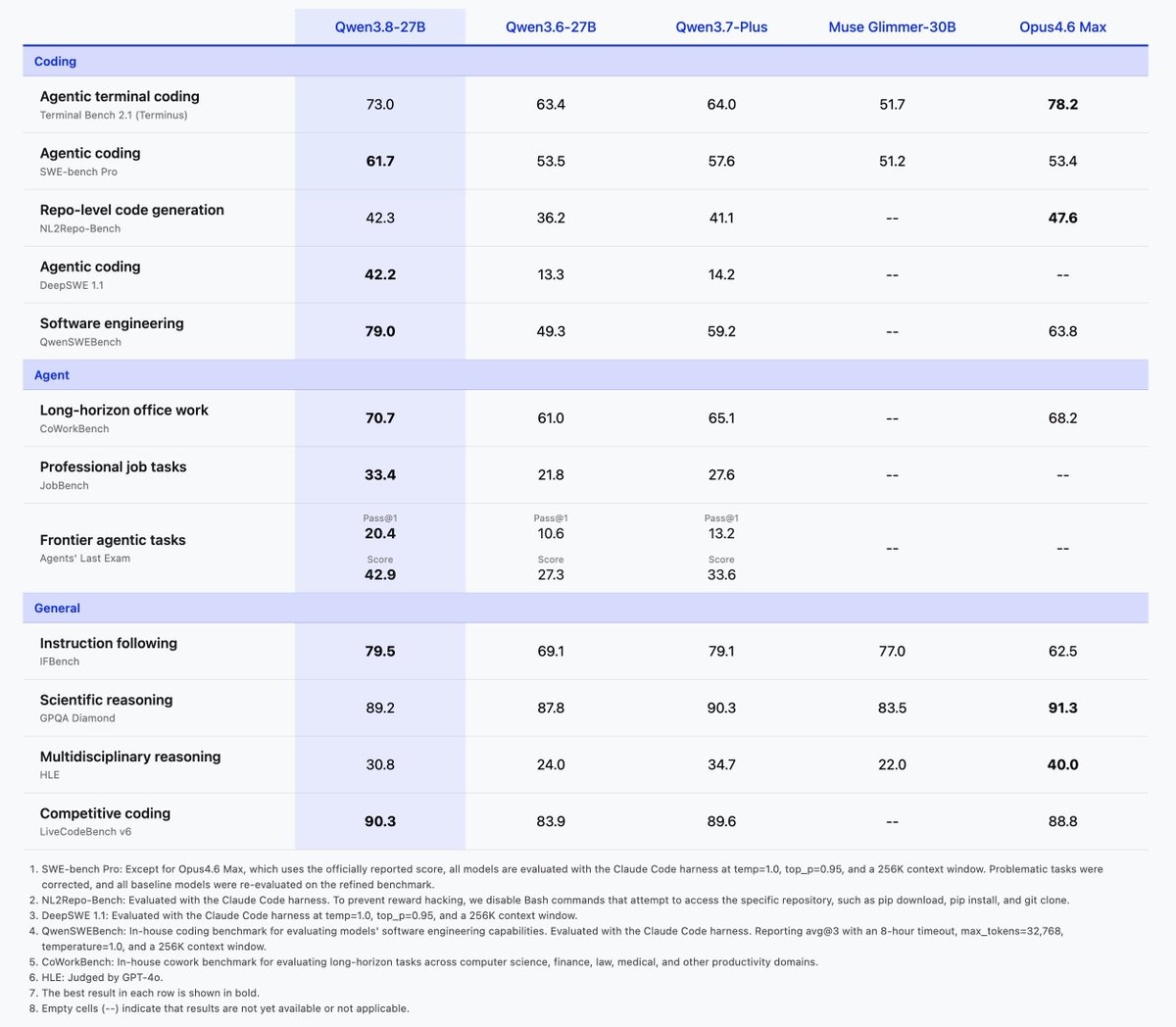
@rohanpaul_ai highlighted (9 likes, 1 reply, 2,063 views) Alibaba’s open-weight Qwen3.8-27B as a 27B multimodal model built for local deployment, with 262K native context, optional reasoning control, and reported competitiveness on SWE-bench Pro, CoWorkBench, and other agent-style tasks. The attached comparison table made the local-deployment claim concrete rather than rhetorical.
@paulg observed (247 likes, 39 replies, 17,524 views) that startup tuning of open-weight models, written off a year ago, now “seems to be back.” The replies made the threshold explicit: if customization now takes hours instead of weeks and open models are close enough on task quality, the tuning loop becomes worth reopening.
Discussion insight: The live argument was no longer “open or closed?” It was whether the gap is now small enough that post-training, fine-tuning, and local deployment meaningfully beat generic frontier rent.
Comparison to prior day: August 13 centered cheaper coding models and task economics. August 14 added public evidence that open weights and post-training can now change that equation.
1.3 Teams trusted workload tuning and first-party data more than default reasoning settings or generic prompts (🡕)
Another strong cluster of posts said that the interesting AI gains now come from choosing the right effort level and feeding the model real operating data, not from blindly turning reasoning up or asking for generic ideas.
@octane_security reported (15 likes, 6 replies, 596 views) that across two stages of its security-detection pipeline, GPT-5.6 max was never the winning configuration and an xhigh setting beat max at lower cost on the stage where new variants won. The chart matters because it turns “reason harder” into an empirical workload-tuning problem.

@morganlinton published (14 likes, 3 replies, 1,411 views) a VulcanBench effort sweep where Grok 4.6 peaked at medium effort with 87.0% pass@1, dropped to 73.9% at high, and only partially recovered at xhigh. A reply explicitly confirmed that medium outperformed high and xhigh on this suite, which is exactly the kind of knob-level result public leaderboards usually hide.

@0xrux argued (18 likes, 5 replies, 397 views) that the sharper use of Claude for YouTube creators is not “give me 10 video ideas” but connecting the model to real channel analytics so it can reason from retention, CTR, search, and comments. @yunta_tsai said (240 likes, 18 replies, 9,192 views) Grok 4.6 multimodal improved video-review workflows by 10x to 100x in day-to-day use, and clarified in replies that it handles arbitrary video speed while still returning answers quickly.
Discussion insight: The shared standard was evidence-grounded AI: right knob, right connector, right workload, right data.
Comparison to prior day: August 13 pushed evaluation toward deployment-grade measurement. August 14 pushed that same instinct into effort controls and live data connectors.
1.4 Builders kept shipping narrow agent surfaces instead of one general bot (🡕)
The most credible product-sharing today was not “one agent for everything.” It was bounded systems with a clear interface: legal review, pentesting, embodied 3D agents, or robotics data collection.
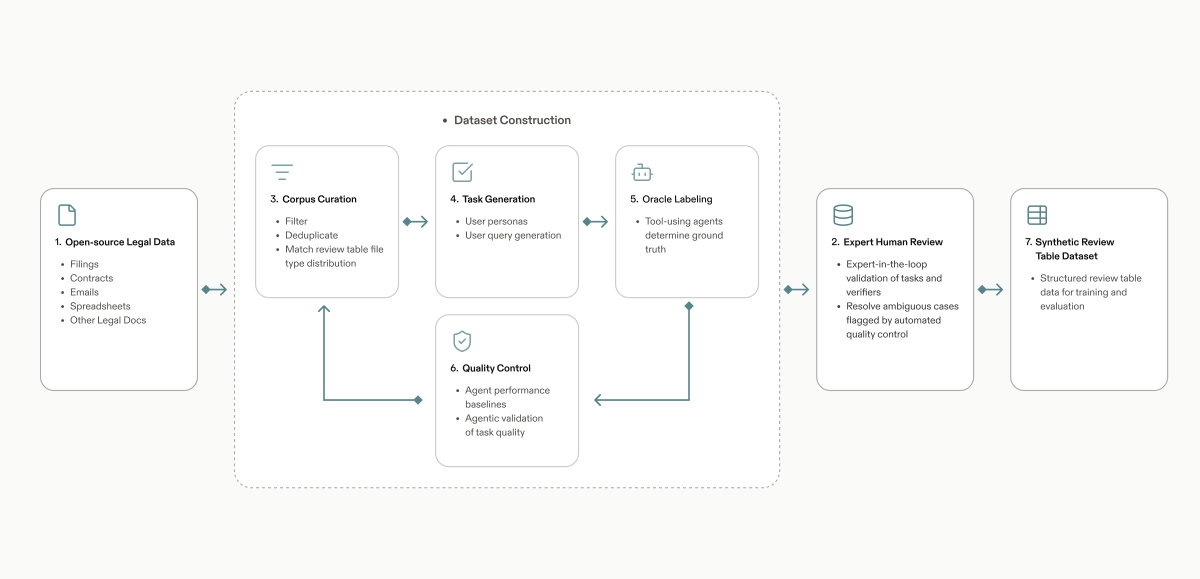
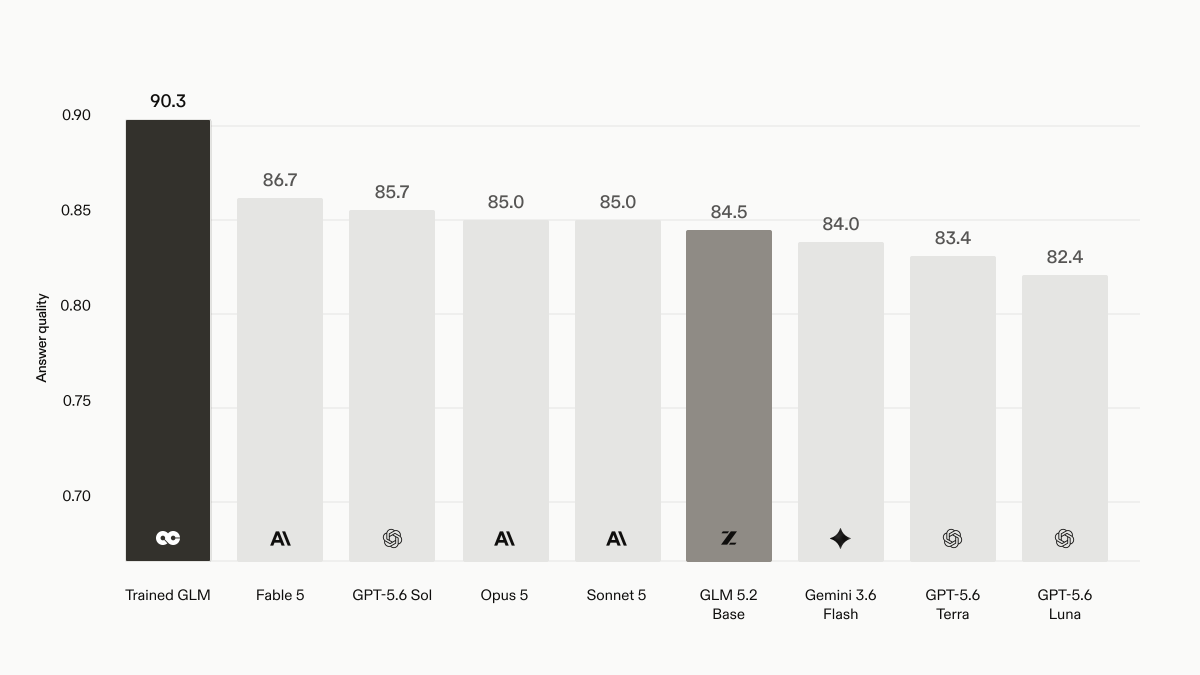
@harvey said (4 likes, 1 reply, 411 views) it post-trained a GLM-5.2 variant for Review Tables, where lawyers can ask up to 500 questions over up to 10,000 documents, and cut cost by 50% while improving answer and citation quality. The images are unusually specific: one shows the document-grid interface, one maps the synthetic-dataset pipeline, and two quantify the answer-quality and cost tradeoffs versus frontier baselines.

@tom_doerr shared (7 likes, 2,206 views) PentestAgent, and the public README describes a LiteLLM-backed TUI with /assist, /agent, /crew, browser tooling, Docker images with pentest utilities, and MCP child-agent spawning for hierarchical work. @fourjjjjt recapped (18 likes, 5 replies, 190 views) three.ws, whose public README and site describe a browser-native 3D agent platform with text/image-to-3D, real-time voice and face capture, MCP and A2A tool connectivity, and pay-per-chat USDC flows. @Kai_Nimo02 described (18 likes, 17 replies, 96 views) Axis Robotics as a “compounding” data engine for physical AI, where simulation and human correction focus the next batch of robotics data on current model failures.
Discussion insight: The feed rewarded systems with a narrow job, explicit data boundary, and a visible operating loop.
Comparison to prior day: August 13 favored narrow work surfaces over general chatbots. August 14 extended that pattern into agent platforms, enterprise review systems, and robotics data infrastructure.
2. What Frustrates People
Orchestration and reasoning knobs still fail silently
Severity: High. The clearest frustration was that agent quality can collapse for reasons most teams still do not measure explicitly. @Argona0x argued (166 likes, 4 replies, 312 bookmarks, 36,535 views) that the same tasks can swing from strongly negative to strongly positive depending only on agent wiring, while @octane_security showed (15 likes, 6 replies, 596 views) and @morganlinton showed (14 likes, 3 replies, 1,411 views) that higher reasoning settings can cost more and still underperform medium or xhigh alternatives depending on the workload. @0xClodex summarized (17 likes, 10 replies, 18 bookmarks, 553 views) the same failure mode from the harness side: when an agent fails, the missing piece is often context delivery, not raw model intelligence. The workaround today is explicit topology testing, stage-specific effort sweeps, and trace-driven eval loops. This is directly worth building for.
AI systems still lack the right data at the point of work
Severity: High. Several posts complained less about model weakness than about missing evidence in the loop. @0xrux argued (18 likes, 5 replies, 397 views) that creators get generic junk when they ask for ideas without real YouTube analytics, and @Kai_Nimo02 described (18 likes, 17 replies, 96 views) robotics as bottlenecked by the absence of an “internet of actions” rather than by model intelligence. Even Harvey’s post (4 likes, 1 reply, 411 views) made the same point from enterprise legal work: quality improved only after the team built a synthetic, reviewed task corpus inside the exact document-review harness. The workaround is connector-heavy, domain-specific data plumbing rather than more generic prompting. This is directly worth building for.
Buyers still cannot tell custom AI from thin wrappers
Severity: High. @mardehaym reported (8 likes, 6 replies, 1,009 views) a PE diligence case where a supposed proprietary AI platform turned out to be a React frontend and system prompt around GPT-4o, and used that example to list four recurring diligence gaps: model dependency, training-data liability, talent concentration, and integration failure risk. @paulg noted (247 likes, 39 replies, 17,524 views) that tuning open-weight models is viable again only because the economics and quality gap changed; that implicitly raises the bar for anyone claiming durable differentiation from a thin wrapper. The workaround is technical diligence that inspects actual model ownership, training data provenance, and replacement risk. This is directly worth building for.
Enterprise AI ROI and provider selection are still murky
Severity: Medium. @AlphaSenseInc shared (4 likes, 2 replies, 3 bookmarks, 510 views) an interview summary from a Dell employee saying Anthropic had taken workload share from OpenAI on context-heavy, token-rich tasks because quality held up better and effective cost improved at scale, while non-coding chatbot and reasoning ROI was still negative and open-source deployments carried hidden staffing and integration costs. The useful complaint was not that one model provider “won” forever; it was that real costs only became visible after token volume, privacy constraints, switching friction, and internal ops headcount were counted. This is worth building for.

Safety and moderation systems can apply unevenly
Severity: Medium. @Wallface argued (6 likes, 74 views) that X’s AI safety pipeline appears to skip “High PageRank” accounts when scanning for abuse, and attached a public audit graphic showing 406 archived attack posts from one verified account plus higher median reach for those attack posts than for that account’s normal content. The post does not prove the internal label assignment, but it does show a concrete user complaint tied to code-reading and archived outcomes rather than a generic fairness slogan. The workaround today is independent auditability and consistent classifier application across account tiers. This is worth building for.

3. What People Wish Existed
Orchestration and effort tuning that auto-selects the best setup per task
People clearly want a control layer that decides when to stay single-agent, when to fan out, and how much reasoning effort to buy for each stage. @Argona0x argued (166 likes, 4 replies, 312 bookmarks, 36,535 views) that supervision and topology change outcomes more than one extra model call, while @octane_security showed (15 likes, 6 replies, 596 views) and @morganlinton showed (14 likes, 3 replies, 1,411 views) that default high/max reasoning can be the wrong choice for real pipelines. The need is practical, immediate, and tied to money, latency, and failure rates rather than curiosity. Opportunity type: direct.
Cheap local customization of capable open models
The feed kept asking for a world where strong local models can be adapted quickly to real work. @paulg observed (247 likes, 39 replies, 17,524 views) that tuning open-weight models is back, @sudoingX showed (159 likes, 12 replies, 122 bookmarks, 6,709 views) that one llama.cpp flag can materially raise Qwen 3.8 throughput on consumer GPUs, and @RituWithAI presented (8 likes, 65 views) Unsloth as a path to laptop or free-Colab fine-tuning. This is a direct product need because the demand is for faster adaptation loops, not merely cheaper inference. Opportunity type: direct.
Evidence-grounded copilots over user-owned data
Several posts pointed to the same missing product: copilots that can see the user’s real data and reason over it without forcing manual exports or brittle prompt hacks. @0xrux wanted (18 likes, 5 replies, 397 views) Claude connected directly to YouTube analytics, Harvey’s post (4 likes, 1 reply, 411 views) showed the value of a review harness grounded in real legal-document tasks, and @Kai_Nimo02 wanted (18 likes, 17 replies, 96 views) robotics models fed by failure-focused action data instead of generic internet-scale text. The need is both practical and urgent because the complaint is about missing evidence, not missing tokens. Opportunity type: direct.
Technical diligence and provenance tools for AI businesses
The market is also asking for a way to verify what an AI company actually owns. @mardehaym reported (8 likes, 6 replies, 1,009 views) a diligence failure that uncovered a thin wrapper, and the GLM-5.3 discussion added another angle: if the same base model can shift dramatically after post-training, then model identity alone is not enough to understand capability, safety, or defensibility. This is partly a practical need and partly a trust need around procurement, M&A, and compliance. Opportunity type: competitive.
4. Tools and Methods in Use
| Tool | Category | Sentiment | Strengths | Limitations |
|---|---|---|---|---|
| Graph Engineering | Orchestration method | (+/-) | Makes supervision, fan-out, and solo baselines explicit; can materially improve task outcomes | Benefits are task-dependent; extra agents can make results worse |
| GLM-5.3 | Open-weight foundation model | (+) | Same base model, stronger post-training, better coding/cyber scores, 1M context | Weights delayed for safety review; still trails top closed models on some tasks |
| Qwen3.8-27B | Local multimodal open model | (+) | Strong local coding/agent scores, 262K native context, reasoning control, consumer-GPU viability | Benchmark set is still evolving; some claims remain vendor- or tweet-led |
| Unsloth | Fine-tuning stack | (+) | Lowers memory needs, runs on cheap hardware, exports to Ollama/vLLM/GGUF | Public evidence in this dataset is secondary and still needs user validation |
| VulcanBench effort sweeps | Benchmark / evaluation method | (+) | Surfaces non-monotonic effort curves, unfinished runs, and cost-per-solved tradeoffs | Small suite and run-to-run variance mean results are not universal |
| Octane config sweeps | Internal evaluation method | (+) | Stage-specific config testing beats default max reasoning and ties cost to score | Specific to one security pipeline; settings may not transfer cleanly |
| Claude YouTube connector workflow | Connector / analytics copilot | (+) | Grounds suggestions in retention, CTR, comments, and channel data instead of generic prompts | Depends on connector access and only helps where first-party data is available |
| Anthropic on high-token enterprise workloads | Model-provider selection | (+/-) | Better long-context performance and lower effective cost at high token volumes in one enterprise account; privacy posture mattered in vendor choice | Higher base price, workflow lock-in, and overall non-coding ROI still negative |
| PentestAgent | Security agent framework | (+/-) | Multi-model support, browser and terminal tools, Docker images, MCP child agents | Requires setup, API keys, and operator judgment in a sensitive domain |
| three.ws | Embodied agent platform | (+/-) | Browser-native 3D agents, text/image-to-3D, tool connectivity, payments, AR | Complex surface area; evidence of durable adoption is still early |
| Harvey Review Tables custom model | Task-specific model + harness | (+) | Better answer/citation quality at lower cost inside a defined legal workflow | Domain-specific and backed by one company’s internal task surface |
Overall sentiment skewed positive toward narrower systems with explicit task surfaces, but the optimism was conditional. People liked GLM-5.3, Qwen3.8-27B, Harvey’s custom model, and connector-driven Claude workflows because they looked deployable and measurable, not because they were simply bigger or newer. @AlphaSenseInc shared (4 likes, 2 replies, 3 bookmarks, 510 views) a more cautious enterprise migration story: Anthropic was taking share from OpenAI on context-heavy work, but overall ROI remained negative outside coding and open-source stacks still carried hidden integration costs. The common workaround pattern was the same across the day: tune the harness, tune the effort knob, bring in first-party data, and validate on the real workflow before paying for more reasoning or more agents. The migration pressure was away from generic frontier defaults and toward a stack of open models, eval sweeps, domain connectors, and bounded agent surfaces.
5. What People Are Building
| Project | Who built it | What it does | Problem it solves | Stack | Stage | Links |
|---|---|---|---|---|---|---|
| Harvey Review Tables custom model | @harvey | Post-trained legal review model and harness for answering and citing across very large document tables | Frontier model inference was too expensive and citation quality needed improvement at review-table scale | GLM-5.2, Applied Compute AC2, synthetic legal-task generation, single-turn RAG, agentic search | Shipped | post |
| PentestAgent | @tom_doerr | Open-source framework for black-box security testing with assist, agent, crew, and interactive modes | Manual pentest workflows still require too much operator orchestration across tools and models | Python, LiteLLM, Docker, Playwright, browser + terminal tools, MCP child agents | Beta | repo |
| three.ws | @trythreews | Browser-native 3D AI agent platform with embodied avatars, tools, payments, and optional on-chain identity | Text-only agents lack differentiated surfaces, monetization rails, and portable embodied interfaces | Forge text/image-to-3D, MCP, A2A, LiveKit, ElevenLabs, Base/Solana, WebXR | Shipped | site · repo |
| Axis compounding data engine | @axisrobotics | Simulation-first robotics data platform that routes human effort toward current model failures | Robotics models lack scalable action data and targeted failure-correction loops | Browser teleoperation, simulation trajectories, AXIS-V1 dataset, egocentric capture, contribution tracking | Alpha | post |
Harvey was the day’s clearest example of a company narrowing an expensive frontier-model problem into a domain-specific post-training and harness problem. The attached materials showed both the workflow surface and the cost/quality tradeoff, which made the claim much more concrete than a generic “we fine-tuned a model” announcement.

PentestAgent and three.ws point in a different direction: more opinionated agent platforms instead of general chat. PentestAgent narrows the task around security workflows and tool access, while three.ws expands the surface into avatars, payments, and real-time interaction. Axis fits a third pattern: builders are moving one layer down the stack and trying to own the data engine that future robotics models depend on.
6. New and Notable
Open-weight releases are starting to inherit frontier-style safety delays
@kimmonismus reported (173 likes, 17 replies, 31 bookmarks, 12,121 views) that GLM-5.3’s weights were being held for roughly two weeks despite the model launch, and Z.ai’s public GLM-5.3 documentation says the same base model was kept while post-training pushed coding and cyber scores sharply upward. That matters because the dataset shows an open-model release being slowed not by lack of capability, but by the need to evaluate and harden the new capabilities before a weight drop.
A one-flag local speedup became a community benchmark event
@sudoingX showed (159 likes, 12 replies, 122 bookmarks, 6,709 views) that Qwen 3.8’s shipped multi-token prediction head could be activated in llama.cpp without building a separate draft model. The follow-on replies turned the post into a small public replication thread, with different GPUs reporting their own speedups and settings, which is notable because it shows the community treating inference flags as part of the product surface.
Public complaints about AI moderation are getting more audit-like
@Wallface argued (6 likes, 74 views) from archived posts, code-reading, and reach comparisons rather than from a generic fairness complaint. Even if the post does not independently prove the internal label assignment, the structure of the evidence is notable: metrics, archived content, and classifier behavior were presented as something readers should verify rather than simply believe.
7. Where the Opportunities Are
[+++] Orchestration and eval tuning for agent systems — Evidence appears across sections 1, 2, and 4. @Argona0x showed topology can swing outcomes from sharply negative to strongly positive, while Octane and VulcanBench showed that default reasoning settings can be both slower and worse. A product that chooses graph shape, supervision level, and effort setting per stage would answer a repeated practical complaint.
[+++] First-party data copilots for domain workflows — Harvey’s review-table model, Claude’s YouTube analytics connector, and Axis’s robotics data loop all point to the same gap: people want copilots that reason over the user’s own evidence, not generic prompts. The opportunity is strong because the data boundary is explicit and the pain is already operational.
[++] Local open-model acceleration and customization kits — GLM-5.3, Qwen3.8-27B, the Qwen MTP speedup thread, and Unsloth all show demand for stacks that make strong open models faster to run, cheaper to adapt, and easier to own. The competition will be real, but the need is concrete and already backed by practitioner experimentation.
[++] AI diligence and provenance infrastructure — The thin-wrapper diligence story and the GLM-5.3 safety-delay story both point to a trust gap in how buyers, investors, and operators evaluate AI systems. Tools that map model dependency, training-data provenance, post-training history, and replacement risk would serve procurement, M&A, and compliance rather than just builders.
[+] Robotics data infrastructure — Axis’s post is still early and the engagement is small, but it isolates a specific bottleneck: models need more failure-focused action data. If physical AI keeps rising as a theme, the data layer could become more valuable than any single robot demo.
8. Takeaways
- Agent quality is increasingly a systems problem, not just a model problem. The clearest evidence came from graph-engineering and harness posts showing that supervision, context timing, and evaluation loops can dominate the outcome. (Argona0x)
- Open-weight momentum is real again because both post-training and local execution improved on the same day. GLM-5.3’s gains came without changing its base model, while Qwen 3.8 threads focused on practical local throughput and deployment, not only on headline releases. (kimmonismus)
- Default max reasoning is losing credibility as a blanket strategy. Octane and VulcanBench both showed that higher effort can cost more while doing worse on the actual workload being measured. (octane_security)
- The most credible builders kept narrowing the job instead of promising a universal agent. Harvey targeted legal review tables, PentestAgent targeted black-box security testing, three.ws targeted embodied browser-native agents, and Axis targeted the robotics data bottleneck. (harvey)