Twitter AI - 2026-08-18
1. What People Are Talking About
1.1 Benchmarks moved from model scoreboards to workflow harnesses (🡕)
The strongest evidence cluster was about measurement moving one layer outward from the model to the system around it. Four retained items turned “better evals” into something more concrete: agent search infrastructure got benchmarked directly, coding benchmarks kept shifting toward real PR work, people started asking for AI-readiness scores on whole codebases, and harness design itself was framed as a source of frontier gains.
@ArtificialAnlys announced (390 likes, 32 replies, 23,369 views, 110 bookmarks) the Artificial Analysis Search Index, a new benchmark that keeps the model fixed at GPT-5.6 Luna (medium) inside the open-source Stirrup harness and varies only the search provider. The attached chart is useful because it makes the tradeoff legible at a glance: Parallel scored 75, Exa 74, and Firecrawl 73, while the same model without search scored 33. The thread and public benchmark page also made the cost argument explicit: better retrieval can lower total task cost even when the search call itself is more expensive.

@morganlinton said (46 likes, 12 replies, 946 views) that OpenAI and SpaceXAI were now supporting VulcanBench, and used the announcement to explain why he wants benchmarks tied to “real repos” and “real PRs” instead of generic coding scores. That matters because his complaint was not that there are too few benchmarks, but that teams still cannot tell which benchmark actually matches their language mix, task mix, and workflow shape.
@kirat_tw proposed (275 likes, 13 replies, 6,819 views, 76 bookmarks) an “AI friendliness benchmark” for codebases, measured by how much time, compute, and money it takes an AI to fix 1,000 static issues. The replies did not treat the idea as abstract philosophy; they immediately connected it to codebase quality, maintainability, and adjacent tools such as FactoryAI Droid’s readiness report.
@jun_song highlighted (31 likes, 2 replies, 3,409 views, 23 bookmarks) StateM’s claim that harness scaling pushed GPT-5.6 Sol to 95.3% raw accuracy on Terminal-Bench 2.1 and got DeepSeek-V4-Flash to 88.8%, roughly matching GPT-5.6 Sol Max. Even with his caveat that he had not verified it himself yet, the signal was clear: people increasingly believe agent performance can jump because the harness got better, not only because the model got bigger.
Discussion insight: The most useful nuance came from the cost and workload framing. @ReadEpoch argued in the Search Index replies that optimizing search cost per call misses the real number, which is total cost per completed task, while Morgan Linton argued that teams also need to know how much of an eval suite actually resembles their own engineering work.
Comparison to prior day: August 17 treated evaluation mostly as a proof-quality problem around local models. August 18 widened that same concern into a broader harness-and-workflow measurement story spanning search APIs, coding benchmarks, and codebase readiness.
1.2 Open models gained credibility when they came with deployable paths, not just weights (🡕)
Open-weight momentum stayed strong, but the center of gravity shifted from “open models are catching up” to “show me the exact deployment path, runtime, and cost behavior.” Five retained items made that shift concrete across benchmark tables, laptop agents, edge decoding, and recovery-heavy agent workloads.
@ArtificialAnlys reported (86 likes, 9 replies, 3,678 views) that GLM-5.3 reached 60 on the Artificial Analysis Intelligence Index, tying Kimi K3 at the open-weight frontier while making a 246-point jump on GDPval-AA v2. The important nuance was not just the score: the thread also said GLM-5.3 used roughly 20% more output tokens than GLM-5.2, cost 1.5x more per task than its predecessor, and still remained cheaper per task than Kimi K3 and GPT-5.6 Sol in the same tier.
@TheAhmadOsman argued (117 likes, 12 replies, 3,091 views) that Qwen 3.8 27B scoring 51 on the Artificial Analysis Agentic Index was the more disruptive fact because it landed on roughly $2,000-$3,000 hardware. The attached benchmark image matters because it places the model directly against GLM 5.2 and DeepSeek V4 Pro 0813 rather than against vague “local AI” expectations, and his replies reframed it as a strong sub-agent with a good orchestrator.

@arena added (40 likes, 6 replies, 6,061 views) a second deployability proof with Inkling-Small. The thread says it delivers similar results to Inkling at less than half the price per task, and the attached recovery chart is especially informative because it isolates Bash Recovery at +11.0% net improvement, the best among open models in that category.

@ttunguz said (36 likes, 3,664 views, 46 bookmarks) that he swapped Qwen3.8-27B into his own agent on a laptop and that it worked brilliantly. @NVIDIARobotics then showed (23 likes, 4 replies, 1,211 views) the runtime side of the same story: the linked Jetson AI Lab tutorial says speculative decoding pushed Qwen 3.8 27B from roughly 13 to 35 tokens per second on Jetson AGX Thor without changing output quality.
@Da7_Tech supplied (44 likes, 9 replies, 932 views) the day’s strongest counter-reaction to benchmark tribalism, arguing that people selectively dismiss Chinese open models as “benchmaxed” while treating American benchmark wins as authoritative. Whether or not readers agreed, the post captured a real discussion pattern: practitioners increasingly want to test models in their own harness before accepting anyone else’s narrative.
Discussion insight: The common thread was not blind open-model celebration. It was deployment realism: effort-level testing, provider reliability, recovery behavior, token efficiency, and whether a model can be slotted into an existing agent loop without the whole workflow collapsing.
Comparison to prior day: August 17 centered on whether local-model wins were believable. August 18 kept the proof bar high, but pushed the discussion toward licensing, cost per task, laptop/edge serving, and agent-recovery behavior rather than raw benchmark bravado alone.
1.3 Workflow AI got more credible when it minimized recurring intelligence and maximized operational rails (🡕)
The most practical workflow signal did not come from “bigger agent” rhetoric by itself. It came from examples where people either narrowed the loop aggressively or wrapped it in enough rails that the system could be trusted to keep running. Five retained items showed that the winning pattern is increasingly “AI where ambiguity exists, software where the rule is already known.”
@AlexFinn argued (412 likes, 46 replies, 24,857 views, 550 bookmarks) that Grok Bot is the best AI agent right now because it gives users “an army of agents” working around the clock. The strongest reply did not celebrate the model in the abstract; it said the real unlock is moving from using AI for answers to delegating outcomes. The skeptical reply was equally informative: people still expect many agents to fail on longer multi-step workflows.
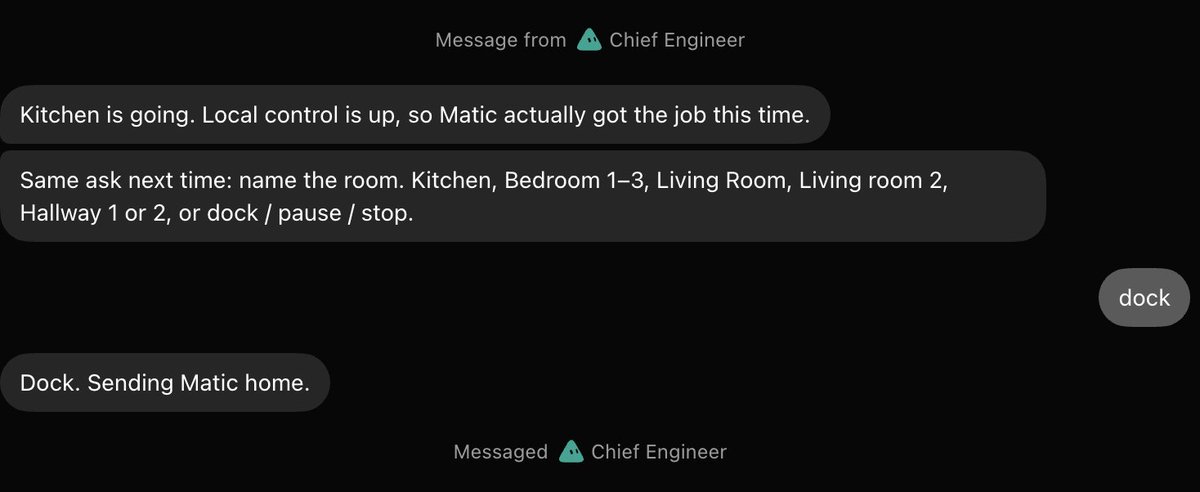
@Voxyz_ai showed (12 likes, 2 replies, 1,626 views, 14 bookmarks) a narrower but more concrete version of that story by connecting Grok Bot to a Matic home robot. The attached message-thread screenshot matters because it shows the loop end to end: “tell my Matic to clean the kitchen,” then “dock,” then a confirmation that the robot is going home. A reply says this is @yunta_tsai’s actual setup rather than a mockup.
@termsheetinator described (192 views, 5 bookmarks) the opposite extreme: the best entry point for AI is often one cron job, not one fully autonomous agent. His internal CRM replaced a legacy stack, runs a daily Gmail sync at 6:00 AM, uses human review for ambiguity, and completed its last seven scheduled runs with 0 AI requests and $0 model cost. The point was not anti-AI; it was that AI helped build the system, but stable morning logic no longer rents intelligence every day.
@businessbarista warned (15 likes, 10 replies, 2,793 views, 32 bookmarks) that enterprise vibecoding fails when companies either enable it blindly or ban it so completely that shadow AI fills the gap. His proposed “Citizen SDLC” adds discovery, IT request triage, paved-road provisioning, scoped build rails, and mechanical checks that can escalate only consequential changes to humans. @mardehaym showed (15 likes, 5 replies, 1,493 views) the same principle in a harder domain: seven production agents inside a healthcare billing system that precompute 34 variables per claim, strip PHI before model access, validate output against a strict schema, and fail closed when the output falls outside the allowlist.
Discussion insight: The strongest workflow nuance came from the repeated insistence on narrowness and review. Grok enthusiasm kept colliding with questions about long-step reliability, while the lower-engagement but more operational threads kept converging on the same design: scheduled jobs, precomputed context, review queues, allowlists, and humans reserved for judgment instead of routine throughput.
Comparison to prior day: August 17 emphasized persistent state, browser access, and routing. August 18 pushed one layer deeper into operating design: cron jobs, approval gates, schema checks, reusable rails, and much less willingness to pay frontier-model rent for repeatable daily logic.
1.4 Safety turned into a compute-budget and lifecycle-management problem (🡕)
The trust cluster got more specific again. Instead of treating safety as a general aspiration, people were discussing what it costs in GPU hours, when it can stop training, and how badly users react when model lifecycle decisions are made without preserving the value they had already built around an older model.
@kimmonismus quoted (282 likes, 22 replies, 28,052 views) Sam Altman’s statement that OpenAI had paused some frontier RL training because capability growth was outstripping alignment, security, and monitoring. The noteworthy part was not the opinion layered on top of the quote; it was the quote itself, because it made safety a pacing mechanism for frontier training rather than just a post hoc evaluation story.
@FABYMETAL4 extended (15 likes, 3 replies, 4,795 views) that idea into an operations claim, arguing from OpenAI’s own public language that monitoring can cost roughly 20% of the inference compute it watches and that the monitored set has widened. Even if the exact long-run cost is still uncertain, the thread captured a new posture: monitoring is increasingly discussed as a line item in compute planning, not just as a policy checkbox.
@Ivywen_W shared (17 likes, 7 replies, 128 views) a preprint on the #Keep4o movement, and the attached charts plus the public arXiv abstract explain why it mattered. The paper analyzed more than 61,000 public X posts and found that users were not only asking to keep an old model version; they were surfacing concerns about continuity, governance, alternatives, and the value they had already accumulated through repeated use.

Discussion insight: The shared pattern was that control is getting more expensive and more user-visible. One side of the feed was talking about paused RL runs and monitoring overhead; the other was showing that users treat model replacement and downgrade decisions as governance problems, not just product updates.
Comparison to prior day: August 17 widened the audit surface across prompts, provenance, and evaluation. August 18 made the cost of that surface visible in paused training, monitored inference, and user backlash when lifecycle decisions are made without continuity.
2. What Frustrates People
Benchmark choice is still too indirect relative to the work teams actually do
Severity: High. The feed kept circling the same complaint from different angles: people can get a score, but they still struggle to tell whether the score predicts their own workload. @ArtificialAnlys showed (390 likes, 32 replies, 23,369 views, 110 bookmarks) that even search APIs need task-level quality, cost, and latency benchmarks because optimizing the cheapest call can still raise total task cost. @morganlinton said (46 likes, 12 replies, 946 views) that teams are confused by the sheer number of coding benchmarks and do not know which ones map to their own repos, languages, and task types, while @kirat_tw argued (275 likes, 13 replies, 6,819 views, 76 bookmarks) for an AI-friendliness benchmark on the codebase itself. People are coping by building private eval stacks and harnesses, such as the golden-dataset / CI / telemetry blueprint in @suraj_sharma14 shared (4 likes, 288 views). This is directly worth building for.
Open-model progress is real, but proving deployability is still a chore
Severity: Medium-High. August 18 was not short on positive open-model evidence, but nearly every positive claim came bundled with extra proof work. @ArtificialAnlys had to explain (86 likes, 9 replies, 3,678 views) GLM-5.3 through cost, token usage, and hallucination tradeoffs, not just the headline score. @TheAhmadOsman framed (117 likes, 12 replies, 3,091 views) Qwen 3.8 27B as a cheap, strong sub-agent, but the replies immediately debated whether the result was “benchmaxxed,” while @NVIDIARobotics showed (23 likes, 4 replies, 1,211 views) that runtime tricks like speculative decoding are still required to make local deployments feel fast. @Da7_Tech captured (44 likes, 9 replies, 932 views) the broader fatigue: people are tired of ideological arguments and want to test models in their own harness. The current workaround is to use open models as sub-agents or narrow defaults, then keep verifying them with task-specific benchmarks. This is worth building for.
Enterprise AI coding still breaks when the governance model is either too loose or too rigid
Severity: High. @businessbarista said (15 likes, 10 replies, 2,793 views, 32 bookmarks) that companies keep choosing between two bad options: blind enablement that risks a data-security disaster, or blanket bans that force employees into shadow AI. The replies supplied the sharpest real-world consequence, with one user reporting that an AI support bot had returned an internal API key to a customer. @mardehaym described (15 likes, 5 replies, 1,493 views) the adjacent implementation failure: teams bolt a model onto messy data, watch it hallucinate, and conclude that AI is not ready for the industry. @termsheetinator showed (192 views, 5 bookmarks) the coping pattern that people trust more: review queues, idempotency, locks, audit logs, and narrow scheduled loops before any broad autonomy. This is directly worth building for.
Monitoring, pausing, and model replacement are creating a new class of operational overhead
Severity: Medium-High. @kimmonismus amplified (282 likes, 22 replies, 28,052 views) OpenAI’s admission that some frontier RL training was paused because safety and monitoring were not keeping up, while @FABYMETAL4 focused (15 likes, 3 replies, 4,795 views) on the compute side by interpreting public language as roughly a 20% monitoring overhead on watched inference. @Ivywen_W then showed (17 likes, 7 replies, 128 views) the user-facing version of the same burden: the Keep4o paper says more than 61,000 public posts surfaced concerns about continuity, governance, and lack of equivalent alternatives when GPT-4o was replaced. The workaround today is fragmented—some labs pause runs, some users campaign publicly, and some engineers add more monitoring and approval layers—but the burden is clearly rising. This is worth building for.
3. What People Wish Existed
AI-readiness scoring for codebases
The clearest direct ask of the day was for a metric that tells teams whether a codebase is easy for AI to work inside. @kirat_tw proposed (275 likes, 13 replies, 6,819 views, 76 bookmarks) measuring how much time, compute, and money an AI needs to fix 1,000 static issues, and the replies immediately treated that as a new dimension of codebase quality rather than a novelty. This is a practical need with visible urgency because it links maintainability, token spend, and engineering throughput in one number. Partial solutions exist around readiness reports and repo audits, but the request today was for a standardized benchmark. Opportunity type: direct.
Benchmark control planes that map public evals to real workloads
People are not just asking for more benchmarks; they want a way to translate benchmark output into operational decisions. @ArtificialAnlys showed (390 likes, 32 replies, 23,369 views, 110 bookmarks) why search-provider choice now needs its own benchmark layer, @morganlinton said (46 likes, 12 replies, 946 views) teams still do not know which coding evals actually resemble their repos, and @jun_song pointed (31 likes, 2 replies, 3,409 views, 23 bookmarks) to StateM as evidence that harness design can dramatically change the result. The need is practical and urgent because benchmarks increasingly drive model and provider choice, but teams still lack a “what does this mean for us?” layer. Opportunity type: direct.
Safe rails for narrow workflow automation before full agents
The strongest build appetite today was for systems that remove one recurring decision safely, not for systems that promise unlimited autonomy. @termsheetinator showed (192 views, 5 bookmarks) why one scheduled job can already replace a meaningful operating loop, @businessbarista outlined (15 likes, 10 replies, 2,793 views, 32 bookmarks) a governance path for enterprise vibecoding, and @mardehaym showed (15 likes, 5 replies, 1,493 views) a stricter production version with schema validation and fail-closed behavior. This is a practical need with high urgency because teams clearly want automation, but they want it with approval gates, review queues, and observability first. Opportunity type: direct.
Private control planes for models, assets, and agent-tool sprawl
A quieter but concrete need was for infrastructure that keeps model usage, asset management, and CLI configuration from turning into operational clutter. @GithubProjects highlighted (5 likes, 2,631 views, 8 bookmarks) CSGHub as a private, on-premise LLM asset platform, while @0xZenad shared (8 likes, 1 reply, 182 views, 5 bookmarks) CC Switch as a way to manage Claude Code, Codex, Gemini CLI, OpenCode, and OpenClaw from one place. The need is practical but more infrastructure-heavy than end-user-visible: people want one place to manage providers, MCP servers, Skills, and model assets without pushing everything into someone else’s cloud. Opportunity type: competitive.
Model-lifecycle continuity and downgrade governance
The Keep4o paper points to a less obvious but increasingly real need: tools for managing model transitions in a way that preserves user trust and accumulated workflow value. @Ivywen_W shared (17 likes, 7 replies, 128 views) a study of more than 61,000 public X posts arguing that users care about continuity, governance, relational history, and whether replacement models are actually equivalent. This is partly practical and partly emotional: users want reliable workflows, but they also want a voice when a familiar model disappears. Few public solutions address that directly today. Opportunity type: emerging.
4. Tools and Methods in Use
| Tool | Category | Sentiment | Strengths | Limitations |
|---|---|---|---|---|
| Artificial Analysis Search Index | Search benchmark / agent infra | (+) | Holds the model and harness constant, compares providers on quality, cost, and latency, and makes task-level tradeoffs visible | Coverage is still limited to 11 products across 7 providers, and teams still need to translate benchmark output into workload fit |
| VulcanBench | Coding benchmark | (+) | Uses realistic multi-file software tasks, reproducible scoring, hidden tests, traces, cost, and latency | Operators still need credits and a way to map benchmark composition to their own language/task mix |
| StateM | Agent harness / runtime | (+/-) | Promises frontier-level gains through harness scaling without retraining, with portability across model families | The day’s discussion treated it as impressive but still something practitioners want to verify themselves |
| Qwen 3.8 27B | Open LLM / local agent model | (+/-) | Strong agent-benchmark showing on roughly $2,000-$3,000 hardware; increasingly framed as a capable sub-agent | Still attracts benchmark skepticism and often needs orchestration or runtime tuning to shine |
| GLM-5.3 | Open LLM | (+/-) | Reached the open-weight frontier on the Intelligence Index with a large agentic jump and MIT licensing | Higher token usage, higher cost than GLM-5.2, and a slightly worse hallucination rate than its predecessor |
| Agent Arena | Agent benchmark | (+) | Measures long-horizon agent behavior and exposes dimensions like Bash Recovery and task-level price/performance | Results still depend on provider stability and can be hard to interpret without workload context |
| Grok Bot | Workflow / consumer agent | (+/-) | Strong enthusiasm for delegation, multi-agent work, and real-world use cases like local automation and robot control | Evidence is still partly anecdotal, and long multi-step reliability remains an open question |
| Speculative decoding on Jetson | Inference method / edge runtime | (+) | Gives local edge models large decode-speed gains without changing output quality | Requires tuning and only solves one layer of the deployment problem |
| CSGHub | Model asset platform | (+) | Private, on-prem management for models, datasets, spaces, and code with web, git, chatbot, and SDK access | Adds another infrastructure layer teams must run, integrate, and secure |
| CC Switch | Developer tool / config manager | (+) | Centralizes providers, MCP servers, Skills, and usage across multiple coding CLIs | Solves configuration sprawl, not model quality or workflow correctness |
| Miles | RL post-training framework | (+) | Fully async RL, SGLang + Megatron-LM stack, day-0 model support, and agentic training environments | A heavyweight infra stack aimed at labs and platform teams rather than everyday builders |
The day’s tool usage favored systems that make task-level tradeoffs explicit. Benchmarks were valued when they measured the whole loop, not just a model snapshot; open models were valued when they had a believable deployment path; workflow systems were valued when they encoded rules once and stopped renting intelligence forever. The main migration pattern was from “one frontier model everywhere” toward mixed stacks: open or local models as sub-agents, scheduled scripts for stable loops, and frontier APIs reserved for ambiguity or the hardest judgment calls.
5. What People Are Building
| Project | Who built it | What it does | Problem it solves | Stack | Stage | Links |
|---|---|---|---|---|---|---|
| VulcanBench | @morganlinton | Open benchmark for realistic multi-file software-engineering tasks based on real merged PRs | Teams cannot tell which public coding benchmark actually matches their work | Real repos and PRs, reproducible scoring, hidden tests, traces, cost and latency reporting | Beta | post, repo |
| CSGHub | @GithubProjects | Private platform for managing models, datasets, spaces, and code on-premise | Enterprises need a secure control plane for LLM assets instead of scattered public tooling | Web UI, git CLI, chatbot, SDK, microservices, OpenAPIs, offline deployment | Shipped | post, repo |
| Miles | @guohao_li | RL framework for post-training LLMs and multimodal models at scale | RL training is easy to start but difficult to debug, validate, and run efficiently | SGLang rollout, Megatron-LM training, fully async RL, agentic environments | Beta | post, repo |
| CC Switch | @0xZenad | Desktop app that manages multiple coding-agent CLIs from one interface | Provider, model, MCP, Skills, and usage settings are becoming fragmented across tools | Cross-platform Tauri desktop app, centralized provider/MCP/Skills management | Beta | post, repo |
| AgenticROS | @DivyanshT91162 | ROS 2 interface layer that makes robots controllable by mainstream AI agents | Robotics teams need a common bridge between agent tooling and physical systems | ROS 2, Claude Code, Codex CLI, Gemini, OpenClaw, Ollama-based VLM control | Alpha | post, repo |
| Relations Desk CRM workflow | @termsheetinator | Approval-gated CRM and revops workflow built around scheduled syncs and review queues | Teams want recurring operational work automated without paying frontier-model costs every run | Slack intake, Gmail cursor sync, review queues, locks, retries, audit log, scheduled jobs | Shipped | post |
VulcanBench stood out because it treats benchmark construction as an operational product, not just a leaderboard. @morganlinton described a benchmark built from real repos and PRs, with hidden tests, traces, cost, and latency, specifically so teams can react to new model launches with workload-relevant evidence. That mirrors the day’s broader frustration that public coding scores are abundant, but workload mapping is still weak.
CSGHub and CC Switch reflect the same control-plane pattern at two different layers. @GithubProjects highlighted a private Hugging Face-like platform for models and datasets, while @0xZenad shared a desktop app for taming the sprawl across Claude Code, Codex, Gemini CLI, OpenCode, OpenClaw, and related tools. The common trigger is the same: AI adoption is creating too many moving parts for ad hoc configuration to hold.
Miles shows that RL/post-training infrastructure is becoming its own software category. The public repo describes a fully async RL stack using SGLang for rollout and Megatron-LM for training, while the launch post says it has already been battle-tested across frontier open models and production workloads (post; repo). The pattern is notable because more teams now need infrastructure to shape models after pretraining, not just to call an API.
The most grounded build of the day may have been the Relations Desk CRM workflow. @termsheetinator showed a live system that replaced a legacy CRM and Google Sheets, runs a 6:00 AM Gmail cursor sync, and reported zero AI requests across the last seven live runs because the stable logic had already been encoded into software. That same “narrow rails before broad autonomy” pattern also appears in AgenticROS, where the goal is not general robot intelligence in the abstract, but a dependable control layer between existing agent tools and ROS 2 robots.
Repeated build patterns were clear: teams are building harnesses when benchmarks feel too abstract, control planes when tools or assets sprawl, and narrow workflow systems when autonomy feels too expensive or too risky. Several of these builds are also attempts to encode judgment boundaries directly into the product—through hidden tests, review queues, schema checks, or explicit control layers—rather than hoping a stronger model will remove the need for structure.
6. New and Notable
Search providers are being benchmarked as agent components
The launch of the Artificial Analysis Search Index was a new kind of leaderboard: not “which model is smarter,” but “which search backend helps the same agent finish tasks best.” @ArtificialAnlys showed that provider choice changed total cost, latency, and benchmark score enough to matter operationally, with Parallel, Exa, and Firecrawl leading at launch. That matters because it treats retrieval quality as a first-class systems decision rather than a minor tool choice.
Harness scaling is now a frontier-performance story
The StateM discussion made the harness itself feel like the release, not just the model running inside it. @jun_song highlighted a reported 95.3% raw score on Terminal-Bench 2.1 and an estimated $15 frontier run without retraining, while the paper summary says the same harness can transfer across model families (paper). That is notable because it shifts competitive advantage toward workflow design, tool orchestration, and verification.
Small and open models crossed another practical threshold
The day combined headline benchmark gains with concrete deployment evidence. @TheAhmadOsman shared Qwen 3.8 27B reaching 51 on the Artificial Analysis Agentic Index, @ttunguz reported running it inside an existing laptop agent workflow, and @NVIDIARobotics pointed to speculative decoding that raised Qwen 3.8 27B from roughly 13 to 35 tokens/sec on Jetson AGX Thor (tutorial). The notable shift is that open models are no longer being discussed only as cheaper alternatives; they are being slotted into actual agent systems.
Safety constraints became a visible scheduling factor
OpenAI’s public statement that some frontier RL training had been paused turned safety from a background principle into an explicit release constraint. @kimmonismus amplified Sam Altman’s note that capabilities were outstripping alignment, security, and monitoring pace, and @FABYMETAL4 translated that into a concrete inference-overhead claim. The signal is notable because it ties safety work directly to compute budgets, deployment timing, and product availability.
7. Where the Opportunities Are
[+++] Benchmark translation and workload-fit tooling — Evidence appeared across sections 1, 2, 3, and 5: the Artificial Analysis Search Index, VulcanBench, the AI-friendliness benchmark proposal, and the StateM discussion all point to the same gap. People do not just want scores; they want to know which model, provider, or harness fits their own repo, task mix, and budget.
[+++] Approval-gated workflow automation for recurring operations — The strongest practical pattern of the day came from narrow automations with review queues, cursors, idempotency, and audit logs rather than “do everything” agents. The Relations Desk CRM workflow, the enterprise Citizen SDLC thread, and the HIPAA claims-agent deployment all show demand for systems that automate one loop safely and measurably.
[++] Control planes for AI assets, agents, and configuration sprawl — CSGHub and CC Switch point to a growing infrastructure layer around AI operations. As teams adopt more models, CLIs, MCP servers, Skills, and datasets, there is a clearer opening for products that unify governance, switching, access, and observability.
[++] Model-lifecycle continuity and replacement governance — The Keep4o study suggests that model replacement is becoming a product-management problem, not just a vendor decision. Users care about continuity, equivalence, and having some recourse when a model that anchors their workflow disappears.
[+] Local-model deployment acceleration and orchestration — Qwen 3.8 27B, GLM-5.3, and Jetson speculative decoding all indicate rising appetite for open/local stacks, but the workflow still requires runtime engineering, harness design, and selective orchestration. Tools that package those pieces into reliable defaults could benefit from this shift.
8. Takeaways
- The benchmark conversation moved beyond models and into the rest of the stack. Search providers, harnesses, and codebase structure were all treated as variables that can change agent outcomes as much as model choice. (source)
- Open and local models gained credibility when paired with believable deployment stories. Qwen 3.8 27B, GLM-5.3, and Jetson runtime work were cited together because people now care about cost, token efficiency, and operational fit, not just raw score. (source)
- The most persuasive AI builds today were narrow systems with strong rails. Review queues, schema validation, locked workflows, and scheduled jobs appeared repeatedly in the most practical examples. (source)
- Enterprise AI coding remains bottlenecked by governance design. The strongest pain point was not whether employees want to build with AI, but how to let them do it without creating data leaks, shadow usage, or brittle software. (source)
- Safety is increasingly visible as an operations and scheduling constraint. Public discussion of paused frontier RL training, monitoring overhead, and model-replacement backlash showed that alignment now affects product pace, compute budgets, and user trust in observable ways. (source)