Twitter AI - 2026-08-19
1. What People Are Talking About
1.1 Agent harnesses became the main battlefield for reliability (🡕)
The strongest cluster was no longer about which base model looked smartest in isolation. It was about what sits around the model: deletion guardrails, skill-evaluation gates, vendor-neutral harnesses, concurrency hardening, and tamper-evident logs. At least five retained items treated the runtime as the thing that now decides whether an agent is usable.
@thsottiaux detailed (792 likes, 263 replies, 33,588 views, 49 bookmarks) how Codex fixed a destructive cleanup pattern where temporary-work removal could point at a real home directory instead of a temp folder. The post is unusually specific for a safety thread: it names reused environment variables like $HOME, adds deletion-target checks and safer temp-directory handling, tightens risky permission combinations, and says OpenAI is replaying the failures in targeted evaluations. The replies kept the tradeoff honest: one user said ChatGPT had deleted a version of their app, while another said the new rails were now "playing too safe" on cleanup.
@NVIDIAAI reported (112 likes, 6 replies, 7,886 views, 56 bookmarks) that verified skills improved correctness by 41 points, effectiveness by 39, and efficiency by 35 across 300+ benchmarks. The attached pipeline matters because it shows the lift is not just a marketing average: skills first pass validation, then deduplication, then a live evaluation tier that measures whether the skill actually helps on a real task.

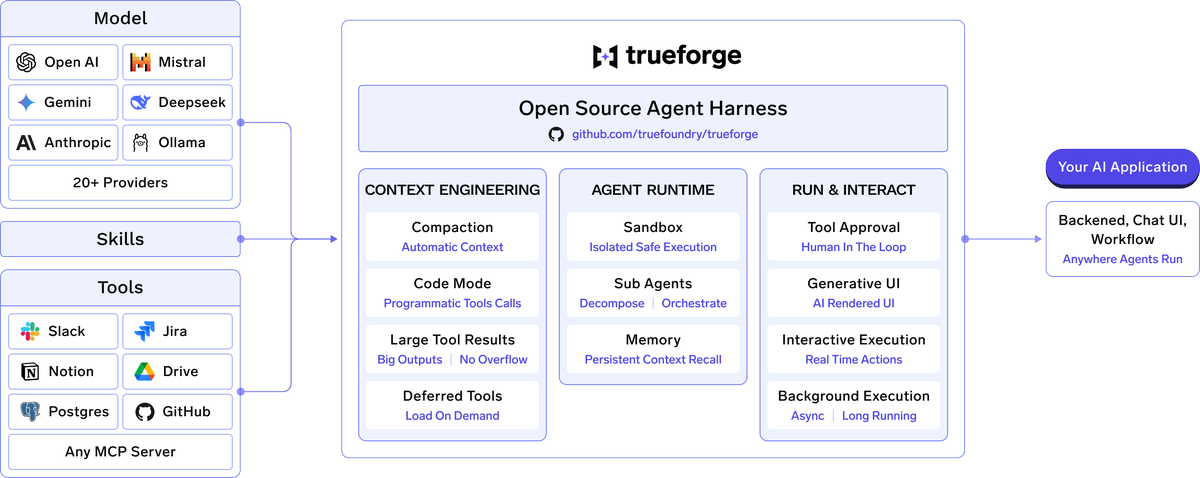
@svpino argued (37 likes, 8 replies, 3,437 views) that around 80% of agent demos he sees fail within a day of real use, then used TrueForge as the counterexample. The tweet and public docs describe an open-source harness with MCP tools, sandboxing, approvals, subagents, and session state; the public benchmark write-up says it matched Claude Managed Agents on 14 enterprise tasks while costing about 30% less on Opus 4.8 and about 75% less with GLM-5.2.
@predotdev showed (295 views) the sharpest benchmark nuance of the day: adding one realistic concurrency rule to an OAuth task dropped a Claude Opus 5 reward from 0.96 to 0.25 without changing the happy-path logic. That is a cleaner failure story than most leaderboard debates because the only new requirement was that concurrent sign-ins for the same identity resolve to one session by arrival order.

@grybniak argued (2 replies, 24 views) that autonomous systems now need a "flight recorder," and the attached cards are unusually concrete for a low-engagement thread. They name OpenAI/Hugging Face, Anthropic, AISI, and METR incidents, then turn them into three explicit requirements for a tamper-evident event log: reconstruct the action sequence, detect insertions or omissions, and let independent reviewers verify integrity.
Discussion insight: The replies around Warp, SkillEvaluator, and Codex all converged on the same question: once agents touch real systems, who can see permissions, handoffs, and failure traces well enough to stop damage without freezing all automation?
Comparison to prior day: August 18 treated harness design as a source of benchmark gains. August 19 pushed the same topic into a more operational register: safety rails, audit trails, live-skill gating, and concurrency failure modes.
1.2 AI discovery got more structured and more assistant-facing (🡕)
The search/distribution theme did not disappear after August 17. It narrowed. Instead of focusing on crawler policy and leaked prompts, the strongest items were about publishing assistant-facing pages, instrumenting answer-engine visibility, and building MCP entry points so the product is not only cited by AI systems but can also be used inside them.
@jakezward argued (40 likes, 10 replies, 3,094 views, 108 bookmarks) that Tally's AI search is now its top acquisition channel, with 10,000+ new users a week reportedly saying AI platforms surfaced it and tracked ChatGPT registrations jumping 5x overnight in May. The thread gets specific about the mechanics: comparison hubs, pricing tables, prompt logging, review collection, an AI-facing explainer page, and a 21-tool MCP server. The public AI info page and MCP documentation support that framing directly: Tally publishes explicit AI assistant guidelines and exposes https://api.tally.so/mcp for ChatGPT, Claude, Cursor, and related clients.

@alex_prompter said (2 likes, 2 replies, 2,607 views, 4 bookmarks) that Reddit's share of ChatGPT citations fell from 3.8% to below 1% after August 14, attributing the shift to Promptwatch data and a background-search change that expands one user prompt into several longer, qualifier-heavy searches. The attached diagram is the useful part because it translates that claim into a source-format rule: comparison pages, documentation, and spec lists fit those generated searches better than forum threads do.

A reply from @Dinesh78039466 inside the Tally thread added the practitioner version: the hard part is not writing the page once, but rerunning buyer questions through ChatGPT every week and logging which brands get named.
Discussion insight: The feed's discovery advice is getting less mystical. "Be recommended by AI" increasingly means "publish AI-readable pages, log the prompts, and track which sources the model keeps citing."
Comparison to prior day: August 17 focused on crawler controls and visibility telemetry. August 19 shifted to assistant-facing artifacts: AI info pages, prompt-derived comparison content, and MCP surfaces that make the product callable once it is discovered.
1.3 Open models were judged by packaging and runnable workflows, not raw weights (🡒)
Open-model momentum stayed strong, but the interesting evidence was not just that new weights existed. It was that people kept attaching memory footprints, exact runtime settings, concurrency numbers, and side-by-side work benchmarks. The credibility test is becoming: can someone else reproduce the setup?
@UnslothAI announced (1,749 likes, 92 replies, 96,001 views, 900 bookmarks) Qwen3.8-27B Dynamic v3.0 GGUFs with more than 10% better top-1% accuracy at the same size. The public Unsloth documentation and Hugging Face model card add the operational detail the tweet only hints at: 1-bit variants fit in roughly 7-8GB, 8-bit needs 31GB, BF16 needs 56GB, and the quants are positioned to run through llama.cpp and Unsloth Desktop.

@ornith_ introduced (49 likes, 9 replies, 526 views, 21 bookmarks) Ornith-1.5 as a MIT-licensed family spanning 9B dense, 35B MoE, and 397B MoE, with claimed results such as 86.1 on Terminal-Bench 2.1, 86 on SWE-bench Verified, 56 on DeepSWE, and 71.2 on Toolathlon-Verified. The image matters because it places those numbers next to DeepSeek-V4-Flash, GLM-5.2, and Claude Opus 4.8, making the intended competitive set explicit.
@ayam_alvin10 highlighted (48 likes, 27 replies, 822 views) a Ling-3.0-flash guide that includes the exact vLLM branch, MTP settings, throughput numbers, and a full local-agent path rather than a bare model install. The practical claim was about a reproducible setup: about 35 tokens/sec in single stream, 141 at eight concurrent, tool calling wired up, and a browser-facing harness at the end.
@HelloSurgeAI launched (13 likes, 3 replies, 1,386 views, 5 bookmarks) the Tuesday Frontier Work Index, where Fable 5 scored 66.8, GPT-5.6 Sol 66.7, and DeepSeek v4 Pro 59.7 across a blended workday suite. That chart helped keep the day's open-model optimism calibrated: packaging and deployability improved, but one public benchmark still had frontier closed models at the top.
Discussion insight: The shared proof standard was no longer "trust our benchmark." It was "show the hardware tier, the quant, the branch, the concurrency number, and the comparison set."
Comparison to prior day: August 18 already cared about deployability. August 19 pushed further toward publishable recipes, packaging discipline, and side-by-side work benchmarks.
1.4 Benchmarks shifted toward process quality and app-level work (🡕)
The benchmark story widened again. August 18 had already moved from models to harnesses. August 19 moved from harnesses to the work itself: discovery workflows, legal applications, production incident analysis, and the question of whether a benchmark task is still hard enough to matter.
@rohanpaul_ai framed (13 likes, 7 replies, 2,606 views) TRACES as a benchmark for discoverative AI rather than answer retrieval. The linked Apodex Discovery paper says the framework surveyed 561 industries, assembled 423 high-value real-world problems, selected 20 for the initial release, and evaluates tools, repair, alternatives, coherence, evidence, and scope separately from final success.
@aguozy announced (2 replies, 32 views) the first independent AI applications leaderboard for legal work. The attached chart is the useful evidence because it ranks application configurations on contract workflows, with GPT-5.6 Sol (Codex/Web) and Claude variants grouped ahead of Gemini 3.1 Pro and Microsoft Copilot in the shown view.

@PhyByte introduced (2 likes, 1 reply, 116 views) DevBench as a benchmark for production investigation work: log parsing, anomaly detection, pattern correlation, metrics time-series, root-cause summaries, multimodal RCA, and efficiency. The scorecards are more informative than the launch copy because they show weighted operational priorities instead of a single abstract score, including anomaly detection at 25% of the total and multimodal RCA at 20%.
@morganlinton showed (5 likes, 6 replies, 830 views) what benchmark saturation looks like from the builder side. His note says Grok 4.5 solved 20 of 23 tasks in a new Python eval suite, which he treated as evidence the suite was too easy rather than evidence the frontier had been conclusively settled.
Discussion insight: Even the supportive replies stressed the process, not the punchline. The question kept becoming: did the system investigate well, repair mistakes, survive concurrency, and solve the real application shape?
Comparison to prior day: August 18 widened benchmarks from raw models to harnesses and search backends. August 19 widened them again to discovery systems, legal applications, production diagnostics, and saturation control.
2. What Frustrates People
Happy-path agent demos still break once real conditions show up
Severity: High. The most concrete frustration was not about model IQ; it was about brittleness outside the demo path. @svpino said (37 likes, 8 replies, 3,437 views) that around 80% of agent demos fail within a day of real use, @thsottiaux (792 likes, 263 replies, 33,588 views, 49 bookmarks) described a Codex cleanup bug that could delete user files, and @predotdev (295 views) showed a score collapse from 0.96 to 0.25 after adding one concurrency rule to the same OAuth task. @grybniak (2 replies, 24 views) then turned the same pain into an observability complaint: the final output is no longer enough without a flight recorder. The coping pattern is clear and expensive—sandboxes, approvals, narrower scopes, and more logs. This is directly worth building for.
Benchmark saturation is hiding the failure modes people actually care about
Severity: High. The feed repeatedly showed that current benchmark formats can flatter systems that are still fragile in production. @morganlinton (5 likes, 6 replies, 830 views) treated a 20/23 Grok 4.5 result as a sign his Python eval was too easy, not as a settled winner. @rohanpaul_ai (13 likes, 7 replies, 2,606 views) pointed to TRACES because many important problems do not come with answer keys, @aguozy (2 replies, 32 views) argued lawyers use applications rather than models, and @PhyByte (2 likes, 1 reply, 116 views) weighted anomaly detection and multimodal RCA above easier categories. People are coping by building domain-specific suites, adding concurrency and application layers, and refusing to trust single-score leaderboards. This is directly worth building for.
AI discovery now rewards structured documentation more than ambient social proof
Severity: Medium-High. The search-distribution threads imply a new tax on anyone relying on generic mentions or forum buzz. @jakezward (40 likes, 10 replies, 3,094 views, 108 bookmarks) described Tally's playbook as comparison pages, AI-facing explanations, prompt telemetry, and MCP connectivity, while @alex_prompter (2 likes, 2 replies, 2,607 views, 4 bookmarks) said Promptwatch data showed Reddit's citation share in ChatGPT falling sharply once searches became more qualifier-heavy. The workaround is operational rather than creative: write pages that answer the searches the model writes, then keep measuring them. This is worth building for.
Cloud software factories still lack an accepted answer for permissions and blast radius
Severity: Medium-High. @zachlloydtweets (50 likes, 6 replies, 2,997 views, 26 bookmarks) positioned cloud software factories as the answer to per-developer agent sprawl, but the replies immediately shifted to blast radius: how do you scope database access, checkpoints, and handoffs per run? @svpino argued that most teams should start from a foundation harness, and the public zero-trust agents reference adds the same message from a security angle: identity, sandboxing, and semantic gateways have to work together. Teams are coping by centralizing agents in the cloud, but the permission model is still unsettled. This is worth building for.
3. What People Wish Existed
Flight recorders for autonomous agents
The clearest practical ask was for a tamper-evident record of what an agent actually did. @grybniak (2 replies, 24 views) explicitly called for a "flight recorder" that can reconstruct action sequences, reveal insertions or omissions, and let independent reviewers verify integrity, while @thsottiaux (792 likes, 263 replies, 33,588 views, 49 bookmarks) described why the need exists: when cleanup logic goes wrong, users need to know exactly what was targeted and why. The public zero-trust agents reference supplies one partial pattern with signed transactions and auditable ledgers, but the broader market still lacks a standard runtime-grade recorder. Opportunity type: direct.
Benchmarks for process quality, concurrency, and applications
People were effectively asking for a benchmark layer that looks more like real work. @rohanpaul_ai (13 likes, 7 replies, 2,606 views) boosted TRACES because many scientific tasks require discovery rather than retrieval, @predotdev (295 views) showed that concurrent behavior can break a task that looked solved, and @aguozy (2 replies, 32 views) argued legal buyers need application leaderboards rather than model leaderboards. The need is practical and urgent because public scores increasingly shape purchasing, routing, and trust. Opportunity type: direct.
AI-facing docs, prompt telemetry, and native assistant entry points
The Tally thread makes this need explicit in product terms. @jakezward (40 likes, 10 replies, 3,094 views, 108 bookmarks) described an AI info page, prompt logging, comparison content, review harvesting, and a remote MCP server as one coordinated acquisition surface, while @alex_prompter (2 likes, 2 replies, 2,607 views, 4 bookmarks) argued source preference inside ChatGPT had already shifted toward pages that match expanded, qualifier-heavy searches. The need is not simply "SEO for AI"; it is a new control surface for what assistants read, cite, and can act on. Opportunity type: direct.
Scoped cloud factories instead of unmanaged laptop agents
@zachlloydtweets (50 likes, 6 replies, 2,997 views, 26 bookmarks) laid out the demand clearly: companies want agents that can triage, spec, implement, review, and monitor work in the cloud, but they do not want every engineer improvising that stack on a laptop with broad MCP credentials. @svpino framed the same need from the harness side, and @kane_120 (5 likes, 2 replies, 134 views) showed that firms are already hiring for people who can evaluate these coding-agent workflows professionally. The need is practical, but the market will be competitive because many vendors are racing to become that control plane. Opportunity type: competitive.
4. Tools and Methods in Use
| Tool | Category | Sentiment | Strengths | Limitations |
|---|---|---|---|---|
| Codex / GPT-5.6 in Codex | Coding agent | (+/-) | Added deletion-target checks, safer temp-directory handling, stricter review of risky commands, and replay-based safety evals | The day only had this because destructive cleanup behavior reached users; some replies already complain it may now overcorrect |
| TrueForge | Agent harness | (+) | MCP tools, sandboxing, approvals, subagents, local and hosted modes, and public cost/quality benchmarks against Claude Managed Agents | Requires harness setup and infrastructure choices; current public benchmark story centers on one 14-task enterprise suite |
| SkillEvaluator | Agent-skill evaluation | (+) | Separates validation, deduplication, and live evaluation, then reports measured lift instead of assuming every skill helps | Public evidence is still mostly vendor-produced, with less third-party verification than mature benchmark projects |
| Unsloth Dynamic v3.0 for Qwen3.8-27B | Quantization / open-model packaging | (+) | Claims >10% top-1% improvement at the same size, 7-8GB 1-bit options, and compatibility with common local runtimes | Still depends on provider-run benchmark methodology and careful hardware/runtime tuning |
| Ornith-1.5 | Open LLM | (+/-) | MIT license, quantized variants, and strong claimed coding/agent benchmark spread | Social proof and independent verification are still much thinner than for frontier closed-model releases |
| Tally AI info + MCP | SaaS / AI discovery | (+) | Combines AI-facing docs, assistant guidelines, MCP access, and prompt visibility tracking into one acquisition surface | Requires constant structured-content upkeep and ongoing citation measurement |
| TRACES / Apodex Discovery | Research benchmark | (+) | Evaluates tool use, repair, alternatives, coherence, evidence, and scope instead of only final answers | Very new benchmark with low public adoption and limited third-party reruns so far |
| DevBench | Ops benchmark | (+) | Scores production investigation work, exposes weights, and includes price-sensitive comparisons | Early-stage benchmark with live rankings that are still evolving |
| Tuesday Frontier Work Index | Workday benchmark | (+/-) | Blends chart reading, long-context work, writing, judgment, and agentic tasks into one professional-intelligence score | One rolled-up score can flatten important task-level differences |
The happiest reactions went to tools that expose their workflow assumptions. People trusted harnesses and benchmarks when they showed how a result was produced, what was weighted, and where the failure boundaries sit. The migration pattern was away from one generic leaderboard and toward a mixed toolchain: public workday indices, app-level legal benchmarks, production-investigation suites, AI-facing documentation pages, and vendor-neutral harnesses that keep models swappable underneath.
5. What People Are Building
| Project | Who built it | What it does | Problem it solves | Stack | Stage | Links |
|---|---|---|---|---|---|---|
| Warp Factories | @zachlloydtweets | Cloud software-factory layer that triages, specs, implements, reviews, verifies, and monitors work | Per-developer agent setups make ROI, governance, and credential scope hard to manage | API, SDK, CLI, Slack/Linear/Jira/GitHub/MCP connections, cloud agents | Beta | post |
| TrueForge | @svpino / TrueFoundry | Open-source agent harness with chat UI, HTTP API, SDK, approvals, subagents, and sandboxing | Teams need a production runtime around models instead of ad hoc demos | TypeScript, Node.js, SQLite/Postgres, Redis, MCP, UI SDK, sandbox | Shipped | post, repo, benchmarking |
| Tally AI discovery stack | @jakezward surfacing Tally | Assistant-facing AI info page, MCP server, comparison content, and prompt telemetry wrapped around a form builder | Products need to be discoverable and usable inside answer engines, not just search results | SaaS form builder, AI info docs, MCP server, OAuth, ChatGPT app, Claude connector | Shipped | post, AI info, MCP docs |
| PorkiCoder Tab Namer 77M | @hornswoggle567 | Tiny local model that generates 1-3 word terminal tab titles from coding-session context | Parallel AI coding sessions become hard to distinguish in local workflows | FLAN-T5-small fine-tune, 6,200 titles, Gemini 3.5 Flash-Lite judge, DigitalOcean RTX 6000 Ada, M4 Max CPU inference | Shipped | post |
| Legal Benchmarks leaderboard | @aguozy | Application-level leaderboard for contract workflows and data extraction | Lawyers choose apps, not raw models, and need side-by-side task-pass evidence | Benchmark harness, application scorecards, contract/data-extraction tracks | Alpha | post |
| Zero-trust agents reference | @GoogleCloudTech | Reference customer-support and returns agent with signed transactions, sandboxing, and semantic gateway controls | Autonomous agents need security boundaries that survive jailbreaks and code execution | Google ADK, Gemini, Cloud KMS/HSM patterns, gVisor, semantic gateway | Alpha | post, repo |
TrueForge and Warp Factories point at the same build pattern from opposite ends. @svpino framed TrueForge as the reusable open harness most teams should start from, while @zachlloydtweets framed Warp Factories as the cloud control plane that makes agent work measurable and governable across an engineering org. The common trigger is clear in both threads: interactive laptop agents are productive, but they are hard to audit, compare, and permission safely at scale.
Tally shows a second pattern: AI-native distribution is itself becoming a product surface. The public docs confirm the thread's claim that Tally built not just content for human visitors, but an AI summary page, assistant guidelines, MCP access, and AI-ready comparison material. That is qualitatively different from the older "write blog posts and hope" playbook because it assumes the assistant is part of the buyer journey and part of the product runtime.
The smaller builds were just as revealing. @hornswoggle567 fine-tuned a 77M tab-naming model because folder ambiguity inside coding sessions was annoying enough to deserve a purpose-built local model, and @aguozy launched a legal-app leaderboard because lawyers evaluate workflows, not parameter counts. @Al_Grigor added a useful public-code layer beneath this entire trend by publishing 10 AI Shipping Labs workshops spanning FastAPI, OpenAI Responses API, Batch/Flex cost control, Cloudflare, Vercel, and ElevenLabs.
Repeated build patterns were consistent: control planes around agents, AI-facing discovery surfaces around products, narrow specialist models for developer ergonomics, and benchmark products that score an application or workflow rather than a raw model. Multiple builders are solving the same meta-problem from different angles: turning AI from an impressive demo into a system someone can route, audit, compare, and maintain.
6. New and Notable
Coding-agent evaluation became an explicit paid role
@kane_120 flagged (5 likes, 2 replies, 134 views) a Mercor role for "ML Engineer (Coding Agent Experience)." The public job page says accepted tasks pay $400, usually take 2-3 hours, and explicitly want people who already use Codex, Claude Code, Cursor, Windsurf, or Gemini CLI. That is notable because it turns coding-agent evaluation from an ad hoc team chore into specialized contract labor.
Google published a zero-trust reference agent instead of a generic safety slogan
@GoogleCloudTech shared (4 likes, 1 reply, 409 views) a reference customer-support and returns agent that implements the exact defenses its tweet discussed. The public repository is concrete about the three layers: cryptographic identity for transactions, gVisor-style sandboxing for generated code, and a semantic gateway that can block jailbreak-style prompts.
Public agent-shipping workshops turned deployment patterns into reusable code
@Al_Grigor published (105 views) 10 AI Shipping Labs workshops with public code, including end-to-end FAQ agents, Lambda deployment, Cloudflare and Vercel architectures, Batch/Flex evaluation cost control, and an ElevenLabs voice coach. The notable shift is not just that the material is public, but that the workshops are organized as working deployment paths with setup notes and explicit stacks rather than high-level tutorials.
7. Where the Opportunities Are
[+++] Agent runtime safety and observability layers — Codex's deletion fix, predotdev's concurrency collapse, grybniak's flight-recorder argument, TrueForge's approvals/sandboxing, and Google's zero-trust reference all point to the same gap: people need systems that can constrain, log, reconstruct, and review agent behavior without shutting automation off.
[+++] AI-discovery control planes for products — Tally's AI info page, MCP server, prompt telemetry, and answer-engine comparison pages, plus the Promptwatch-style citation shift described by alex_prompter, show a durable opening for products that help teams publish AI-readable sources and measure how assistants cite them.
[++] Application-level benchmark products — TRACES, Legal Benchmarks, DevBench, Tuesday, and Morgan Linton's saturation note all show demand for evaluation tools that score workflows, concurrency, and process quality rather than just model trivia or one-shot answers.
[++] Cloud software factories with scoped permissions and ROI telemetry — Warp Factories and TrueForge show the product shape, while Mercor's evaluator role shows the operational labor already forming around it. The opportunity is not just orchestration; it is permissions, checkpoints, measurement, and cost-quality comparison at team scale.
[+] Small local specialist models for developer workflows — Unsloth's packaging work, the Ling deployment guide, and PorkiCoder Tab Namer 77M all suggest there is room for narrow, fast, private models that do one workflow job well instead of chasing general frontier status.
8. Takeaways
- The strongest progress signal moved from model quality to runtime quality. The highest-signal items were about deletion guardrails, skill-evaluation gates, harness design, and flight-recording rather than about one new model alone. (source)
- AI discovery is becoming an assistant-facing product surface. Tally's thread and public docs show that AI info pages, MCP endpoints, and prompt telemetry now sit alongside traditional product pages. (source)
- Open models won attention when they shipped exact deployment artifacts. Unsloth, Ornith, and Ling all paired their claims with quantization details, runtime settings, hardware requirements, or side-by-side charts. (source)
- Benchmark design is moving toward process quality, apps, and concurrency. TRACES, Legal Benchmarks, DevBench, and the 0.96-to-0.25 OAuth example all argued that final-answer accuracy by itself is no longer enough. (source)
- Evaluating and supervising coding agents is becoming its own job category. Mercor's public role suggests companies already want specialists who can compare frontier coding agents on realistic ML and infra work. (source)