Twitter AI - 2026-08-20
1. What People Are Talking About
1.1 Open local models stopped sounding like downloads and started sounding like deployment recipes (🡕)
The strongest open-model cluster was not about abstract openness. It was about exact packaging: file size, quantization method, runtime branch, context ceiling, decode speed, and what kind of consumer GPU could actually carry the workload. At least five retained items treated deployability as the proof standard.
@Eschalabs reported (243 likes, 38 replies, 11,634 views, 201 bookmarks) that its 2-bit Qwen3.8-27B build runs at 82.6 tokens/sec on a single RTX 5090 while holding the full model in 10.15 GB on disk. The public model card makes the tweet more than hype: it specifies Apache-2.0 licensing, verified 24 GB cards, and an OpenAI-compatible server backed by Escha's SGLang runtime. The replies sharpened the mood of the day immediately, with one reader asking whether 2-bit could really match FP8 and another saying DFlash2 support was now the missing piece.
@analogalok showed (68 likes, 12 replies, 5,594 views, 86 bookmarks) that the battleground has already moved one layer down into inference engineering. His strict A/B chart compares native MTP against DFlash2 on the same Qwen3.8 27B / RTX 4090 setup and shows decode speed moving from 66.8 to 77.4 tokens/sec at 150k context and from 70.8 to 80.8 at high-precision settings, while prefill still favors native MTP.

@TeksEdge highlighted (12 likes, 914 views, 11 bookmarks) a smaller but equally important move: Empero's Qwen3.8-4B GGUF distills reasoning from a 2.4T Qwen teacher into a recommended 2.783 GB local build. The attached card is useful because it does not hide the tradeoff: MMLU rises from 35.4% to 55.3%, but GSM8K falls from 85.0% to 78.5%.
@aisearchio amplified (47 likes, 3 replies, 2,301 views, 13 bookmarks) Ornith-1.5's claim that frontier open weights are closing even more ground. The public Ornith release says the 397B MoE flagship scored 86.1 on Terminal-Bench 2.1, 56.0 on DeepSWE, and 44.6 on HLE under an MIT license, while @ayam_alvin10 pointed (53 likes, 34 replies, 899 views) to the next practical step: a Ling guide with the exact vLLM branch, MTP settings, and tool-calling/browser harness path needed to turn local weights into a usable agent.
Discussion insight: The replies were unusually intolerant of vague claims. People wanted receipts on quantization quality, explicit runtime settings, and visible benchmark regressions, not just another “this beats Opus” headline.
Comparison to prior day: August 19 already rewarded deployable open-model recipes. August 20 pushed that same theme deeper into 2-bit quantization, 4B distillation, and decode-path tuning.
1.2 Agent products were increasingly described as stacks, not single bots (🡕)
The most energetic agent threads were less about one assistant replacing everything and more about composing a small team: a cloud worker for app-heavy execution, a cheaper or more sovereign executor underneath it, and an open harness layer for products that want to own the workflow surface. The feed treated orchestration design as the real product.
@KanekoaTheGreat said (329 likes, 55 replies, 83,490 views) Grok Bot was the first agent system he had used “right out of the box” with zero coding, and described assistants for research, writing, clipping, and accounting running from the cloud on his X archive. The replies kept the claim grounded: one user immediately objected to the roughly $300/month price, and the author answered that it was still an early beta that only makes sense if it automates revenue-generating work.
@milesdeutscher mapped (22 likes, 10 replies, 8,814 views, 18 bookmarks) a cleaner architecture for the same idea. His diagram splits Grok Bot and Hermes into different jobs rather than treating them as substitutes: Grok handles sign-ins and app-heavy work across Salesforce, Slack, Gmail, and Figma, while Hermes handles sensitive or cost-heavy background tasks with self-hosted memory and a much lower cost floor.

@TheRealAdamG boosted (48 likes, 2 replies, 2,797 views, 17 bookmarks) the public Codex as a platform post, which says the open-source Codex harness now powers the app, CLI, and IDE extension. That matters because the article is explicit about what the reusable layer is: context management, tools, sandboxing, approvals, and the agent loop itself, exposed through app-server, SDK, and exec interfaces.
A more open-source variant appeared when @LoFiAlon highlighted (9 likes, 19 replies, 1,940 views, 5 quotes) Open Bot, a Grok-like one-person-company stack with AI coworkers, generative UI, computer use, agent-human handoffs, and user-owned recordings. The quote-tweet and reply from @grok mattered less as proof of scale than as proof of direction: solo-company automation is already being translated into open-source primitives.
Discussion insight: The strongest counterweight came from @LukasHozda, whose Autolith feature list drew replies asking where the trust boundary sits when an agent can redefine parts of its own environment. Even in enthusiastic threads, the unresolved question was who approves what.
Comparison to prior day: August 18 and 19 focused on harness quality and runtime rails. August 20 made composability much more explicit: chief-of-staff bots, sovereign execution layers, and reusable open harnesses underneath app-specific interfaces.
1.3 Benchmark culture moved toward evidence loops and vertical work (🡕)
The benchmark story kept drifting away from “which base model is smartest?” and toward whether a system can search, verify, repair, and specialize inside a real task shape. The most cited claims were about discovery workflows, document-heavy retrieval, and domain-trained subagents rather than generic answer retrieval.
@igus_ai summarized (98 likes, 2 replies, 1,573 views, 10 bookmarks) TRACES as a benchmark for “discoverative AI,” and the public TRACES paper plus Apodex overview make the shift concrete: the framework scores tools, repair, alternatives, coherence, evidence, and scope in problems that do not come with a known answer key. That is a meaningful change in what “good” is supposed to mean.
@murtuza_merc reported (103 likes, 14 replies, 9,119 views, 11 bookmarks) that Mistral Agentic Search tripled tested filing accuracy from 26.7% to 86%. Both Mistral's own launch post and the Fathom summary say the layer works by giving models five file-system-style tools - search, open, navigate, read, and grep - and can also cut p90 latency by up to 39.6% while reducing token use by up to one-third.
@BrendanFoody argued (43 likes, 1 reply, 3,287 views) that Harvey's Tenet marks the application-layer version of the same shift. Harvey's public post-training update says Tenet is a Kimi K3 base post-trained for long-horizon legal work, paired with specialist subagents for M&A diligence, review tables, and firm knowledge, and optimized for token efficiency alongside performance.
Discussion insight: The skepticism did not disappear; it just got more specific. @bindureddy said (55 likes, 8 replies, 36,415 views) the model hype cycle is now “72 hours,” and the sharpest reply said real developers do not ask one benchmarkable question - they ask 20 in a row, under shifting context, where the day-3 failures finally show up.
Comparison to prior day: August 19 widened evaluation from model scores into legal apps, discovery systems, and operational diagnostics. August 20 made the new test explicit: evidence, repair, specialization, and traceable retrieval mattered more than one-shot correctness.
1.4 AI-native operating models became a real management problem (🡕)
Several of the most useful posts were no longer about model selection at all. They were about how teams promote local models, route work across different systems, change job design, and govern autonomous behavior once AI starts touching production workflows.
@rachelwolan said (7 likes, 2 replies, 1,586 views, 10 bookmarks) that in 1,858 openings across “The Lenny 100,” AI-native product orgs look smaller because forward-deployed engineering is absorbing part of the old PM surface. Her thread says PM work is moving toward evals, edge cases, and model behavior, while 89% of Product roles and 76% of Design roles now require 5+ years of experience.
@chadwahl shared (88 likes, 4 replies, 2,948 views, 12 bookmarks) Deutsche Bank's take that Palantir's sovereignty story is increasingly about model liquidity rather than one-model lock-in. The attached note says AIP Evolve can test frontier, open-weight, and proprietary models against hierarchical customer needs, reroute workloads, rewrite prompts, and replace unnecessary model calls with deterministic code.
@lordbarmz showed (16 likes, 12 replies, 99 views) the most operational artifact of the day: a Chronara build-week board where local models first shadow external models, then only earn real workloads after meeting fixed standards, and can be demoted automatically if performance slips. The same board is equally notable for what is still broken - monitoring crashes, manual restarts, and failover not yet proven.

@stanine added (36 likes, 2 replies, 418 views) the governance overlay directly with Rippling's AI governance suite: MCP Gateway, AI Gateway, Agent Identity Management, and Shadow AI Detection tied back to existing worker identity and compliance policies.
Discussion insight: The common rule across these posts was that models do not get promoted into production just because they can answer prompts. They need routing rules, identity, review gates, and a way to fall back safely when something drifts.
Comparison to prior day: August 19 concentrated on agent rails such as skill gating, concurrency, and audit trails. August 20 showed what the next layer looks like in practice: org redesign, promotion gates for local models, and governance control planes.
2. What Frustrates People
Benchmark headlines still collapse when they meet real workflows
Severity: High. The frustration was not that benchmarks exist; it was that they still over-reward what people can brag about on day 1 and under-reward what buyers and builders learn on day 3. @bindureddy reduced (55 likes, 8 replies, 36,415 views) the problem to a memeable cycle - viral benchmark win, then basic-math or edge-case disappointment - while the sharpest reply said real developers ask 20 questions in a row under shifting context. The retained TRACES, Mistral Agentic Search, and Harvey Tenet threads show the current workaround: move evaluation into verifiable retrieval loops or domain-specific subagents. This is directly worth building for.
Agent coworkers are exciting, but the trust boundary is still blurry and the price can be real
Severity: High. @KanekoaTheGreat offered (329 likes, 55 replies, 83,490 views) one of the strongest positive adoption signals of the day for Grok Bot, but the most memorable reply in the thread was still “I can't afford $300 a month for the bot.” On the more technical side, the replies under @LukasHozda surfaced (40 likes, 8 replies, 2,098 views, 13 bookmarks) the question of what approvals stop a self-modifying harness from crossing the Unix trust boundary, while @stanine answered (36 likes, 2 replies, 418 views) the enterprise version with Rippling's MCP gateway, agent identity, and shadow-AI detection layer. Teams are coping by stacking cheaper or more sovereign executors under premium orchestrators, centralizing policy, and demanding clearer approval surfaces. This is directly worth building for.
Open local models still make users do too much proof work
Severity: Medium-High. The feed was enthusiastic about local progress, but nearly every winning post also carried extra validation labor. @Eschalabs reported (243 likes, 38 replies, 11,634 views, 201 bookmarks) a strong result and was immediately challenged on whether 2-bit could really match FP8, @analogalok had to publish (68 likes, 12 replies, 5,594 views, 86 bookmarks) the exact DFlash2 versus MTP numbers and VRAM tuning matrix, @TeksEdge explicitly surfaced (12 likes, 914 views, 11 bookmarks) the GSM8K regression in Empero's 4B distill, and @ayam_alvin10 then showed (53 likes, 34 replies, 899 views) the current coping pattern: a good thread is no longer “download model, done,” but “here is the branch, the setting, the concurrency number, the harness, and the pitfalls.” This is worth building for.
Consumer AI still faces distrust, onboarding friction, and a mismatch with how many people want to live
Severity: High. @omooretweets argued (50 likes, 13 replies, 3,382 views, 19 bookmarks) that for mainstream users the word “AI” still means an uphill battle, then listed four concrete gaps: more free usage, more everyday use cases, less onboarding friction, and better public messaging. The attached screenshot collage matters because it shows the hostility is not theoretical; it includes comments like “F*ck AI” and “Smart people hate AI.” At the other end of the same discomfort curve, @viemccoy complained (135 likes, 21 replies, 3,848 views, 57 bookmarks) that model providers keep collapsing everything into one default assistant persona, while the replies pushed toward character training and more plural personalities. This is worth building for.

3. What People Wish Existed
Agent control planes that combine approvals, routing, identity, and spend
The feed kept describing this need from multiple angles. @KanekoaTheGreat showed (329 likes, 55 replies, 83,490 views) demand for always-on agent coworkers, @milesdeutscher split (22 likes, 10 replies, 8,814 views, 18 bookmarks) orchestration from sovereign execution, @TheRealAdamG pointed (48 likes, 2 replies, 2,797 views, 17 bookmarks) to an open harness that already handles approvals and sandboxing, and @stanine explicitly launched (36 likes, 2 replies, 418 views) the governance layer around identity and shadow-AI detection. The urgency is practical: people already have bots that can act, but they still lack one obvious place to define who the bot is allowed to be, what it can touch, how much it can spend, and when it must ask for help. Opportunity type: direct.
Benchmarks and retrieval layers that score the investigation, not just the answer
TRACES, Mistral Agentic Search, and Harvey Tenet all point at the same missing layer. @igus_ai described (98 likes, 2 replies, 1,573 views, 10 bookmarks) a benchmark for discovery without answer keys, @murtuza_merc highlighted (103 likes, 14 replies, 9,119 views, 11 bookmarks) a retrieval loop that can search, open, navigate, read, and grep before answering, and @BrendanFoody described (43 likes, 1 reply, 3,287 views) specialist legal subagents trained for real document-heavy workflows. The need is practical and urgent because buyers increasingly know that leaderboard wins alone do not predict trustworthy work. Opportunity type: direct.
Local-model proof kits for normal hardware and normal teams
People clearly want more than raw weights. They want a repeatable package that tells them what hardware is enough, which runtime branch to use, what quality tradeoffs they are accepting, and whether the setup still works in a real agent loop. @Eschalabs reported (243 likes, 38 replies, 11,634 views, 201 bookmarks), @analogalok published (68 likes, 12 replies, 5,594 views, 86 bookmarks), @TeksEdge surfaced (12 likes, 914 views, 11 bookmarks), and @ayam_alvin10 documented (53 likes, 34 replies, 899 views) one piece of that kit, but no single post solved the full workflow from benchmark receipt to production confidence. The need is practical, but the space is getting crowded by runtimes, quantizers, and benchmark wrappers. Opportunity type: competitive.
Consumer AI that feels affordable, low-friction, and more humanly varied
This need is partly practical and partly emotional. @omooretweets asked (50 likes, 13 replies, 3,382 views, 19 bookmarks) for more free AI, simpler onboarding, and use cases that matter to ordinary people instead of only power users. @viemccoy asked (135 likes, 21 replies, 3,848 views, 57 bookmarks) for something different: not just cheaper access to the same assistant, but the ability to train stranger, more plural characters rather than collapsing everything onto one default persona. The need is less standardized than enterprise governance, but the dissatisfaction is real. Opportunity type: aspirational.
4. Tools and Methods in Use
| Tool | Category | Sentiment | Strengths | Limitations |
|---|---|---|---|---|
| Escha Qwen3.8-27B-Escha-W2 | Local LLM / runtime | (+) | 10.15 GB 2-bit build, verified 24 GB consumer GPUs, strong local throughput, open-weight licensing | Requires Escha runtime and careful validation; readers still challenge whether the quality really matches FP8 |
| DFlash2 on Qwen3.8 27B | Inference optimization | (+) | Meaningful decode-speed lift on the same 4090 setup; explicit VRAM/context tradeoff table | Lower prefill, single-GPU caveats, and more tuning complexity |
| Empero Qwen3.8-4B GGUF | Local LLM | (+/-) | Very small 2.783 GB recommended build; big MMLU gain for commodity hardware | Visible GSM8K regression; needs recent runtime support for the architecture |
| Ornith-1.5 | Open-weight LLM | (+/-) | Strong reported reasoning, coding, and agentic scores under MIT license; self-improvement training loop | Public excitement is high, but the strongest scores are still vendor-reported |
| Grok Bot | Agent platform | (+/-) | Persistent cloud computer, cross-app execution, multi-bot coordination, low setup friction | Price complaint around the beta tier; trust and approval boundaries remain unresolved |
| Hermes | Self-hosted agent / memory layer | (+) | Cheap always-on execution, sovereignty, useful for sensitive or memory-heavy tasks | Not positioned as the best layer for app-heavy orchestration on its own |
| Codex open-source harness | Agent runtime / harness | (+) | Open app-server, SDK, approvals, sandboxing, tool use, reusable agent loop | Best suited to teams willing to integrate it into their own workflow software |
| Mistral Agentic Search | Retrieval / enterprise search | (+) | Search/open/navigate/read/grep loop; strong gains on FinanceBench and OfficeQA Pro; lower latency and token use | Real-world permissions, versioning, and corpus messiness can still break the promise |
| Harvey Tenet | Vertical legal model | (+) | Post-trained for legal work, specialist subagents, improved task completion and token efficiency | Domain-specific and tied to Harvey's legal harnesses and datasets |
| Rippling AI governance suite | Governance / MCP layer | (+) | Agent identity, shadow-AI detection, and policy linkage to existing worker identity systems | Public evidence today is mostly launch framing rather than broad operating results |
| Chronara local-model router | Sovereign AI stack / routing method | (+/-) | Explicit promotion rules, shadowing of external models, request logging, and automatic demotion | Monitoring, backups, restart behavior, and failover are still openly unfinished |
| Cyberscan | Security agent | (+/-) | Narrow repo-vulnerability workflow, public access, open-model stack | Most evidence is launch copy; effectiveness claims are not independently validated in-thread |
The satisfaction spectrum ran from strong enthusiasm for tools that expose exact configs and constrained roles, to mixed feelings about expensive all-purpose agents and benchmark-heavy open-model launches. The dominant workaround pattern was layering: cloud orchestrators on top of sovereign executors, one-shot retrieval upgraded into navigable search loops, and generic base models wrapped in vertical harnesses or governance control planes. Migration pressure also ran in two directions at once - away from vague “best model” claims and toward either concrete local deployment recipes or domain-specific systems whose value can be checked against the work itself.
5. What People Are Building
| Project | Who built it | What it does | Problem it solves | Stack | Stage | Links |
|---|---|---|---|---|---|---|
| Escha Qwen3.8-27B-Escha-W2 | Escha Labs | Serves a 2-bit Qwen3.8-27B build that fits frontier-style local inference into a single consumer GPU workflow | Reduce local deployment cost and hardware requirements without giving up too much quality | Qwen3.8-27B, Escha runtime, SGLang, CUDA | Shipped | post, model, runtime |
| Empero Qwen3.8-4B Distill GGUF | Empero | Distills a large Qwen3.8 teacher into a tiny 4B GGUF meant for stock local runtimes | Put stronger reasoning on laptops and small GPUs instead of waiting for an official small release | Qwen3.8 2.4T teacher, Qwen3.5-4B architecture, GGUF, llama.cpp / Ollama / LM Studio | Shipped | post, model |
| Codex open-source harness | OpenAI / Codex team | Exposes the agent loop behind Codex so teams can embed it inside their own products | Reuse context, tool use, sandboxing, and approval logic without inventing a new runtime from scratch | Codex harness, app-server, SDK, exec, MCP-compatible integrations | Shipped | post, blog, repo |
| Mistral Agentic Search | Mistral AI | Adds a multi-step retrieval layer that can search, open, navigate, read, and grep across long documents | Fix one-shot RAG failure on dense, table-heavy, multi-document enterprise questions | Mistral Search Toolkit, indexed retrieval, multi-step agent loop | Shipped | post, launch |
| Harvey Tenet | Harvey | Post-trained legal model with specialist subagents for M&A diligence, review tables, and firm knowledge | Lower cost and improve long-horizon legal task performance inside a domain-specific harness | Kimi K3 base, post-training RL, legal benchmarks, specialist subagents | Beta | post, research update |
| Chronara sovereign stack | Chronara | Connects planning product workflows, local models, and a private mesh while promoting local models only after fixed standards are met | Keep requests and data inside controlled infrastructure while reducing dependence on external models | Hyvia, local models, router, shadow-eval loop, private Supernode network | Alpha | post |
| Cyberscan | Prem | Public security agent that connects a GitHub repo and scans for vulnerabilities using open models | Narrow vulnerability detection into a faster, lower-friction agent workflow | Kimi-K3, Qwen-3.8-Max, GitHub integration | Beta | post |
The most meaningful build pattern was compression plus packaging. Escha and Empero were not just releasing weights; they were shipping a fit-tested local footprint, naming the runtime assumptions, and showing what class of hardware becomes newly viable. That pattern matters because it turns “open model progress” into something a small team can actually adopt without a dedicated infra group.
The second pattern was verticalization through harness design. Mistral Agentic Search and Harvey Tenet both assume the base model is not enough by itself: one wraps it in navigable retrieval, the other wraps it in legal-specific post-training and specialist subagents. The same impulse appears in Codex from the platform side, where the claim is that product teams should own the interface, tools, and approvals while reusing the agent loop.
The third pattern was governance before promotion. Chronara is especially revealing here because the attached board openly says local models shadow external ones first, only earn real workloads after fixed standards, and can be demoted if they slip. Even the more marketing-heavy launches, like Cyberscan, are still narrow by design - security scan a repo, do not “solve AI” in the abstract.
6. New and Notable
Oversight assistants are starting to scale with the models they monitor
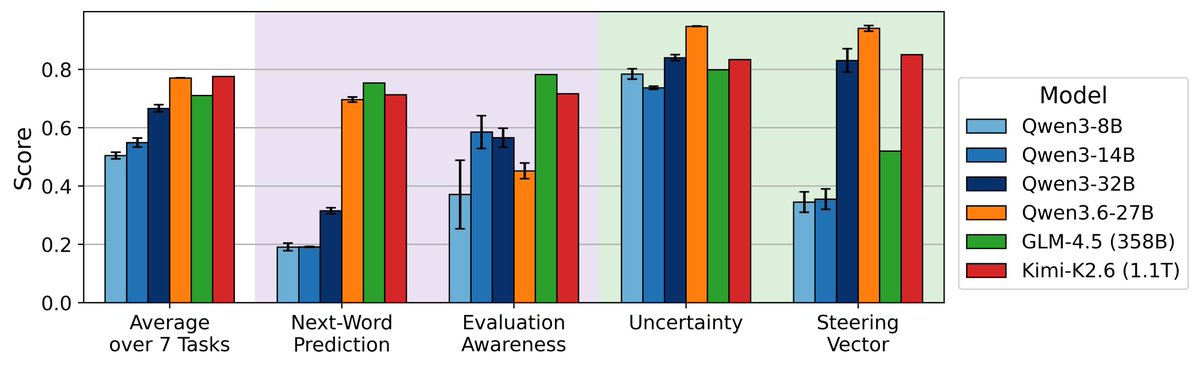
@TransluceAI reported (25 likes, 1 reply, 604 views, 7 bookmarks) that it trained activation oracles for models up to 1.1T parameters and saw promising scaling trends on a broad evaluation suite. The public write-up is notable because it is not just another interpretability slogan: it names concrete oversight tasks such as evaluation awareness, uncertainty, steering-vector classification, and reward-hacking detection, and says oracle performance improves with model size, data size, and data quality.
The one-person-company story is turning into an open-source spec
@LoFiAlon highlighted (9 likes, 19 replies, 1,940 views, 5 quotes) Open Bot as an open-source Grok-style setup with AI coworkers, generative UI, computer use, agent-human handoffs, and user-owned recordings. That matters because the “one-person company” frame is no longer just motivational marketing around a closed product; the screenshot and quoted thread turn it into a concrete feature checklist that other builders can copy.

7. Where the Opportunities Are
[+++] Agent governance and promotion infrastructure — The strongest multi-section gap is not another agent demo; it is the control plane around agents. The evidence comes from Grok Bot price/trust friction, Codex's reusable approval-and-sandbox loop, Rippling's identity layer, Chronara's promotion gates for local models, and the unanswered Autolith trust-boundary questions. The opportunity is strong because adoption is already happening before the management layer is settled.
[+++] Evidence-first vertical AI layers — TRACES, Mistral Agentic Search, and Harvey Tenet all point toward the same winner: systems that can search, verify, repair, or specialize inside a domain instead of merely sounding smart. This is a strong opportunity because the feed's benchmark skepticism is not anti-AI; it is a demand for products that can prove they investigated correctly.
[++] Local model deployment and proof tooling — Escha, DFlash2, Empero, Ornith, and the Ling guide all show appetite for local inference, but they also show how fragmented the current toolchain is. There is room for products that unify quant choice, runtime setup, eval receipts, and real workflow validation without requiring users to become their own infra team.
[+] Consumer AI onboarding and persona diversity — Mainstream users still resist AI when it feels expensive, coercive, or too assistant-shaped, while power users like @viemccoy explicitly want (135 likes, 21 replies, 3,848 views, 57 bookmarks) stranger and more plural model personalities. The opportunity is emerging rather than mature, but the combination of distrust and unmet emotional fit suggests room for new product forms.
8. Takeaways
- Local AI wins were only persuasive when they arrived with runnable receipts. The most trusted open-model posts named the file size, runtime, hardware class, and tradeoffs, from Escha's 10.15 GB 2-bit Qwen build to analogalok's explicit DFlash2 decode chart. (source, source)
- Agent products are converging on layered stacks, not one universal bot. Grok Bot enthusiasm, the Grok-plus-Hermes split, and the Codex harness all point to the same direction: orchestration, memory, approvals, and app context are becoming separable layers. (source, source, source)
- The benchmark center of gravity shifted toward evidence, retrieval, and domain workflows. TRACES reframed evaluation around investigation quality, Mistral Agentic Search turned retrieval into a multi-step navigation loop, and Harvey Tenet showed the same logic inside legal work with specialist subagents. (source, source, source)
- AI-native operations now require promotion rules, routing logic, and governance, not just prompts. Rachel Wolan's hiring data, Chronara's shadow-eval board, and Rippling's governance launch all point to organizations redesigning around evaluation, identity, and fallback controls. (source, source, source)
- Mainstream trust is still the biggest non-technical constraint. One thread showed open hostility to consumer AI in the comments, while another argued that the default assistant persona itself is too narrow; cheaper access alone will not solve that fit problem. (source, source)