Twitter AI - 2026-08-21
1. What People Are Talking About
1.1 AI application work was framed as an engineering discipline, not a prompting trick (🡕)
The strongest management thread was not “which model won?” but what reliable AI application work now requires. At least four retained items treated evaluation, approval, and operational rigor as the real differentiators between a demo and a deployable system.
@AndrewYNg surfaced (2,816 likes, 62 replies, 152,810 views, 4,754 bookmarks) the skills map for building and deploying AI applications. Public recaps of the map break that work into LLM foundations, grounding with data, agentic systems, evaluation-driven development, production operations, and ML foundations (summary). The useful part of the thread was the pushback in replies: several practitioners argued that production work still comes down to triggers, source-of-truth boundaries, acceptance tests, rollback paths, and reading traces rather than just scoring outputs.
@realmadhuguru argued (41 likes, 1,645 views, 54 bookmarks) for a laddered eval strategy instead of one benchmark wall. His stack separates hill-climb long evals, regression evals, smoke tests, and launch evals, which made the day’s broader “evaluation-driven development” talk concrete.
@bybardiia warned (100 likes, 71 replies, 3,010 views) that “Approve” on autogenerated PRs is not a real security plan. The linked public discussion around “disciplined agentic engineering” pushes the same direction: plan first, make access controls explicit, review what ships, and do not deploy code you do not understand.
Discussion insight: The shared objection across these posts was that a compiling answer or green checkmark is too weak. People wanted evidence about why a system behaved correctly, who approves consequential actions, and what fails safely when the workflow drifts.
Comparison to prior day: August 20 already emphasized evals and governance rails. August 21 turned that same concern into explicit skills-map language, named eval layers, and sharper security discipline.
1.2 Cheap and open models kept entering the stack through routing and hybrid operation, not clean replacement (🡕)
The open-model conversation advanced, but the mood was more operational than ideological. The retained posts treated cheaper and local-capable models as layers inside a routing strategy, with frontier models still reserved for heavier or higher-trust work.
@deepseek_ai announced (2,291 likes, 137 replies, 111,964 views, 326 bookmarks) DeepSeek-V4-Flash-Vision-Exp, an experimental multimodal model that the official DeepSeek changelog says keeps V4-Flash-level text performance while adding stronger visual-agent performance. The attached benchmark table is unusually specific: it shows 83.9 on Terminal Bench 2.1, 59.3 on DeepSWE, 36.5 on ApexBench Pass@1, 64.3 on Chartography, and 35.0 on ZeroBench, putting the model close to Opus-4.8 on several multimodal tasks while staying on Flash pricing.

@viditchess reported (235 likes, 22 replies, 10,963 views, 24 bookmarks) the most grounded hybrid-usage note of the day after 10 days on DGX Spark. He said he had temporarily cancelled $300+ of frontier subscriptions, moved much of his Hermes workflow to local models, but still kept frontier models for harder work because he trusted them more. The key constraint was speed, not philosophy: in-thread he said Qwen 3.8 27B at around 20 tok/s on Spark felt “almost unusable.”
@bindureddy promoted (48 likes, 9 replies, 267,276 views, 22 bookmarks) RouteLLM API as an OpenAI-compatible router that sends simple turns to cheaper models and expensive work to stronger ones. The public TokenRouter docs back the infrastructure claim with one base URL, Responses API support for Codex CLI, and explicit model tables, while the replies exposed the tension: users immediately asked for self-hosted options and pointed out that the savings only show when a large share of traffic is actually easy.
Discussion insight: Nobody in the retained set behaved as if frontier models were dead. The stronger pattern was selective use: local or cheaper models for memory, routine turns, and cost control; frontier models for the work people still do not fully trust to quantized or lower-tier systems.
Comparison to prior day: August 20 centered on deployable local-model recipes. August 21 moved one layer up into routing, hybrid economics, and multimodal capability at Flash-level prices.
1.3 Agent interfaces started touching ads, websites, and money with explicit approval boundaries (🡕)
The agent-product conversation moved from abstract copilots toward systems that can act inside real business and financial surfaces. What stood out was not just actionability, but the effort to define where action must stop and ask for permission.
@XFreeze said (112 likes, 27 replies, 291,290 views, 61 bookmarks) that X Ads had become “agent-native” through an MCP layer that can read performance, create campaigns, change targeting, and promote posts through normal conversation. The most credible detail in the thread was the safety default: new campaigns and line items are created paused, so the agent cannot start spending until a human activates them.
@Kimilooweb3 argued (33 likes, 24 replies, 1,660 views) that the consequential permission for AI will be access to money, not email. MoonPay’s public PayBox launch makes that concern concrete: users can choose either “Always Ask” passkey approval or an “Autonomous” mode with user-defined limits, while MPC and secure enclaves are meant to keep the agent from ever holding the full credential itself.
@rauchg shared (39 likes, 7 replies, 4,011 views, 24 bookmarks) Is Agentic, a public scanner for how well agents can read and use a site. The product page at is-agentic.com is notable because it exposes the whole stack — stable report URLs, JSON, CLI, OpenAPI, and MCP — but the best reply in the thread challenged the score itself: getting to 100/100 by running the scorer in a loop is not the same as proving an unfamiliar agent succeeds on first visit.
Discussion insight: Across all three posts, the product problem was not raw capability. It was bounded action. Paused-by-default ad spend, always-ask money movement, and public evidence for site audits all point to the same demand: agent interfaces need explicit trust surfaces.
Comparison to prior day: August 20 focused on harnesses, approvals, and governance layers. August 21 showed those layers attaching to concrete surfaces — ad accounts, websites, and payment vaults.
1.4 Physical AI talk shifted toward data engines, one-shot learning, and unit economics (🡕)
The physical-AI posts were notable because they were less about humanoid spectacle and more about what actually scales: physical data, task coverage, and whether a useful robot can get cheap enough to deploy. The best evidence came from a mix of research summaries and public infrastructure docs.
@starlitmatcha summarized (21 likes, 2 replies, 2,057 views, 14 bookmarks) Generalist AI’s GEN-1.5 as a robotics analogue to GPT-3-style one-shot learning. The official GEN-1.5 post says the model can learn new tasks from 3–12 seconds of demonstration with no gradient updates, averaging 59% success across 10 tasks, and rises to 83% after 10 gradient steps on roughly 5 minutes of data per task.
@Shohel98787959 framed (29 likes, 19 replies, 204 views) Axis Robotics as a way to turn browser teleoperation into robot-training data. The public AXIS site and research notes give the post much more weight than its score alone suggests: AXIS reports 207 tasks, 50K+ trajectories, 60K+ scene variants, and π0.5 improving from 83.9 to 88.8 overall success after AXIS pretraining.

@KyleNoble said (27 likes, 7 replies, 7,267 views, 11 bookmarks) his team had spent three months working on a robot “useful enough to do real work and affordable enough to deploy at scale.” The most important number came later in the thread, where he said the target is under $10/hour to start — a small detail, but exactly the kind of unit-economics framing missing from many robotics announcements.
Discussion insight: The common thread was that more model capability alone is not enough. The retained evidence kept returning to physical prompting, robust data distributions, failure-driven collection, and economics clear enough to matter outside a lab.
Comparison to prior day: August 20 was dominated by software-agent governance and local-model operation. August 21 added a more concrete physical-AI layer: one-shot physical learning, browser-based robot data collection, and price targets for deployment.
2. What Frustrates People
Agent output is getting faster than the review discipline around it
Severity: High. @bybardiia warned (100 likes, 71 replies, 3,010 views) that blindly approving autogenerated PRs is not a security model, while @AndrewYNg highlighted (2,816 likes, 62 replies, 152,810 views, 4,754 bookmarks) a skills map whose replies immediately turned toward traces, acceptance tests, rollback, and observability. @realmadhuguru filled in (41 likes, 1,645 views, 54 bookmarks) the missing operational detail with separate hill-climb, regression, smoke, and launch evals. The workaround people keep reaching for is not “prompt better”; it is to wrap the model in explicit tests, approvals, and postmortem-ready evidence. This is directly worth building for.
Hybrid and local stacks are cheaper, but still bottlenecked by speed, privacy, and usage limits
Severity: High. @viditchess reported (235 likes, 22 replies, 10,963 views, 24 bookmarks) that hybrid local/frontier operation cut his monthly spend sharply, but his thread also admitted that Qwen 3.8 27B at roughly 20 tok/s on DGX Spark was “almost unusable.” @bindureddy pitched (48 likes, 9 replies, 267,276 views, 22 bookmarks) routing across cheaper and stronger models, and the first reply pattern was predictable: is there a self-hosted version, and do the savings disappear when hard queries still hit the frontier tier? Even the bullish Grok Bot thread from @AlexFinn ran into (356 likes, 40 replies, 23,495 views, 503 bookmarks) complaints about usage limits, rereading every output, and uncertainty about when it is safe to trust the result. This is directly worth building for.
Physical AI still has a data bottleneck, not just a model bottleneck
Severity: High. @Shohel98787959 said (29 likes, 19 replies, 204 views) there is no internet-scale corpus of grasp data, and the public AXIS research notes largely agree: what matters is diverse, filtered, failure-aware data distributions, not raw trajectory count. @starlitmatcha used (21 likes, 2 replies, 2,057 views, 14 bookmarks) Generalist AI’s GEN-1.5 to make the same point from the model side — physical prompting works only because the pretraining engine kept absorbing months of interaction data. @KyleNoble added (27 likes, 7 replies, 7,267 views, 11 bookmarks) the deployment reality check by targeting under $10/hour robot operation. People are coping by turning data collection into a loop and demanding deployment economics, not just demo videos. This is directly worth building for.
3. What People Wish Existed
Agent control planes that combine permissions, evaluation, and spend policy
The need was visible from several angles at once. @bybardiia argued (100 likes, 71 replies, 3,010 views) that review discipline has to sit upstream of agent-generated code, @XFreeze highlighted (112 likes, 27 replies, 291,290 views, 61 bookmarks) ad tooling whose most important feature is paused-by-default spend, @Kimilooweb3 pointed (33 likes, 24 replies, 1,660 views) to money permissions as the real frontier, and @rauchg shared (39 likes, 7 replies, 4,011 views, 24 bookmarks) a public readiness audit for websites. The practical need is one place to define what an agent may touch, how it is evaluated, how much it can spend, and what evidence a human sees before approving the next step. Opportunity type: direct.
Private hybrid routers and local-model proof kits
People no longer seem to want a single “best model.” They want routing and proof. @deepseek_ai announced (2,291 likes, 137 replies, 111,964 views, 326 bookmarks) a cheaper multimodal model with official benchmark disclosures, @viditchess showed (235 likes, 22 replies, 10,963 views, 24 bookmarks) the real operator behavior of mixing local and frontier models by task, and @bindureddy offered (48 likes, 9 replies, 267,276 views, 22 bookmarks) the routing layer itself. The unmet need is a package that combines privacy controls, routing policy, cost visibility, and believable validation on quantized or local deployments so people do not have to become their own infra and eval team. Opportunity type: direct.
Domain-specific substrates for agents outside plain-text chat
The most interesting builder signals came from places where chat is no longer the natural interface. @DavidSacks amplified (554 likes, 33 replies, 58,911 views, 135 bookmarks) Harvey Tenet as a legal model with specialist subagents, @try_litefold launched (105 likes, 5 replies, 12,380 views, 59 bookmarks) LiteMol-1 as an agent-friendly molecular generation model, @OpenBMB released (23 likes, 604 views, 8 bookmarks) MathForm with Lean verification loops, and @Shohel98787959 described (29 likes, 19 replies, 204 views) AXIS as browser-based collection for robot trajectories. The need is for compact, editable domain representations plus built-in verifiers or data engines, so agents can work in law, molecules, formal math, and robotics without pretending that everything is just text. Opportunity type: direct.
4. Tools and Methods in Use
| Tool | Category | Sentiment | Strengths | Limitations |
|---|---|---|---|---|
| DeepSeek-V4-Flash-Vision-Exp | Multimodal LLM / API | (+) | Keeps V4-Flash-level text performance, strong visual-agent benchmarks, same API surface and Flash pricing | Benchmarks are vendor-reported, model is still experimental, no open weights disclosed |
| TokenRouter API | Model router / gateway | (+/-) | One base URL, OpenAI-compatible, works with Codex CLI, broad model catalog | Privacy concerns in replies, and savings depend on how much traffic is actually “easy” |
| DGX Spark + local/frontier split | Operating method | (+/-) | Cuts subscription spend, keeps local memory/private workflows, preserves frontier fallback for hard tasks | Local speed bottlenecks and quantized-model trust still break the ideal |
| Harvey Tenet | Vertical legal model | (+) | Legal-specific post-training, specialist subagents, better task completion with token-efficiency gains | Domain-specific and still evaluated mainly through Harvey-selected harnesses |
| X Ads MCP | Business API / MCP surface | (+/-) | Conversational campaign management, many ad-account actions, paused-by-default spend | Public evidence today is thread-level, and the core trust boundary is still debated |
| MoonPay PayBox | Agent payments vault | (+) | Always Ask vs Autonomous policy modes, MPC/TEE custody design, broad transaction surface | Requires careful permission setup and user trust in policy limits |
| Is Agentic | Agent-readiness audit | (+/-) | 100+ checks, stable public reports, CLI, JSON API, MCP server | Scoring well may still diverge from real first-visit agent success |
| LiteMol-1 | Scientific foundation model | (+) | One model spans multiple molecule classes and fits agentic search/edit loops better than structure-heavy stacks | Public benchmark detail is still concentrated in the launch thread and images |
| MathForm-8B | Formal math framework / model | (+) | Retrieval from Mathlib, Lean verification loop, strong Pass@8 results despite smaller size | Specialized to Lean 4 autoformalization rather than general reasoning |
| AXIS | Physical-AI data engine | (+/-) | Browser teleoperation, large task/trajectory set, measured robustness gains from data refinement and augmentation | Noisy crowd data still needs heavy backend filtering and validation |
| EnvHarness / EnvRigger | Agent-training environment method | (+) | Keeps trusted verifiers while adapting stale environments, improves held-out performance with fewer steps | Research-stage method, not yet an everyday production tool |
The satisfaction spectrum ran from strong approval for tools that expose explicit interfaces, verifiers, or limits, to mixed feelings about anything that still depends on hidden trust assumptions. The preferred workaround pattern was layering: route cheap requests away from frontier models, keep private or memory-heavy work local, wrap the action surface in approvals or policy, and push domain work into specialized substrates with native checks.
Migration pressure pointed in two directions at once. On the supply side, cheaper open and experimental models kept pulling routine workloads away from premium subscriptions. On the demand side, the winning products were not generic chat wrappers; they were tools that either made consequential actions safer or made a specialized workflow more legible to an agent.
5. What People Are Building
| Project | Who built it | What it does | Problem it solves | Stack | Stage | Links |
|---|---|---|---|---|---|---|
| Harvey Tenet | Harvey | Post-trained legal model with specialist subagents for diligence, review tables, and firm knowledge | Improve long-horizon legal work while reducing cost per task | Kimi K3 base, Fireworks research, RL, legal harnesses, subagents | Beta | post, research update |
| TokenRouter API | Bindu Reddy / TokenRouter | OpenAI-compatible routing gateway across frontier and open models | Reduce cost and tooling fragmentation across many model providers | TokenRouter gateway, Responses API, routing, caching | Shipped | post, site, docs |
| PayBox | MoonPay | Payment vault that lets Claude or ChatGPT agents transact under user-defined policy limits | Give agents a way to move money without giving them custody | Custom connector, passkeys, x402, MPC, TEEs | Shipped | post, release |
| Is Agentic | Vercel / Ora | Scores whether a website is discoverable and usable by AI agents | Help teams find and fix public agent-readiness gaps | Public scanner, report API, CLI, OpenAPI, MCP server | Shipped | post, site |
| LiteMol-1 | LiteFold | Multi-molecule diffusion language model for agentic molecular design | Make large-scale molecule search and editing cheaper than structure-heavy workflows | Diffusion language model, molecular sequence tokens, MCTS | Alpha | post, research |
| MathForm-8B | OpenBMB | Lean 4 autoformalization framework, dataset, and model | Convert natural-language math into verified formal code with retrieval and refinement | Mathlib retrieval, LeanExplore, FormalVerse, SFT + RL | Alpha | post, paper, repo |
| AXIS | Axis Robotics | Browser teleoperation and data engine for robot-policy training | Scale physical-AI data collection without local simulators or robot hardware | MuJoCo-WASM browser control, validation pipeline, augmentation, evaluation suite | Alpha | post, site, docs |
@DavidSacks amplified (554 likes, 33 replies, 58,911 views, 135 bookmarks) the clearest vertical-model build of the day. Harvey’s public update says Tenet is not just a fine-tuned legal chatbot; it is a Kimi K3 base model post-trained for long-horizon legal work and paired with specialist subagents for diligence, review tables, and firm knowledge. That combination of post-training plus task-specific routing is increasingly what “application moat” looked like in this feed.
@Kimilooweb3 pointed (33 likes, 24 replies, 1,660 views) to a different kind of vertical layer: agent-native payments. MoonPay’s PayBox release is notable because it treats trust as product surface area — passkeys, user-scoped permission modes, and a claim that the agent never receives direct custody of the key or card. Is Agentic fits the same meta-layer pattern from the website side: before an agent can use a site well, the site itself has to expose readable structure, recoverable errors, and machine-facing interfaces.
@try_litefold launched (105 likes, 5 replies, 12,380 views, 59 bookmarks) one of the day’s most substantive scientific agent tools. The thread and image set show LiteMol-1 spanning multiple molecule classes while staying inside editable sequence space rather than expensive structure-only search loops.
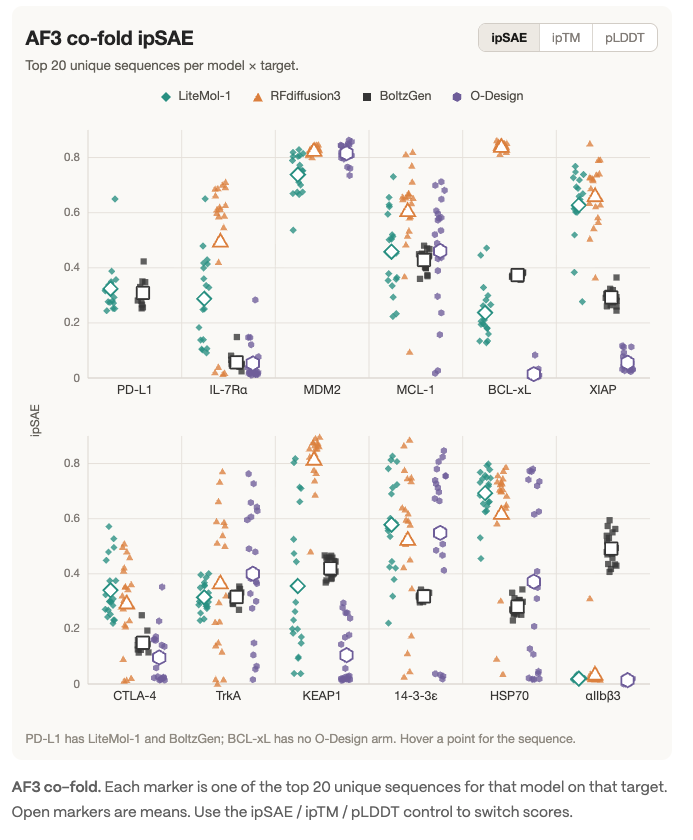
A second LiteMol chart is what makes the claim interesting rather than just ambitious: on its shared docking graphic, LiteMol-1 and its search variants sit near or above several peptide baselines on targets like MDM2, KEAP1, and MCL-1, while another chart places the small-molecule variant at 8.02 median docking, close to ProtoBind-Diff at 8.17. The point is not that molecular design is solved; it is that builders are giving agents a compact molecular workspace they can repeatedly edit, score, and regenerate.
@OpenBMB released (23 likes, 604 views, 8 bookmarks) a similarly verifier-first stack for formal math. The public MathForm repo says the system retrieves the right Mathlib definitions, runs Lean compilation and semantic checks, and iteratively refines outputs before training the released 8B model.

The attached benchmark table makes the scale claim concrete: MathForm-8B averages 88.06 syntax-check and 72.37 consistency-check Pass@8, while reaching 63 on FATE-H and 37 on FATE-X despite competing against several 32B autoformalizers. AXIS completes the pattern from robotics: it is not a robot persona, but a data engine that turns browser control, filtering, augmentation, and held-out evaluation into something trainable.
Across these projects, the repeated build pattern was clear: agents stop looking generic once the builder gives them the right substrate. In legal work that substrate is a document harness and specialist subagents; in payments it is permissioned custody rails; in molecules it is editable sequence space; in formal math it is retrieval plus Lean verification; in robotics it is a growable data engine.
6. New and Notable
Anthropic’s own capability chart implied only a modest next-step lift
@ChrisGPT highlighted (47 likes, 11 replies, 3,865 views, 7 bookmarks) a small but important detail in Anthropic’s published materials: an internal AECI trajectory that places “Model 2” only about 1.5 points above Claude Mythos 5, with large error bars. That matters because the chart itself explicitly warns that Anthropic’s internal score is not directly comparable to Epoch’s public leaderboard, yet it still gives the market a rare look at how one frontier lab is thinking about capability progress over time.

Google’s EnvHarness made environment design part of agent progress itself
@omarsar0 flagged (14 likes, 3 replies, 1,442 views, 14 bookmarks) EnvHarness as a way to stop agent-learning environments from going stale. The public paper says EnvHarness wraps static environments without changing their trusted verifier, while EnvRigger synthesizes targeted modifications from agent trajectories; the reported result is up to 9.0 held-out points with 9.8% fewer execution steps. That is notable because it shifts the locus of progress from “better model” to “better co-evolution between model and environment.”
7. Where the Opportunities Are
[+++] Permissioned agent operations — The strongest multi-section opportunity sits around agents that can touch real systems without silently crossing trust boundaries. The evidence comes from X Ads paused-by-default campaign creation, PayBox’s Always Ask versus Autonomous modes, Is Agentic’s public evidence layer, and the security pushback against auto-approved PRs. The need is strong because action is arriving faster than trustworthy control surfaces.
[+++] Hybrid routing and proof infrastructure — DeepSeek’s cheaper multimodal release, viditchess’s hybrid DGX Spark setup, and TokenRouter’s OpenAI-compatible gateway all show demand for cost-aware orchestration. The opportunity is strong because users want routing, privacy, and believable validation in one place rather than separate tools for each concern.
[++] Domain-specific agent substrates with native verifiers — Harvey, LiteMol, MathForm, and AXIS all point toward the same pattern: agents become useful when the substrate itself is specialized for the task. Legal harnesses, molecular sequence spaces, Lean verifiers, and robot-data engines all reduce the gap between “smart output” and “work that can actually be checked.”
[+] Physical-AI data engines and deployment economics — Generalist AI’s one-shot physical learning, AXIS’s browser data engine, and Kyle Noble’s under-$10/hour target show an emerging but still early opportunity. The signal is weaker than software-agent infrastructure today, but the combination of data bottlenecks and unit-economics pressure makes it one of the more credible robotics directions in the feed.
8. Takeaways
- AI engineering itself became a top-level topic. The most important posts were not just model announcements; they defined the skills, eval layers, and review discipline needed to ship AI systems safely. (source, source, source)
- Hybrid local/frontier operation is now a normal cost and trust strategy. DeepSeek’s Flash-priced multimodal launch, viditchess’s DGX Spark workflow, and TokenRouter’s routing layer all point to selective model placement instead of one-model loyalty. (source, source, source)
- Real agent adoption depends on permission rails as much as model quality. Ad accounts, websites, and payment vaults all now need explicit approval, evidence, and spending boundaries. (source, source, source)
- The strongest builder signals came from specialized substrates, not generic chat wrappers. Harvey’s legal harness, LiteMol’s molecular workspace, MathForm’s Lean verification loop, and AXIS’s robot-data engine all make the agent legible to the domain it serves. (source, source, source, source)
- Physical AI looked more credible when the claim was about data and economics, not spectacle. Generalist AI’s one-shot physical prompting, AXIS’s dataset engine, and the sub-$10/hour robot target all pulled the discussion toward deployability. (source, source, source)