Twitter AI - 2026-08-24
1. What People Are Talking About
1.1 Evaluation moved from benchmark scores to production-grade verification loops (🡕)
The densest theme in the dataset was evaluation, but not in the old "which model won?" sense. The strongest retained items were about how to keep judges calibrated in production, how to benchmark agents on identical setups, and how to prevent contaminated or overly coarse tests from hiding operational failures.
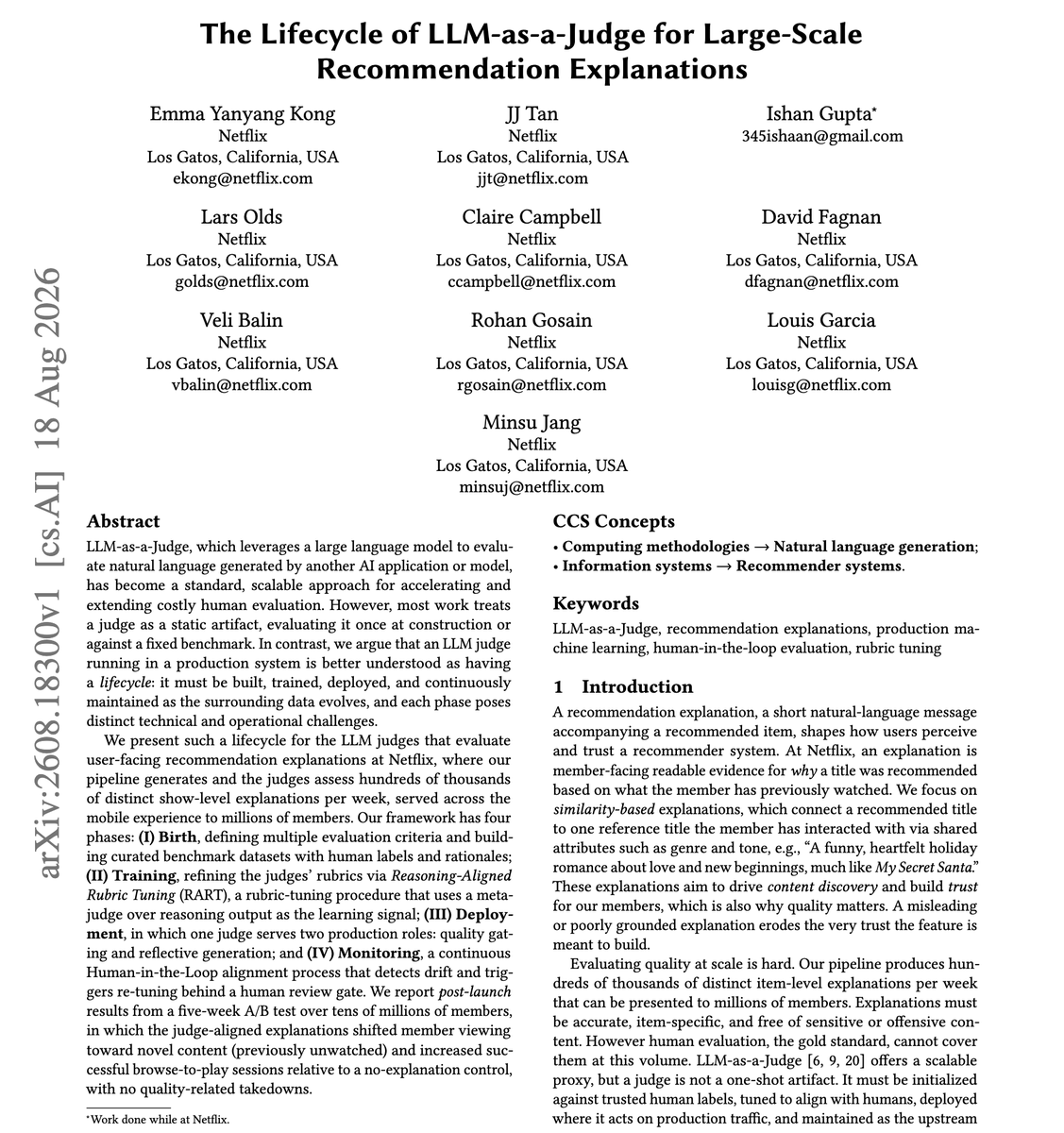
@omarsar0 highlighted (37 likes, 2 replies, 2,786 views, 56 bookmarks) Netflix's paper on lifecycle-managed LLM judges. The public paper and the tweet both say Netflix judges evaluate hundreds of thousands of recommendation explanations per week, treat evaluation as a four-phase lifecycle rather than a one-time benchmark, and improved browse-to-play behavior in a five-week A/B test over tens of millions of members without quality-related takedowns.
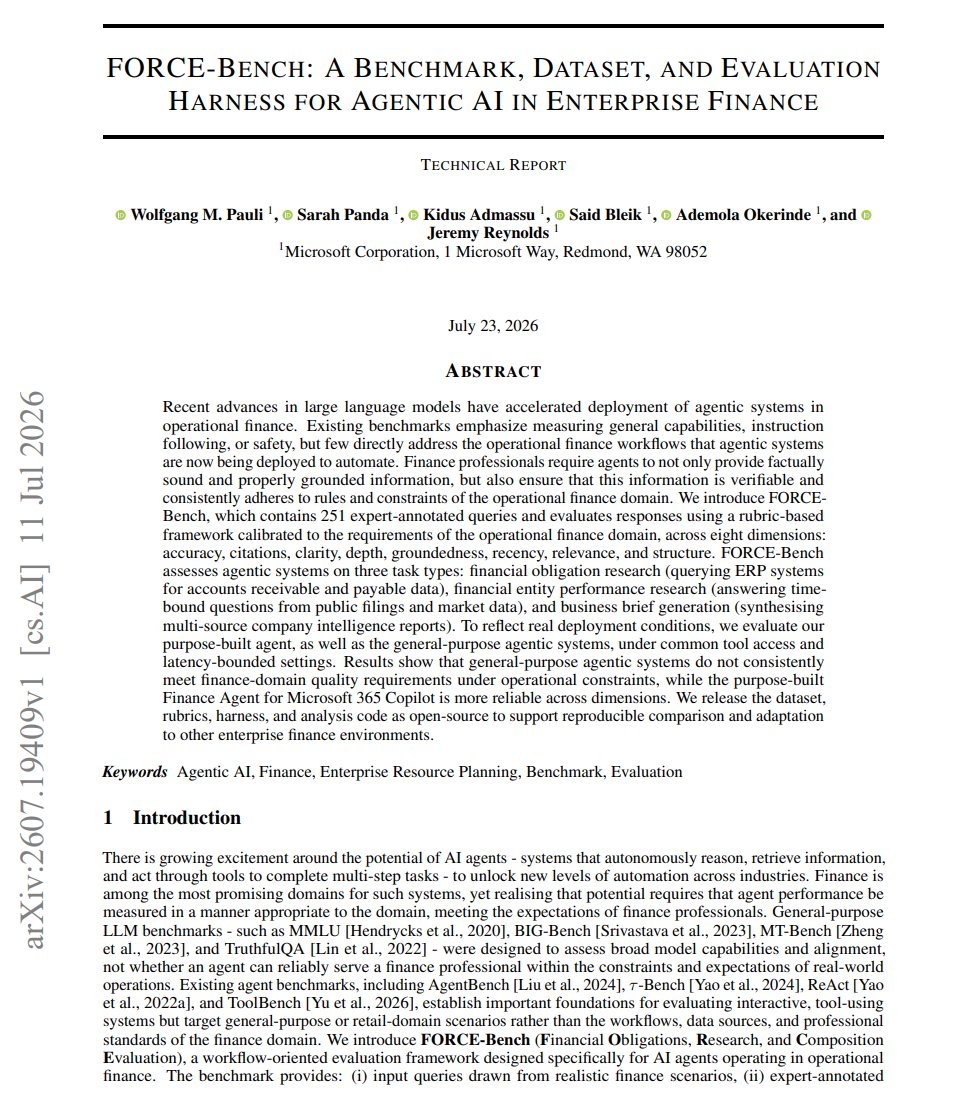
@marfinxx argued (20 likes, 3 replies, 734 views, 15 bookmarks) that Microsoft's FORCE-Bench shows why enterprise agents need domain harnesses instead of generic-chat grading. The public FORCE-Bench paper and the attached abstract say the benchmark uses 251 expert-annotated finance queries, scores eight dimensions, and found that purpose-built Microsoft 365 Copilot Finance was more reliable than general-purpose agents under tool and latency constraints.
@DataChaz framed (27 likes, 6 replies, 16,084 views, 12 bookmarks, 2 quotes) the same trust problem from the tooling side: if every agent benchmark runs on a custom browser, custom tools, and custom harness, the comparison ends with "it depends." The quoted launch and public AgentSky site describe one API for multiple cloud agents, persistent sessions, and side-by-side runs on the same task, browser, and tools.
@Blue_Beba_ ran (20 likes, 10 replies, 148 views, 11 bookmarks, 7 quotes) the "Phantom API Test," a tiny but vivid hallucination probe built around a nonexistent React hook. The attached chart makes the point clearer than the thread: GPT-4o rejected the fake API in all 20 runs, while the newer models in the comparison fabricated answers 10% to 90% of the time.

@Al_Grigor added (36 likes, 4 replies, 1,386 views, 33 bookmarks) that evaluation now appears most often across 4,894 AI-engineering job descriptions, while @1jehuang introduced (9 likes, 4 replies, 1,391 views) Jcode Bench, a coding benchmark built around a working reference implementation, exhaustive verification, and deterministic instruction-count scoring instead of static answer keys.
Discussion insight: The sharpest disagreement was not about whether evaluation matters. It was about what kind of evaluation can still be trusted once labs and builders have seen the tasks. The responses to these posts kept favoring exhaustive verifiers, same-setup comparisons, and domain-constrained harnesses over public-scoreboard theater.
Comparison to prior day: On 2026-08-23, verification talk was still centered on repeated search, artifact checks, and long-horizon regression tests. On 2026-08-24, the conversation moved closer to deployment: lifecycle-managed judges, ERP-routed harnesses, same-setup agent arenas, and benchmarks designed to resist contamination.
1.2 Physical AI conversation narrowed to correction quality and replay fidelity (🡕)
Physical-AI posts stayed focused on data, but today's threads were more specific about what makes a dataset trustworthy after collection. The retained AXIS cluster was not asking for more teleop volume alone; it kept returning to which human corrections survive validation, and whether a trajectory remains valid across browser collection, replay, training, and evaluation.
@yapslingerx argued (66 likes, 59 replies, 1,197 views) that robotics still carries a bottleneck language models never had: a trained operator can occupy only one robot at a time. His thread cites AXIS as a sequence of attempts to remove different pieces of that bottleneck—browser teleoperation, public task generation, and then a post-training loop where the policy fails first and humans only correct the failure moment.
@Olamicryptt showed (41 likes, 19 replies, 438 views, 1 quote) why that last step matters. The thread says AXIS filtered 660 correction candidates down to 161 verified snippets, raised success from 41.3% to as high as 52.5% across seeds, and found that training on full human trajectories performed worse than training on the filtered corrections. The public AXIS site matches the underlying logic: browser collection on the front end, then success checking, quality filtering, smoothing, augmentation, and fixed-protocol evaluation on the back end.

@juraucrypt added (22 likes, 17 replies, 261 views) the replay-fidelity layer. His point was that a human trajectory that works in the browser but changes behavior when replayed by the policy or physics runtime is not just noisy; it poisons later evaluation and training. That is a more operational complaint than yesterday's broader call for more robot data.
Discussion insight: The replies around these threads were unusually aligned: more data is not the breakthrough by itself. The repeated applause line was that useful human corrections have to be filtered into signal, not blindly appended to the corpus.
Comparison to prior day: On 2026-08-23, physical-AI talk was mostly about browser-scale collection and the existence of a 50K+ trajectory engine. On 2026-08-24, the emphasis moved deeper into correction selection, replay alignment, and whether the same demonstration can survive the full training loop.
1.3 Agent economics got quantified in token curves, price tables, and throughput charts (🡕)
The business side of AI became much more operational today. Instead of arguing abstractly about "AI demand," retained items kept quantifying what agentic workloads do to token volume, hardware budgets, and price competition.
@SciTechera reported (6 likes, 2 replies, 183 views, 2 bookmarks) that OpenRouter's seven-day average agentic usage grew from roughly 0.51 trillion tokens in early February to 7.3 trillion by August 10. The attached chart says agent traffic crossed above human traffic on February 6 before growing roughly 14x, while the public OpenRouter rankings page adds the right caveat that the data measures traffic routed through OpenRouter rather than the whole market.

@P_Bonnet framed (64 likes, 9 replies, 24,329 views, 129 bookmarks, 6 quotes) the same trend at the pricing layer, comparing AI tokens to aluminium: once-expensive material, then 99.9% price collapse, then enormous market expansion. That framing mattered because the replies immediately translated it into application-layer consequences, with one reader arguing that even a 90% drop from 2026 to 2030 might undershoot what is coming.
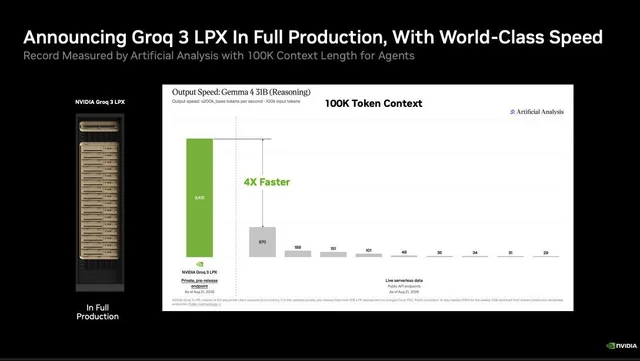
@ionet warned (29 likes, 3 replies, 4,039 views, 1 quote) that rising AI-server prices can still choke startups even if model access gets cheaper, while @StockSavvyShay highlighted (30 likes, 23 replies, 4,089 views, 1 bookmark) a different lever: Groq 3 LPX at roughly 3,431 output tokens per second on 100K context versus about 870 for the next result in the slide he shared.
@jiahanjimliu posted (4 likes, 779 views, 2 bookmarks) side-by-side Terra, Sol, and Kimi pricing grids to argue that the model price war is already compressing. One of the attached screenshots shows GPT-5.6 Terra short-context input at $2 and output at $12 per million tokens, with lower batch and flex variants available for Sol.

Discussion insight: The most useful reply pattern was not "the smartest model wins." Under both the agent-benchmark and token-economics posts, readers kept returning to the same idea: once a cheaper model is good enough inside a longer workflow, per-task economics and throughput start to outweigh brand-tier intelligence.
Comparison to prior day: On 2026-08-23, the competition story was still about who funds open weights and who controls the stack. On 2026-08-24, that competition was re-expressed as unit economics: token price, tokens per second, and whether agent loops can survive the infrastructure bill.
1.4 The agent product moved up a layer from chat to persistent environments and fit planners (🡕)
Another clear pattern was builders trying to make agents persist beyond one prompt window. The retained items here were less interested in a single smarter model than in workspaces, protocols, and fit-checkers that keep context, choose the right runtime, or keep tool connections stable.
@Suryanshti777 argued (46 likes, 14 replies, 1,269 views, 8 bookmarks) that Offloop's real advantage is not just benchmark wins but that agents live inside shared channels, pick up prior decisions, and hand work to the next owner instead of forcing every teammate to restart from a blank prompt. The public Offloop site describes the product in the same terms: small teams using AI agents to run recurring work across launches, follow-up, research, growth, and operations.
@dr_cintas pointed (1 like, 330 views, 3 bookmarks) to canIrun.ai, a browser-side local-AI fit checker that scores which open models should run on a given machine before anything is downloaded. The public explainer is unusually concrete about how it works: WebGL and WebGPU hardware detection, quantization-aware VRAM estimates, bandwidth-based token-per-second estimates, and client-side grading instead of opaque compatibility claims.
@gemchange_ltd added (9 likes, 1,284 views, 7 bookmarks) a useful hardware-fit reality check with a table that puts memory, bandwidth, price, and verdict into one frame and argues that TOPS alone is the wrong buying metric for local inference.

@LomashKumar52 wrote (11 likes, 775 views, 10 bookmarks) that the usual "USB-C for AI" description of MCP hides the operational tradeoffs—runtime discovery, stateful sessions, and security failure modes included—while @zoolsher announced (29 likes, 4 replies, 1,199 views, 6 bookmarks, 4 quotes) RomeAI Lab open-sourcing Rome, which calls itself an agentic OS built around tools, workflows, memory, and persistent apps rather than hidden harness state.
Discussion insight: The shared design instinct across these items was persistence. People were trying to preserve the environment around an agent—channel history, hardware fit, tool state, workflow memory—because the community is increasingly treating "start over from zero" as the default failure mode of agent products.
Comparison to prior day: On 2026-08-23, local-AI discussion was still dominated by sparsity tricks, KV-cache growth, and raw hardware fit. On 2026-08-24, the conversation climbed one layer higher into the environment: channels, protocols, persistent sessions, and pre-download fit planners.
2. What Frustrates People
Evaluation surfaces that still fail under real work
Severity: High. The loudest frustration was not that models lack benchmarks; it was that too many benchmarks still hide the failure modes that matter in production. @marfinxx argued (20 likes, 3 replies, 734 views, 15 bookmarks) that FORCE-Bench exists because generic agents do not reliably satisfy finance-domain constraints under tool and latency limits, while @Blue_Beba_ ran (20 likes, 10 replies, 148 views, 11 bookmarks, 7 quotes) a fake-API probe where several newer models still fabricated confident technical answers. @DataChaz said (27 likes, 6 replies, 16,084 views, 12 bookmarks, 2 quotes) that custom harnesses make agent comparisons slippery, and @1jehuang positioned (9 likes, 4 replies, 1,391 views) Jcode Bench as a response to benchmark contamination and coarse grading. People are coping by building domain harnesses, like-for-like arenas, exhaustive verifiers, and hiring for eval skill directly. This is directly worth building for.
Physical-AI data that gets more expensive to trust after collection
Severity: High. The robotics cluster kept returning to the same complaint: collecting demonstrations is only step one; proving that the resulting data stays valid through replay, filtering, and retraining is the harder part. @yapslingerx argued (66 likes, 59 replies, 1,197 views) that physical presence remains the original data bottleneck, @Olamicryptt showed (41 likes, 19 replies, 438 views, 1 quote) that only 161 of 660 human corrections survived verification, and @juraucrypt warned (22 likes, 17 replies, 261 views) that browser collection and replay have to stay aligned or later training data becomes hard to trust. The public AXIS site shows the community answer today: browser collection, then backend validation, smoothing, augmentation, and held-out evaluation. This is directly worth building for.
Compute budgets and local-model fit that are still easy to misjudge
Severity: High. The unit-economics posts made clear that lower model prices do not remove planning pain. @ionet warned (29 likes, 3 replies, 4,039 views, 1 quote) that 15% server-price hikes can end a startup runway if infrastructure already dominates spend, while @gemchange_ltd argued (9 likes, 1,284 views, 7 bookmarks) that memory bandwidth and VRAM, not TOPS, determine whether a local box is honest about fit. @dr_cintas pointed (1 like, 330 views, 3 bookmarks) to canIrun.ai precisely because people are still guessing, downloading the wrong model, and hitting out-of-memory errors. The workaround pattern was practical: use browser-side fit checks, compare providers by price and throughput, and route long workflows to cheaper modes where possible. This is directly worth building for.
Verifying autonomous agents without overexposing their private context
Severity: Medium. One of the clearest unresolved design tensions was whether agent accountability requires raw prompt exposure. @Mmenyene_C argued (60 likes, 59 replies, 219 views) that autonomous systems need traceable records, defined strategy boundaries, and observable outcomes without exposing every private input, while @LomashKumar52 warned (11 likes, 775 views, 10 bookmarks) that protocol choices like MCP also carry security and data-handling consequences that hype threads tend to skip. Thomson Reuters' launch note adds the same trust instinct from another direction by explicitly saying customer data is never used to train Thomson. This is directly worth building for.
3. What People Wish Existed
Benchmarks that are hard to contaminate and easy to compare
This was the clearest practical need in the dataset. @DataChaz said (27 likes, 6 replies, 16,084 views, 12 bookmarks, 2 quotes) that agent comparisons break down once every team changes the browser, tools, and harness, while @1jehuang built (9 likes, 4 replies, 1,391 views) Jcode Bench around exhaustive verification and deterministic cost. @marfinxx used (20 likes, 3 replies, 734 views, 15 bookmarks) FORCE-Bench to make the same point in enterprise finance: realistic workflows need realistic harnesses. What people want is not another aggregate leaderboard; they want benchmarks that remain legible after labs have seen them and still compare the same system under the same conditions. Opportunity: direct.
Private-yet-verifiable agent audit trails
The need here is for trust without indiscriminate log exposure. @Mmenyene_C argued (60 likes, 59 replies, 219 views) that autonomous agents should expose strategy boundaries, traceable records, and observable outcomes rather than every private input, while Thomson Reuters' launch note says Thomson is being deployed under the constraint that customer data is never used for training. The missing product is a credible middle layer between privacy and accountability.

The sentiment here was not anti-privacy. It was anti-opacity: readers repeatedly preferred narrow safety signals, durable records, and reviewable outcomes to either full transcript dumps or blind trust. Opportunity: direct.
Local-AI fit planners and cost routers
This need is partly technical and partly financial. @dr_cintas pointed (1 like, 330 views, 3 bookmarks) to canIrun.ai because people still need help knowing what will run on their machine before they waste time downloading it, @gemchange_ltd argued (9 likes, 1,284 views, 7 bookmarks) that bandwidth and VRAM matter more than marketing TOPS, and @jiahanjimliu showed (4 likes, 779 views, 2 bookmarks) that even frontier-model pricing is now fragmented across standard, batch, and flex modes. What people want is a planner that chooses the right model, quantization, provider, and billing mode for a specific task instead of making them learn the market the hard way. Opportunity: competitive.
Persistent agent workspaces that remember the team context
This need was expressed more through product praise than explicit wish language, but the gap is clear. @Suryanshti777 argued (46 likes, 14 replies, 1,269 views, 8 bookmarks) that Offloop matters because output no longer dies in a chat window, and @zoolsher announced (29 likes, 4 replies, 1,199 views, 6 bookmarks, 4 quotes) Rome as an open-source environment for persistent tools, memory, and workflows. The missing product is a shared workspace where agent state survives handoffs, recurring work keeps its own home, and the next teammate does not restart from zero. Opportunity: competitive.
Motion-data feedback loops for physical AI
The physical-AI cluster was effectively asking for a data engine that keeps improving after release. @yapslingerx argued (66 likes, 59 replies, 1,197 views) that robotics data still depends on scarce human bodies, @Olamicryptt showed (41 likes, 19 replies, 438 views, 1 quote) that only a filtered subset of corrections becomes useful signal, and @juraucrypt added (22 likes, 17 replies, 261 views) that replay alignment decides whether those corrections stay trustworthy. The public AXIS site shows one working version of this loop, but the repetition of the need suggests room for broader collection, provenance, filtering, and replay validation layers. Opportunity: direct.
4. Tools and Methods in Use
| Tool | Category | Sentiment | Strengths | Limitations |
|---|---|---|---|---|
| LLM-as-a-Judge lifecycle | Evaluation framework | (+) | Treats judges as build/train/deploy/monitor systems and ties evaluation to measurable product outcomes | Requires curated labels, ongoing retuning, and human monitoring |
| FORCE-Bench | Domain benchmark / harness | (+) | 251 expert finance queries, eight-dimensional rubric, realistic tool and latency constraints | Finance-specific and still shows how weak generic agents are under operational limits |
| AgentSky | Agent API / comparison arena | (+/-) | Same-task, same-browser, same-tool comparisons with persistent cloud sessions | Vendor-operated surface; public claims still depend on a platform run by the builder |
| Jcode Bench | Coding benchmark | (+) | Exhaustive verifier, deterministic instruction-count scoring, continuous improvement curve | Narrow task family focused on low-level primitives rather than broad software work |
| AXIS | Physical-AI data engine | (+) | Browser teleop, validation, filtering, augmentation, and held-out evaluation in one loop | Still early and highly dependent on replay fidelity and backend cleaning |
| OpenRouter rankings | Usage visibility | (+/-) | Exposes real routed token-volume trends and model-adoption windows | Measures OpenRouter traffic only, not the whole market and not model quality |
| Offloop | Agent workspace | (+) | Persistent channels for recurring team work instead of one-shot chat output | Benchmark and cost claims are vendor-reported rather than independently audited |
| canIrun.ai | Local AI planner | (+) | Client-side hardware detection, quant-aware fit grades, and no-server scoring | Estimates can diverge from real-world thermal, driver, and runtime conditions |
| MCP | Agent protocol | (+/-) | Standardized connectivity to tools, data sources, and stateful workflows | Security and implementation pitfalls still matter in real deployments |
| Rome | Agentic environment | (+) | Persistent apps, workflows, memory, and Docker-distributed setup | Preview-stage product with a heavier environment footprint than chat tools |
| GLiNER2.5 | Extraction model | (+) | Small open model with long-context extraction, boundary prediction, and Apache 2.0 licensing | Specialized for extraction / classification rather than general-purpose agent work |
| Thomson | Domain model | (+) | Proprietary legal data and expert tuning produced strong benchmark competitiveness at lower build cost | Initial deployment is narrow and the model remains proprietary |
| SenseNova-Vision | Multimodal vision model | (+) | One unified model across OCR, detection, segmentation, depth, and point-map tasks | Heavy research-system requirements make it less turnkey than smaller vision stacks |
The tools people trusted most today were the ones that exposed constraints instead of magic. @marfinxx used (20 likes, 3 replies, 734 views, 15 bookmarks) FORCE-Bench to show where generic agents fail under finance constraints, @1jehuang published (9 likes, 4 replies, 1,391 views) a benchmark with exhaustive verification instead of secret answer keys, @dr_cintas pointed (1 like, 330 views, 3 bookmarks) to a fit checker that explains its scoring, and the public AXIS site openly describes each data-engine stage.
The workaround pattern was layering. Teams pair generic models with domain harnesses, compare multiple agents side by side before committing to one, route cheaper batch or flex modes where latency allows it, run browser-side fit checks before local downloads, and move recurring work into persistent channels or app environments (@DataChaz said (27 likes, 6 replies, 16,084 views, 12 bookmarks, 2 quotes); @jiahanjimliu posted (4 likes, 779 views, 2 bookmarks); @Suryanshti777 argued (46 likes, 14 replies, 1,269 views, 8 bookmarks)).
The migration pressure pointed in the same direction across almost every cluster: away from single-model heroics and toward routing, evaluation, memory, provenance, and deployment fit. That is why benchmark harnesses, workspace layers, price routers, and growable data engines kept appearing next to model releases in the same day's feed.
5. What People Are Building
| Project | Who built it | What it does | Problem it solves | Stack | Stage | Links |
|---|---|---|---|---|---|---|
| Offloop | Offloop team | Channel-based workspace for recurring team work with AI agents | Prevents multi-step team work from restarting as one-off chat sessions | Persistent channels, recurring-work agents, team workflow orchestration | Beta | site |
| AgentSky | AgentSky team | One API and playground for multiple cloud coding / browser agents | Makes agent hosting and side-by-side comparison consistent across the same task and tools | Cloud agents, persistent sessions, channel connectors, single API | Beta | site |
| Jcode Bench | @1jehuang | Public coding benchmark with exhaustive verification and deterministic cost scoring | Replaces easy-to-contaminate coding leaderboards with auditable, continuous measurement | Public GitHub harness, exhaustive verifiers, Callgrind instruction counts | Shipped | site, repo |
| AXIS | Axis Robotics | Browser teleoperation data engine and benchmark for robot-policy training | Scales robot data collection and quality refinement without requiring local simulator setup | MuJoCo-WASM browser control, backend validation, augmentation, held-out evaluation | Alpha | site |
| canIrun.ai | midudev | Browser-based hardware compatibility checker for local AI models | Tells users which open models and quantizations fit their machine before download | WebGL/WebGPU detection, client-side scoring, quant-aware VRAM estimator | Shipped | site, repo |
| Rome | Rome AI Lab | Open-source agentic OS for persistent apps, workflows, and memory | Gives recurring agent work a durable environment instead of a transient chat thread | Docker distribution, app runtime, app web SDK, persistent capabilities | Beta | repo, site |
| GLiNER2.5 | Fastino Labs | Small open extraction model with boundary-prediction architecture | Makes long-context entity and relation extraction cheaper and easier to deploy | 74M/0.2B/0.3B checkpoints, boundary prediction, Hugging Face, Apache 2.0 | Shipped | model |
| Thomson | Thomson Reuters | Proprietary legal model built on an open foundation plus proprietary legal data | Pushes specialized professional AI beyond renting generic frontier models | Open-source base model, Westlaw/Practical Law/Reuters content, expert tuning, CoCounsel deployment | Beta | overview, press release |
| SenseNova-Vision | OpenSenseNova | Unified multimodal vision model for text, image, and mixed-structure outputs | Collapses separate vision-task heads into one generation-style interface | Unified multimodal model, mixed text-image decoding, 7B-MoT runtime, benchmark suite | Alpha | repo |
@Suryanshti777 argued (46 likes, 14 replies, 1,269 views, 8 bookmarks) that Offloop's real product is persistent channel memory, not just low benchmark cost, while @DataChaz framed (27 likes, 6 replies, 16,084 views, 12 bookmarks, 2 quotes) AgentSky as the infrastructure layer that lets people compare and host multiple agents behind one API. Taken together, they show a repeated build pattern: builders are externalizing the harness, state, and handoff layer rather than treating the model output alone as the product.
@1jehuang introduced (9 likes, 4 replies, 1,391 views) Jcode Bench because he thinks coding benchmarks are too easy to benchmaxx or saturate, and @dr_cintas pointed (1 like, 330 views, 3 bookmarks) to canIrun.ai because local-model experimentation still starts with too much guesswork. Those two projects attack different pain points, but both are measurement layers: one measures agent coding ability more rigorously, the other measures whether a model should even be attempted on the user's machine.

AXIS remains the strongest build in the physical-AI cluster because it is more than a dataset drop. The public AXIS site documents a browser-teleoperation pipeline, 207 tasks, 50K+ trajectories, and a growable snapshot model, while @Olamicryptt showed (41 likes, 19 replies, 438 views, 1 quote) that the real product edge may be verified short correction snippets rather than raw demo volume.
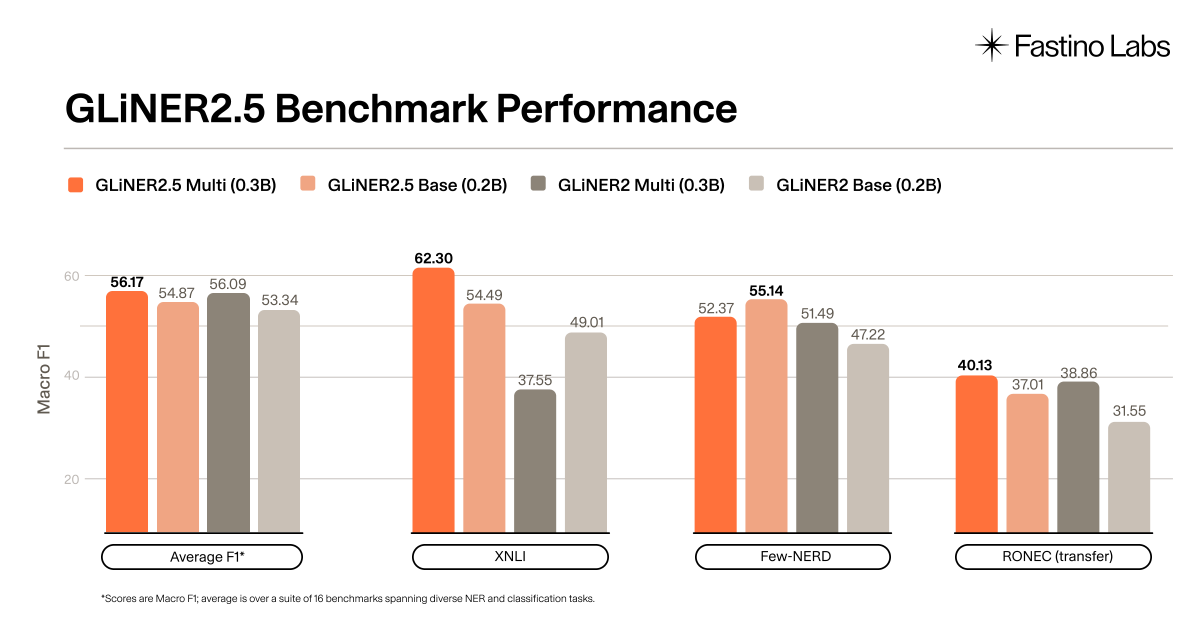
The model-building cluster split into three different strategies. @fastinoAI launched (17 likes, 1 reply, 781 views, 6 bookmarks, 1 quote) GLiNER2.5 as a small, Apache-licensed extraction model that shifts from span enumeration to boundary prediction; @ConorBronsdon surfaced (6 likes, 2 replies, 243 views, 1 bookmark, 1 quote) Thomson as a legal-domain model built for frontier-adjacent quality at much lower training cost; and @rsasaki0109 shared (51 likes, 2,287 views, 31 bookmarks) SenseNova-Vision as a unified multimodal generation stack for dense and symbolic computer-vision tasks.
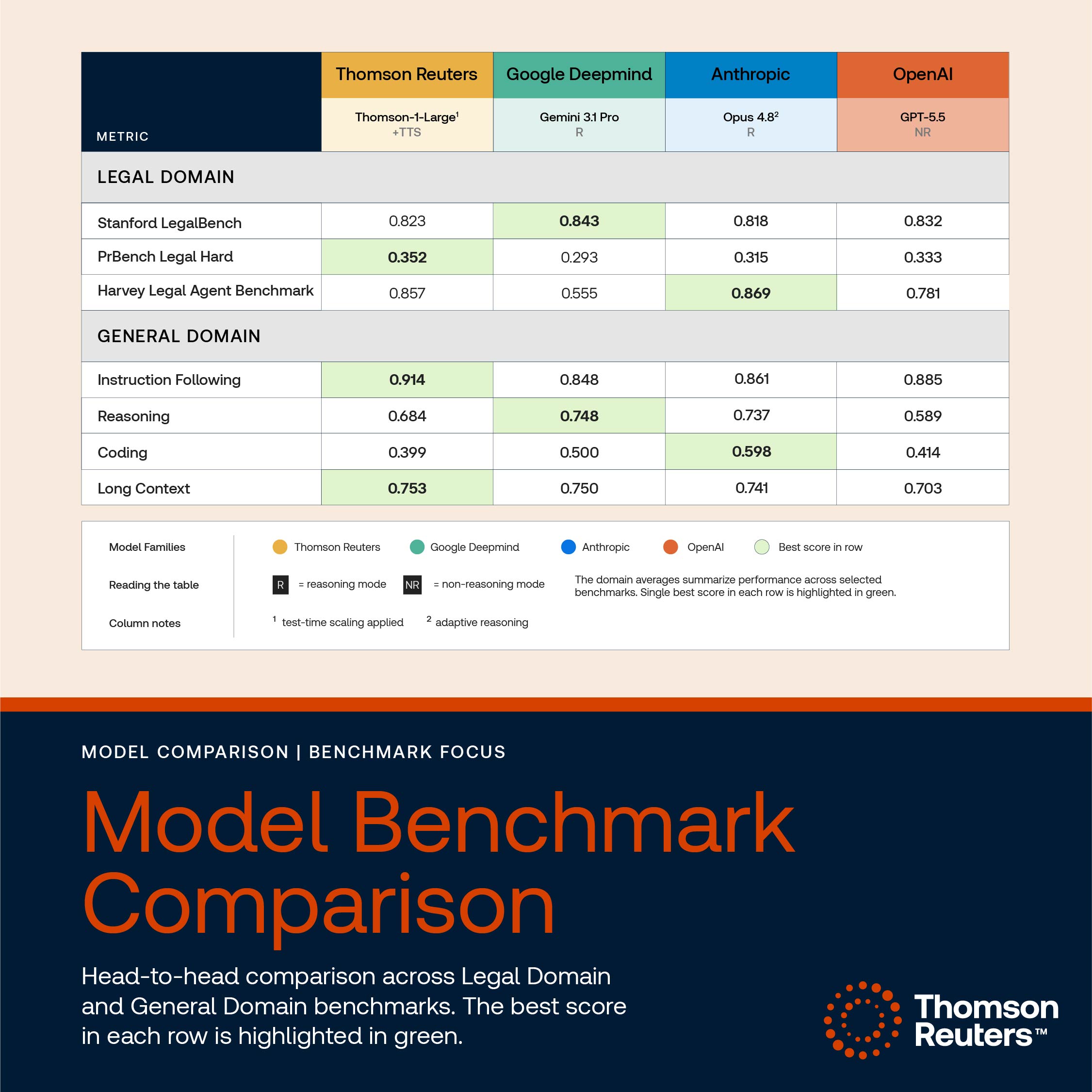

The common builder instinct across all of these projects was specialization around the workflow boundary. Some teams are specializing the environment around the model, some are specializing the measurement layer, and some are specializing the model itself around legal, extraction, or multimodal vision tasks. That is a broader and more practical pattern than a simple "new model dropped" story.
6. New and Notable
Thomson 1 shows how far a domain model can go with proprietary data and expert tuning
@ConorBronsdon surfaced (6 likes, 2 replies, 243 views, 1 bookmark, 1 quote) Thomson Reuters' Thomson 1 launch as a model-layer decision by a 175-year-old information company rather than another application wrapper. Thomson Reuters' own write-up and press release say the system was built from an open-source foundation plus proprietary legal and news assets, cost about $40 million overall, and is already being deployed into CoCounsel Legal tabular analysis. That made it one of the clearest examples today of a company choosing to own the model layer for a specific profession.
GLiNER2.5 pushed the small-model extraction niche forward
@fastinoAI launched (17 likes, 1 reply, 781 views, 6 bookmarks, 1 quote) GLiNER2.5 with a boundary-prediction architecture, three small parameter sizes, and Apache 2.0 licensing. The public model page makes the release notable because it is not just another NER checkpoint: it adds long-context extraction, joint relation decoding, constrained classification, and span attributes in a deployable open package.
Anthropic's introspection work entered mainstream conversation, with caveats attached
@itsharmanjot amplified (20 likes, 4 replies, 1,267 views, 7 bookmarks, 2 quotes) Anthropic's work on emergent introspective awareness as if models might be noticing tampering in their own hidden states. The public arXiv paper, Emergent Introspective Awareness in Large Language Models, makes the result more specific and narrower: the researchers inject concept vectors into activations and observe partial, unreliable detection under controlled conditions. That distinction also appeared immediately in replies, which treated the work as a measurement signal rather than proof of machine self-awareness.
SenseNova-Vision widened the day beyond text agents
@rsasaki0109 shared (51 likes, 2,287 views, 31 bookmarks) SenseNova-Vision as a unified multimodal generation system that emits both symbolic outputs such as OCR and boxes and dense outputs such as masks, depth, normals, and point maps. The public GitHub repo makes the launch notable because it frames computer vision as one generation interface instead of task-specific heads and decoders.
Sovereign AI shifted from slogan to structured program details
Two posts made sovereign AI concrete instead of rhetorical. @ArtificialAnlys said (15 likes, 2 replies, 2,302 views, 4 bookmarks) South Korea's sovereign AI initiative narrowed from four teams to three, with evaluation counting for 25% of judging and each advancing team expected to receive about 1,000 B200 GPUs for six months, while @DhatriKamat described (419 likes, 2 replies, 34,874 views, 17 bookmarks) India's chip-commercialization bottlenecks in terms of OEM trust, IP-block costs, and a three-year revenue lag. The notable shift was not patriotism; it was operational detail around compute grants, benchmark governance, and procurement levers.
7. Where the Opportunities Are
[+++] Verification-bound agent workflows — The strongest repeated signal was demand for systems that prove what an agent did, not just what benchmark score it posted. Evidence came from FORCE-Bench in finance (@marfinxx post (20 likes, 3 replies, 734 views, 15 bookmarks)), Jcode Bench's uncontaminatable coding-harness design (@1jehuang post (9 likes, 4 replies, 1,391 views)), AgentSky's same-task comparison layer (@DataChaz post (27 likes, 6 replies, 16,084 views, 12 bookmarks, 2 quotes)), and the Phantom API hallucination probe (@Blue_Beba_ post (20 likes, 10 replies, 148 views, 11 bookmarks, 7 quotes)). This is strong because the pain, the wish, the methods, and the builder activity all lined up.
[+++] Persistent agent workspaces and handoff layers — Offloop and Rome pointed to a growing product layer above chat where tasks, channels, memory, and tools persist across sessions and collaborators (@Suryanshti777 post (46 likes, 14 replies, 1,269 views, 8 bookmarks); @zoolsher post (29 likes, 4 replies, 1,199 views, 6 bookmarks, 4 quotes)). This is strong because people were not just praising UX polish; they were reacting to a concrete failure mode where valuable multi-step work disappears when the chat ends.
[++] Local-model fit and inference-cost routing — The combination of canIrun.ai, VRAM/bandwidth guidance, OpenAI's tiered pricing, OpenRouter token-growth data, and server-price warnings suggests a real opportunity in choosing the right model, quantization, provider, and billing mode for each workload (@dr_cintas post (1 like, 330 views, 3 bookmarks); @gemchange_ltd post (9 likes, 1,284 views, 7 bookmarks); @ionet post (29 likes, 3 replies, 4,039 views, 1 quote)). This is moderate because several partial solutions already exist, but the market is still fragmented and easy to misread.
[++] Privacy-preserving audit and compliance layers for autonomous systems — The MOSS framing of defined strategy, verifiable actions, traceable records, and observable outcomes without revealing every private input lines up with Thomson's explicit customer-data boundary and with broader protocol-security caution around MCP (@Mmenyene_C post (60 likes, 59 replies, 219 views); @LomashKumar52 post (11 likes, 775 views, 10 bookmarks)). This is moderate because the need is clear but the implementation space is likely crowded with governance, logging, and security vendors.
[+] Physical-AI correction, provenance, and replay validation — AXIS and related discussion showed that raw demonstration volume is less differentiated than verified correction snippets, provenance, and replay-safe data loops (@yapslingerx post (66 likes, 59 replies, 1,197 views); @Olamicryptt post (41 likes, 19 replies, 438 views, 1 quote); @juraucrypt post (22 likes, 17 replies, 261 views)). This is emerging because the signal is high quality but still concentrated in a smaller physical-AI subcommunity.
[+] Specialized model stacks for regulated or structure-heavy domains — Thomson in legal, GLiNER2.5 in extraction, and SenseNova-Vision in multimodal structured perception all point to the same opening: smaller or domain-tuned systems can win when the output format, provenance requirements, or task ontology are unusually specific (@ConorBronsdon post (6 likes, 2 replies, 243 views, 1 bookmark, 1 quote); @fastinoAI post (17 likes, 1 reply, 781 views, 6 bookmarks, 1 quote); @rsasaki0109 post (51 likes, 2,287 views, 31 bookmarks)). This is emerging because it requires domain assets or specialized research depth, but the value proposition was unusually concrete.
8. Takeaways
- Trust shifted from benchmark totals to verifiable harnesses. The strongest posts were about finance-specific eval design, uncontaminatable coding tests, side-by-side agent arenas, and public hallucination probes rather than generic leaderboard wins. (FORCE-Bench, Jcode Bench, AgentSky, Phantom API test)
- Physical AI discussion was about keeping data trustworthy after collection, not just collecting more of it. AXIS-related posts emphasized browser collection, verification, correction filtering, and replay alignment, including one example where only 161 of 660 corrections survived screening. (AXIS overview, correction quality post, replay post)
- Model usage is expanding even as price pressure forces more routing discipline. OpenRouter token-growth charts, OpenAI's new price menu, and infrastructure-cost warnings all pointed to the same outcome: teams still want more agentic usage, but they are becoming more selective about where they spend it. (OpenRouter usage post, OpenAI pricing post, server-cost warning)
- The product layer above the model is thickening. Offloop, Rome, canIrun.ai, and MCP discussion all revolved around memory, handoffs, deployment fit, and tool connectivity rather than model novelty alone. (Offloop, Rome, canIrun.ai, MCP note)
- Specialized models had the most concrete release stories. Thomson, GLiNER2.5, and SenseNova-Vision each tied a model to a clear workflow boundary: legal reasoning on proprietary data, long-context extraction, and unified multimodal perception. (Thomson, GLiNER2.5, SenseNova-Vision)
- Sovereign AI looked more operational than rhetorical. South Korea's compute-backed competition and India's chip-commercialization thread both provided concrete numbers for evaluation, procurement, and time-to-revenue rather than generic national-AI branding. (Korea sovereign AI, India chip strategy)