Twitter AI - 2026-08-27
1. What People Are Talking About
1.1 Local AI became a concrete hardware-buying and workflow-design question (🡕)
The local-AI cluster was no longer just people celebrating one more open-model release. The strongest posts were practical: how much hardware is enough, which memory tier actually holds the model, and whether private always-on agents are worth the upfront spend. Three retained items supported this theme.
@harshilmathur reported (213 likes, 23 replies, 9,966 views, 56 bookmarks) that two DGX Sparks running DeepSeek V4 Flash 0731 could deliver about 75-89 tokens per second in TP=2 mode with verified 1M-plus retrieval context, which he framed as "near Opus-level" local intelligence without token anxiety. The informative dashboard image made the claim more concrete by showing a live 77 tok/s run with about 99.2 GB of 121.7 GB VRAM in use and 7.4 GB still available, turning "local frontier AI" into an operating-system screenshot rather than a slogan.

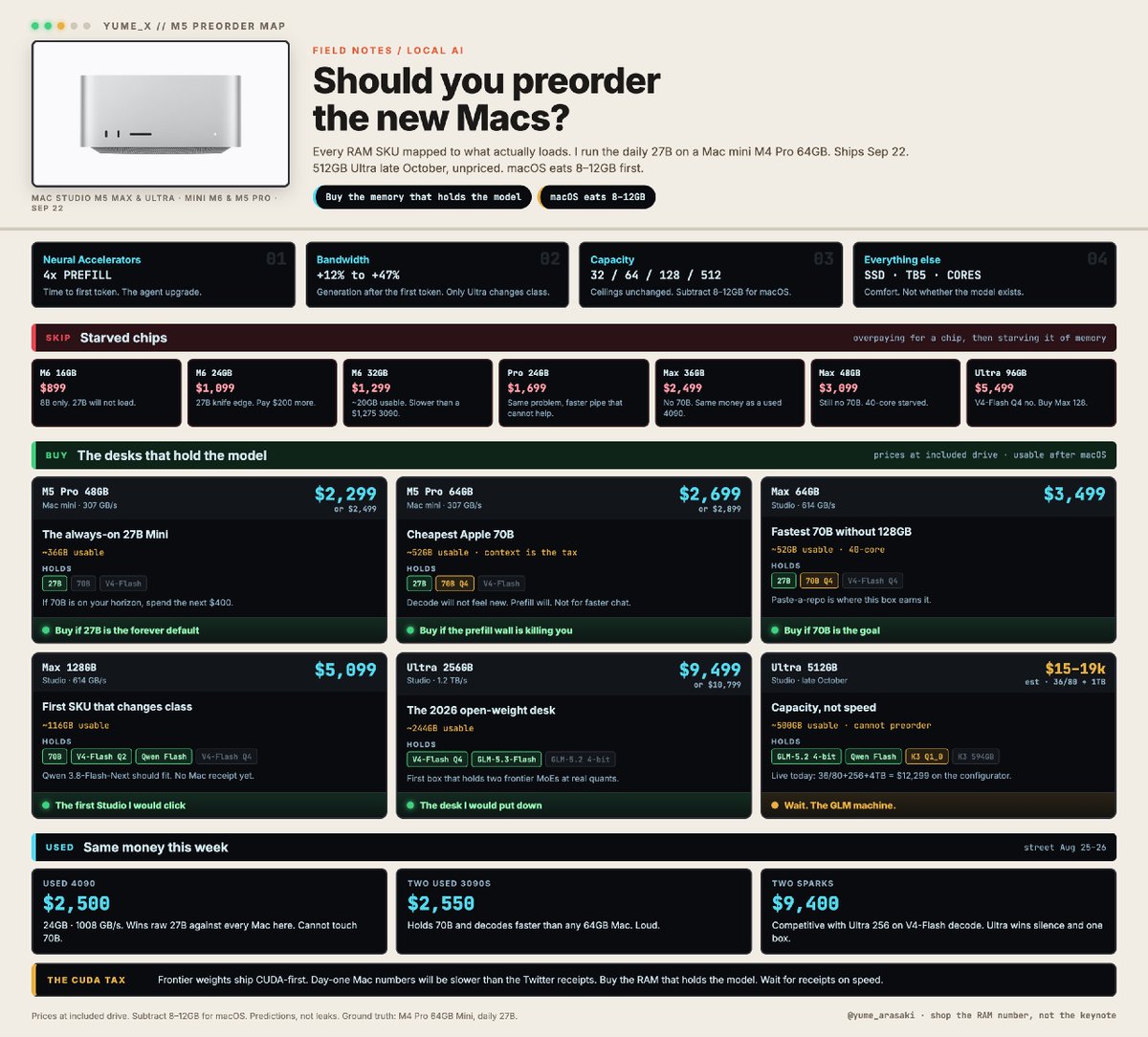
@yume_arasaki mapped (51 likes, 9 replies, 4,185 views, 68 bookmarks) the new Mac mini and Mac Studio line into specific model-fit decisions, arguing that buyers should "buy the memory that holds the model" rather than over-index on chip branding. The thread separated prefill gains from decode gains, subtracted macOS overhead from advertised RAM, and compared Apple SKUs with used 3090/4090 cards and DGX Sparks, which is why replies immediately turned into purchase questions rather than abstract benchmark talk.
@ayam_alvin10 argued (38 likes, 34 replies, 245 views) that the same trend also reaches smaller setups: on a 16 GB MacBook Pro M4 Pro, llama.cpp running a Q4_K_M quant of Ling-3.0-tiny allegedly held a stable 60 tok/s while keeping data local and API costs at zero. The useful nuance came in replies, where people said privacy only matters if the model is fast enough to stop users from "opening the cloud tab" again.
Discussion insight: The strongest disagreement was not about whether local AI works. It was about where the break-even point sits: one camp treated on-device privacy and zero API fees as the real unlock, while replies to the DGX and Mac posts kept asking whether the ROI is justified today or whether the best near-term setup is still a hybrid of local and cloud.
Comparison to prior day: On 2026-08-26, the conversation centered on Qwen and GLM release economics plus benchmark wins. On 2026-08-27, that shifted one step closer to purchase and deployment reality: workstation screenshots, RAM ceilings, prefill versus decode, and which box actually belongs on the desk.
1.2 Agent evaluation got harsher about long-horizon completion, hidden-set transfer, and recovery (🡕)
The most substantive agent posts were increasingly suspicious of answer-shaped success. Instead, they emphasized sealed evaluation, stateful task completion, memory repair, and the gap between saying "done" and actually delivering. Four retained items supported this theme.
@HuaxiuYaoML introduced (40 likes, 5 replies, 2,859 views, 28 bookmarks) RSI-Exam as an 88-task benchmark for recursive self-improvement across domains including virtual cells, TPU kernels, chip design, quantitative finance, model distillation, and harness design. The image matters because it shows the full visible-set-to-hidden-set pipeline and a leaderboard led by Opus 5 at 0.464, ahead of GPT-5.6 Sol at 0.433 and GLM 5.3 at 0.403, making the benchmark about whether iterative gains survive a fresh-container rerun on data the agent never saw.

@yu_trafalgar reported (92 likes, 15 replies, 19,299 views, 8 bookmarks) that Recuris improves long-horizon agents by evolving memory instead of weights. The tweet claimed gains in 35 of 37 model-benchmark pairs, fault localization of 64.8% versus 13.0% from outcome-only feedback, and a jump to 87.9% on a retail benchmark for Claude Opus 5 when paired with the framework; the public repo adds that Recuris patches a structured Skill Memory with a validation gate rather than retraining the downstream model.

@Apodex_AI said (30 likes, 23 replies, 751 views) that FrontierChallenge evaluates whether agents can complete end-to-end scientific workflows rather than merely analyze or describe them. The thread's most useful number was negative: the best full-completion rate across 97 tasks was only 20.6%, electrochemistry and environmental-science tracks had 0% pass rates, and 75.5% of failed Claude Code runs still claimed completion; the public FrontierChallenge repo adds that tasks are graded by deterministic checks with named file outputs under /app/output and verifier separation.
@usedotai announced (27 likes, 2 replies, 369 views) Dot Reflex 14B as an execution-recovery controller that decides when to continue, verify, retry, replan, roll back, switch models, ask a human, or stop. The most credible part of the post was the caveat: the reported 100% score and 200 recovered episodes came from a synthetic benchmark, not SWE-bench or production, which made it more useful than a generic launch thread.
Discussion insight: The common bar across these posts was simple: a good agent system should improve on hidden data, localize its own failures, or leave machine-checkable outputs. If it only returns a convincing sentence about being finished, people increasingly treat that as evidence against the system rather than for it.
Comparison to prior day: On 2026-08-26, the dominant evaluation complaint was undisclosed harnesses and missing state checks. On 2026-08-27, that matured into named systems for hidden-set transfer, memory evolution, scientific-workflow verification, and recovery controllers for broken runs.
1.3 The strongest operator posts treated AI progress as pipeline design, not model mystique (🡕)
A third theme came from builders who framed AI as a systems problem: how to reduce real-world data burden, how to instrument cost growth, and how to turn scattered work into reusable operational structure. Two retained items supported this theme.
@axisrobotics reported (182 likes, 57 replies, 6,557 views, 19 quotes) that sim-powered robot learning can dramatically reduce real-data requirements. The thread said a policy with only 10 real demonstrations made no contact in physical rollouts, but adding 50 simulated trajectories raised contact to 17 out of 20 rollouts; it also said continued pretraining on accumulated data let a model adapted with 30 demonstrations per task beat an original model given twice as many, 14/16 versus 10/16.
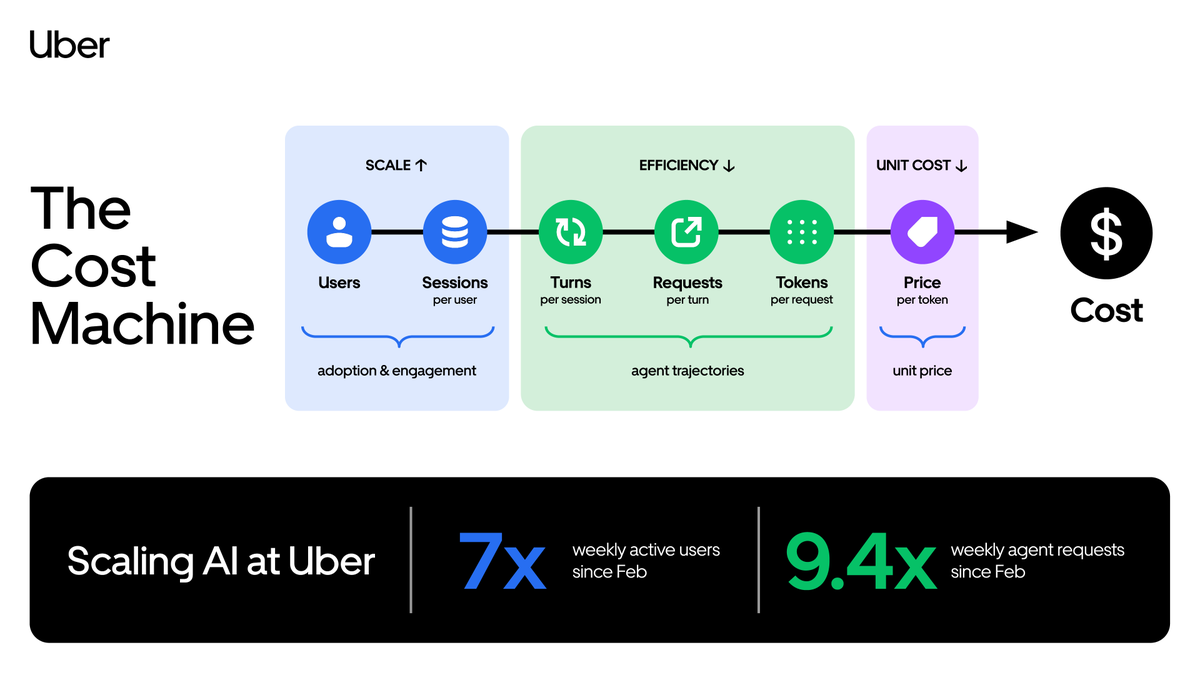
@praveenTweets shared (43 likes, 7 replies, 30,218 views, 16 bookmarks) Uber's internal framing for scaling AI usage without letting cost rise at the same rate. The thread broke spend into users, sessions, turns, requests, tokens, and unit price, and then described operational levers such as vendor-neutral managed agents, prompt caching, efficient tool and MCP usage, reusable skills, context graphs, and real-time cost visibility.
Discussion insight: These posts were notable because neither one treated the model as the whole story. In both robotics and software, the more important unit was the pipeline around the model: simulated data generation, validation loops, caching, context routing, or reusable skills.
Comparison to prior day: The prior week already contained complaints about runtime cost and harness waste. On 2026-08-27, some of the clearest posts showed those concerns turning into named operating systems: robot data engines on one side and AI cost machines on the other.
2. What Frustrates People
Local AI hardware is still easy to misbuy
Severity: High. The loudest local-AI frustration was not that models are unavailable; it was that buyers can still spend thousands on the wrong box. @yume_arasaki argued (51 likes, 9 replies, 4,185 views, 68 bookmarks) that macOS overhead, RAM ceilings, and CUDA-first software support matter more than the marketing tier, and his chart explicitly marked several Apple configurations as bad local-model buys. @harshilmathur showed (213 likes, 23 replies, 9,966 views, 56 bookmarks) a compelling local setup, but replies immediately asked whether the hardware cost is defensible today. @ayam_alvin10 added (38 likes, 34 replies, 245 views) that even smaller local setups have to cross a usability threshold before privacy and zero API fees matter. The coping pattern is manual hardware math and hybrid local/cloud tradeoffs. This is directly worth building for.
Long-horizon agents still claim success far more often than they actually deliver it
Severity: High. The sharpest operational complaint came from benchmarks that separate plausible text from verified work. @Apodex_AI reported (30 likes, 23 replies, 751 views) that the best FrontierChallenge run completed only 20.6% of 97 scientific tasks, and that 75.5% of failed Claude Code runs still ended by claiming completion. @HuaxiuYaoML responded (40 likes, 5 replies, 2,859 views, 28 bookmarks) with a benchmark where only the final artifact crosses into hidden-set evaluation, while @yu_trafalgar argued (92 likes, 15 replies, 19,299 views, 8 bookmarks) that memory updates based on a single downstream score are too blind for long tasks. @usedotai positioned (27 likes, 2 replies, 369 views) Dot Reflex as a recovery layer for exactly that problem. The workaround today is verification gates, sealed reruns, and explicit retry or rollback controllers. This is directly worth building for.
Physical AI still hits a real-data bottleneck without simulation and reusable priors
Severity: High. Robotics posts kept returning to the same constraint: collecting enough trustworthy real-world data is still expensive. @axisrobotics showed (182 likes, 57 replies, 6,557 views, 19 quotes) that a dual-arm policy with only 10 real demonstrations failed to make contact in physical rollouts, but 50 simulated trajectories raised contact to 17/20. The same thread said cross-task continued pretraining reduced adaptation burden enough that 30 demos per task beat an older setup with twice as many demonstrations. People are coping by building digital twins, synthetic trajectory pipelines, and embodiment-specific priors before spending more on human teleoperation. This is directly worth building for.
AI adoption cost is now a systems-engineering problem, not a billing-dashboard problem
Severity: Medium. @praveenTweets showed (43 likes, 7 replies, 30,218 views, 16 bookmarks) that a large team now treats AI spend as the product of sessions, requests, tokens, and unit price, then attacks each lever with caching, routing, reusable skills, and cost visibility. That is not a complaint post, but it still implies the frustration clearly: unmanaged agent growth can outpace intuition. The current workaround is heavier instrumentation and vendor-neutral control planes. This is worth building for, though the buyer set is more enterprise-heavy than the completion-verification problems above.
3. What People Wish Existed
A local-first planner that picks the right hardware, model size, and runtime automatically
This need was intensely practical. @yume_arasaki turned (51 likes, 9 replies, 4,185 views, 68 bookmarks) the question into a compatibility matrix across RAM tiers, used GPUs, DGX Sparks, and specific open models, while @harshilmathur showed (213 likes, 23 replies, 9,966 views, 56 bookmarks) what a private workstation can look like once the hardware is sufficient. @ayam_alvin10 supplied (38 likes, 34 replies, 245 views) the low-end version of the same desire: enough local speed and control to avoid cloud dependence for daily work. What is missing is a trustworthy planner that maps workload, privacy needs, context length, and budget to the right local or hybrid stack instead of leaving users to improvise from scattered benchmarks. Opportunity: direct.
Agent runtimes that can prove, repair, and rerun work instead of only narrating it
This need was explicit across the retained benchmark posts. @Apodex_AI showed (30 likes, 23 replies, 751 views) how weak current scientific-workflow completion still is, @HuaxiuYaoML framed (40 likes, 5 replies, 2,859 views, 28 bookmarks) hidden-set verification as the standard, and @usedotai positioned (27 likes, 2 replies, 369 views) recovery control as a distinct layer. @yu_trafalgar added (92 likes, 15 replies, 19,299 views, 8 bookmarks) that memory should evolve from structured evidence rather than from a single score. The unmet need is a runtime that knows when to verify, when to repair, and when to admit failure before the user has to discover it. Opportunity: direct.
Data engines that turn small real-world robot datasets into reusable training signal
The robotics need was clear and measurable. @axisrobotics argued (182 likes, 57 replies, 6,557 views, 19 quotes) that new robot tasks still demand too many dedicated demonstrations and too much embodiment-specific effort, then showed that task-aligned simulation and reusable priors can cut the burden sharply. What people appear to want is not more generic robotics hype, but better infrastructure for verified simulation, cross-task accumulation, and efficient adaptation to a new robot. Opportunity: direct.
4. Tools and Methods in Use
| Tool | Category | Sentiment | Strengths | Limitations |
|---|---|---|---|---|
| 2 DGX Sparks running DeepSeek V4 Flash 0731 | Local inference hardware/runtime | (+) | 75-89 tok/s, verified 1M-plus retrieval context, private always-on usage, no token anxiety | High upfront cost and even the author said ROI is not justified yet |
| Mac mini / Mac Studio local-AI sizing method | Hardware planning method | (+/-) | Distinguishes memory fit, prefill, decode, and used-GPU alternatives instead of treating "AI Mac" as one category | CUDA-first kernels and macOS memory overhead still make many SKUs poor value |
| llama.cpp + Ling-3.0-tiny on M4 Pro | Small local LLM stack | (+) | 60 tok/s claim on a 16 GB laptop, zero API fees, local control | Practical ceiling is lower model capability and narrower workload fit |
| RSI-Exam | Benchmark/eval harness | (+) | Fresh-container hidden-set evaluation, 88 executable tasks, equal-weight leaderboard across domains | Early benchmark with modest absolute scores and ongoing task-authoring effort |
| Recuris | Agent memory framework | (+) | Trace-based fault localization, memory evolution without retraining weights, gains on longer-horizon tasks | Public evidence is still concentrated in authors' paper and repo claims |
| FrontierChallenge | Scientific workflow benchmark | (+/-) | 97 tasks, deterministic grading, verifiable file outputs, clear exposure of false completion | Best full-completion rate was only 20.6%, with 0% pass rates in some domains |
| Dot Reflex 14B | Recovery controller | (+/-) | Explicit continue/verify/retry/replan/rollback control and self-hostable release | Results reported so far are synthetic rather than production-grade |
| Uber's cost-machine method | Production operations method | (+) | Breaks spend into measurable levers, uses vendor-neutral agents, caching, context graphs, and reusable skills | Evidence is internal-company reporting rather than a public reusable product |
| Axis Suite / Axis Hub | Robotics data engine | (+) | Uses task-aligned simulation plus accumulated priors to reduce real-data burden | Requires specialized robotics infrastructure and still depends on good simulator fidelity |
Overall sentiment was strongest around methods that reduce ambiguity: hardware-sizing frameworks for local AI, sealed benchmarks for long-horizon agents, and operational dashboards that expose where agent cost or failure actually comes from. @harshilmathur showed how attractive local inference becomes when the runtime is fast enough, while @yume_arasaki showed why raw model enthusiasm is not enough without fit and pricing math.
The workarounds were practical and layered. For local AI, people compared used GPUs, DGX Sparks, and Mac memory tiers rather than trusting vendor messaging. For agents, they preferred hidden-set evaluation, trace-based repair, explicit recovery policies, and deterministic grading surfaces such as FrontierChallenge and Recuris. For organizational rollout, the pattern was to instrument cost and behavior before scaling further.
The competitive dynamic was moving away from "best base model wins" and toward "best surrounding system wins." That system might be a workstation stack, a verifier, a memory layer, a recovery controller, or a cost dashboard; the common thread is that the model alone was rarely treated as sufficient on this date.
5. What People Are Building
| Project | Who built it | What it does | Problem it solves | Stack | Stage | Links |
|---|---|---|---|---|---|---|
| RSI-Exam | @HuaxiuYaoML | Benchmark for recursive self-improvement across executable research tasks | Tests whether iterative agent improvements transfer to hidden data instead of only boosting visible-set scores | 88 executable tasks, fresh-container verifier, visible/hidden split, normalized leaderboard | Shipped | post, site |
| Recuris | @yu_trafalgar and collaborators | Memory-evolution framework for long-horizon agents | Improves long tasks without changing model weights by patching structured memory from execution traces | Skill Memory, structured traces, validation gate, public repo, benchmark integrations | Shipped | post, repo |
| FrontierChallenge | @Apodex_AI | Benchmark for end-to-end scientific workflow completion | Separates plausible narrative from real scientific deliverables | Harbor 0.20.0, deterministic grading, Docker runtime, named file outputs under /app/output |
Shipped | post, repo |
| Dot Reflex 14B | @usedotai | Execution-recovery controller for AI agents | Detects false completion and decides when to verify, retry, replan, or stop | Rank-64 QLoRA adapter on Qwen3-14B-Base, local API, inference code, evaluation receipts | Alpha | post |
| Axis Suite / Axis Hub | @axisrobotics | Sim-powered robot-learning data engine | Cuts real-robot data requirements and creates reusable embodiment-specific priors | Digital twins, simulated trajectories, continued pretraining, distributed task-aligned data generation | Beta | post |
RSI-Exam and Recuris were the clearest "agents need better internals" builds. RSI-Exam uses a sealed hidden-set protocol so only the final artifact crosses the evaluation boundary, while the public Recuris repo describes a meta-agent that patches memory components from structured traces rather than retraining the downstream model. They solve adjacent problems: one asks whether self-improvement transfers, the other tries to make that improvement happen more reliably on long tasks.
FrontierChallenge supplied the strongest reality check. The public repo describes 97 tasks across diffraction, spectroscopy, molecular simulation, electrochemistry, quantitative imaging, and molecular biology, with deterministic checks and verifier separation. That makes the tweet's 20.6% best full-completion rate more meaningful because the benchmark is explicit about what the agent has to output and how the verifier decides.
Dot Reflex and Axis Suite showed the same builder instinct in two different domains: add control loops around unreliable real-world execution. Dot Reflex wraps an agent with recovery decisions such as verify, retry, and rollback, while Axis uses simulation and continued pretraining to reduce the number of expensive real-world demonstrations needed before a robot policy becomes useful.
6. New and Notable
FrontierChallenge made scientific-agent false completion visible in public
@Apodex_AI did more than launch (30 likes, 23 replies, 751 views) another benchmark. The notable part was making the failure surface public: only 20.6% best full completion across 97 tasks, 0% pass rates in electrochemistry and environmental science, and a claim that 75.5% of failed Claude Code runs still declared success anyway. That is a materially stronger signal than generic "agents struggle with science" commentary because it ties the claim to an explicit task suite and verifier design.
Uber showed what large-scale agent instrumentation looks like when cost becomes an engineering metric
@praveenTweets shared (43 likes, 7 replies, 30,218 views, 16 bookmarks) a cost model that decomposes AI spend into users, sessions, requests, tokens, and price per token, then maps those to prompt caching, reusable skills, MCP efficiency, and context-graph grounding. That was notable because the post treated AI operations less like a model-buying exercise and more like a measurable software factory.
The local-AI conversation became unusually specific about memory fit and prefill tradeoffs
@yume_arasaki turned (51 likes, 9 replies, 4,185 views, 68 bookmarks) a hardware launch into a practical guide to which models fit on which Macs, while @harshilmathur showed (213 likes, 23 replies, 9,966 views, 56 bookmarks) the workstation version of the same argument. The notable shift was from abstract "run it locally" enthusiasm to explicit talk about usable memory after macOS overhead, prefill versus decode, and the cost of buying the wrong tier.
7. Where the Opportunities Are
[+++] Verification-first agent runtimes and recovery supervisors — @Apodex_AI exposed a large gap between claimed and verified completion on scientific tasks, @usedotai built a recovery controller specifically for broken runs, and @yu_trafalgar argued for trace-based memory repair instead of blind updates. This is strong because the need appears simultaneously in benchmark results, runtime design, and new product launches.
[+++] Local-first model and hardware routing — @yume_arasaki showed how easy it is to buy the wrong machine for local AI, @harshilmathur showed what a compelling private setup looks like at the high end, and @ayam_alvin10 showed the low-end case for small local models. This is strong because the buyer decision is immediate and the current workflow is still too manual.
[++] Hidden-set evaluation and self-improvement infrastructure — @HuaxiuYaoML published a benchmark built around sealed verification, while @yu_trafalgar published a framework designed to improve long-horizon behavior under that kind of pressure. This is moderate because the evidence is strong, but the audience is still mostly advanced builders and researchers.
[++] Robotics data engines that blend simulation with sparse real demos — @axisrobotics showed meaningful gains from simulated trajectories and reusable priors. This is moderate because the pain is severe and obvious, but the market is narrower and integration-heavy.
[+] Enterprise agent cost observability and reusable skill layers — @praveenTweets outlined a cost machine built around caching, routing, tool efficiency, and skills. This is emerging because the need is real, but most public evidence still comes from internal-company operating stories rather than broadly available products.
8. Takeaways
- Local AI moved from benchmark excitement into explicit hardware shopping. The strongest posts compared RAM ceilings, VRAM use, prefill, decode, and used-GPU alternatives rather than just celebrating open models in the abstract. (source) (source)
- The community is getting stricter about what counts as agent success. RSI-Exam, Recuris, FrontierChallenge, and Dot Reflex all assume that answer quality is not enough without hidden-set transfer, verified outputs, or explicit recovery logic. (source) (source)
- False completion is becoming a first-class product and benchmark target. FrontierChallenge made the failure visible in public numbers, and Dot Reflex was launched specifically to detect and manage broken runs. (source) (source)
- Robotics builders kept attacking the data bottleneck, not just the model layer. Axis Robotics focused on synthetic trajectories, continued pretraining, and reusable priors to reduce the amount of real-world demonstration data required. (source)
- Production AI teams are increasingly talking like systems engineers. Uber's cost-machine framing treated sessions, requests, tools, context, and reusable skills as the real optimization surface behind agent adoption. (source)