Twitter AI - 2026-09-01
1. What People Are Talking About
1.1 Multimodal releases converged on specific work loops instead of generic chat (🡕)
The strongest launch cluster was not about one more general-purpose assistant. It was about specialized perception modules for speech, voice, video, and 3D world reconstruction. Four retained items supported this theme, and the prior-week comparison also moved up: in the top 80 tweets, multimodal-release matches rose to 14 on 2026-09-01 from 9 on 2026-08-31.
@AIatMeta introduced (231 likes, 14 replies, 12,346 views, 56 bookmarks) Muse Voice Transcribe as Meta Superintelligence Labs' first real-time audio perception model, claiming streaming ASR, diarization for 20-plus speakers, endpointing, multilingual code-switching, and benchmark wins on streaming speech-to-text and diarization. Meta's own announcement adds the technical detail missing from the tweet: 80 ms audio chunks, an autoregressive multimodal model from the Muse Spark family, and an adaptive-delay reinforcement-learning setup that trades off latency and accuracy word by word. The same thread also says the model is already available through Meta Model API, Meta AI for Mac, and Muse Code, which made this feel like a product launch rather than a lab-only teaser.


@drfeifei announced (176 likes, 21 replies, 12,183 views, 45 bookmarks) World Labs' Atlas as a multimodal world model trained from scratch for camera-controlled generation, sparse-view 3D reconstruction, and space-time simulation. The official Atlas page sharpens the claim: Atlas is a multimodal autoregressive diffusion transformer that operates on text, images, video, and 3D, can generate up to one minute of 1440p video, and uses camera geometry as a native input rather than inferring camera moves from prose. That combination pushed world-model discussion away from cinematic demo language and toward controllable inputs that matter for VFX and robotics.
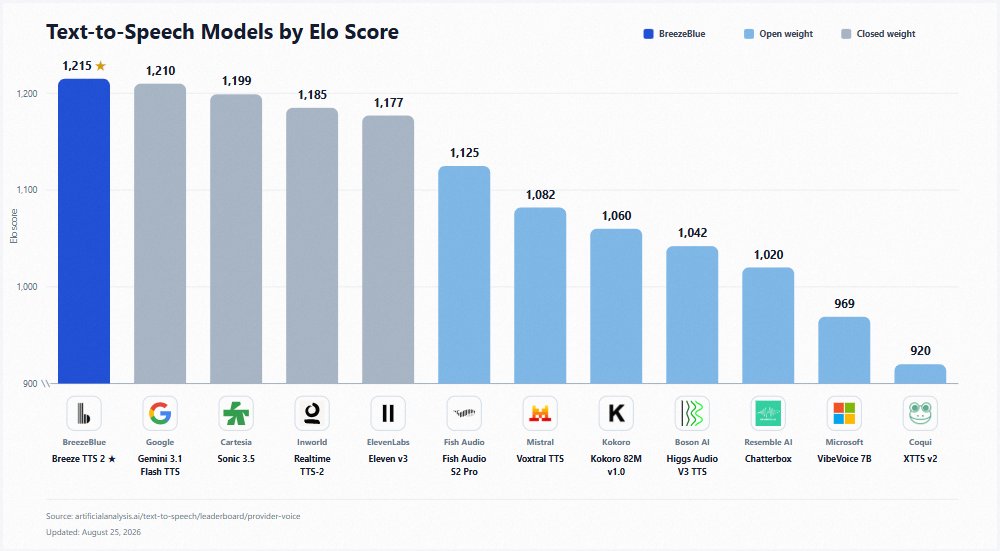
@ModelScope2022 launched (44 likes, 3 replies, 2,346 views, 29 bookmarks) Breeze-TTS-2 as a real-time voice-cloning and voice-direction model, and the attached leaderboard was informative rather than decorative: it put Breeze TTS 2 at the top of Artificial Analysis' public text-to-speech Elo table. The public model page plus the tweet text add the practical details readers actually need: Apache-licensed code, research/non-commercial weight terms, under-40 ms time-to-first-audio on the warmed-up path, and a 12 GB GPU recommendation for self-hosting.
@_philschmid wrote (57 likes, 1 reply, 2,557 views, 28 bookmarks) that Gemini video understanding is now agentic: the model can choose whether to inspect transcripts, audio, or visual frames and can dynamically search a timeline instead of paying a fixed frame-rate tax. Google's launch post for agentic video understanding matches the tweet's summary with concrete numbers: up to 88% fewer tokens, 66% lower cost, and up to 7% better benchmark accuracy across Gemini 3.7 Flash, 3.6 Flash, and 3.5 Flash-Lite. That made multimodal efficiency itself part of the product story, not just model IQ.

Discussion insight: The most useful replies did not question whether these systems work at all; they questioned what production use means. A reply to Meta said the real product issue is who can query the live transcript stream and who cannot, while one reply on Atlas said camera pose as a native input mattered more than the marketing phrase "world model."
Comparison to prior day: On 2026-08-31, multimodal discussion was already active, but it leaned more on forecasting and general visual reasoning. On 2026-09-01, it became more operational: speech, TTS, video search, and 3D camera control all arrived with deployable interfaces or product roadmaps.
1.2 Model buyers stopped trusting static benchmarks as a buying guide (🡕)
A second theme was distrust of leaderboard theater. The strongest posts argued that model choice has become task-shaped, session-shaped, and infrastructure-shaped, so one-prompt comparisons are no longer enough. Four retained items supported this theme, and it was the clearest acceleration in the prior-week scan: top-80 evaluation-and-harness matches rose to 50 on 2026-09-01 from 34 on 2026-08-31.
@AlexFinn argued (52 likes, 16 replies, 5,684 views, 31 bookmarks) that anyone evaluating a fresh coding model should build a private harness around their own recurring work categories instead of trusting vendor or timeline benchmarks. The tweet was unusually actionable: categorize your work, generate multi-step tests, wrap them in a small app, and run new models head to head through a router. The point was less "ignore all benchmarks" than "move the benchmark boundary inward until it resembles the work you actually pay for."
@MaorShlomo introduced (48 likes, 5 replies, 2,843 views, 7 bookmarks) Base44's Model Comparison with the same critique: the best model changes with the task, and side-by-side output on your own app is more informative than a chart. His description of the feature mattered because it turned that complaint into product behavior: one prompt, two models, two branches, and a keep-one-or-both decision inside the builder.
@gippp69 argued (33 likes, 11 replies, 524 views, 20 bookmarks) that coding-agent benchmarks have been measuring the wrong thing, quoting Tomas Hernando Kofman's methodology release on interactive model-routing benchmarks. The quoted claim was specific enough to matter: a router staying Pareto-dominant across interactive benchmarks while reaching roughly Opus xhigh quality at 20% to 80% lower cost, because it routes with session history and cache behavior in mind instead of optimizing a single turn.
@edwardjhu shared (50 likes, 3 replies, 2,196 views, 27 bookmarks) the most credible counterexample to shallow evaluation: Mercor's 397B SkyRL training guide came with code, weights, traces, task format, and a chart showing Qwen3.5-397B-A17B rising from 16.11% to 27.29% Pass@1 on APEX-Agents. That post mattered because it replaced benchmark screenshots with a reproducible training and evaluation recipe, including the three de-risking steps Mercor says happen before any serious compute is spent.

Discussion insight: The replies kept pushing toward realism. One reply to Alex Finn said a useful harness has to include old failures rather than only common tasks, while a reply to Jafar Najafov's later Hugging Face course thread said observability and evaluation are the hard part, not spinning up another loop around an API.
Comparison to prior day: 2026-08-31 already had strong evaluation discussion, but it still centered on model-and-harness pairs at a high level. On 2026-09-01, people moved one step closer to procurement and operations: private test batteries, side-by-side branches, interactive routing, and released eval traces.
1.3 Cyber capability talk shifted from red-team bravado to gated deployment and defensive loops (🡕)
Cybersecurity discussion was still capability-heavy, but the framing changed. The strongest items were not celebrating offense in the abstract; they were describing why offensive capability now forces release constraints, specialized model stacks, and closed-loop defense systems. Two retained items supported this theme, and top-80 cyber-safety matches rose to 11 from 8 on 2026-08-31.
@testingcatalog wrote (271 likes, 12 replies, 15,981 views, 27 bookmarks) that Astra is coming with limited cybersecurity capabilities despite much stronger exploit performance than GPT-5.6 Sol. The quoted OpenAI post and the official Path to Astra write-up made the reason legible: Astra crossed OpenAI's Critical cybersecurity threshold, scored 100% on public ExploitBench, and was additionally tested on a private 20-vulnerability Internal Port benchmark covering newer high-severity V8 bugs. The informative image in the thread showed the performance gap clearly enough that the "limited release" language stopped sounding like PR hedging and started sounding like product gating.

@NVIDIAAI wrote (23 likes, 5 replies, 3,241 views, 8 bookmarks) that CrowdStrike's SafeMind system uses offensive and defensive agents in the same loop to create detections and retest them against new attacks. NVIDIA's Fal.Con recap and the tweet replies add the concrete mechanics: Red Tempest attack agents, Blue Solano defensive agents, Nemotron 3 Ultra orchestration, Falcon telemetry, and an internal report that mean backtest detection improved from 16.5% to 41.9%, with three promoted rules catching all eight unseen attacks in a follow-on test. The emphasis was not on a single frontier model winning; it was on a specialized red-vs-blue exoskeleton that keeps learning.

Discussion insight: The sharpest replies were about enforcement surfaces. One commenter on Astra asked what "limited" means in terms of tools and escalation paths, and another observed that account-level vetting is a different control layer from refusal behavior inside model weights.
Comparison to prior day: On 2026-08-31, cyber posts were still expanding the evaluation vocabulary. On 2026-09-01, the conversation got more operational and more sober: which systems are releasable, which defenses can self-improve, and where exactly the control boundaries live.
1.4 Physical AI still looked like a data-engineering problem (🡕)
Physical AI remained a real theme, but the evidence kept pointing to data quality rather than robot spectacle. The retained posts did not celebrate humanoid hardware; they focused on datasets, trajectory cleaning, replay fidelity, and whether demonstrations survive preprocessing. Two retained items supported this theme.
@Jaxon0x argued (61 likes, 34 replies, 1,725 views) that Axis Robotics is building the underappreciated moat in robotics: scalable, high-quality pretraining data. The tweet tied that claim to public infrastructure instead of vague vibes, citing the Axis Franka Dataset, 160,000-plus downloads, and the plan to scale toward 1.2 million trajectories across 1,200 tasks. The point was that robotics may finally be getting its own pretraining data flywheel.
@juraucrypt argued (37 likes, 30 replies, 216 views) that the harder problem is not collecting more human demonstrations but separating meaningful corrections from accidental noise. The attached infographic made the argument concrete with reported reductions in acceleration artifacts and jerk after cleaning and resampling, but the post also insisted that smoother traces are not enough without replay checks and task evaluation. That is a much narrower and more useful claim than "better data helps robotics."

Discussion insight: The replies stayed on the same bottleneck. One response to Jaxon said everyone watches the robots while few watch the data, which captures how the thread framed the real constraint.
Comparison to prior day: On 2026-08-31, physical-AI talk was already centered on data loops. On 2026-09-01, the discussion became more specific by separating dataset scale from trajectory quality and by treating replay reliability as a first-class requirement.
2. What Frustrates People
Static leaderboards still fail the "will this work on my app?" test
Severity: High. @AlexFinn said (52 likes, 16 replies, 5,684 views, 31 bookmarks) that developers should trust neither vendor benchmarks nor random X threads and should instead build a private harness around their own recurring tasks. @MaorShlomo made the same complaint from the product side, saying the "best" model changes with the task and that charts miss how a prompt behaves inside a real app, while @gippp69 added (33 likes, 11 replies, 524 views, 20 bookmarks) that long sessions, interruptions, and cache state are exactly what common coding-agent benchmarks leave out. The workaround is visible and increasingly standardized: build side-by-side evaluation into the workflow itself. This is directly worth building for.
Frontier agent training still starts with environment reliability, not modeling novelty
Severity: Medium. @edwardjhu shared (50 likes, 3 replies, 2,196 views, 27 bookmarks) a rare public look at why knowledge-work RL is hard: Mercor's training guide says the first three steps are all de-risking, and that no real compute is spent until the environment, harness, and token accounting are stable. The post also says realistic professional-service worlds are expensive to build and long-horizon rollouts are expensive to train on, which helps explain why so little comparable research is public. Builders are coping by releasing recipes, traces, and smaller-scale ablations before the "hero run." This is worth building for, but it is more infrastructure-heavy than consumer-facing.
Physical-AI demonstrations can succeed and still teach the wrong motion
Severity: High. @juraucrypt argued (37 likes, 30 replies, 216 views) that a robot can reach the right end state using a bad demonstration full of sudden acceleration, oscillation, and inefficient corrections, so raw task completion is not a sufficient training signal. @Jaxon0x connected that problem to the larger infrastructure race around the Axis Franka Dataset, where scale only matters if the data survives cleaning, replay, and evaluation. The coping strategy is to treat replay and motion-quality metrics as first-class checks rather than as afterthoughts. This is directly worth building for.
Better multimodal perception creates new permission and governance headaches
Severity: Medium. The cleanest example came in a reply to Meta's Muse launch, where one commenter said real-time transcription and 20-speaker diarization are capability, but the product question is who can query that stream and who cannot. OpenAI's Astra release echoed the same constraint from another angle: @testingcatalog reported (271 likes, 12 replies, 15,981 views, 27 bookmarks) that Astra will be available soon, but with its cybersecurity capabilities limited even after strong benchmark results. People are coping by shifting control upward into account vetting, APIs, and deployment policies rather than trusting weights alone. This is worth building for, especially where agents can hear, watch, or act continuously.
3. What People Wish Existed
Workflow-native model evaluation
The clearest need was for a model test that runs on the user's own task, in the user's own environment, under the user's own session conditions. @AlexFinn explicitly recommended a custom harness over public benchmarks, while @MaorShlomo shipped a first in-product answer by running one prompt across two models in parallel branches. This is a practical need, not an aspirational one, and people want it now because model quality is too task-dependent for generic charts. Opportunity: direct.
Governance layers for always-listening or always-watching agents
The Muse and Astra threads both exposed the same missing layer: not "can the model do it?" but "who gets to call it, on what data, under what policy?" A reply to Meta's Muse launch said the real product question is who can query a live transcript stream, while the Astra debate focused on what "limited" release actually means for tools and escalation paths. Some of this is addressed today through API access controls and account vetting, but the public evidence suggests the governance tooling still lags the raw capability. Opportunity: competitive.
Replay-safe physical-AI data pipelines
Physical-AI posters were effectively asking for a system that can collect demonstrations, clean them, replay them faithfully, and prove that the cleaned trace still captures the task. @juraucrypt spelled out that lower acceleration artifacts and jerk do not replace replay verification, while the Axis dataset discussion points to scale without yet closing that trust gap. This is a practical need with clear research and infrastructure buyers behind it. Opportunity: direct.
Research assistants that keep evidence attached to the page
The Open Paper item was strong because it described a very concrete desire: researchers want an assistant that stays next to the PDF, answers with exact citations, and lets notes, highlights, and cross-paper comparisons accumulate instead of vanish into chat history. @ihteshamali highlighted a real open-source answer in Open Paper, which means the need is already being met partially rather than remaining hypothetical. That makes this more competitive than greenfield, but it is still urgent because the pain is daily and obvious. Opportunity: competitive.
4. Tools and Methods in Use
| Tool | Category | Sentiment | Strengths | Limitations |
|---|---|---|---|---|
| Muse Voice Transcribe | Audio perception / ASR | (+) | Real-time transcription, 20-plus-speaker diarization, adaptive delay, shipping through Meta APIs and apps | Closed model; replies immediately raised access-control questions |
| Atlas | World model / 3D generation | (+) | Camera geometry as input, sparse-view reconstruction, long controllable video, robotics relevance | Public material is still launch-page heavy; failure modes and production access are thin |
| Breeze-TTS-2 | TTS / voice model | (+) | Open code, strong public leaderboard result, real-time voice design and cloning, modest GPU footprint | Weight and derivative terms are research/non-commercial only |
| Gemini agentic video understanding | Multimodal API | (+) | Up to 88% lower token use, 66% lower cost, dynamic use of transcripts, audio, and frames | Benefits are strongest on longer videos; still requires tool-aware prompting |
| Base44 Model Comparison | App builder / evaluation | (+/-) | Side-by-side branches on the same prompt and app state, faster real-task comparison | Tied to one builder rather than a universal standard |
| SkyRL + APEX-Agents | RL training / benchmark | (+) | Public recipe, long-horizon knowledge-work tasks, released traces and weights | Expensive environments, careful token accounting, and infrastructure work remain the bottleneck |
| SafeMind on Nemotron | Cybersecurity agent stack | (+/-) | Offensive-defensive loop, specialized cyber data, Falcon-native deployment, strong claimed cost profile | Enterprise-focused and dependent on proprietary telemetry and harnesses |
| Axis Franka Dataset | Robotics dataset | (+) | Public dataset, strong download traction, large task roadmap, useful for VLA and world-model work | Dataset scale alone does not prove replay quality or real-world generalization |
| Open Paper | Research assistant | (+) | Citation-grounded answers, project-level synthesis, structured extraction, Zotero sync | Self-hosting is heavier than the hosted experience |
| SYLVA | Browser graphics / world generation | (+) | MIT-licensed, no external assets, live editor, Three.js/WebGL2 stack visible in public repo | Early-stage and still optimization-heavy |
Across the table, satisfaction was highest where the tool solved a narrow workflow concretely: speech transcription, TTS, video analysis, PDF reading, or a specific evaluation loop. Mixed sentiment appeared whenever the tool surfaced a second problem behind the first one, such as governance for ambient audio, infrastructure cost for RL training, or builder lock-in for comparison features. The biggest migration pattern was away from static benchmark reading and toward direct workflow testing: private harnesses, side-by-side branches, released traces, and public datasets people can actually inspect.
5. What People Are Building
| Project | Who built it | What it does | Problem it solves | Stack | Stage | Links |
|---|---|---|---|---|---|---|
| Open Paper | @ihteshamali highlighting Khoj | Citation-grounded research workspace for PDFs, notes, projects, and extraction tables | Researchers lose context when jumping between a paper, notes, and an external chatbot | GitHub README lists Next.js client, FastAPI server, Celery jobs, PDF parsing, Zotero sync | Shipped | post, repo, site |
| SYLVA | @TokenGremlin | Fully procedural cinematic forest running directly in the browser | Open worldbuilding and graphics experimentation without closed assets or downloaded scene packs | Three.js, WebGL2, GLSL, Vite, GitHub Pages demo | Alpha | post, repo, demo |
| Model Comparison | @MaorShlomo / Base44 | Runs the same builder prompt across two models in parallel branches and lets users keep one or both results | Choosing a model from public charts instead of actual app behavior | Base44 builder, multi-model branch execution | Shipped | post |
| ApexAgents-SkyRL-Recipe | @edwardjhu / Mercor Research | Public RL recipe, weights, traces, and methodology for training a 397B knowledge-work agent | Lack of open, reproducible recipes for long-horizon professional-work agents | Qwen3.5-397B-A17B, SkyRL, DPPO, Harbor, APEX-Agents | Shipped | post, blog, GitHub |
| Muse Voice Transcribe | @AIatMeta / Meta Superintelligence Labs | Real-time audio-perception model for ASR, diarization, and endpointing | Low-latency multilingual transcription and speaker separation in real conversations | Muse Spark family multimodal LLM, Meta Model API, Meta AI for Mac | Shipped | post, announcement |
| Breeze-TTS-2 | @ModelScope2022 / BreezeBlue | Real-time voice cloning, voice design, and instruction-following TTS | Need for faster, more controllable open-weight voice generation | Apache-licensed code, ModelScope distribution, 12 GB GPU target | Shipped | post, model page |
| Atlas | @drfeifei / World Labs | Camera-controlled multimodal world model for image, video, and 3D generation | Sparse-view reconstruction and controllable world simulation for creative tools and robotics | Multimodal autoregressive diffusion transformer with shared spatial context | Alpha | post, World Labs page |
The most interesting builder pattern was not "another agent." It was infrastructure around agents: evaluation harnesses, grounded research workbenches, model-comparison interfaces, and public RL training recipes. Open Paper is a good example of why that pattern matters: the value is not that it chats about PDFs, but that it keeps the citation attached to the exact passage, supports project-level synthesis, and exposes an evaluation suite for grounded scientific QA.
SYLVA stood out for a different reason. Its README is explicit that the forest contains no downloaded art assets at all; terrain, bark, foliage, water, sky, and weather are generated live in the browser from WebGL2 and GLSL. That is a recognizable independent-builder pattern on AI Twitter right now: release the code, show the live demo, and let the repo itself prove the claim.
Mercor's SkyRL release was the opposite end of the maturity spectrum, but it followed the same trust-building logic. Instead of posting a single benchmark screenshot, the team published a recipe, weights, traces, and the de-risking steps that happen before the expensive run. That kind of builder disclosure got more respect in this dataset than generic "new SOTA" claims.
6. New and Notable
Camera geometry became a first-class product claim
The Atlas launch was notable because it did not sell a world model as "it feels more realistic." It sold precise camera geometry, sparse-view reconstruction, and shared spatial context as the core abstraction, with the official World Labs page describing one-minute 1440p outputs and novel-view synthesis from as little as one image. That makes Atlas more relevant to real VFX and robotics workflows than a generic image model announcement. Supporting evidence came from @drfeifei and World Labs' own launch page.
A frontier cyber model was launched with public language about hard release boundaries
OpenAI's Astra discussion was notable because the public conversation no longer treated stronger offensive capability as a simple win. The tweet by @testingcatalog and the linked Path to Astra framing both emphasized limitations, threshold categories, and private follow-on evaluation rather than only headline scores. That is a meaningful change in public AI discourse: capability claims are now landing together with explicit shipping constraints.
Open RL training for knowledge work got materially more reproducible
Mercor's SkyRL guide was notable because it released more than a claim. Between the tweet by @edwardjhu, the blog post, and the public code repository, the work exposed training steps, environment choices, eval traces, and model weights for a 397B knowledge-work agent. In a feed full of benchmark arguments, that level of reproducibility stood out.
7. Where the Opportunities Are
[+++] Workflow-grounded evaluation and routing — Evidence spans sections 1, 2, and 4: @AlexFinn wants private task batteries, @MaorShlomo built side-by-side comparison into Base44, and @gippp69 highlighted interactive routing benchmarks that account for long sessions and cache state. This is strong because the pain is explicit, the workaround is recurring, and current products are still fragmented.
[++] Citation-grounded knowledge-work assistants — Open Paper shows there is real demand for assistants that stay attached to the source document, expose citations, and support extraction across a paper library. The opportunity is moderate rather than maximum because credible products already exist, but the need is repeatable and the workflow is daily.
[++] Robotics data cleaning and replay infrastructure — @juraucrypt and @Jaxon0x both point to the same gap: scaling physical-AI data only matters if demonstrations can be cleaned, replayed, and trusted. This is strong because it sits directly underneath broader robotics enthusiasm and still lacks a simple, standardized answer.
[+] Governance for ambient multimodal agents — Meta's Muse thread and OpenAI's Astra release both surfaced the same missing layer: product controls around who can query, trigger, or escalate a model that is always listening, watching, or acting. The demand is emerging rather than fully formed, but the capability trend is already here.
8. Takeaways
- Specialized multimodal systems had the strongest launch energy today. Meta shipped real-time speech perception, World Labs pushed camera-controlled 3D world modeling, ModelScope advanced open-weight TTS, and Google turned video understanding into a tool-using workflow instead of a static frame sampler. (source)
- The market no longer trusts one-shot benchmark charts to choose models for real work. Private harnesses, side-by-side branches, and session-aware routing were more persuasive than headline scores across the strongest coding-agent posts. (source)
- Cyber capability is now being discussed together with explicit shipping constraints. Astra's Critical-threshold framing and SafeMind's specialized red-vs-blue loop both treated control layers as part of the product, not as cleanup after launch. (source)
- Physical AI still looks like a data-quality and replay problem before it looks like a hardware problem. The strongest robotics tweets focused on dataset scale, trajectory cleanup, and whether demonstrations survive evaluation as usable training data. (source)
- Open builders still win credibility when they ship code and traces instead of slogans. Open Paper, SYLVA, and Mercor's SkyRL recipe all got traction by exposing repositories, demos, or evaluation artifacts that readers can inspect directly. (source)