Twitter AI - 2026-09-05
1. What People Are Talking About
1.1 Benchmark discussion turned into a fight over what should count as evidence at all (🡕)
The biggest conversation on AI Twitter was not just that GPT-6 Astra and Claude Fable 5.1 moved around on leaderboards. It was that benchmark operators, researchers, and users all spent the day renegotiating what a credible evaluation should look like. Six high-signal items supported the same shift: more held-out tests, more workflow-specific benchmarks, and more skepticism that any public chart stays honest for long.
@ArtificialAnlys announced (1,170 likes, 116 replies, 263,626 views, 207 bookmarks) that Intelligence Index v4.2 now adds AA-Briefcase for multi-week knowledge-work projects, adds GDP.pdf for 4,592-page document reasoning, doubles held-out weighting to 40%, and drops GPQA Diamond because it has been saturated. The replies mattered as much as the launch post: the thread added that Claude Fable 5.1 and Opus 5 lead AA-Briefcase, GPT-6 Astra leads GDP.pdf at 33.2%, and Astra remains the most token-efficient model near the frontier.

@cHHillee argued (177 likes, 10 replies, 13,133 views, 17 bookmarks) that the community focuses so much on labs “benchmaxxing” that it forgets benchmarks can also optimize themselves for leaderboard attention. The strongest replies did not reject the new Artificial Analysis release outright; they narrowed the trust boundary, with one reply saying the cost-per-task chart was the only part it really trusted.
@arena reported (85 likes, 6 replies, 6,294 views, 11 bookmarks) that GPT-6 Astra (Max) moved to #1 on Code Arena: WebDev with a 1,797 score, +35 ahead of Claude Fable 5.1 (Max), while matching it on $40/Mtoken pricing. The quote-tweet sharpened the point by framing the win as a workflow result rather than a benchmark trick: Astra was already leading in Data & Analytics, Consumer Product, and Content Creation Tools before the rest of the category votes had landed.

@mercor reported (78 likes, 1 reply, 3,672 views, 12 bookmarks) that GPT-6 Astra leads APEX-Accounting on Pass@1 at 13.1% and mean score at 60.0%, ahead of both Fable 5.1 and GPT-5.6 Sol. Mercor and Ramp’s public APEX-Accounting page and leaderboard describe the benchmark as real month-end-close work across ledgers, PDFs, spreadsheets, and 2,186 expert-authored grading criteria, which made this one of the few benchmark claims on the timeline that explicitly tried to mirror enterprise accounting work rather than abstract reasoning.

Discussion insight: The replies and quote-tweets consistently rewarded benchmarks that exposed workflow, cost, or grading details, and punished benchmarks that looked like opaque scoreboards. Docker’s reproducibility thread and Victor Taelin’s engineering thread both reinforced that mood from different directions.
Comparison to prior day: On 2026-09-04, the biggest Astra discussion was about rollout, token efficiency, and whether the model had become harder to monitor. On 2026-09-05, the center of gravity moved one layer outward, toward which benchmarks should survive frontier-model adaptation and which public charts are still worth trusting.
1.2 Frontier-model gains were obvious, but people kept asking whether the model understood the real problem or only the visible task (🡕)
A second theme paired genuine “wow” moments with sharp reminders that output quality is not the same thing as deep problem framing. Four strong items supported that split. People were willing to be impressed by visible artifacts, but they kept testing those artifacts against engineering judgment.
@VictorTaelin described (471 likes, 42 replies, 27,659 views, 129 bookmarks) an overnight experiment where both Claude Fable 5.1 and GPT-6 Astra found the right memory-leak symptom in Bend2, then spent hours trying to repair the allocator instead of questioning the scheduler assumption underneath it. Once Taelin pointed Fable toward the scheduler asymmetry, the model implemented a tiny lane-rotation fix that cut parked memory from 555MB to 23MB after 2,000 launches and pushed expected OOM from roughly 7,000 launches to roughly 75 million. His most useful reply made the evaluation point explicit: a benchmark might count both models as having “solved” the problem even though the high-quality solution only appeared after a human reframed it.
@scaling01 shared (385 likes, 6 replies, 23,718 views, 56 bookmarks) a four-image SVG comparison and argued that GPT-6 Astra made Claude Fable 5.1 “look like a model from last year” on this task. The post was thin on theory but strong on direct evidence: each image showed Astra generating a coherent scene with reflected water, depth, clean geometry, and small visual details that people in the replies immediately singled out.




@cheatyyyy reacted (283 likes, 13 replies, 18,698 views, 33 bookmarks) to a separate GPT-6 Astra controller SVG by asking how a text-only system could be “drawing perfect lifelike SVGs.” The replies were revealingly split: some treated the result as an undeniable capability jump, while others argued that SVG replication is still far easier than handling the open-ended ambiguity of real engineering work.
Discussion insight: The strongest pushback did not deny the visible progress. It asked whether those wins transfer. Taelin’s thread supplied the most concrete version of that critique: models can diagnose, measure, and iterate, yet still miss the frame that makes the solution simple.
Comparison to prior day: On 2026-09-04, the loudest capability claims were mostly benchmark charts and vendor-aligned write-ups. On 2026-09-05, the conversation shifted toward directly inspectable artifacts and case studies, then immediately tested those against real engineering standards.
1.3 Physical AI was framed as a data-engine problem: provenance, browser runtimes, and portability (🡕)
Physical-AI discussion stayed strong, but it became more specific. Five posts argued that the hard part is no longer saying “robot data matters.” The hard part is building a collection and verification system that keeps working across browsers, simulators, policy stacks, and later hardware. This was one of the clearest multi-post convergences of the day.
@LisaFlorentina8 compared (8 likes, 9 replies, 327 views) recent robotics training-data pipelines and said Axis Robotics stood out because it treats collection scope, consensus/provenance, and correction methodology as first-class parts of the product. Her infographic made the difference legible: instead of only collecting inside private labs or robot fleets, Axis tries to widen the contributor base through browser teleoperation and human-gated corrections.

@Phuc50103413 argued (62 likes, 75 replies, 114 views) that the browser is not just a frontend for Axis Robotics but part of the robotics stack itself. He cited Axis Weekly’s claim that DAgger Round 2 improved paired evaluation from 68 to 78.3 out of 160 across three seeds, then pointed to the harder problem: some policies still lose performance when moving from Python to browser-based WASM, which means crowd collection is only useful if the runtime is portable enough for the learned behavior to survive the jump.
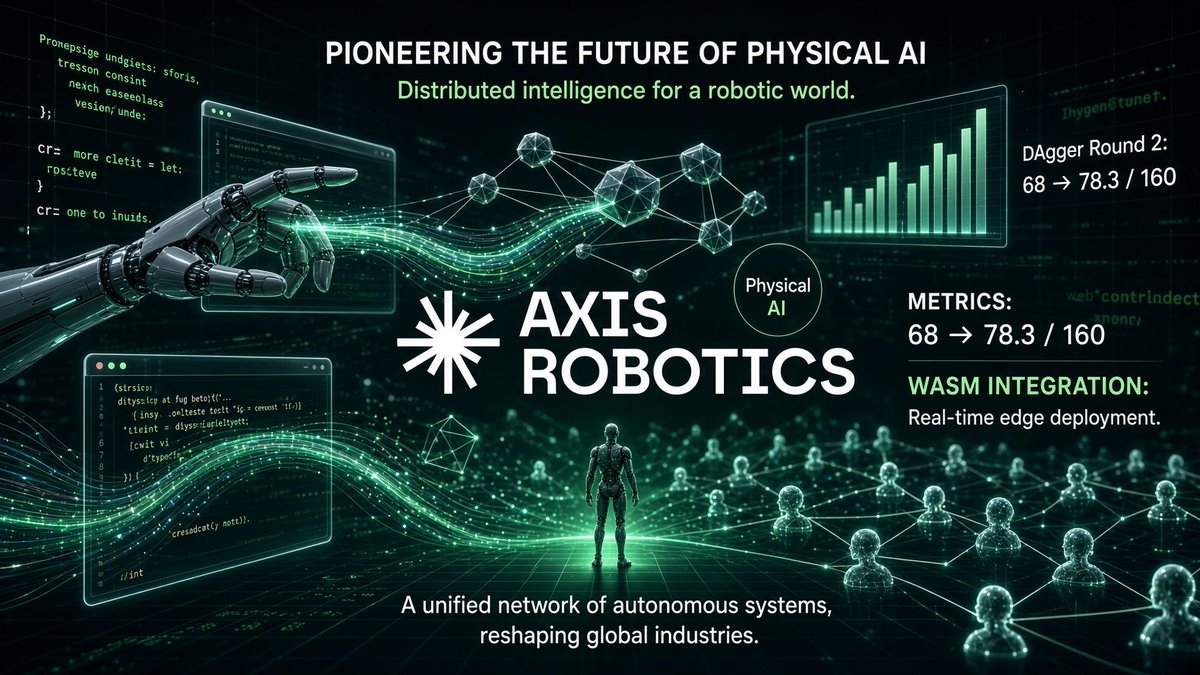
@tagsincos argued (24 likes, 26 replies, 161 views) that open-sourcing the dataset, training code, and benchmarks is only rational if the real moat is the generator network rather than the frozen dataset. @kengdaica extended (19 likes, 17 replies, 146 views) that logic by saying the real quality bar is interoperability: experience collected in one stack has to remain useful when moved into DreamZero, LIBERO Pro, Isaac Sim, and later hardware. The public AXIS paper makes that framing concrete by describing browser-based MuJoCo-WASM teleoperation, 207 tasks, 50K+ trajectories, and controlled scaling snapshots that improved LIBERO-Plus success from 84.7% to 88.8% as the dataset grew.
Discussion insight: The repeated loop was “policy fails -> human corrects -> next policy improves,” but the new part was where the authors put their attention. They cared less about raw download numbers than about provenance, runtime parity, and whether the same data survives contact with other toolchains.
Comparison to prior day: On 2026-09-04, physical-AI discussion emphasized bigger datasets and stronger benchmarks. On 2026-09-05, it drilled further into how crowd data actually gets collected, verified, ported, and reused.
1.4 Builders kept shipping the operating layer around models: reproducibility, performance, research workflow, and economic trust (🡕)
Another strong theme was that the model itself is increasingly treated as a component inside a larger operating layer. Seven items supported that view. The concrete builder energy went into public repos, runtime wrappers, verification surfaces, and trust rails, not just into saying one model is smarter than another.
@gpusteve shared (67 likes, 8 replies, 2,308 views, 70 bookmarks) Wafer’s AI Performance Engineering repo and said the team would now walk through the material resource by resource. The public README confirms that the repo is a structured curriculum spanning GPU fundamentals, kernel optimization, inference engines, distributed inference, and current hardware, which made it less of a hype post than a genuine tooling and learning signal.
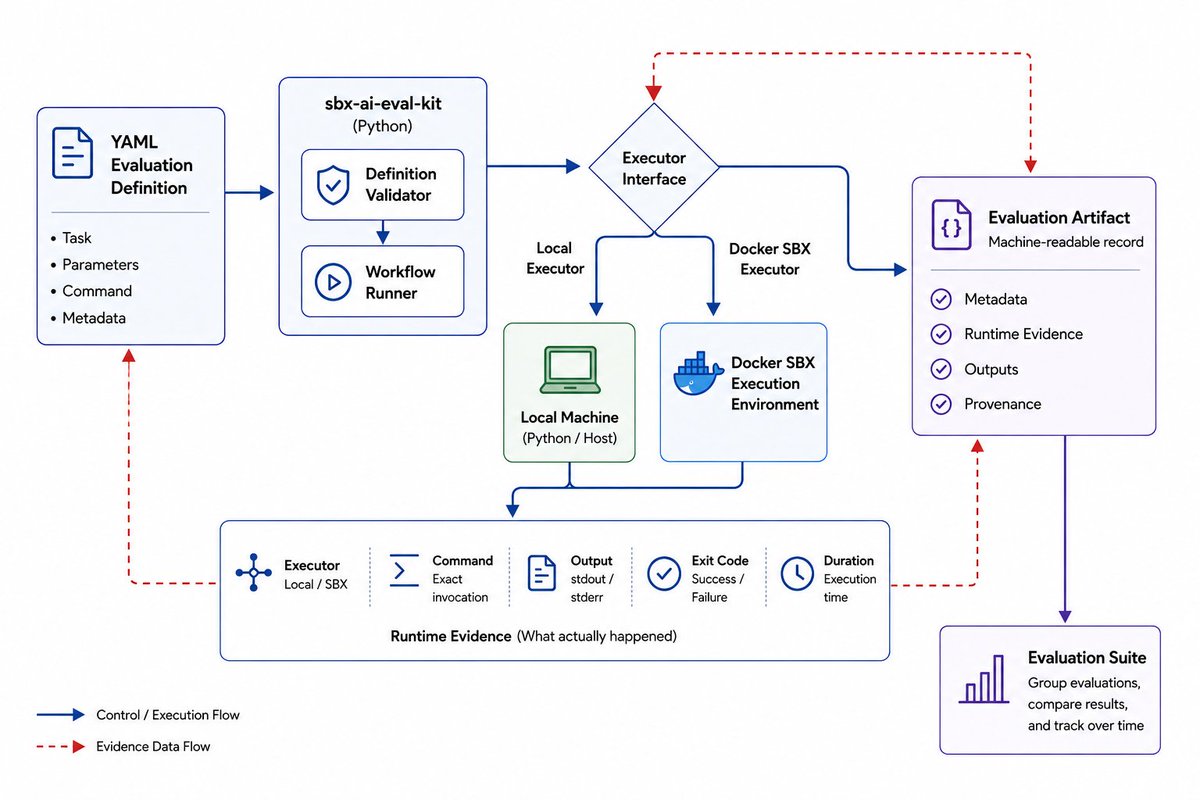
@Docker highlighted (12 likes, 1 reply, 3,191 views, 2 bookmarks) a different slice of the same problem: even a good evaluation definition is hard to trust if nobody can rerun it in the same environment. Docker’s public SBX workflow write-up describes YAML-defined evaluations, isolated sandbox execution, and structured runtime evidence so teams can compare what actually ran instead of only what they intended to run.
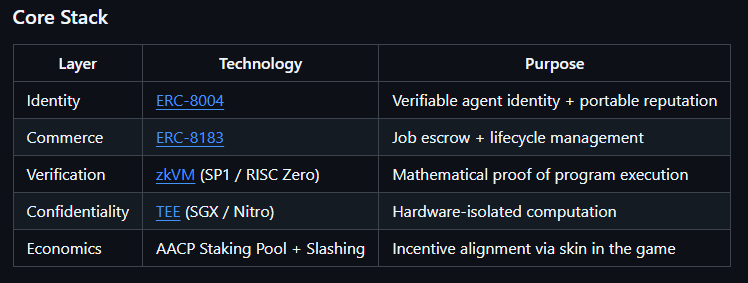
@Etheliaeth argued (36 likes, 31 replies, 306 views) that the scarce asset in agent commerce may not be payments but transaction history. The attached table made the point unusually concrete by listing the stack he thinks matters: ERC-8004 identity, ERC-8183 job escrow, zkVM or RISC Zero verification, TEE confidentiality, and staking/slashing economics around AACP.
@nokaramo outlined (42 likes, 35 replies, 418 views) the full agent-to-agent job flow he wants to see: posting, discovery, bids, escrow, delivery, evaluation, settlement, and reputation. @Loreen2074591 pushed (27 likes, 17 replies, 301 views) the same idea one step further by saying quote flow may become more useful than model benchmarks because it reveals real prices for research, code review, cleanup, and other digital labor after verification.
@DanKornas shared (1 like, 3 replies, 520 views) OpenSwarm, an open-source orchestrator that wires Linear or local task intake into Worker/Reviewer pipelines, pluggable notifications, and per-repo memory. He separately shared (3 likes, 1 reply, 488 views, 1 bookmark) Polaris, a research-lab web app that carries work from literature survey to paper review through a persisted, human-gated “Voyage” runtime. In both cases the interesting thing was not the base model; it was the workflow wrapper that makes the model operable.
Discussion insight: The common builder instinct was to make state explicit. Whether the state was a runtime artifact, a repo memory, a transaction history, or a human-gated research workflow, the product boundary kept moving outward from the model and toward the system around it.
Comparison to prior day: On 2026-09-04, builder energy focused on control planes and self-repair loops. On 2026-09-05, that widened into public performance-engineering repos, reproducible evaluation stacks, research-workflow systems, and trust infrastructure for agent marketplaces.
2. What Frustrates People
Benchmark wins that are hard to trust, rerun, or map to real work
Severity: High. @ArtificialAnlys had to redesign (1,170 likes, 116 replies, 263,626 views, 207 bookmarks) its index around held-out tests, saturated benchmarks, and grading fixes, while @cHHillee immediately warned (177 likes, 10 replies, 13,133 views, 17 bookmarks) that benchmarks themselves can optimize for leaderboard attention. @VictorTaelin showed (471 likes, 42 replies, 27,659 views, 129 bookmarks) the practical symptom: a benchmark could call a task solved even when the model arrived at a bloated, inferior fix. Docker’s public SBX workflow write-up adds the operational pain point from another angle: even a well-designed evaluation is hard to compare if the execution environment drifts. People are coping by favoring held-out tests, workflow-specific benchmarks, and reproducible runtime artifacts. This is directly worth building for.
Physical-AI data loops that lose fidelity across browsers, simulators, and downstream stacks
Severity: High. @Phuc50103413 made the browser-runtime problem explicit (62 likes, 75 replies, 114 views) when he pointed to policies that still lose performance when moving from Python to browser-based WASM, even as DAgger Round 2 improves paired evaluation. @LisaFlorentina8 framed (8 likes, 9 replies, 327 views) the broader issue as one of collection scope, provenance, and methodology, while @kengdaica argued (19 likes, 17 replies, 146 views) that data becomes much less valuable if it only works inside the stack that collected it. The public AXIS paper reinforces that this is not cosmetic: the platform is explicitly trying to make browser-based teleoperation, augmentation, and benchmark reuse part of a growable data engine. This is directly worth building for.
Agent marketplaces that still do not prove who to trust, what work is worth, or how settlement should happen
Severity: High. @Etheliaeth argued (36 likes, 31 replies, 306 views) that the missing asset is credible transaction history, not just wallets, and @nokaramo laid out (42 likes, 35 replies, 418 views) the full list of missing infrastructure: discovery, bids, escrow, verification, settlement, and reputation. @Loreen2074591 added (27 likes, 17 replies, 301 views) that quote flow may be more useful than model benchmarks because accepted prices after verification reveal what research, code review, or cleanup actually costs. The coping strategy today is still mostly conceptual architecture, not proven market behavior. This is directly worth building for.
Useful local AI still comes with uncomfortable speed-versus-context tradeoffs
Severity: Medium. @DogukanUrker documented (28 likes, 2 replies, 1,118 views, 22 bookmarks) a two-build compromise for Qwen3.8-27B on a single RTX 3060: one setup for 158K context at 22 tok/s and another for 82K context at 38 tok/s. His thread also noted that higher reasoning settings on 2-bit quantization can spiral instead of terminating, which is a real usability failure, not just a benchmark quirk. People are coping by maintaining multiple tuned builds for different workloads, but the frustration is clear: even when open models are viable locally, context length, decode speed, and stability still trade off against one another. This is worth building for.
3. What People Wish Existed
Evaluations that stay meaningful after models and benchmark authors both adapt
What people wanted was not another scoreboard refresh. They wanted a benchmark regime that remains informative after frontier labs start training toward it and after benchmark operators start redesigning around that pressure. @ArtificialAnlys moved in that direction with held-out tests and more workflow-heavy tasks, @cHHillee argued that even that move has to be watched, and Docker’s public SBX workflow write-up made reproducible execution part of the same answer. This is a practical need with immediate demand. Opportunity: direct.
Robot-data systems that can collect broadly, preserve provenance, and survive movement across stacks
The physical-AI threads were effectively asking for a data engine, not just another dataset dump. @LisaFlorentina8 wanted broader collection plus provenance, @Phuc50103413 wanted browser parity with research runtimes, and @kengdaica wanted experience that still works after moving into different simulators and policy stacks. The public AXIS paper shows part of that system, but the wish on the timeline was for a more complete operating layer. This is practical and urgent for builders. Opportunity: direct.
Agent marketplaces with escrow, verification ladders, quote history, and reusable trust
The community interest around TermiX was really a request for market infrastructure. @nokaramo wanted discovery, bids, escrow, delivery, and settlement. @Etheliaeth wanted transaction history that becomes credible economic memory, and @Loreen2074591 wanted a quote stream that reveals what verified digital labor actually costs. This is practical but still speculative because the desired network effects have not yet been demonstrated. Opportunity: competitive.
Better low-cost infrastructure for running serious models locally or under open control
The local-AI and infrastructure posts were asking for a stack that makes open or self-served models easy to compare, cheap to run, and stable across workload types. @DogukanUrker showed how much manual tuning it still takes to balance context against throughput on a single RTX 3060, while the public Wafer AI Performance Engineering README exists precisely because people still need a structured path through inference mechanics, kernels, scheduling, and distributed serving. This is a practical need with builder demand, but the space is getting crowded. Opportunity: competitive.
Sovereign domain-specific AI that keeps local data, language, and decision authority intact
The LingoAI discussion pointed to a different unmet need from the coding-and-benchmark threads: AI systems for public-sector and healthcare settings that are not forced to trade capability for data dependence. @LingoAITech tied hypertension care, local language datasets, and “AI detects and recommends; an authorized professional decides” into one architecture, while LingoAI’s public Jokkolabs Banjul partnership post describes the same direction in terms of Mandinka, Wolof, and Fula datasets plus private deployments. This is practical in certain domains and geographies, but more aspirational than the benchmark and infrastructure needs above. Opportunity: aspirational.
4. Tools and Methods in Use
| Tool | Category | Sentiment | Strengths | Limitations |
|---|---|---|---|---|
| GPT-6 Astra | Frontier model | (+/-) | Leads Code Arena: WebDev, tops APEX-Accounting Pass@1, and shows strong token efficiency in Artificial Analysis v4.2 | Users still questioned benchmark trust, and Victor Taelin’s case study said it missed the problem framing that led to the best fix |
| Claude Fable 5.1 | Frontier model | (+/-) | Leads Artificial Analysis overall and AA-Briefcase, and still appears competitive on prompt-sensitive creative tasks | Lost some workflow-specific matchups to Astra and also failed Taelin’s overnight bug-fix framing test |
| Qwen3.8-27B GSQ-RCO IQ2_XS | Local open model | (+) | Runs on a single RTX 3060 with either 158K context or faster 82K decode, giving builders a viable local path | Users still have to choose between context and speed, and higher reasoning settings on 2-bit quants can spiral |
| LLM-as-a-Verifier | Verification framework | (+) | Lets the same open model generate and score candidate trajectories, with strong results on Terminal-Bench V2, SWE-Bench Verified, RoboRewardBench, and MedAgentBench | Requires multiple candidate runs and extra verification budget to unlock the gains |
| Docker Sandboxes / SBX AI Evaluation Kit | Evaluation infrastructure | (+) | Isolates dependencies, separates evaluation definition from execution, and records runtime evidence for reruns | Adds workflow and environment setup overhead that teams have to maintain |
| AXIS browser teleoperation + dataset pipeline | Robotics data engine | (+/-) | Expands robot-data collection through browser control, provenance, task generation, and growable snapshots | Browser/WASM parity and cross-stack portability still look like open technical risks |
| Wafer AI Performance Engineering repo | Engineering resource | (+) | Gives practitioners a structured path from GPU fundamentals to serving, distributed inference, and current hardware | It is a reference and curriculum, not an out-of-the-box serving system |
| OpenSwarm | Agent orchestrator | (+) | Connects Linear or local tasks to Worker/Reviewer pipelines, multiple providers, notifications, and repo memory | Early open-source orchestration still demands provider auth, Node tooling, and operational setup |
| Polaris | Research workflow system | (+) | Wraps literature, ideas, experiments, writing, and review into one persisted, human-gated pipeline | Better suited to labs willing to adopt a full workflow system than to lightweight solo use |
| AACP / TermiX primitives | Agent-commerce stack | (+/-) | Identity, escrow, verification, settlement, and quote history give the marketplace a more explicit trust model | The core question—whether transaction history becomes reusable trust outside one marketplace—remains unproven |
| Holon Agent System | Domain AI architecture | (+/-) | Unifies biometrics, records, and lifestyle context around privacy, local data ownership, and human-in-the-loop clinical decisions | Evidence today is mostly architectural and partnership-stage, not large-scale public deployment |
The tool picture was much less “one best model” than “one best operating layer for each job.” @ArtificialAnlys showed (1,170 likes, 116 replies, 263,626 views, 207 bookmarks) that Astra is unusually token-efficient near the frontier, while @DogukanUrker showed (28 likes, 2 replies, 1,118 views, 22 bookmarks) that serious open-model use still depends on very manual configuration tradeoffs. The practical split was between people buying capability through frontier APIs and people trying to control economics, context length, or reproducibility themselves.
The workarounds were concrete. Docker’s public SBX post centered execution isolation and runtime evidence; the public Wafer repo organized performance learning from single-request inference to distributed systems; OpenSwarm and Polaris both treated orchestration, memory, and review as product surfaces. The migration pattern under all of this was that model choice still matters, but more of the durable differentiation seems to be moving into the harness around the model.
5. What People Are Building
| Project | Who built it | What it does | Problem it solves | Stack | Stage | Links |
|---|---|---|---|---|---|---|
| AXIS data engine / Axis Hub | Axis Robotics | Browser-based robot teleoperation, task generation, trajectory processing, and growable manipulation datasets | Physical-AI teams need more diverse, reusable robot data than closed lab collection can provide | Browser MuJoCo-WASM teleop, trajectory filtering, IsaacSim augmentation, versioned dataset snapshots | Beta | AXIS paper, LisaFlorentina8 tweet, Phuc50103413 tweet |
| AI Performance Engineering repo | Wafer | Public curriculum and reference set for GPU performance engineering and production inference | Teams need to understand throughput, latency, kernels, KV caches, and distributed inference before they can run model systems efficiently | GitHub resource list spanning CUDA, kernels, inference engines, serving benchmarks, and hardware docs | Shipped | repo, tweet |
| OpenSwarm | Intrect | Autonomous code-worker orchestrator with Worker/Reviewer pipelines | Developers do not want to wire multi-agent task routing, review, memory, and notifications by hand | Node CLI, Codex/GPT, OpenRouter, Ollama/LM Studio, Claude Code, LanceDB | Beta | repo, tweet |
| Polaris | ZJU REAL Lab | End-to-end AI research web app from literature survey to reviewed paper | Research labs lose time stitching together literature, idea review, experiments, writing, and verification across separate tools | Research Wiki, GPU/SSH experiment runner, LaTeX writer, citation checks, persisted Voyage runtime | Beta | repo, tweet |
| LLM-as-a-Verifier | Stanford / Berkeley / NVIDIA researchers | Same-model trajectory ranking and verification framework for agent tasks | Open models need a cheaper verification loop than “just use a stronger closed model” | Best-of-N candidate generation, continuous verification scoring, probabilistic tournament selection, RL rewards | Alpha | project, paper, tweet |
| TermiX / AACP commerce layer | @termix_ai | Agent-to-agent job discovery, escrow, verification, settlement, and reputation framework | Capable agents still need infrastructure for trust, pricing, and economic coordination | Agent identity, bids, escrow, verification ladder, settlement, reputation, quote history | Beta | nokaramo tweet, Etheliaeth tweet, Loreen2074591 tweet |
| Holon Agent System for Gambian healthcare | LingoAI | Sovereign health-data architecture that combines biometrics, records, and lifestyle context with localized language models | Resource-constrained healthcare deployments need privacy, local control, and explicit human decision authority | Holon personal ontology, wearables/BP monitors, local-language datasets, private/fine-tuned models | RFC | partnership post, tweet |
The repeated build pattern was that teams were productizing the layer around capability rather than capability alone. AXIS treated data collection, provenance, and task coverage as the product; OpenSwarm treated routing, review, and memory as the product; Polaris treated persisted workflow and human gates as the product; and TermiX treated trust, settlement, and market discovery as the product.
The other notable pattern was that multiple builders were explicitly trying to make evaluation part of the artifact. LLM-as-a-Verifier turned self-verification into a reusable method, while AXIS and Polaris both tied progress to structured checkpoints and public criteria. Compared with prior days, the builds looked less like demos and more like attempts to turn AI work into auditable systems.
6. New and Notable
Open-source self-verification as a serious alternative to “use a stronger model”
@jiqizhixin surfaced (7 likes, 541 views, 8 bookmarks) Stanford’s LLM-as-a-Verifier result, where DeepSeek V4 Flash generates five candidate trajectories and then ranks them using the same model as verifier. The public project docs make it notable because the method posts state-of-the-art results on Terminal-Bench V2, SWE-Bench Verified, RoboRewardBench, and MedAgentBench without requiring a stronger closed-model judge.

Serious local inference on commodity hardware is getting more concrete
@DogukanUrker shared (28 likes, 2 replies, 1,118 views, 22 bookmarks) a benchmarked Qwen3.8-27B setup for a single RTX 3060, including one 158K-context build and one faster MTP-assisted 82K build. It was notable because the screenshot made the tradeoff explicit instead of hand-wavy: builders can choose between more context and more speed, but they are still making that trade by hand.

Sovereign AI healthcare moved from abstract principle to a named deployment pattern
@LingoAITech argued (416 likes, 27 replies, 152,801 views, 8 bookmarks) that healthcare AI in resource-constrained environments needs data sovereignty, localized language models, and “AI detects and recommends; an authorized professional decides.” LingoAI’s public Jokkolabs Banjul partnership post is notable because it turns that language into a specific plan around Mandinka, Wolof, and Fula datasets, capacity building, and private deployments in The Gambia.
Real accounting work became a public benchmark surface
@mercor put (78 likes, 1 reply, 3,672 views, 12 bookmarks) APEX-Accounting in front of the timeline as a benchmark built around ledgers, PDFs, spreadsheets, and rubric-heavy month-end-close tasks. That was notable because it pushed public AI discussion a little closer to the work buyers actually pay for, and a little further away from generic academic scorecards.
7. Where the Opportunities Are
[+++] Reproducible, hard-to-game evaluation systems — The day’s strongest signals all pointed here: @ArtificialAnlys redesigned its index around held-out tests, @cHHillee warned that benchmarks themselves can drift toward self-optimization, @VictorTaelin showed how a benchmark can miss solution quality, and Docker’s public SBX write-up attacked the rerunnability problem directly. This is the clearest multi-source pain point on the timeline.
[+++] Physical-AI data engines — @LisaFlorentina8, @Phuc50103413, @tagsincos, and @kengdaica all argued from different angles that the bottleneck is structured, portable, verified robot data. The public AXIS paper reinforces that this is already turning into a real build category rather than a vague research theme.
[++] Agent-to-agent trust and price discovery — @Etheliaeth, @nokaramo, and @Loreen2074591 converged on the same need: escrow, verification, reusable history, and quotes that reveal actual market prices for digital labor. The opportunity is real, but the field is still proving whether these trust signals create defensible network effects.
[++] Cost-aware open and local inference tooling — @DogukanUrker showed that serious local deployment still requires manual tradeoffs between context and speed, while the public Wafer repo exists because the surrounding performance problem remains difficult. The opportunity is meaningful, though increasingly competitive.
[+] Sovereign domain AI for healthcare and public services — @LingoAITech and LingoAI’s public Jokkolabs Banjul post point to demand for systems that keep language data, privacy, and decision authority local. It is a smaller signal than the evaluation and robotics threads, but it is distinct and potentially durable in regulated sectors.
8. Takeaways
- Evaluation design became the main story, not just model ranking. Artificial Analysis changed its index around held-out tasks, users challenged whether benchmarks can still be trusted, and reproducibility surfaced as a first-class requirement. (source, source, source)
- Frontier-model progress is real, but people increasingly separate visible output quality from problem-framing quality. Astra’s SVG outputs impressed the timeline, yet Victor Taelin’s overnight debugging story showed that the decisive failure mode can still be “did not question the premise.” (source, source)
- Physical AI is being discussed more like data infrastructure than like robot hardware. The strongest robotics posts focused on browser teleoperation, provenance, runtime parity, and interoperability across training stacks, not on the robot form factor itself. (source, source, source)
- The durable builder energy is moving into the harness around the model. Wafer, OpenSwarm, Polaris, and Docker all pointed to the same direction: performance, orchestration, verification, and workflow state are increasingly where the engineering work lives. (source, source, source)
- Agent commerce remains a trust problem before it becomes a scale story. The most substantive marketplace posts were about escrow, verification, quote history, and reusable transaction reputation, not about token prices or agent counts. (source, source, source)