Twitter AI - 2026-09-06
1. What People Are Talking About
1.1 AI education and onboarding became a product category of their own (🡕)
The clearest new cluster was not another model launch thread. It was a wave of posts arguing that AI still needs better on-ramps: domain-specific practice environments, curated repo maps, and formal training for agent builders. Three strong items supported the theme, and all three were concrete about packaging rather than just saying people should learn more.
@ChrisHayduk launched (212 likes, 17 replies, 8,545 views, 171 bookmarks) BioTorch in public beta and argued that biological AI still lacks the kind of legible learning path that general LLM work already has. The post was unusually specific: 116 PyTorch exercises, 17 model guides, and a goal of making systems like AlphaFold2, ESM2, and RFdiffusion understandable by implementation rather than by passive reading. The linked BioTorch site adds that the product is a practice workspace with raw tensor exercises, isolated code execution, stored progress, and adaptive review scheduling.

@BharukaShraddha shared (63 likes, 2 replies, 2,820 views, 81 bookmarks) a ten-repo starter map for AI engineers that grouped learning by actual work: LLM internals, inference, local models, RAG, agents, and multi-provider APIs. The post did more than list names. It told readers to pick one path and build, and the linked repos such as Hands-On Large Language Models, LLM Course, and GenAI_Agents all expose substantial runnable material rather than brochure copy.

@databricks positioned (37 likes, 5 replies, 2,413 views, 16 bookmarks) “context engineer” as a real job skill, not a loose buzzword. Its linked certification post says the beta exam is dedicated to context engineering specifically and pairs it with training on agent fundamentals, retrieval, and evaluation. That made the education theme broader than self-study: parts of AI Twitter were trying to formalize what competent agent work even means.
Discussion insight: The strongest reply under BioTorch was not generic praise. It immediately expanded into a concrete protein-design workflow using RFdiffusion, ProteinMPNN, ColabFold, and downstream filtering, which suggests the audience rewarded learning tools that connect directly to production or lab practice.
Comparison to prior day: On 2026-09-05, builder energy centered on performance-engineering repos, reproducible evaluation, and research workflow systems. On 2026-09-06, the focus shifted one step earlier in the funnel, toward how people get into specialized AI domains and how agent-building skills get taught.
1.2 Benchmark skepticism stayed high, but people were more interested in better scoring and harness design than in another anti-benchmark rant (🡒)
Benchmark distrust was still everywhere, but the more interesting posts tried to replace bad evaluation habits with better ones. Four items supported the same pattern: lab scorecards were treated as weak evidence on their own, while code quality, harness design, and independent public testing were treated as stronger directions.
@NateSilver538 argued (207 likes, 18 replies, 31,197 views) that lab-published benchmarks are mostly PR and that only real-world behavior across actual use cases matters. The replies complicated that claim rather than simply echoing it: some agreed that self-reported charts are just press releases, while others argued that imperfect proxies are still useful as filters when nobody benchmarks a team's exact workload.
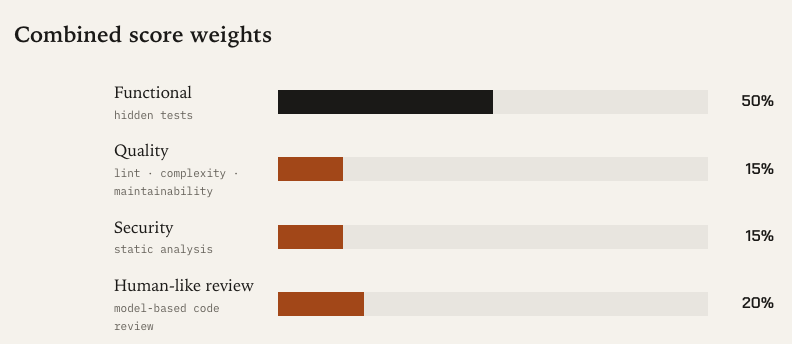
@morganlinton pointed to (58 likes, 4 replies, 4,263 views) a more concrete response in VulcanBench-SWE v4: 20% of the score now comes from code quality because hidden-test wins can still leave teams owning brittle code. The quoted benchmark image made the shift legible by showing a weighting split across functional hidden tests, quality, security, and human-like review rather than task completion alone.
@HuggingPapers highlighted (10 likes, 3 replies, 931 views, 12 bookmarks) StarHarness, a ServiceNow method that keeps model weights fixed and instead evolves the agent scaffold around them. The linked paper summary says the harness can include prompts, tool interfaces, skills, MCP-backed providers, subagents, and loop configuration; the post and image claim 20-35 point gains across enterprise benchmarks while cutting inference cost by up to 53%.

@DavidPawlan said (34 likes, 3 replies, 2,389 views, 15 bookmarks) he was testing 40 AI assistants across 14 benchmarks and would publish all results. That mattered less for the numbers, which were not yet out, than for the appetite it reflected: the timeline was clearly asking for independent comparison work rather than vendor narratives.
Discussion insight: The most useful disagreement was not “benchmarks good” versus “benchmarks bad.” It was whether benchmarks should be narrow proxies, maintenance-aware scorecards, or public side-by-side tests. That is a healthier dispute than simple leaderboard cheering.
Comparison to prior day: On 2026-09-05, the benchmark fight centered on new leaderboard releases and whether they could still be trusted. On 2026-09-06, the conversation moved toward redesigning scoring itself and making the harness, not just the model, part of the evaluation target.
1.3 Agent work kept moving up the stack into control planes, durable workflow surfaces, and self-verification loops (🡕)
Another strong theme was that AI Twitter kept treating the model as one layer inside a bigger operating system. Three posts converged on the same idea from different angles: state should persist, workflows should stay inspectable, and agents should be able to verify their own work against references instead of only emitting outputs.
@MengTo showed (170 likes, 10 replies, 9,727 views, 152 bookmarks) Astra generating detailed three.js interfaces and product-style 3D scenes from prompts alone. The replies are what made the post analytically useful: multiple people said the compare loop was the real breakthrough, and MengTo replied that the agent could keep checking itself against a reference and even drop expensive effects for weaker browsers. The point was less “look at this pretty UI” than “verification loops are becoming part of the prompt interface.”
@github framed (24 likes, 4 replies, 6,985 views) canvases as a durable surface for tracking what ran, what changed, and what still needs review. The linked GitHub blog post is more explicit than the tweet: it argues that chat is good for intent but weak for durable execution, and it describes explicit workflow states, persisted drafts, and human approval points as the pattern that makes agent work governable.
@DanKornas shared (11 likes, 6 replies, 781 views) MATE, an open-source control layer for agents built on Google ADK or LangGraph. The linked repo confirms the operational pitch in the tweet: live configuration, versioned agent definitions stored in a database, per-agent RBAC, token analytics, MCP compatibility, and regression evaluation without forcing another redeploy.

Discussion insight: Replies under both GitHub's canvases post and MATE pushed the same nuance: durable surfaces are only fully useful when every state change points back to the run or artifact that produced it. Visibility alone is not enough; provenance is the missing multiplier.
Comparison to prior day: On 2026-09-05, builders were shipping reproducibility layers, research workflow wrappers, and trust rails. On 2026-09-06, the same instinct showed up as more explicit workflow state, more live control over agents, and more emphasis on self-checking loops.
1.4 Reality checks came from bad software and from physical AI's data hunger (🡒)
The loudest capabilities talk was repeatedly pulled back to earth by two stubborn constraints: legacy software that is still broken in ordinary customer flows, and physical AI systems that still do not have enough compounding data. Those are very different domains, but the mood was the same: model progress does not remove systems work.
@GergelyOrosz wrote (198 likes, 17 replies, 17,736 views) that AI doomerism feels less convincing when a basic 2026 mobile-subscription flow still requires long phone calls because the backend cannot handle common cases. His own follow-up made the key point sharper: AI might help teams fix software faster, but it does not somehow diagnose and repair the institutional mess by itself.
@BarabiloT argued (34 likes, 33 replies, 223 views) that physical AI's real bottleneck is data, not models or hardware. The image did most of the explanatory work by contrasting fragmented robotics datasets and brittle demos with an “Axis” loop of generated worlds, human behavior collection, refinement, and failure-driven retraining.

Discussion insight: Gergely's replies immediately turned into product requests for better support tooling, while BarabiloT's replies kept repeating the same thesis in different words: every failure should become a better data-collection target. Both threads were less about abstract intelligence than about feedback loops around messy systems.
Comparison to prior day: On 2026-09-05, physical-AI discussion focused on provenance, portability, and browser runtimes. On 2026-09-06, the framing simplified into a sharper product claim: general-purpose robotics still needs a better data engine, just as mainstream software still needs people to untangle broken workflows.
2. What Frustrates People
Benchmarks that say a model won but do not say whether the work was trustworthy
Severity: High. @NateSilver538 argued (207 likes, 18 replies, 31,197 views) that lab benchmarks are mostly PR, while @morganlinton pointed to (58 likes, 4 replies, 4,263 views) the practical failure mode: a model can ace hidden tests and still leave a team with maintainability debt. @HuggingPapers added (10 likes, 3 replies, 931 views, 12 bookmarks) a different engineering complaint by showing that changing the harness around a fixed model can move enterprise scores by 20-35 points, implying that many benchmark results are partly measuring environment fit rather than raw model quality. People are coping by asking for code-quality scoring, harness-aware evaluation, and independent public comparisons such as @DavidPawlan planning (34 likes, 3 replies, 2,389 views, 15 bookmarks) a 40-assistant test set. This is directly worth building for.
Agent workflows that disappear into chat logs or require another redeploy for every tweak
Severity: High. @github said (24 likes, 4 replies, 6,985 views) canvases are needed because chat alone buries what ran, what changed, and what needs review. @DanKornas described (11 likes, 6 replies, 781 views) the same pain from the builder side: prompt, model, access-rule, and hierarchy changes still too often mean code edits and redeploys. The replies under both threads added the harder version of the complaint: even when a dashboard exists, teams still need provenance linking every state change back to the run or artifact that produced it. This is directly worth building for.
Software that is still structurally broken no matter how much AI optimism sits on top of it
Severity: High. @GergelyOrosz used (198 likes, 17 replies, 17,736 views) a mundane mobile-subscription flow to make the point that bad software quality remains a customer problem even in 2026. The most revealing reply was not philosophical; it was a direct product request for “the mobile-first intercom for mobile subscription businesses.” In parallel, @IntCyberDigest amplified (57 likes, 7 replies, 4,207 views, 14 bookmarks) Bjarne Stroustrup's criticism that AI-generated code becomes bloated, bug-prone, and hard to validate, with replies emphasizing reviewer scarcity as the bottleneck. People are not rejecting AI help here. They are pointing out that someone still has to understand, verify, and repair the system. This is directly worth building for.
Physical AI still lacking enough compounding data to escape brittle demos
Severity: Medium. @BarabiloT said (34 likes, 33 replies, 223 views) the limiting factor is robotics data, not model count or hardware headlines. His image and the replies all converged on the same coping strategy: generate more worlds, collect more human traces, and turn every policy failure into a targeted next batch of data. The frustration is that this is still infrastructure work rather than a solved input stream like web-scale text. This is worth building for, but the evidence today pointed more to an emerging infrastructure need than to an immediate commodity market.
3. What People Wish Existed
Better ways into specialized AI fields and agent engineering
What people wanted was not more generic motivation. They wanted a path into difficult subfields that already names the tools, the exercises, and the review loop. @ChrisHayduk asked for (212 likes, 17 replies, 8,545 views, 171 bookmarks) a clearer path into biological AI and built BioTorch around exactly that problem, while @BharukaShraddha grouped (63 likes, 2 replies, 2,820 views, 81 bookmarks) AI-learning repos by outcome such as RAG, local inference, multi-provider APIs, and agent workflows. @databricks took (37 likes, 5 replies, 2,413 views, 16 bookmarks) the same desire into enterprise language by turning context engineering into a certifiable skill. Opportunity: direct.
Independent evaluation that reflects how teams actually use assistants
The strongest unmet need was for evaluation readers can trust without taking a vendor's word for it. @NateSilver538 rejected (207 likes, 18 replies, 31,197 views) lab benchmarks as PR, @morganlinton pushed (58 likes, 4 replies, 4,263 views) for scoring that includes code quality, and @DavidPawlan explicitly promised (34 likes, 3 replies, 2,389 views, 15 bookmarks) public testing across 40 assistants and 14 benchmarks. What people seem to want is neither zero benchmarking nor endless charts, but public comparison work tied to real workflows, maintainability, and environment fit. Opportunity: direct.
Agent control planes with provenance, approvals, and durable state
Multiple posts circled the same need from different levels of maturity. @github argued (24 likes, 4 replies, 6,985 views) for canvases because agent work needs a durable shared surface, and @DanKornas argued (11 likes, 6 replies, 781 views) that prompt and access changes should not require redeploys. The replies under both posts show the remaining gap: readers want explicit approval points and a clean trail from every change to the run that caused it. This is a practical need rather than an aspirational one, but it is already becoming competitive. Opportunity: competitive.
Service software that resolves messy real-world flows instead of only generating better output
The request hidden inside @GergelyOrosz complaint (198 likes, 17 replies, 17,736 views) was straightforward: please fix the systems that make ordinary customer tasks miserable. One reply literally asked for a better support product for mobile-subscription businesses. Unlike the agent-control need, this is not a new AI-native category, but AI-assisted repair, diagnosis, and workflow cleanup could still be a strong wedge if tied to specific high-friction industries. Opportunity: direct.
4. Tools and Methods in Use
| Tool | Category | Sentiment | Strengths | Limitations |
|---|---|---|---|---|
| GPT-6 Astra | LLM | (+/-) | Strongly perceived on visual/browser generation; can drive compare-and-verify loops for iterative UI work | Raw benchmark wins were repeatedly treated as insufficient proof of real-world quality |
| StarHarness | Agent harness method | (+) | Improved enterprise benchmark scores by 20-35 points and cut inference cost by up to 53% without changing model weights | Requires environment-specific harness evolution work rather than a simple model swap |
| VulcanBench-SWE v4 | SWE evaluation system | (+) | Adds code quality, security, and human-like review to benchmark scoring | Still a benchmark, so it only helps if teams trust its weighting and judges |
| GitHub Canvases | Workflow surface | (+) | Makes workflow state, decisions, and approval points durable instead of burying them in chat | The linked blog says good canvases require up-front design effort and token spend |
| MATE | Agent control plane | (+/-) | Live configuration, per-agent RBAC, token analytics, MCP compatibility, and regression evals without redeploy | Replies flagged provenance and worker-state synchronization as unresolved operational risks |
| BioTorch | Learning platform | (+) | Turns bio-AI concepts into raw PyTorch exercises with isolated execution, progress tracking, and adaptive review | Focused on building blocks and practice rather than full end-to-end model reproduction |
| RFdiffusion -> ProteinMPNN -> ColabFold | Bio-AI workflow | (+) | Concrete path from backbone generation to sequence design and structure validation | Still depends on custom filtering, QC scripts, and strong human judgment downstream |
| Hands-On LLM / LLM Course / GenAI_Agents | Learning resources | (+) | Give builders runnable paths into LLM internals, deployment, RAG, tool use, and multi-agent workflows | The advice attached to them was to choose narrowly and build, implying resource overload is still a risk |
| vLLM / llama.cpp / LiteLLM | Inference and portability layer | (+) | Recurred as the stack for scalable serving, local inference, and multi-provider abstraction | Mentioned as important building blocks, but not as complete workflow solutions on their own |
Overall, the satisfaction spectrum was strongest around scaffolding and workflow infrastructure, not around pure model branding. The common workaround pattern was to add structure around the model: compare loops, durable canvases, harness tuning, explicit evaluation, or a richer control plane. The nearest thing to a migration trend was methodological rather than vendor-specific: people were moving from chat-only usage and raw benchmark screenshots toward persistent workflow state, code-quality-aware scoring, and stack-specific learning paths.
5. What People Are Building
| Project | Who built it | What it does | Problem it solves | Stack | Stage | Links |
|---|---|---|---|---|---|---|
| BioTorch | Chris Hayduk | Practice workspace for biological AI that teaches model components by implementation | Bio AI lacks a legible path from curiosity to contribution | PyTorch, isolated code runner, adaptive reviews, progress history | Beta | post · site |
| MATE | Dan Kornas | Control layer and dashboard for production AI agents | Prompt/model/access changes and evals should not require code edits and redeploys | Python, Google ADK, LangGraph, LiteLLM, MCP, RBAC, evals | Shipped | post · repo |
| GitHub Canvases | GitHub | Durable shared workflow surfaces for agent tasks | Chat-only agent work hides plans, state, approvals, and review points | GitHub Copilot app canvases, workflow states, persisted drafts, approval gates | Shipped | post · blog |
| VulcanBench-SWE v4 | VulcanBench | SWE benchmark that scores more than task completion | Hidden-test wins alone miss maintainability and security quality | Hidden tests, code-quality scoring, static security checks, human-like review | Shipped | quote · source post |
| StarHarness | HuggingPapers | Method for evolving the harness around a fixed model in enterprise environments | Model-environment mismatch in tool-rich agent tasks | Prompt and task framing, tool interfaces, skills, MCP providers, subagents, loop configuration | RFC | post · paper |
BioTorch was the cleanest example of today's education-to-builder pipeline. The product is narrow on purpose: instead of promising full bio-AI automation, it breaks the space into inspectable tensor operations, code exercises, and model guides, then ties them to review and practice history. The replies made the adjacent workflow explicit by naming RFdiffusion, ProteinMPNN, ColabFold, and custom QC as the sequence-design stack people actually expect to learn next.
MATE and GitHub Canvases show the same build pattern from different directions. Both assume the model is already there and that the unsolved work is operational: versioning changes, surfacing workflow state, assigning permissions, preserving review points, and keeping context durable across long-running tasks. That repeated pattern matters because it appeared independently in both open-source and platform-native form.
VulcanBench-SWE v4 and StarHarness extend that same “build around the model” instinct into evaluation. One changes what the score means by pricing in code quality and human-like review; the other changes the surrounding harness to reduce model-environment mismatch without changing weights. The repeated trigger is clear across the day: people are building the operating layer, not just celebrating the model layer.
6. New and Notable
Context engineering got treated like a named profession
@databricks used (37 likes, 5 replies, 2,413 views, 16 bookmarks) the phrase “context engineer” in a way that went beyond marketing copy. Its linked certification post says the exam is specifically about curating memory, retrieval, and tool parameters for production-grade agents, making this one of the clearest signs that parts of the market now see context handling as a formal skill rather than a vague prompting habit.
Independent assistant testing turned from complaint into a public work plan
@DavidPawlan said (34 likes, 3 replies, 2,389 views, 15 bookmarks) he was already testing 40 assistants across 14 benchmarks and would publish all results. That matters because it answers one of the day's main complaints directly: if readers do not trust lab scorecards, then the obvious substitute is a public comparison project built outside the labs.
The validation bottleneck got framed as a human-capital problem
@IntCyberDigest amplified (57 likes, 7 replies, 4,207 views, 14 bookmarks) Bjarne Stroustrup's claim that AI-generated code becomes hard to validate and that senior reviewers are tired of prompt-dependent output drift. Whether or not readers agreed with the whole critique, the replies kept returning to the same high-signal point: code generation is only as useful as the review capacity behind it.
7. Where the Opportunities Are
[+++] Maintenance-aware evaluation and independent assistant testing — Evidence came from @NateSilver538 rejecting (207 likes, 18 replies, 31,197 views) lab PR scorecards, @morganlinton pushing (58 likes, 4 replies, 4,263 views) code-quality-aware scoring, @HuggingPapers highlighting (10 likes, 3 replies, 931 views, 12 bookmarks) harness evolution, and @DavidPawlan planning (34 likes, 3 replies, 2,389 views, 15 bookmarks) public tests. The strongest opportunity is not “more benchmarks,” but scoring that captures maintainability, harness fit, and public side-by-side behavior.
[++] Agent control planes with provenance and durable review surfaces — @github showed (24 likes, 4 replies, 6,985 views) demand for durable workflow state, and @DanKornas showed (11 likes, 6 replies, 781 views) demand for live, no-redeploy control. The reply-level nuance makes the opportunity stronger: visibility without provenance still leaves teams doing archaeology.
[++] Specialized AI training products that connect theory to runnable workflows — @ChrisHayduk built (212 likes, 17 replies, 8,545 views, 171 bookmarks) a bio-AI practice surface, @BharukaShraddha mapped (63 likes, 2 replies, 2,820 views, 81 bookmarks) the repo stack newcomers should use, and @databricks formalized (37 likes, 5 replies, 2,413 views, 16 bookmarks) context engineering as a credential. People want guided practice in bio AI, context engineering, RAG, inference, and agent orchestration, not just broad “learn AI” messaging.
[+] Physical-AI data engines and failure-driven collection loops — @BarabiloT argued (34 likes, 33 replies, 223 views) and related Axis posts argued that the moat is turning policy failures into better next-round data. The evidence today was thinner than the software-agent discussion, but the need was specific and persistent.
[+] AI-assisted repair for mundane but costly enterprise workflows — @GergelyOrosz showed (198 likes, 17 replies, 17,736 views) that ordinary support and carrier flows remain broken enough to create direct buyer pain. The opportunity is narrower than a general coding assistant, but the demand signal was unusually concrete.
8. Takeaways
- Education was one of the day's strongest product surfaces. BioTorch's beta launch, the ten-repo AI-engineer map, and Databricks' context-engineering certification all show that builders want guided paths into specialized AI work, not just broader awareness. (source)
- The benchmark argument is getting more operational. The strongest posts were no longer just mocking scoreboards; they were asking for code-quality weighting, harness-aware evaluation, and independent public comparisons. (source)
- The operating layer around agents kept getting thicker. Compare loops, canvases, and control planes all point to the same shift: the valuable work is increasingly in workflow state, approvals, provenance, and self-checking, not just text generation. (source)
- Reality checks still came from ordinary software and robotics data, not from model demos. Gergely Orosz's carrier-support example and the Axis data-engine thread both argued that messy systems work remains the bottleneck. (source)
- Validation capacity remains a core constraint on AI coding adoption. The Stroustrup thread and the VulcanBench scoring change both converged on the same point: if teams cannot trust or review the output efficiently, model gains do not translate cleanly into production value. (source)