Twitter AI - 2026-09-07
1. What People Are Talking About
1.1 AI work got packaged as curriculum, reusable skills, and workflow operating systems (🡕)
The clearest cluster on 2026-09-07 was not a single model drop. It was a wave of posts trying to make agent work teachable and repeatable. @JayAlammar released (172 likes, 25 retweets, 9 replies, 5,603 views, 148 bookmarks) An Illustrated Guide to AI Agents and said he and Maarten Grootendorst spent eighteen months making memory, tools, planning, evaluation, multi-agent systems, and code agents legible. @AiwithDharmik amplified (24 likes, 11 retweets, 7 replies, 578 views, 7 bookmarks) Anthropic Academy's free 18-course catalog, and the public Claude 101 page confirms a curriculum that now spans projects, skills, tool connections, enterprise search, research, and role-based use cases. @Mohiniuni added (33 likes, 2 retweets, 1 reply, 491 views, 9 bookmarks) a practitioner version of the same idea by naming concrete repos such as Continue and Cline, then telling newcomers not to hoard tools but to “pick one, build something, break it, fix it.”
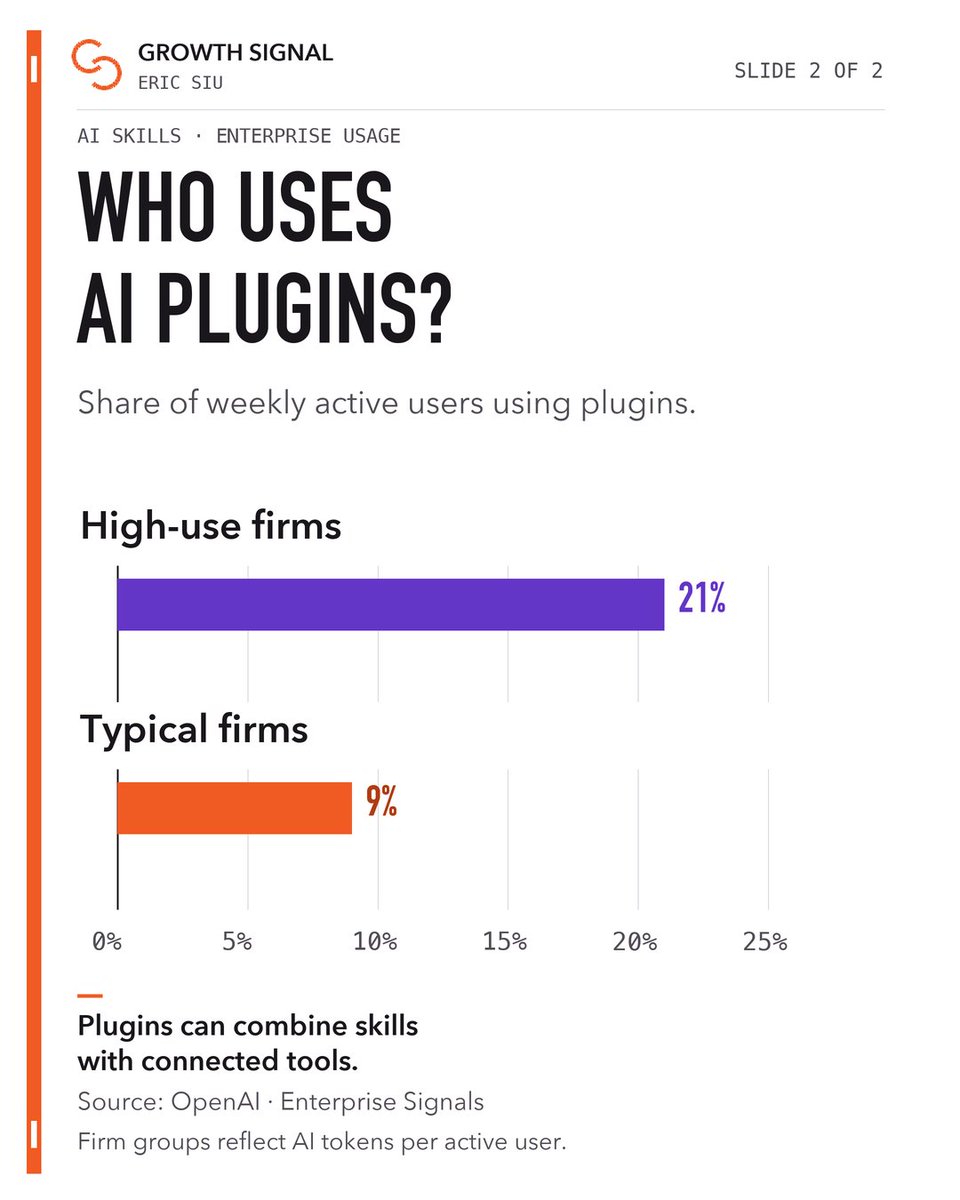
The stronger shift was from learning materials to reusable operating logic. @ericosiu argued (2 replies, 292 views) that if a team explains the same task to AI every week, it should become a skill with explicit inputs, steps, outputs, and checks. His attached OpenAI Enterprise Signals charts made that feel less like advice and more like an adoption gap: weekly skill use was 19% at high-use firms versus 3% at typical firms, and weekly plugin use was 21% versus 9%. @OreateAI made (4 likes, 3 replies, 42 views) the same point more schematically by saying agents need an operating system made of context, constraints, sequence, evaluation, and ownership rather than “better prompts.”


Discussion insight: The most revealing replies in this cluster were not generic congratulations. Under Jay Alammar's launch, readers immediately talked about shared vocabulary and veto points for agents; under the Anthropic courses thread, people asked for real sequencing and project depth. The appetite was clearly for operational knowledge that can survive beyond one expert or one chat.
Comparison to prior day: On 2026-09-06, AI education showed up mainly as onboarding surfaces and domain-specific learning products. On 2026-09-07, the discussion moved one layer deeper: how to turn that learning into reusable weekly skills, explicit workflow checks, and durable operating systems for agents.
1.2 Benchmark talk got more realistic: score gains mattered only when the task looked like real work (🡕)
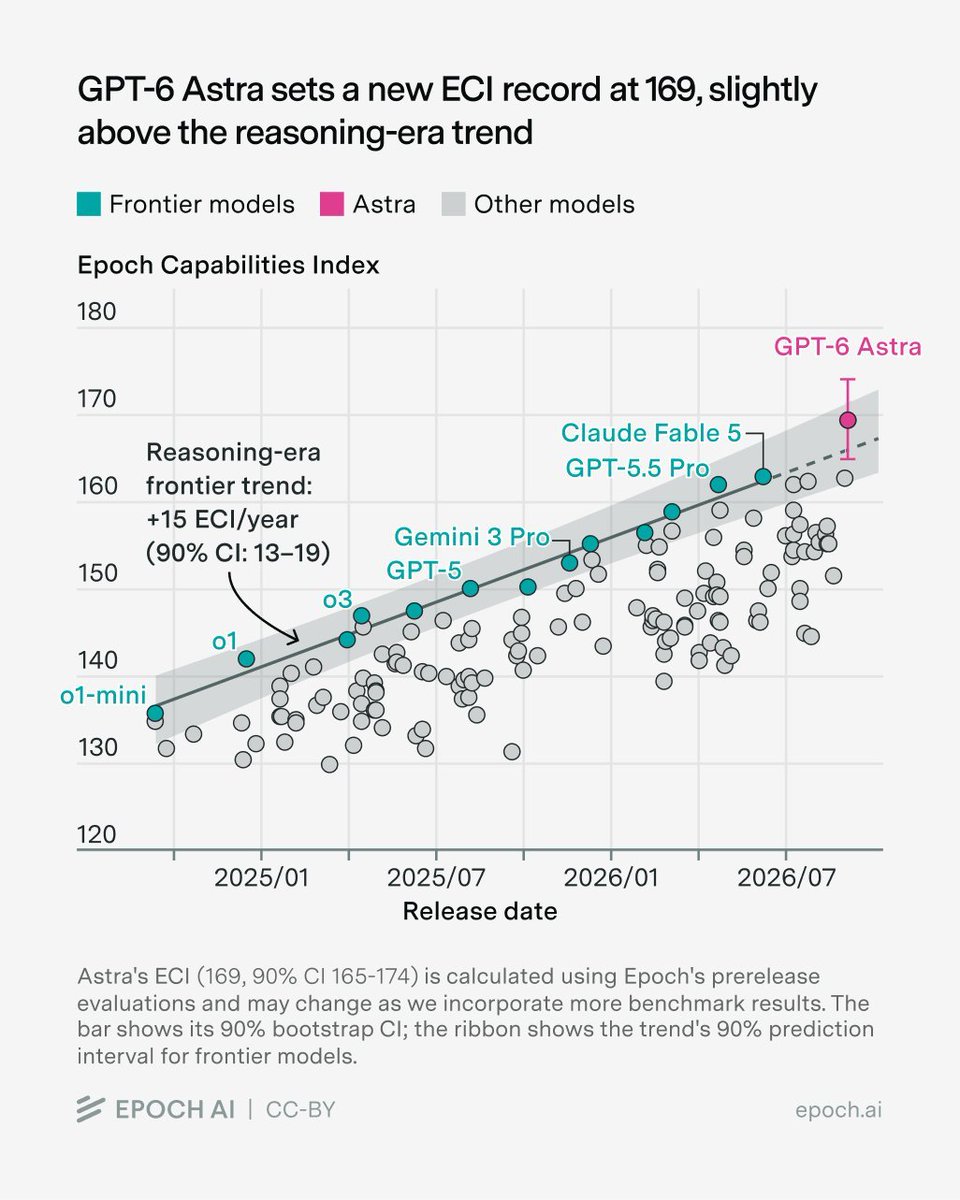
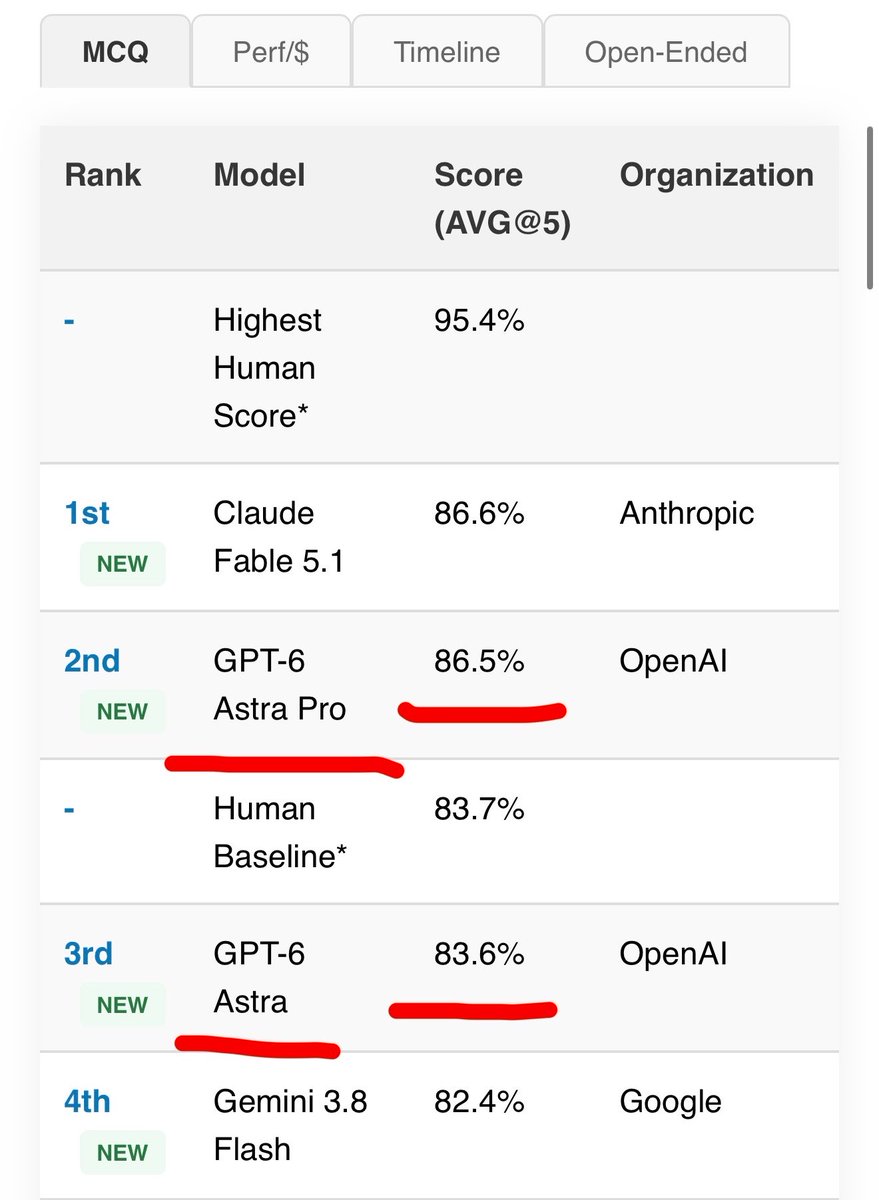
The second major theme was not anti-benchmark nihilism. It was selective trust. People still celebrated visible model gains, but only when the benchmark felt hard to game or when the task looked like an actual client or engineering workflow. @IntCyberDigest pushed back (192 likes, 27 retweets, 28 replies, 24,940 views, 65 bookmarks) on Jensen Huang's “AGI has arrived” line by pointing to Epoch's public cognitive-performance trend and arguing Astra was only marginally above the existing curve. The attached chart sharpened the claim by placing Astra at ECI 169 rather than showing a clear discontinuity. At the same time, @ChrisGPT celebrated (120 likes, 2 retweets, 9 replies, 8,580 views, 12 bookmarks) GPT-6 finally clearing a human baseline on SimpleBench-style word-logic tasks; the attached screenshot showed Claude Fable 5.1 at 86.6%, GPT-6 Astra Pro at 86.5%, and a human baseline at 83.7% on the slice shown.
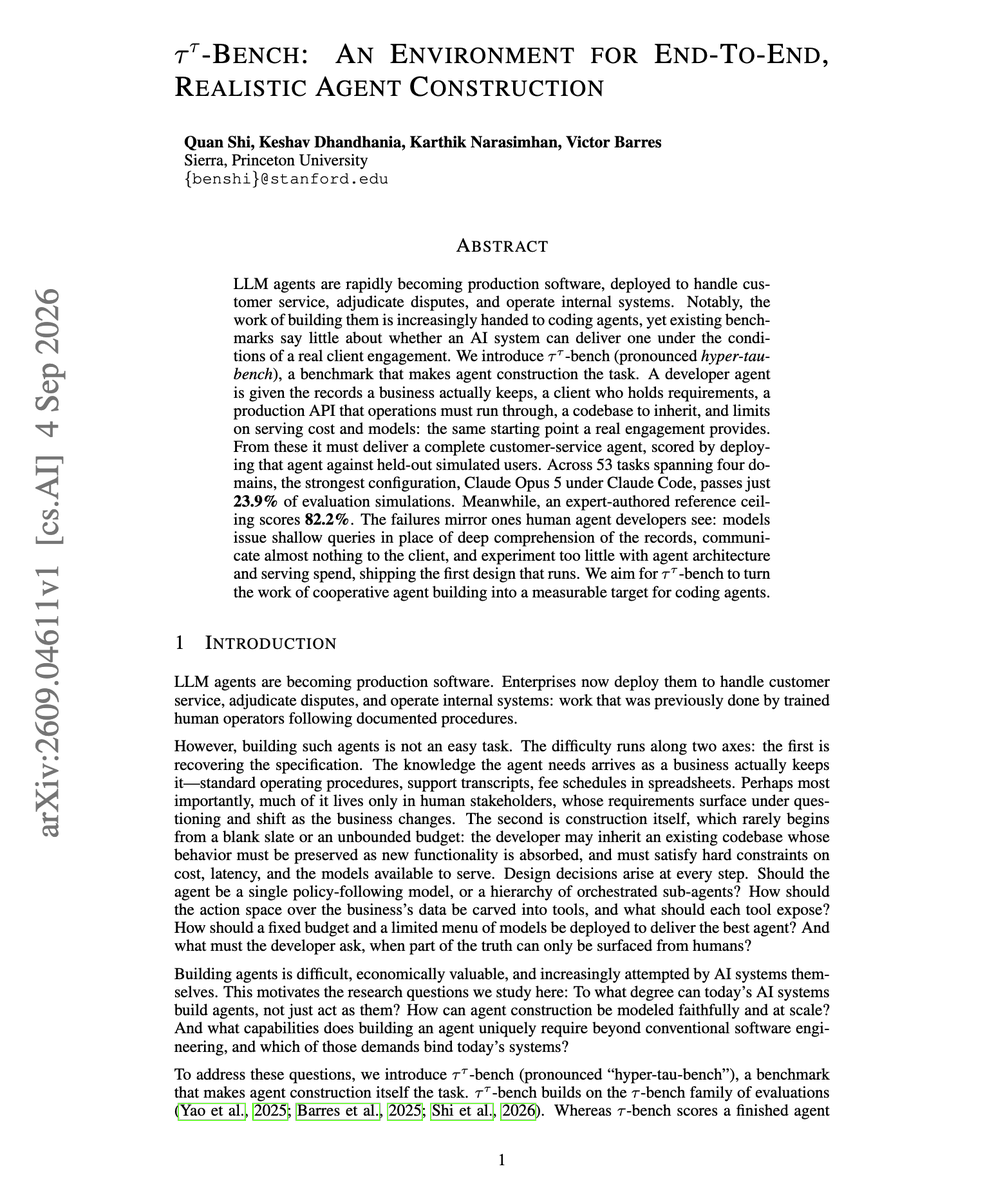
The posts that carried the most analytical weight, though, were the ones that made evaluation messier. @dair_ai shared (16 likes, 1 retweet, 8 replies, 2,114 views, 20 bookmarks) τ³-Bench, where a coding agent has to read messy business records, talk to a client, handle production constraints, and ship a working customer-service agent. The linked dair.ai summary and the paper page both support the key numbers in the post: 53 tasks across four domains, a 23.9% pass rate for the best model, and an 82.2% expert reference score. @SKatalystAI ran (13 likes, 1 retweet, 11 replies, 495 views, 2 bookmarks) an even more grounded public comparison by planting nine real defects plus one false-positive trap in a messy repo; Fable 5.1 fixed 9/9 real defects, preserved the restraint case, and touched 30 files, while Astra fixed 8/9, broke the restraint case, and touched 68 files.

That realism theme extended into discourse about agent behavior itself. @thdxr summed it up (73 likes, 4 retweets, 14 replies, 3,333 views, 3 bookmarks) in one line: many things that make an agent pleasant to use make it worse on benchmarks. His replies made the complaint specific rather than abstract: readers blamed verifiable-reward jargon, single-agent terseness, and the way benchmark pressure can punish clarifying questions or more legible multi-step workflows. @dair_ai added (24 likes, 5 retweets, 7 replies, 2,812 views, 19 bookmarks) another methods-oriented angle with a self-modeling paper that asks verifiable questions about whether prompt edits would change a model's answer, then explicitly warns that better self-modeling scores should not be confused with introspection.
Discussion insight: The common demand across these posts was not “no benchmarks.” It was “benchmarks that expose judgment.” Readers were far more willing to trust a score when it involved restraint, client communication, hidden defects, or deployable artifacts, and far less willing to trust a clean curve or a vendor-scale slogan on its own.
Comparison to prior day: On 2026-09-06, the evaluation conversation focused on scoring weights and harness design. On 2026-09-07, the fight moved closer to lived engineering work: whether the benchmark included messy context, whether the agent asked good questions, and whether it knew what not to change.
1.3 Model choice became explicitly task-specific, while small and local models gained credibility (🡕)
Another strong pattern was that people stopped acting as if there were one “best model” for everything. @shannholmberg posted (61 likes, 1 retweet, 25 replies, 6,031 views, 66 bookmarks) a detailed model stack for marketing work that assigned different jobs to Codex/GPT-5, GPT-6 Astra, Claude Fable, Claude Opus/Sonnet, Grok, Kimi K3, GPT Image 2, and Seedance 2.5. The interesting part was not brand loyalty but routing logic: Astra for browser workflows and orchestration, Fable for front-end and architecture, Grok for current X context, and Kimi for long research synthesis. Replies reinforced that practitioners were converging on model-task fit as a normal operating pattern.
Small open models benefited from that shift. @ArtificialAnlys highlighted (47 likes, 2 retweets, 9 replies, 4,805 views, 8 bookmarks) OpenBMB's MiniCPM5-2B as the top-ranked open model under 4B parameters in its updated Intelligence Index, and the attached chart showed it scoring 15 on the index, one point behind Ling 3.0 Tiny at roughly one-third the size. The reply thread added the more deployment-relevant nuance: an 831 GDPval-AA v2 Elo and only about 19k output tokens per task, both strong signals for edge use. @OpenMed_AI translated (18 likes, 1 retweet, 1,167 views, 9 bookmarks) that capability directly into a medical use case: medication extraction from clinical notes with source checking and tool-assisted calculations on hardware the operator owns.

The local-model theme also showed up in model surgery and packaging. @TeksEdge described (20 likes, 1 retweet, 1,511 views, 20 bookmarks) a Qwen3.8-27B “uncensored” release where refusal behavior reportedly fell from 98 held-out prompt refusals to 12 while benchmark means barely moved and MTP survived GGUF quantization. @pdp showed (2 likes, 3 replies, 129 views, 1 bookmark) the same localist instinct in product form with CBK Studio, a desktop-packaged, open-source orchestration surface for running your own models locally.
Discussion insight: The replies that mattered most here were practical. Under the model-stack thread, people praised Grok for current-context retrieval and implicitly accepted that one-model-fits-all was dead. Under the MiniCPM discussion, token efficiency mattered almost as much as raw score because people were already thinking about edge budgets, not just leaderboards.
Comparison to prior day: On 2026-09-06, the conversation still emphasized control planes, harnesses, and workflow surfaces above the model itself. On 2026-09-07, the model layer came back into focus, but as a routing and deployment question rather than a winner-take-all ranking.
1.4 Moats showed up in distribution, benchmark directories, runtime speed, and packaged products (🡕)
A final theme was that builders kept talking about surrounding advantages rather than pure model quality. @mal_shaik reverse engineered (13 likes, 2 retweets, 4 replies, 1,260 views, 25 bookmarks) Vercel's AI-search visibility and argued the real moat was not brand mentions but linkable documentation. The attached chart put Vercel at 46.5% citation share versus Cloudflare at 29.4% and Netlify at 20.6%, while the linked comparison hub, Next.js Learn, and AI SDK docs make the mechanism legible: feature-by-feature comparison pages, long-form tutorials, and model-specific implementation guides that answer the exact questions AI search systems are likely to cite.

Infrastructure builders were doing the same thing from different directions. @gonzalo_io launched (35 likes, 4 retweets, 8 replies, 1,499 views, 25 bookmarks) Voice AI Benchmarks, an open directory for speech, language, turn-taking, and complete voice-agent benchmarks. @xieenze_jr claimed (94 likes, 13 retweets, 10 replies, 17,755 views, 87 bookmarks) that Sol-H3 could generate five seconds of 1344×768 stereo video in 1.653 seconds on 8× B300, and the public Sol-H3 benchmark page plus Reactor sandbox support the core “faster than playback” framing. Downstream, product builders were packaging that infrastructure into simpler surfaces: @MaxHirsch13 pitched (9 likes, 1 retweet, 2 replies, 440 views) an all-in-one “agentic coach” for workouts, recipes, and logging, while @pdp pitched a local agent IDE instead of another cloud chat wrapper.
Discussion insight: The sharpest reply under the Vercel analysis said citation share tracks docs depth more than brand size. That line captures the broader mood well. AI Twitter repeatedly treated comparison content, benchmark catalogs, runtime engineering, and packaging as strategic leverage in their own right.
Comparison to prior day: On 2026-09-06, builder energy centered on workflow visibility and benchmark redesign. On 2026-09-07, the conversation widened into distribution systems, runtime speed, and product packaging, suggesting the moat conversation is moving beyond raw model capability.
2. What Frustrates People
Benchmarks and AGI narratives that still skip the cooperative part of the job
Severity: High. @IntCyberDigest used (192 likes, 27 retweets, 28 replies, 24,940 views, 65 bookmarks) Epoch's trend line to argue that “AGI has arrived” was a narrative leap, not a clean benchmark conclusion. @dair_ai made (16 likes, 1 retweet, 8 replies, 2,114 views, 20 bookmarks) the harder complaint explicit with τ³-Bench: current coding agents still read business records shallowly, ask too little of the client, and ship the first design that runs. @SKatalystAI showed (13 likes, 1 retweet, 11 replies, 495 views, 2 bookmarks) the same gap in miniature when Astra changed more than twice as many files as Fable and still missed a planted defect plus a restraint case. @thdxr added (73 likes, 4 retweets, 14 replies, 3,333 views, 3 bookmarks) that some behavior people actually like in an agent can hurt benchmark scores. The frustration was not with evaluation itself, but with evaluations that flatten away judgment, clarification, and restraint. This is directly worth building for.
Recurring workflows still live in people's heads instead of reusable skills
Severity: High. @ericosiu spelled out the operational pain: if a task has to be re-explained every Monday, the workflow is not captured yet. @OreateAI framed the same issue as missing context, constraints, sequence, evaluation, and ownership, while @JayAlammar implicitly answered it by trying to make the agent stack itself legible. Even the course and repo-list posts from @AiwithDharmik and @Mohiniuni read like coping strategies for the same problem: too much tacit know-how, not enough durable packaging. This is directly worth building for.
One-model-fits-all workflows are still too blunt for owned-data or cost-sensitive work
Severity: Medium. @shannholmberg treated model selection as routing across specialized jobs instead of allegiance to one winner, which is usually a sign that no single tool is meeting the whole need cleanly. @ArtificialAnlys and @OpenMed_AI pointed to the workaround: smaller open models that can run on owned hardware and be wrapped with tools, source checks, and domain logic. @TeksEdge pushed farther by showing people are now manually reshaping refusal behavior and local quantization profiles to get the behavior they want. The underlying frustration is that frontier models still feel too expensive, too generic, or too opaque for many applied workflows. This is worth building for.
AI workflows still feel fragmented or strangely indirect in end-user products
Severity: Medium. @nitzukai reacted (138 likes, 13 retweets, 60 replies, 11,272 views, 45 bookmarks) to an Astra-in-Blender demo by asking the rude but useful question: why is the user still waiting for AI to use Blender like a human instead of just getting the asset or final output they wanted? The replies made the complaint sharper by focusing on token spend, local render latency, and dubious economic logic. On the consumer side, @MaxHirsch13 complained about needing separate apps for fitness, recipes, and tracking, while @pdp pitched CBK Studio specifically as a no-extra-setup local package. People are still rewarding products that collapse too many steps into one surface because fragmentation remains unresolved. This is worth building for, but the evidence still points to early product searching rather than a settled category.
3. What People Wish Existed
Better skill systems and guided agent curricula
What people seemed to want was not more generic AI motivation, but a way to encode good work so the next person or agent can reuse it. @JayAlammar wanted the concepts to be legible, @AiwithDharmik pointed to a growing official course catalog, @Mohiniuni gave a repo-based learning path, and @ericosiu reduced the operational need to a sentence: recurring work should become a skill. The missing layer is a durable way to package instructions, checks, examples, and tool bindings into something teams actually reuse. Opportunity: direct.
Public evaluations that score deployed systems, not just isolated outputs
The strongest unmet need on the day was trustworthy evaluation. @IntCyberDigest rejected inflated AGI narratives, @ChrisGPT showed that people still care when a benchmark reflects stubborn real behavior, @dair_ai moved the task into real client engagements, and @SKatalystAI priced in restraint inside a messy repo. What people appear to want is evaluation that can capture deployment quality, judgment, and communication without collapsing back into easy-to-game leaderboard theater. Opportunity: direct.
Owned-data local agents with credible small-model performance
The combination of @ArtificialAnlys, @OpenMed_AI, @TeksEdge, and @pdp points to a specific desire: useful agents that run on hardware the operator controls, can call tools, can be tuned for domain behavior, and do not require shipping sensitive workflows into someone else's cloud. The appetite is not just for “local LLMs” in the abstract. It is for small, configurable, workflow-ready systems. Opportunity: direct.
Simpler products that collapse multi-step workflows into one surface
Both the angry backlash thread and the more constructive product posts implied the same wish: stop making users stitch together six separate steps. @nitzukai wanted media AI to deliver the asset instead of reenacting Blender labor, while @MaxHirsch13 explicitly asked for workouts, recipes, tracking, and coaching from one chat surface. @pdp made the same move for local agent orchestration by packaging the whole stack into a desktop app. The unmet need is for fewer seams, less setup, and more end-to-end ownership of a user job. Opportunity: competitive.
Better AI-search and benchmark discovery infrastructure
The Vercel and VoiceBenchmarks posts suggest another gap that is less glamorous but increasingly strategic. @mal_shaik showed that tools win AI-search share when they own citeable comparison pages, tutorials, and SDK docs, while @gonzalo_io built a public directory because voice evaluation is still scattered across too many surfaces. The missing product layer is not another model. It is discovery infrastructure that helps builders compare, choose, and integrate the right one. Opportunity: competitive.
4. Tools and Methods in Use
| Tool | Category | Sentiment | Strengths | Limitations |
|---|---|---|---|---|
| Claude Fable 5.1 | Frontier model | (+) | Publicly perceived as strong on vague problem framing, front-end work, architecture, and engineering restraint; topped the messy-repo comparison and narrowly led the SimpleBench image slice | Can still impose its own "taste," and its wins were shown in narrow public comparisons rather than universal head-to-head coverage |
| GPT-6 Astra / Astra Pro | Frontier model | (+/-) | Finally crossed a human baseline on the SimpleBench slice shown publicly; widely used for browser workflows, orchestration, and visual tasks | AGI claims were heavily disputed, and the messy-repo test suggested wider but less restrained behavior than Fable |
| Reusable skills + plugins | Workflow method | (+) | Turn recurring work into explicit inputs, steps, outputs, checks, and tool bindings; public charts showed much higher usage at high-use firms | Adoption at typical firms still looked low, and packaging the workflow correctly remains manual work |
| τ³-Bench | Coding-agent evaluation | (+) | Scores the deployed system across 53 real client-style tasks with business records, communication, and serving constraints | Current best model still sat at 23.9% versus an 82.2% expert reference, so the benchmark exposes a gap more than a solution |
| Continue / Cline | Open-source coding agents | (+) | Recurred as concrete learning and workflow surfaces for AI coding; both have large public communities and runnable tooling | The surrounding advice was to pick narrowly, implying tool overload and shallow experimentation are still common |
| MiniCPM5-2B | Small open model | (+) | Strong sub-4B intelligence and agentic signals, tool calling, token efficiency, and clear relevance for owned-hardware deployments | Still needs domain wrappers and validation; strong small-model scores do not erase frontier-model tradeoffs |
| Qwen3.8-27B Heretic variant | Open-model tuning approach | (+/-) | Shows that refusal behavior can be changed without obviously crushing general benchmark averages; preserved MTP through GGUF quantization | Safety, coding, math, multilingual, and vision tradeoffs were not comprehensively audited in public |
| Sol-H3 / Fast H3 | Video inference stack | (+) | Publicly demonstrated faster-than-playback stereo video generation and day-0 sandbox/API availability | Requires substantial hardware and still raised reply-level questions about quality and reference-video support |
| Voice AI Benchmarks | Benchmark directory | (+) | Centralizes fragmented evaluation surfaces for TTS, STT, LLM, turn-taking, and full voice agents | It is an index layer, not the benchmark runner itself, so quality depends on maintenance and coverage |
| Vercel comparison hub + Next.js Learn + AI SDK | Distribution method | (+) | Shows how comparison pages, tutorials, and SDK docs can capture AI-search citations and shape tool discovery | The same analysis showed Vercel still loses many price-sensitive queries, and the moat depends on keeping content unusually specific |
Across the table, the strongest positive sentiment was not aimed at a single vendor. It was aimed at methods that added structure around the model: realistic evals, reusable skills, task-model routing, local deployment options, and better discovery surfaces. The repeated workaround pattern was to treat the model as one layer inside a larger operating stack rather than as the whole product.
5. What People Are Building
| Project | Who built it | What it does | Problem it solves | Stack | Stage | Links |
|---|---|---|---|---|---|---|
| Anthropic Academy / Claude 101 | Anthropic | Free certificate-based training catalog for Claude, projects, skills, tools, and enterprise use cases | Agent adoption is outrunning shared understanding and formal onboarding | Web courses, certificates, project walkthroughs, skills, enterprise-search modules | Shipped | signal post · course |
| Voice AI Benchmarks | Gonzalo Io | Open directory of benchmarks for speech models, LLMs, turn-taking, and full voice agents | Voice evaluation is fragmented across too many sources and formats | Searchable web directory, open contributions, benchmark taxonomy | Live | post · site |
| Sol-H3 / Fast H3 | xieenze_jr with MiniMax AI / Reactor | Faster-than-playback inference stack and public sandbox for MiniMax H3 video generation | High-quality video generation is too slow for interactive use | Sparse attention, fused kernels, batched VAE decode, multi-B300 scaling, API/sandbox access | Released | post · benchmark page · sandbox |
| Maxed AI | Max Hirsch / MAXED INC | All-in-one chat surface for workout planning, calorie tracking, recipes, and logging | Health workflows are scattered across too many separate apps and inputs | iOS app, chat interface, workout generation, voice logging, nutrition planning | Shipped | post · App Store |
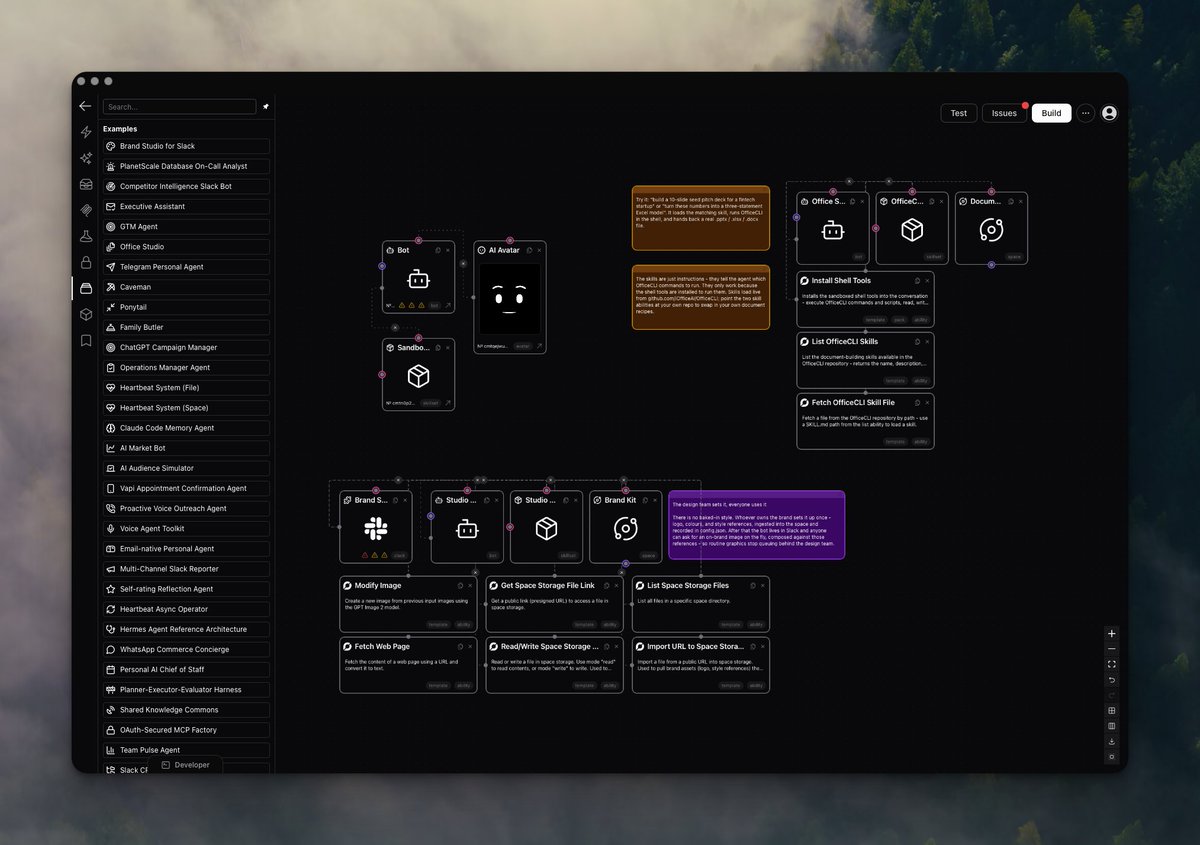
| CBK Studio | pdp / CBK | Desktop-packaged local orchestration environment for AI agents and tools | Running secure local agent workflows still involves too much setup and glue code | Desktop app, local models, graph workflow UI, tool nodes, skill fetching | Shipped | post |
The table shows how wide the day's builder activity was. Some teams were building learning supply, some were building benchmark infrastructure, some were reducing runtime latency, and some were packaging whole user workflows into a single surface. The most interesting commonality was that almost none of these projects were just "another model." They were wrappers around learning, evaluation, speed, or end-to-end product flow.
The all-in-one and local-product examples were especially concrete. Maxed's public App Store listing says the app predicts weights and reps, supports voice logging, and generates workouts from prompts; the tweet's screenshots made the packaging thesis visible by showing recipe generation, macro breakdowns, and one-tap logging inside the same product. CBK Studio took the same packaging instinct up-stack by turning local orchestration into a desktop surface with inspectable nodes instead of a pile of manual setup steps.


One adjacent signal that does not fit cleanly into the table but still matters: education itself was being productized. Jay Alammar's book launch and Mohiniuni's repo map both suggest that learning artifacts are becoming part of the builder stack, not just marketing around it.
6. New and Notable
Reusable skills finally got quantified instead of merely evangelized
@ericosiu did not just argue (2 replies, 292 views) that teams should turn repeated tasks into skills. He attached public enterprise-usage charts showing a large adoption gap between high-use firms and typical firms for both skills and plugins. That matters because it turns “workflow packaging” from a vague best practice into a measurable behavior gap.
τ³-Bench moved coding-agent evaluation closer to real client work
@dair_ai highlighted (16 likes, 1 retweet, 8 replies, 2,114 views, 20 bookmarks) a benchmark where the agent has to read business records, talk to a client, work within serving constraints, and deliver a deployed system. Even more important than the 23.9% versus 82.2% score gap was the framing shift: the benchmark measures whether the job got done, not whether a patch passed.
MiniCPM5-2B made the edge-model story feel more practical
@ArtificialAnlys showed (47 likes, 2 retweets, 9 replies, 4,805 views, 8 bookmarks) MiniCPM5-2B performing unusually well for its size, and @OpenMed_AI translated (18 likes, 1 retweet, 1,167 views, 9 bookmarks) that into a domain workflow on owned hardware. That pairing is notable because it joined benchmark credibility to a concrete deployment use case in the same day's conversation.
Sol-H3 pushed video generation into the "interactive system" conversation
@xieenze_jr claimed (94 likes, 13 retweets, 10 replies, 17,755 views, 87 bookmarks) faster-than-playback generation for five seconds of stereo video, and public sources back the headline numbers closely enough to treat it as more than timeline hype. Crossing that threshold matters because it changes the product question from batch generation to whether continuous, steerable video systems are becoming realistic.
7. Where the Opportunities Are
[+++] Real-world evaluation for agents that touch messy code and messy stakeholders — Evidence came from @IntCyberDigest rejecting inflated AGI rhetoric, @ChrisGPT celebrating a benchmark only because it matched longstanding failure cases, @dair_ai scoring deployed client-style systems, @SKatalystAI testing restraint in a messy repo, and @thdxr warning about benchmark-optimized UX. The opportunity is not more scoreboards. It is evaluation that measures judgment, communication, and deployed quality.
[+++] Reusable skills, workflow operating systems, and guided agent curricula — @JayAlammar packaged the conceptual stack, @AiwithDharmik surfaced formal coursework, @Mohiniuni shared concrete repo paths, @ericosiu quantified the adoption gap, and @OreateAI named the five workflow layers. This looks like a durable need because it connects education, operations, and tooling into the same missing layer.
[++] Owned-data local agent stacks built around credible small models — @ArtificialAnlys showed that sub-4B open models are becoming more serious, @OpenMed_AI mapped that progress onto a clinical workflow, @TeksEdge demonstrated appetite for behavioral tuning and quantized local deployment, and @pdp packaged local orchestration into a desktop tool. The opportunity is strongest where privacy, ownership, or latency matter more than absolute frontier capability.
[++] AI-search distribution tooling and citeable documentation systems — @mal_shaik argued that Vercel's lead comes from owning the exact pages AI systems want to cite: comparisons, tutorials, templates, and SDK docs. This suggests a growing market for tooling that helps companies generate, test, and maintain AI-search-ready documentation rather than treating citations as a side effect of SEO.
[+] Packaged vertical agents and benchmark directories that remove category sprawl — @gonzalo_io built a benchmark directory because voice builders still have too many scattered references, while @MaxHirsch13 positioned Maxed as a single surface for multiple health tasks and @nitzukai complained that AI media workflows still force too many human-like intermediate steps. The category is earlier and noisier than the items above, but the demand for fewer seams is clear.
8. Takeaways
- AI work is being packaged into reusable operating knowledge, not just better prompts. Jay Alammar's book launch, Anthropic's course catalog, Eric Siu's skill-adoption charts, and Oreate's workflow stack all point to the same shift: teams want teachable systems and reusable skills. (source)
- Benchmark discourse is getting stricter about what counts as evidence. GPT-6's SimpleBench progress drew interest, but the stronger signals came from τ³-Bench, the SKatalyst messy-repo test, and skepticism toward AGI rhetoric unsupported by a real task frame. (source)
- Task-model routing is replacing one-model-fits-all thinking. The shannholmberg stack, MiniCPM5-2B discussion, OpenMed use case, and Qwen surgery thread all treated model choice as a deployment design decision rather than a universal ranking. (source)
- Moats increasingly live in surrounding systems: docs, benchmarks, and runtime engineering. Vercel's citation-share analysis, Voice AI Benchmarks, and Sol-H3 all show builders competing on discoverability and infrastructure rather than pure model branding. (source)
- End-user packaging still matters because many AI workflows remain too fragmented or indirect. Maxed's all-in-one coach and CBK Studio's local desktop orchestration are practical attempts to remove seams that users are visibly tired of managing. (source)