Twitter AI - 2026-09-10
1. What People Are Talking About
1.1 Model upgrades became migration and regression events (🡕)
The strongest theme was not that another frontier model scored higher. It was that model changes now behave like infrastructure migrations: they can break established instructions, alter tool behavior, and invalidate workflows. Four high-signal items moved evaluation toward replay tests and real repositories.
@BradGroux reported (572 likes, 12 replies, 229,930 views, 158 bookmarks) that his GPT-5.6 workflow did not transfer reliably to GPT-6 Astra after six days of records. Replies supplied the business consequence: teams cannot afford to rewrite operating procedures for every release, and a matched set of past tasks should be replayed before migration.
@iamdamianpala tested (3 likes, 3 replies, 63 views) three models against the same feature contract in isolated copies of one repository. The attached result showed that the cheapest and fastest run did not pass every mutation group, while the most expensive run was the only one to pass all four.

@nasqret said (207 likes, 8 replies, 11,620 views, 48 bookmarks) GPT-6 Astra had solved the final unsolved FrontierMath Tier 4 task, closing out a benchmark designed in the o4-mini era. The implication was not that mathematical evaluation is finished, but that hard sets now need faster renewal.
Discussion insight: The replies favored regression suites over one-off leaderboards. The recurring question was whether a new model preserves a team's actual contracts, instructions, and failure boundaries.
Comparison to prior day: On 2026-09-09, evaluation moved toward maintainability, hardware fit, and serving-stack effects. On 2026-09-10, that became a migration discipline: replay old work, compare defects and cost, and assume model swaps can regress production behavior.
1.2 Open and local models intensified the price-performance contest (🡕)
Five items supported a widening competition around open weights, smaller models, and local inference. DeepSeek V4.1 Flash dominated the benchmark conversation, but hardware tuning and multilingual small models showed that the trend was broader than one release.
@Yuchenj_UW highlighted (132 likes, 17 replies, 11,353 views) DeepSeek V4.1 Flash results above GPT-5.6 Sol on several displayed coding and agent benchmarks while claiming roughly 97% lower cost. The image showed 74.2 on DeepSWE, 88.1 on CyberGym, and 54.8 on AutomationBench; the price claim should still be treated as a release-day claim rather than independent replication.

@TeksEdge documented (20 likes, 1 reply, 1,697 views, 11 bookmarks) a dual Radeon AI PRO R9700 optimization path for Qwen3.8-27B that progressed from 19.2 to 185 tokens per second across llama.cpp and SGLang configurations. @mhrnz_m presented (20 likes, 2 replies, 547 views) Tiny Aya L2-Thinker, a 3.35B-parameter model with 32K context trained for reasoning in 45 languages.
Discussion insight: The excitement was conditional. Benchmark wins generated interest, but builders kept asking whether the same advantage survives their repository, serving stack, language, and hardware.
Comparison to prior day: On 2026-09-09, local-model talk centered on selecting models that fit a machine. On 2026-09-10, it accelerated into active price-performance competition among open models, frontier APIs, optimized runtimes, and small multilingual systems.
1.3 Agent reliability shifted from rules to reversible runtime controls (🡕)
Six items extended the agent-supervision theme into concrete infrastructure. The common design was to control what agents read, preserve context across tools, monitor limits, and make execution reversible rather than hoping a better prompt prevents failure.
@marfinxx surfaced (11 likes, 4 replies, 772 views) SHEPHERD, a research runtime whose meta-agent can intercept, fork, modify, and revert execution traces. The attached paper result showed CooperBench pair pass rate rising from 28.8% to 54.7%, with forks shown in the roughly 134-143 millisecond range.

@BharukaShraddha pointed to (10 likes, 561 views, 8 bookmarks) Headroom, which compresses logs, tool results, files, and conversation history locally while retaining reversible retrieval. Its repository reports 21%-57% savings in four reproducible scenarios; the broader 60%-95% claim in the tweet is workload-dependent.
@DanKornas showed (4 likes, 6 replies, 658 views) DSH Chat Import moving prior conversations from roughly 20 coding agents into resumable sessions, while @KeisukeIshikawa released (2 likes, 2 replies, 114 views) a small widget that tracks usage resets across Claude, OpenAI, and other providers.
Discussion insight: These projects treat reliability as state management. Compression, quotas, traces, and portable histories are all attempts to make the hidden operating state visible and recoverable.
Comparison to prior day: On 2026-09-09, people specified supervision rules such as verification, supersession, and fallback standards. On 2026-09-10, builders supplied implementation primitives: reversible traces, local compression, cross-agent imports, and quota telemetry.
1.4 AI deployment evidence spread across media, biology, robotics, and infrastructure (🡕)
Five items showed AI moving from generic capability claims into measurable operating systems and experiments. The evidence ranged from a scaled media business to animal research, open robotics, and national compute capacity.
@RohanNayak2 described (111 likes, 22 replies, 12,951 views, 29 bookmarks) Pocket FM's path to roughly $500M ARR and EBITDA profitability, citing AI-first localization, retention, content, and advertising workflows. The attached slides said the company now produces 17,500 ads per month.

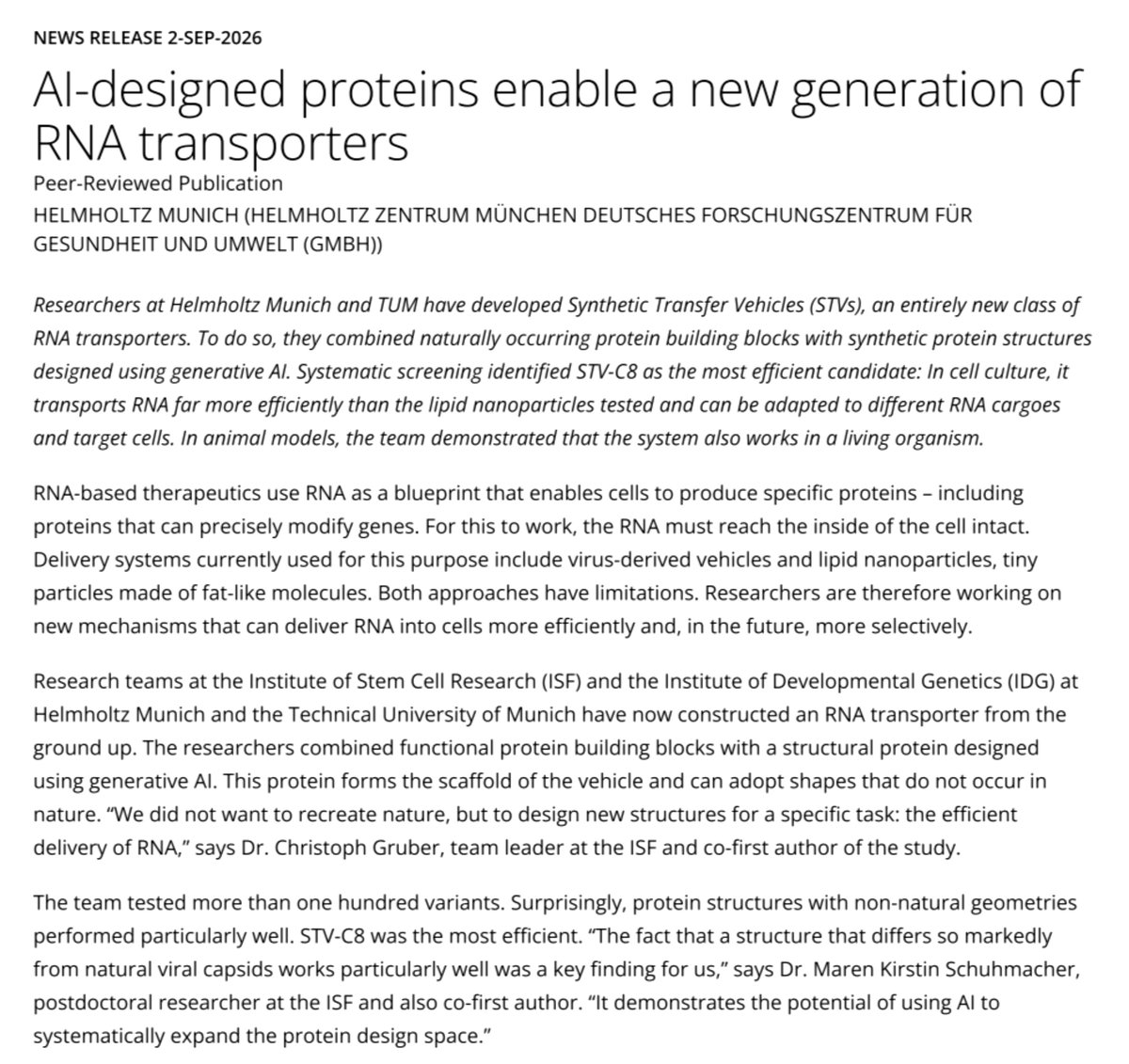
@SciTechera shared (4 likes, 1 reply, 232 views) research on STV-C8, an AI-designed synthetic RNA transporter tested in animals and in a CRISPR/Cas9 pig-muscle experiment. The attached material explicitly labels the work experimental, which makes it a promising research signal rather than a clinical result.
@UnitreeRobotics announced (90 likes, 8 replies, 6,018 views, 14 bookmarks) the open-source UnifoLM-WLA-1.0 embodied foundation model for single- and dual-arm robots. @nvidianewsroom announced (164 likes, 8 replies, 51,391 views) Australian partners expanding land, power, and shell capacity for DSX-based AI factories.
Discussion insight: The most credible deployment posts supplied an operating metric, experimental stage, code release, or infrastructure commitment. Broad claims without one of those anchors attracted much less analytical weight.
Comparison to prior day: On 2026-09-09, diffusion was framed as a bottleneck involving workflows, real-world data, and local infrastructure. On 2026-09-10, the conversation supplied concrete instances of that diffusion in scaled media operations, experimental biology, embodied models, and compute buildout.
2. What Frustrates People
Model releases that silently invalidate working procedures
Severity: High. @BradGroux reported (572 likes, 12 replies, 229,930 views, 158 bookmarks) repeatedly restating instructions after moving from GPT-5.6 to GPT-6 Astra. @iamdamianpala found (3 likes, 3 replies, 63 views) that three models given the same real-repository feature contract produced materially different defects, completion times, and costs.
The coping method is to pin models, preserve known-good instructions, and replay representative tasks before switching. This is directly worth building for because frequent model upgrades convert an otherwise attractive commodity into recurring migration work.
Benchmark and vendor claims that are hard to audit
Severity: High. @nasqret marked (207 likes, 8 replies, 11,620 views, 48 bookmarks) the saturation of a formerly difficult math set, while DeepSeek V4.1 Flash claims circulated faster than independent reproductions. At the trust layer, @firstadopter amplified (9 likes, 1 reply, 1,928 views) Anthropic's allegation that DeepSeek and Moonshot relayed customer requests to Claude and captured exchanges for training. Those are Anthropic's claims, not independently established facts, but they show why model provenance is becoming part of evaluation.
@babakph argued (7 likes, 3 replies, 2,098 views) that an unverifiable promise about whether confidential work trains a model is not a control. Teams cope through contractual restrictions, private deployments, reproducible harnesses, and independent tests. This is worth building for: evidence packaging, lineage, and policy enforcement remain weaker than model-selection interfaces.
Context, token, and quota costs that surface mid-workflow
Severity: Medium. @BharukaShraddha highlighted (10 likes, 561 views, 8 bookmarks) the waste of sending entire logs when an agent needs only one error, and @KeisukeIshikawa described (2 likes, 2 replies, 114 views) discovering provider resets by hitting a limit mid-task. @RituWithAI summarized (7 likes, 1 reply, 70 views, 6 bookmarks) a Deloitte survey claim that 60% of finance leaders expect AI costs to rise substantially through 2027 even as 43% keep embedding it.
Current workarounds include local compression, cheaper-model routing, terse outputs, and quota dashboards. This is worth building for, though point solutions are already appearing and savings claims need workload-specific validation.
Integrations that still require hand-maintained operational knowledge
Severity: High in regulated workflows. @mardehaym described (16 likes, 10 replies, 2,035 views) a small team manually maintaining hundreds of prior-authorization templates before deploying agents across more than 600 payer plans under HIPAA. The frustration is not access to a capable model; it is keeping fragmented rules, credentials, validation, and exceptions current.
Teams cope by placing tool-using agents inside controlled workflows rather than exposing a general chatbot. This is directly worth building for where the domain has high integration churn, auditable outcomes, and enough transaction volume to justify ongoing maintenance.
3. What People Wish Existed
A model-neutral migration gate for real work
Builders want a harness that replays representative tasks, compares defects and cost, detects changed instruction behavior, and blocks an upgrade when contracts regress. @BradGroux made (572 likes, 12 replies, 229,930 views, 158 bookmarks) the need urgent, while @iamdamianpala demonstrated (3 likes, 3 replies, 63 views) a small manual version in one repository. Existing benchmark harnesses only partially address workflow-specific instructions and migration risk. Opportunity: direct.
Portable, compressed context across every coding agent
The practical request is to switch models and tools without losing the history that explains the current codebase. @DanKornas introduced (4 likes, 6 replies, 658 views) a conversation importer, while @BharukaShraddha highlighted (10 likes, 561 views, 8 bookmarks) local, reversible context compression. Both partially address the need, but a neutral interchange format with provenance, supersession, and selective retrieval is still missing. Opportunity: competitive.
Auditable controls for data use and model provenance
People want proof of where a response came from, whether their inputs were retained, and whether a vendor obeyed its policy. @babakph framed (7 likes, 3 replies, 2,098 views) this as the difference between a promise and a control. @AndrewCurran_ called for (22 likes, 1 reply, 2,555 views) concrete laboratory monitoring practices as models gain autonomy and tool access. Contracts and private hosting only partially solve the issue because customers still lack portable evidence. Opportunity: direct.
Integration maintenance that learns changing domain rules
Regulated operators want agents that can absorb changing payer, policy, and validation rules without recreating brittle template libraries. @mardehaym described (16 likes, 10 replies, 2,035 views) the acute version across more than 600 payer plans. Production agents partially address it, but safe rule discovery, approval, and rollback remain domain-specific. Opportunity: competitive.
4. Tools and Methods in Use
| Tool | Category | Sentiment | Strengths | Limitations |
|---|---|---|---|---|
| GPT-6 Astra | Frontier model | (+/-) | Saturated a hard math set; strong embodied-task gains | Existing GPT-5.6 instructions did not transfer reliably for one power user |
| DeepSeek V4.1 Flash | Open model | (+/-) | Strong displayed coding and agent scores at low claimed cost | Release-day results need replication; provenance allegations cloud trust |
| Headroom | Context infrastructure | (+) | Local, reversible compression; supports many agents and content types | Savings vary sharply with payload; adds a proxy and retrieval layer |
| SHEPHERD | Agent runtime | (+) | Intercept, fork, modify, and revert execution traces | Research-stage evidence; meta-agent supervision adds another control surface |
| DSH Chat Import | Developer tool | (+) | Carries prior conversations into resumable sessions | Imported history still needs filtering, provenance, and supersession |
| Codenotch | Usage monitoring | (+) | Makes fragmented provider quotas and resets visible | Small point solution; provider coverage and accuracy can change |
| TRL 1.13 | Training framework | (+) | Open-source post-training guidance for 1M-plus-token context | Long-context training still carries substantial memory and evaluation cost |
| Real-repository replay | Evaluation method | (+) | Exposes defects, duration, cost, and contract compliance | Small task sets can overfit one codebase and are expensive to maintain |
| Tuned llama.cpp and SGLang | Local inference | (+) | Large throughput gains from hardware-specific optimization | Results depend on GPUs, quantization, kernels, and exact model configuration |
The satisfaction spectrum was widest around models and narrowest around operational tools. @Yuchenj_UW praised (132 likes, 17 replies, 11,353 views) DeepSeek's displayed price-performance, while @BradGroux documented (572 likes, 12 replies, 229,930 views, 158 bookmarks) an Astra migration regression. The workaround was not loyalty to one vendor: it was routing, replaying, compressing, and preserving the option to switch.
@Thom_Wolf released (15 likes, 2 replies, 1,947 views) TRL 1.13 with a long-context post-training guide, and @TeksEdge showed (20 likes, 1 reply, 1,697 views, 11 bookmarks) how runtime tuning can matter as much as the nominal model. Competitive advantage is moving toward the surrounding measurement and serving stack.
5. What People Are Building
| Project | Who built it | What it does | Problem it solves | Stack | Stage | Links |
|---|---|---|---|---|---|---|
| GPT-2-style MoE | @gpjt | Routes each token to two of six experts in a 446M-parameter model | Makes MoE mechanics teachable and reproducible on one workstation | Python, PyTorch, RTX 3090 | Shipped | Write-up and code |
| Headroom | Headroom Labs | Compresses agent inputs locally with reversible retrieval | Reduces repeated logs, tool output, and context cost | Python, TypeScript, proxy, MCP | Shipped | GitHub |
| SHEPHERD | Stanford and Northwestern researchers | Gives a meta-agent reversible control over another agent's trace | Prevents or recovers from runtime failures | Programmable agent runtime | RFC | Paper |
| DSH Chat Import | @DanKornas | Imports prior coding-agent conversations into resumable sessions | Avoids losing context when changing harnesses | DeepSeek Harness plugin | Alpha | Introduced (4 likes, 6 replies, 658 views) |
| Codenotch | @KeisukeIshikawa | Pins multi-provider usage and reset status to the desktop | Prevents quota surprises during long tasks | Open-source desktop app | Alpha | Released (2 likes, 2 replies, 114 views) |
| Tiny Aya L2-Thinker | @mhrnz_m and collaborators | Performs in-language reasoning across 45 languages at 3.35B parameters | Broadens multilingual reasoning under local-scale constraints | 3.35B model, 32K context | Beta | Presented (20 likes, 2 replies, 547 views) |
| UnifoLM-WLA-1.0 | Unitree | Supplies an embodied foundation model for single- and dual-arm robots | Provides an open training and inference base for robot learning | Model, training code, datasets | Shipped | Announced (90 likes, 8 replies, 6,018 views, 14 bookmarks) |
| Prior-authorization agents | @mardehaym and team | Submits treatment approvals across payer plans | Replaces hand-maintained payer templates and repetitive operations | Tool-using agents, HIPAA controls | Shipped | Described (16 likes, 10 replies, 2,035 views) |
@gpjt documented (149 likes, 5 replies, 22,563 views, 263 bookmarks) the most reproducible educational build. The six-expert, two-active model trained for nearly eight days on one RTX 3090, and the write-up explains the auxiliary loss needed to keep experts balanced rather than only presenting a final score.
Headroom and DSH Chat Import attack adjacent forms of context debt: one shrinks what must be sent, while the other preserves what would otherwise be stranded. The visible DSH interface supports imports from many coding agents and exports to Claude Code, Codex, and Kimi Code.

The repeated build pattern was infrastructure around model interchangeability. Even the robotics and healthcare projects paired models with domain datasets, tools, validation, or controls rather than treating a raw model endpoint as the product.