Twitter AI - 2026-09-12
1. What People Are Talking About
1.1 Control layers and independent evaluation displaced pure frontier hype (🡕)
The loudest non-builder conversation was not about a new model release. It was about who controls advanced models, who gets to inspect them, and whether "AI will save us" and "AI will kill us" narratives both distract from the same operational gap: present-day governance.
@MabreyTed argued (162 likes, 23 replies, 11,179 views, 54 bookmarks) that frontier rhetoric hides a more immediate problem: companies are upside down on spend versus outcomes, their intellectual assets are leaking into model providers, and real utility depends on precise controls rather than hypothetical omnipotence. He also argued that open or off-frontier small models are already at price/performance parity for many use cases once teams add their own data and decision traces.
@DarioAmodei announced (100 likes, 25 replies, 3,847 views, 30 bookmarks) his "We Must Pace the Frontier" essay and said Anthropic will give third-party evaluators employee-level access so they can verify safety measures, report incidents, and assess alignment during training. The immediate reply pattern showed how quickly the discussion widened: people asked whether Chinese labs would also slow down and when Anthropic would ship an open-weight Claude, turning a safety post into an argument about geopolitics and market structure.
Discussion insight: The replies under both tweets converged on the same narrow question: what does a minimum viable control layer actually look like? One respondent on Mabrey's thread asked that directly, while Dario's replies split between wanting hard oversight and doubting any slowdown can hold without China coordination or open weights.
Comparison to prior day: Compared with 2026-09-11, when governance mostly appeared as enterprise identity, process, and legacy-system debt, 2026-09-12 turned the same concern into a public argument over pace, oversight, and who gets to inspect frontier systems.
1.2 Smaller and local models were treated as usable workers, not budget fallbacks (🡒)
The small-model posts on this date were unusually concrete. Instead of claiming that on-device models are "catching up," they showed local or compact systems investigating incidents, choosing when to render an interface, and taking over recurring business operations.
@_avichawla showed (33 likes, 4 replies, 3,032 views, 36 bookmarks) MiniCPM5-2B running fully locally on a multi-step revenue-drop investigation, with the model inspecting orders, traffic, payments, refunds, and deployment logs before writing an incident report. The notable claim was not just that a 2B model can chat on-device; it was that OpenBMB had tuned it for coding, tool use, and multi-step statefulness across SGLang, vLLM, llama.cpp, Ollama, and mobile runtimes.
@TeksEdge highlighted (22 likes, 2 replies, 1,391 views, 14 bookmarks) Saanora Labs' Mark 1x-9B, a post-trained Qwen3.5-9B derivative that decides when an answer should be a chart, simulation, concept map, or JSON payload instead of plain prose. The attached benchmark chart mattered because it paired the interface claim with competitive small-model scores across IFEval, MMLU-Pro, GPQA Diamond, and AIME-style tests.

@pbteja1998 described (24 likes, 2,511 views, 22 bookmarks) creating a "Finance Operations Lead" inside Squad after moving three days of business and finance context into the system. The attached workspace screenshot showed why the post resonated: the product already has mission queues, built-in search, Composio, a cloud computer, and long-lived memory, so the pitch is not just "chat with an assistant" but "hand an area of the business to a teammate" (site).

@AlexFinn argued (72 likes, 19 replies, 6,737 views, 51 bookmarks) that even a cheap Mac Mini is enough to start replacing smaller workflows with local models via LM Studio. His replies made the limits clearer than the main post did: he uses dedicated devices, and small hardware mainly replaces narrower workflows rather than every cloud call.
Discussion insight: Replies across the local-model posts had moved beyond "does it run?" and into model-to-RAM matching, dedicated-device uptime, and whether a model can keep enough state to use tools without thrashing memory.
Comparison to prior day: Compared with 2026-09-11's focus on multi-model harnesses that make frontier coding agents cheaper, 2026-09-12 pushed the cost story down to the edge: smaller models, open weights, and agent teammates that either stay on the machine or reuse subscriptions teams already pay for.
1.3 Agent research threads were about training loops and reusable environments, not bigger backbones (🡒)
The densest builder cluster was a run of papers claiming that long-horizon agent gains now come from better training signals, hidden evaluation, and reusable environment layers rather than from simply attaching a larger model to the same loop.
@omarsar0 summarized (44 likes, 13 replies, 4,029 views, 43 bookmarks) "Thinking with Looped Flows," a recurrent reasoning paper that trains early loop steps with local denoising objectives so later reasoning can build on them. The attached figure and arXiv abstract made the claim concrete: more inference-time computation can buy harder reasoning without adding parameters, and the authors report 58.8% on ARC-AGI-1 and 12.2% on ARC-AGI-2 (paper).

@marfinxx distilled (27 likes, 6 replies, 1,228 views, 26 bookmarks) Meta's AIRA2 as a three-part fix for research agents: asynchronous multi-GPU workers, hidden consistent evaluation, and stateful ReAct loops that can debug live code. The paper preview and charts showed 81.5% mean percentile rank on MLE-bench-30 at 24 hours and 83.1% at 72 hours, plus a widening gap between 1-GPU and 8-GPU evolutionary search over time (paper).

@gurtej__gill_ spotlighted (9 likes, 172 views, 8 bookmarks) Microsoft's Orchard framework, where Orchard Env acts as a Kubernetes-native, harness-agnostic sandbox layer shared across agent recipes. The cited abstract says Orchard-SWE reaches 73.0% on SWE-bench Verified with value-model reranking, Orchard-GUI averages 68.4% across three web benchmarks, and Orchard-Claw reaches 59.6% pass@3 before rising to 73.9% with a stronger harness (paper).
@HuggingPapers flagged (9 likes, 5 replies, 582 views, 10 bookmarks) WMRL, which replaces real-environment execution with a world model during RL and claims 3.1x-3.4x lower training compute while still improving held-out scores. The discussion was notable for its caveat: replies immediately asked whether the world model might simply learn the simulator's blind spots instead of the underlying task (project page).
Discussion insight: These threads were strikingly self-critical. Replies kept asking whether the gain was compute-matched, whether the evaluator itself could be gamed, and whether a learned world or benchmark split was leaking false progress.
Comparison to prior day: 2026-09-11 already emphasized trace review and benchmark skepticism, but 2026-09-12 moved from critique to mechanism: hidden eval containers, Kubernetes-native env layers, recurrent denoising objectives, and world-model RL.
1.4 Infrastructure and physical-AI posts converged on bottlenecks, provenance, and runtime fidelity (🡕)
The remaining high-signal posts read less like product launches and more like maps of where systems still break: GPU memory ceilings, inference profiling, the skill stack needed to run clusters, and the gap between a robotics policy that wins in Python and one that survives in the browser runtime.
@suraj_sharma14 mapped (72 likes, 5 replies, 2,093 views, 86 bookmarks) a 12-stage "AI Infrastructure Engineer" roadmap that starts with Linux and networking, passes through Kubernetes, vLLM, KV-cache management, KEDA, and FSDP, and ends with public latency and cost benchmarks. The replies sharpened the point: one said long-context coding agents often fail on KV-cache residency and concurrency before they fail on raw FLOPs.
@Siddhant_K_code published (103 likes, 6 replies, 2,058 views, 63 bookmarks) a Springer paper and the open-source LLMTraceFX profiler, which collects inference evidence into a canonical schema, verifies outputs with deterministic workloads, and only recommends configuration changes when the measured evidence meets policy (repo, paper).
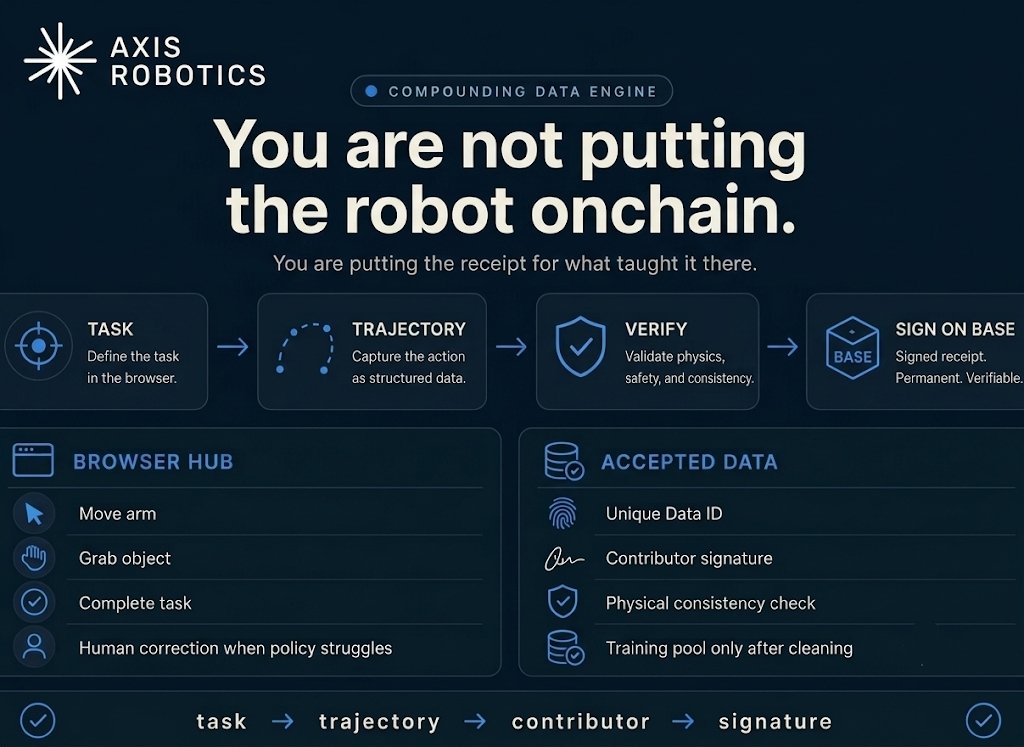
@AzadWeb3 walked through (39 likes, 36 replies, 262 views) Axis Robotics' data pipeline, where a browser task becomes a trajectory, the trajectory is replayed and verified, and only the accepted-data receipt gets signed on Base. The image is useful because it turns a vague physical-AI data-engine claim into a specific provenance chain: task to trajectory to verification to contributor signature, with the raw robot dataset staying off-chain.
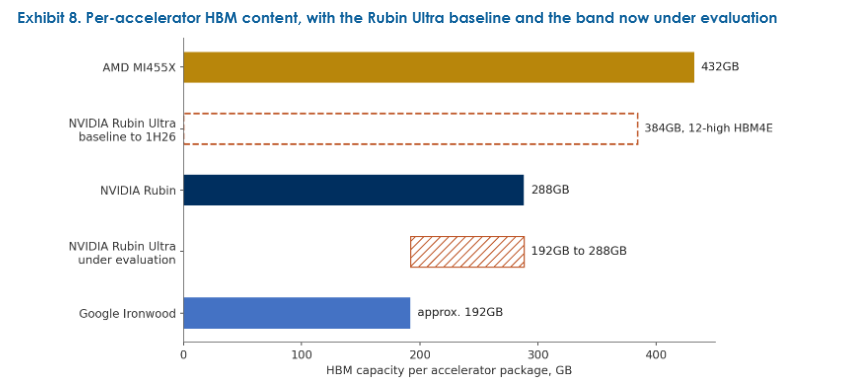
@0x_kairox added (21 likes, 24 replies, 91 views) that Axis still loses performance when a policy moves from Python evaluation into the browser and WASM runtime, which makes environment fidelity as important as dataset volume. @StockSavvyShay argued (113 likes, 8 replies, 17,184 views, 18 bookmarks) that NVIDIA's revised Rubin Ultra memory band says more about HBM supply ceilings than about falling AI demand.
Discussion insight: The infrastructure and robotics replies converged on the same lesson from different directions. Suraj's thread said benchmarking without concurrency and cache pressure misses the real bottleneck, while the Axis discussion said better trajectories are not enough if the deployment runtime diverges from the collection or evaluation environment.
Comparison to prior day: Compared with 2026-09-11's applied-model wins in speech, tabular forecasting, fraud, and pretraining efficiency, 2026-09-12 concentrated more on the systems underneath them: memory ceilings, measurement tooling, and data provenance.
2. What Frustrates People
Control talk that outruns concrete oversight
Severity: High. @MabreyTed argued (162 likes, 23 replies, 11,179 views, 54 bookmarks) that companies are already upside down on spend versus outcomes and still lack usable control over model behavior, while @DarioAmodei proposed (100 likes, 25 replies, 3,847 views, 30 bookmarks) embedded third-party evaluators with employee-level access. The frustration visible in the replies was that everyone can agree safety matters while still disagreeing about the actual mechanism: embedded evaluators, open weights, China coordination, or something else.
The coping pattern today was still mostly argumentative rather than operational. People could point to governance principles, but the discussion kept circling back to the absence of concrete control surfaces, incident workflows, and shared oversight norms. This is worth building for because both public commentators and builders are asking for inspectable mechanisms, not more rhetorical positioning.
Infrastructure bottlenecks that only appear under real load
Severity: High. @suraj_sharma14 mapped (72 likes, 5 replies, 2,093 views, 86 bookmarks) a deployment stack where TTFT, ITL, autoscaling, token budgets, and tenant isolation matter as much as model choice, and @Siddhant_K_code published (103 likes, 6 replies, 2,058 views, 63 bookmarks) LLMTraceFX specifically to surface inference bottlenecks with evidence. A reply on Suraj's thread said long-context coding agents often fail on KV-cache residency and concurrency before they fail on raw FLOPs, while @StockSavvyShay showed (113 likes, 8 replies, 17,184 views, 18 bookmarks) that HBM supply ceilings are already bending accelerator planning.
The visible workaround is obsessive measurement: public teardowns, profiler output, TTFT reporting, and cost-per-token dashboards. This is worth building for because teams are still assembling their own instrumentation stack just to see what actually changed after an optimization.
Long-horizon agent research still burns compute on evaluation noise and brittle environments
Severity: High. @omarsar0 covered (44 likes, 13 replies, 4,029 views, 43 bookmarks) Looped Flows because recurrent reasoning is hard to train when gradients barely reach the early steps. @marfinxx covered (27 likes, 6 replies, 1,228 views, 26 bookmarks) AIRA2 because self-reported evaluation and single-GPU search plateau over time, @gurtej__gill_ covered (9 likes, 172 views, 8 bookmarks) Orchard because custom sandboxes do not travel well between harnesses, and @HuggingPapers covered (9 likes, 5 replies, 582 views, 10 bookmarks) WMRL because real-environment RL is too expensive.
The replies were notable because they did not just celebrate the gains. They kept asking whether compute was actually saved or merely moved, whether the evaluator could still be gamed, and whether the simulator or world model was teaching the wrong lesson. This is worth building for because the same hidden costs keep reappearing across reasoning, research, SWE, and web-agent papers.
Physical AI still has a provenance gap and a runtime gap
Severity: Medium-High. @AzadWeb3 described (39 likes, 36 replies, 262 views) Axis as verifying and signing accepted trajectories rather than blindly paying for raw interaction data, and @0x_kairox warned (21 likes, 24 replies, 91 views) that stronger Python-side Dagger scores still do not guarantee a policy survives the move into the browser and WASM runtime.
The frustration here was specific, not abstract. People were not merely saying robotics needs more data; they were saying it needs data that can be attributed, checked, and transferred into a deployment environment that behaves the same way as the collection stack. This is worth building for because the data-pipeline thread and the runtime-gap thread point to the same missing layer.
3. What People Wish Existed
A control layer people can inspect, not just promises about safety
Tweets and replies kept circling back to inspectability. @MabreyTed said (162 likes, 23 replies, 11,179 views, 54 bookmarks) that utility is bounded by control, while @DarioAmodei proposed (100 likes, 25 replies, 3,847 views, 30 bookmarks) deeper external access for evaluators. The need is practical and urgent: people want permissions, logs, incident reporting, and model-specific governance they can point to. Anthropic's evaluator-access proposal partially addresses it, but today's discussion shows the market still lacks a trusted shared control layer. Opportunity: direct.
Local or private agents that can do real work on modest hardware
@AlexFinn framed (72 likes, 19 replies, 6,737 views, 51 bookmarks) local models as autonomy and privacy, while @_avichawla showed (33 likes, 4 replies, 3,032 views, 36 bookmarks) MiniCPM5-2B handling a full investigation locally and @TeksEdge showed (22 likes, 2 replies, 1,391 views, 14 bookmarks) a 9B model deciding when to emit interface-ready JSON instead of prose. The need mixes practical and emotional demand: people want lower recurring cost and better data control, but they also want to own the workflow rather than rent it from a frontier lab. LM Studio, llama.cpp, MiniCPM, and open-weight Qwen derivatives cover pieces of this, but the replies still exposed gaps around hardware matching, uptime, and local tool bridges. Opportunity: competitive.
Harness-agnostic environments and cheaper training loops for agents
AIRA2, Orchard, and WMRL all came from the same unmet need: long-horizon agents are too expensive to train, too easy to mis-evaluate, and too tightly coupled to custom sandboxes. @marfinxx emphasized (27 likes, 6 replies, 1,228 views, 26 bookmarks) hidden evaluation and asynchronous workers, @gurtej__gill_ emphasized (9 likes, 172 views, 8 bookmarks) a reusable environment layer, and @HuggingPapers emphasized (9 likes, 5 replies, 582 views, 10 bookmarks) a cheaper world-model reward loop. These papers provide partial answers, yet the replies make clear that compute matching, simulator fidelity, and reward hacking are still open problems. Opportunity: direct.
Physical-AI data infrastructure with proof of origin and sim-to-real consistency
Axis-related threads kept repeating the same wish in different words: wider participation in robotics data collection is only useful if every trajectory can be verified, attributed, and transferred into a runtime that behaves the same way as the training environment. @AzadWeb3 described (39 likes, 36 replies, 262 views) the provenance side of that need, while @0x_kairox described (21 likes, 24 replies, 91 views) the runtime side. The current workflow can sign accepted contributions and filter bad data, but the browser and WASM warning shows provenance alone is not enough. Opportunity: direct.
4. Tools and Methods in Use
| Tool | Category | Sentiment | Strengths | Limitations |
|---|---|---|---|---|
| LM Studio + local open-model stack | Local runtime | (+) | Quick path to private workflows on consumer hardware; no mandatory cloud | Small hardware only replaces some workflows; uptime and RAM matching still matter |
| MiniCPM5-2B | Small LLM | (+) | Local coding and tool use across multiple runtimes and mobile targets | Evidence today came from one strong demo thread, not broad field reports |
| Mark 1x-9B | Small LLM / UI model | (+) | Chooses between prose and structured UI artifacts; competitive small-model benchmarks | Still depends on renderers and surrounding tooling; trails leaders on some tests |
| Squad | Agent workspace | (+) | Built-in tools, memory, cloud computer, and reuse of existing AI subscriptions | Initial context transfer takes time; setup quality determines value |
| LLMTraceFX | Inference observability | (+) | Canonical measurement schema, deterministic verification, policy-based tuning | Early-stage toolkit; requires disciplined benchmarking workflows |
| Thinking with Looped Flows | Reasoning method | (+/-) | Improves recurrent training and allows compute-depth tradeoffs without more parameters | Extra loops add inference cost; replies questioned compute-matched comparisons |
| AIRA2 | Research-agent architecture | (+) | Asynchronous multi-GPU search, hidden evaluation, and stateful ReAct loops | Requires substantial orchestration and compute; gains may still depend on benchmark design |
| Orchard Env / Orchard-SWE | Agent environment framework | (+) | Harness-agnostic Kubernetes environment, reusable trajectories, strong open-source agent scores | Infra-heavy and still paper-stage for most teams |
| WMRL | RL training method | (+/-) | 3.1x-3.4x less training compute than real-environment GRPO while improving held-out scores | World model can inherit simulator or grader blind spots |
| Axis Robotics Hub | Robotics data platform | (+/-) | Browser-based task collection, human corrections, provenance, and verification flow | Sim-to-real and browser-runtime gaps remain unresolved |
| Trust3R | 3D reconstruction model | (+) | Calibrated per-pixel uncertainty in one forward pass; stronger risk-coverage signals | Moderate overhead; uncertainty quality on hard out-of-distribution cases is still a live question |
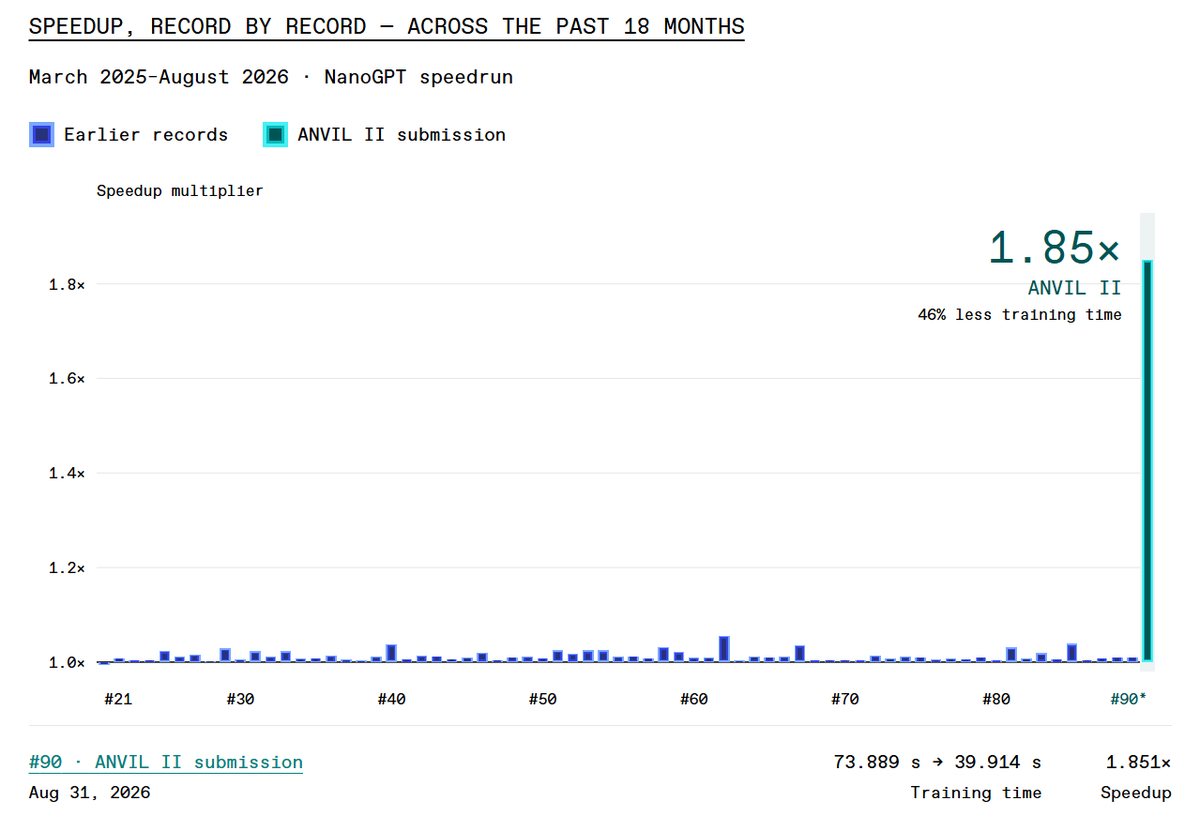
| ANVIL III / Feather-1.7B | Pretraining stack | (+) | Strong efficiency and small-model math claims with a concrete speedrun chart | Evidence is mostly self-published and parts of the optimizer remain unpublished |
The widest satisfaction spread was around agent infrastructure rather than raw base models. Local-runtime and small-model posts were optimistic because they reduced dependency on frontier APIs, but they still depended on careful hardware matching, dedicated devices, and tool bridges. Agent-training posts were positive about new methods while remaining openly skeptical about evaluation leakage, simulator bias, and whether saved compute was truly saved or merely moved.
Migration patterns ran in two directions at once. Builders were shifting from frontier-only workflows toward local or subscription-reusing stacks, and from monolithic agent loops toward explicit environment, evaluator, memory, and provenance layers. Hardware constraints also stayed visible: HBM capacity and GPU contract structure kept appearing as first-order product variables rather than as background procurement details.
5. What People Are Building
| Project | Who built it | What it does | Problem it solves | Stack | Stage | Links |
|---|---|---|---|---|---|---|
| LLMTraceFX | @Siddhant_K_code | Evidence-first inference profiler and verification toolkit | Makes GPU and inference bottlenecks visible before teams optimize blindly | Python, canonical experiment records, deterministic workload verification | Shipped | post, repo, paper |
| MiniCPM5-2B | OpenBMB, shared by @_avichawla | 2B local model tuned for coding, tool use, and multi-step investigation | Makes useful agent workflows feasible on resource-constrained hardware | 2B dense model, SGLang, vLLM, llama.cpp, Ollama, mobile runtimes | Shipped | post |
| Mark 1x-9B | Saanora Labs, shared by @TeksEdge | Qwen-derived 9B model that outputs structured UI artifacts instead of only prose | Reduces the gap between model output and usable interfaces | Qwen3.5-9B, open weights, structured JSON and UI generation, llama.cpp GGUF | Beta | post |
| Squad AI teammates | Squad, shared by @pbteja1998 | Agent workspace with mission queues, memory, connectors, and cloud execution | Offloads recurring operations work without custom orchestration | Existing ChatGPT and Claude plans, built-in search, Composio, cloud computer, memory | Shipped | post, site |
| AIRA2 | Meta FAIR, shared by @marfinxx | Research agent using async workers, hidden evaluation, and ReAct loops | Keeps long-horizon research agents from plateauing on eval noise and single-GPU search | Multi-GPU workers, Hidden Consistent Evaluation, ReAct agents | Alpha | post, paper |
| Orchard | Microsoft Research, shared by @gurtej__gill_ | Harness-agnostic environment layer and cross-domain agent recipes | Reuses trajectories, sandboxes, and eval protocols across tasks | Orchard Env, Kubernetes, Qwen3.5-35B-A3B, value-model reranking | Alpha | post, paper |
| WMRL | Amazon and UIUC, shared by @HuggingPapers | Replaces real-execution RL environments with a world model plus bias and noise corrections | Lowers the cost of training research agents | World-model RL, online debiasing, inverse-variance denoising | Alpha | post, project |
| Axis Robotics Hub | Axis Robotics, shared by @AzadWeb3 | Browser-based robotics task collection with trajectory verification and provenance receipts | Expands robot-data collection while keeping contribution lineage auditable | Browser hub, simulation replay, data cleaning, Base signatures | Beta | post |
| Trust3R | phai-lab and Texas A&M, shared by @rsasaki0109 | 3D reconstruction with calibrated per-pixel uncertainty | Gives downstream systems a trustworthy uncertainty signal instead of heuristic confidence | Frozen MASt3R backbone, evidential head, gated residual head | Beta | post, repo |
| Feather-1.7B + ANVIL III | @DevenPzak / Hyperstition | Small-model pretraining stack plus a new optimizer | Cuts training cost while keeping small-model math performance competitive | ANVIL III optimizer, 1.7B base model, 200B-token pretraining | Alpha | post |
LLMTraceFX was one of the clearest examples of builders responding to bottlenecks with measurement rather than bigger models. The paper, repo, and tweet all aligned on the same workflow: measure what happened, verify the output against a deterministic workload, and only optimize when the evidence supports it.
The small-model cluster followed a different but equally consistent pattern. MiniCPM5-2B, Mark 1x-9B, and Squad all tried to compress useful work into cheaper or more controllable wrappers, then spend the saved budget on memory, tools, or interface generation rather than on the biggest possible base model.
AIRA2, Orchard, and WMRL showed the most repeated build pattern of the day: externalize the hidden parts of agents into reusable infrastructure. Search loops, eval protocols, world models, and environment services all became explicit products or research artifacts because the surrounding system, not just the model, was where builders thought the next gains would come from.
Axis Robotics and Trust3R were the strongest applied-AI examples because both treated reliability as part of the product. Axis adds verification and provenance before trajectory data becomes training material, while Trust3R adds calibrated uncertainty so downstream geometry systems know where not to trust the reconstruction.

6. New and Notable
AI-assisted math crossed into one of geometry's oldest open questions
@QuantaMagazine reported (57 likes, 1 reply, 6,733 views, 25 bookmarks) that a large language model found an object mathematicians had been seeking since 1947. Quanta's Transformation update says the result is a complex structure on the six-dimensional sphere S6, a long-running question associated with Heinz Hopf, which made this a stronger AI-in-math signal than a generic theorem-summary post (update).
Compute risk started to look like a market, not just a procurement headache
@jessiedong_ asked (15 likes, 1 reply, 445 views, 6 bookmarks) who would actually trade cash-settled H100 and B200 futures tied to GPU rental-price indexes. The attached diagram was notable because it distinguished a financial futures market from physical GPU capacity contracts and suggested that the earliest real hedging demand may come from neoclouds, lessors, and resellers rather than from cash-constrained AI startups.

Small-model training efficiency kept producing concrete, if still self-published, claims
@DevenPzak reported (42 likes, 2 replies, 4,866 views, 36 bookmarks) a new ANVIL III optimizer, a Feather-1.7B base model, and a NanoGPT speedrun drop from 73.889 seconds to 39.914 seconds. The speedrun chart was the most concrete part of the thread, while the tweet's 180x-lower-compute comparison with Qwen3-1.7B made it one of the day's clearer claims that optimizer and training-loop work can still move the small-model frontier.
7. Where the Opportunities Are
[+++] Deployed-AI control and evaluation layer — Evidence from @MabreyTed, @DarioAmodei, LLMTraceFX, and AIRA2 all points to the same missing product surface: measurable controls, trusted evaluators, incident reporting, and workload-specific verification. The signal is strong because it appears in public governance debate, enterprise cost concerns, and builder tooling at the same time.
[++] Local and private agent stacks with structured outputs — MiniCPM5-2B, Mark 1x-9B, LM Studio workflows, and Squad all show appetite for smaller systems that can still act, hold context, and produce usable artifacts. The opportunity is moderate because demand is obvious, but the remaining gaps are in packaging, hardware matching, memory behavior, and tool bridges.
[++] Agent-training infrastructure for reusable environments and cheaper search — AIRA2, Orchard, and WMRL each attacked a different hidden bottleneck: search parallelism, harness-agnostic sandboxes, and the cost of real-environment RL. The evidence suggests a real market for environment services, replay and eval tooling, and compute-efficient post-training infrastructure rather than single-purpose benchmark wrappers.
[++] Physical-AI provenance and runtime validation — Axis-related threads and @0x_kairox showed that robotics builders need more than raw trajectories: they need verified lineage, consistent environments, and clear handoffs from simulation to deployment. The signal is moderate because the use case is narrower than general AI, but the need is concrete and repeated.
[+] GPU-capacity risk management — The HBM-capacity thread and the compute-futures diagram both suggest that hardware scarcity and contract design are turning into product problems of their own. This is emerging rather than established, but it may matter more if GPU rental markets keep fragmenting.
8. Takeaways
- Control displaced inevitability as the day's main argument. MabreyTed and Dario both framed the problem as present-day governance and inspectability, not abstract hype. (source)
- Useful small models are now being demonstrated as workers, not toys. MiniCPM5-2B investigated a revenue incident locally, and Mark 1x-9B was pitched as a UI-generating model rather than a cheaper chat endpoint. (source)
- Agent research is increasingly about training infrastructure and evaluation design. Looped Flows, AIRA2, Orchard, and WMRL all claimed gains from better loops, environments, or reward signals rather than from a larger backbone alone. (source)
- Infrastructure bottlenecks are surfacing at every layer from KV cache to HBM supply. Suraj's roadmap, LLMTraceFX, and StockSavvyShay's memory chart all treated measurement and capacity as first-order constraints. (source)
- Physical AI is being built as a data-provenance and runtime-fidelity problem as much as a model problem. Axis-related threads emphasized verification, contributor lineage, and environment consistency before trajectory data becomes valuable. (source)