Twitter AI - 2026-09-17
1. What People Are Talking About
1.1 Safety and autonomy talk only carried weight when it named the control surface 🡕
Across 310 original tweets from 290 authors, the biggest safety and autonomy posts only stayed persuasive when they named a concrete boundary, audit path, or approval rule. @VitalikButerin argued (1,384 likes, 182 replies, 156,612 views, 464 bookmarks) that AI can make cybersecurity defense-favoring by making whole-program formal verification practical, but he also spelled out the catch: teams have to define security across message delivery, key discovery, servers, databases, caches, and even compilers instead of pretending one cryptographic core is the whole system. @esrtweet made (279 likes, 38 replies, 11,217 views, 175 bookmarks) the anti-doom case by treating extinction as a long chain of contestable assumptions rather than a single inevitability, and the strongest replies immediately narrowed the disagreement to product reality: labs are making systems more agentic, so boundaries and intervention points matter more than slogans.
The operational posts translated that same argument into shipping infrastructure. @testingcatalog reported (10 likes, 4 replies, 2,443 views) that Opal Zero maps every agent to a human owner, purpose, and allowed systems, while the quoted launch text says requests are decided just in time and enforced in an existing MCP gateway rather than a separate control plane; the public product page expands that into inventory, risk review, policy reasoning, and gateway enforcement. @cv_usk laid out (3 likes, 4 replies, 84 views) the same control mindset as an architecture pattern: trace IDs across reasoning and tool calls, full prompt storage in object storage, tail-based sampling, and provenance back to source documents and human approvers. Even consumer-agent control arrived wrapped in access policy: @shawnchauhan1 complained (1 like, 127 views) that Google Home MCP gives outside agents device control only behind a $20-per-month Premium Advanced tier, US-only eligibility, and English-only rollout.
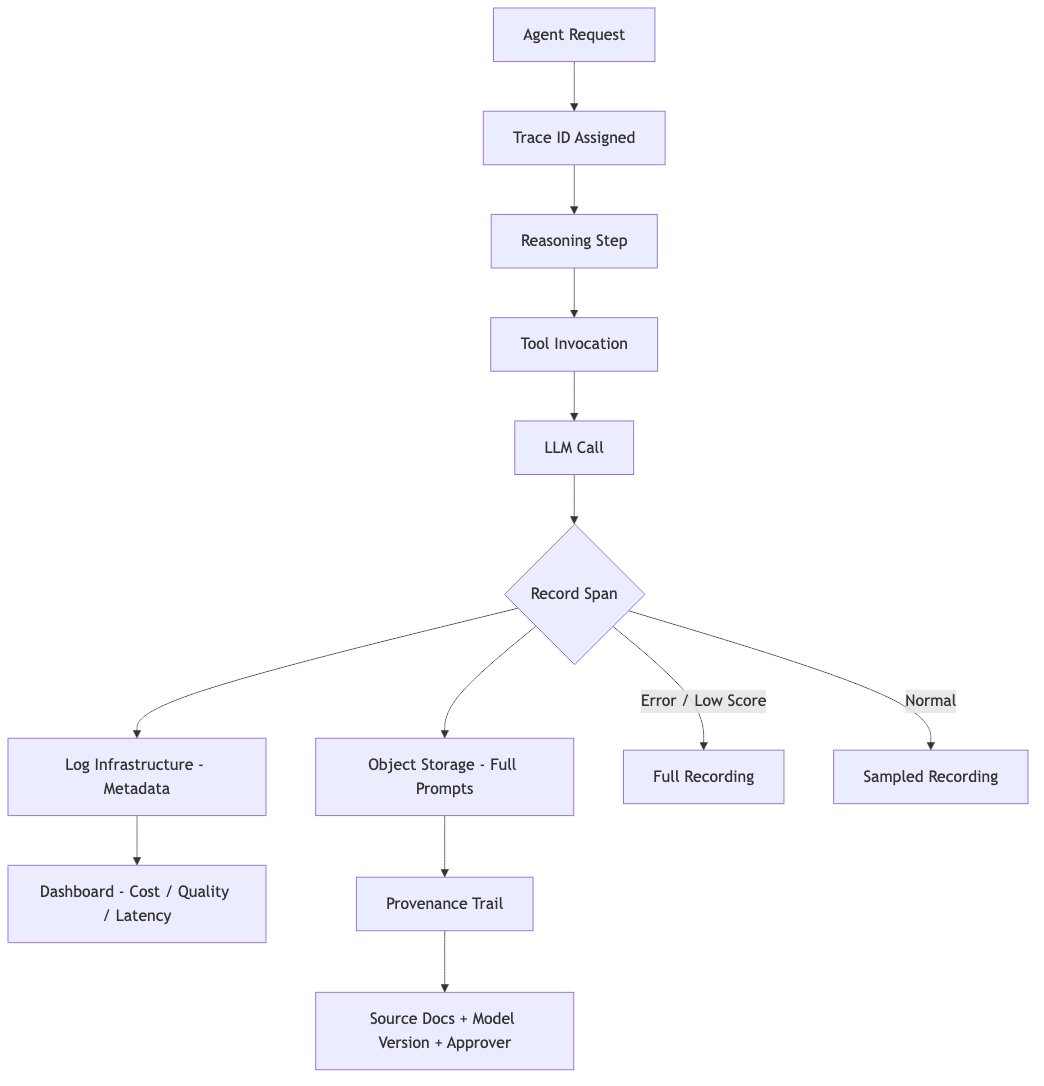
Discussion insight: The practical disagreement was not about whether agents will exist. It was about whether they can be assigned to owners, kept inside least-privilege boundaries, logged well enough for postmortems, and forced to expire access instead of accumulating it.
Comparison to prior day: Compared with 2026-09-16, the conversation was less driven by one concrete breach narrative and more by preventive architecture: proofs, permission envelopes, and traceable decisions.
1.2 Physical AI posts narrowed to hearing failure and fresh 3D capture 🡕
Physical AI discussion kept collapsing onto two missing inputs: speech under real conversational messiness, and up-to-date ground-level geometry that web-scale text or street-level mapping fleets cannot provide. @Timthadon01 highlighted (32 likes, 28 replies, 364 views) BRIDGE ASR 2.0 as a benchmark for 23 models across 23 languages under interruptions, overlapping speakers, and code-switching, and the quoted benchmark text defined it as a six-metric stack for real deployment rather than clean-demo audio. The public BRIDGE page makes the design more specific: WER, CER, MER, WIL, error-type breakdowns, script-fairness handling, and code-switching metrics all run on the same normalized dual-speaker conversations.
@hoodsher55 argued (15 likes, 16 replies, 4,515 views) that physical AI is still starving for data the internet cannot provide, and that Vangrid's more important move is not crypto branding but turning ordinary phones into distributed capture nodes for fresh 3D observations. The public Vangrid docs back the mechanics in the tweet: contributors record short phone videos, those videos are reconstructed into 3D models, and each capture is fingerprinted with coarse location and timestamp before being anchored on Base so buyers can verify provenance instead of trusting a private database.


Discussion insight: Replies did not ask for another robot sizzle reel. They asked whether noisy-speech benchmarks, privacy-safe capture, and provenance checks can turn messy real-world inputs into something reliable enough for training and procurement.
Comparison to prior day: Compared with 2026-09-16's broader “missing data layer” framing, 2026-09-17 split the gap into two sharper requirements: AI that can hear through overlap, and AI that can learn from phone-captured 3D ground truth.
1.3 Open-model attention followed deployability, not bragging rights 🡕
The strongest open-model posts were really about fit-to-machine, fit-to-budget, and fit-to-workflow. @TheAhmadOsman argued (44 likes, 9 replies, 2,912 views, 33 bookmarks) that local AI hardware comparisons break down unless people separate capacity, bandwidth, and software stack, and he laid out a ladder spanning RTX cards, Apple unified memory, DGX Spark, Strix Halo, AMD, Intel, and Tenstorrent. @TeksEdge highlighted (13 likes, 515 views) China Telecom's Xing4.0-29B-A4B as a 29B open model with only 4B active parameters per token, 256K native context extendable to 512K, and official scores such as SWE-bench Verified 75.0 and Terminal-Bench 2.1 57.5; the public README confirms those figures and shows the release was designed around agent and coding tasks.
Actual user choice leaned the same way. @liambraus argued (52 likes, 4 replies, 493 views, 17 bookmarks) that “nobody votes with benchmarks,” and the quoted Bolt post said 54% of users picked GLM 5.3 Flash after open models were offered with up to 50x usage because it was faster, cheaper, and allowed larger prompts. @He1s_Sammy said (19 likes, 10 replies, 684 views) he hit GPT-6 Astra quota limits in three days and started pointing people to Colibri, an open-source local inference engine whose public repo treats storage, RAM, and VRAM as one hierarchy; the most useful reply immediately added the caveat that no-GPU mode shifts the bottleneck to system-memory bandwidth, making giant local models better for overnight batch work than fast interactive coding. @TeksEdge also noted (19 likes, 1,038 views) that Qwen3.8-Omni-Flash pairs 1M context with an agentic video-understanding mode that cut OmniVideoBench query tokens from 145,736 to 79,117 while improving accuracy from 63.4 to 67.8, though he also noted that Alibaba was still serving it as an API product rather than open weights.
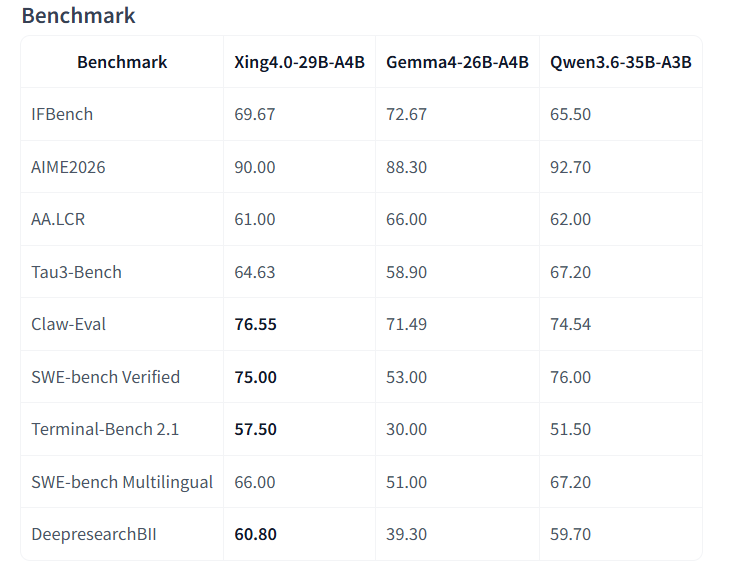
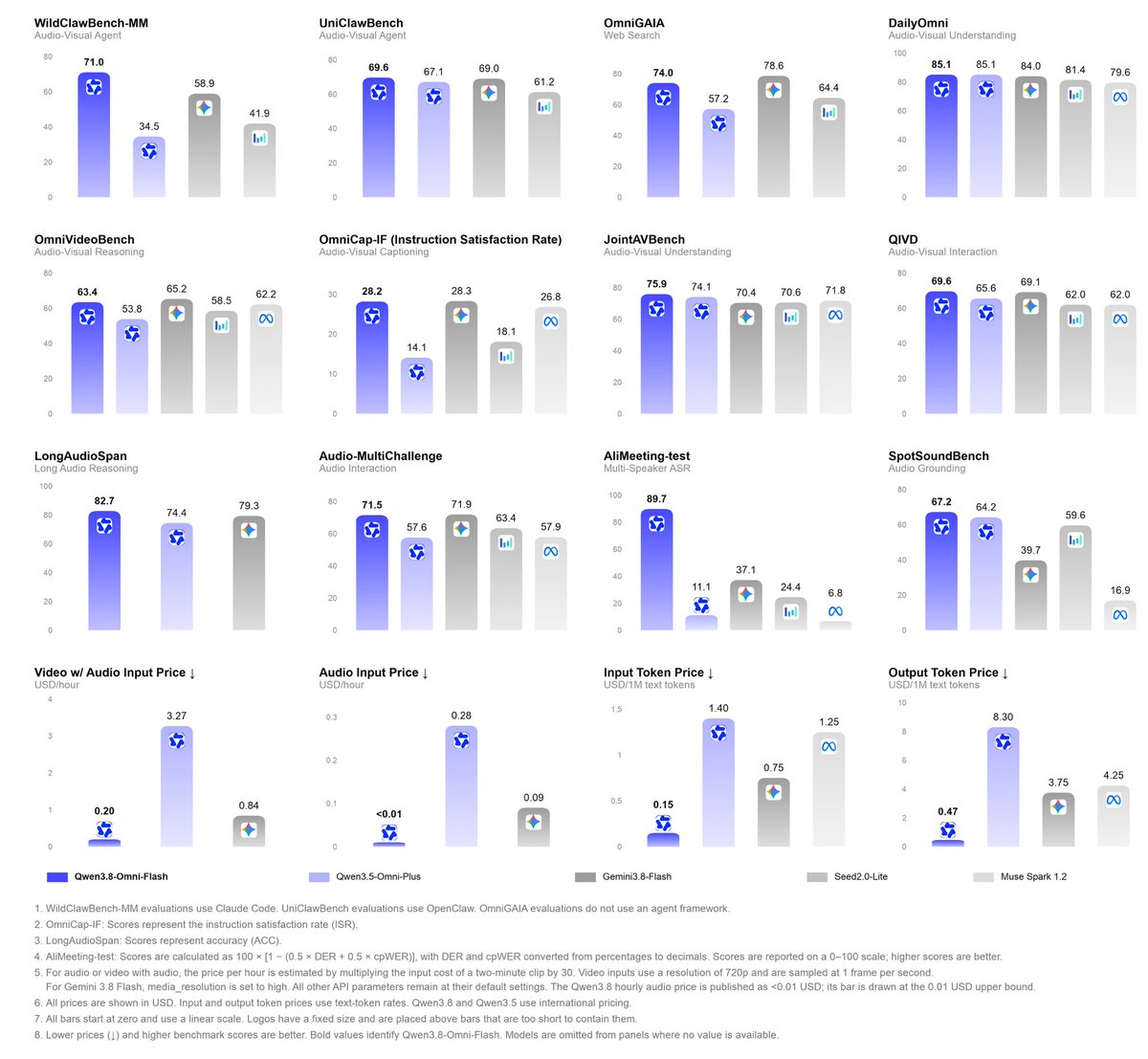
Discussion insight: The replies turned model choice into resource accounting: API-key friction, weekly quota exhaustion, bandwidth ceilings, prompt-size limits, and routing each job class to a different model instead of crowning one universal winner.
Comparison to prior day: Compared with 2026-09-15 and 2026-09-16, open-model talk became even more concrete. The discussion moved from “local and routed models are promising” to “here is what fits on 24 GB, what saturates DDR5, and what users actually pick when the models sit side by side.”
1.4 Scientific and benchmark work won attention when it shipped reusable public artifacts 🡕
Research-heavy posts got traction when they arrived with code, explicit review rubrics, or correctness-based datasets instead of one more abstract claim. @AnthropicAI reported (374 likes, 48 replies, 32,802 views, 117 bookmarks) that Claude optimized more than 30 open-source biology models to run roughly 4x faster on average; the accompanying blog post and repo make that concrete with 36 open optimization kits, a low-memory “Big” mode for systems above 10,000 tokens on one NVIDIA GPU node, and a wet-lab-backed protein design competition. @PhAILabs reported (4 likes, 971 views) that ScienceIDE turns verified scientific trajectories into supervision for PhAI-IDE models, lifting a held-out PLUTO-Particles-Dust verifier reward from 0 to 0.333 and improving selected independent confirmation tasks such as CodeXGLUE defect detection from 45.93% to 52.92%.
Benchmark trust itself also looked more like a product category than a side complaint. @EpochAIResearch announced (18 likes, 697 views) Benchmark Reviews, and the public documentation names the launch set: four benchmarks marked Verified, nine marked Flawed, and two marked as lacking enough information. That public labeling mattered because the day's lower-signal benchmark posts kept making the same demand from the other side: domain-specific tasks, real failure analysis, and explicit caveats when results have not been independently reproduced.

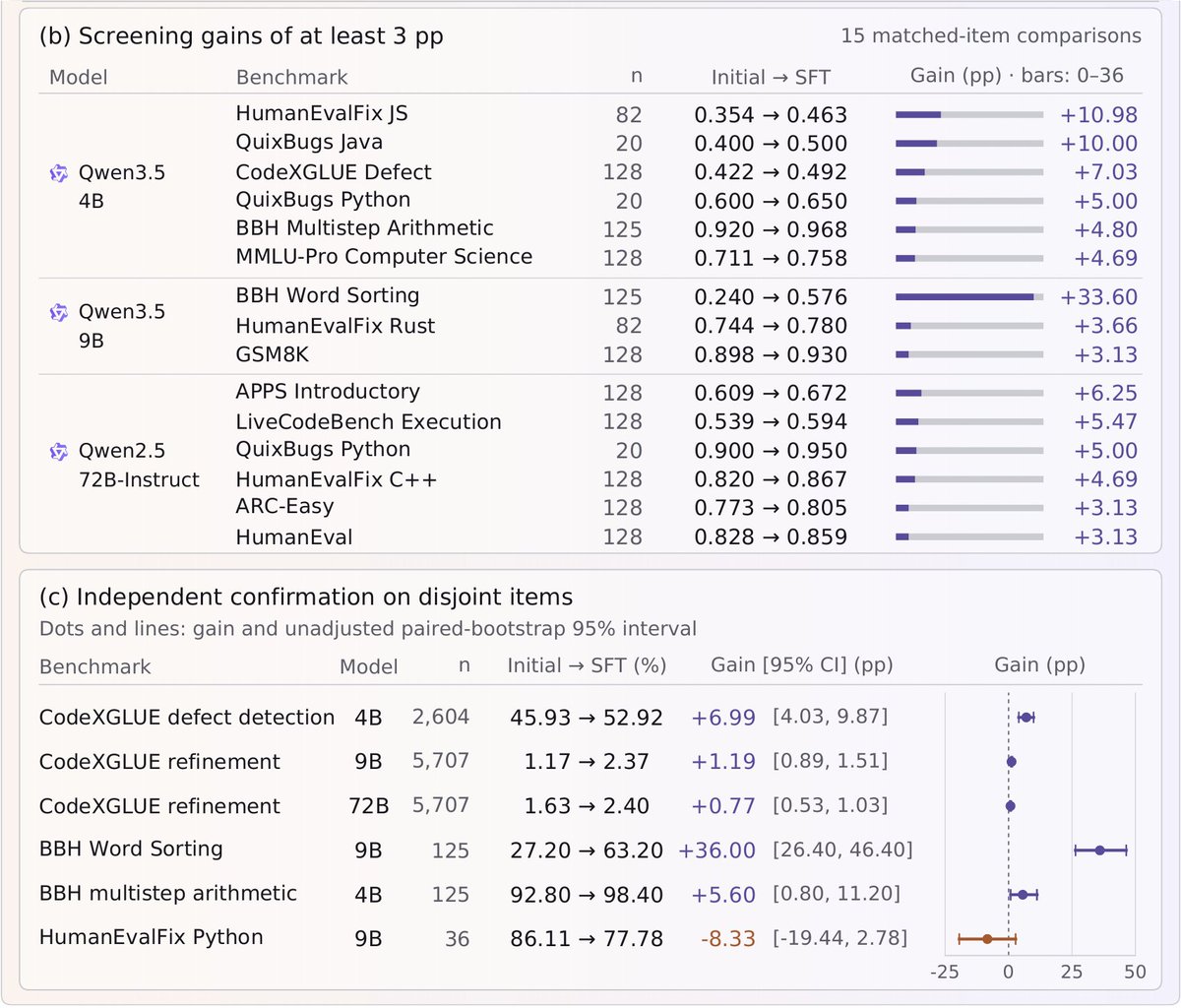
Discussion insight: The strongest science and benchmark posts either published code, released a review rubric, or showed transfer numbers with caveats. Even enthusiastic model-release threads increasingly paused to say which numbers were official, which were unreproduced, and where performance still varied by task.
Comparison to prior day: Compared with 2026-09-16's biology-model and evaluator-trust discussion, 2026-09-17 pushed further toward public infrastructure: open kits, verifiable scientific trajectories, and benchmark audits with named verdicts.
2. What Frustrates People
Agent deployments that still need human trust because the control plane is incomplete
The day's enterprise-agent posts kept pointing at the same missing layer: agents may be capable enough to act, but most teams still do not have default-safe ways to decide, constrain, and reconstruct those actions. @testingcatalog reported (10 likes, 4 replies, 2,443 views) that Opal Zero exists because agents need owners, purposes, just-in-time access, and expiring permissions rather than standing privileges. @cv_usk argued (3 likes, 4 replies, 84 views) that every production agent should emit reasoning traces, tool invocations, costs, eval scores, and provenance back to source documents and human approvers, while @VitalikButerin warned (1,384 likes, 182 replies, 156,612 views, 464 bookmarks) that verifying only the small part of a system you call “security-critical” is exactly how surrounding components sink the whole thing.
Severity: High. People are coping with manual approvals, scoped policies, tail-sampled traces, and human escalation, but the repeated insistence on owner mapping, expiring access, and post-hoc accountability suggests this is one of the clearest products worth building for.
Benchmarks that summarize performance but hide the real failure mode
Twitter's evaluation frustration was not “we need more benchmarks.” It was “the current ones still collapse too much information.” @Timthadon01 highlighted (32 likes, 28 replies, 364 views) BRIDGE ASR 2.0 precisely because it tests overlap, interruptions, and code-switching that clean-audio leaderboards miss, and the public benchmark page exposes error types instead of one blended score. @EpochAIResearch announced (18 likes, 697 views) Benchmark Reviews and then publicly labeled four benchmarks Verified, nine Flawed, and two unreviewable without enough information. Even model-release boosters felt the same pressure: @TeksEdge explicitly refused (13 likes, 515 views) to repeat a 152 tok/s claim for Xing4.0 on an RTX 3090 because the referenced PR did not actually identify the hardware used.
Severity: High. Teams are coping by publishing richer metrics, releasing review rubrics, and caveating official numbers, but the number of posts devoted to auditability shows that benchmark trust is still a live pain point and a strong building opportunity.
Local and open models are attractive, but deployability still lives and dies on bandwidth, storage, and quotas
The open-model conversation sounded practical because people kept describing the part that hurts. @TheAhmadOsman argued (44 likes, 9 replies, 2,912 views, 33 bookmarks) that capacity only tells you what fits, while bandwidth tells you whether the box can actually “breathe.” @He1s_Sammy said (19 likes, 10 replies, 684 views) he was switching from a $200-per-month subscription to Colibri because there was “no token bill” and “no dependency on an API,” but the best reply immediately noted that no-GPU mode pushes the bottleneck into DDR5 and can make giant local models painful for interactive work. @liambraus summarized (52 likes, 4 replies, 493 views, 17 bookmarks) the same frustration from the other side: users choose the session that does not stall and does not drain the budget mid-project, not the model with the nicest benchmark story.
Severity: High. Common workarounds are model routing, quantization, local APIs, and hardware-specific planning, but the frequency of these posts suggests there is still room for better planners, quota awareness, and workflow-aware local deployment tools.
Physical AI still lacks fresh, verifiable world data and messy speech data
The physical-AI frustration was upstream of the model. @hoodsher55 said (15 likes, 16 replies, 4,515 views) that “you can't scrape the physical world,” which is why fresh 3D capture has to come from people and devices in the field rather than from existing web corpora. @Timthadon01 made (32 likes, 28 replies, 364 views) the parallel complaint on the audio side: models that look competent on clean speech can still fail once people interrupt each other or switch languages mid-sentence. The replies added the two missing qualifiers that showed up repeatedly today: the data has to stay privacy-safe, and the provenance has to be inspectable.
Severity: Medium-high. People are coping with narrower benchmarks and new capture networks, but neither the speech side nor the spatial-data side looks mature enough yet to count as solved infrastructure.
3. What People Wish Existed
Agent permission and provenance systems that work by default
What people kept asking for was not “more agent autonomy.” It was agent autonomy with owners, purpose limits, expiry, and reconstructable evidence. @testingcatalog reported (10 likes, 4 replies, 2,443 views) that Opal Zero assigns owners, scopes requests, and expires access, while @cv_usk said (3 likes, 4 replies, 84 views) production agents need trace IDs, tool-level observability, and provenance back to source documents and human approvers. This is a practical need, and the urgency is high because the current coping strategy is still manual policy review and logging after the fact. Partial answers exist today in Opal Zero, existing observability platforms, and Google Home MCP's permission model, but the market still looks wide open. Opportunity: direct.
Benchmarks that explain failure type instead of handing back one number
The appetite was clearly for evaluation systems that reveal what broke, not just where a model ranked. @Timthadon01 highlighted (32 likes, 28 replies, 364 views) BRIDGE ASR 2.0 because overlap, code-switching, and interruptions are where production ASR actually fails, and the public benchmark page exposes error classes rather than a single averaged score. @EpochAIResearch announced (18 likes, 697 views) a review framework that marks benchmarks Verified, Flawed, or too opaque to judge, while @TeksEdge refused (13 likes, 515 views) to overclaim an unreproduced throughput number for Xing4.0. This is a practical and urgent need, and today's public reviews and richer metric stacks only partially address it. Opportunity: direct.
Local and open model stacks that understand hardware, storage, and budget limits
People want model stacks that understand the actual machine and the actual budget, not just parameter counts. @TheAhmadOsman argued (44 likes, 9 replies, 2,912 views, 33 bookmarks) that buyers should ask what must fit, what bandwidth tier they need, and what software stack they trust; @He1s_Sammy looked for (19 likes, 10 replies, 684 views) “no token bill” and “no dependency on an API”; and @liambraus summarized (52 likes, 4 replies, 493 views, 17 bookmarks) that actual users pick the model that does not stall or get expensive mid-session. This is a practical need with clear cost pressure. Colibri, Bolt, and sparse open models like Xing4.0 are partial answers, but the problem is now competitive rather than solved. Opportunity: competitive.
A scalable, privacy-safe ground-truth data layer for physical AI
The physical-AI threads implied a need that is both technical and infrastructural: a steady supply of fresh, verifiable speech and 3D captures from the real world. @hoodsher55 said (15 likes, 16 replies, 4,515 views) that “you can't scrape the physical world,” and @Timthadon01 framed (32 likes, 28 replies, 364 views) the audio side as the shift from perfect recordings to overlapping, interrupted, multilingual speech. Vangrid and BRIDGE are early answers, but the urgency is still medium-high because both supply and verification remain sparse. Opportunity: aspirational.
Reusable scientific environments where correctness comes from execution, not taste
The science posts showed demand for domain-specific environments where the reward signal is whether the work actually computes, predicts, or validates correctly. @AnthropicAI shared (374 likes, 48 replies, 32,802 views, 117 bookmarks) optimization kits that cut biology-model inference cost enough to widen access, while @PhAILabs argued (4 likes, 971 views) that verified scientific trajectories can transfer into better held-out scientific-code repair and selected general benchmarks. This is a practical need for labs and scientific-software teams, though it is narrower than general consumer AI. Partial answers now exist in Anthropic's kits and ScienceIDE. Opportunity: direct.
4. Tools and Methods in Use
| Tool | Category | Sentiment | Strengths | Limitations |
|---|---|---|---|---|
| Jev / TypeSafe AI | Decision model | (+/-) | Typed answers, probabilities, confidence scores, and fast structured outputs that slot into software workflows | Text-only, does not generate code or explanations, and at least one reply flagged US-only SaaS availability |
| Opal Zero | Access governance | (+/-) | Owner mapping, just-in-time scoped access, expiring permissions, enforcement in existing MCP gateways | Newly launched, still depends on policy quality and log review, general availability not until end of September |
| BRIDGE ASR 2.0 | Benchmark | (+) | Real dual-speaker multilingual audio, overlap and code-switching coverage, error-type metrics beyond one score | It diagnoses failure modes but does not fix them, and public adoption is still early |
| Vangrid | Physical data layer | (+/-) | Turns phones into capture nodes, reconstructs 3D data, adds provenance and bounty-driven demand signals | Human capture quality varies, privacy questions remain, and network effects are still required |
| Qwen3.8-Omni-Flash | Multimodal model | (+/-) | 1M context, agentic video search, lower audio/video token costs, multimodal office-work coverage | Shared as an API product with no open weights noted in the tweet |
| Xing4.0-29B-A4B | Open model | (+/-) | 4B active parameters per token, long context, strong official coding and agent scores, quantized local path | Benchmark table is official rather than independently reproduced, and framework support was still in PR branches |
| Colibri | Local inference engine | (+/-) | Local access to frontier MoE models, no API dependency, unified storage/RAM/VRAM hierarchy | Massive storage requirements, experimental performance profile, and no-GPU mode can be too slow for interactive use |
| GLM 5.3 Flash on Bolt | Hosted model | (+) | Won actual usage by being fast, cheap, and prompt-friendly inside a shared picker | Real-world preference is specific to Bolt's environment and may not transfer to every workload |
| micro1 Cortex | Evaluation platform | (+/-) | Expert human judgment on real workflows, failure diagnosis, post-launch monitoring, Azure procurement path | Human evaluation is slower and more expensive than fully automated benchmark loops |
Overall satisfaction skewed toward tools that constrained behavior or compute rather than promising abstract capability. The positive posts were about typed decisions, real-world benchmarks, cheap-enough multimodal processing, and faster or more practical deployment. Mixed sentiment appeared when a tool solved one bottleneck but exposed another: Jev is structured but narrow, Colibri removes API dependence but shifts pain into storage and bandwidth, Vangrid promises fresh data but must standardize noisy capture, and Opal Zero or micro1 add safety and evaluation at the cost of extra policy or human-review overhead.
The dominant workaround pattern was multi-layered. Builders route different tasks to different models, trace every important request, and separate fast metadata from expensive raw prompt storage. That is why OpenTelemetry-style traces plus Langfuse, LangSmith, or Arize dashboards showed up as the operational counterpart to model choice: the workflow now matters at least as much as the model.
5. What People Are Building
| Project | Who built it | What it does | Problem it solves | Stack | Stage | Links |
|---|---|---|---|---|---|---|
| Uplifting biomolecular modeling | Anthropic | Open optimization kits for biomolecular models plus a protein-design competition | Makes specialized biology models cheap and fast enough to run more broadly | Claude-assisted GPU optimization, 36 public kits, technical report, Proteinbase competition | Shipped | post (374 likes, 48 replies, 32,802 views, 117 bookmarks); blog; repo |
| BRIDGE ASR 2.0 | Humyn Labs | Real-world ASR benchmark across 23 models and 23 languages | Exposes overlap, interruption, and code-switching failures hidden by clean-audio leaderboards | Dual-speaker conversation set, six-metric stack, error taxonomy, code-switching analysis | Shipped | post (32 likes, 28 replies, 364 views); site |
| Opal Zero | Opal Security | Access-governance layer for AI agents | Replaces standing permissions with owner-mapped, just-in-time, expiring access decisions | Paladin policy reviewer, MCP gateway enforcement, inventory and risk layers | Launching | post (10 likes, 4 replies, 2,443 views); site |
| Jev / System One | TypeSafe AI | Decision-native model that returns typed outputs, probabilities, and confidence | Replaces brittle text parsing inside security and workflow automation | System One docs, structured output schema, calibrated confidence, API integration | Early access | post (29 likes, 5 replies, 3,101 views, 26 bookmarks); docs; site |
| micro1 Cortex | micro1 | Human-expert agent evaluation stack sold through Azure Marketplace | Helps enterprises diagnose why agents fail in real workflows and monitor drift | Expert human review, workflow evals, targeted training data, Azure procurement path | Shipped | post (39 likes, 6 replies, 1,513 views, 9 bookmarks) |
| Vangrid capture pipeline | Vangrid | Phone-based capture and provenance pipeline for spatial data | Creates fresher, verifiable 3D physical-world data without a dedicated sensor fleet | Smartphone video, 3D reconstruction, fingerprinting, Base anchoring | Beta | post (15 likes, 16 replies, 4,515 views); docs |
| Xing4.0-29B-A4B | XingChen AGI | Sparse open model for coding and agent work | Offers a long-context open model with lower active-parameter cost per token | 29B total parameters, 4B active, MindSpore training, GGUF quantization path | Shipped | post (13 likes, 515 views); repo |
| Colibri | JustVugg | Local inference engine for frontier MoE models | Escapes hosted quotas and API dependence for large local runs | Pure C engine, local APIs, storage/RAM/VRAM hierarchy | Shipped | post (19 likes, 10 replies, 684 views); repo |
| ScienceIDE / PhAI-IDE | PhAI Labs | Verified scientific trajectories reused to train domain models | Supplies execution-grounded supervision instead of generic assistant dialogue | Verified trajectories, supervised fine-tuning, model family from 4B to 72B | Research | post (4 likes, 971 views) |
The strongest build pattern was infrastructure around model use, not just bigger models. Opal, micro1, BRIDGE, and Jev all tighten the control surface around decisions, permissions, or evaluation. Anthropic, Vangrid, ScienceIDE, and Colibri tighten a different constraint: what data, hardware, or domain artifacts are required before a capable model is actually useful.
This also explains why several lower-engagement project posts still mattered. They were not competing for mass consumer attention. They were exposing the operational layers that increasingly decide whether AI systems are trusted, adopted, and affordable.
6. New and Notable
Benchmark Reviews made benchmark criticism legible and public
@EpochAIResearch announced (18 likes, 697 views) a framework that labels benchmarks Verified, Flawed, or too undocumented to review. That mattered because it turned a common complaint into a named public artifact with specific verdicts instead of vague skepticism.
Qwen3.8-Omni-Flash made multimodal progress feel like a token-economics story
@TeksEdge highlighted (19 likes, 1,038 views) Qwen3.8-Omni-Flash not because “omni” branding is new, but because the reported gain came with a concrete systems tradeoff: fewer tokens per video query while improving accuracy. That is a more durable story than raw feature count because it maps directly to deployment cost.
C2C was one of the few genuinely new coordination ideas in the feed
@thesupermannx shared (21 likes, 4 replies, 1,264 views, 15 bookmarks) Cache-to-Cache communication as a way for models to exchange KV-cache state directly instead of translating everything through text. Whether it generalizes broadly is still open, but it stood out because it proposed a machine-native multi-model interface and shipped a public repo alongside the claim.
Google Home MCP showed consumer agent control arriving as a gated platform layer
@shawnchauhan1 argued (1 like, 127 views) that Google's Home MCP rollout is a closed-platform move because it puts home-device control for outside agents behind a premium subscription and regional restrictions. Even at low engagement, that post mattered as an early warning that consumer agent infrastructure may arrive metered first and standardized later.
7. Where the Opportunities Are
[+++] Auditable agent control planes and evidence bundles — Sections 1, 2, 4, and 5 all pointed to the same operational gap: owners, purpose tags, expiring access, trace IDs, provenance, and reviewable logs for every important agent action. Opal Zero and the cv_usk tracing pattern show partial answers, but the demand still looks direct and urgent.
[+++] Benchmark review, failure-taxonomy, and reproducibility services — BRIDGE ASR 2.0, Benchmark Reviews, and even cautious Xing4.0 discussion all show that teams increasingly care how a model fails and whether the claim survives inspection. The opportunity is not just more evals. It is eval infrastructure that developers, buyers, and researchers can all trust.
[++] Hardware-aware routing, quota planning, and local deployment software — The local-model conversation was full of quota pain, API-key friction, prompt limits, and memory-bandwidth tradeoffs. The next useful layer is software that decides when to use local sparse models, when to pay for hosted multimodal calls, and how to avoid stalling a workflow halfway through.
[++] Provenance-first physical-world data supply chains — Vangrid and BRIDGE imply that physical AI still needs better upstream evidence: fresh speech, fresh 3D capture, privacy-aware collection, and machine-readable provenance. This looks more infrastructure-heavy than app-like, but that also makes it durable.
[++] Scientific infrastructure built on verified trajectories and cheaper domain inference — Anthropic's optimization kits and ScienceIDE's verified trajectories both show appetite for domain systems where correctness comes from execution, validation, or lab outcomes. This is narrower than generic chat AI, but the need is real and the current tooling is still early.
8. Takeaways
- The day's center of gravity shifted from abstract capability talk to control surfaces. @VitalikButerin argued (1,384 likes, 182 replies, 156,612 views, 464 bookmarks) for full-program verification, while @testingcatalog described (10 likes, 4 replies, 2,443 views) owner-mapped, expiring access for agents. The throughline was that useful autonomy now depends on precise boundaries and reconstructable evidence.
- Benchmark legitimacy is becoming a product category of its own. @Timthadon01 surfaced (32 likes, 28 replies, 364 views) a benchmark built around real failure conditions, and @EpochAIResearch launched (18 likes, 697 views) public benchmark audits with named verdicts. People increasingly want inspection, not just leaderboard positions.
- Open-model adoption followed deployability, not prestige. @liambraus summarized (52 likes, 4 replies, 493 views, 17 bookmarks) the practical rule that users vote for the session that does not stall or drain the budget, while @TheAhmadOsman explained (44 likes, 9 replies, 2,912 views, 33 bookmarks) why bandwidth and software stack matter as much as memory size. The winning story was fit-to-workflow.
- Physical AI conversation kept moving upstream into missing data and messy perception. @hoodsher55 argued (15 likes, 16 replies, 4,515 views) that the physical world cannot be scraped into existence, and @Timthadon01 pointed to (32 likes, 28 replies, 364 views) overlap and code-switching as the hearing problem labs still gloss over. The demand was for fresher ground truth, not more hype.
- The strongest builder signals came from reusable public artifacts. @AnthropicAI shared (374 likes, 48 replies, 32,802 views, 117 bookmarks) open biomolecular optimization kits, @PhAILabs shared (4 likes, 971 views) verified scientific trajectories and transfer results, and @thesupermannx shared (21 likes, 4 replies, 1,264 views, 15 bookmarks) a public C2C repo. Shipping inspectable code or inspectable methodology mattered more than grand positioning.