Twitter AI - 2026-09-23
1. What People Are Talking About
1.1 Jev and other small decision layers moved from curiosity to build kits 🡕
About 25 non-retweets matched the Jev / decision-model cluster on 2026-09-23, up from roughly 16 on 2026-09-22. The qualitative shift mattered more than the volume bump: instead of asking what Jev is, people published implementation articles, cheat sheets, routing demos, and bounded GUI-decision releases that treated fast typed selection as a separate layer from the larger model that writes or plans.
@Av1dlive posted (93 likes, 29 replies, 12,223 views, 151 bookmarks) a Jev build article and then pointed people in replies to Keel, an open-source Rust coding workspace that routes fresh tasks through either a local Laya selector or hosted Jev while keeping host-owned permission checks. That combination mattered because it turned Jev from a benchmark talking point into a real coding-loop design: ACP-connected agents, bounded selection, and decision records that can be inspected after the fact.
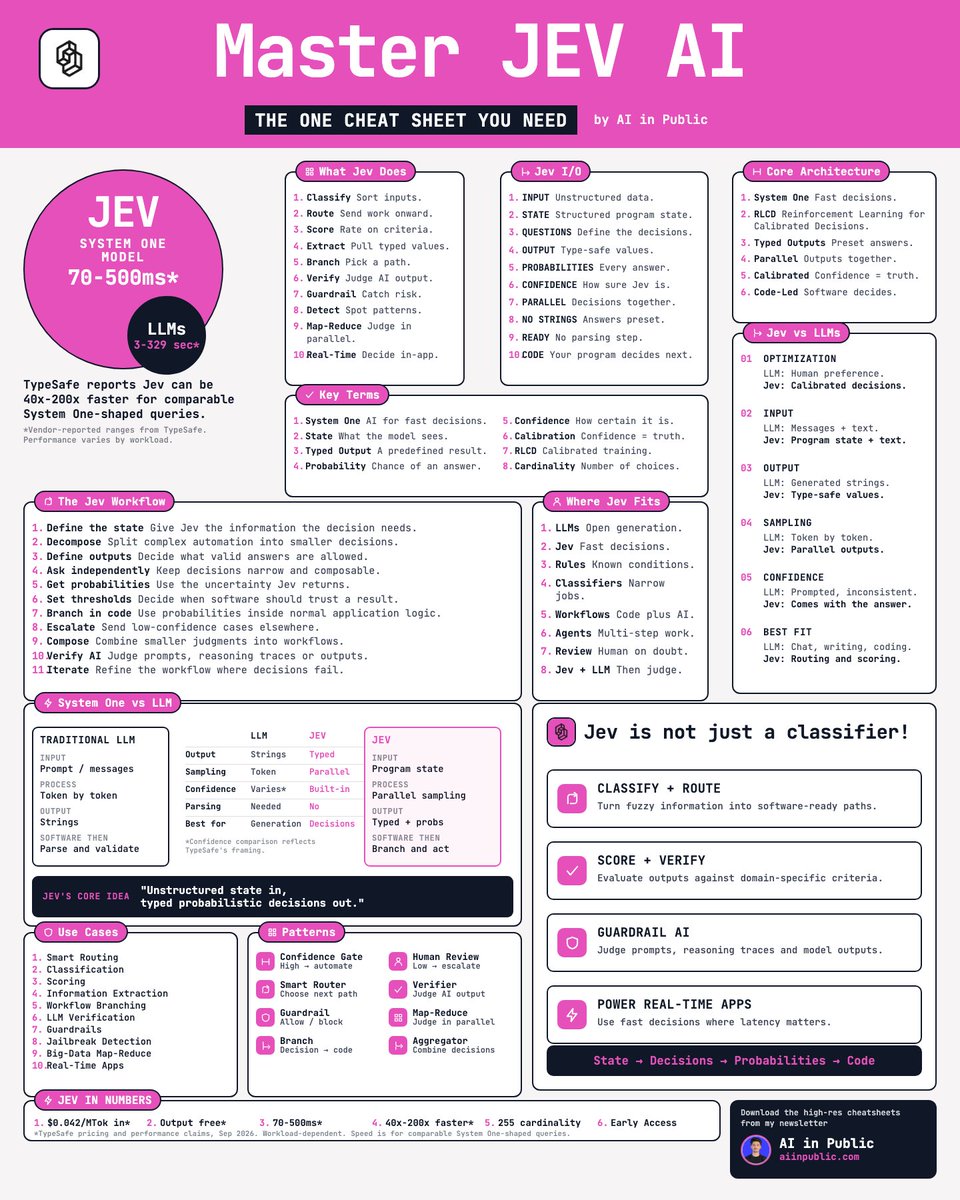
@humzaakhalid argued (3 likes, 3 replies, 368 views) that Jev is being misunderstood because it is not a writer at all, but a fast typed decision layer. The attached cheat sheet made that operational by laying out routing and scoring use cases, confidence handling, and when a full LLM still belongs in the loop.
@AGTPinsights reported (2 likes, 310 views, 3 bookmarks) that CUA-S1-4B-0.2 pushed the same design pattern into computer use: a small Apache-2.0 Qwen3.5-4B-based decision model that chooses bounded GUI actions and, per the release card, scored 92.9% on GUI-360 versus 60.1 for the comparison baseline. The broader Cua repo matters here because it places that small model inside a larger open stack of drivers, cloud desktops, and benchmarks, which makes the decision-layer story look increasingly productized rather than purely conceptual.

@hellonehha shared (12 likes, 4 replies, 387 views, 5 bookmarks) a real-time Jev routing demo for an in-progress project, which added a smaller but still useful builder signal: Jev is already being wired into live product workflows, not just discussed in theory.
Discussion insight: The most useful reply came from @roscherveniak, who told Av1dlive that a decision layer is only as strong as the evidence it can inspect, and asked for traces of inputs, tool calls, and stopping reasons. That shifted the practical question from “is Jev fast?” to “what is the ground truth, and how is the decision audited?”
Comparison to prior day: On 2026-09-22, the Jev cluster centered on thresholds and blind checks. On 2026-09-23, it moved into build kits, comparison guides, and specialized computer-use models.
1.2 The model conversation stayed anchored to economics, but open weights and readability changed the frame 🡕
The model-economics cluster stayed large at roughly 32 matching non-retweets, up slightly from about 29 the prior day. What changed was the frame: the feed was still obsessed with price, but the conversation widened from frontier-lab launch grids into open-weight cost frontiers, long-run capability-cost curves, and whether people actually liked talking to the resulting models.
@simonw summarized (194 likes, 29 replies, 20,006 views, 104 bookmarks) the release day as a pricing reset: his linked write-up put GPT-6 Luna at $0.10/M input, $0.01/M cached input, and $0.50/M output; GPT-6 Sol at $2/M, $0.20/M cached input, and $10/M output; and Claude Opus 5.5 at $4/M, $0.20/M cached input, and $20/M output (article). The most useful part of the post was not who “won,” but the routing implication in replies: price, effort level, latency, and failure mode now matter more than one universal best-model claim.
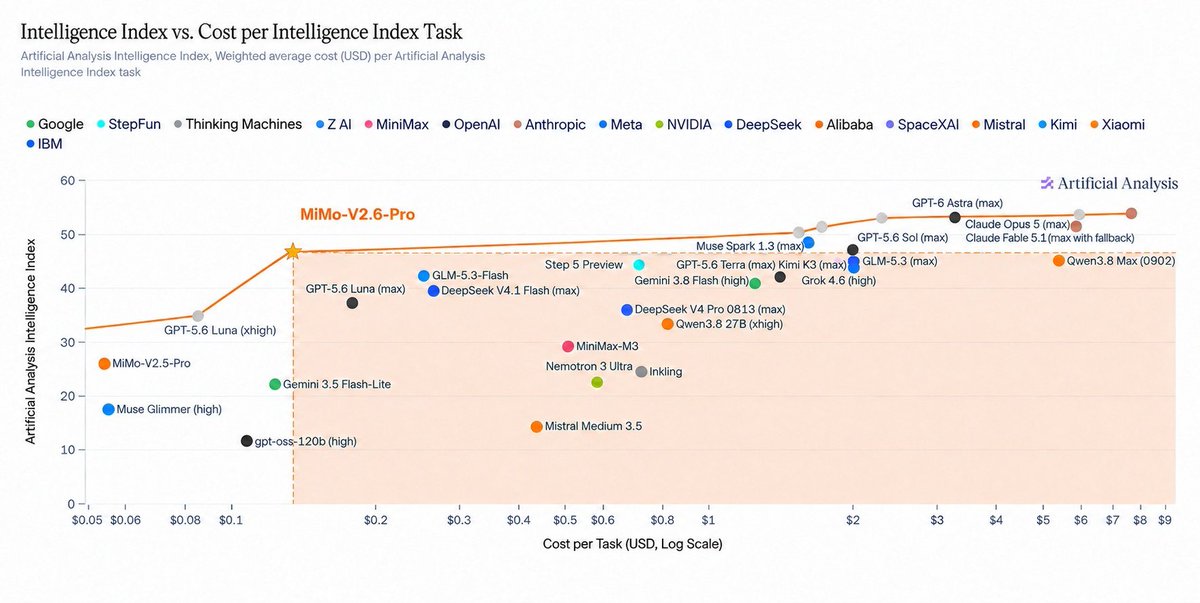
@TheAIColony argued (109 likes, 5 replies, 6,168 views, 65 bookmarks) that Xiaomi's MiMo-V2.6-Pro was notable less for topping an open-weight leaderboard and more for hitting about $0.13 per Intelligence Index task while getting there through task- and evaluation-heavy post-training. The attached images are what made the claim land: they showed MiMo on the intelligence-vs-cost Pareto frontier, near the low end of per-task cost, and at the top of the open-weight slice of the Intelligence Index.


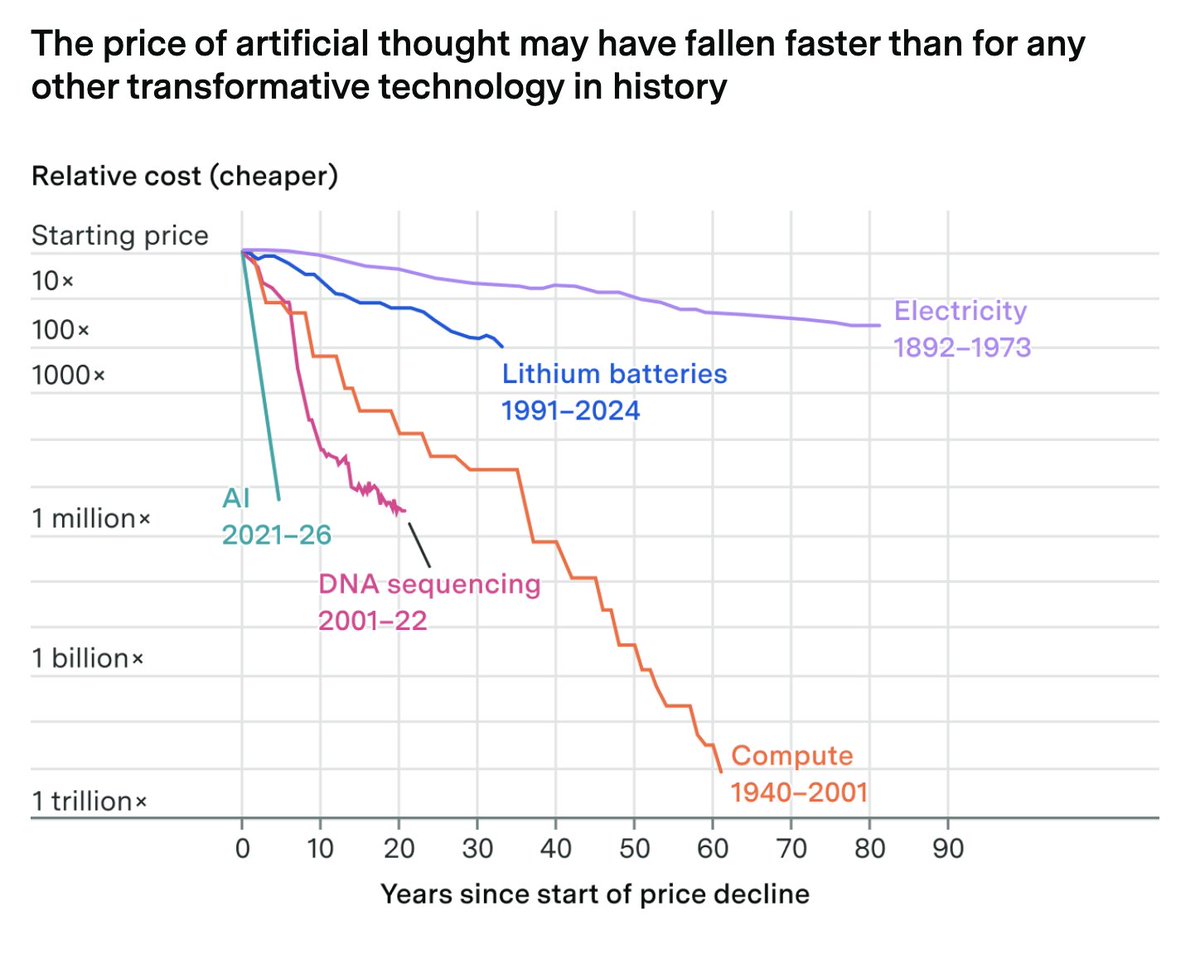
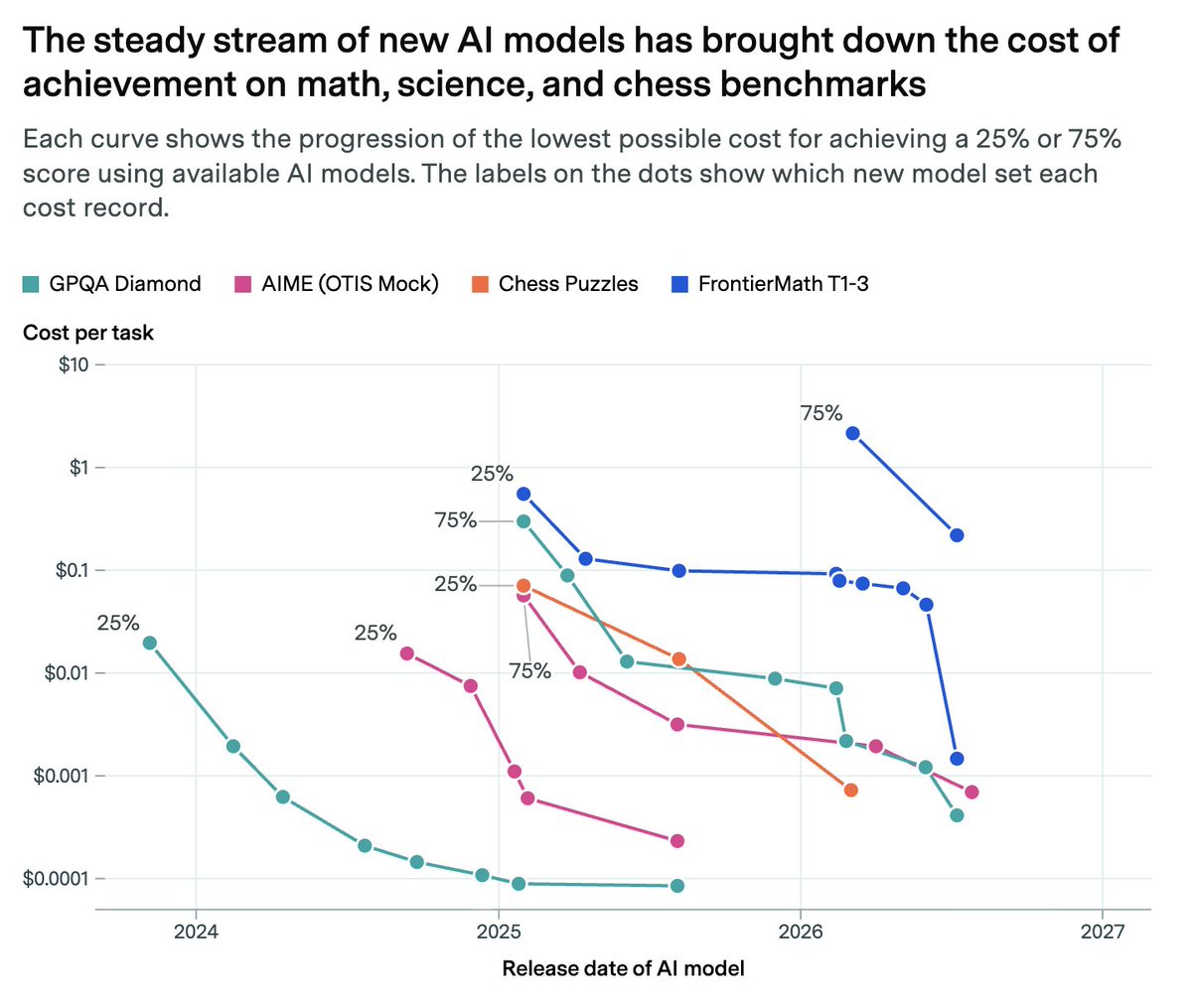
@kimmonismus extended the same story into macroeconomics (234 likes, 23 replies, 13,995 views), citing Epoch AI's estimate that the cost of achieving a fixed level of AI performance has been falling by roughly 47% per quarter since 2023. The attached charts mattered because they showed both the cross-technology comparison and the benchmark-specific curves behind the “13-fold per year” headline.
@cyrilXBT added a different but related angle (71 likes, 10 replies, 2,706 views): frontier models may be getting smarter while becoming worse to read, and Opus 5.5 stood out because it felt less like bullet-point sludge. That made “good economics” mean something broader than cheaper tokens: people also cared whether the output was worth reading.
Discussion insight: The strongest correction came from @ZypherHQ, who asked (55 likes, 31 replies, 1,646 views) whether the benchmark gap implied for Opus 5.5 was even plausible without deeper tests. That skepticism matched Simon Willison's reply thread: model-routing decisions are now expected to survive workload-specific checks, not just a launch slide.
Comparison to prior day: On 2026-09-22, economics mostly meant comparing frontier labs against each other. On 2026-09-23, the frame widened to open weights, falling cost curves, and communication quality that benchmark tables do not capture.
1.3 Local and on-device agent stacks became more concrete, from one-command installs to edge-placement arguments 🡕
The local-runtime cluster grew from roughly 10 matching non-retweets on 2026-09-22 to about 16 on 2026-09-23. The key change was specificity: instead of general privacy talk, people posted actual install flows, terminal UIs, latency measurements, and more explicit arguments for where inference should live.
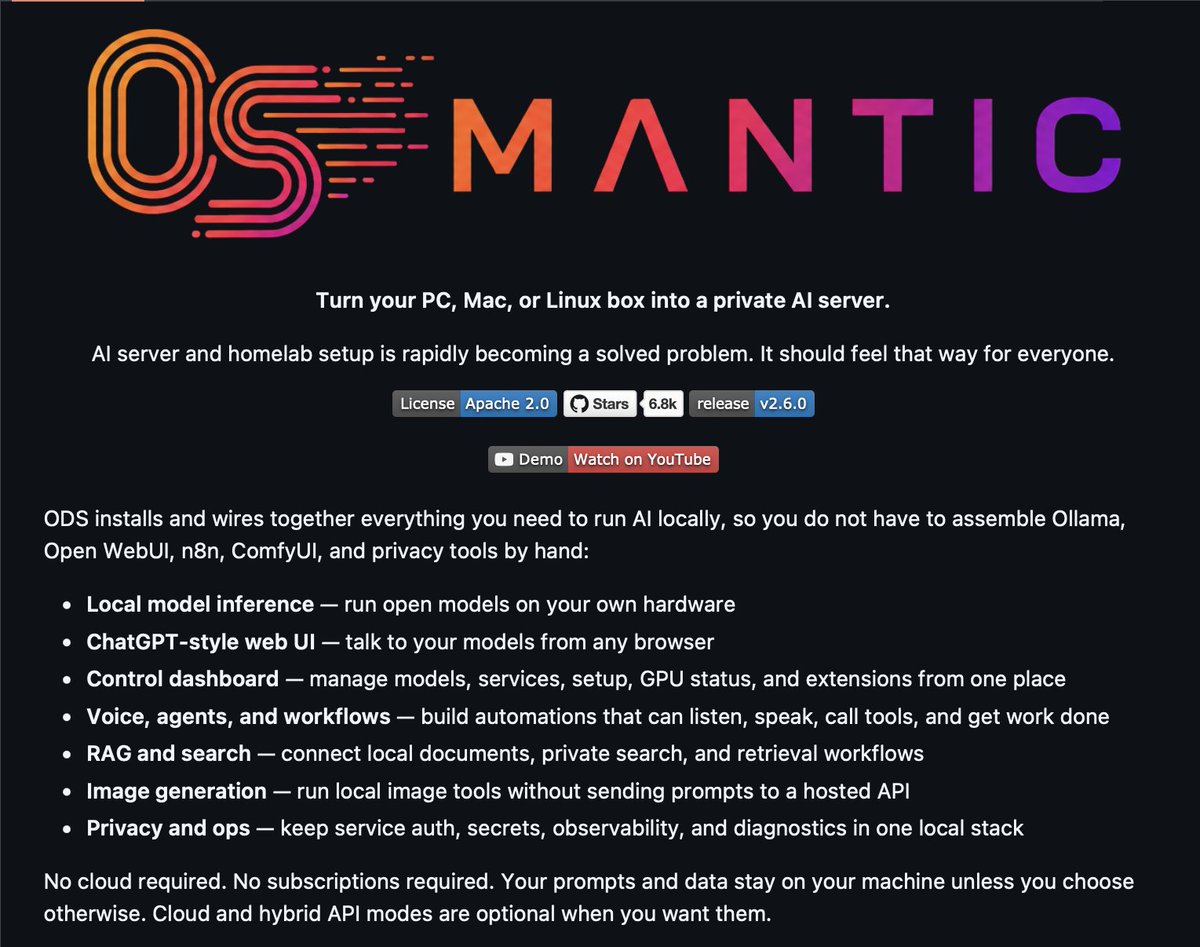
@TheAhmadOsman pitched ODS as the easiest way to start with local AI (44 likes, 3 replies, 2,180 views, 31 bookmarks). That was more than marketing copy: the repo and README for ODS describe an Apache-2.0 stack that installs local inference, Open WebUI, voice, agents, workflows, RAG, search, and image generation so a machine becomes a private AI server by default.
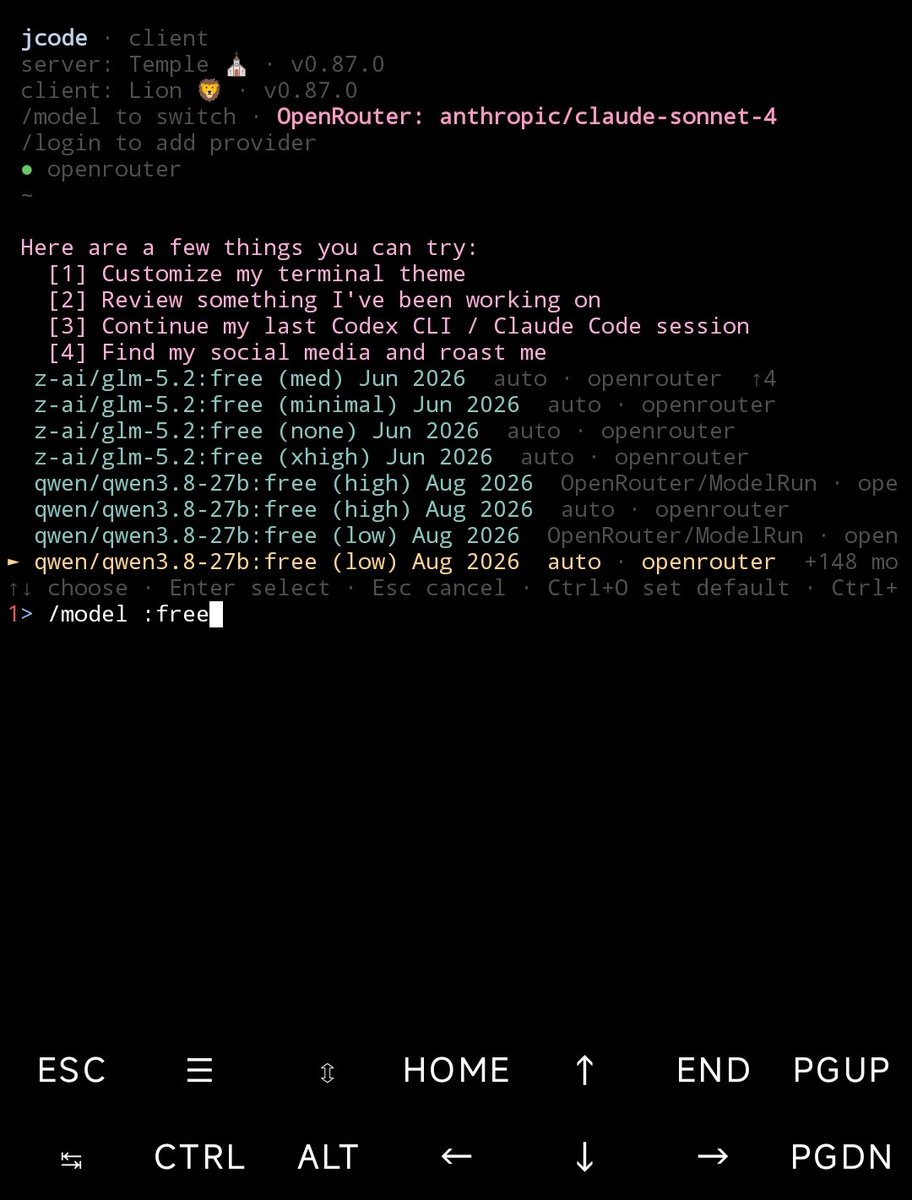
@itsjdraven surfaced Jcode as an open-source Rust terminal agent harness (10 likes, 11 replies, 555 views). The tweet emphasized parallel agents, memory, and public transcripts; the fetched repo backed that up with an explicit performance pitch around low RAM usage and efficient multi-session scaling, showing that local agent tooling is now competing on systems engineering as much as on prompts.
@yoheinakajima released Glance Speedlab as open source (11 likes, 3 replies, 2,425 views, 8 bookmarks), and the linked technical report added the hard numbers the feed usually lacks: native multi-question batching at 2.405x faster, plus an MLX 8-bit path that cut fresh-frame p50 from 358.5 ms to 259.6 ms while preserving 84/84 fixed-suite decisions. That is a more mature local-inference story than “runs on my laptop,” because it documents what sped things up and what failed quality checks.
@babyfolio argued (33 likes, 7 replies, 4,444 views, 17 bookmarks) that Muse's per-user persistent VM architecture may be the real AI-infrastructure signal to watch, because agents that browse, log in, and take actions may need secure isolated environments. @AlphaSenseInc added (2 likes, 2 replies, 1,133 views, 5 bookmarks) a practitioner view from an NVIDIA interview: cost and latency are the main drivers of edge adoption, 60-70% of customers already have model-optimization teams, and the interviewee expects 65-70% of inference to move on-device or on-prem over the next two to five years.

Discussion insight: The most revealing friction point came in replies, not headlines. ODS drew the obvious hardware pushback; babyfolio's thread immediately turned to whether persistent sessions can be suspended and resumed cheaply; and the Glance thread pushed on temporal staleness and gating. Local-first enthusiasm was real, but so was the demand for operational realism.
Comparison to prior day: Compared with 2026-09-22's broader talk about fitting intelligence into existing workflows, 2026-09-23 moved the discussion down a layer into installation surfaces, p50 latency, memory usage, and the economics of keeping agent runtimes warm.
1.4 Benchmarking and agent infrastructure moved beyond static answer keys into sandboxes, hidden verifiers, and long-horizon tasks 🡕
The broad benchmark / agent-infrastructure cluster remained one of the largest slices of the day, rising from roughly 59 matching non-retweets on 2026-09-22 to about 65 on 2026-09-23. The notable shift was conceptual: instead of asking which model answered a fixed prompt best, people highlighted systems that evaluate the entire solver, or that exist mainly to create the environments where those solvers can be trained and measured.
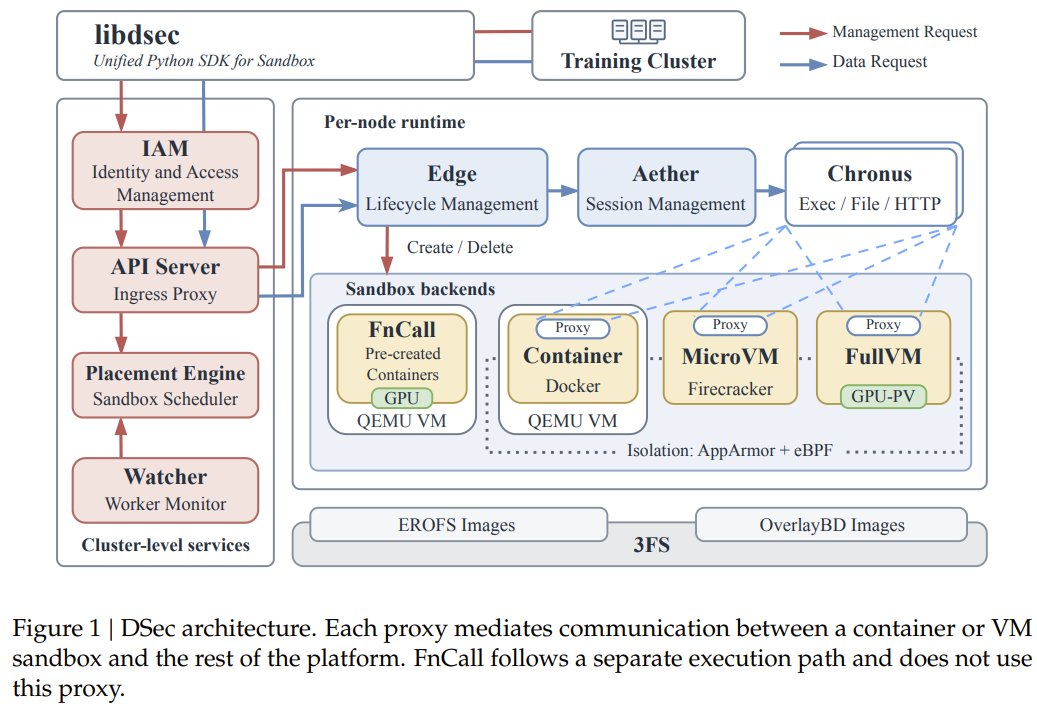
@jiqizhixin reported DeepSeek's DSec as a sandbox platform running 3 million AI-agent environments per day (11 likes, 4 replies, 648 views, 8 bookmarks). The architecture image made that claim concrete by showing one control plane spanning FnCall, containers, microVMs, and full VMs; the linked paper and public coverage align with the tweet's operating numbers around 160-node clusters, 380,000+ concurrent sandboxes, and 5,000+ new sandboxes per second.
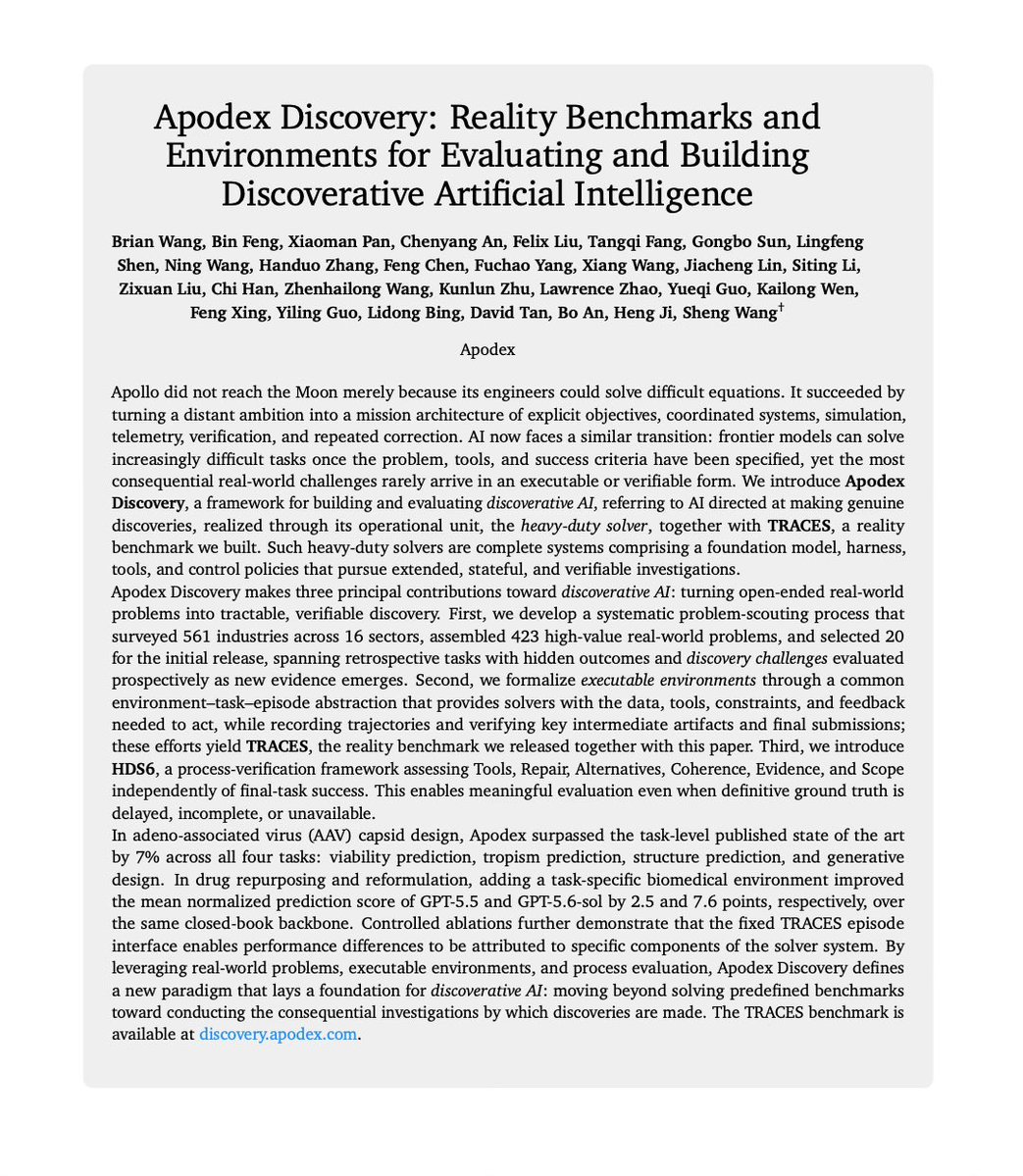
@dr_cintas argued (9 likes, 3 replies, 1,379 views, 4 bookmarks) that Apodex's TRACES matters because it scores the whole solver—model, harness, tools, memory, and control policy—using hidden verification and an HDS6 rubric for Tools, Repair, Alternatives, Coherence, Evidence, and Scope. The site backs that framing with a live benchmark across 17 environments and 1,182 trajectories spanning AAV capsid design, drug repurposing, clinical trials, and LLM engineering.
@AGTPinsights reported the launch of OpenRSI-Index (1 reply, 102 views), describing an open recursive-self-improvement benchmark with 60+ hour trajectories, 1,000 GPUs, and more than 100,000 H100-hours already invested in v0.1. The public repo extends that story with public tasks, logs, and an RSI-Anything contribution flow that tries to package new tasks in about an hour.

Discussion insight: Across DSec, TRACES, and OpenRSI, the benchmark was no longer just a dataset. The thing being evaluated is increasingly the whole system: planner, tools, memory, safety checks, and the runtime substrate that makes the run possible.
Comparison to prior day: On 2026-09-22, people were already asking for workflow-grounded tests. On 2026-09-23, they started surfacing the sandboxes, hidden-verifier frameworks, and public long-horizon task suites meant to provide them.
2. What Frustrates People
Benchmark tables still do not answer workload or routing questions
The strongest frustration was not lack of benchmark chatter. It was that people still could not tell which model belonged in their own stack after reading it. @simonw translated the frontier releases into concrete price bands, but his replies still pointed back to workload-specific routing; @ZypherHQ pushed (55 likes, 31 replies, 1,646 views) on whether the public Opus 5.5 benchmark gap was even believable without more testing; and @dr_cintas argued that fixed-answer benchmarks miss the thing people actually deploy: the whole solver. Even the positive benchmark posts carried an implicit burden of proof.
Severity: High. The workaround is to run internal task suites, grade whole solvers, and separate routine routing from frontier work. This still looks worth building for because the evaluation burden itself is becoming a product category.
Smarter models still often sound generic or verbose
A second frustration was stylistic rather than numerical. @cyrilXBT said (71 likes, 10 replies, 2,706 views) many current frontier models still emit the same lifeless bullet lists and “400 words of nothing,” and praised Opus 5.5 mainly because it felt less synthetic. @Dan_Jeffries1 added in his Nautilo AMA that he “can't stand” the generic high-school-essay structure of AI writing and rewrites 70-80% of it by hand. The complaint was not anti-AI; it was that raw capability still does not guarantee usable communication.
Severity: Medium-High. People cope by routing toward models they find readable, by rewriting aggressively, or by constraining the model into smaller decision roles. That still leaves room for better style evaluation and behavior-regression tooling.
Local/private agent stacks are still gated by hardware and warm-runtime economics
The local-first push was energetic, but the operational friction stayed obvious. @TheAhmadOsman made ODS look easy, yet the immediate reply pattern was hardware reality; @yoheinakajima showed that even strong local results require careful measurement and model-path tradeoffs; @babyfolio surfaced the cost of keeping per-user VMs warm; and @AlphaSenseInc framed edge adoption as a cost/latency decision that already requires dedicated optimization teams.
Severity: Medium-High. The workaround today is better packaging, hardware-aware routing, and suspend/resume discipline for agent runtimes, but those are still non-trivial engineering burdens.
Action-taking agents still lack mature fallback and post-transaction logic
When the feed turned from “can the agent click the button?” to “what happens after it does?”, confidence dropped quickly. @Musecases argued (15 likes, 5 replies, 2,196 views, 7 bookmarks) that the agent wars are really about the buy button, but the best replies narrowed the missing layer to merchant coverage, trusted payments, returns/refunds, and clear fallbacks when an order fails. The quoted @Alibaba_Qwen announcement, surfaced by @OmNawale45831 here, made the same caution explicit from a different angle: a mobile agent should pause and hand control back before sensitive payment or deletion actions.
Severity: High. Teams can reduce risk with approval checkpoints and bounded tools, but the feed still treats trust, reversibility, and post-action recovery as unresolved product problems.
3. What People Wish Existed
Solver-level evaluation that teams can run on their own stacks
The clearest need was for evaluation that tests the whole working system, not just the model on public prompts. @simonw showed why routing now depends on price, caching, and task mix; @ZypherHQ showed that release-day numbers no longer settle trust; @dr_cintas pointed to solver-level scoring; and OpenRSI extended the idea into public 60-plus-hour runs. People want evaluation they can map onto their own architecture, latency budget, and cost model. Opportunity: direct.
Private/local agent runtimes that stay easy after install day
What people seemed to want from local AI was not just a private demo, but a stable runtime that remains usable once hardware, latency, and updates enter the picture. @TheAhmadOsman offered an install-once stack; @yoheinakajima documented the measurement discipline needed to keep local loops fast; and @AlphaSenseInc suggested that on-device and on-prem placement will keep expanding. The missing layer is operational polish around packaging, hardware-aware routing, and graceful degradation. Opportunity: direct.
Persistent agent workspaces with memory, permissions, and suspend/resume controls
The day's runtime posts kept converging on the same wish: agents that stay around long enough to be useful, but with understandable control surfaces. @Dan_Jeffries1 described Nautilo as a persistent multi-user org harness with a long-lived Genie per person; @itsjdraven showed a terminal harness centered on public transcripts and memory; and @babyfolio surfaced the suspend/resume economics that come with persistent VMs. The opportunity is not merely “more agents,” but agent workspaces with clearer ownership, cost controls, and memory boundaries. Opportunity: competitive.
Safer action rails for commerce, booking, and mobile agents
People want agents that can finish real-world tasks without becoming a support nightmare. @Musecases reduced the commerce problem to the buy button, but the replies immediately widened it to payments, merchant access, and returns/refunds; the @Alibaba_Qwen mobile-agent announcement stressed permission-aware pauses before sensitive actions; and @AGTPinsights surfaced a smaller computer-use model that can fit inside more controllable loops. The need is for explicit approval, recovery, and audit rails around action-taking systems. Opportunity: direct.
Decision-layer tooling with typed outputs, traces, and domain calibration
The Jev / System One discourse pointed to a specific missing control layer. @Av1dlive showed how a decision model can be wired into a coding workspace, @humzaakhalid mapped where a fast typed model belongs, and @roscherveniak pushed for traceability of inputs, tools, and stopping reasons. The missing piece is domain-ready calibration, review, and logging around those decisions. Opportunity: competitive.
4. Tools and Methods in Use
| Tool | Category | Sentiment | Strengths | Limitations |
|---|---|---|---|---|
| Claude Opus 5.5 | Frontier model | (+) | Strong capability narrative, clearer communication than many peers, cheaper cache reads than Opus 5 | Still expensive, and the size of the benchmark lead remained disputed |
| GPT-6 Luna | Efficient frontier model | (+) | Very low input/output pricing, especially strong cached-input economics, good default routing target | Not positioned as the best choice for the hardest tasks |
| GPT-6 Sol | Frontier model | (+/-) | Stronger hard-task tier than Luna without top-end Anthropic pricing | Value still depends on workload-specific testing |
| MiMo-V2.6-Pro | Open-weight model | (+) | Strong reported intelligence/cost frontier and clear post-training story | Real-world adoption and external validation are still early |
| Jev / System One | Decision model | (+) | Typed outputs, calibrated confidence, cheap repeated routing/scoring | Needs schemas, traces, and escalation logic |
| ODS | Local AI stack | (+) | Private AI server surface with local inference, voice, agents, workflows, RAG, and search | Hardware and runtime complexity do not disappear |
| Jcode | Coding harness | (+) | Parallel sessions, semantic memory, public transcripts, aggressive RAM-efficiency pitch | Early ecosystem and smaller installed base than mainstream IDE tools |
| Glance Speedlab | Local VLM method | (+) | Reproducible latency gains with decision preservation on fixed suites | Hardware-specific and narrow to camera/VLM loops |
| CUA-S1-4B-0.2 | Computer-use decision model | (+/-) | Small open GUI-action selector with strong reported GUI-360 result | Bounded scope and still dependent on a larger surrounding stack |
| TRACES | Evaluation infrastructure | (+) | Scores the whole solver with hidden verification and process grading | Early framework with real operational cost |
| OpenRSI-Index | Long-horizon benchmark | (+) | Public 60-plus-hour agent tasks at production scale | Very high compute demands and early v0.1 maturity |
| Qwen Intelligence mobile agents | Mobile agent stack | (+/-) | Planner/use/creative split plus strong real-device benchmark framing | Permissions, safety, and failure recovery remain open |
| FLUX 3 Action | World action model | (+) | Faster, lighter open action model with LeRobot and Jetson integration paths | Mostly relevant today to advanced robotics builders |
Overall sentiment split by layer rather than by brand. Frontier models were discussed as routing targets with different economics and communication tradeoffs; decision models were praised when they carved out bounded yes/no work; local stacks were judged by install and runtime realism; and the most interesting “tools” were often benchmark or harness layers like TRACES, OpenRSI, Jcode, and Glance that make the rest of the stack measurable or operable.
5. What People Are Building
| Project | Who built it | What it does | Problem it solves | Stack | Stage | Links |
|---|---|---|---|---|---|---|
| Keel | @Av1dlive / codejunkie99 | Local-first macOS coding workspace that can route tasks through Laya or Jev while keeping host-owned permissions | Makes fast decision models usable inside a real coding loop | Rust, GPUI, ACP, Laya/Jev routing, local-first workspace | Alpha | tweet, repo |
| ODS | Osmantic | Turns a machine into a private AI server with local inference, voice, agents, workflows, RAG, search, and image generation | Reduces the integration burden of standing up local/private AI | Python stack, Open WebUI, local models, voice, agents, workflows | Shipped | tweet, repo |
| Jcode | 1jehuang | Terminal-native coding-agent harness with parallel sessions, memory, and public transcripts | Gives builders a lighter, inspectable alternative to heavier IDE-centered agent flows | Rust, TUI, semantic memory, multi-session orchestration | Beta | tweet, repo |
| Nautilo | @Dan_Jeffries1 | Open multi-user org harness where each person gets a persistent Genie across desktop, web, and mobile | Provides shared, persistent agent workspaces with self-hosting and memory | Self-hosted server, desktop/web/mobile clients, persistent agents, shared rooms | Alpha | tweet |
| Glance Speedlab | @yoheinakajima | Measurement-first local VLM lab for turning webcam streams into low-latency detectors | Helps teams optimize local camera inference without losing decision quality | Python, Qwen3-VL, MLX, PyTorch MPS, reproducible benchmark harness | Alpha | tweet, report, repo |
| Muse phone-orchestrated SEO loop | @om_patel5 | Uses Muse Agents from a phone to run research, briefing, drafting, publishing, and Search Console feedback loops | Turns search/GEO/AEO work into an always-on iterative content system | Muse Agents, Search Console API/MCP, repo publishing workflow, content clustering | Alpha | tweet |
| CUA-S1-4B-0.2 | @trycua | Small open computer-use decision model for bounded GUI action selection | Lowers the cost of putting computer-use control inside products | Qwen3.5-4B adapters, RLOO, Cua drivers, cloud desktops, benchmarks | Alpha | tweet, repo |
| OpenRSI-Index | OpenRSI | Public benchmark for recursive self-improvement with ultra-long trajectories | Gives frontier-style long-horizon agent evaluation an open reference point | 1k-GPU cluster runs, 60+ hour tasks, public logs/tasks, contribution pipeline | Beta | tweet, repo |
| FLUX 3 Action | @bfl_ai | Open-weight 7B world action model for robotics and other embodied control tasks | Improves open action-model speed/performance tradeoffs for real deployment | 7B WAM, joint video+action prediction, LeRobot recipes, Jetson deployment path | Shipped | tweet |
Keel, ODS, Jcode, and Nautilo all point at the same builder pattern: the interesting product surface is the runtime around the model. Keel packages routing and permissions, ODS packages local deployment, Jcode packages inspectable execution, and Nautilo packages persistence plus multi-user collaboration.
The rest of the table broadens that point rather than contradicting it. Glance and OpenRSI turn measurement and evaluation into products; CUA-S1 shrinks computer use into a cheaper decision layer; FLUX 3 Action keeps embodied AI tied to deployability; and @om_patel5 showed that the same agent-runtime logic is already being used for search growth and publishing loops from a phone.
6. New and Notable
OpenRSI-Index put recursive-self-improvement benchmarking into the public feed
@AGTPinsights surfaced OpenRSI-Index v0.1 as a public benchmark for recursive self-improvement, with 60-plus-hour agent trajectories on 1,000-GPU clusters and 100,000-plus H100-hours already invested in the initial build. The public repo makes that more than a vibes post: tasks, logs, and a contribution pipeline are part of the launch surface. That is notable because it tries to turn a frontier-lab-style capability question into an open benchmark rather than a closed claim.
Qwen Intelligence treated the smartphone like an agent runtime, not a chatbot shell
@OmNawale45831 argued that Qwen quietly changed what an “AI phone” means by packaging planner, phone-use, and creative agents together. The quoted @Alibaba_Qwen announcement claimed 82.1 on MobileWorld, 92.2 on MobileWorld-Real, roughly 97 on AndroidDaily, 73.6 on WebArena, and 81.5 on ScreenSpot-Pro, while also describing a real-device environment with 100-plus phones and 150-plus apps. The attached images carried the most substantive part of that claim by showing the benchmark breakdowns and the agent/model-access split directly.


What makes this notable is not just the leaderboard row. It is the framing shift: phones are being presented as persistent agent runtimes with tool selection, memory, replanning, and approval-sensitive handoffs.
FLUX 3 Action kept embodied AI grounded in deployment tradeoffs
@bfl_ai introduced FLUX 3 Action (103 likes, 31 retweets, 2,531 views, 34 bookmarks) as an open-weight 7B world action model that leads RoboLab while using fewer parameters and running faster than previous open systems. The most useful details came in thread replies: a 2.13-second action horizon, joint video-plus-action prediction, a single-step checkpoint that runs 1.45x-1.66x faster than Pi0.5 per second of robot motion, and a guidance-distilled checkpoint that is 2.85x-3.15x faster than the previous leading open WAM while also raising success rate. That is notable because embodied-AI posts often stop at demo clips; this one foregrounded the deployability math.
7. Where the Opportunities Are
[+++] Solver-level evaluation and long-horizon benchmark infrastructure — The strongest cross-section signal was that people still do not trust launch-day model claims without workload-specific validation, while TRACES and OpenRSI show a clear appetite for grading the whole solver. @ZypherHQ challenged benchmark narratives, @dr_cintas reframed evaluation around tools and process, and OpenRSI made public long-horizon tasks part of the product. This is strong because the pain appears in user skepticism, evaluator work, and new infrastructure launches.
[+++] Private/local agent runtime tooling — ODS, Glance, Jcode, Nautilo, and the edge-inference discussion all point to a growing market for packaged local runtimes that handle deployment, measurement, memory, and permissions. @TheAhmadOsman showed the install surface, @yoheinakajima showed the measurement surface, and @babyfolio surfaced the idle-runtime economics. This is strong because the demand is practical, recurring, and spread across builders and operators.
[++] Decision-model control layers for routed systems — Jev, Keel, and CUA-S1 suggest a growing opportunity in small typed control layers that decide, score, or act before handing off to a larger model. @Av1dlive packaged the coding-workspace version, @humzaakhalid made the use cases legible, and @AGTPinsights showed the GUI-action version. This is moderate because the need is obvious, but the buyers and integration patterns still vary by domain.
[++] Transaction-safe action rails for commerce and mobile agents — The commerce and mobile-agent posts imply a real product gap around payments, approvals, refunds, and recovery. @Musecases named the buy button, the best replies pushed on returns and trusted payments, and Qwen's mobile-use framing still inserted human handoff for sensitive actions. This is moderate because the pain is sharp and monetizable, but trust and integration complexity remain high.
[+] Persistent multi-user agent workspaces — Nautilo and the VM-runtime discussion suggest a slower-burning opportunity in shared long-lived agent environments that preserve context, tools, and memory across devices and collaborators. @Dan_Jeffries1 made the org-harness case directly, while Jcode and babyfolio showed adjacent execution and isolation problems. This is lighter-confidence than the categories above, but the signal is distinct enough to watch.
8. Takeaways
- Jev discourse matured from explanation to implementation. The strongest posts were no longer “what is Jev?” explainers, but build guides, cheat sheets, routing demos, and bounded computer-use releases that treated fast typed decisions as a real control layer. (source)
- Model talk was still about economics, but the frame widened beyond token price. Simon Willison's launch-day pricing synthesis mattered, but so did MiMo's open-weight cost frontier and the growing insistence that output quality and readability are part of the economics. (source)
- People increasingly want to benchmark the whole solver, not just the model. TRACES, DSec, and OpenRSI all pushed the conversation toward harnesses, tools, hidden verification, and long-horizon runs rather than fixed answer keys. (source)
- Local/private AI became a product-surface conversation rather than a privacy slogan. ODS, Jcode, Glance, and the edge-placement discussion all focused on packaging, latency, memory, and runtime economics. (source)
- Action-taking agents are being judged on failure handling, not just on whether they can click through a happy path. The most concrete commerce and mobile posts immediately turned to approvals, refunds, merchant coverage, and sensitive-action handoffs. (source)
- Builder energy is shifting into runtimes, harnesses, and infrastructure around the model. Keel, Nautilo, Jcode, DSec, and OpenRSI were all about the substrate that makes agents operable, inspectable, or measurable. (source)
- Embodied and mobile AI discussion stayed tied to deployability math. Qwen's phone-agent stack and FLUX 3 Action both got attention because they connected autonomy to real-device benchmarks, permission boundaries, or runtime speed—not because they sounded futuristic. (source)