Twitter AI - 2026-09-25
1. What People Are Talking About
1.1 Agent stacks kept unbundling into specialist layers 🡕
The strongest infrastructure posts were not arguing about a single best model. They were describing which layer should plan, which layer should route, which layer should replay, and which layer should diagnose failures after deployment. The result was a more modular picture of agent systems than the one that dominated a day earlier.
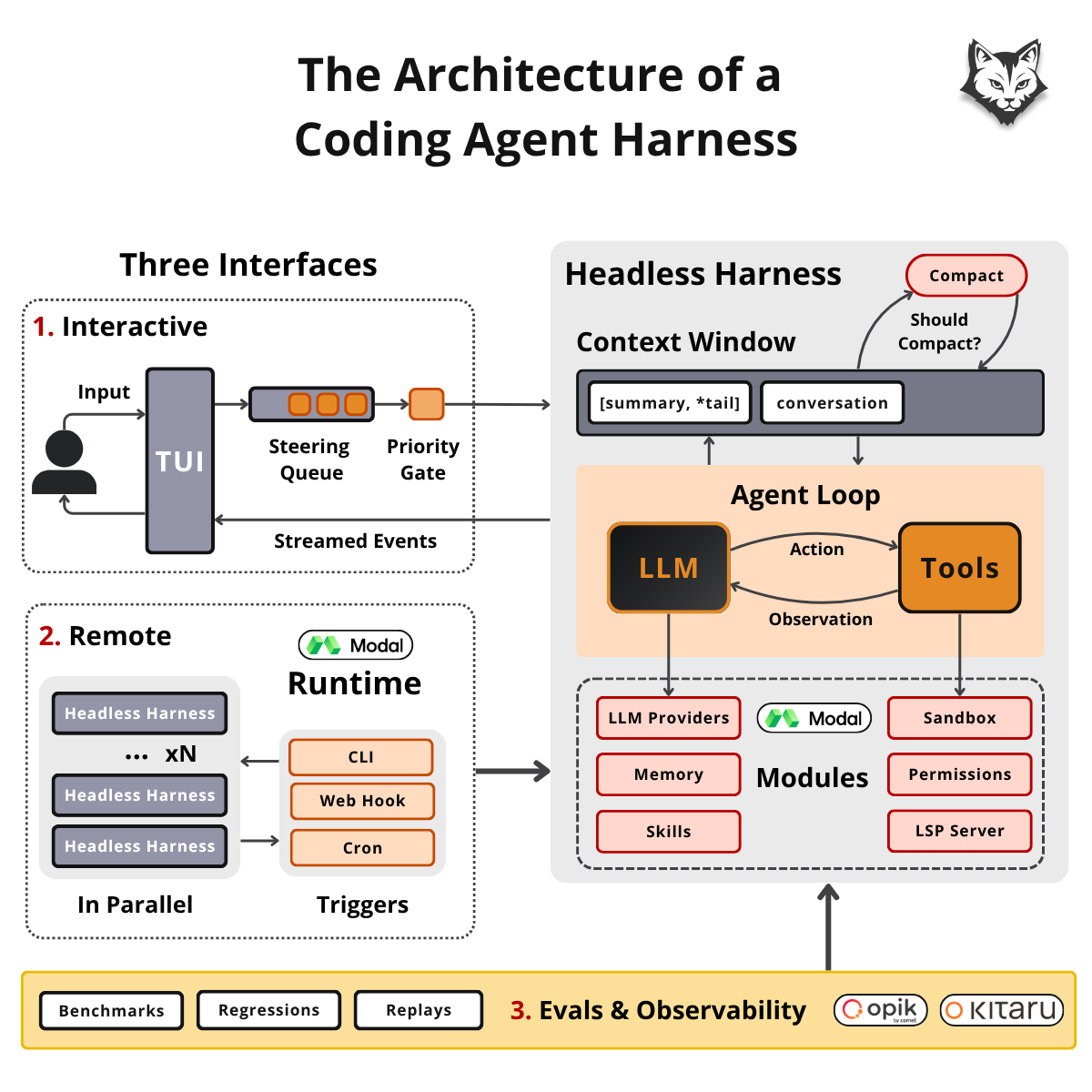
@pauliusztin_ shared (9 likes, 14 replies, 262 views) the stack behind his open-source coding agent Decode in unusual implementation detail: Pydantic AI for the loop, Gemini and OpenRouter for hosted models, Modal for open-weight serving and remote sandboxes, seatbelt/bubblewrap for isolation, Opik for traces and evals, and Kitaru for replaying runs against different models or prompts. The attached architecture diagram mattered because it made the composition explicit: interactive and remote entry points feed a headless harness, the harness loops between an LLM and tools, and separate modules handle providers, memory, permissions, and benchmarks.
@akshay_pachaar explained (11 likes, 2 replies, 1,987 views, 9 bookmarks) NVIDIA and Stanford's Contrastive Language Model as a system-one component for bounded decisions rather than a general text generator. The post was unusually specific about the mechanism: CLM encodes state and candidate actions separately, caches action embeddings, and turns similarity scores into a probability distribution, which the author says yields up to 9x lower latency for tool selection, routing, and verifier-style jobs.
@HacksonClark announced (16 likes, 14 replies, 404 views) that SREGym had been accepted to NeurIPS 2026, then used the thread to argue that the next benchmarking bottleneck is what happens after deployment. The thread says SREGym has grown from 90 to 125 production-failure problems spanning applications, Kubernetes, networking, operating systems, hardware, concurrent failures, and metastable failures; the public site and repo describe diagnosis, mitigation, and end-to-end metrics instead of a single pass/fail coding score (site, repo).
Discussion insight: The most useful replies kept pushing on the seams between layers rather than on model IQ. In Decode's replies, replay validity immediately became a repo-state problem; in SREGym's thread, the key result was that end-to-end resolution can swing by up to 40 points depending on failure category; and in the broader infrastructure cluster, the recurring idea was that some decisions should be scored or replayed, not regenerated from scratch each time.
Comparison to prior day: Compared with 2026-09-24, the infrastructure conversation widened from verifier quality and score-vs-cost charts into a fuller control plane: replay systems, production-incident benchmarks, and specialist decision layers all got more attention.
1.2 High-stakes work raised the bar for what counts as a useful eval 🡒
Benchmark talk stayed dense, but the sharper argument was that raw benchmark wins do not matter much if a team cannot define the right answer in its own workflow. The posts with the most practical weight were about answer keys, deployment risk, and benchmark freshness.
@businessbarista reported (23 likes, 8 replies, 3,270 views, 29 bookmarks) a conversation with a large data-labeling business whose core claim was that enterprise AI value will sit in internal eval environments and proprietary answer keys, not in access to the same public models everyone else can buy. The post tied that directly to adoption: most companies have not moved far beyond coding agents because they still lack the eval infrastructure needed to make non-engineering agents reliable.
@rjs wrote (19 likes, 4 replies, 1,516 views, 39 bookmarks) that some software is simply too high-stakes to vibe-code, then used a follow-up reply with far larger reach to say the "everyone is a builder now" thesis blurs a more stubborn reality: roles still emerge from differences in judgment. That mattered because the pushback was not anti-AI; it was a demand for sharper scoping, clearer problem framing, and a recognition that some failures are expensive enough to require human review and specialized expertise.
@axisrobotics introduced (48 likes, 15 replies, 2,125 views) Open Axis Benchmark as a living evaluation engine for robot-manipulation models. The distinctive claim was that every round locks a fresh task set drawn from a growing library, so models have to generalize instead of memorizing a frozen suite.
Discussion insight: Replies kept returning to the same constraint from different angles: the hard part is not running a benchmark, it is defining what "good" means for a specific business or task family and keeping the test fresh enough that overfitting does not replace real performance.
Comparison to prior day: On 2026-09-24, eval debate was still dominated by public benchmark scores, verifier quality, and token budgets. On 2026-09-25, the center of gravity moved closer to internal answer keys, post-deployment failures, and benchmarks designed to keep changing.
1.3 Physical AI's bottleneck stayed the data layer, but the evidence got more concrete 🡕
The physical-AI cluster was not mainly about model capability claims. It was about where real-world experience comes from, how it gets verified, and why static benchmarks or coarse sensing still leave robots under-trained. Several reviewed posts used almost the same structure: models and hardware are improving, but the missing layer is fresh, grounded experience.
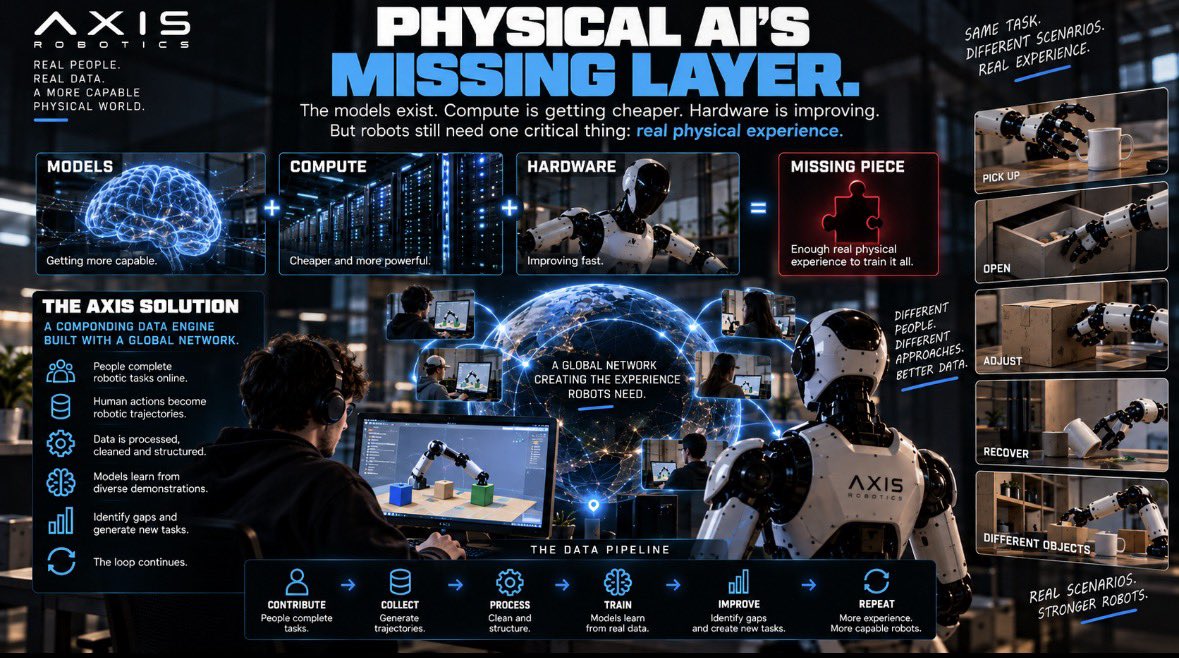
@abgweb3 argued (12 likes, 11 replies, 134 views) that physical AI already has the models, compute, and improving hardware, but still lacks enough real physical experience. The attached infographic mattered because it turned that into an operating loop: contributor demonstrations become trajectories, trajectories become structured data, models improve, new behavioral gaps are identified, and the next tasks are generated to close those gaps.
@elenalin01 argued (25 likes, 22 replies, 138 views) that physical AI does not have a robot problem so much as a ground-truth problem. Her post described Vangrid's pitch as smartphone-based spatial capture plus cryptographic provenance and Base-anchored attestations, while the replies supplied the most useful skepticism of the day: consumer sensors may be poorly calibrated, location proofs may be spoofable, and replacing specialized fleets with mass-market devices is still an open question.
@alex_crypto98 framed (19 likes, 16 replies, 644 views) the same problem as a scaling mismatch: satellites are too coarse for sidewalk detail, corporate fleets are too expensive to refresh globally, and world-model builders need a denser capture loop. The attached image added the concrete claims missing from many other posts in this cluster by naming 3 billion smartphones, 100,000+ verified captures, direct onchain verification, and a recent $9M raise.

Discussion insight: The bullish posts all converged on decentralized capture, but the replies kept a hard boundary around credibility: if the provenance layer cannot stop spoofing, or if commodity sensors cannot produce stable ground truth, then scale alone will not solve the robotics-data problem.
Comparison to prior day: Compared with 2026-09-24, physical-AI posts were slightly more numerous and noticeably more operational. The language shifted away from broad world-model ambition and toward compounding data engines, task libraries, and verifiable capture pipelines.
1.4 Consumer and agent-commerce products were framed around routines, identity, and trust rails 🡕
Consumer-agent posts were more specific than generic "AI assistant" commentary. The highest-signal items cared about how an agent is visually framed, whether it becomes part of a daily routine, and how two agents will settle a disagreement once they start transacting without a human in the loop.
@alexcornell explained (431 likes, 38 replies, 25,293 views, 154 bookmarks) why Muse deliberately wraps its responses in message bubbles. The image shows the same answer flow with and without a bubble, and the replies add the product logic that the screenshot alone cannot carry: Muse is meant to live in one canonical thread, handle growing context, and proactively message the user, so visible turn boundaries matter in a way they do not for a passive search box.

@sgrsagor argued (66 likes, 85 replies, 206 views) that consumer AI distribution matters more than most feature lists, then backed that up with quoted Sleepagotchi numbers: 500K+ registered users, about 80K daily actives, and more than 75% opening the app within 10 minutes of waking up. The post's larger claim was that specialized agents for routines like sleep, fitness, shopping, and productivity may have a stronger wedge than another standalone general-purpose assistant.
@d3rekson described (24 likes, 12 replies, 498 views) Internet Court as a dispute layer for agent commerce: bots preselect a route, evidence is bundled automatically, and three different AI judges review the case instead of a single model. The attached diagram is simple, but it makes the pitch legible as infrastructure rather than metaphor.

Discussion insight: Replies across the commerce cluster kept separating flashy automation from the harder trust problem. @0xvati argued (46 likes, 6 replies, 7,378 views, 13 bookmarks) that payments, verification, reputation, discovery, and dispute handling are the real coordination layer; @Loreen2074591 added (29 likes, 21 replies, 279 views) that persistent work history matters more than polished profiles once agents start hiring each other repeatedly.
Comparison to prior day: On 2026-09-24, the commerce conversation centered on incentives, merchant rails, and governance. On 2026-09-25, it added product-shape evidence on the consumer side and sharper trust primitives on the commerce side: single-thread UX, routine retention, dispute routes, and persistent work records.
2. What Frustrates People
Benchmarks still get fuzzy when the work becomes expensive, specific, or deployed
The most repeated frustration was that a public benchmark score is not enough once the task has real downside. @businessbarista reported (23 likes, 8 replies, 3,270 views, 29 bookmarks) that enterprises increasingly treat internal eval environments and answer keys as proprietary IP, because those are what let non-engineering agents become reliable in their own workflows. @rjs said (19 likes, 4 replies, 1,516 views, 39 bookmarks) some software is too high-stakes to vibe-code, and his follow-up reply with much higher engagement argued that role boundaries reappear wherever one person cannot judge every failure mode.
The same complaint showed up in benchmark design itself. @HacksonClark wrote (16 likes, 14 replies, 404 views) that SREGym performance varies by up to 40 percentage points depending on the failure category, while @axisrobotics argued (48 likes, 15 replies, 2,125 views) frozen robotics benchmarks mislead models into memorizing the test instead of generalizing. Severity: High. The visible workarounds were custom answer keys, live-environment incident suites, and living task libraries; this remains worth building for because the complaints target operational trust, not cosmetic leaderboard presentation.
Physical AI still struggles to secure enough trustworthy ground truth
The second clear frustration was that better models and cheaper compute do not solve missing experience. @abgweb3 (12 likes, 11 replies, 134 views) said robots need real physical experience, not just better weights; @elenalin01 said (25 likes, 22 replies, 138 views) physical AI has a ground-truth problem; and @alex_crypto98 added (19 likes, 16 replies, 644 views) that satellites are too coarse while dedicated fleets are too expensive to keep fresh globally.
What made this a true frustration rather than a marketing slogan was the skepticism in replies. People questioned whether smartphone sensors are calibrated enough, whether provenance systems can stop spoofing at scale, and whether decentralized contributors can keep feeding useful examples long enough to matter. Severity: High. The current coping strategies are contributor networks, cryptographic attestations, and benchmark/task engines that generate new gaps to target, but the thread-level evidence still says this is an unsolved systems problem and therefore a strong build target.
Agent-to-agent commerce still lacks verification, reputation, and dispute rails
The commerce cluster kept returning to the same missing layer: agents can already negotiate and transact in demos, but they still struggle to prove work quality, preserve reputation, and settle disagreements cheaply. @0xvati called out (46 likes, 6 replies, 7,378 views, 13 bookmarks) payments, verification, settlement, reputation, and discovery as the plumbing nobody wants to build. @d3rekson described (24 likes, 12 replies, 498 views) Internet Court precisely because human courts are too slow and too expensive for five-dollar autonomous microtasks, and @Loreen2074591 argued (29 likes, 21 replies, 279 views) that persistent work history matters more than profile polish once agents hire each other repeatedly.
Replies sharpened the failure mode instead of resolving it: validation may miss subjective make-good decisions, second opinions become important when the stakes rise, and a technically correct ruling may still fail to preserve a valuable relationship. Severity: Medium-High. The workaround pattern today is to preselect dispute routes, bundle logs automatically, and accumulate agent receipts over time; this looks worth building for because every workaround is effectively a hand-built trust layer.
3. What People Wish Existed
Workflow-specific eval systems teams can trust
The clearest practical need was for eval infrastructure that matches a company's actual risk surface, not just a public leaderboard. @businessbarista said (23 likes, 8 replies, 3,270 views, 29 bookmarks) internal eval environments and answer keys are becoming proprietary IP, @rjs said (19 likes, 4 replies, 1,516 views, 39 bookmarks) some software is too high-stakes to vibe-code, and @HacksonClark showed (16 likes, 14 replies, 404 views) that even production-incident agents vary wildly by failure class. This is a practical need with high urgency. SREGym and Open Axis Benchmark partially address it today, but the feed still suggests most teams lack workflow-shaped answer keys and failure suites. Opportunity: direct.
Coordination, reputation, and dispute layers for agent-to-agent work
People were not asking for smarter prose here; they were asking for boring rails. @0xvati wanted (46 likes, 6 replies, 7,378 views, 13 bookmarks) a universal coordination layer for payments, verification, settlement, reputation, and discovery, @d3rekson proposed (24 likes, 12 replies, 498 views) an AI-judge dispute route for low-value machine commerce, and @Loreen2074591 argued (29 likes, 21 replies, 279 views) that persistent work history will matter more than benchmarks after hiring. This is a practical need with medium-high urgency. Early pieces exist, but nothing in the feed looked close to a shared default. Opportunity: direct.
Reusable control-plane components that let teams compose agents instead of buying monoliths
A third need was for components that slot between models and work rather than replace both. @pauliusztin_ showed (9 likes, 14 replies, 262 views) a custom harness assembled from Pydantic AI, Modal, Opik, Kitaru, and sandboxing tools, @itsjdraven surfaced (4 likes, 4 replies, 474 views, 5 bookmarks) My Free Code as a routing and fallback gateway for multiple coding agents, and @RoundtableSpace highlighted (10 likes, 2 replies, 26,836 views, 7 bookmarks) Cua as an open-source stack for giving agents real computers. This is a practical need with high urgency for builders, but it is already a crowded area with several credible implementations. Opportunity: competitive.
Ground-truth infrastructure for physical AI
The robotics side of the feed kept implying the same missing product: something that can produce fresh, trusted physical-world experience faster than dedicated fleets can collect it. @abgweb3 described (12 likes, 11 replies, 134 views) a compounding data engine, @elenalin01 focused (25 likes, 22 replies, 138 views) on cryptographically provable capture, and @alex_crypto98 tied (19 likes, 16 replies, 644 views) the problem to global scale and freshness. This is a practical need, but it remains capital-intensive and credibility-sensitive because spoofing and calibration are active objections. Opportunity: competitive.
4. Tools and Methods in Use
| Tool | Category | Sentiment | Strengths | Limitations |
|---|---|---|---|---|
| Pydantic AI | Agent framework | (+) | Keeps the model/tool loop simple and composable for custom harnesses | Still requires teams to assemble their own control plane around it |
| Modal | Cloud runtime / sandbox | (+) | Runs remote sandboxes, open-weight serving, and parallel triggers from the same platform | Adds deployment/runtime complexity outside the agent loop itself |
| Opik | Observability / evals | (+) | Traces sessions and supports benchmarks, regressions, and online evals in the same stack | Useful as instrumentation, but not a standalone answer-key system |
| Kitaru | Replay / optimization | (+/-) | Replays runs against new prompts or models without redoing tool work | Reused outputs can become invalid when the underlying repo or environment changes |
| SREGym | Benchmark platform | (+) | Evaluates diagnosis, mitigation, and end-to-end incident resolution on live-style failures | Infrastructure-heavy and highly dependent on failure-category coverage |
| Open Axis Benchmark | Robotics benchmark | (+) | Fresh task sets and a growing library push models toward generalization instead of memorization | Still early, and its value depends on sustained task generation quality |
| my-free-code | AI gateway | (+) | Multi-provider routing, ordered fallback, health backoff, and stable model identity for coding agents | Proxy setup and local security hardening are part of the operational burden |
| Cua | Computer-use stack | (+) | Gives agents desktops, local VMs, specialist computer-use models, and benchmark tooling | Powerful but still stack-like rather than plug-and-play for most teams |
| CLM | Decision model | (+) | Cached action embeddings promise low-latency tool selection, routing, and verifier-style scoring | Only works when the candidate action set is already known |
| Jev-Mem | Memory architecture | (+) | Uses a lightweight controller to cut memory-build time and query latency while improving retrieval quality | Paper-stage evidence so far, not yet a widely used product |
| Vangrid | Physical-data network | (+/-) | Pushes for broad spatial capture, provenance, and verifiable settlement around ground-truth collection | Replies challenged spoof resistance, calibration quality, and long-term contributor incentives |
| Internet Court | Dispute-resolution layer | (+/-) | Bundles evidence and uses a multi-model judge panel for low-value autonomous disputes | Subjective make-good decisions and relationship tradeoffs still escape formal rules |
Overall satisfaction split by layer rather than by vendor. Frameworks and control-plane tools such as Pydantic AI, Modal, Opik, Kitaru, my-free-code, and Cua were discussed positively because they solve specific operational seams. In contrast, Vangrid and Internet Court drew more mixed reactions, not because the ideas were dismissed, but because the trust assumptions under them were challenged directly in replies.
The common workaround pattern was decomposition. Instead of asking one frontier model to do everything, builders described a stack where one component plans, another routes or scores options, another handles replay/eval, and another owns the execution environment. That same pattern showed up in evaluation too: live cloud incidents for SREGym, fresh task libraries for Open Axis, and separate control logic for Jev-Mem and CLM.
The competitive dynamic was not one base model replacing another. It was specialized layers competing to become the default attachment points around models: gateways, replayers, memory controllers, desktops, and benchmark engines.
5. What People Are Building
| Project | Who built it | What it does | Problem it solves | Stack | Stage | Links |
|---|---|---|---|---|---|---|
| Cua | trycua | Open-source computer-use stack that gives agents desktops, local VMs, specialist decision models, and benchmark tooling | Lets agents operate real computers instead of staying trapped in chat or API-only loops | Desktop automation, isolated cloud desktops, local macOS/Linux VMs, CUA-S1, Cua Bench | Beta | tweet, repo, site |
| My Free Code | hkqr | Multi-provider gateway for Claude Code and other coding agents | Gives teams routing, fallback, and provider abstraction instead of tying each agent to one vendor | Python, FastAPI, Anthropic/OpenAI-compatible endpoints, provider adapters, fallback routing | Beta | tweet, repo |
| Decode | @pauliusztin_ | Custom coding-agent harness with sandboxes, traces, and replays | Helps builders compose and inspect their own coding agents rather than buying a monolith | Pydantic AI, Gemini, OpenRouter, Modal, seatbelt/bubblewrap, Opik, Kitaru | Alpha | tweet |
| SREGym | SREGym | Benchmarking platform for AI SRE agents resolving live-style production incidents | Measures what agents do after software breaks in production | Python, Docker/Kubernetes, live cloud environments, observability tools, benchmark leaderboards | Beta | tweet, repo, site |
| Open Axis Benchmark | @axisrobotics | Living benchmark engine for robot-manipulation models | Prevents overfitting to frozen robotics task sets | Axis Library, fresh task-set locking, continual task generation, OpenRoboto collaboration | Beta | tweet |
| SFR-AutoR&D | @SFResearch | Autonomous R&D loop that discovers, builds, evaluates, and learns from experiments | Pushes agents beyond code writing into measured improvement on repos or models | Discover/Build/Evaluate/Learn workflow, reproducible experiments, repository/model goals, budget bounds | Alpha | tweet, site |
Cua was the clearest traction signal in the builder set. @RoundtableSpace noted (10 likes, 2 replies, 26,836 views, 7 bookmarks) that it had become the number-one trending GitHub repo, and the public repo/README describe a stack that spans cloud fleets, local VMs, specialist decision models, and benchmark tooling rather than one narrow demo. That makes it notable because it packages the whole computer-use surface area into one open-source system.

My Free Code and Decode point at the same builder instinct from different directions. My Free Code turns coding-agent infrastructure into a gateway problem—routing, fallbacks, stable model identity, and provider health—while Decode turns it into a harness problem with remote sandboxes, replayable traces, and explicit module boundaries. In both cases, the build is motivated by the same pain point visible elsewhere in the feed: teams want control surfaces around agent behavior, not just another model endpoint.
SREGym and Open Axis Benchmark extend that pattern into evaluation. SREGym treats production incidents as the unit of work and measures diagnosis plus mitigation, while Open Axis Benchmark treats frozen task suites as the failure mode and keeps drawing fresh robotics tasks from a living library. Both are reactions to the same trigger: public benchmarks become less useful once agents start overfitting them.
SFR-AutoR&D broadened the builder picture beyond coding and ops. @SFResearch presented (2 likes, 1 reply, 365 views) a loop where an agent discovers a hypothesis, builds the method, evaluates it, and keeps only verified gains, which is a much stricter workflow than "generate code and hope." The image matters because it shows the checkpointed structure explicitly.

The repeated build pattern was clear: people are shipping control planes, benchmark engines, and execution environments around models rather than claiming one new model solves everything. A second pattern was trust infrastructure for repeated use—work histories, dispute layers, and verifiable outcomes—showing up independently in commerce, ops, and robotics conversations.
6. New and Notable
AI-search optimization got its clearest citation-economics case study yet
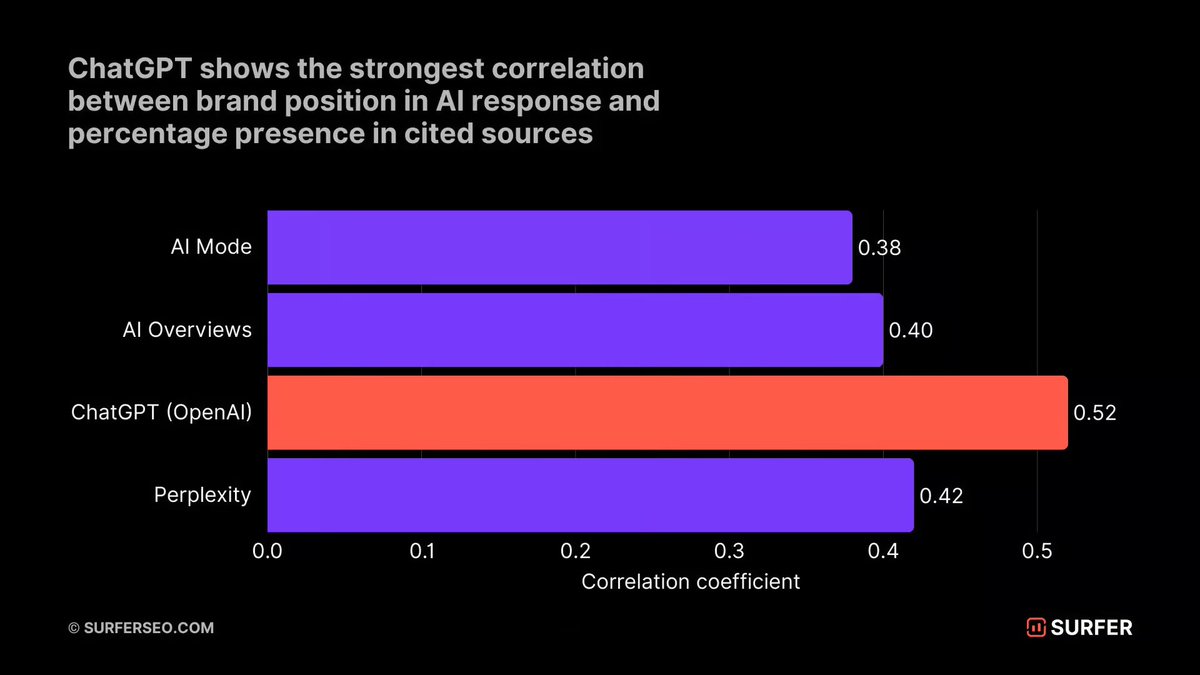
@alexgroberman walked through (18 likes, 7 replies, 1,079 views, 5 bookmarks) a Surfer study spanning 26,573 AI calls, 289,105 cited URLs, and nearly 1,000 prompts across 12 industries. The main chart matters because it made the thesis concrete: in this dataset, ChatGPT showed the strongest reported relationship between brand presence in cited sources and recommendation position (0.52), ahead of Perplexity (0.42), Google AI Overviews (0.40), and Google AI Mode (0.38). The same thread also claimed ChatGPT cited 84.7% more sources than AI Mode and 129.7% more than AI Overviews, which makes off-site brand mentions look more consequential rather than less.
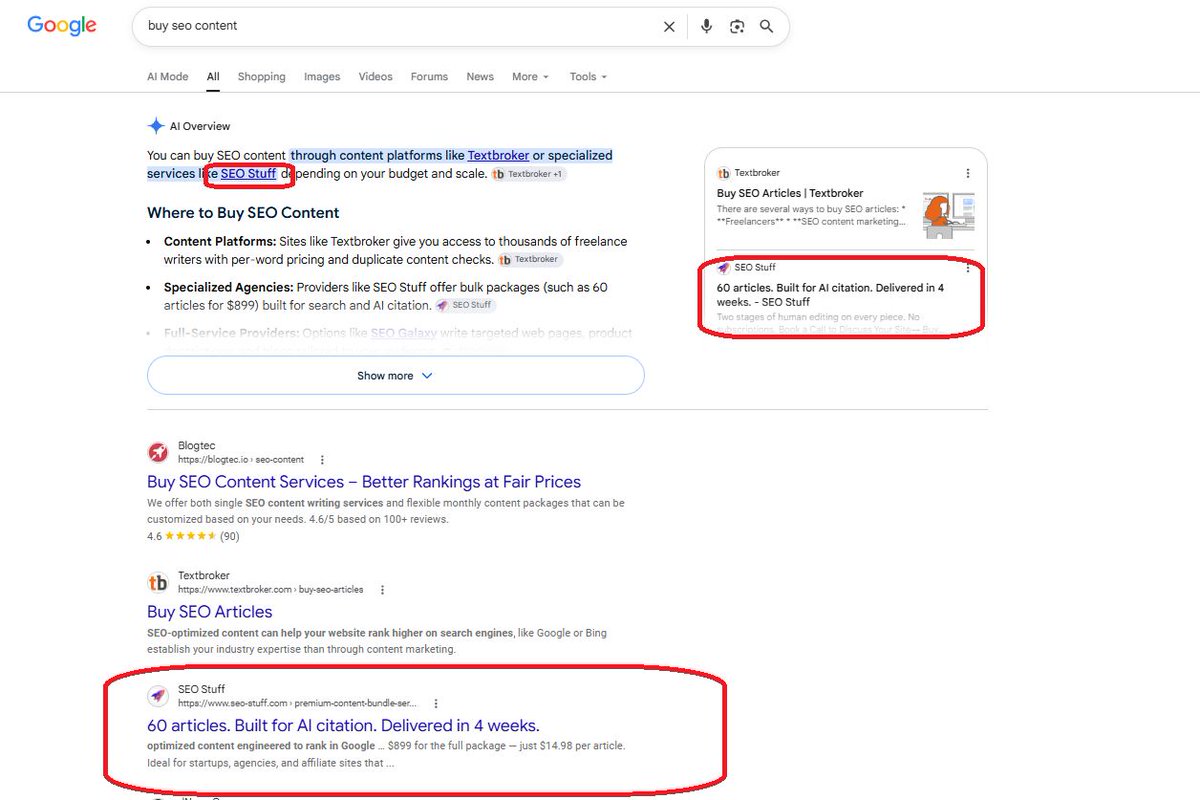
The thread became more notable because it did not stop at theory. One of the attached screenshots showed Google AI and search results surfacing a service promising "60 articles. Built for AI citation," which turns AI-search optimization from a vague marketing slogan into a concrete supply-side business.
Jev-Mem put hard numbers on controller-led memory
@omarsar0 highlighted (6 likes, 861 views, 9 bookmarks) a Jev-Mem report that treats memory as a control problem instead of a bigger-context problem. The visible claims were concrete enough to matter: a lightweight controller handles memory typing, routing, retrieval budget, graph traversal, scoring, and stopping; memory construction becomes 6.6x faster; average query latency drops 36.7% to 0.93 seconds; and the system scores 0.777 on LoCoMo with an LLM judge. That made it a useful extension of the day's broader move toward specialist layers.
LongCat 2.5 preview showed how quickly launch claims now get benchmark pushback
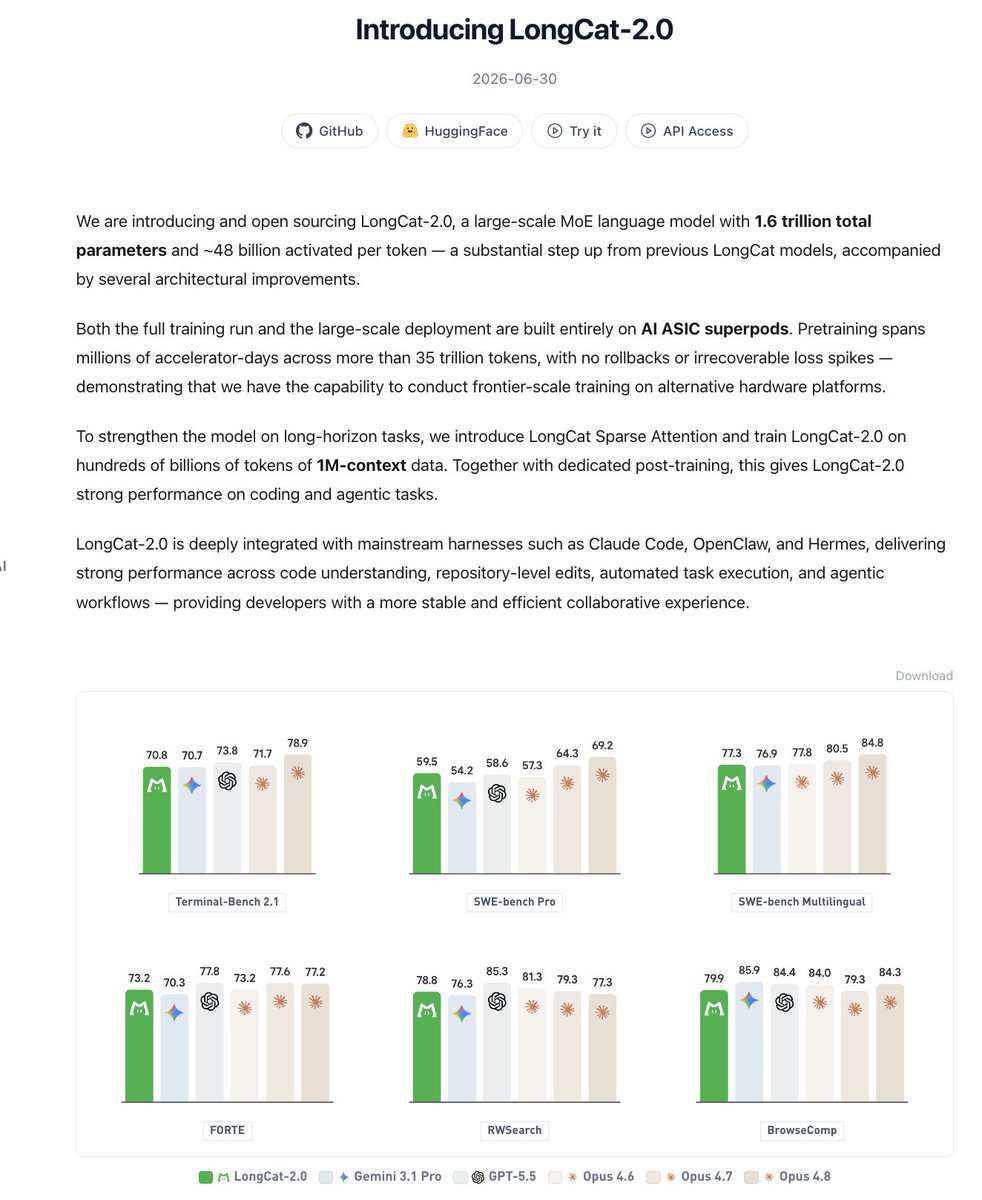
@teortaxesTex criticized (65 likes, 5 replies, 4,407 views, 17 bookmarks) LongCat 2.5 Preview not because the launch sounded small, but because it sounded large without publishing fresh benchmark evidence. The attached screenshot still foregrounded big claims—1.6T parameters, roughly 48B active, 1M context, integration with Claude Code/OpenClaw/Hermes, and older benchmark bars—while the post and replies kept asking the same question: where are the new benchmarks for this release?
7. Where the Opportunities Are
[+++] Workflow-specific eval and incident infrastructure — This was the strongest cross-section signal. Businessbarista's enterprise answer-key thesis, rjs's high-stakes warning, SREGym's production-failure benchmark, and Open Axis Benchmark's fresh-task design all point to the same gap: teams need evaluation that matches their own failure modes after deployment, not just public benchmark bragging rights.
[+++] Agent coordination, reputation, and dispute rails — 0xvati's coordination-layer post, d3rekson's Internet Court flow, and Loreen2074591's work-history argument all converged on trust infrastructure for repeated autonomous work. The opportunity is strong because the underlying need spans payments, verification, reputation, and settlement rather than one narrow feature.
[++] Computer-use and gateway control planes — Cua, Decode, and My Free Code show builders packaging desktops, sandboxes, routing, fallbacks, replays, and provider abstraction around models. This is a solid opportunity, but it is already visibly competitive because several serious projects are chasing adjacent slices of the same control surface.
[++] Physical-AI ground-truth engines — Axis Robotics and Vangrid both targeted the same bottleneck from different directions: generate more real-world experience, verify it, and keep the task/data pipeline fresh. The opportunity is meaningful because the pain is explicit, but credibility and data quality are still active objections.
[+] AI-search citation intelligence — The Surfer study and the attached screenshots of paid "AI citation" services show a real emerging niche around tracking which sources answer engines cite and how brand presence changes ranking. It is still early and marketing-heavy, but the data made it more concrete than on most prior days.
8. Takeaways
- Agent builders increasingly care about the layers around a model, not just the model itself. Decode's published stack, CLM's cached decision layer, and SREGym's production-incident benchmark all point to routing, replay, sandboxing, and post-deployment diagnosis as first-class product surfaces. (source)
- Enterprise adoption still hinges on answer keys and workflow-specific evals. The strongest enterprise-facing post of the day argued that a company's eval environment is becoming proprietary IP and that many teams still cannot make non-engineering agents reliable. (source)
- "Too high-stakes to vibe-code" is becoming a practical boundary, not just a slogan. rjs's post and follow-up reply reframed the issue as judgment and role separation: when the cost of failure is high enough, people still want sharper scoping, explicit review, and specialized expertise. (source)
- Physical AI conversation kept circling back to missing ground truth. The day produced multiple versions of the same argument: robots need fresh physical experience, static benchmarks and coarse sensing are not enough, and provenance only matters if it can withstand calibration and spoofing doubts. (source)
- Consumer AI traction looked strongest where an agent fits a routine or a persistent identity. Muse's single-thread bubble framing and Sleepagotchi's morning-open behavior both suggest that usage pattern and product shape may matter more than another abstract "assistant" feature list. (source)
- Agent-to-agent commerce still needs a boring trust layer before it can scale. Payments alone did not satisfy the feed; the missing pieces were verification, dispute handling, and persistent reputation, whether framed as a coordination layer, an AI court, or an agent work history. (source)
- AI-search optimization moved from folklore toward measurable citation strategy. The Surfer thread did not prove causation, but it did give builders a concrete dataset, a correlation chart, and a visible market for paid "AI citation" services. (source)