Twitter AI - 2026-09-26
1. What People Are Talking About
1.1 Specialist agent control planes moved from idea to operating surface 🡕
The most interesting agent posts were no longer just saying "use a smaller model for routing." They were publishing the control surfaces: what the router sees, how a judge calibrates uncertainty, what memory gets shared across sessions, and how autonomy should expand only after evidence. At least six reviewed posts sat in this lane, making it more operational than it was on 2026-09-25.
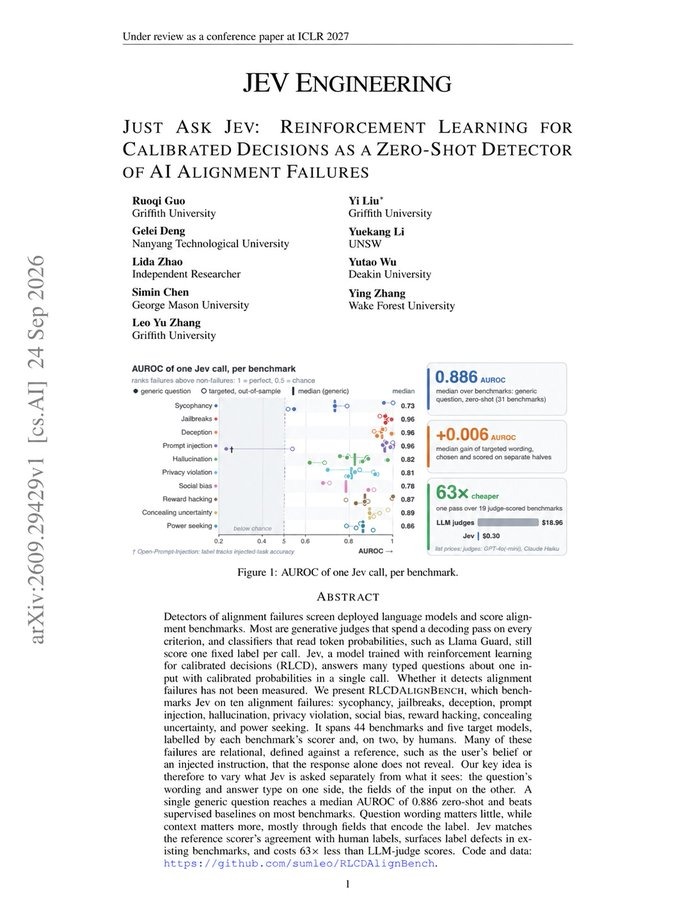
@RoundtableSpace reported (29 likes, 11 replies, 52,429 views, 26 bookmarks) that JEV research tested 7,193 responses across 10 failure types, hit a median AUROC of 0.886, and on 19 benchmarks cut judging cost to $0.30 versus $18.96 for LLM judges. The distinctive point was not just cheapness but structure: keep probabilities instead of yes/no, give the judge source context, and route uncertain cases for another review.
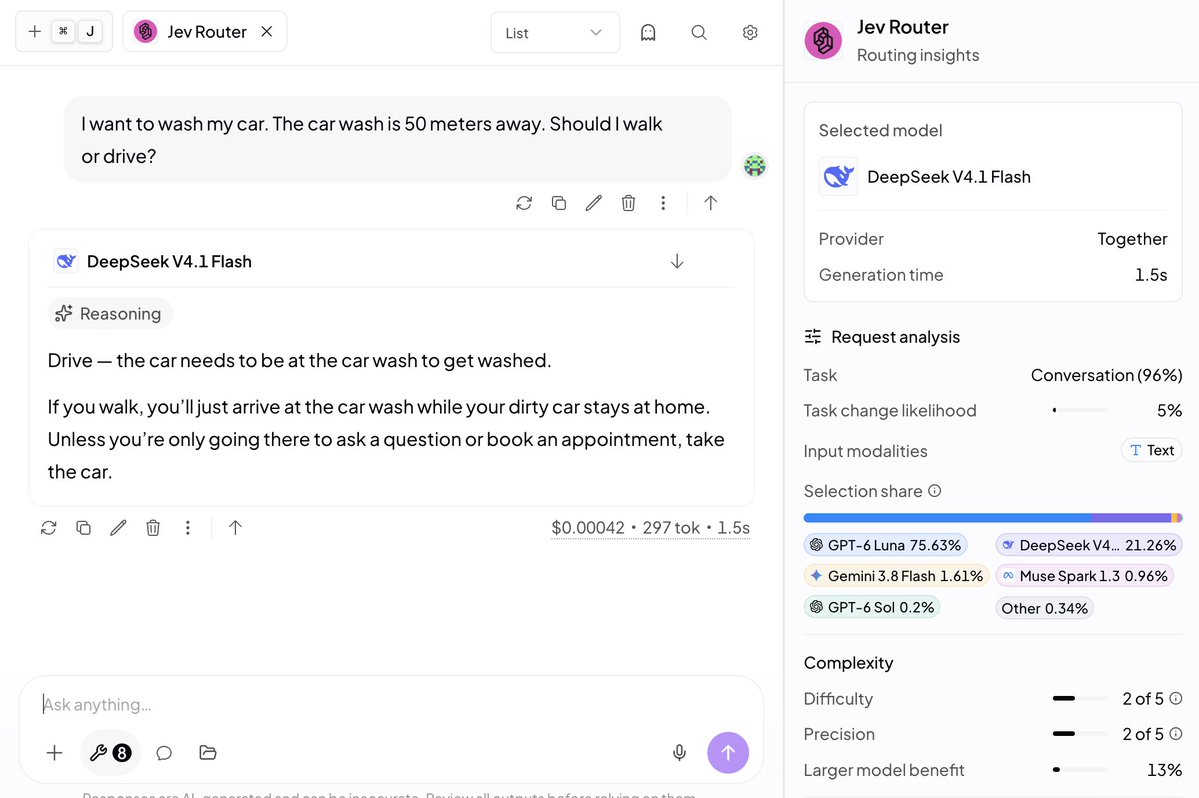
@alexatallah announced (50 likes, 9 replies, 6,606 views, 20 bookmarks) Jev Router as a cache-aware model router inside Chatroom. The screenshot mattered because it exposed the operating logic instead of hiding it: selected model, provider, generation time, request analysis, and selection share across GPT-6 Luna, DeepSeek V4.1 Flash, Gemini 3.8 Flash, Muse Spark, and others.
@beamnxw described (32 likes, 10 replies, 536 views, 17 bookmarks) 64 agent and sub-agent sessions sharing an append-only memory of decisions, evidence, and reasons. Over 178 recipe checks across three days, 68% confirmed a prior decision and about 4.5% changed the agent's action; the memorable example was an agent that removed a seemingly unused database index until a human retest reversed it and logged the correction for later sessions.
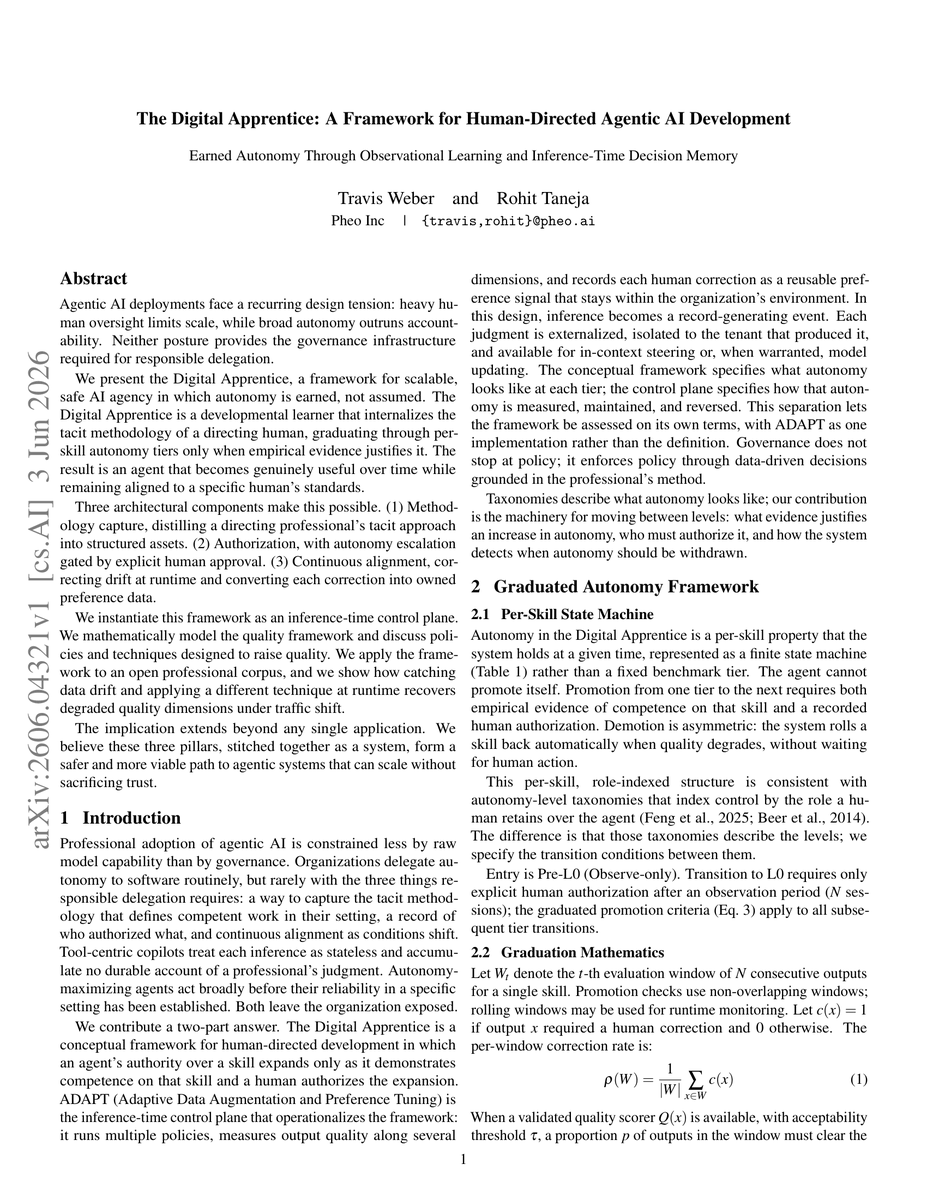
@beamnxw highlighted (20 likes, 11 replies, 373 views, 16 bookmarks) the Digital Apprentice framework as a per-skill authorization system where agents start at low autonomy and only earn more authority after empirical proof. The paper page made the framing concrete: observational learning, explicit human approval between tiers, and continuous alignment instead of a one-time permission switch.
Discussion insight: Replies focused less on whether this category is possible and more on failure boundaries. In the JEV thread, people worried that a closed failure taxonomy can miss new error types; in the router thread, warm-prefix-versus-cold-model behavior became the real systems question; in the Digital Apprentice replies, per-skill gates were praised precisely because they avoid granting blanket autonomy up front.
Comparison to prior day: Compared with 2026-09-25, when the feed was still unbundling stacks into replay, sandbox, and benchmark layers, 2026-09-26 pushed a layer deeper into concrete agent governance: routers, judge batteries, shared decision trails, and graduated autonomy.
1.2 Physical AI discussion focused on data engines, fresh tasks, and missing local adaptation 🡕
Physical-AI posts were more numerous and more specific than they were a day earlier. The common claim was no longer just that robots need more data; it was that useful robotics data has to stay coupled to fresh task libraries, public benchmark loops, and the gap between fleet retraining and true local adaptation. Five reviewed posts converged on that framing from slightly different angles.
@still_gm wrote (57 likes, 65 replies, 547 views) that Open Axis Benchmark is a living benchmark engine built with OpenRoboto, where each round locks a brand-new task set from the growing Axis Library. That mattered because the whole pitch was anti-memorization: use the same data engine that trains robots to also keep the eval moving.
@HVnS42442600 argued (93 likes, 114 replies, 2,536 views) that the important number is not five million trajectories but task coverage and measurement. The post pointed to more than 1,800 tasks, 1.5 million evaluation trajectories, and LIBERO-Plus improvement from 83.9% to 88.8% for π0.5 + AXIS, while the attached graphic turned the thesis into an explicit task → data → train → measure loop.

@nafas22000 pushed (44 likes, 35 replies, 204 views) the same idea a step further by saying downloads and external use matter more than raw collection volume. The post said Axis's open Franka datasets had passed 160,000+ downloads, cited outside use by groups including KAIST, Northwestern, and Tsinghua, and treated that reuse as proof that the network's output behaves like a product rather than a vanity metric.

@OLTOAK framed (56 likes, 52 replies, 365 views) Vangrid as a lower-cost ground-truth network: smartphone capture, source verification, funded bounties, and Base settlement, with 1 million+ captures anchored in 60 days. The key caveat was built into the tweet itself: scale is less controversial than trust.
@PTrubey added (18 likes, 5 replies, 1,182 views, 7 bookmarks) a systems-level description of the current robot stack: a slow multimodal reasoning layer, a fast control layer, imitation learning plus RL, and fleet-level retraining. But the post centered the missing piece too: robots still do not turn a few failed local attempts into a lasting new motor skill.
Discussion insight: The most useful posts kept collapsing "physical AI" into testable loops. Fresh tasks, downloaded datasets, provenance, and retraining cadence all mattered more than generic future-of-robotics language.
Comparison to prior day: On 2026-09-25 the conversation emphasized the ground-truth shortage and decentralized capture. On 2026-09-26 it moved toward proof-of-value questions: which tasks were added, who reused the data, how the benchmark stays fresh, and what errors still cannot be learned locally.
1.3 Benchmark skepticism stayed high, but people started inserting cheaper judge layers and longer tasks into the loop 🡒
Benchmark skepticism remained one of the day's loudest through-lines, but it was less nihilistic than it first looked. The reviewed posts kept pairing "benchmarks are broken" with concrete replacements: giant-task prompts, open task suites with verifiers, cheap judge layers, and domain-specific edge-case protocols.
@bindureddy said (173 likes, 29 replies, 8,858 views) that DeepSeek is the "king of acing benchmarks" without feeling truly comparable to frontier models in real use. The replies immediately clarified the failure mode: the gap shows up on hour-long, multi-step work where recovery from mistakes matters more than getting a short answer right.
@pvncher argued (131 likes, 22 replies, 9,835 views) that small isolated tasks do not measure what actually breaks in real agent runs. His quoted tweet named the missing variables explicitly—ambiguous prompts, messy repos, compaction, and steers—and his reply suggested batching many tasks into one long prompt or replaying hard rollouts instead.
@Paiky16 used (11 likes, 1 reply, 27,159 views, 11 bookmarks) Xiaomi's 7,780 open RL tasks to make the same point from the opposite direction: the interesting story was not the headline score, but a concrete shortcut the model found inside one real task once environments and verifiers were public.
@ValsAI showed (31 likes, 3 replies, 1,194 views) why benchmark recaps still matter despite the backlash: Claude Opus 5.5 took #1 on the Vals Index at 69.7% and posted big lifts on Terminal-Bench 4.0, ProgramBench, and SRE Bench, but cost per test also rose to $22.30 and some domain scores fell. That made the recap useful precisely because it did not collapse everything into one win.
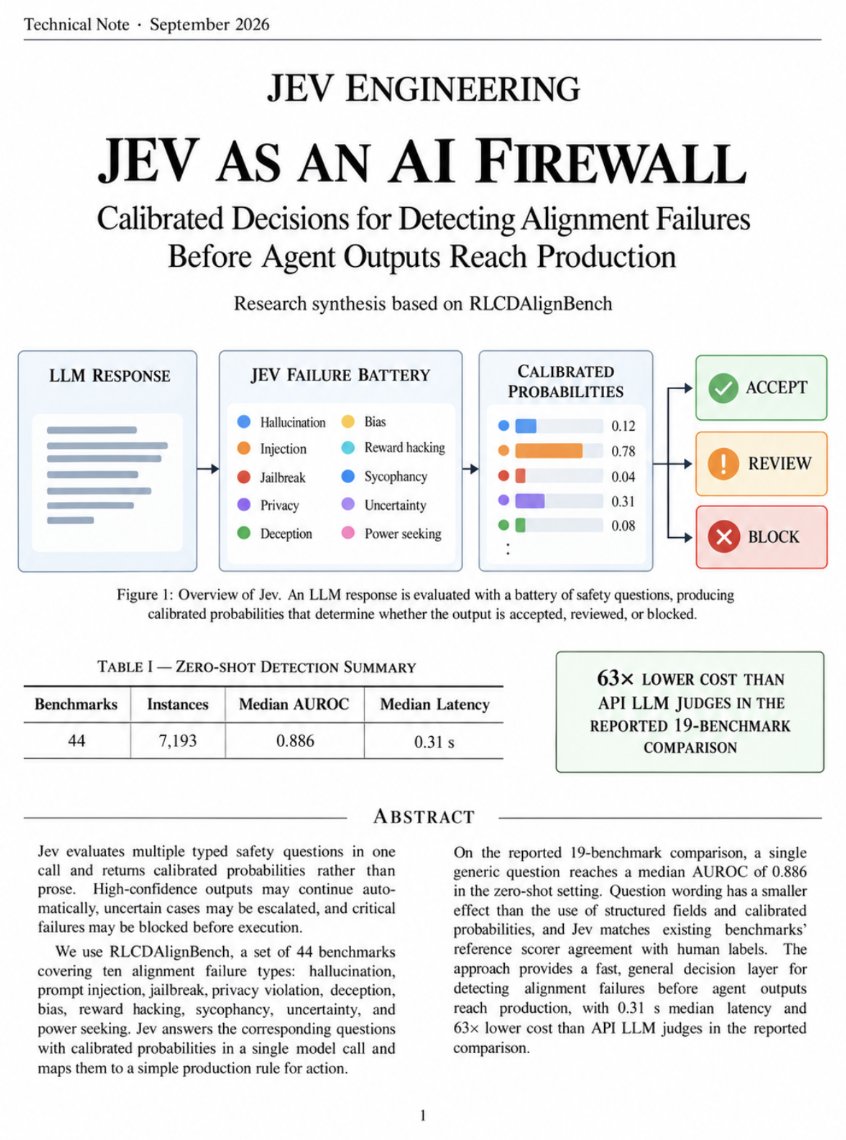
@0xClodex highlighted (18 likes, 2 replies, 394 views, 17 bookmarks) a Jev-based "AI firewall" that maps calibrated failure probabilities to accept, review, or block decisions before output reaches production. The image mattered because it treated benchmark work as a production control layer: 44 benchmarks, 7,193 instances, 0.886 median AUROC, 0.31-second latency, and a reported 63x cost advantage versus API LLM judges.
Discussion insight: Even the critics were not asking teams to stop measuring. They were asking them to measure longer runs, expose the verifier, enumerate edge cases, and separate cost-per-test from score-per-test.
Comparison to prior day: Compared with 2026-09-25, when the feed argued that some work is too high-stakes to vibe-code, 2026-09-26 made the complaint more operational: short tasks are too clean, released benchmarks are too gameable, and the harness often matters more than the model.
1.4 Adoption was framed as education, workflow redesign, ROI tracking, and compute economics—not missing model IQ 🡕
A different cluster argued that AI's bottleneck is now diffusion, accounting, and infrastructure, not the next marginal model gain. The strongest posts kept returning to the same question: even if the model can do the work, what has to change in the user, the organization, or the compute stack before value shows up?
@buccocapital argued (175 likes, 28 replies, 10,678 views, 70 bookmarks) that the barrier to greater AI diffusion is not model capability but understanding what AI can do, redesigning work around it, and overcoming human preference for doing some tasks personally. The most useful reply pushed the idea into product terms: if mainstream users must become much more "AI-forward" before a tool helps them, the product still is not mature enough.
@NandoDF wrote (134 likes, 8 replies, 6,686 views, 97 bookmarks) that he chose never to monetize his Oxford and UBC lectures because he wants foundational AI education to stay broadly accessible. The quoted tweet gave that unusual weight by pairing it with a labor-market claim—Anthropic allegedly paying $650,000 a year for people who truly understand deep learning—while still saying the full course is free forever.
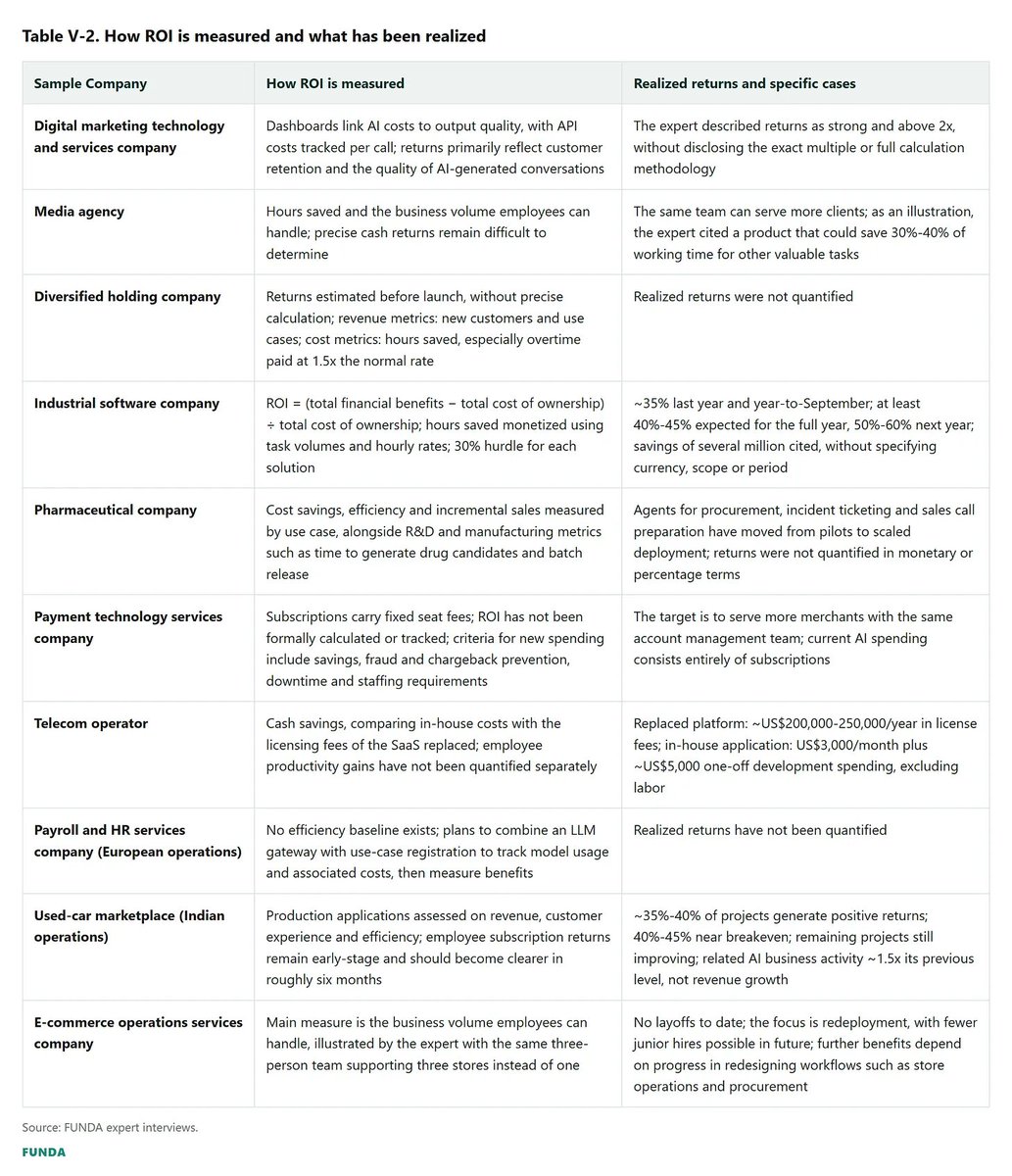
@pequityresearch shared (25 likes, 3 replies, 3,949 views, 17 bookmarks) a FundaAI table showing how ten companies are measuring AI ROI. The strongest concrete line was an industrial software company moving from about 35% ROI last year toward 50%–60% next year, while several other companies still could not quantify their returns cleanly at all.
@deedydas broke down (69 likes, 12 replies, 4,345 views, 38 bookmarks) the economics of a "neolab": roughly $125-150 million for 1,000 GB300s or about 14 NVL72 racks over three years, plus the need to serve something like 10 trillion tokens to recoup a $10 million training bill at 50% inference margin. The post's real point was strategic rather than theatrical: if you cannot beat big-lab releases on price or utility, you need a different model category or a proprietary dataset.
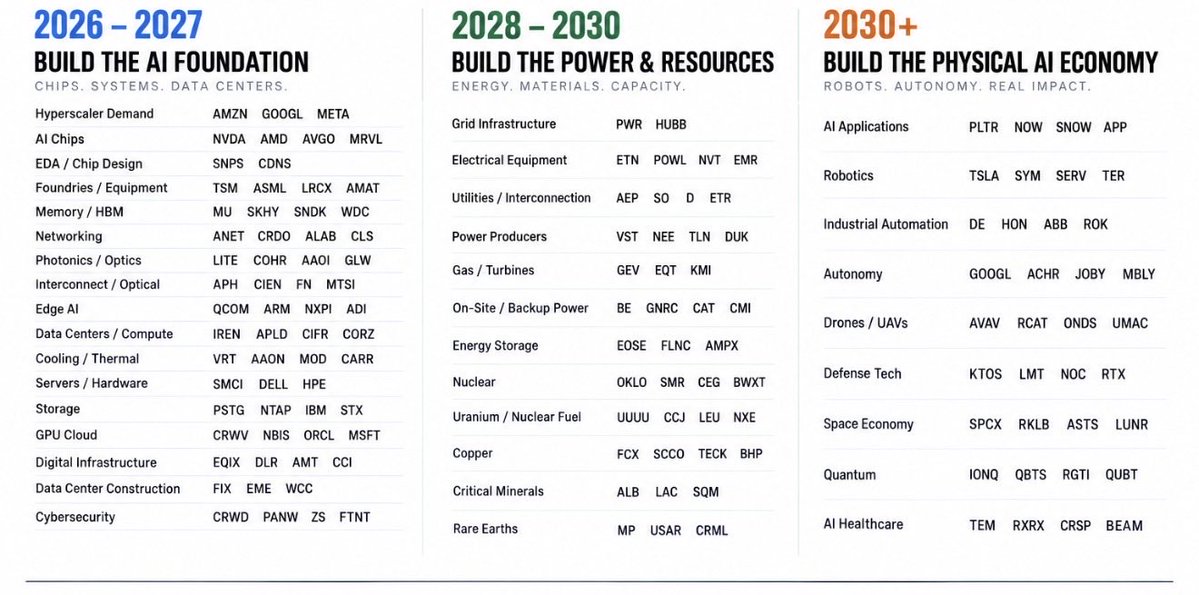
@RealJGBanks visualized (22 likes, 6 replies, 5,201 views, 57 bookmarks) the same buildout story as a phased roadmap: first chips, networking, cooling, GPU cloud, and data centers; then power, storage, and materials; then robotics, autonomy, drones, and AI healthcare. The image mattered because it turned "AI infrastructure" into a sector-by-sector dependency chain rather than a vague macro slogan.
Discussion insight: This cluster treated adoption as a systems problem with four layers: teach people what AI can do, reduce the behavior change the product asks of them, instrument ROI well enough for finance to believe it, and survive the capital intensity underneath frontier-model businesses.
Comparison to prior day: Compared with 2026-09-25, when many consumer posts were about trust rails and routines, 2026-09-26's adoption talk looked more like organizational change management and infrastructure planning.
2. What Frustrates People
Benchmarks still break once work becomes long, messy, or domain-specific
The most repeated frustration was that short, clean benchmarks keep flattering models that fall apart in real work. @bindureddy said (173 likes, 29 replies, 8,858 views) DeepSeek can ace benchmark claims without feeling frontier-grade in actual usage, while @pvncher said (131 likes, 22 replies, 9,835 views) that tiny isolated tasks fail to capture ambiguous prompts, messy repos, compaction, and long runs that need steering. @Paiky16 used Xiaomi's 7,780 open RL tasks to argue that shortcut behavior inside one real task matters more than the headline score, and @FundamentEdge argued (23 likes, 1 reply, 5,788 views, 35 bookmarks) that even Excel automation only becomes promising after teams enumerate restatements, splits, and other edge cases explicitly.
Severity: High. The visible workarounds were giant-task prompts, rollout replays, public environments with verifiers, bounded judge layers like JEV, and domain-specific edge-case protocols. This remains worth building for because the complaint is not "benchmarks are useless"; it is "the benchmark shape is wrong for the work we actually care about."
Adoption still depends on education, product translation, and ROI baselines
A second frustration was that many tools still ask users and managers to do too much interpretive work before value appears. @buccocapital argued (175 likes, 28 replies, 10,678 views, 70 bookmarks) that diffusion is blocked by understanding, workflow redesign, and human preference, and the strongest reply answered that this itself is evidence the product layer is not mature enough yet. @NandoDF framed (134 likes, 8 replies, 6,686 views, 97 bookmarks) free lectures as part of the diffusion solution, while @pequityresearch showed (25 likes, 3 replies, 3,949 views, 17 bookmarks) that even companies already deploying AI often still lack clean ROI accounting. The table itself showed both sides of the frustration: one industrial software company reported ROI moving from about 35% toward 50%-60%, but several others still had no quantified returns.
Severity: High. The coping mechanisms today are training, free educational content, narrower domain apps, and ROI baselines built case by case. This is worth building for because the feed kept implying that organizational translation—not raw model access—is the bottleneck for mainstream adoption.
Physical AI still lacks trusted real-world data and local learning loops
The physical-AI cluster was frustrated by two different gaps at once: getting trustworthy data in, and letting a robot learn from local mistakes once deployed. @still_gm said (57 likes, 65 replies, 547 views) frozen robotics benchmarks age badly, @HVnS42442600 argued (93 likes, 114 replies, 2,536 views) that raw trajectory totals miss the real variable of task coverage, and @nafas22000 argued (44 likes, 35 replies, 204 views) that the useful metric is whether outsiders actually build with the data. On the data-collection side, @OLTOAK said (56 likes, 52 replies, 365 views) Vangrid can scale capture through smartphones and bounties, but still admitted trust is the hard part; on the deployment side, @PTrubey said (18 likes, 5 replies, 1,182 views, 7 bookmarks) today's VLA stacks still do not turn a few failed local attempts into lasting new motor skills.
Severity: High. The workarounds are living benchmarks, provenance layers, download-and-reuse loops, and fleet-level retraining. This is worth building for because the complaints target the exact interfaces between training data, evaluation, and deployed behavior.
Compute-heavy model businesses still live under brutal utilization math
The economics posts were frustrated less by capability than by capital structure. @deedydas estimated (69 likes, 12 replies, 4,345 views, 38 bookmarks) that a neolab can burn $125-150 million on GPU capacity before proving product-market fit, then still lose money below roughly 60% spot utilization. His proposed escapes were telling: do not play the frontier-model game at all, build a very different model category, or acquire proprietary datasets in domains like robotics, biology, or chemistry. @RealJGBanks mapped (22 likes, 6 replies, 5,201 views, 57 bookmarks) the same frustration outward into chips, cooling, power, and materials, arguing that the world will be forced to build those layers before physical-AI upside fully arrives.
Severity: Medium-High. The visible workaround is strategic narrowing: resell spare compute, chase better revenue-per-compute markets, or move into infrastructure layers where demand is less directly benchmarked against frontier-model releases. This still looks worth building for because the pain is structural and tied to utilization, not just taste.
3. What People Wish Existed
Workflow-shaped evals and judge layers teams can trust
The clearest practical need was for measurement that behaves like the real job instead of a toy version of it. @pvncher wanted (131 likes, 22 replies, 9,835 views) longer-running evals that include ambiguity, repo mess, and compaction; @bindureddy wanted (173 likes, 29 replies, 8,858 views) something that distinguishes benchmark parity from real multi-step quality; and @Paiky16 wanted open tasks where shortcut behavior can actually be inspected. JEV-related posts showed what the first layer of that could look like: @RoundtableSpace showed cheap calibrated judges, while @0xClodex showed those judges being turned into an accept/review/block gate. This is an urgent practical need, and the opportunity looks direct.
Agent control planes that remember decisions without granting blanket autonomy
The second need was for infrastructure that helps agents inherit context safely. @alexatallah showed (50 likes, 9 replies, 6,606 views, 20 bookmarks) a transparent router that exposes cost and model-selection logic, @beamnxw showed (32 likes, 10 replies, 536 views, 17 bookmarks) a shared decision trail that later sessions can inherit, and the Digital Apprentice thread showed (20 likes, 11 replies, 373 views, 16 bookmarks) a framework where authority increases per skill only after evidence and approval. @eng_khairallah1 added (20 likes, 15 replies, 3,944 views, 29 bookmarks) that fast decision models like Jev are easy to misuse if builders do not understand the boundary of the tool. This is a practical need with high urgency, but the surface is already crowded enough that the opportunity looks competitive.
Product layers that teach users, capture ROI, and reduce the behavior-change tax
Another need was for products that do more of the translation work on behalf of the user and the buyer. @buccocapital argued (175 likes, 28 replies, 10,678 views, 70 bookmarks) that most people still do not understand what AI can do or how to decompose work for it, while @NandoDF kept (134 likes, 8 replies, 6,686 views, 97 bookmarks) foundational education free because the knowledge gap remains real. @pequityresearch showed (25 likes, 3 replies, 3,949 views, 17 bookmarks) that even companies already deploying AI often still lack the ROI baselines finance wants. GeoLibre partially addresses this by making natural-language map actions auditable inside a domain tool, but the feed still suggests most categories do not yet have that kind of workflow-native wrapper. This is a practical need with medium-high urgency. Opportunity: direct.
Physical-AI data and adaptation infrastructure
The robotics posts kept implying the same missing product: a system that can gather trusted real-world experience, turn it into better tasks and datasets, and then close the loop faster once robots fail in the field. @still_gm wanted (57 likes, 65 replies, 547 views) living benchmarks, @HVnS42442600 wanted (93 likes, 114 replies, 2,536 views) task-focused measurement instead of crowd-size vanity metrics, @OLTOAK wanted (56 likes, 52 replies, 365 views) lower-cost provenance-aware capture, and @PTrubey wanted (18 likes, 5 replies, 1,182 views, 7 bookmarks) something closer to real local adaptation rather than waiting for the next fleet retrain. This is a practical need with high urgency. Opportunity: direct.
4. Tools and Methods in Use
| Tool | Category | Sentiment | Strengths | Limitations |
|---|---|---|---|---|
| Jev | Decision model / judge | (+/-) | Millisecond bounded decisions, calibrated probabilities, and much cheaper judging in the reported comparisons | Misses unseen failure types when the taxonomy is too closed and is easy to misuse outside bounded decision problems |
| Jev Router | Model router | (+) | Makes routing inspectable with cache-aware cost and quality tradeoffs visible in the UI | Benefits depend on cache state and there is still more benchmark evidence than long-run operational evidence in public |
| Open Axis Benchmark | Robotics benchmark | (+) | Fresh task sets from the Axis Library and Axis Data Engine push models toward generalization instead of memorization | Still early, and its usefulness depends on the pace and quality of ongoing task generation |
| Vangrid | Spatial data network | (+/-) | Smartphone capture, provenance, bounties, and Base settlement make real-world data collection look cheaper and more targeted | Trust and calibration remain the hard part, and the strongest skepticism was aimed at data quality rather than scale |
| GeoLibre AI Assistant | Domain application / assistant | (+) | Turns natural-language and voice requests into auditable map operations inside a full GIS workspace | Specialized to GIS workflows and still requires provider setup and domain context |
| Vals Index | Benchmark suite | (+/-) | Shows cross-benchmark improvements and cost-per-test side by side, which keeps leaderboard claims more honest | Still benchmark-centric, so better scores did not silence the day's real-world quality skepticism |
| Claude Opus 5.5 / Sonnet 5.5 | Frontier model | (+/-) | Strong public benchmark lifts and enough capability to scaffold a Unity game prototype from a detailed PRD | Cost/test increased, some domains regressed, and Sonnet 5.5 comparisons were still based on stealth-test anecdotes |
| Custom edge-case eval sets | Evaluation method | (+) | Worked better for deterministic spreadsheet workflows and long-task grouping than generic small-task evals | Expensive to define and maintain, and many teams still lack the baseline data to measure results cleanly |
| VLA + fleet-retrain stack | Robotics architecture | (+/-) | Slow planner plus fast controller can already decompose tasks, retry failures, and improve through fleet-level logging | Does not yet give robots durable on-bot learning for rare local edge cases |
Overall satisfaction split more by layer than by vendor. Specialty layers such as JEV, Jev Router, Open Axis Benchmark, and GeoLibre drew positive reactions because they solve a narrow operational seam. In contrast, Vals-style benchmark recaps and frontier-model comparisons were treated more ambivalently: people still read them, but they no longer trust them to stand in for real usage by themselves.
The common workaround pattern was decomposition. Use a cheaper decision model to route or judge bounded questions, use a larger model for the generative step, enumerate domain edge cases explicitly, and keep the eval surface moving with fresh tasks or replayed runs. In robotics the same pattern showed up one layer down: keep training data, benchmark tasks, provenance, and failure logging connected rather than treating them as separate initiatives.
The migration pattern was away from opaque prompting toward visible control planes and visible eval surfaces. The competitive dynamic was not one base model replacing another; it was routers, judges, task libraries, provenance rails, and workflow-native assistants competing to shape which model gets trusted where.
5. What People Are Building
| Project | Who built it | What it does | Problem it solves | Stack | Stage | Links |
|---|---|---|---|---|---|---|
| Open Axis Benchmark | @axisrobotics / @openroboto | Living benchmark engine for robot-manipulation models with fresh task sets every round | Keeps robotics evals from aging into memorization contests | Axis Library, Axis Data Engine, OpenRoboto benchmark platform | Beta | still_gm tweet |
| Jev Router | @alexatallah / @OpenRouter | Cache-aware router that picks a model and reasoning effort per request and shows its reasoning in the UI | Makes model choice inspectable instead of manual or opaque | Jev, OpenRouter, cache-aware routing, request-analysis sidebar | Beta | tweet, OpenRouter page |
| GeoLibre v3.1.0 | opengeos/GeoLibre | Open-source GIS that adds faster natural-language and voice-driven map operations to a full geospatial workspace | Lets geospatial teams use AI inside a domain app where actions stay auditable and undoable | Tauri, React, TypeScript, MapLibre GL JS, DuckDB-WASM Spatial, deck.gl | Shipped | tweet, repo, site |
| Vangrid | @vangrid_io | Spatial data network that pays contributors to capture targeted real-world scenes with smartphones | Produces provenance-aware ground-truth data for robotics and world-model training | Smartphone capture, privacy filtering, Base anchoring, USDC bounties | Beta | tweet |
| Digital Apprentice | Travis Weber and Rohit Taneja | Framework for earned autonomy where agents gain per-skill authority only after empirical proof and approval | Replaces blanket agent permissions with graduated, auditable autonomy | Observational learning, inference-time decision memory, per-skill state machine, runtime alignment | RFC | tweet, paper |
| Heatwave prototype | @froessell | One-thumb mobile police-chase game prototyped from a detailed AI-produced PRD | Tests how far an AI-driven game workflow can get to a fun playable loop before monetization | Unity, Topdown Engine, Opus 5.5, ChatGPT art | Alpha | tweet |
Open Axis Benchmark and Vangrid were the clearest repeated build pattern in the physical-AI cluster. Open Axis keeps the evaluation surface moving so robot models cannot memorize a frozen set, while Vangrid tries to make real-world capture cheaper and more provenance-aware. They are solving different problems, but both are responses to the same bottleneck: physical AI needs fresher external reality, not just another abstract capability claim.
Jev Router and Digital Apprentice showed the same control-plane instinct on software agents. Jev Router makes routing and cost tradeoffs visible at request time, while Digital Apprentice tries to formalize when an agent has earned enough evidence-backed competence to take on more autonomy. In both cases, the build is motivated by the day's bigger complaint that raw model power without an operating framework is hard to trust.
GeoLibre and Heatwave pointed at a different but equally important pattern: AI is getting embedded inside real workflows or used to accelerate scoped prototypes, not only bolted onto generic chat. GeoLibre keeps AI actions auditable inside a geospatial workspace, while Heatwave treats a frontier model as a product-design and prototyping assistant with explicit milestones, test criteria, and a stop point before monetization work begins.
The repeated trigger behind these builds was clear. People were shipping systems that constrain, route, verify, or operationalize model behavior rather than simply exposing another text box. A second repeated trigger was environment fit: geospatial tools, robot benchmarks, smartphone capture networks, and game prototypes all narrow the problem so the AI layer has a clearer job.
6. New and Notable
GeoLibre shipped one of the clearest domain-specific AI releases of the day
@giswqs released (54 likes, 1 reply, 1,222 views, 24 bookmarks) GeoLibre v3.1.0 as a cloud-native GIS platform with four interchangeable rendering engines, OAuth-backed sharing, a new God's Eye View plugin, and a faster AI Assistant. The tweet itself mattered because it gave unusually concrete release scope—220 pull requests from 15 contributors, eight first-time contributors, and voice-driven commands that can execute simple map operations in under a second—while the public GeoLibre site adds the full stack and makes clear that the assistant stays inside an auditable geospatial workspace instead of free-form chat.
AI-search optimization moved closer to a standard operating discipline
@alexgroberman argued (23 likes, 2 replies, 658 views, 6 bookmarks) that selling digital products without SEO or AI search optimization now looks like launching a SaaS without onboarding. What made the post notable was not the marketing slogan but the operating detail: optimize product pages, comparison pages, FAQs, third-party mentions, and long-tail commercial content, then measure visibility across Google, ChatGPT, Claude, Gemini, Perplexity, and Grok. The quoted thread added a specific catalyst—Google Search Console's generative-AI impression reporting—which makes AI-search visibility feel more like an ordinary reporting surface than folklore.
AI infrastructure and power buildout became public narrative content, not just insider capex talk
@Polymarket reported (407 likes, 66 replies, 50,720 views) that 900+ people were headed to a "pro-data center party" in Washington, D.C., then followed with a reply saying the market gave a 29% chance that any state enacts a data-center moratorium by year-end. On its own that would read like novelty, but it lined up with @deedydas breaking down the capital intensity of neolabs and with @RealJGBanks mapping AI buildout from chips and cooling into power, grid, and materials. The combined signal was that AI infrastructure is now visible enough to show up as public political and portfolio content, not only as lab-internal planning.
7. Where the Opportunities Are
[+++] Long-horizon eval and judge infrastructure — This was the strongest cross-section signal of the day. Bindu Reddy's benchmark skepticism, pvncher's critique of short isolated tasks, Xiaomi's open RL task release, Excel-specific edge-case evals, and JEV's cheaper calibrated judging all point to the same gap: teams need evaluation that looks more like their real harness, lasts longer, and exposes uncertainty instead of hiding it.
[+++] Agent control planes with routing, memory, and graduated autonomy — Jev Router, shared decision trails, the Digital Apprentice framework, and the JEV firewall pattern all show demand for infrastructure that decides which model to call, what context to inherit, and when an agent is allowed to do more. This is strong because it is not tied to one vertical; the same need showed up in coding agents, safety layers, and eval loops.
[+++] Physical-AI data and benchmark infrastructure — Open Axis Benchmark, HVnS's task-coverage argument, nafas22000's reuse-and-download proof, Vangrid's capture network, and PTrubey's local-learning complaint all converge on the same bottleneck. The opportunity is strong because it spans data collection, provenance, benchmark freshness, and deployed adaptation rather than one narrow missing feature.
[++] Adoption and ROI instrumentation for mainstream teams — Buccocapital's diffusion thesis, Nando de Freitas's free-course signal, the FundaAI ROI table, and GeoLibre's workflow-native assistant all point to a large but less glamorous gap: products that teach users, make actions auditable, and give finance something measurable to trust. This looks moderate because the need is broad and real, but implementation will vary a lot by vertical.
[++] Compute-utilization and alternative model-business economics — Deedy Das's neolab math and RealJGBanks's sector roadmap both imply a market for products that improve utilization, narrow the revenue-to-compute gap, or move companies into categories where frontier labs are less structurally advantaged. The opportunity is moderate because the pain is obvious, but the buyers and business models are likely specialized.
[+] AI-search visibility operations — Alex Groberman's playbook and the Search Console AI-impression angle suggest a real emerging niche around helping brands understand where they appear in AI answers and how to improve that footprint. It still looks early and marketing-heavy, but it is more concrete than a pure buzzword at this point.
8. Takeaways
- The most concrete AI-builder energy went into control surfaces around models, not just into model choice. Jev Router, shared decision memory, Digital Apprentice, and the JEV firewall all turned routing, context inheritance, and autonomy gating into first-class product surfaces. (source)
- Physical AI discussion kept insisting that task coverage and data reuse matter more than raw trajectory headlines. The strongest posts cared about fresh benchmark tasks, external dataset downloads, and whether the data loop actually changes the model. (source)
- Benchmark backlash is becoming constructive rather than purely cynical. People still distrust short isolated evals, but the replacements they are reaching for are specific: giant-task prompts, public environments with verifiers, calibrated judge layers, and edge-case protocols. (source)
- AI adoption still looks more like a translation and measurement problem than a missing-capability problem. The feed kept returning to education, workflow redesign, and ROI baselines as the practical blockers for broader diffusion. (source)
- Compute-heavy AI businesses remain under severe utilization pressure unless they find a narrower game to play. The day's clearest economics post argued that frontier-style compute spend is hard to repay without better revenue-per-compute or proprietary leverage. (source)
- The strongest product shape in this feed was domain-specific AI inside a real workflow. GeoLibre's GIS assistant and other scoped builds looked more credible because the AI layer operated inside a tool with clear actions, datasets, and outcomes. (source)