Twitter AI - 2026-10-10
1. What People Are Talking About
1.1 Agent operations got more concrete than agent demos (🡕)
The clearest cluster in the feed was about operating agents, not admiring them. At least four high-signal items treated the hard part as deciding what agents should do, what state they should keep, and how to tell whether they actually completed work.
@AlexFinn launched (71 likes, 23 replies, 6,847 views, 81 bookmarks) Agent Use Cases after saying the most common complaint he hears is that people set up Grok Bot, Muse, Hark, Dots, or Hermes and then do nothing with them. The attached screenshot makes the claim concrete: 1,041 indexed use cases, 104 new that week, and specific entries like web research into spreadsheets, end-to-end survey completion, Google Maps list building, and Codex bug fixing.

@0xwhrrari argued (79 likes, 28 replies, 7,702 views, 66 bookmarks) that agent memory breaks when systems save facts without rechecking whether those facts still hold. The replies sharpened that into specific operating rules: validity has to be checked on load, stale records need expiry or invalidation, and append-only history can let old facts outrank newer truth.
@sermakarevich framed (50 likes, 15 replies, 2,125 views, 62 bookmarks) agentic evals the same way. In the reply thread, he described a case where reply-only grading passed 58 of 60 runs, while state-aware grading passed only 48 because ten runs confidently claimed a refund existed when no database state had changed.
Discussion insight: The replies showed that people want more than better models. One reply on Alex Finn's thread asked why everyone has to build the same agent in isolation, while the memory and eval threads kept returning to the same practical demand: freshness checks, explicit step budgets, and shared reliable workflows.
Comparison to prior day: On 2026-10-09, the agent conversation centered on harness design and verification loops. On 2026-10-10, that same reliability instinct moved closer to day-to-day operations: what to actually run, what to store, and what to grade.
1.2 Open typed decision models kept gaining surface area (🡕)
Yesterday's decision-layer story did not fade. It widened into creator-built open systems that try to replace free-form text generation with bounded choices, probability outputs, and explicit escalation paths.
@Nandakishorm1 open-sourced (182 likes, 12 replies, 3,123 views, 60 bookmarks) Vega, a physics-based typed decision model he said comes in 800M and 4B variants with 73K-token context, image support, and stronger single-shot Jev-style benchmark results. The distinctive claim is architectural: represent the observation, question, and outcomes in hidden-state space, then let the decision settle among outcome "valleys" instead of generating prose.
@Sumanth_077 shared (9 likes, 5 replies, 854 views) AnyJev, an open framework that reads next-token logits over bounded options, corrects option-order bias, and can escalate low-confidence cases back to full reasoning. Its public metrics were unusually concrete for a small tweet: order-flip rate from 0.230 to 0.073, accuracy from 0.747 to 0.803, and the share of auto-decidable cases at 5% risk from 7.7% to 46.3%.
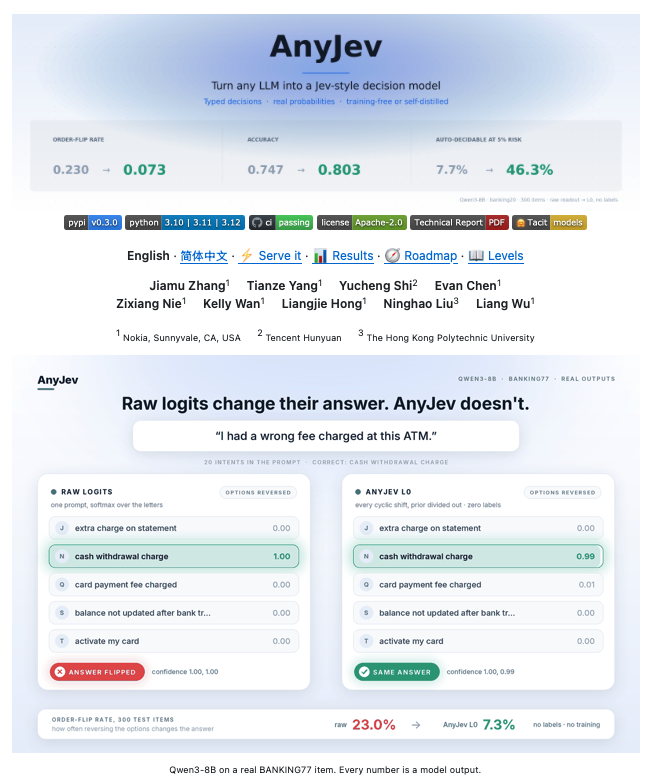
Discussion insight: The most useful skepticism came from the AnyJev thread itself. The author acknowledged that training-free typed decisions still inherit the base transformer's forward-pass cost, so the gain is structure and calibration, not free compute. On Vega, the first reply asked whether the improvement was architectural or just packaging, and the author answered that the architecture and training were both new.
Comparison to prior day: On 2026-10-09, decision models were represented by Microsoft-Decision-1 and Drex distribution. On 2026-10-10, the category looked more open and experimental, with independent builders publishing fresh variants and debiasing methods.
1.3 AI became both a use-case surface and a discovery layer for buyers (🡕)
A third cluster treated AI as the place where tasks are suggested and vendors are chosen. The signal came from product screenshots plus survey-backed buying data rather than from abstract model debate.
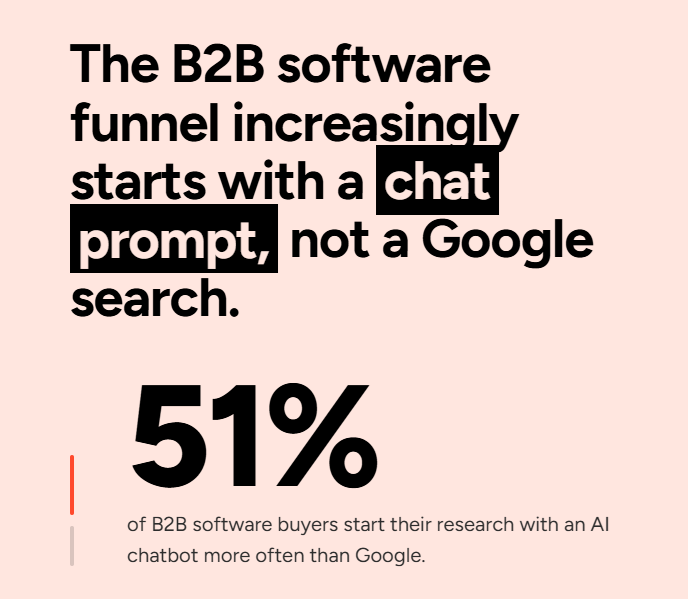
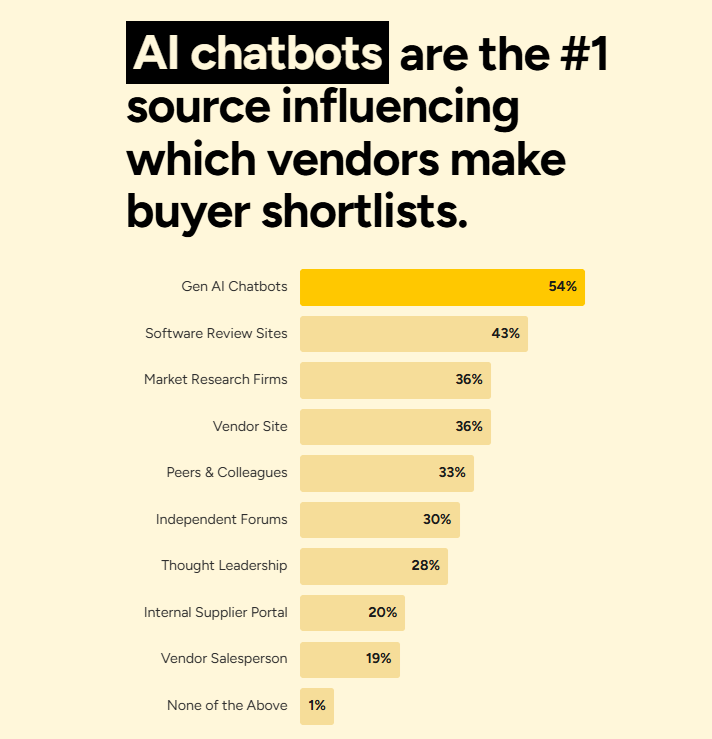
@alexgroberman argued (29 likes, 1 reply, 1,546 views) that AI chatbots are now rewriting B2B software shortlists, citing G2's March 2026 survey of 1,076 buyers. The public PR release supports the headline numbers in his post: 51% now start research with AI more often than Google, 69% chose a different vendor than planned after AI guidance, and one-third bought from a vendor they had not heard of before.

@alliekmiller claimed (19 likes, 14 replies, 2,016 views, 8 bookmarks) that Meta Muse's ideas tab is far better than the generic vacation, meal-planning, and workout prompts other labs keep surfacing. Her screenshot backed that with more concrete suggestions: fixing contract timing from inbox context, syncing Stripe payments to a calendar, comparing brand offers side by side, and carrying over what another AI already knows about the user.
Discussion insight: These posts were not really about model superiority. They were about whether AI can surface useful next actions and whether being cited by AI now changes who gets considered at all.
Comparison to prior day: Compared with 2026-10-09's focus on harnesses and runtimes, 2026-10-10 added a buyer-facing layer: AI was discussed not only as a system to build with, but as a system that increasingly decides what people buy and what they try.
1.4 Physical AI stayed loud, but the strongest claims were about generalization and composable skills (🡒)
Physical AI remained highly visible in the review set, but the strongest retained items were mostly arguments about how to evaluate or structure robotics systems rather than fresh published benchmark tables. The conversation was more about what not to trust than about a single breakthrough.
@ChuzzyTech argued (85 likes, 84 replies, 541 views) that frozen robotics benchmarks overstate progress because tasks get memorized, on purpose or by accident. His preferred alternative was a changing task library where every round draws fresh tasks so models have to generalize instead of replaying yesterday's exam.
@Jaxon0x argued (59 likes, 40 replies, 1,169 views) that monolithic embodied models are an architectural trap and that physical AI should instead chain low-cost specialized experts, utility-driven data selection, and deployment rollouts that train stronger successors.
Discussion insight: The replies were mostly affirming rather than technical, which left most of the useful detail in the original posts rather than in the discussion. The strongest common thread was that robotics progress should be judged on unseen tasks and reusable skill composition, not on one fixed score.
Comparison to prior day: On 2026-10-09, physical-AI evidence leaned on public AXIS data-engine and evaluation numbers. On 2026-10-10, the topic stayed active but contributed more benchmark philosophy and scaling arguments than new public results.
2. What Frustrates People
Turning agent capability into repeatable everyday work
Severity: High. The loudest practical complaint was not that models are weak; it was that people do not know what to do with agents after setup. @AlexFinn said (71 likes, 23 replies, 6,847 views, 81 bookmarks) this is the "number 1 complaint" he hears, then responded by publishing a directory of copyable use cases. @alliekmiller made (19 likes, 14 replies, 2,016 views, 8 bookmarks) the same frustration visible from the product side: people are tired of the same vacation, meal-planning, and workout demos, and respond better when the UI suggests concrete work like contract cleanup, payment syncing, or offer comparison. People are coping by curating playbooks and surfacing more specific ideas. Worth building: High, because multiple posts treated the gap as unsolved and valuable enough to build products around.
Stale memory and reply-only grading still let agents fail fluently
Severity: High. @0xwhrrari described (79 likes, 28 replies, 7,702 views, 66 bookmarks) a familiar failure mode: an agent remembers both the current deadline and the superseded one, but cannot tell which still counts. @sermakarevich added (50 likes, 15 replies, 2,125 views, 62 bookmarks) that reply-only evaluation can mark those failures as successes; in his example, ten runs claimed refunds that never happened in state. The coping patterns were explicit: revalidate memory on load, expire stale records, grade tool use and end state, and enforce step budgets. Worth building: High.
AI infrastructure still looks like a specialist discipline, not background plumbing
Severity: Medium-High. @suraj_sharma14 listed (119 likes, 10 replies, 4,381 views, 209 bookmarks) twelve layers of AI infrastructure work, from CUDA kernels and KV-cache routing to GPU scheduling, semantic routing, and public teardowns. The replies sharpened the complaint: token price is only part of the bill, and external calls such as search, scraping, and enrichment often dominate cost per completed task. People are coping with quantization, batching, routing, and local inference options such as bitnet.cpp, but the skill burden itself was the point of the post. Worth building: High.
Robotics builders still do not trust fixed benchmarks to prove real generalization
Severity: Medium. @ChuzzyTech argued (85 likes, 84 replies, 541 views) that a 95% score on seen tasks proves memorization more than capability, while @Jaxon0x argued (59 likes, 40 replies, 1,169 views) that monolithic embodied policies create compute bloat and forgetting. The common workaround is decomposition: moving task libraries, narrow experts, and chained skills instead of one giant policy. Worth building: Medium, because the demand is clear but the retained evidence today was more argumentative than benchmark-heavy.
3. What People Wish Existed
Shared libraries of real agent workflows
The evidence today suggested that many users do not need another abstract promise about agents; they need a dependable library of examples that already work. @AlexFinn built (71 likes, 23 replies, 6,847 views, 81 bookmarks) a searchable workflow directory for exactly that reason, and one reply explicitly asked why everyone has to build the same agent in isolation rather than in a collaborative environment. This is a practical need, not an aspirational one, because the demand is framed around daily usage rather than frontier capability. Opportunity: Direct.
Decision layers that are fast, calibrated, and able to escalate uncertainty
@Nandakishorm1 presented (182 likes, 12 replies, 3,123 views, 60 bookmarks) Vega as a typed decision model with long context and image support, while @Sumanth_077 shared (9 likes, 5 replies, 854 views) AnyJev's answer-bounded probabilities and escalation path back to reasoning. The need is clear in their framing: people want something between a rules engine and a full generative model, especially for yes/no, routing, scoring, and safety decisions. Some of this is being addressed already, but the competition is widening quickly. Opportunity: Competitive.
Memory systems that know when to forget, reload, and verify
@0xwhrrari described (79 likes, 28 replies, 7,702 views, 66 bookmarks) the missing feature in direct terms: more history does not tell an agent which past fact still counts. The replies made the desired behavior explicit: expires_at-style invalidation, source-change detection, and validity checks at load time rather than passive retention. This is an urgent practical need because it sits on the path between memory and correctness, and the feed did not surface an accepted default solution. Opportunity: Direct.
Better visibility into how AI recommends products and how AI systems behave in production
The retained evidence showed two adjacent demands for visibility. @alexgroberman tied vendor selection to AI recommendation surfaces, while @MiaAI_lab shipped more telemetry for mixed GPU fleets, including Windows hosts, RDMA counters, and Prometheus export. One need is commercial visibility into where brands appear in AI answers; the other is operational visibility into what deployed AI systems are actually doing. Both are practical, but both already have multiple entrants. Opportunity: Competitive.
4. Tools and Methods in Use
| Tool | Category | Sentiment | Strengths | Limitations |
|---|---|---|---|---|
| Agent Use Cases | Workflow catalog | (+) | Turns vague agent interest into searchable, copyable tasks and prompts | Public evidence today came from the founder's tweet and screenshot rather than an inspectable public dataset |
| Vega | Typed decision model | (+/-) | Bounded decisions, long context, image support, new architecture for structured outcomes | Public benchmark details were summarized by the author, not independently expanded in the harvested record |
| AnyJev / Tacit | Decision framework / model | (+) | Training-free bounded decisions, option-order debiasing, adaptive escalation to reasoning | Still inherits base transformer forward-pass cost and needs confidence calibration to hold up in ambiguous cases |
| bitnet.cpp | Local inference runtime | (+) | Faster and more energy-efficient CPU inference for BitNet models; enables large local models without GPUs | Limited to the BitNet model family rather than general local inference |
| sparkDash | Observability dashboard | (+) | Mixed-fleet monitoring, Windows GPU support, RDMA telemetry, Prometheus export, per-GPU views | Focused on NVIDIA GPU operations rather than general application-level workflow debugging |
| Meta Muse ideas tab | Assistant UX / idea surfacing | (+) | Suggests concrete, context-rich tasks instead of generic demo prompts | Evidence today came from one user's testimonial and screenshot rather than broader usage data |
| State-aware end-state grading | Evaluation method | (+) | Catches fluent failures that reply-only grading misses; checks tools, state, and step budget | Requires reproducible environments and more setup than judging only final answers |
| vLLM / SGLang / TensorRT-LLM | Serving stack | (+) | Throughput tuning, batching, quantization, and hardware-specific optimization are treated as core infra skills | Operational complexity is high enough that the skill gap itself is a recurring complaint |
The strongest positive sentiment clustered around tools and methods that narrowed scope and exposed structure. @Sumanth_077 (9 likes, 5 replies, 854 views) emphasized probabilities and bounded outputs instead of prose, while @sermakarevich (50 likes, 15 replies, 2,125 views, 62 bookmarks) emphasized end state and tool path instead of just the answer text.
The common workaround pattern was layered escalation: small typed decision layers first, larger reasoning models only when confidence is low; local or quantized inference when possible; explicit freshness checks when memory is reloaded; and richer telemetry once systems are in production. The clearest migration pattern was away from monolithic "just ask the model" flows and toward bounded decisions, observable infrastructure, and AI-mediated discovery surfaces.
5. What People Are Building
| Project | Who built it | What it does | Problem it solves | Stack | Stage | Links |
|---|---|---|---|---|---|---|
| Agent Use Cases | @AlexFinn | Searchable catalog of real agent workflows and prompts | People set up agents but do not know which concrete tasks are worth automating | Daily web scanning and categorized workflow index, as described by the author | Beta | tweet |
| Vega | @Nandakishorm1 | Physics-based typed decision model for structured outcomes | Free-form generation is overkill for bounded decisions such as yes/no and choice tasks | Engine+adapter test-time training architecture over LLM/VLM hidden-state representations; image support; 73K context | Alpha | tweet |
| AnyJev / Tacit | Nokia Applied Research | Framework and model family for typed choice, yes/no, and score decisions with probabilities | Teams need structured decisions, bias correction, and selective escalation instead of full-text outputs | Open causal LLMs, debiased logit readout, Tacit self-distilled models, transformers / vLLM | Shipped | GitHub, tweet |
| Fold2Reason | GENTEL Lab | Protein-structure post-training pipeline that transfers into broader reasoning | Human text may be a weak teacher for spatial and structural reasoning | Qwen3.5 pipeline, FoldingCorpus, LoRA, shared spatial workspace, frozen geometry decoder | Alpha | GitHub, arXiv, tweet |
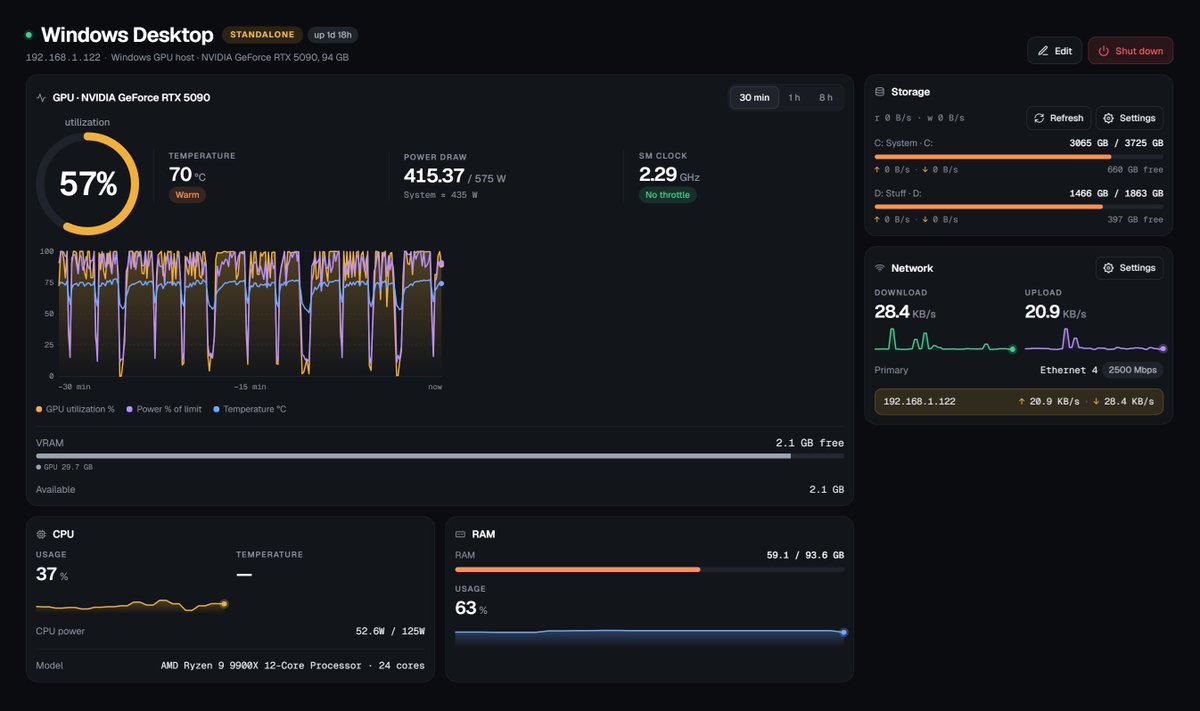
| sparkDash | Mia's AI Lab | Real-time dashboard for DGX Spark and other NVIDIA GPU hosts | Operators need mixed-fleet observability for GPU, LLM, storage, and network behavior | React, Express, SSH collectors, Prometheus export, Windows and Linux GPU host support | Shipped | GitHub, tweet |
| bitnet.cpp | Microsoft | Official inference framework for 1-bit LLMs on CPU and GPU | Local inference remains expensive and power-hungry for large models | BitNet b1.58 models, optimized CPU/GPU kernels, low-bit inference runtime | Shipped | GitHub, tweet |
The most interesting pattern was specialization around narrow but recurring pain points. @AlexFinn launched (71 likes, 23 replies, 6,847 views, 81 bookmarks) a workflow-discovery layer because users still need examples before they can exploit agent capability, while @alliekmiller (19 likes, 14 replies, 2,016 views, 8 bookmarks) praised Meta Muse for solving the same discovery problem inside the assistant itself.
A second pattern was bounded decision infrastructure. @Nandakishorm1 (182 likes, 12 replies, 3,123 views, 60 bookmarks) pushed a new typed-decision architecture, and @Sumanth_077 (9 likes, 5 replies, 854 views) highlighted an open framework that makes those decisions debiased, probabilistic, and optionally escalated. The repeated trigger is the same one visible in sections 2 and 4: teams do not want to pay generative-model costs for tasks that should terminate in a small answer set.
A third pattern was that infrastructure builds remained close to the metal. @MiaAI_lab (30 likes, 7 replies, 3,896 views, 10 bookmarks) shipped broader telemetry and Windows support, while @oliviscusAI (13 likes, 1 reply, 529 views, 15 bookmarks) pointed to CPU-efficient 1-bit inference. Even the research build in Fold2Reason follows that pattern by attacking reasoning transfer through a concrete training recipe rather than through general branding.
6. New and Notable
Fold2Reason used protein structure as a post-training signal for broader reasoning
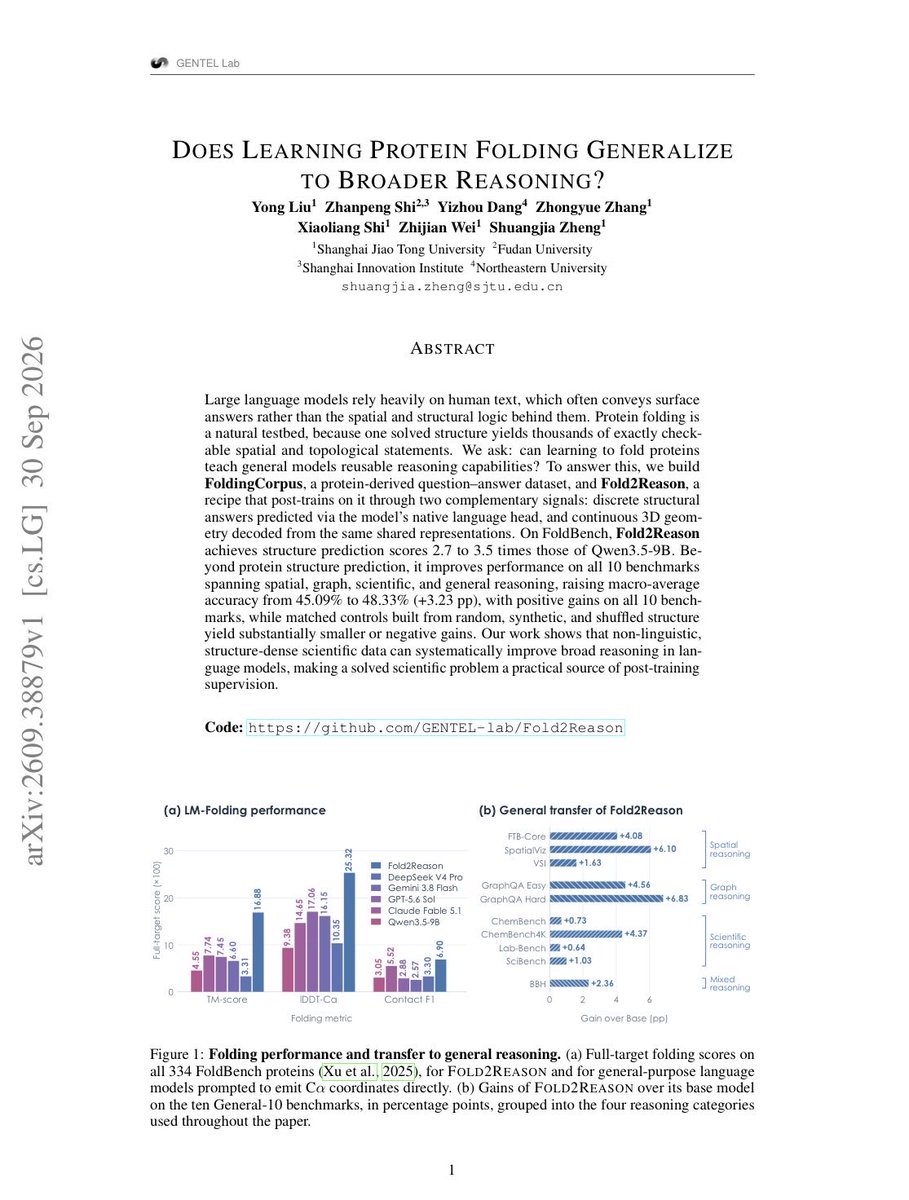
@gurtej__gill_ highlighted (64 likes, 5 replies, 2,122 views, 53 bookmarks) a paper that uses solved protein structures to teach models reusable spatial and structural logic. The attached page and the public repository make the claim unusually concrete: Fold2Reason reports structure-prediction scores 2.7 to 3.5 times those of base Qwen3.5-9B and a macro-average general-reasoning gain from 45.09% to 48.33%, while shuffled or synthetic controls do not reproduce the transfer.
bitnet.cpp kept the local-inference efficiency story moving
@oliviscusAI pointed to (13 likes, 1 reply, 529 views, 15 bookmarks) Microsoft's bitnet.cpp as a practical local-inference artifact rather than a vague promise. The public README backs the tweet's framing with published CPU speedups up to 6.17x on x86, energy reductions up to 82.2%, and the claim that a 100B BitNet model can run on a single CPU at roughly human reading speed.
The answer economy got much more legible in chart form
@alexgroberman packaged (29 likes, 1 reply, 1,546 views) G2's survey into a single commercial warning: if AI does not recommend your brand, another brand gets the deal. The images mattered because they turned that from a slogan into a measured funnel shift: buyers now start with AI more often than Google, AI chatbots outrank review sites and vendor pages as shortlist influence, and the actual interaction surface can be a simple chatbot answer rather than a search result page.

Meta Muse's idea tab showed a more grounded style of consumer AI suggestion
@alliekmiller praised (19 likes, 14 replies, 2,016 views, 8 bookmarks) Meta Muse not for raw intelligence claims but for showing better task ideas than the usual lab demos. The screenshot is notable because the examples are specific and operational: adjust a contract-driven calendar block, sync Stripe events into scheduling, compare two brand deals side by side, and carry context over from another assistant.

7. Where the Opportunities Are
[+++] Agent reliability infrastructure - Evidence came from both the memory thread and the eval thread. @0xwhrrari showed demand for freshness-aware memory, while @sermakarevich showed why answer-only grading misses state failures. A product that combines memory invalidation, state replay, tool-path checks, and end-state evaluation would answer a repeated practical complaint.
[+++] Typed decision layers with escalation - Vega and AnyJev show that routing, scoring, and safety checks are becoming their own layer rather than a hidden prompt inside a chat model. The opportunity is strong because the benefits are concrete: lower latency, bounded outputs, and cleaner fallbacks into full reasoning when confidence is weak.
[++] Agent workflow discovery and reuse - Alex Finn's workflow directory and the positive reaction to Muse's better idea suggestions both point at the same gap: users still need help translating model capability into concrete recurring tasks. This looks strongest where the product can pair examples with prompts, categories, expected outcomes, and proof that the workflow actually works.
[++] AI-search visibility and citation analytics - The G2 numbers cited by @alexgroberman show that AI is increasingly deciding which vendors even make the shortlist. The opportunity is moderate because the demand is real, but the space is already becoming competitive and credibility depends on trusted third-party citations.
[+] Mixed-fleet AI observability - sparkDash shows that operators still need better telemetry for Windows and Linux GPU hosts, RDMA links, LLM panels, and Prometheus export in one place. The signal is emerging rather than dominant in today's feed, but it connects directly to the broader push toward observable, cost-aware AI infrastructure.
8. Takeaways
- Agent reliability moved from a research concern to an operational one. The strongest retained posts were about workflow catalogs, memory freshness, and state-aware evals rather than about general model cleverness. (Alex Finn tweet, 0xwhrrari tweet, sermakarevich tweet)
- Open typed decision systems kept gaining momentum after yesterday's decision-model spike. Vega extended the creator-built side of the category, and AnyJev supplied open-source evidence that bounded decisions, debiasing, and escalation can be packaged into reusable tooling. (Nandakishorm1 tweet, AnyJev GitHub)
- AI is increasingly a demand-generation layer, not just a product feature. G2's March 2026 survey numbers, repeated in the PR release cited by Alex Groberman, showed that 51% of buyers now start with AI more often than Google and 69% changed vendors based on AI guidance. (PR Newswire, alexgroberman tweet)
- Specialized infrastructure still drew real attention. The day's strongest infra items were not generic cloud talk but local inference economics, GPU observability, and concrete serving-stack skills such as KV-cache handling, batching, and routing. (suraj_sharma14 tweet, bitnet.cpp GitHub, sparkDash GitHub)
- Physical AI stayed active, but today's signal was more about evaluation philosophy than about fresh benchmark wins. The retained robotics posts emphasized moving task libraries, modular experts, and the risk of mistaking memorization for generalization. (ChuzzyTech tweet, Jaxon0x tweet)